

INTRODUCTION
As a part of the ecosystem, insect population has a close relationship with all the factors within it. From the population side, this relationship is nothing but regulations. Of this regulation, Solomon (1964) recognized two types: the density dependent and density independent. Both regulators are important in maintaining the stage or level of a certain population within its ecosystem. Regulations of insect population are few (Horsfall, 1963) and must have existed primary in a limited space.
Four separate items were treated in this study: the relationship of leaves condition and the population of APHIS GOSSYPII, the relationship between the type of food and the population of TRIBOLIUM CASTANEUM, the type of beans for oviposition of BRUCHUS PHASEOLI and finally the abundance of several insects caught by a light trap.
These items have one thing in common, they are relatively small ecosystems. However, these ecosystems have different types of regulator which will be discussed separately.
APHIDS AND THE CONDITION OF THE LEAVES
Aphids of the species APHIS GOSSYPII were reared on cotton plants (COSSYPIUM HIRSUTUM) in the greenhouse. After 3 months, the first 5 leaves were infected with 1-3 alates (the wing-form of aphid) per leaf. The difference between the youngest and the oldest leaves was 1 month. Counting of the alates, nonalates and immatures were done daily for a period of 3 months, by that time all the first 5 leaves had fallen down. The temperature and the humidity within the greenhouse were recorded daily (fig. 1).
Results
The graphs (fig. 2 A, E) showed the patterns of the population growth of APHIS GOSSYPII. With one exception, the aphid population on the 24 leaves showed a normal symetrical growth-curve. The population started with 1-3 alates which soon produced another immatures. The number of the adults exceeded the number of the immatures 10 to 15 days after the start of the colony. While the adults continued to increase until the maximal number, the immatures increased very slowly and with small fluctuations. When the adults began its decline, there was a sudden decrease of the immatures (fig. 3 arrow), but soon it was followed by an increase so that the number exceeded the adults for the second time.
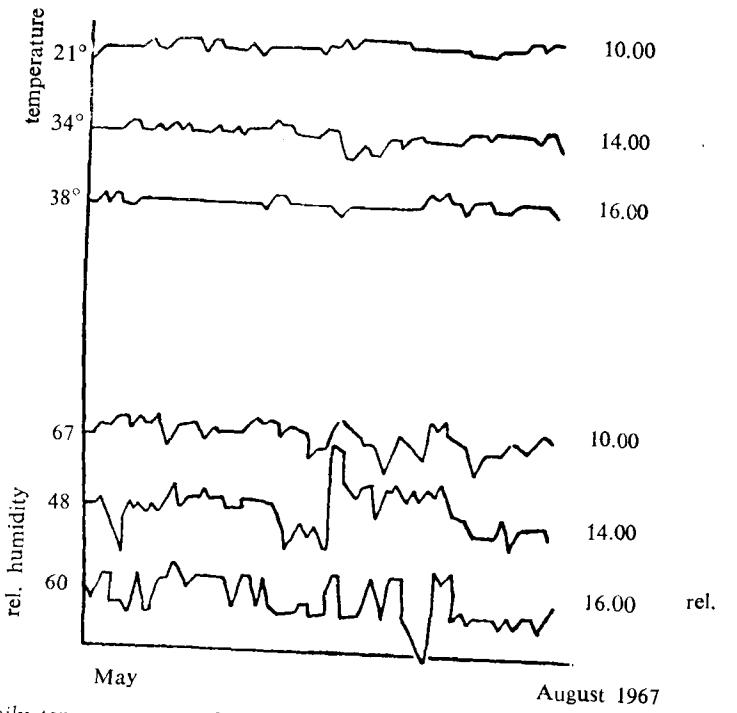
Fig. 1. Daily temperature and humidity within the greenhouse. Recorded three times daily at 10.00, 14.00 and 16.00.
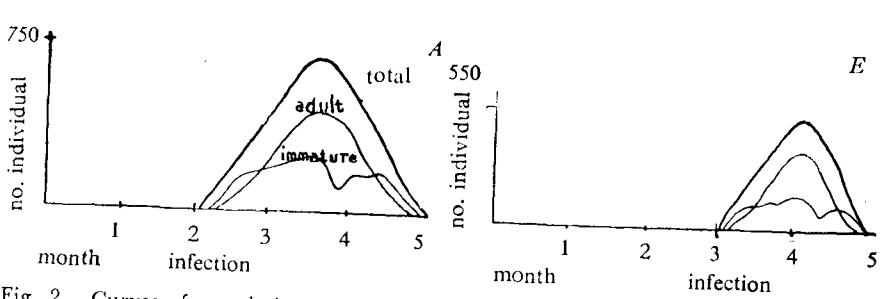
Fig. 2. Curves of population growth of Aphis gossypii on cotton plant leaves. A was one month younger than E.
TRIBOLIUM CASTANEUM
AND THE TYPE OF FOOD
TRIBOLIUM sp. has been known to cause plenty of damages on stored products such as rice, beans and corn. In this experiment, TRIBOLIUM CASTANEUM were used, the common pest in this area.
INSTITUT TEKNOLOGI BANDUNG
In comparing the capacity to survive and reproduce, four kinds of food were used: corn, soybean, rice and katjang idjo (PHASEOLUS RADIATUS), all in meal form. Each bottle consisted of 20 grm. of food and 20 imagines to start with. The food for the fifth series consisted of a mixture of corn and rice meal and milk powder (45:45:10), 10 grm. per bottle and the population—started with 10 imagines.
Countings were done for every 2 weeks, no extra food was added. Temperatures and humidity were room conditions.
Results
The following graphs represent the population growth pattern of TRI-BOLIUM CASTANEUM on the five kinds of food.
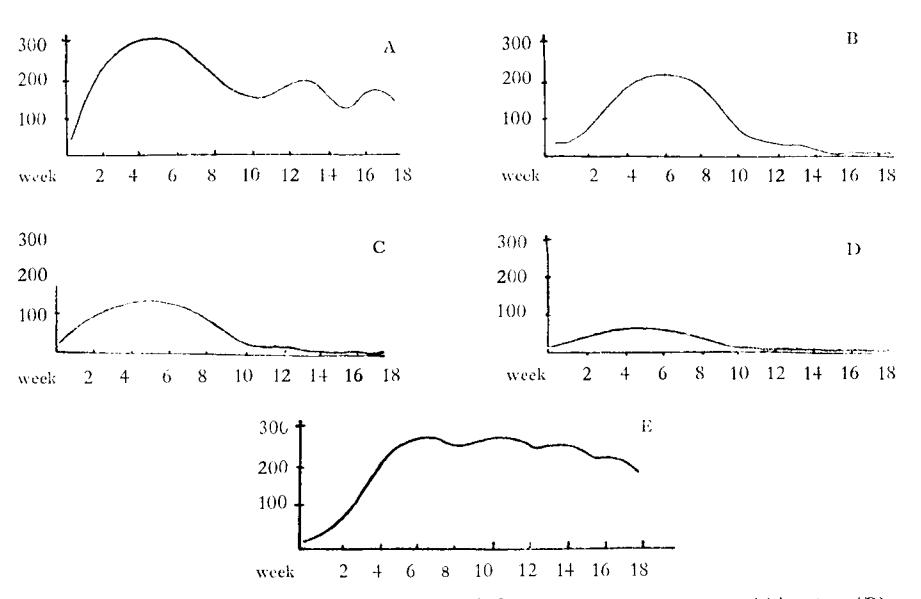
Fig. 3. Pattern of population growth of Tribolium castaneum on corn (A), rice (B), soy (C), katjang idjo (D) and mixture of corn, rice and milk powder (E). All the media in meal form. The numbers denote the individuals. Data for E was kindly provided by drs. W. Parjatmo.
Corn meal: Two weeks after the start, the number of larvae were 270, whereas the adults were still 20. The greatest number was 300 which was found on the 4th, week after the start of the colony. The population has been oscillating but with decreasing optimal number. On the 16th, week, the number was 200.
Soy meal: The optimal number (190) was found on the 6th, week after the start of the colony. Then the population declined fastly to the original number (20) 12 weeks after the start. The low level persisted for the following weeks.
Rice meal: The first optimal number (110) was found on the 5th, week after the start. This number was declining fastly to 20 imagines. The population was low for the following weeks.
Katjang idjo (P. RADIATUS) meal: The lowest number of TRIBO-LIUM was found within this medium. The maximal number was 50 which was found on the 4th, week after start. The number was constantly low.
Mixture of corn and rice meal and milk powder: In this medium TRI-BOLIUM has been thriving. The first optimal number (300) was found on the 6th, week after the start. The population oscillated on this level until there was no longer any food left.
BRUCHUS PHASEOLI
AND THE OVIPOSITIONAL SITE
In the first series, BRUCHUS PHASEOLUS, another kind of stored product insects, were reared on katjang idjo, the bean and the meal form. Each bottle consisted of 40 grm. of this medium and to start with there were 20 imagines. Counting of the insects were done 1 to 2 weeks after the adults emerged, by that time all the insects were dead.
In the second series, the insects were reared on katjang idjo (PHASE-OLUS RADIATUS), katjang tanah (ARACHIS HYPOGLEA), katjang merah (PHASEOLUS VULGARIS) and katjang pandjang (VIGNA SI-NENSIS). Each bottle consisted of 40 grm. of these beans and 20 imagines. Counting of the eggs were done after all the adults were dead.
Results
Small whitish eggs were visible attaching on the beans, several days after imagines were living on it. The larvae live within the beans. Table 1 and 2 contain the results of the 1st. and 2nd. experimental series.
| start | 26 days | 52 days | 4 days | ||
|---|---|---|---|---|---|
| bean | 20 | - 160 | 1600 | 160 | |
| meal | 20 | 0 | 0 | 0 |
No Bruchus appeared from katjang idjo meal.
| Tab | le I | I | |||||
|---|---|---|---|---|---|---|---|
| The | number | of | eggs | on | 4 | different | beans. |
| start | numb | er of | eggs | afte | er 2 week | |
|---|---|---|---|---|---|---|
| soybean | 20 | 54 | 92 | 54 | 12 | 99 |
| peanut | 20 | 64 | 95 | 42 | 91 | 138 |
| P. vulgaris | 20 | 73 | 113 | 1 | 90 | 116 |
| P. radiatus | 20 | 103 | 101 | 78 | 92 | 53 |
| V. sinensis | 20 | 48 | 35 | 30 | 87 | 74 |
INSECTS CAUGHT BY A LIGHT TRAP
Several nocturnal insects were attracted by light. By means of a light trap, the counting of insects caught and killed is possible. The results may show a close relationship between the type and the quantity of the insects caught and the immediate environmental conditions (Williams, 1961).
Results
The following are the results of the light-attracted insects caught by a trap installed at I.T.B. campus. The trap is 6 m from the ground, the diameter is 25 cm and the length is 70 cm. The light came from a 60 watt bulb.
Lepidoptera: The moths caught was almost constant, with a maximal number of 30 in September. The lowest number was found in October. Most of these moths have bean known to live on rice plants.
Diptera: The dipterids showed great fluctuations; large number was found first in July, then in November and December. The lowest number was found in October. The largest specimen representing this order is Chironomidae which may have the breeding place on the rice field and ditches.
Coleptera: The number of colepterids were relatively large in June and continued to decline until October, by that time the number of the specimen was the lowest. Staphilinids have been the largest coleopterids caught in this period. The number increased after October and by this period there were two families with large specimen: Staphilinidae and Lammelicornia. Hymenoptera: Until November, the number of hymenopterids caught was low. There was a sudden increase of hymenopterids due to a sudden appearance of a certain species of hymenopterid within 1-2 day in November. The second peak was found in December and the species was different from the first one.
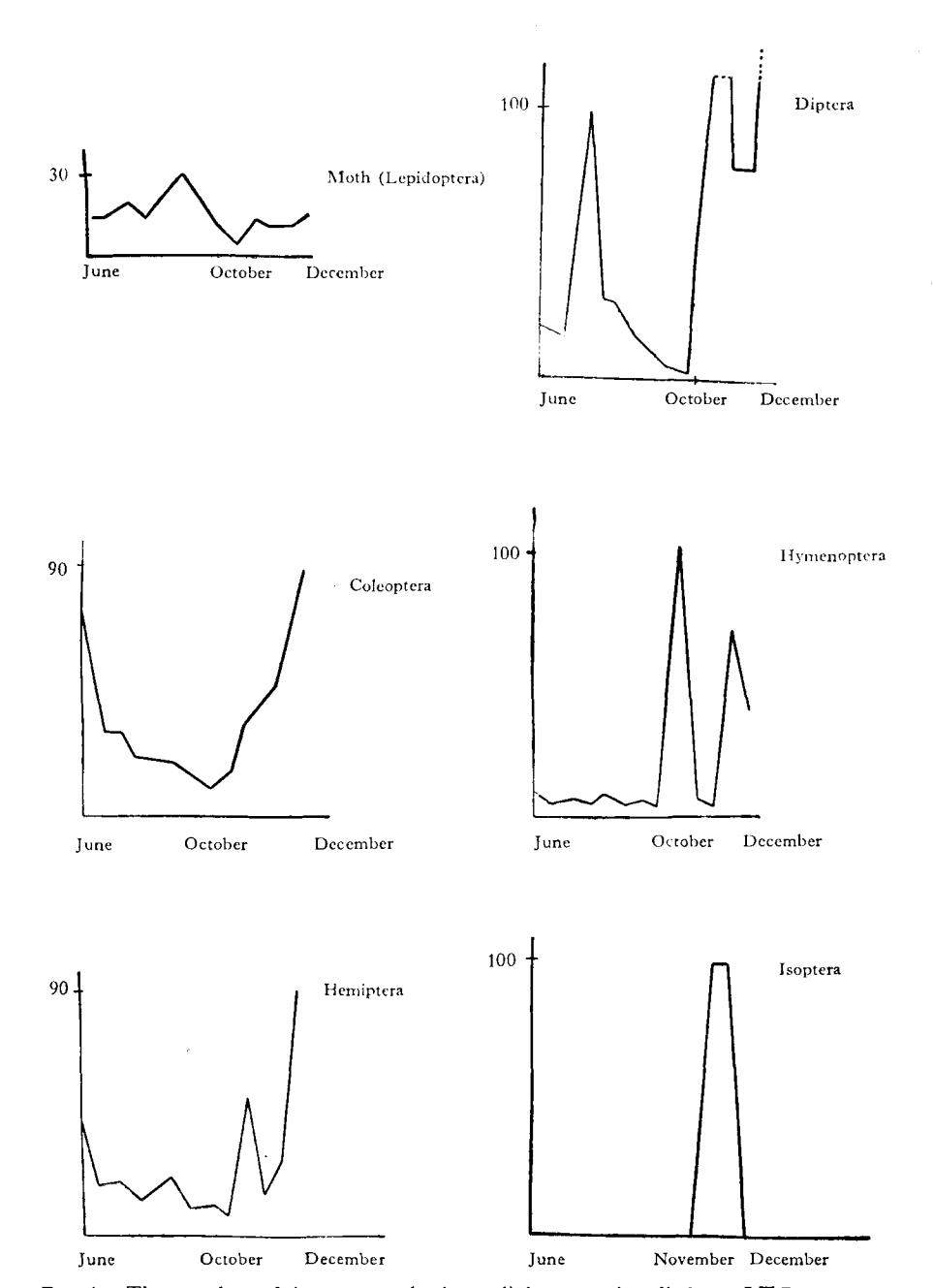
Fig. 4. The number of insects caught by a light trap, installed on I.T.B. campus, from June to December 1967.
INSTITUT TEKNOLOGI BANDUNG
Hemiptera: The lowest number of hymenopterids caught was in October. Isoptera: Termites appeared in a large number from mid November to early December.
Orthoptera: Very few. Neuroptera: Very few.
It is quite possible that these two groups of insects are mainly diurnal insects and also the location of the trap is not suitable for catching them. Crickets and CHRYSOPA sp. were the only representative of these two orders.
DISCUSSION
The primary regulating factor for the population growth of APHIS GOSSYPII is believed to be the age or the physiological condition of the cotton leaves. The average age of the leaves was 5 months. The shape of the population growth-curve within a single leaf is determined by the innate capacity for increase of the insects (Birch, 1953), but the exact moment for the maximal number (which is half the period between the start of the infection and the falling of the leaf) is determined by the age of the leaf. The population started on younger leaves has a higher maximal number of the total population as well as a longer period for the population growth. Interferences from temperature, humidity and parasites or predators can be neglected.
The decline of the adults is soon compensated by a sudden increase of the immatures (fig. 2 arrow). However, due to the declining of the leaf condition (nutritionally) much of these immatures are dead or migrated to other younger leaves. Similar things happened to the adults.
Instead of living on a "short-term" food supply, TRIBOLIUM CAS-TANEUM were reared on 20 grm. of food which lasted much longer, and have an almost constant condition compared with the cotton leaves. Therefore the population growth-curves showed the usual oscillating curves with an ever decreasing optimal number. Canibalism (Slobodkin, 1963) and the condition of the food may have caused the decreasing optimal number. There are differences in the capasity to accomodate the TRIBOLIUM population within these five types of food. The factor or factors which effected the number of the population may either be physiological, which means the presence of some elements within the food itself, physical, which means the structure of the place to live in or behavioural (Chent, 1963; Slobodkin, 1963. The results suggested that either corn or milk or both of them contain
some elements that permitted the thriving of TRIBOLIUM population. This insect live very poorly on katjang idjo meal.
BRUCHUS PHASEOLI has another primary regulating factor for the population growth, the ovipositional site. This is behavioral factor. Although katjang idjo is capable in supporting the development of this insect, adult would not lay the eggs on katjang idjo meal. BRUCHUS is willing to lay the eggs on 5 different kinds of bean (table 2). The data so far showed that there is no special preference for one of the beans, since the eggs were found almost equally at the surface of these five different beans. The choise for ovipositional site may have been physical instead of chemical since the insects oviposited on the surface of several kinds of bean and also on dirt, but not on meal.
The effect of weather on insect population is shown by insects caught by a light trap. This environmental factor may have worked on the activity of the insects or on the life cycle. Both can be recognized from the number of the catch. The number of insects caught in October was very small except for a certain species of hymenopterid which appeared in a large number within a single night. Moths were caught relatively in a large number in September, by that time the rice plant, about 500 m from the trap, were mature.
The first rain fall was followed by a sudden increase of dipterids, hemipterids and coleopterids. Termites and small hymenopterids appeared suddenly after the second rain fall.
It is apparent that only few factors acted as regulators such as the physiological condition of the leaves in regulating the population growth of APHIS GOSSYPII on cotton plants. Some elements within the milk or corn determined the size of TRIBOLIUM population, while ovipositional site is believed to be the primary regulating factor for BRUCHUS population. Finally, the population of several orders of insects caught by a light trap appeared to have a close relationship with the rainfall.