

INTRODUCTION
The cluster NGC 6866 1s sltuated ar R.A, (f950) = ZOh 02T6; tec. (1950) - + 44o02' (L = 79i4; b = +6:8). According ro Ruprechr (1966) the clusEer belongs to the Trumpler class II2m. lnspectlon of Lyndsl Catalogue of Dark Nebulae (1962) shows that the cluster is sltuated ac the edge of a dark cloud. Photometric data for 25 stars by Hoag et a1. (195f) ln the cluster area shows that che color-magnltude dlagraro of the clusler reseobleg that of the lntermediate-age cluster.
The purpose of the presen! study is to determine the angular extent of the cluster and to flnd any nonunlformity of the reddening across the cluster area. The lnvestlgatlon is based on the photofiraph-1c phoEoDetry of 575 stars down to a limltlng B-nagnitude of 16T5, in
* \'Contributlon frorn the Bosscha Observatory, No, 44, I972.
,trk)'Bosscha 0bservatory, Lembang, Java, Indonesia.
an area of 15' from the adopted center of the cluster. This area is considered large enough to include the possible intrusion of the dark cloud. In the present study only stars which are well separated were measured photographically.
PHOTOGRAPHIC PHOTOMETRY
The photometric material in the UBV system were collected with the Hamburg Schmidt Telescope. Table I gives the relevant data of the photometric plates. The photometric measurements was carried out with the Eichner astrophotometer of the Bosscha Observatory. It was tied
TABLE I The Photometric Plates
| D | ate | Plate No. | Color | Kodak Emulsion and Filter | Exp. in Minute | Observer | |
|---|---|---|---|---|---|---|---|
| Oct. | 9, 1 | 67 | 3858 | บ | 103a-0 + UG 1 | 15 | Hidajat |
| Oct. | 9, 1 | 67 | 3865 | U | 11 | 30 | 11 |
| Oct. | 9, 1 | 67 | 3866 | U | 11 | 15 | 11 |
| July 2 | 28, ' | 68 | 4023 | В | IIa-0 + GG 13 | 19 | Lubeck |
| July 2 | 28, ' | 68 | 4024 | В | 18 | 20 | " |
| July 2 | 28, ' | 68 | 4025 | В | 18 | 20 | 11 |
| July 2 | 23, ' | 68 | 4010 | v | 103a-D + GG 11 | 7 | 11 |
| July 2 | 23, ' | 68 | 4011 | V | 71 | 10 | 11 |
| July 2 | 23, ' | 68 | 4012 | V | ti . | 10 | IT |
into the UBV-photometric system by means of photoelectric standards established by Hoag et al. (1961), the faintest of which reaches U = 16.5; B = 16.4 and V = 15.9. Extrapolation of the calibration curves, no more than 0.3 in each of the colors was justified because of the linearity of the calibration curves in the magnitude-intervals employed in the present study. The measurements of the standard deviations of the sequence stars from the calibration curves for a certain plate is used as a measure of the weight of the magnitudes determined from this particular plate. Using these weights the mean magnitudes and colors of the program stars are calculated. A comparison between the mean photographic and photoelectric data of the sequence stars was used as an estimate of the accuracy. The standard error from the mean of V, B-V and U-B obtained in this way are 0.06, 0.08 and 0.08 respectively. It was observed that there is no appreciable systematic differences between the measurements carried out by each of us. The results of the photometric determinations are presented in the Appendix. The numbers correspond to the number in Plate 1.
STELLAR COUNTS
In order to determine the extent of the cluster a stellar-count as a function of the radius was performed. The area where the counts were made is 15' from the cluster's center. The cluster area was di-
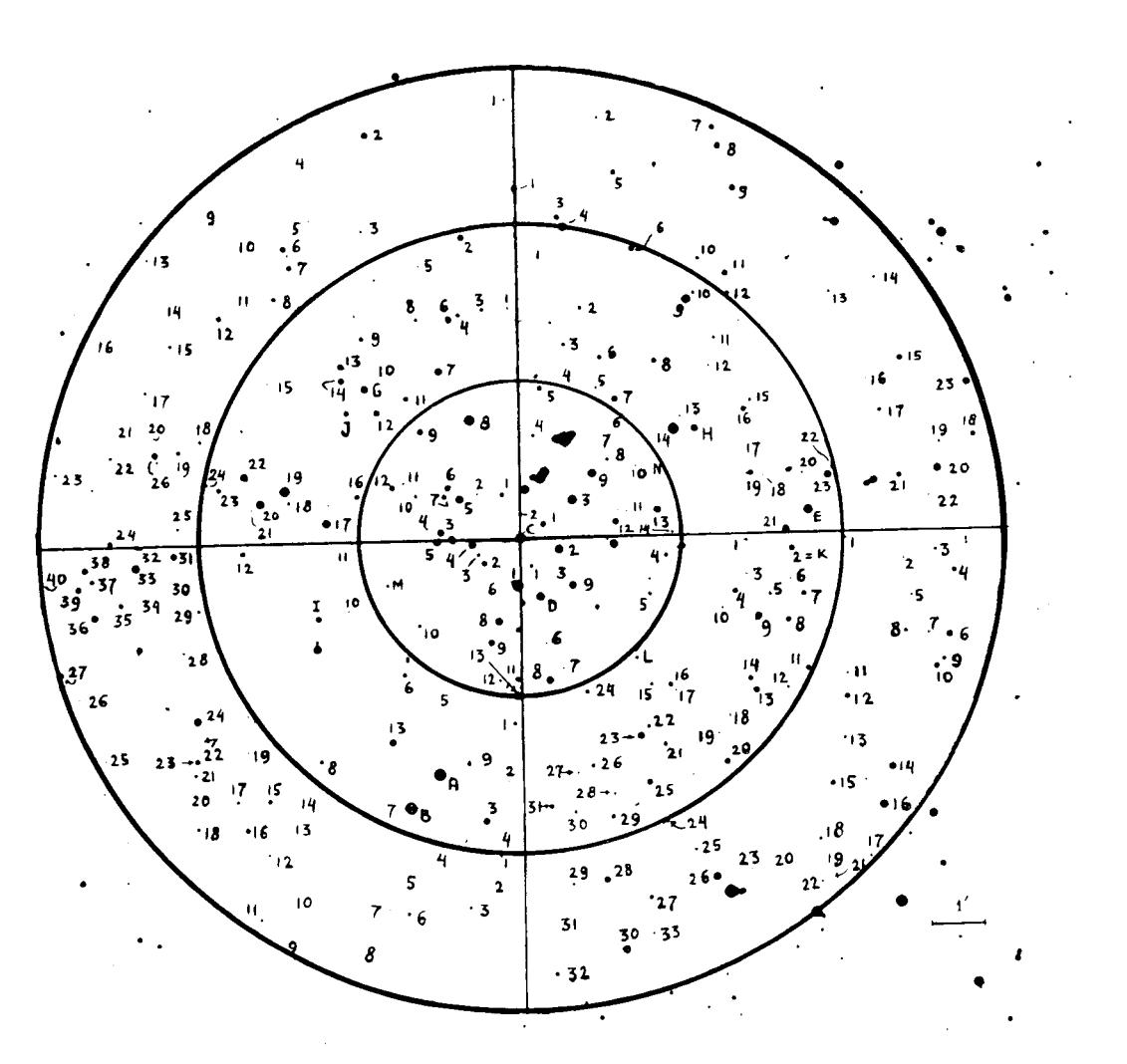
\(\underline{Plate l}\): Identification chart for stars in NGC 6866.
vided into 4 quadrants, defined more or less by the north-south and easE-rrest directlons. Concentric clrcles, whose radii differ by 3t of arc, L'ere draun upon the cluster area. A11 stars down to 8=16,00 nere then counced. The stars per unit area, which is che area of the innermosf circle, are plotted as a funcEion of the angular distance from the cluster. The result is shown in Flg, J-
The error of the counts is proportional to the /n, where n 1s the number of sEars 1n the particular ring in each quadrant. The mean of the counts for each rlng can Ehen be made, taklng into account the errors of the counts. Solld llnes are drawn Ehrough the means. It can be seen in Flg. 1 that the curve seems to level off at the end of ring 3, the radius of whlch ls 9t. The figure also reveals that Quadrant IV conslstently contal-ns larger nr.rmber of stars than that found in other quadrants. Thls trend ls also observed in ghe stellar counts for stais brighter lhan vlsual magnitude oJ f5T8. The "excess" of stars ln Quadrant IV rnay be accounted for the possible existence of unequal absorp!ion anong the quadrant. This view may be supported by the resulE of the exanlnatlon of the Palomar Sky Aclas. On the red plate, of the general dlrection of che cluster, there appears a lrace of absorblng cloud coverlng part of Quadrant III.
INTERSTELT.A,REDDENING AND DISTANCE
Separate color-color dlagrarns for sEars in different quadranEs sugSest thaE quadrant III shows slightly higher reddenlng than that can be observed ln other quadrants. However, in view of the accuracy of the present photometry, no atcempt has been made to nerforn a cpnrrate lnvest.lgaclons for eacn quadrant.
ln the follotrlng, only sEars within 9 I from the adopted center of the clusfer wlll be discussed. The color-coLor diagran for these stars 1s presenEed in Flg. 2. l! is possible then to fir the two-color dlagram of the unreCdened maln sequence stars (shown as solid line) as given by Johnson and Irlarte (1958) to the observed color-color plot of the clusEer. If rhe reddenlng line is taken as 0.12 j.L can be found that the color excess E __ is 0T16. B-V
It is noted that there is a group of stars (14 in numbers) whose colors are centered around U-B = - 0'12 and B-V = + 0T90. lhese srars may not be clusEerrs members. lf they were clusterts members they must have come from Che upper parE of the nain sequence. this would glve too large a reddenlng (OTO) for the cluster, whlch \,roul-d contradlct the reddenlng law found for the general direction of the cluster. As has been found earlier Fltzgerald (1968), Wehlnger and Hidajat (1972), and Llndoff (1972), the reddenlng in the direction in this particular galactlc longltude should not exceed 0T20. Lindofffs study sas based on the cluster NCC 6811. The group of stars ,nentioned here may form a group of early-type stars. Taking the ralio of the total to selective absorption equal to 3.0* we can then find the total a1,* sorption in front of the clus:er is 0'148.
Fig. 3 shows the color-rnagnitude diagran of the cluster. In this diagram the main sequence of the clusler can be identlfied. The spread of the points ln this dlagram is rather large which may be clue to the uneveness of the absorption across the cluster area, The distance nodulus of the cluster can be determined by fitFing t.he zero-age rnain sequence given by Blaauw (f963) to the cLusEerrs main sequence. This method yields an uncorrected. distance rnodulus of V-\ = ffT10.
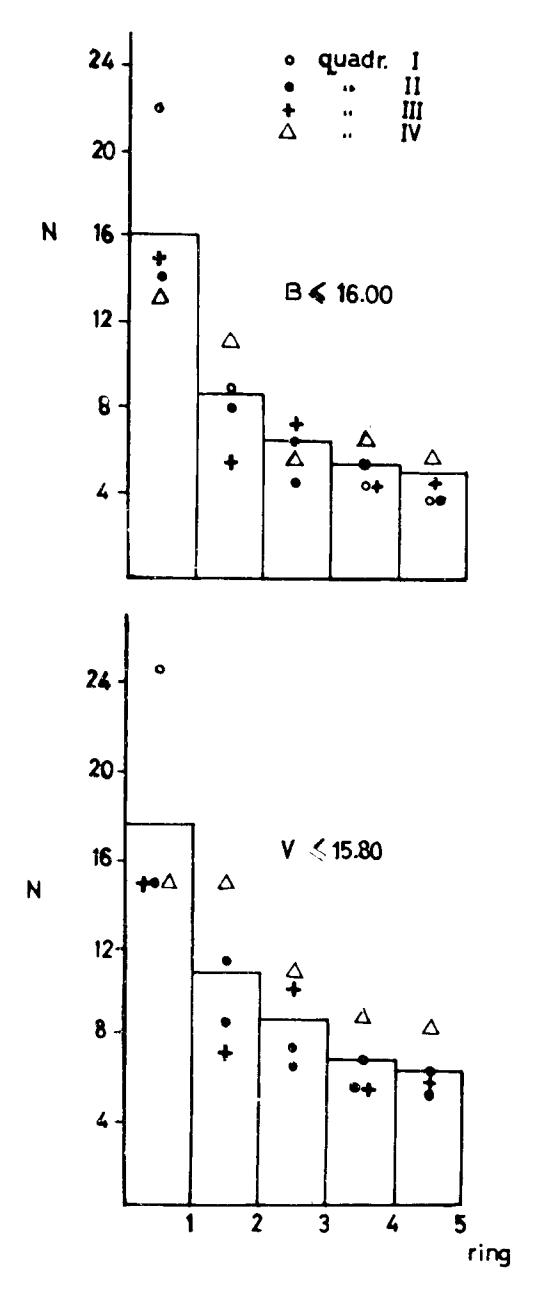
\(\underline{\text{Fig. 1}}\): Surface density of stars in NGC 6866. N is the number of stars per unit area. The area of ring 1 is adopted as unit area.
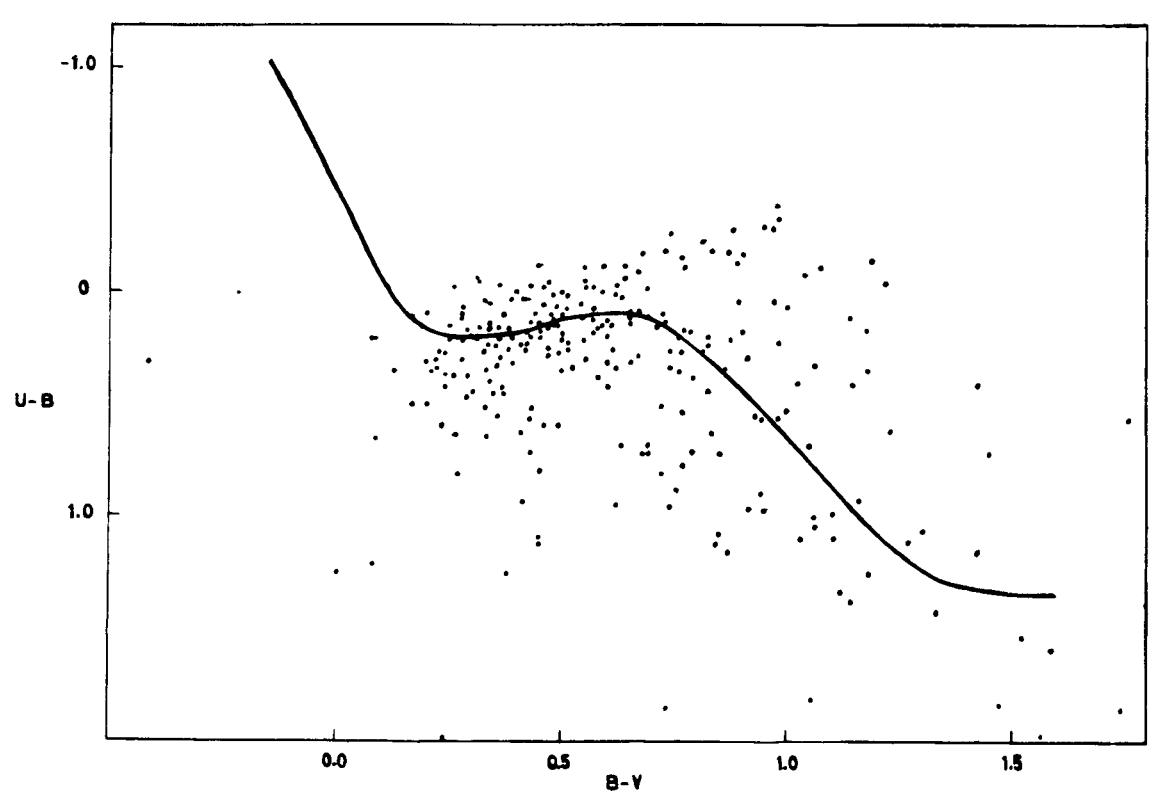
\(\underline{\text{Fig. 2}}\) : Two colour diagram of stars within radius of 9' from the adopted centre.
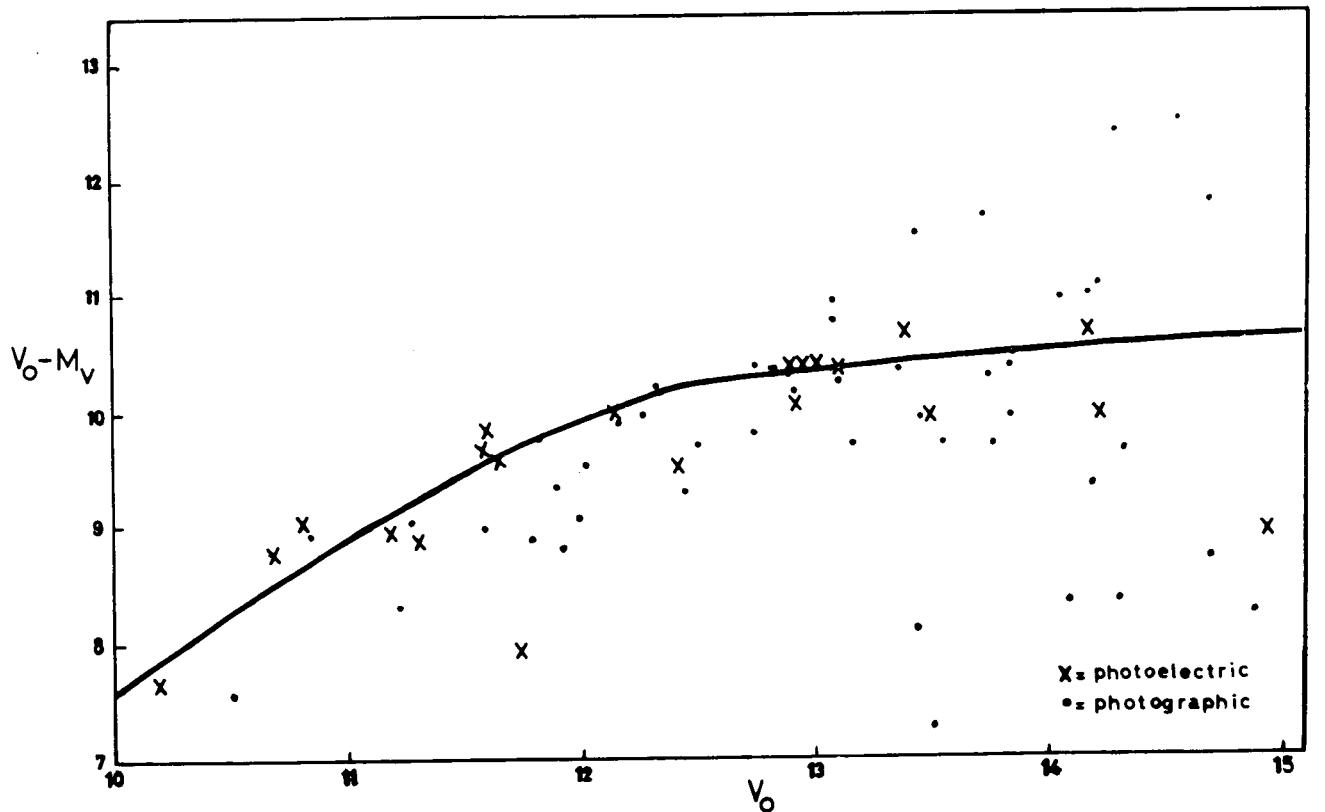
\(\underline{\text{Fig. 3}}\): Colour-magnitude diagram of stars within radius of ' from the adopted centre.
Using the absorption found above, the true distance nodulus ls found to be 10T62, correspondlng to a distance of 13j0 pc.
Following Johnson (1960) we computed the corrected disLance modulus of stars in the cluster. The average reddening, rarher than reddenlng for individual sEars, has been used to obtain the true dlstance modulus and corrected apparent magnitude. The intrinsic colors \ave been obtained by subtractlng the reddening from the observed colors. These colors were then used to determine the absolute rnagnltudes by neans of che color-nagnitude relation calibrated by Blaauw (1963). Uslng the correcEed distance modulus and the corrected apparent magni-Eude the evolutlonary deviatlon crirve can be conestructed. Flg, 4 shows Ehe evoluEionary devlaEion curve. Then, the evolved main sequence curve was fitted Eo both in modulus and in magnltude, as sho$n wlth solid line in Fig. 4. Fron the fainter, still unevolved sEars a dlstance modulus of 10T64 was ot,tained. the value corresponds to a distance of 1343 pc. Averaging the lwo estimates of distance we flnd the nean dj.stance of the cluster is 1336 pc. Becker (1963) and Johnson et al. (1961), respectlvely found 1205 pc. and 1200 pc. for the distance of the cluster.
The turn-off point of the cluster provlde the estimate of the age. Comparing hrith Lindoff (1968) cne age of the cluster ls estlmated to be about 2.5 x l0o years.
ACKNOWLEDGEMENT
One of the authors (8.H.) would like to express his thanks to the Director of the Hanburg Observatory and to Dr. K. Lubeck who made the photometrlc plates available for Ehis study, Tne present study is part of the authorts proSram whlie he received the grant fron the D.A.A.D. He should llke to record his gratitude for the grant.
The authors are indebted to the Institut Teknologi Bandung for the PELITA-Fund Lhat supported part of this study.