

Introduction
The energy metabolism in fish has been worked out for many species. LEINER (1938) and BLACK (1951) have given good reviews of the literature.
There seems to be no investigations on the energy metabolism of Gadus callarias or Gadus virens after the larval stage. Some physiological data have been gathered on these two species and the present paper considers some results from the research experiments.
Material and methods
The fish which were used in the experiments were all caught off the west coast of Norway. The size range was from 2.8 — 1750 grams.
*) Department of Biology Institute of Technology Bandung.
The epidermis of Gadus virens is easily damaged and lethal infections follow. Gadus callarias, however is a good experimental animal. Adaptation to the experimental condition is good, making the fish easy to work with.
All fish were starved 3 to 4 days before they were placed in the experimental aquarium (\(1.00 \times 0.50 \times 0.45\) m.). The experimental period lasted up to 10 days.
After the experiments the fish were transfered to large storage aquaria.
Their survival, food intake and behaviour in the following weeks were used as an indication that conditions had been normal during the measurements of the energy metabolism. Data from fish which seemed to have been under abnormal conditions were omitted.
Winkler's method, with the modification introduced by KROGH (1935), was used in estimating the oxygen consumed. The respiration of the seawater was measured, but the value stayed inside the error limit of the analyses. The oxygen consumption of the fish was measured in closed aquaria.
Energy metabolism under standard conditions
The term "basal metabolism" is used in medicine, but it is impossible to keep a fish in basal conditions according to such a definition. In most works about fish the external data have been standardized, but the measured metabolic rate has not always been a standard metabolism. The physiological conditions of the fish are very important. The energy metabolism of fish under standard conditions may be defined as a steady energy metabolic rate (inside the biological variation) over long time intervals, which can be defined as a normal rate by the chemical and physical characteristics of the environment.
The experimental conditions were far different from normal conditions and therefore was very high just after transfer to the experimental aquarium.
WINTERSTEIN (1908) mentioned this fact, which he considered himself able to show by experiments.
Gadus callarias and Gadus virens have a significantly increased energy metabolism after being transferred to the experimental aquarium (fig. : 1,2,3 and 4).
It seems that the acclamation time is different for small and large Gadus callarias. The same was found on Gadus callarias which were investigated in different aquaria. This is valid for Gadus virens as well (fig. : 3 and 4).
The difference in the acclimation time between large and small specimens may have a connection with body size in relation to the volume of the experimental aquarium. However, measurements on small specimens in a small aquarium do not confirm this.
Their acclimation time is as short as it would be in a large aquarium. It is not possible to give a general acclimation time for Gadus callarias and Gadus virens in the same way as KEYS (1930a) and WELLS (1932) have done for Fundulus parvipinnis.
WELLS (1932) writes: "Indeed I should expect that with very active, nervous fishes several days would be required for them to reach a normal level of metabolism, while on the other hand, quiet, sedentary fishes may do so in a few hours".
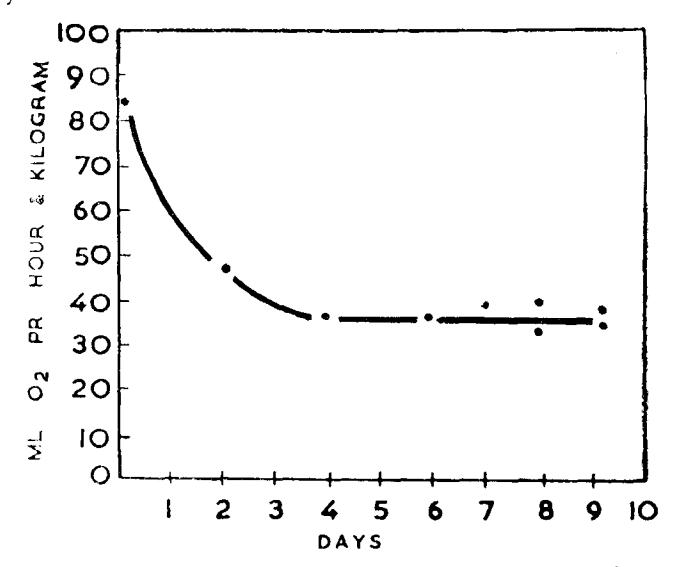
Fig. 1. Oxygen consumption of Gadus callarias of 1750 gr.
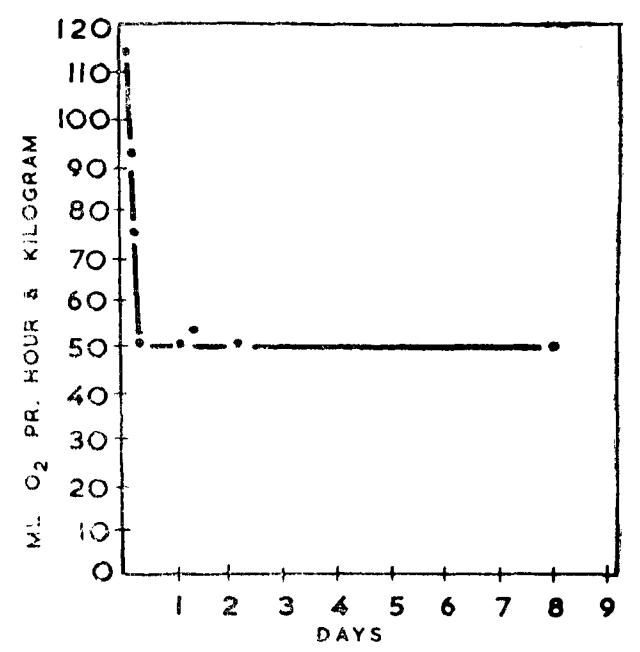
Fig. 2. Oxygen consumption of Gadus callarias of 280 gr.
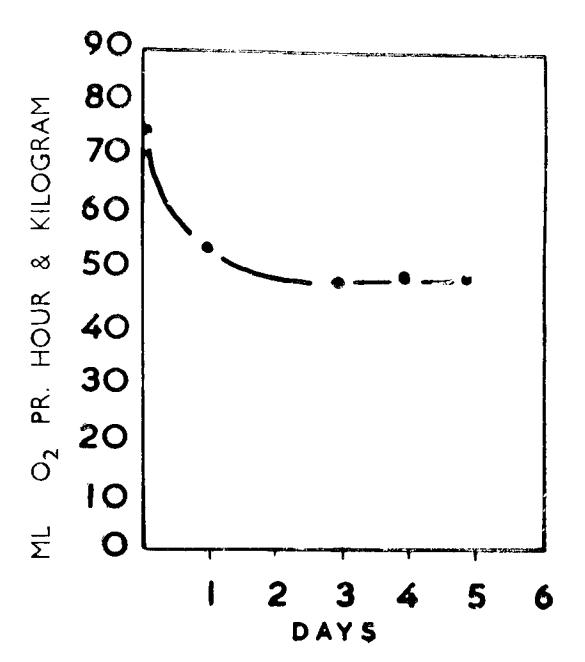
Fig. 3. Oxygen consumption of Gadus virens of 1020 gr.
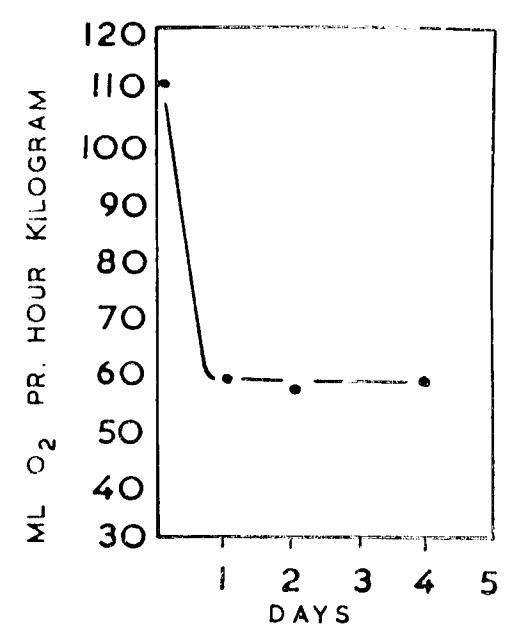
Fig. 4. Oxygen consumption of Gadus virens of 230 gr.
The results in this present paper show that the acclimation time is not species specific. The phenomenon in more complicated and contributing factors must be sought in each single individual and among the external stimuli.
The high oxygen consumption in Gadus callarias and Gadus virens just after being transferred to another aquarium is known. SUNDNES (1956) outlines the situation when these species are transported alive in well boats.
Energy metabolism in relation to body size
Oxygen consumption in relation to body size has long been discussed. One of the difficulties is the unit of body size, because this is important in the comparison of different animals. ZEUTHEN (1947) finds that N<sub>2</sub>-content and body weight give good comparative units.
There is little of this work. CRONHEIM (1911) writes that he finds from the experiments of KNAUTHE (1898) that the oxygen consumption in Cyprinus sp. is proportional to the surface of the body. LINDSTEDT (1914) reaches the same results on Tinca vulgaris.
PUNT & JONGBLOED (1946) emphasize that the oxygen consumption in fish is proportional to the body surface, KEYS (1930 a), VISWANATHAN & TAMPI (1952) and WEELS (1935) have made investigations on fish in relation to body weight for almost the whole size range of the species.
The conditions in this present work have been standardized. The results are plotted (fig. : 5).
KEYS (1930 b) has found a three phase curve for Fundulus parvipinnis. ELIASSEN (1952) has found the same for Artemia salina and ZEUTHEN (1947) the same for Mytilus edulis.
In a later word ZEUTHEN (1953) believes he finds the same phenomenon in other groups of the animal kingdom from the results of other authors and his own experiments.
Statistics
When the values originally found in the present investigation are transferred to a logarithmic scale, there seems to be a clear linear regression between the weight of the fish and the oxygen consumption. The correlation coefficient was found to be 0,99 for the whole material (ca 30 fish—see Appendix).
This significant coefficient does not exclude the possibility of a difference in oxygen consumption in relation to the weight between small fish and the bigger ones.
The parameter found, can not prove that the oxygen consumption increases in linear proportion to increasing weight. As a hypothesis the 11 smallest fish were tested as one group and the 19 biggest fish as another group. The correlation coefficient found were 0.97 and 0.94 respectively.
Testing three different correlation coefficients against each other has not been done, as no simple criterion is known. On account of the small
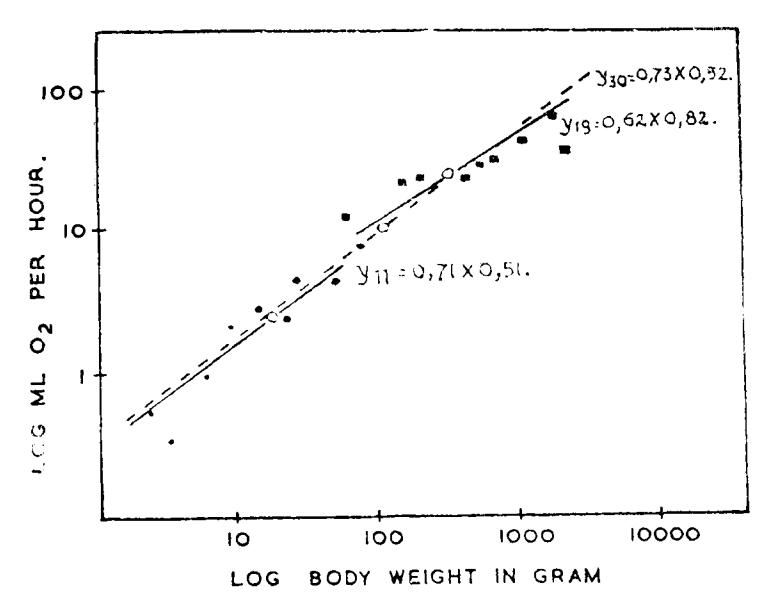
Fig. 5. Energy metabolism of Gadus callarias and Gadus virens in relation to body weight (both species lumpel together).
Ø REGRESSION LINE FOR THE WHOLE MATERIAL.
- REGR.LINE FOR THE "II-GROUP"
- REGR. LINE FOR THE "19 GROUP"
amount of material no further statistical methods have been involved and it would in any case have been difficult to get significant answers to the problems.
The regression lines for the three mentioned groups have, however, been calculated and as will be seen from the diagram there is a slight difference between the rise of the 11 group and the 19 group. This might imply that the oxygen consumption by increasing weight does not increase to the same extent among big fish as among small ones.
REFERENCES
BLACK, E.C., 1951. Respiration in fishes. Publ. Ont. Res. Lab. 71 pp. 91-111.
CRONHEIM, W., von 1911. Gesamtstoffwechsel der Kaltblüttigen Wirbeltiere, im besonderen der Fische. Z. Fish XV pp. 319-369.
ELLIASSEN, E., 1952. The energy metabolism of Artemia salina in relation to body size, seasonal rhythms and different salinities. Univ. Bergen. Arb. no. 11 pp. 1-17.
- KEYS, A.B., 1930 a. The measurements of the respiratory exchange of aquatic animals. Biol. Bull. Woods Hole 59 pp. 187-198.
- 1930 b. A study of selective action of decreased salinity of asphyxiation on the Pacific Killifish Fundulus parvipinnis. Bull. Scripps Inst. Oceanogr. Tech. 2, pp 417-490.
- KNAUTHE, K., 1898. Zur Kenntnis des Stoffwechsels der Fische. Pflüg. Arch. ges. Physiol. 75.
- KROGH, A., 1935. Syr'nge Pipets, Precise determination of oxygen in water by syringe pipets. Industr. Eng. Chem. 7 pp. 131-133.
- LEINER, M., 1938. Die Physiologie der Fischatnung. Akademische Verlagsgesellschaft M.B.H.
- LINDSTEDT, Ph., 1914. Untersüchungen über Respiration und Stoffwechsel von Kaltblütern. Z. Fisch 14 pp. 193-245.
- PUNT, A. and J. JONGBLOED., 1946. On factors influencing the gas exchange in fish. Arch. Neerl. Zool. 7 pp. 1-15.
- SUNDNES, G., 1956. Transport of live fish. Thesis.
- VISWANATHAN, R. and P.R.S. TANPI, 1952. Oxygen consumption and viability of Chan-os chanos in relation to size. Proc. Ind. Acad. Sci. XXXVI pp. 135-159.
- WELLS, N. A., 1932. The importance of the time element in the determination of the respiratory metabol'sm of fish.Proc. Nat. Acad. Sci. Wash. 18 pp. 580-585.
- ——————————————————————————————————————
- WINTERSTEIN, H., 1908. Beträge zur Kenntnis det Fischatnüng. Pflüg. Arch. ges. Physiol. 125 pp. 73-98.
- ZEUTHEN, E., 1947. Body size and metabolic rate in the animal kingdom. C.R. Lab. Carlsberg. Ser. Chim. 26.
- ----, 1953. Oxygen intake as related to body size in organisms. Quart. Rev. Biol. 28 pp. 1-11.
(Received 6th April 1972).
Appendix : Body weight of Gadus callarias and Gadus virens in srarns.
| Weight grams | |
|---|---|
| 1?50 | 1145 |
| 280 | 475 |
| 1650 | 1350 |
| 1550 | 10?0 |
| 290 | 1020 |
| 1450 | 230 |
| 1250 | 1r70 |
| 950 | 1065 |
| 1030 | 285 |
| 295 | 1150 |
| 560 | i3B0 |
| 850 | 285 |
| 1050 | t465 |
| drc | 454 |
| 540 | 1650 |