

INTRODUCTION
This paper is an attempt to expose the basic principle of geothermy and the possible potential of Indonesia in this field. Its further implication to the future industrial development program is also mentioned.
The basic principle of geothermy exposed in this paper is partly built on the concept of Facca and Tonani (1961, 1964) and also based on the author's own findings in the Dieng Mountains, in the Kamodjang Solfataric fields and the thermal fields in Sumatra.
Though several geothermal surveys were made and the Dieng Geothermal Project has started the author is of the opinion that not enough attention has been paid to geothermy. Indonesia is endowed with so many volcanic areas. At least Indonesia should start to find out what benefit she can get from it.
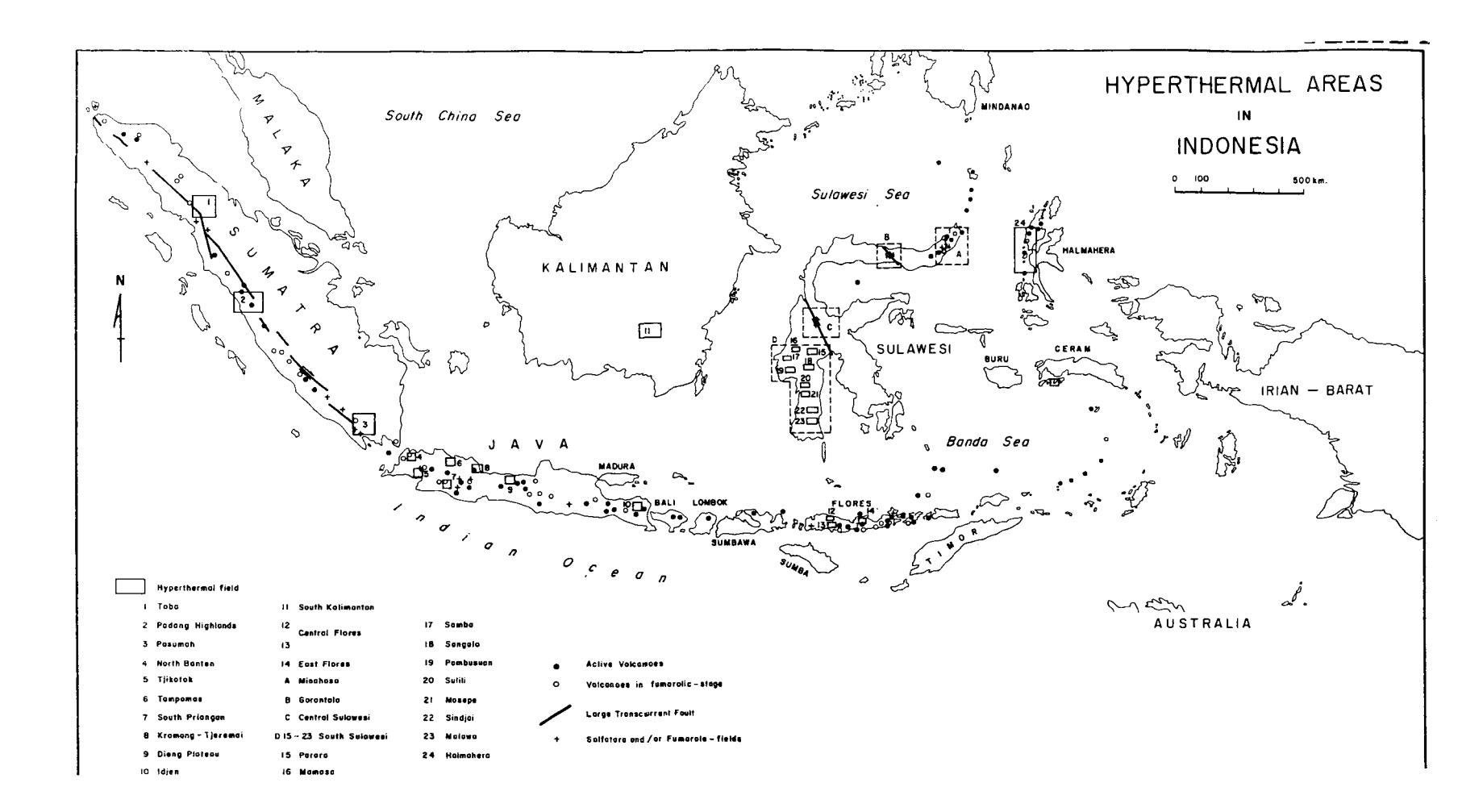
The map in Plate I is based on the information collected by the author during his recent visit to Irian and Sulawesi. The thermal fields of Northern Sumatra, the Padang Highlands, and Southern Sumatra were visited in early 1972, Kalimantan in 1971, Flores in 1969 (through the aid of the Institute of Power Research in Jacarta), whereas the thermal fields of Java have been visited for the so many times.
CONCEPT AND DEFINITION OF A COMMERCIAL STEAMFIELD
General Statement
Before a lengthy discussion of the potential areas in Indonesia is attempted the author think it is fruitful to discuss the fundamental concept of a commercial steamfield since this concept has changed so much with the development of modern geothermy. The history and development of the attempt to utilise natural steamfield for commercial purposes in Indonesia has been discussed by the author in his previous papers (Zen, 1968, 1970, 1971).
Definition and Description of a Commercial Field
Defini.ti.on. By definition energy is that entity that enables man or machine to perforrn some work. It may change through a wide variety of forms, but 1t can not be destroyed. When it disappears in one form it reappears in another. Heat, light, electricity, forces of motion and sound waves are all dlfferent manifestations of that one fundamental entity called enercv.
Most of the energy used by man on the surface of the earth originates as solar energy or radlant energy of sunlight whereas a.LL sources of subsur,face ndtural heat that can be utilised for practical purposes prodtLee leoth€rmttl elrcrq!1 .
However, the definition just given has a very wide meaning. It covers not only the actual but also the future possibilities of practical use of natural heat. It is very 1ikely that in the future every kind of geothermal energy will be of practical va1ue. At present, however, only the natural stcrm can be utilised economically for industrial development.
First of all we have to define what a natural steamfield isl ttte next step is to define the physical requirements which a natural steamfield should have in order to be able to support an industrial development commercially. In other words, a commercial steamfield should be defined first.
In this paper a natuyal stecvnfieLd is defined as Ltn el..)e in the ecuth cvust ahere sufficient natural stedrn cctn be produced by drilling to support an industnial deuelopnent.
This implies that the interest of geothermy is limited to the steamfield t.hat can produce large quantities of energy comrnercially. Since exploration costs are high a lower limit should be set for the commercial interest and this means that a field producing less energy than the certain quantity set up by the limit is not classified as a commercial natural steamfie1d.
Many economic and tecl-rnological factors are involved in defining this lower 1imit. With the conditions prevailing at present and the technological progress we are in, it can be safely stated that a steanfieLd ahieh has the capacitU of pz:o&.Lcing half a billi.on of Kuh per Aear is a field uthich cetn p:L'oduce 5 million of tons of steam at e pv,essure of 5 atmosphez,e or more, and uith a minirrum temperatur'e of 150"C (Facca and Tonani, 1961). Thls definltion is irnportant since it provides a base by which a geological conditions and environment can be defined which might produce steam in such a quantity.
Geologic Conditions and Environnents of a Steamfielcl
The most essential geologic condition to produce a steamfield is a heat source. However, just a heat source is not enough. It should be in a geologic environments such that a kind of a trap can be formed to produce steam in commercial quantity.
llany geologic ptrenomena can act as a source of heat such as faulting and geochemical reactions. However, the quantity r.rf heat generated in such a way usually can never reach the defincd requirementg of a steamfield, The most likely geologic process which is capabLe co provide sufficient quantities of heat is the mobilisation of subcrusLal heat stored uo i n rJct'1; seated magma.
Upwelling of basaltic magmas, processes of magmatic evo-Iu[ion and the genesis of volcanoes are geologic events i.n rilrich a transfer of heat from the deepest part to the upper Lat'crs of the earth crust are involved.
IJased on this, the natural steamfields now in production are classified into 3 main types. These are:
- 1. Larderello Type ) . 2. Mount An)iata Type ) ttary
- 3. Wairake Type New Zealand
- l. The Larderello Type of a steamfield is one of which the heat source is a granitlc pluton, seated at an unknown, but not at a very great depth. It is a magmatic body, a batholith or lacolith, which has come very close to the surface but without having any direct communication with the surface.
- 2. The Mount Amiata Type is a steamfield generated by a rnagmatic body which has reached the upper part of the crust with sufficient energy to give birth to a distinct volcanic manifestation in the form of pliocene or quaternary volcanoes which are extj,nct at present.
- 3. The Wairake Type is a steanrfield which is distinctly connected with an active volcano.
Based on the three models \re can define 3 favorable areas for steam exploration, and these are:
- 1. Areas wlth relatively shallow intrusions
- 2, Areas of recently extinct volcanoes
- 3. Areas around active volcanoes .
Petrofeum geology a firm knowledge of the sedimentary basin is essentlal for an exploration program since it enables us to make a scientific, rational choice of potential areas, whereas the theory of hydraulics will help us to locate more exactly the probable single exploratory well. This is also valid in setting up a geothermal exploration.
In this way it can be stated with certainty that actual surface shows are no longer necessary condition for the choice of a drilling site. However, they are very useful from a regional point of view. This concept of course alters drastically the method and technique of a geothermal exploration program.
Conditions and Environments for Heat Accumulation
We have previously defined the heat source necessary to generate a steamfield. A heat source is a basic prerequisite. However, it is not sufficient.
The most ideal geologic condition and environment of a steamfield is such that we encounter a source's cap rock, a productive aquifer and an aquifer cap rock such as illustrated in Fig. 1.
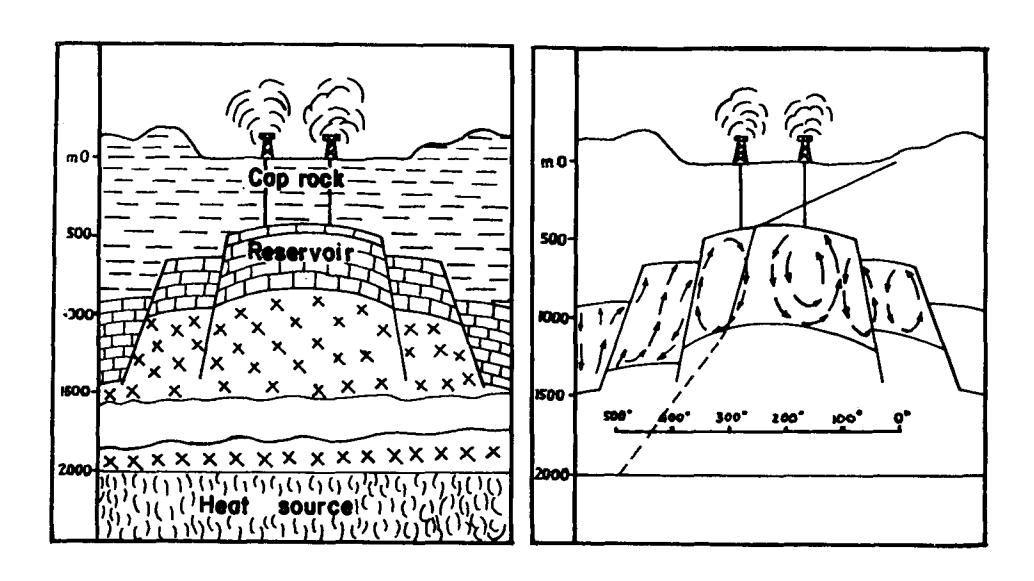
Fig. 1. Scheme of an ideal geothermal field according to Tonani et al., 1964.
Right on top of the heat source there is a sourcets cap roctr: which consists of an impervious series overlying the magmatic bod)'. In reality it is the magmati.c body and the overlying impervious body whicll make out the heat source.
On top of the source's cap rock there is a very pervious and porous reservoir which is cal1ed the productive aquifer. Tliis layer again is overlain by an impervious layer which is called the aquifer cap rock. The productive aquifer is sandrvicired in between two impervious sequences.
Tire situation must be such that in the previous horizon of the sourcets cap rock the thermal conductivity is raised ancl the tlrerrnal gradient is lowered caused by the thermal convr'ction, and also vice versa in the irnpervious horizon. In tlris rvay tire higtrest possible temperature for the top of the per:meable series is assured.
The to2 surface of tire sourcets cap rock should enable a steady and upward flow of heat. The water of a productive aquifer is heated at the bottorn. If the permeability ls high and if the thickness of the productive aquifer ls sufficlent, convection currents will originate and assure an upward transfer of heat (Fercca and Tonani, 1961). A11 the water of the very pervious aquifer is heated, whereas the temperature at the top of the pervious layer is not so different from the temperature at the bottom. The heat transfer, assured by the convection currents, occurs in an entirely different way than tlre heat transfer in the i.mpervious beds. In the pervious beds the strong convection aqualises the top and bottom temperature of the fluids.
l.Ihereas in the irnpervious beds where no fluids movement is possible t1-re temperature increases with depth at the high rate stated by Che low conductivity of the rocks and by the total liigh flow of heat. Therefore the temperature at the pervious bed happens to be high in this case (Facca and Tonani, 1961). In other words, a commercial steamfield 1s a trap for the convection geothermal currents generated by a sufflcient heat flow (Facca and Tonani, 1961).
Prospectable Areas 1n Geotl-rermal- Exploration
Based on the classification of present day operating geothernrel fields, the prospectable areas of natural steamfields
- ( i ) fields connected with shallow intruslons
- ( ii ; fields linked to present day active volcanoes
- (ij-i) fields linked to recently extlnct volcanoes.
Areas of active and e:<tinct volcanoes are very easy to locate. Hor^rever, there are so many areas of recently extinct volcanoes so that somethi.ng more elaborate has to be said. In this respect, all areas of extioct volcanoes r.,;j.th some signs of post volcanic activity (Karnodjang sol-fatara field in western Java) are considered prospectable; without such si_gns all quaternary and pli.ocene vol-canic areas are prospectable. Nothing can be said at this state about pre-pliocene volcanoes, however, if there is some evidence of actual thermal activity, this area deserves further investi-gati-on.
A geologic envi.ronment with a high probabllity for finding a steam trap is when a thlck sedimentary series are being pierced by a volcano. In this case thb subsurface geological sequence with lts pervious and impervious layers can be forecasted better. The geological as well as the geophysical information are more rel-iable so that the cholce of a rational locatj-on for the explorat.ory well will be not so difflcult. In an entirely volcanic series, like in the Dieng volcanic mountai"ns (Central Java), the pervious and i-mpervious strata can only be ascertained by drilling (Zen, I97l). In this case nei-ther can there information be obtained about the lateral extend of the different volcanic facies.
Like in petroleum exploration geol-ogic and geophysical methods can be applled such as gravimetry, magnetometry, geoelectricity and seismometry. The most successful- method in delineating hot r{7ater reservolr is the geoelectric method (Zen, L97L) aided by a geochemical investigation. The most reconnnended geophysical procedure to be used in delineating a hot-water reservoir up till now would be profiling with direct current resistivlty method, cornbined with direct current resistivity soundings to depths of the order of 3 Km (Banwe11, 1970) .
POTENTIAL ARNAS IN INDONESIA
The Volcanic Geology of Indonesia
After the basic concept of geothermy has been explained we can now attempt to define potential geotherrnal areas in Indonesia. However, some understanding of the volcanic evolutio?r in Indonesj-a will be a very valuable aid in this attempt.
In Indonesia, not less than 128 active eruption centers are found, of which 78 have erupted since 1600,29 are in solfataric stage and about 21 are solfataric fields which are not obviously connected with a volcano, whereas the number of volcanoes which are in a more or less advanced stage of exhaustion and disintegration i.s much greater; it exceeds 500. However, the volcanic activity we witness taking place around us nor^r is part of a phase which commenced in the Quaternary. Before, several phases were known. However, phases of volcanism did not start at the same time all over the islands (Table I - 2).
In Java, the latest and third cycle of volcanism started in the Quaternary and lasted until the present time. It is very interesting to note that some Quaternary volcani.c activity in Java with leucite-bearing ejecta occurred along the north coast of the island, namely in the sedirnentary basin of the island, where the volcanic channels plerced through the thick young sedlmentary strata. However, no potential areas have been found as yet along this zone.
The volcanoes in the Indonesian Archipellago are arranged in a number of zones. The zones form generally the inner arc of mountain systems; their outer arcs are non volcanj-cs. One typlcal example is the Sunda Mountain System. lts volcanoes are situated on the axis of a large anticline which stretches from the Barj,san Mountains in Sumatra through Java to the Lasser Sunda Islands. The non-volcanic outer arc runs through the islands west of Sumatra and the submarine ridge which cuts the trough south of Java into two. In northern Moluccas, two zones of active volcanism are found, whose complex sides face each other with one non-volcanic outer arc in conmon.
rglcslEl__Arees
Areas of greatest potentials in Indonesia are the area along the Semangko Rift Zone in Sumatra, Java, Central Flores, South and Northern Sulawesi, Halmahera and several others (see Plate I). Very 1itt1e j-s known about the thermal springs in Kalimantan; Bali has recently been investigated (not indicated in Plate I) and nothing is known about West lrian.
Ttrough several geothermal surveys have been made (Zen, 1967) the real and exact potential of Indonesia in the field of geothermy is not known. One United Natlon expert put the geothermal potential of Java as high as several thousands of Megav/atts (Meidav, 1972> .
0f the so many potential areas only the Volcanic Complex of Dieng in Central Java has reached itb exploratory drilling state, whereas the Kamodjang Solfatara field in West Java might be explored and investigated more in detail by a combined New Zealand - Indonesian team.
As of now quite a lot of attention is paid to several areas in Java. However, the potentials of Sumatra and Sulawesi remain praccically unknoinm. It is the authorts opinion that inventarisatlon of data of those respectlve areas should be done as quickly as possible. A fair geologic map on a scale of at least 1:250.000, with a more detailed lnformation on geothermy should be available in order to make these areas .ittractive for future investment in this field.
Table 1. Evolution of eastern Borneo p. 70) Ehe Meratus Mountains in south- (according to Van Bemmelen, 1954,
| Orogenesis | and plutonism Volcanisrn | |||
|---|---|---|---|---|
| uplift in 3rd inpulse of Plio-P1ei.s tocene times. | No external volcanism. The ero not yet sion has sufficiently progressed far to establish the presence or absence of concomit grani-te intrusions. tan | |||
| subsidence in Terti Quiet ary times | persists inLo External volcanisrn Eocene times. | |||
| 2r,d impulse of uplift at the end of Cretaceous times | Paci volcanism of the External sulte. The quarLz dioritic fic present vents are at f111ings of exoosed. | |||
| in subsidence Middle Quite times and Late Cretaceous | No exEernal volcanism. | |||
| I st irnpulse of uplift in Early Cretaceous ti-mes | volcanism. Granites No external pluto into the basic intruded the suite. nites of ophiolitic | |||
| in Jurassic Subsidence times. | of ophiolitic intru Formation and extrusions. sions | |||
Table 2. Evolution of the (according to Van Barisan Mountains in Sumatra Bemmelen, 1954, p. 71).
| Orogenesis | Volcanism and plutonism | ||
|---|---|---|---|
| 3rd impulse of uplift in Plio-P1eis tocene times | Revival of the basalto external volcanism. Intruding andesltic granites (3rd generation) caus ed vj-o1ent eruptions of dacitic pumicer and rhyolitic €.8. those of Ranau and Toba. | ||
| subsidence in Mio Quiet Pliocene times | External volcanism, malnly of basaltic and andesitic comDosi tion. | ||
| 2nd irnpulse of uplift in Middle Miocene times | Violent eruptions of dacitic and rhyolitic pumice, especially a long Semangko fault the zone on geanticline, the top of the are associated with the intrusion of (2nd generati.on). granites | ||
| subsidence Oligo in Quiet Miocene times | Strong volcanic activity, mainly of and andesitic, but basaltic sometimes dacitic composition. Produced Andesite for the "01d matlontt. | ||
| lst of impulse 'rn1i f t i n and Early Late Cretaceous Eocene tlmes | Intru No external- volcanism. (lst genera granites slon of rion) . | ||
| Geosynclinal subsidence, especially in Late Mesozo (geosynclinal ic times foredeep of a mountain chain N.E. of the Barisan Zone. | the ge Ophiolitic rocks intrude in osynclinal sediments, €.8. Moun the Garba and the Gumai tains in southern Sumatra. | ||
GEOTHERMY AND ITS IMPLICATION TO THE FURTHER INDUSTRIAL DEVELOPMENT IN INDONESIA
Complete data on the resource of energy of Indonesia and its consumption pattern is not available. At this stage it can be said that the lignite reserve is estimated at roughly 6 billion metric tons, coal at 500 millions tons (recent exploration not included), natural gas at 43 billion cubic meters (Arismunandar, 1972). Anticipated oil production before 1980 will be around 3 million barrels a day. Total Hydropower capacity is estimated at 28.000 MW, whereas the gcothermal potential of Java only is estimated as high as several thousands of megawatts. It is further estimated that the demand for electric power will reach 5100 MW in the year 1990 (Hoesni, et al. 1971).
Because of its relatively low cost geothermal power is competitive as a source of energy. However, geothermal energy is not free energy. Capital as well as coordinated efforts should be invested in this field in order to obtain a clear picture as to what extent it can play a role in the industrial development planning in Indonesia. The idea of saving petroleum as an export commodity as much as possible and use geothermal energy together with hydropower and other kinds of energy, except oil, for domestic use is quite attractive. Besides, it is predicted that within a couple of decades all fossil fuels will be consumed. It is within this frame of reference that the author feels the urgent need of exploring all kind of possibilities of developing new kinds of energy, geothermal energy included.
Last but not least, how far will the utilization of geothermal energy be damaging to the environments? This is one prime question to be solved far in advance.
The current most debated energy crisis and the long term projected finiteness of fuel resources on one hand and the increasing success of environmentalist in stalling the building of new generating plants in many developed countries make developments of geothermal power plants more attractive. As of now no indications have been cited about pollution caused by geothermal plants. Gilluly (1970) stated that tapping these naturally occurring pools of hot water beneath the earth crust would cause few of the pollution problems created by conventional or nuclear power plants.
Magma power Co (Gilluly, 1970) which has a geothermal power pilot plant in Brady, Nevada, is using a system of heat transfer that eliminates some of the possible disadvantages of geothermal power. The system brings hot water and steam from a geothermal reservoir to the surface, but the steam itself does not actually operate the power plant. Instead the steam and hot water are used to heat isobutane-and the isobutane turns the plant's turbine. Then the hot water is pumped back into the reservoir.
Dallas Peck (op. cit. Gilluly, 1970) stated that such a heat transfer system eliminates two possible sources of environment damage: leftover brine, which in some cases might be toxic and difficult to dispose of, and possible sinking of the ground caused by removing the subsurface water. Russian engineers are experimenting with similar heat transfer system, using Freon instead of isobutane.
That geothermy could be a new source of energy, is no longer questioned. However, could geothermal energy be large enough to play a role in supporting an overall industrial development program such as planned by Indonesia?
It is estimated that the Dieng Mountains in Central Java might be able to supply electric power of the order of 200 megawatts for 25 years or 100 megawatts for 50 years. The long draught of 1972 has proved clearly that Indonesia's electric power supply is far from adequate to meet the consumer's demand whereas Indonesia has not even entered its full industrialisation program. It is scheduled that the emphasis of Indonesia's second Five Year Plan will be more in the industrial sector.
In the United States, geothermy has gained considerable attention. In California, the Imperial Valley Geothermal site only is reported to be able to produce electricity of 20.000 to 30.000 megawatts. Other countries such as the Soviet Union, the Philippines, Turkey, Chile, El Salvador start a wide geothermal exploration program.
In Indonesia, many mining districts will be opened in the Eastern part of the archipellago (International Nickel Company in East Sulawesi, Aneka Tambang in Center Sulawesi, Pacific Nickel in Gag Island, Free port Sulphur in West Irian). Present day mineral exploration program in the eastern part of Indonesia might discover new areas which might develop into mining districts.
If Indonesia in the future no longer would consider exporting ores but start exporting finished or half finished mining products, a large amount of energy will be required for the process. On the other hand all the producing oil well are in the western part of Indonesia.
Finally, the author of this paper is of the opinion that Indonesia should have a clear cut policy on energy, geothermal energy included.
Once and for all the government must solve the problem whether a private enterprise (domestic or foreign) could de-
*) Indonesia's state electric company.
velop such a geothermal power plant and se11 its electricitv to the public beside the pLN*).
It is the authorts firm opinion that the government of Indonesi-a alone through the PLN would not be able to provide the gigantic demand of electricity needed for Indonesiars future industrialisation program. The power black out during the draught of 7972 is a clear proof.