

LIST OF SYMBOL
| a | - | radius of the cylinder | ||||||
|---|---|---|---|---|---|---|---|---|
| \(C_{\mathbf{L}}\) | - | lift coefficient | ||||||
| \(C^{\mathbf{D}}\) | _ | drag coefficient | ||||||
| D | - | drag force | ||||||
| i | _ | √-1 | ||||||
| L | _ | lift force | ||||||
| Re- | - | Reynolds number | ||||||
| S | - . | Strouhal number | ||||||
| t | - | time | ||||||
| U | - | free stream velocity | ||||||
| ົນ | von Karman's vortex velocity | |||||||
| V | - | velocity | ||||||
| \(v_o\) | _ | velocity of point vortex at \(\mathbf{z}_{o}\) | ||||||
| \(\mathbf{u}_{o}\) | _ | \(x\) component of \(V_{O}\) | ||||||
| \(v_o\) | . – | y component of \(V_{O}\) | ||||||
| Ŵ | _ | complex potential | ||||||
| w. | - | v/u | ||||||
| x | - | longitudinal coordinate | ||||||
| у | _ | lateral coordinate | ||||||
| z | - | x + iy | |||||||
|---|---|---|---|---|---|---|---|---|---|
| Γ | - | vortex strength | |||||||
| ф | - | angular position of point vortex | |||||||
| Υ | - | dimensionless vortex strength | |||||||
| λ | - | ratio between lateral to longitudinal distances of von Karman vortices | |||||||
| ρ | - | distance between \(\mathbf{z}_o\) and \(\mathbf{z}_1\) expressed in units of a | |||||||
| θ | - | angular position of separation point | |||||||
I. Introduction
The oscillating lift acting on a circular cylinder has been a subject of continued interest, especially in the light of increased effort to understand and overcome wind excited vibration in the field of industrial aerodynamics. experimental investigations were performed by many investigators, among others Roshko (4,5), Fung (3), and Bishop and Hassan (2). Recently, Alexander (1) has proposed a simple theory to calculate the oscillating lift acting on a circular cylinder. The present article presents an analytical model somewhat similar to that introduced by Alexander, but introduces additional conditions based on physical considerations. Alexander has preassumed the vortex trajectory, assumed that the vortex shed off the cylinder breaks away from the cylinder or joins the vortex street at the instant when the lift force on the cylinder attained its maximum value, and hence suddenly the force on the cylinder due to the vortex In the present theory, the above assumptions are removed, and instead, the vortex trajectory is computed employing the condition of zero force on the vortex and its feeding vortex sheet. The vortex breaks away from the cylinder and is convected by the fluid after its strength reaches a maximum value.
The present model is capable of predicting the oscillating lift within the right order of magnitude of available experimental results. However, to some extent, most experimental results are affected by three dimensional effects.
II. Analytical Model
Consider the flow around a circular cylinder, and assume that initially a simple vortex is shed off at one of the separation points on the cylinder, and then convected downstream.
In thls process, the vortex grows ln strength. The feedlng points - or separation polnts - wl1l- be defined from exPerlmental evidence, or they uray be arbltrarily deflned and verlfied later. It ls assr:ned that as soon as the vortex attains its maxlmum strength, then lt stoPs growing ln strength and breaks away from lts feedlng vortex sheet and starts to be convected downstream at von Karmanfs velocity and at constant strength. At the same tlme, another vortex ls shed off on the other separatlon polnt. Thls assunption is based on the premlse that the vortex cannot decrease ln strength, or unroll, and if such tendency seems to occur, the vortex wlLl break away from its feedlng vortex sheet and another vortex of opposite sense ls generated. The lnitlal path of the vortex shed off the cyJ"lnder is governed by the condltlon of zero force on the vortex and lts feedlng vortex sheet. The strength of the vortex at any instant ls governed by the conditlon that the veloclty at the separatlon polnt should always be equal to zeto.
I i I I'
a. Gouetning equations:
Figure I illustrates the analytlcal modeL of the fl-ow about a cylinder at subcrltlcal Reynolds number. At some l-nstant after shedding, the vortex shed assumes a posltlon zo and strength f. The complex potential at any positlont z = x * iy for this situation ls glven by:
\[W(Z) = -U(z + \frac{a^2}{z}) - \frac{i\Gamma}{2\pi} \ln (z - z_0) + \frac{i\Gamma}{2\pi} \ln (\frac{a^2}{z} - \overline{z}_0)\] (1)
where all symbols The veloclty field en bv: are defined ln the ttlist of synbols", at any polnt z(x,y) l-n the flow ls giv-
\[V = -\frac{dW}{dz}\] \[= U(1 - \frac{a^2}{z^2}) + \frac{i\Gamma}{2\pi a} \left( \frac{a}{z - z_0} + \frac{a}{z} \frac{a^2}{a^2 - \overline{z}_0 z} \right)\] (2)
which has the u and v components described by:
\[u = U - \frac{Ua^{2}(x^{2} - y^{2})}{(x^{2} + y^{2})^{2}} + \frac{\Gamma}{2\pi} \frac{y - y_{o}}{(x - x_{o})^{2} + (y - y_{o})^{2}} - \frac{a^{2}\Gamma}{2(x^{2} + y^{2})} \frac{\{y(xx_{o} + yy_{o} - a^{2}) + x(yx_{o} - xy_{o})\}}{\{(xx_{o} + yy_{o} - a^{2})^{2} + (yx_{o} - xy_{o})^{2}\}}\](3)
Figure 1. Analytical Model
\[v = -\frac{2Ua^{2}xy}{(x^{2} + y^{2})^{2}} - \frac{\Gamma}{2\pi} \frac{x - x_{o}}{(x - x_{o})^{2} + (y - y_{o})^{2}} + \frac{a^{2}\Gamma}{2(x^{2} + y^{2})} \frac{\{x(xx_{o} + yy_{o} - a^{2}) - y(yx_{o} - xy_{o})\}}{\{(xx_{o} + yy_{o} - a^{2})^{2} + (yx_{o} - xy_{o})^{2}\}}\](4)
Using Blasius theorem for the forces acting on the cylinder, we obtain:
\[D - iL = \frac{1}{2} i\rho \Phi_{c} \left(\frac{dW}{dz}\right)^{2} dz\] (5)
where the integration is carried out along a closed path around the cylinder, and D and L are the time dependent drag and lift forces acting on the cylinder, respectively. Hence:
\[D = \frac{a^2 x_0 \rho \Gamma}{(x_0^2 + y_0^2)^2 (x_0^2 + y_0^2 - a^2)} \times \{\frac{\Gamma}{2\pi} (x_0^2 + y_0^2) - 2y_0 U(x_0^2 + y_0^2 - a^2)\}\] (6)
\[L = \frac{a^{2}\rho\Gamma}{(x_{o}^{2} + y_{o}^{2})^{2}(x_{o}^{2} + y_{o}^{2} - a^{2})} \times \{y_{o} \frac{\Gamma}{2\pi} (x_{o}^{2} + y_{o}^{2}) - U(x_{o}^{2} - y_{o}^{2})(x_{o}^{2} + y_{o}^{2} - a^{2})\}\](7)
Since: \[C_D = \frac{D}{\rho U^2 a}\] and \[C_L = \frac{L}{\rho U^2 a}\] then: \[C_D = \frac{ax_o \Gamma}{U^2(x_o^2 + y_o^2)^2(x_o^2 + y_o^2 - a^2)} \times \{\frac{\Gamma}{2\pi} (x_o^2 + y_o^2) - 2y_o U(x_o^2 + y_o^2 - a^2)\}\] (8)
\[c_{L} = \frac{a\Gamma}{U^{2}(x_{o}^{2} + y_{o}^{2})^{2}(x_{o}^{2} + y_{o}^{2} - a^{2})} \times \{y_{o} \frac{\Gamma}{2\pi} (x_{o}^{2} + y_{o}^{2}) + U(x_{o}^{2} - y_{o}^{2}) (x_{o}^{2} + y_{o}^{2} - a_{o}^{2})\}\](9)
b. The motion of the vortex
The motion of the vortex is governed by the condition that the total force acting on the feeding vortex sheet — which is assumed to have vanishing strength — and the point vortex is zero. Mathematically there is a branch line between \(z_0\) and \(z_1\), the separation point, and the velocity potential \(\varphi\) is discontinuous across this branch line. The discontinuity in \(\varphi\) is equal to \(\Gamma\), the strength of the vortex. Therefore there is a discontinuity in pressure across this branch line with a magnitude of — \(\varphi^{\Gamma}\), and the total force acting on this vortex sheet is equal to
\[-i\rho \dot{\Gamma}(z_0-z_1)\] where \(z_1\) is the location of the separation point.
The force acting on the concentrated vortex is equal to its circulation times, \(-\rho i\) times the relative velocity between the fluid and the vortex at the point vortex, \(V_{0}\) - \(\dot{z}_{0}\), hence has a magnitude of \(i\rho\Gamma(V_{0}\) - \(\dot{z}_{0})\). To make the net force on the concentrated vortex and its feeding vortex sheet vanish, we must have:
\[-i\rho\dot{\Gamma}(z_{0}-z_{1})+i\rho\Gamma(v_{0}-\dot{z}_{0})=0\] (10a)
or
\[\dot{z}_{o} + (z_{o} - z_{1}) \frac{\dot{\Gamma}}{\Gamma} = V_{o}\] (10)
where \(V_{\rm O}\) has components \(u_{\rm O}\) and \(v_{\rm O}\) parallel to the x and y axes, respectively. From equations (3) and (4) and employing a limit process, we obtain:
\[u_{o} = U - Ua^{2} \frac{x_{o}^{2} - y_{o}^{2}}{(x_{o}^{2} + y_{o}^{2})^{2}} - \frac{\Gamma}{2\pi} \frac{a^{2}y_{o}}{(x_{o}^{2} + y_{o}^{2})(x_{o}^{2} + y_{o}^{2} - a^{2})}\](11)
and \[\mathbf{v}_{o} = -\frac{2Ua^{2}x_{o}y_{o}}{\left(x_{o}^{2} + y_{o}^{2}\right)^{2}} + \frac{\Gamma}{2\pi} \frac{a^{2}x_{o}}{\left(x_{o}^{2} + y_{o}^{2}\right)\left(x_{o}^{2} + y_{o}^{2} - a^{2}\right)}\] (12)
The trajectory of the point vortex is a function of time, and is described by:
\[x_0 = x_0(t)\]
\(y_0 = y_0(t)\) (13)
furthermore:
\[u_0 = u_0(t)\] and
\[v_{o} = v_{o}(t) \tag{14}\]
From equation (10) we obtain:
\[\frac{dx_0}{dt} + \frac{x_0 - x_1}{\Gamma} \frac{d}{dt} \Gamma = u_0\] (15)
\[\frac{dy_0}{dt} + \frac{y_0 - y_1}{\Gamma} \frac{d}{dt} \Gamma = v_0\] (16)
If \(\Gamma\) at any instant is known, equations (15) and (16) can be employed to predict the vortex trajectory in a progressive fashion, since the initial position of the vortex shed is known, i.e. at the separation point.
c. Non-dimensionalization
For further computation, it is convenient to write all the pertinent equations in dimensionless forms. For this purpose, we define:
\[\gamma = \frac{\Gamma}{2\pi U a} - \text{dimensionless vortex strength}\] \[w = \frac{V}{U} - \text{dimensionless velocity}\]
After some arrangement, equation (2) can be written as:
\[w = (1 - \frac{a^2}{z^2}) + i\gamma \left[\frac{a}{a - z_0} + \frac{a^3}{z(a^2 - z_0 z)}\right]\] (2a)
d. Calculation of vortex strength
To calculate the strength of the vortex at any instant along its path, the condition that the velocity at the separation point should be equal to zero is imposed.
From equation (2a), and employing a limit process, for \(z = z_1\) is obtained:
\[\gamma = \frac{\Gamma}{2\pi U a} = -\frac{i}{a} \frac{a^2 - z_1^2}{\frac{z_1^2}{z_1 - z_0} + \frac{z_1 a^2}{a^2 - \overline{z}_0 z_1}}\] \[= -\frac{i}{a} \frac{(a^2 - z_1^2)(z_1 - z_0)(a^2 - z_0 \overline{z}_1)}{2z_1^2 a^2 - z_1^3 z_0 - z_0 z_1 a^2} \tag{17}\]
Referring to figure 1, then we can write
\[z_0 - z_1 = a\rho e^{i\phi} \tag{18}\] and
\[z_1 = ae^{i\theta} \tag{19}\]
There is obtained
\[z_0 = a(e^{i\theta} + \rho e^{i\phi}) \tag{20}\] and
\[\bar{z}_0 = a(e^{-i\theta} + \rho e^{-i\phi}) \tag{21}\]
Substituting these values into equation (17) we obtain:
\[\gamma = -\frac{1}{a} \frac{(a^2 - a^2 e^{2i\theta}) (-a\rho e^{i\phi}) [a^2 - a^2 (1 + \rho e^{i(e-\theta)})]}{2a^4 e^{2i\theta} - a^4 e^{3i\theta} (e^{-i\theta} + \rho e^{-i\phi}) - a^4 e^{i\theta} (e^{i\theta} + \rho e^{i\theta})}\] (22)
and after some algebra, equation (22) can be reduced to:
\[\dot{\gamma} = \rho \sin \theta \sec(\theta - \phi) \tag{23}\] which is always real and positive, since from physical reasons,
\[\theta - \frac{\pi}{2} < \phi < \theta + \frac{\pi}{2}\]
e. Direction of the initial vortex shedding
To predict the direction of the initial vortex shedding, consider the flow situation shortly after a vortex is shed from the separation point \(z_1\). Substituting expression (18) into equation (2a), we obtain:
\[v = 1 - \frac{1}{(e^{i\theta} + e^{i\phi})^2} - \frac{i\gamma}{\rho} \frac{1}{(e^{i\theta} + \rho e^{i\phi})(1 + 2\cos(\theta - \phi))}\](24)
Substituting expression (23) into equation (24), we obtain:
\[w = 1 - \frac{1}{(e^{i\theta} + \rho e^{i\phi})^2} - \frac{i \sin \theta \sec(\theta - \phi)}{(e^{i\theta} + \rho e^{i\phi})(1 + 2\cos(\theta - \phi))}\](25)
Taylor series expansion of w with respect to \(\rho\) yields:
\[w = w_{\rho=0} + \rho(\frac{\partial w}{\partial \rho})_{\rho=0} + \dots\] (26)
Omitting terms of order \(\rho^2\) and higher, and after some algebra, equations (25) and (26) give:
\[w = 1 - e^{-2i\theta} - ie^{-i\theta} \frac{\sin \theta \sec (\theta - \phi)}{1 + 2\cos (\theta - \phi)}\]\[+ e^{i\phi - 2i\theta} \left[2e^{-i\theta} + \frac{i\sin \theta \sec (\theta - \phi)}{1 + 2\cos (\theta - \phi)}\right] \tag{27}\]
Since the velocity at the separation point should be equal to zero, we obtain an additional condition that w=0 for \(\rho \to 0\). This condition yields:
\[1 - e^{-2i\theta} - ie^{-i\theta} \frac{\sin \theta \sec (\theta - \phi)}{1 + 2 \cos (\theta - \phi)} = 0\] (28a)
Two relations between \(\varphi\) and \(\theta\) result from equation 28a, but only one relation is valid, i.e.:
\[\phi = \theta - 0.677 \tag{28}\]
Equation (28) determines the direction of the initial vortex shedding.
f. Frequencg of uorteu shed&tng
At some distance downstream, the vortex belng shed off the cyli.nder stops growing, breaks away from the feeding vortex sheet and jotns the rows of von Karman vortices. This situation is assumed to take p1-ace when the vortex attained its maxi.rnum strength. At the same tlme, another vortex of opposite sense starts to be shed off at the other separation point, growing and travelltng downstream in a similar fashion as the former vortex. Hence vortices are shed off alternately at elther separation point, and give rise to time dependent and oscillating lift and drag forces on the cylinder.
To calculate the frequency of vortex sheddlng, whlch in dimensionless form is characterlzed by the Strouhalnumber, we impose the condition that the vortices -whlch join the von Karman vortex street attain the well known von Karmanrs vortex veloci-ty. Hence:
\[u = U - \frac{\Gamma}{21} \tanh \frac{2\pi y}{1} = \hat{U}\] (29a)
't
.t a t t
I
J{
t
\[\frac{\mathbf{u}}{\mathbf{U}} = 1 - \gamma \, \frac{\pi \mathbf{a}}{1} \, \tanh \, \frac{2\pi \mathbf{y}}{1} \tag{29}\] where: I - the dlstance between two successive vortlces
y - Lhe lateral dlstance of the vortlces from the
^ symmetry axis
U - von Karmanrs vortex velocity
When the vortex attains its maxlmum strength' then Y = 0, and from equation (10) we obtain:
\[\dot{z}_{O} = V_{O} \tag{30}\] where Vo'is the l-ocal fLuid veJ-oclty. This sltuation lmplies that the vortex is then convected by the fluld, the fluid velocity being now identified as von Karmanrs vortex velocity. Hence:
\[\mathbf{u}_{o} = \widehat{\mathbf{U}} \tag{31}\] and vo = 0 (which should be verified later).
U is the computed u component of the vortex velocity at the instant when the vortex attalns lts maximum s trength.
Equation (29) can be reduced further into the following form:
\[tanh \alpha = \frac{\beta}{\alpha}\] (32)
where:
\[\alpha = \frac{2\pi y}{1} \tag{33}\]
\[\beta = \frac{2(1 - \hat{U}/U)}{\gamma a/y} \tag{34}\]
Equation (34) can be solved graphically for calculating 1. The Strouhal number can then be obtained from
\[S = \frac{nD}{U} = \frac{2\hat{U}a}{U \ 1} \tag{35}\]
状
III. Calculation of vortex trajectory
Equations (15), (16) and (23) comprise the set of equations that determine the strength and motion of the vortex. The initial condition is defined by assigning the location of the separation point, i.e. the initial position of the vortex, and computation of the direction of the initial vortex shedding, which is given by equation (28). To compute the vortex trajectory, equation (15) and (16) are integrated numerically, while the computation progresses in a step by step fashion. Integrating equation (15) and (16) over the time increment \(\Delta t\), and using linear approximation, we obtain:
\[x_0 + (x_0 - x_1) \ln \gamma - \ln \gamma\]. \(x_0 = u_0\). \(\Delta t\) (36)
\[y_o + (y_o - y_1) \ln \gamma - \ln \gamma\]. \(y_o = v_o\). \(\Delta t\) (37)
where all variables have been rendered dimensionless through division with appropriate characteristic quantities.
The velocity components \(u_0\) and \(v_0\) of the vortex (from equation (3a) and (3b) is given by:
\[u_{o} = 1 - \frac{x_{o}^{2} - y_{o}^{2}}{(x_{o}^{2} - y_{o}^{2})^{2}} - \gamma \frac{y_{o}}{(x_{o}^{2} + y_{o}^{2})(x_{o}^{2} + y_{o}^{2} - 1)}\](38)
\[v_{o} = -\frac{2x_{o}y_{o}}{(x_{o}^{2} + y_{o}^{2})^{2}} + \gamma \frac{y_{o}}{(x_{o}^{2} + y_{o}^{2})(x_{o}^{2} + y_{o}^{2} - 1)}\](39)
Again, all variables in equations (38) and (39) are dimensionless. The computation algorithm is shown in figure 2. The lift and drag forces acting on the cylinder due to the vortex throughout its trajectory is computed from equations (6) and (7).
IV. Results and Discussions
Since the present theory does not explicitly incorporate viscosity, the locations of the separation points cannot be predicted, and recourse should be made to experimental evidence in order to determine these locations and then proceed with the calculation of the vortex trajectory.
Experimental results (6) indicate that the separation points, i.e. the point at which the boundary layer leaves the cylinder, occur at about \(\theta_{\rm S}\) = 95° for Re < 1.06 x 10<sup>6</sup> and between 50° to 80° for 1.08 x 10<sup>6</sup> < Re < 2.12 x 10<sup>6</sup>.
Based on these results, some values of \(\theta\) are assumed, and the vortex trajectory, lift and drag coefficients, vortex strength, vortex velocity, \(\lambda\) — the ratio between lateral separation and longitudinal separation of Karman vortices — and Strouhal number S are computed following the procedure outlined previously. The results are tabulated in Table 1. Some values obtained experimentally and by Alexander are also shown in Table 1 for comparison.
For the case in which the separation point is located on the upstream side of the cylinder, say \(\theta_s = 1.74\) radian, a maximum lift coefficient of 1.55 was obtained. Experimental results indicate considerable scatter, and time dependent lift as high as 1.3 has been shown by Drescher (cited in reference 1) and Macovsky (cited in reference 11) and Bearman (13). should be remarked that most experimental data are affected to some degree by three dimensional effects, which result in lower measured lift coefficients than predicted two-dimensional values. Recent results obtained by Jordan and Fromm (12) employing numerical solution of the equations governing time-dependent, viscous, incompressible flow past a cylinder indicate peak to peak amplitude of the lift oscillation of 1.5 for Re = 400 and 1.9 for Re = 1000. Their results are an adequate description of the flow past a circular cylinder for Re 400, but are not entirely valid for Re > 1000.
The Strouhal number for this case was found to be 0.159, which is within the region of experimental results. Relf and Simmons (8) obtained values of S between 1.9 to 2.4 for Reynolds number between \(8 \times 10^5\) to \(3 \times 10^5\), and \(S = 2.4 \div 3.1\) for Re \(4.0 \times 10^5 \div 10^6\), while recent experiment conducted by Bearman (9) showed that \(S = 1.8 \div 2.3\) for Re \(= 10^5 \div 3.8 \times 10^5\). For supercritical region, i.e. for Re \(= 4 \times 10^5\), Bearman
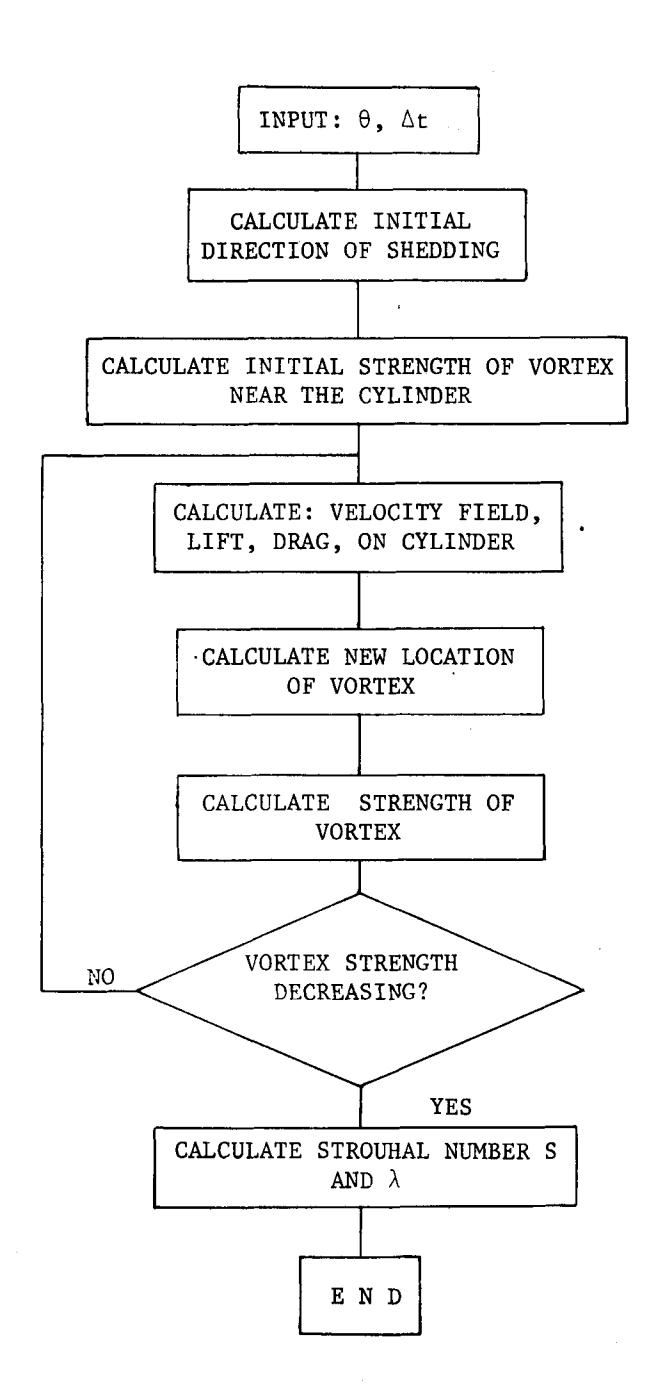
Figure 2: Computation Algorithm
found that S=0.44-0.46, while Delany and Sorensen (10) found that S=0.34-0.48 for Re \(10^6\). In addition, the present method results in the value of \(\lambda\) of 0.288, which is in good agreement with experimental result 0.2806 reported in reference 7.
For Reynolds number greater than \(10^6\), the separation point occurs further downstream, i.e. at about \(50^\circ\) - \(80^\circ\). Assuming separation points located between these values, there results maximum lift coefficient as high as 2.73 for \(\theta_S=1.0\) radian, while \(C_L=1.93\) for \(\theta_S=0.79\) radian. Experimental results indicate that S increases to about 0.24 before sudden reduction of drag coefficient occurs, and increases further to 0.48 at supercritical region. The present method is able to predict the tendency of S to increase if the flow changes from subcritical to supercritical region, i.e. if the separation point moves downstream, but indicate lower values of S at both cases. Clearly the additional increase in S should be due to turbulence, which is not taken into account in the present theory. At supercritical region, \(\lambda\) varies between 0.22 to 0.3 for \(\theta_S\) varying between 0.79 to 1.00.
The time dependent drag obtained by the present method will be zero only when \(v_0=0\), i.e. when the vortex joins von Karman vortex street. Since in general the vortex trajectory is not parallel to the free stream direction, the time dependent drag is non zero. Careful examination of equation (8) reveals that depending on the value of \(\gamma\) and \(y_0\) (lateral position of the vortex), the time dependent drag coefficient may assume positive or negative value. Relatively large value of the time dependent drag \(C_D\) is obtained when the vortex is close to the cylinder, and \(C_D\) decreases rapidly in inverse propotion to \(x_0\) as \(x_0\) increases.
The result indicates discrepancy in the lift coefficient in the order of 40% for forward separation point. Relatively better agreement is shown for act separation point, i.e. within 6%. These results also clearly indicate that the presence of small vertical velocity component of the vortex may give rise to significant changes in the values of time dependent drag and vortex strength, in particular for forward separation point. Further evaluation of the theory should be accompanied by comparison with reliable experimental results, which merits further study.
Work is in progress to investigate the problem of stability and convergence of the numerical computational scheme. However, several computation performed with \(\Delta t\) varying from 0.01, 0.02 and 0.01 has indicated reasonable converging behaviour of the solution, in particular for the calculation of \(\gamma_0\), \(c_{1_{max}}\), \(y_0\), \(x_0\), \(\lambda\) and S, as shown in table 1. The variation of
Table 1: Various Computation Results
| 0 | Δt | uo | vo | r max | CL max | CD | Уo | хo | 1 | λ | S |
| 1.74 | 0.03 | 0.404 | 0.001 | 1.049 | 3.95 | 0.07 | 1.265 | 0.214 | 5.05 | 0.501 | 0.16 |
| 1.74 | 0.02 | 0.57 | 0.02 | 1.041 | 2.80 | -0.146 | 1.308 | 0.230 | 6.45 | 0.406 | 0.177 |
| 1.74 | 0.01 | 0.762 | -0.04 | 1.024 | 1.55 | -0.340 | 1.384 | 0.231 | 9.6 | 0.288 | 0.159 |
| 1.00 | 0.03 | 0.545 | 0.022 | 1.034 | 3.15 | 0.299 | 0.867 | 1.234 | 5.40 | 0.320 | 0.202 |
| 1.00 | 0.02 | 0.574 | 0.001 | 1.018 | 2.73 | 0.379 | 0.883 | 1.251 | 5.65 | 0.312 | 0.202 |
| 0.79 | 0.03 | 0.705 | 0.005 | 1.021 | 2.55 | 0.55 | 0.704 | 1.709 | 6.4 | 0.22 | 0.22 |
| 0.79 | 0.02 | 0.697 | 0.008 | 1.013 | 2.29 | 0.335 | 0.695 | 1.692 | 6.3 | 0.22 | 0.221 |
| 0.79 | 0.01 | 0.695 | 0.008 | 1.007 | 1.93 | 0.426 | 0.694 | 1.684 | 6.2 | 0.22 | 0.224 |
| 0.79* | 0.5 | 0 | 2.3 | 0 | 1.224 | 3.7 | 0.382 | 0.27 | |||
| 1.3** | ** 0.2806 | 0.18+ 0.23 | |||||||||
| 0.23# |
* From Alexander; Alexander determines S1 = 1 and S\(\eta\) = 0.191. where \(y_0\) = \(\eta\). If S is taken to be 0.27, then \(\eta\) = 0.707, and hence 1 = 3.7, \(\lambda\) = 0.382; if S is taken to be 0.2, then \(\eta\) = 0.955, 1 = 5.0, \(\lambda\) = 0.28.
** From Prandtl & Tietjens.
+ From P.W. Bearman, at \(10^5\) < Re < 3.8 x \(10^5\).
++ From Drescher (cited by Alexander).
# Peak to peak amplitude, from reference 12, for Re = 1.000.
time dependent lift coefficients for 0 = 1.74 and 0 = 0.79 are shown in figure 3.
The present simple model is in no way a subsitute for viscous flow analysis, but has been showl to be useful in estimating the time dependent lift on a cylinder -and in identifying factors contritruting to the oscillating lift and drag, and the increase of Strouhal number.
V. Acknouledgement
The present work was initiated during the authorrs stay at National Physical Laboratory, Teddington, England, in Spring 1972. The numerical computation was performed at the Computation Center, Institut Teknologi Bandung.
IV. References
- 1 . Alexander, A.J. A Theory for the Oscill-ating lift on a Circular Cylinde:r, Symposiurn on Wind Effects on Buildings and Structures, Loughborough University of Technology, paper No. 19, 1968.
- Bishop, R.E.D. and Hassan, A.Y. "The Lift and Drag Eorces on a Circular Cylinder Oscillating in a Flowing Fluid", Proc. Roy Soc., Vo1.277, L964. 2 .
- 3. Fung, Y.C. Fluctuating Lift and Drag on a Cylinder in a flovr at Supercritical Reynolds numbers. J. Aero. Sci.; 1960, No. 11, p. B01.
- Roshko, A. Experi-nents of the flow past a Circular Cyllnder at very high Reynolds number. J. Fluid Mech., L96L, Vo1.10, No.3. 4 .
- Roshko, A. On the Drag and Shedding Frequency of Two Dimensional Bluff Bodies. NACA TN 3169, !954.
- S. Goldstein (ed.). Modern Developments in Fluid Dynamics, Vol. II, Dover Publications, Inc., New York, 1965. 6 .
- 7 . Prandtl, L and Tietjens, O.c. Applied Hydro - and Aeromechanics, Dover Publications, Inc., New York, 1957.
- 8. ReJ-f, E.F. and Simmons, L.F.G. The frequency of eddies generated by the motion of circular cylinder through a fluid. ARC R & M/No. 9I7, L924.
- 9. Bearman, P.W. Some Effects of Turbulence on the flow Around Bluff Bodies, NPL Aero Report L264, April 1968.
- 10. Delany, N.K, and Sorensen, N.E. Low Speed Drag of Cylinders of Various Shapes. NACA TN 3038.
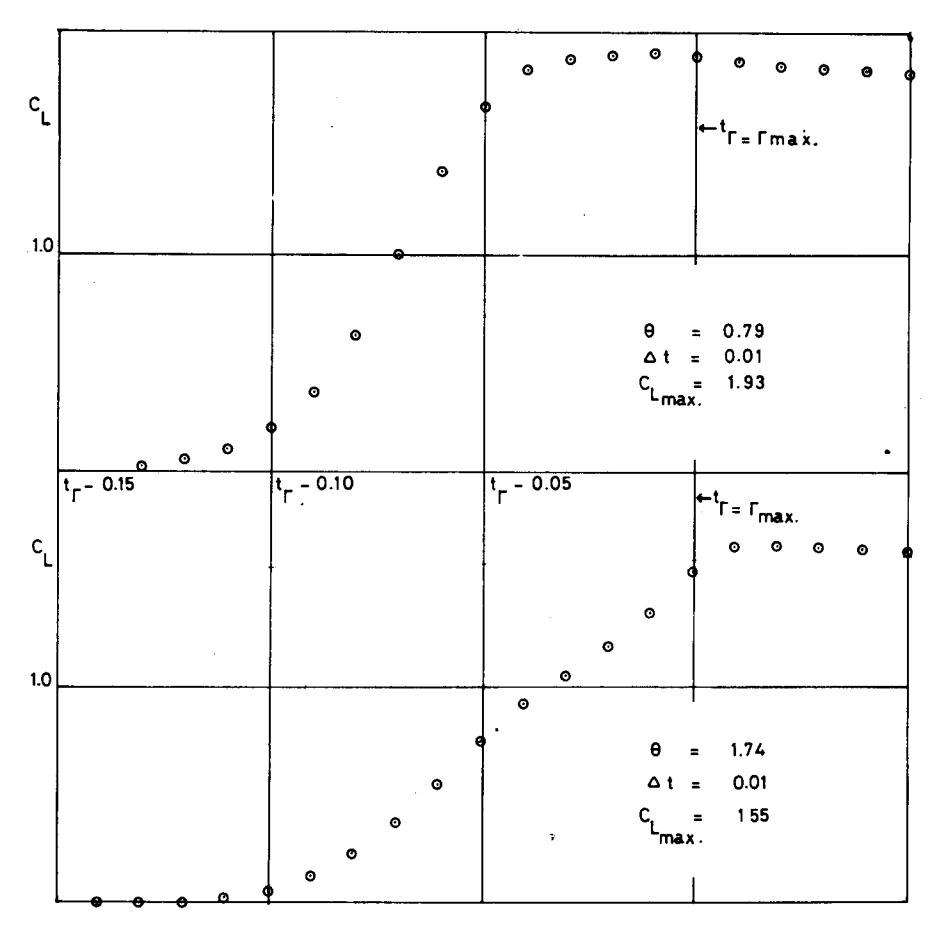
FIGURE 3 : DEVELOPMENT OF TIME-DEPENDENT LIFT DUE TO A SINGLE VORTEX SHED OFF THE CYLINDER.
Figure 3. Development of time-dependent lift due to a single vortex shed off the cylinder
11. Umemura, S., Yamaguchi, T. and Shiraki, K.: On the vibra-Tion of Cylinders Caused by Karman Vortex, Bull. Japan Soc. M.E., 14, No. 75, September 1971.
- 12. Jordan, S.K. and Fromm, J.E.: Oscillatory Drag, Lift and Torque on a Circular Cylinder in a Uniform Flow, The Physics of Fluids, 15, No. 3, March 1972.
- 13. Bearman, PLW.: The Flow around a Circular Cylinder in the Critical Reynolds Number Regime, NPL Aero Report 1257, January 1968.
(Received 7<sup>th</sup> June 1973)