

1. INTRODUCTION
It is generally accepted that the star formation begins in the dense interstellar clouds. Immediately after the star has been formed, the energy is derived at the expense of their gravitational energy. This energy is released very rapidly, as the star experiences hydrodynamic collapse. In the following stages, the star contracts rather slowly, through a series quasihydrostatic equilibrium states.
*) Department of Astronomy, Bandung Institute of Technology.
The cloud of gas, out of which the stars are formed, is thought to have low internal pressure. This condition makes it undergoes gravitational collapse on the free – fall time scale of \(10^5-10^6\) years. At the beginning, the cloud is transparent to its own radiation. Therefore, rapid energy escape is possible. As the density rises the gas becomes almost opaque and the rate of radiation escape decreases.
In the course of time, as the more energy is trapped inside the cloud, the temperature increases. This increase of temperature is accompanied in increase of density and pressure. The collapse stopped when pressure gradient becomes large enough to stand against the gravity. But the central regions continue to be heated, due to the compression exerted by the material from the outer regions. The virial theorem suggests that half of the released gravitational energy is radiated from the surface. The other half goes into heating of the interior.
The next evolution phases, through the quasiequilibrium states, proceeds very slowly. At this state the surface temperature may reache \(3000^{\circ}\text{K}\), but, the central region temperature exceeds \(10^{5}^{\circ}\text{K}\). When the temperature in the central region becomes high enough, the conversion of hydrogen atoms to helium is possible. This is achieved through a proton-proton chain or through the CNO cycle. As the rates of energy production is high, the contraction slows down, and finally stops, when the star reaches its transition phase, from the pre-main sequence to the main sequence state.
The time needed to reach the main sequence depends on the masses of the stars. For the sun, or the solar-like stars, the time is 40 million years. The contraction time scale is in the order of 100 times less that the time for the slow-contraction.
In the following chapters, theory of stellar formation will be briefly treated in Chapter 2. The theory of the early phases of stellar evolution is presented Chapter 3. Comparison with observations is discussed in Chapter 4.
2. STAR FORMATION
The sources of information for this chapter are taken primarily from the articles by Spitzer (1968, 1969), Field (1970), McNally (1971) and Penston (1971). It has been shown by Spitzer (1968) that star formation seems to be general phenomenon in our own Galaxy and in the spiral arms of other Galaxies. Observations suggest that new stars are primarily formed in clusters, but the isolated formation of a single star from an individual interstellar cloud cannot be excluded from the observation.
A fundamental first step in star formation is the creation of condensation in the center of the cloud. This occur when a pulling mechanism, the gravitational force, is at work. Then, when a large cloud or group of clouds surpasses a certain limiting mass, it starts to collapse gravitationally under the pressure of the surrounding material. Spitzer (1968) assumes if pressure equilibrium with \(P_{\rm m}\) equal to 1.4 x \(10^{-13}\) dynes/cm³, then for a typical large HI cloud with a mean density of 20 H atoms per cm³, corresponding to a temperature of 125°K, collapse will begin if the mass exceeds \(10^4 \rm M_{\odot}\). The normal process of condensation produces a group of stars, either a cluster or an association.
For an isolated cloud,
\[P_{\rm m} = 1.40 \frac{(KT/\mu)^4}{G^3 M^2 \{1 - (M_{\rm c}/M)^{2/3}\}^3}\] (1)
\[\frac{GM^2}{R^4} = \frac{25 P_m}{1 - (M_c/M)^{2/3}}\] (2)
For our Galaxy, the numerical value would be: \(\rho\) = 4 x \(10^{-23}\) g/cm<sup>2</sup>. B, the magnetic field, is taken as 3 x \(10^{-6}\) Gauss, M<sub>C</sub> is then 1.2 x \(10^4\)M<sub>©</sub>. These values suggests that clouds of the observed density are more likely to condense into clusters of stars, rather than isolated objects.
3. THE EVOLUTION
The evolution toward the main sequence can be conveniently divided into two groups:
- 3.1. The hydrodynamic phase: where the time scale of evolution is very short.
- 3.2. The quasistatic phase: where the stars remain on hydrostatic equilibrium to a very high degree of approximation.
The second evolutionary phase has a fairly well established theoretical basis. Observationally, there are many more objects that can be observed to prove or disprove the theory of the 2nd evolutionary phase. On the contrary, observational material of objects in the protostellar phase, is very limited. This makes a firm contact between theory and observation is difficult to make. The rapid hydrodynamic time scale of evolution is the major contributing factor.
3.1. The gravitational collapse, is probably caused by a physical mechanism. These physical mechanism lead to instability in the cloud. The first of which occurs when the density of an interstellar cloud, or fragment, gets high enough so that the total energy of the system is negative. Beyond this state internal pressure becomes less than gravitational pull.
The collapse then continue to proceed and the energy is generated by compression. The so obtained energy is radiated away through the optically thin cloud and is not sufficient to contribute something to the internal pressure. The collapse begins to slow down until the pressure gradients increase rapidly relative to gravity. Then the material fall begin to decelerate.
As early as 1939, Bierman and Cowling (1939) have introduced the second instability, which occurs at a later stage of evolution. This state is reached when T \(\sim\) 1800°K to dissociate the hydrogen molecules. According to Bierman and Cowling, at the above mentioned temperature, the adiabatic exponent
\[\Gamma_1 = \left(\frac{d \ln P}{d \ln \rho}\right)_s < \frac{4}{3}\] which means that energy must be supplied to dissociate the molecules faster than the stars can supply it.
Hayashi (1966) computes the maximum radius for stars at the onset of hydrostatic equilibrium phase for a star. The conditions that are necessary in order that a protostar initially in hydrostatic equilibrium can remain in this state:
- 1. The protostar must be dynamically stable \((\Gamma_1 > \frac{4}{3})\)
- 2. The cooling and heating time must be longer than \(t_f\) or \(t_e\). Here \(t_f\) and \(t_e\) stand for "free fall time" and "expansion time" respectively.
These quantities are:
\[t_{f} = \left(\frac{32}{3} \pi G_{\rho}\right)^{-\frac{1}{2}}\] \[t_{e} = \frac{\left(\frac{3M}{4\pi\rho}\right)^{\frac{1}{3}}}{\left(\Gamma_{1}RT/\mu\right)^{\frac{1}{2}}} \text{ (see Cox and Giulli, 1968)}\] and
The interstellar cloud has very low gravitational and thermal energies, compared with those of the star when it comes into equilibrium at radius R. The energy of this final state can be derived from the total energy and the gravitational energy, and is \(E=-0.43~\mathrm{GM}^2/\mathrm{R}\).
Using the basic assumption which ignores the rotation and magnetic fields of the protostar, and make use of the fact that evolution may proceeds adiabatically from the initial
state to the state of radius R, the different in the energies must be accounted for the energy which is used for dissociating the hydrogen molecules and for ionizing the atoms of hydrogen and helium. Then \(\frac{1}{2}(\frac{3}{5-N})\frac{GM^2}{R}=X\frac{M}{m_H}\). Here N is the polytropic structure of index N, \(m_H\) is the mass of hydrogen atom, and X is the ionization-dissociation energy. Taking N = 1.5, and adopting X (number of H atoms) = 0.70 and Y (number of He atoms) = 0.28, Hayashi obtained:
\[\frac{R}{R_{\odot}} = 51.2 \frac{M}{M_{\odot}}\]
For a star of \(1M_{\odot}\), this yield \(T_{\rm C} \sim 1.5 \times 10^{5} {}^{\circ}{}\)K. If the energy loss during contraction is also taken into account, the value of \(T_{\rm C}\) may be raised by a factor of 2.
A cloud of \(1 \rm{M}_{\odot}\), which initially posseses \(\rho = 10^{-19}\) g cm and a radius of 3 x \(10^{17}\) cm, must go through a decrease in radius by a factor of \(10^5\), before it ends into equilibrium. Furthermore, Hayashi (1966), explain that the total time required to reach the equilibrium is 20 years. Afterwards, the star evolves slowly through a quasi hydrostatic equilibrium stages.
Hayashi and Nakano (1965) argue that no matter what the initial entropy distribution in the star, in a time of the order of \(10^2\) years the star will have developed a convective structure. In 1965 Hayashi and Nakano (1965) discussed the essential features of the opaque phase of the cloud. A central region of the protostar becomes optically thick when the mean density is \(10^{-13}\)-\(10^{-4}\) g cm<sup>-3</sup>. It should be kept in mind that a formation of a star from the interstellar medium involves a change in the mean density of \(10^{-24}\) to \(10^\circ\) gm/cm<sup>3</sup>. The uncertainty in the opacity is due to opacity contributed by the grains. The free-fall time then becomes much shorter as compared with the photon diffusion time. This will ensue the adiabatic collapse in the opaque regions.
At one stage of evolution, the infalling layers moving supersonically with respect to the core result in the formation of a shock front at the boundary of the core. The mass in the core then increases, and continue to compress. This will induce the increase of temperature which set the dissociation of molecular hydrogen. The central part of the core begins a second phase of collapse and then the shock wave dies out.
Hayashi (1970) reviews the calculations for 0.05, 1 and 20 \(\rm M_{\odot}\). The initial condition for \(\rm 1M_{\odot}\) is chosen as an opaque protostar with \(\rm T_{C}\) = 100°K and \(\rho_{C}\) = 7 x 10<sup>-9</sup> g cm<sup>-3</sup>. The polytropic index 4 has been taken. Each mass shell is assigned to a velocity that correspond to free fall from infinity. When \(\rho_c\) has increased to \(10^{-2}~g~cm^{-3}~\) the dissociation of molecular hydrogen is completed. The central regions comes to a phase of hydrostatic equilibrium.
When the shock front approaches the surface layers, and if it is located at optical thickness less than 100, the diffusion time of photons behind the front becomes very short. This will cause a "flare up" of the star, which will release energy at a luminosity equal to \(10^{-3} \rm L_{\odot}\) to 5 x \(10^3 \rm L_{\odot}\). All of this release of energy occur in less than 1 day.
All of this release of energy occur in less than 1 day. Fifteen years is needed by all material to finally settle into equilibrium. The convective envelope at this point amount to 30% of the mass, while \(T_c\) is equal to \(10^{5}\) °K.
In order to obtain a complete and detailed picture, at the optically thick phase of evolution several factors should be included:
- radiation flow must be considered in conjunction with hydrodynamics.
- evolution in the center and at the surface may differ by several order of magnitude in the time-scale.
- 3. a more complete treatment of shock wave.
- 3.2. According to Chandrasekhar (1939), in the simple case of a spherical configuration in equilibrium, when \(P_R=0\)
\[2K + W = 0\] where K = the total kinetic energy due to thermal motions of particles, W = gravitational potential energy.
The total internal energy U (which includes vibrational and rotational energies), for Maxwell-Boltzmann gas, is related to K by the relation.
\[K = \frac{3}{2} (\Gamma_3 - 1)U\]
Here \(\Gamma_3\) is defined as
\[\Gamma_3 - 1 = \frac{d(\ln \Gamma)}{d(\ln \rho)}\] (at constant entropy)
Therefore the total energy becomes
\[E = W - U = \frac{3\Gamma_3 - 4}{3(\Gamma_3 - 1)} W = - (3\Gamma_3 - 4)U\]
As long as \(\Gamma_3 > \frac{4}{3}\), an increase in temperature implies. It is to be noted that in the case of fully ionized gas, onclusion that the temperature increase as a result of contraction should be modified. In this case, the major portion of U is received from the high kinetic energy of the electron. Thus, a given decrease in volume may force the electrons into such high momentum states that the temperature of the ions, which are assumed to be in a non-degenerate state, must actually decrease in order to satisfy the energy requirements of the electrons. The discussion of this occurence will not be included in this review.
In the following, a brief account on the slow quasihydrostatic evolution, i.e. the Kelvin contraction, will be discussed. The time scale for contraction can be derived from energy consideration. First, consider the gravitational energy,
\[W = - q \frac{GM^2}{R},\] where q is a number depending on the distribution of mass in the object (which is close to unity). The total energy becomes
\[E = - \alpha q \frac{GM^2}{R}\]
Here \(\alpha = \frac{3\Gamma_3 - 4}{3(\Gamma_3 - 1)}\). Therefore the luminosity, which is the rate of energy loss
\[-\frac{dE}{dt} = L = -\frac{\alpha'qGM^2}{R^2} \frac{dR}{dt} \text{ (in erg. sec}^{-1}\text{)}.\]
This expression holds true when \(\alpha\) and q remain constant during the process of contraction. The time required to contract, to reach a radius of R is
\[t_{K} = \alpha qGM^{2} R^{\int_{R^{1}}^{\infty} \frac{dR'}{R! ^{2} L(R')}} = \frac{\alpha qGM^{2}}{\overline{L}R}\]
\(\bar{L}\) is the average luminosity of star during the contraction. The reasonable values for the sun are \(q=\frac{3}{2}\), \(\Gamma_3=\frac{5}{3}\), then
\[t_{K} = \frac{2 \times 10^{7}}{(\frac{L}{L_{\odot}})(\frac{R}{R_{\odot}})} \frac{M}{M_{\odot}} \text{ years}\]\[= 2 \times 10^{7} \text{ years}.\]
It must be noted that this value is a rather rough estimate, due to the assumption on the constanty of L during the contraction of the sun. Evolutionary behaviour can only by a carried out by a complete solution to the equations of stellar structure. The four basic equations for structure are:
a. From the condition of hydrostatic equilibrium
\[\frac{\partial \rho}{\partial \mathbf{r}} = -\frac{\mathbf{GMr}}{\mathbf{r}^2} \rho\]
b. The mass in a spherical shell
\[\frac{\partial Mr}{\partial r} = 4\pi r^2 \rho\]
c. The first law of thermodynamics applied to a spherical shell,
\[\frac{\partial L_r}{\partial r} = 4\pi r^2 \rho \left\{ -\frac{\partial E}{\partial t} - P \frac{\partial}{\partial t} (\frac{1}{\rho}) \right\}\]
In this equation the heat sources such as nuclear energy or heat sinks (due to neutrino losses) are considered unimportant.
d. The Heat Transport
\[\frac{L_{r}}{4\pi r^{2}} = - \kappa \frac{\partial \Gamma}{\partial r}\]
In the above equations, the symbols have the following mening
P = the total pressure
\(\rho\) = the density of material
E = the interval energy per unit mass
K = the heat conductivity.
If energy is transported by radiation, the conductivity is expressesed by \(K=\frac{16\sigma T^3}{3k\rho}\), where \(\sigma\) is the Boltzmann constant, k is the opacity of the material for radiation.
The systems of differential equations can be solved provided that the total mass M is known, the chemical composition are specified, the four boundary conditions are chosen at the surface of a star r = R, \(M_r\) = M, \(\rho \sim 0\), T = \(T_{eff}\),
\[L = 4\pi r^2 \sigma T_{eff}^4.\]
This is equivalent to stating that the star radiates into space as a black body.
The detailed method of calculation will not be given here. It has been found that general behaviour of quasistatic evolutionary tracks for stars of 0.1 to 100 \(\rm M_{\odot}\) is rather well established. Cox and Giulli (1968) gives the contraction times for stars of different masses:
| \(\frac{M}{M_{\odot}}\) | tcontr.(yr) | \(\frac{M}{M_{\Theta}}\) | tcontr.(yr) |
|---|---|---|---|
| 100 | \(2 \times 10^4\) | 2 | \(7 \times 10^6\) |
| 30 | \(3 \times 10^4\) | 1 | \(4 \times 10^7\) |
| 12 | \(8 \times 10^4\) | 0.8 | \(1 \times 10^8\) |
| 9 | \(1.5 \times 10^{5}\) | 0.5 | \(2 \times 10^8\) |
| 5 | 6 x 10⁵ | 0.3 | 4 x 10⁸ |
| 3 | \(2.5 \times 10^{6}\) | 0.1 | 1 x 10⁹ |
It can be seen that the lower the mass the longer is the contraction time. Kumar (1963a, b) argues that for star having mass less then 8% of the solar mass can never become hot enough to consume its hydrogen. Such stars can never reach the main-sequence state and must shrink directly to the white dwarf state.
When the interior temperatures reach the order of \(10^{7}\,^{\circ}\)K, further evolutionary calculation must include the effects of nuclear energy generations. The main nuclear reactions to be considered are the proton-proton chain and CNO cycle, which result in the conversion of H to \(^{4}\text{H}_{e}\). The CNO cycle occur primarily in the stars of M > 1.5 M<sub>e</sub>, while the proton-proton reaction dominates the other end of the mass ranges (<1.5 M<sub>e</sub>).
4. COMPARISON WITH OBSERVATIONS
In the last few years observations in the infrared part of the spectrum have revealed many objects that are in the various stages of early evolutions. Reddish (1970) puts forward the evolutionary scheme, according to masses.
Six objects have been suspected to be either protostars or stars in the earliest phases of the quasistatic contraction. One of these is the infrared nebulae in Orion, discovered by Kleinmann and Low (1967) to a luminosity of about \(10^5\) L<sub>\(\Theta\)</sub>. This object appears to be a protoclusters, similar in mass to the Orion Nebulae.
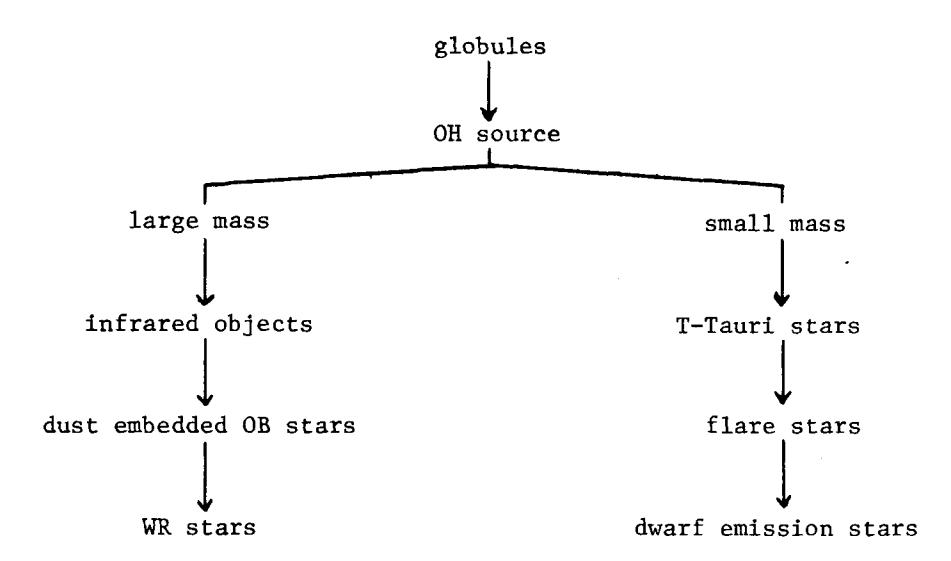
Also, compact HII regions and OH sources have been discovered. While infrared maps of the sky have also suggested an intimate connection between bright infrared stars and compact HII (ionized hydrogen) regions. Only observations in radio wavelength can detect these small condensation of gas. Scraml and Metzger (see Strom and Strom, 1973) have put forward an argument which explains that the bright infrared objects are extremely young HII objects just beginning their outward expansion from a newly formed O star or cluster of O stars.
On the contrary with the observations of objects at the earliest phase of their life-time, observations of objects of the quasihydrostatic phase are much more abundant. Clusters of ages in the order \(10^6-10^8\) years have been found. On of the objects in this second phase evolution is T-Tauri objects.
The nature of T-Tauri stars have been discussed by Kuhi (1970) and by Herbig (1970). The evidence which points to the basic conclusion that these stars are found objects, in the order of \(10^5-10^6\) years old, in the phase of quasistatic contractions are:
- i. They are associated with regions of gas and dust which are the most likely sites for recent star formation. They are often also found in clusters or associated with O and B stars which have been determined to be young by independent nuclear energy considerations.
- ii. They show unusually strong emission lines, irregular variability and mass loss all of which of suggest the presence of very active chromosphere. These activities die with age.
- iii. They posses high Lithium abundance. The presence of element lithium in a star indicates the star is a young object.
- iv. The presence of infrared radiation, is suggestive of an early evolutionary phase. The infrared radiation is caused by thermal emission from a disc of circumstellar dust, a by product of star formation, which is supported by centrifugal force. Moreover, T-Tauri stars fall in the part of the diagram of luminosity and color through which the contraction phase pass.
Herbig (1970 a) explains that the circumstellar regions may in fact be the site in which condensation of solid particles take place. The nebulae eventually is dissipated by radiation pressure and particle outflow from the star, leading one to expect a decrease in the degree of infrared excess.
The authors should like to thank Mr. Ocid Soemantri for his assistance and typing this manuscript.