

INTRODUCTION
Cold deformation process in metal working produces deformed or distorted structure in metal. This cold work struc-
*) This work was done at the University of Kentucky, U.S.A. **) Mechanical Engineering Department, Institute of Technology Bandung.
ture can be transformed back into normal structure by annealing. During the annealing, three processes occur, they are fecovery, recrystallization, and growth processes. The last two processes are accompanied by microstructural change, therefore they can be detected metallographically. While the first one, which is a nonstructural change process, is relatively difficult to determine.
In this work the temperature during which the recovery process occurs in \(\alpha\) Ag-Sn was determined by the use of X-ray diffraction method. From the X-ray peak shift the relation between stacking fault energy and tin content was analyzed. \(\sim\)
MATERIAL AND METHOD :
Materials
. .
Materials which were used in this work are 5 Ag-Sn alloys with 0.0, 2.9, 5.2, 8.1 and 9.9 wt % Sn.
Sample Preparation
The alloys were made by melting silver granules of 99.99% purity, then adding the required amount of 99.99% purity tin into it. Then ingots were made by remelting the alloys and casting them centrifugally into Vycor glass tube with 3.8 mm inner diameter. This procedure gave a dense, uniform and reproducible ingot structure.
The ingots were then homogenized at \(400^{\circ}\text{C}\) for 48 hours. During the homogenization process each ingot was sealed in an evacuated glass tube to minimize oxydation.
Experimental Method -
Cold deformation was introduced to the samples by filing homogenized ingots into chips. Chips of each alloy were then annealed at room temperature, \(100^{\circ}\text{C}\), \(150^{\circ}\text{C}\), \(250^{\circ}\text{C}\) and \(350^{\circ}\text{C}\) for one hour. One sample for each alloy was fully annealed at \(400^{\circ}\text{C}\) for 6 hours.
X-ray diffraction patterns of the samples, which cover (111) and (200) peaks were made and the differences in Bragg angle of the two peaks were measured. These X-ray diffraction patterns were made with \(Cu-K\alpha\) radiation on a General Electric diffraction unit.
RESULT AND DISCUSSION
The differences in Bragg or 29 angle between (111) and ner
(200) peaks, which will be designated with \(\Delta 2\theta\), were plotted against the annealing temperature. This relation is shown in Figure 1. This figure indicates that the value of \(\Delta 2\theta\) for the
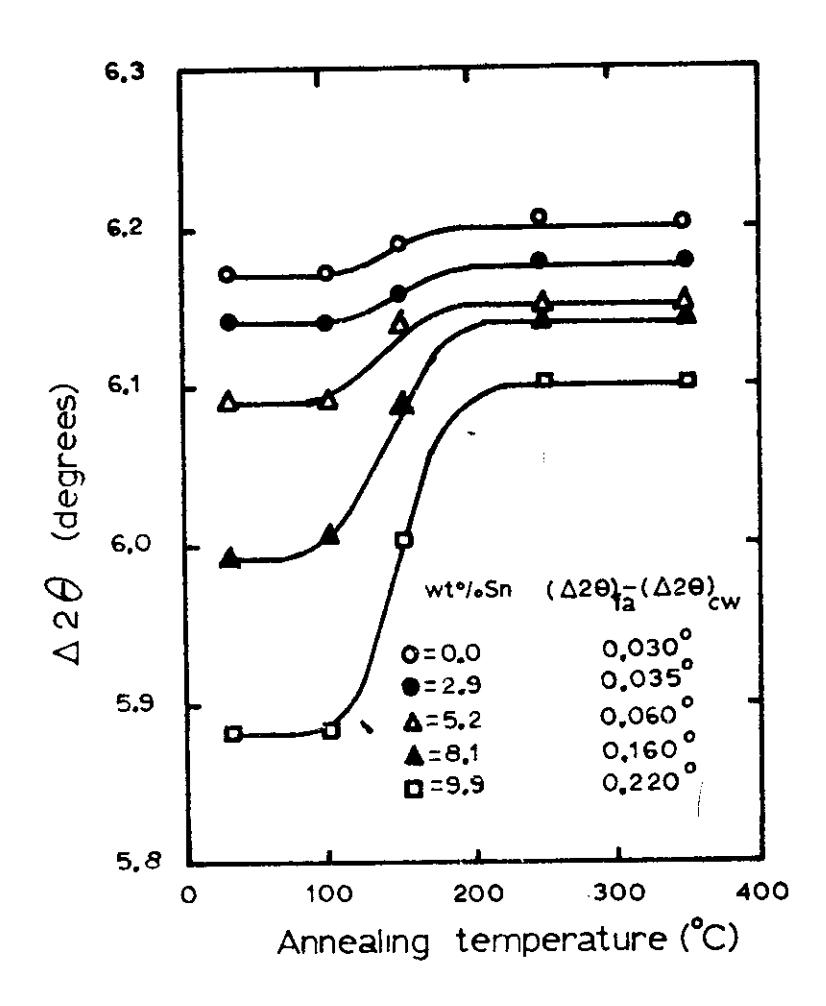
Figure 1 X-ray diffraction peak shift of cold-worked α Ag-Sn alloys
as cold worked and annealed samples are different. This phenomenon is explained in the following.
\(\alpha\) Ag-Sn alloy is a face centered cubic (FCC) metal. It has been known that in most FCC metal, plastic deformation is accomodated by slip between the slip planes. In FCC metal the slip plane i.s the (111-) plane and there are three dlfferently orlented slip planes, whl-ch are usually deslgnated a9 a, b and c, Therefore the stacking sequence of these sllp planes ln FCC netal is ..abcabc...etc. Further, lt aleo has been knou! that the atoDlc arrangeDent of the slip pLane iI hexagonal close packed (IiCP) oetal is exactly the aa$e as that of FCC neta1. The difference between these two atructure lies only on the stacking sequence of thelr slip plane, In HCP oetal the sequence ls .abab...etc.
Durlng the deformation, FCC oetal nay undergo a coaplete slip, a partial sllp or a Elxture of both of theE. In the case of conplete slip, the deforned roetal keeps its stscklng sequence, wh1le ln the case of partlal sllp the orlentatlon of the sltp plane changes rrlth respect to each other. Thls partlal sli.p therefore oay transforn plane a lnto b or c, plane b l-nto a or c and plane c lnto a or b posltlon, sothat., a b a b . . or HCP stacking sequence ltray appear In the deforned FCC Decal. This fault is caLled stacking fault.
From the above explanation 1t can be concluded that defornatlon nay transforo part of FCC Detal lnto HCP structure ln the forn of srackin; fault. consequently X-ray peak positldn of the deforrned FCC metal ElBht nove slightly toward the peak positlon of HCP netal. Thts peak shlfl is the A20' whlch vas detected and measured in this work.
Flgure I also lndlcates that the 420 value of the cold worked sanples changes abruptly toward the value of fu11y annealed saDple at tenperature between 1.00o and 200"C. Thts Deans that at this teEperature range the rolsplaced atoms Dove tosard the norDal FCC arrangenent. Thls atololc rearrangefrent ls the recovery process. So 1t can be concluded lhat ftled a Ag-Sn chips recover at a tenperature between 100' and 200'c. This result ls 1n agreement nlth that of Ne-ltton and n.rtf(I), ln whlch they found that defon0ed Ag-Sn wlth 9 at Z Sn starts to reco"er rapidly at 165"C. The stacklng fault probabillty lras calculated accordlng to the nathehaticat formulation develoPed by wtta"n(2). th. equation is as follow:
\[P = \frac{(\Delta 2\theta)_{c.w} - (\Delta 2\theta)_{f.a}}{(45\sqrt{3}/\pi^2) \left[\tan 2\theta_{(200)} + \frac{1}{2} \tan 2\theta_{(111)}\right]}\]
\ I I
P = stacklng fault probabillty c.v. = cold-vorked lrhere:
f.a. = fully annealed
The values of the calculated stacking fault probability for each alloy were then plotted as a function of the tin content. This relation is shown in Figure 2. From this figure
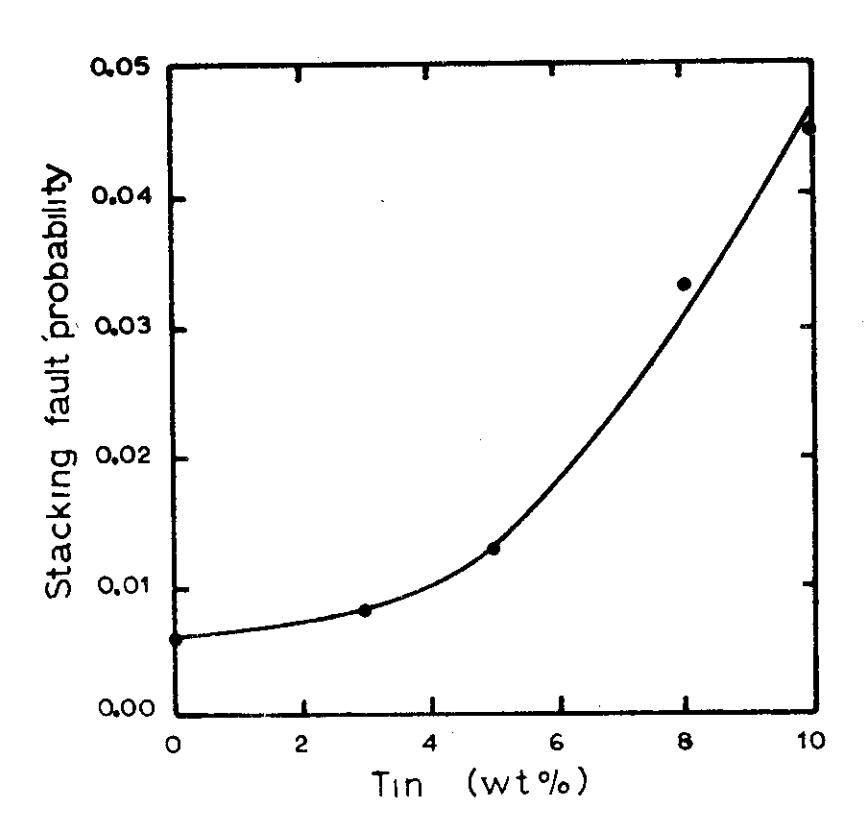
\(\label{eq:Figure 2} Figure \ 2\) Stacking fault probability of cold-worked \(\alpha\) Ag-Sn alloys as function of tin content
it is clear that the stacking fault probability increases with increasing tin content. So it can be concluded that the stacking fault energy decreases as the tin content in the alloy increases. This phenomenon is expected since tin content of more than \(10~\rm yt~\%\) will produce stable hexagonal close packed structure of \(\beta\) Ag-Sn alloy as indicated by the phase diagram of Ag-Sn system<sup>(3)</sup>. This result confirms the work of Ruff and Ives<sup>(4)</sup>, in which they used transmission electron microscopy to calculate the stacking fault energy of a Ag-Sn from the dislocation nodes.
CONCLUSIONS
- X-ray diffraction peak shift could be used to determine the recovery temperature of FCC metals.
- 2. Filed \(\alpha\) Ag-Sn chip recovers at a temperature between 100°C and 200°C.
- 3. The stacking fault energy in \(\alpha\) Ag-Sn alloys decreases with increasing tin content.