

INTRODUCTION
Properties of dental amalgam alloys as any other materials, depend on their compositions and the microstructure into which they form.
Dental amalgam alloys are generally considered to consist of \(Ag_3Sn\) or \(\gamma\) phase, although regions of "basket-weave pattern" or Widmanstatten microstructure are often observed in commercial chip alloy (1). A search of the literature revealed that Petrenko (2) and Murphy (3), on their work in determining the phase diagram of \(Ag_3Sn\) or \(\beta\) phase and no explanation for the structure near the \(Ag_3Sn\) or \(\beta\) phase and no explanation for the structure was offered. Murphy observed the structure and suggested that it resulted from rejection of \(\gamma\) on clevage planes of \(\beta\) during slow cooling. This logical interpretation was, however, confused by occurrence of somewhat similar hatchet markings for compositions both higher and lower in silver. Murphy believed these to be homogeneous and could not explain the markings.
The present metallographic study was undertaken to test Murphy's conclusions regarding \(\gamma\) rejection on cooling of \(\beta\) to form Widmanstatten, and to explain the origin and nature of the hatchet markings. It is expected that the results of this study could lead to systematic development of improved silvertin dental amalgam alloys.
MATERIALS AND METHODS
1. Materials and Material preparations
Three binary alloys of Ag-Sn system of 26.5 wt % Sn, 23.0 wt % Sn and 20.0 wt % Sn were prepared by resistance melting of 99.9 % purity Ag with 99.993 % purity Sn in graphite crucible and centrifugal casting into Vycor tubing to yield ingot with 5 mm in diameter and 50 mm in length. Tops and bottoms of cast and of homogenized ingots were examined in longitudinal and transverse metallographic section for structural uniformity. The silver and tin contents were determined by wet chemical analyses (4).
Commercial dental amalgam chip alloys were also examined in as received condition and after homogenization treatment.
2. Heat Treatments
Both the laboratory made and the commercial alloy specimens were sealed, under vacuum, in pyrex tubing and held for 48 hours at 400°C to homogenize their structure. One series of capsules were quenched into water to secure high cooling rate and a duplicate series was furnace cooled.
3. Metallographic preparation
The preparation of specimens for metallographic study was done according to the conventional methods, e.g.: setting each sample in cold moulded plastic followed by grinding, mechanical polishing and manual etching operations. The etching reagent used in this work was the modified Crowell's etchant.
RESULTS AND DISCUSSIONS
1. Ag-Sn Phase Diagram
The phase diagram for Ag-Sn system, which is currently accepted, is the one proposed by Murphy (3) in 1926, which is shown in Figure 1. This diagram is used for explaining the microstructures ovserved in this work. The
*) Modified Crowell's etchant: \(K_2^{Cr}_2^{O}_7\)
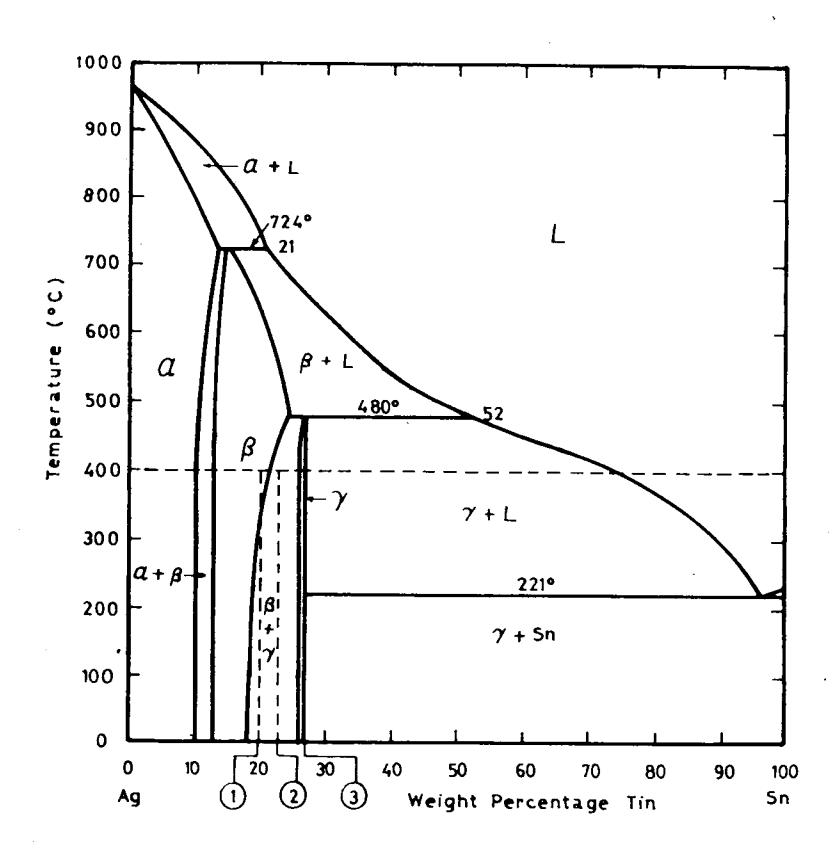
Figure 1. Phase diagram of Ag-Sn system Composition 1 is 20.0 wt % Sn alloy Composition 2 is 23.0 wt % Sn alloy Composition 3 is 26.5 wt % Sn alloy
composition of the laboratory cast ingots are indicated in this diagram.
In as cast condition, all specimens showed complex microstructures and shringkage porosity associated with the peritectic solidification. By homogenization treatment, simpler structure was obtained.
2. \(\gamma\) Phase or Ag\(_3\)Sn and the Hatchet Marks
The 26.5 wt % Sn alloy, intended as stochiometric \({\rm Ag}_3{\rm Sn}\) or \(\gamma\) phase, was uniform in structural appearance, regardless of cooling rate from the homogenizing temperature. The microstructures of the slow cooled and fast cooled sample are shown in Figure 2 and 3 respectively. Structure in Figure 2, reveals an array of "tire tread" or "hatchet mark" patterns. These marks, however, can be removed by polishing the specimen carefully and lightly with 0.05 micron alumina powder for 6 hours, which is relatively a very long operations compared to the conventional one.
From these facts it can be concluded that for \(\gamma\) phase the difference in cooling rare does not produce any structural differences. This fact is in agreement with the phase diagram. The hatchet marks, since they disappeared by prolong polishing, then they must be mechanical twins which form under slight plastic deformation during the sample grinding for the metallographic preparation. Associated with this twinning is a strong tendency toward intergranular cracking. These cracks appear to be the "wide grain boundaries" mentioned by Hume Rothery in the discussion of Murphy's paper (3)
3. Widmanstatten Microstructure
According to the phase diagram in Figure 1, both the 23.0 wt % Sn and the 20.0 wt % Sn alloys, at room temperature contain both \(\beta\) and \(\gamma\) phase. At homogenization temperature, which was 400°C, the 23.0 wt % Sn alloy contains also both phases, while the 20.0 wt % Sn alloy consist of \(\gamma\) phase only.
On fast cooling from the homogenization temperature, both alloys retain their high temperature microstructures. The 23.0 wt % Sn composes of \(\beta\) and \(\gamma\) phases as shown in Figure 4 and the 20.0 wt % Sn alloy consists of \(\beta\) phase only as shown in Figure 5. The dark phase of micrograph in Figure 4, which has a dendrite morphology, is the primary \(\beta\) phase. The lighter phase, which is the interdendritic fill, corresponding to the peritectic reaction of some of the primary with the liquid to form \(\gamma\) phase.
Figure 2. Microstructure of Y Furnace cooled from phase 400 "c; or ABrSn mag. 400 X
Figure 3. Microstructure of y phase or ABrSn Quenched in water frorn 400oC; rnag. 400 X
Figure 4. Microstructure of Quenched in r^rater vrt Z Sn a11oy 4OO"C; mag. 400 X 23.0 from
Figure 5. Microstructure of Quenched in water 20.0 wt 7J Sn a11oy from 400"C; mag. 400 X
The phase diagram shows that there is no change of tin content in phase region will occur with the changing of temperature, but it shows that the tin solubility limit of \(\beta\) decreases with decreasing temperature. Therefore during slow cooling, \(\beta\) phase will reject its excess tin in the form of \(\gamma\) precipitates. This precipitation takes place on a certain crystallographic plane of \(\beta\) phase to form a "basket-weave pattern" or Widmanstatten structure as shown in Figure 6 for the 23.0 wt % Sn alloy and in Figure 7 for the 20.0 wt % Sn alloy.
The Widmanstatten structures in Figure 6 and 7 show as many as three trace directions in a single grain. These multiple markings could not correspond to the single basal plane of the HCP - \(\beta\) phase. The reject planes must therefore correspond to prism or pyramidal planes of the parent \(\beta\) phase. Presumably the \(\beta\) - HCP and \(\gamma\) - orthorhombic lattices have a particularly good match across the crystallographic interface plane. With this explanation Murphy's interpretation of the structure is varified except for his suggestion that the rejection is along cleavage plane of the matrix.
4. Commercial Chip Alloys
Based on the above explanation a conclusion can be drawn that commercial chip alloys which have higher in Ag (or alloy equivalent) than \(\text{Ag}_3\text{Sn}\) and have been slowly cooled from homogenization temperature will exhibit regions of Widmanstatten as shown in Figure 8. Plastic deformation during chipping probably involves movement of dislocations across these interfaces, \(\beta-\gamma\), disorganizing the region of separation. As shown in Figure 9, the Widmanstatten pattern in chip alloy may be suppressed by fast cooling from the homogenization temperature. "Aging" of ingot chip alloy may be the rectification of unstable atomic configurations resulting from non-equilibrium cooling or plastic deformation.
Commercial alloys must represent some empirical balance between composition, homogenization schedule, plastic deformation and "Aging" to secure optimum manipulative and service characteristics in the amalgam restoration (5). Better understanding of the origin of structure should lead to systematic development of improved alloys.
CONCLUSION
1. "Tire tread" and "hatchet mark" patterns in homogenized
Figure 6. Microstructure of 23.0 wt % Sn alloy Furnace cooled from 400°C; mag. 400 X
Figure 7. Microstructure of 20.0 wt % Sn alloy Furnace cooled from 400°C; mag. 400 X
Figure 8. Microstructure of commercial alloy **) Furnace cooled from 400°C; mag. 400 X
Figure 9. Microstructure of commercial alloy *) Quenched in water from 400°C; mag. 400 X
*)Traced from prints
- \(\gamma\) Ag<sub>3</sub>Sn are deformation twins which result from plastic deformation in the early stages of metallographic preparation. The "wide grain boundaries" also reported by Murphy (3) are intergranular cracks caused by mechanical stresses.
- 2. The microstructure of \(\beta+\gamma\) alloys depends on cooling rate from the homogenization temperature. These differences should have their counterpart in manipulative and service behaviour of amalgams.
- 3. The Widmanstatten structure is formed during the slow cooling of \(\beta\), which is supersaturated with \(\gamma\), from the homogenizing temperature. During this slow cooling process \(\gamma\) is rejected and precipitates on favored crystallographic planes of the \(\beta\) parent lattice to generate the Widmanstatten structure.
- 4. Commercial chip alloys must have higher in alloy equivalent Ag than the stochiometric Ag<sub>3</sub>Sn or γ, which make them capable of producing Widmanstatten structure.
ACKNOWLEDGEMENT
This work was supported, in part, by the United States Department of Health, Education and Welface, National Institutes of Dental Research grant DE - 02147, Bethesda, Maryland. Mr James Tingle, student in Metallurgical Engineering at the University of Kentucky assisted in the laboratory work.
REFFERENCES
- Smith, D. L., Ferguson, G. W. and Schoonover, I. C.: "Microstructure of Dental Amalgam", J. Am. Dent. Asoc., 47, p 305 - 311, 1953.
- 2. Petrenko, G. J.: "Uber die Legierungen des Silbers mit Blei und Zinn", Z. anorg. Chem., 53, p 200 211, 1907.
- 3. Murphy, A. J.: "The Constitution of the Alloys of Silver and Tin", J. Ins. Met., 35, p 107 129, 1926.
- Kendall, T. A., Sohl, G. H. and Mateer, R. S.: "Analytic Procedures for Determination of Silver, Tin, Mercury, Copper and Zinc in Dental Amalgams", J. Dent. Res., 50, p 378 - 381, 1971.
5. Wirjosumarto, H. and Mateer, R. S.: "Microstructural Differences in Spherical and Chip Ag-Sn Dental Alloys", J. Dent. Res., January - February, 1973.
(Received 5<sup>th</sup> February 1976)