

1. Introduction
Recent solar radiation data (1975) in different parts of Malaysia (Kuala Lumpur, Penang and Kota Bahru) indicates that solar energy arrives at the surface of Malaysia at a rate of about 420 cal/cm<sup>2</sup> per day. This works out to be about 1550 BTU/ft<sup>2</sup> or 5 KWH/m<sup>2</sup> per day. The average number of bright sunshine hours is 6 (see Fig. 1). Early data (1961 - 1967) recorded in Singapore as reported by Chia<sup>1</sup> was 404 cal/cm<sup>2</sup> per day and the number of bright sunshine hours was 5.57. Thus, there is little difference in solar insolation in different locations of Malaysia, as indicated in Table I.
Table I. Recent solar radiation data 1,2
| Kuala Lumpur | Penang | Kota Bahru | Singapore | |
|---|---|---|---|---|
| Year of Data | 1975 | 1975 | 1975 | 1961 - 67 |
| Solar insolation, cal/cm2 average per day | 418 | 439 | 407 | 404 |
| Hours of bright sunshine average per day | 5.95 | 6.20 | 6.39 | 5.75 |
The total electrical power consumed in Malaysia in 1974 was 4.62 x 10 KWH. Thus, one square mile surface area of Malaysia receives on the average in one year the equivalent of all the electrical power needed in Malaysia. At 10% conversion efficiency, 10 square miles (0,02% of the land area of peninsular Malaysia) could produce the amount of electrical energy Malaysia consumed in 1974. With an area of about 50,000 square miles, peninsular Malaysia itself thus has abundant energy that can be tapped for useful purposes. Unfortunately, technical difficulties in harnessing this energy still abound and it will be quite sometime before an economical and efficient system could be developed to harness this vast amount of energy for all of man's requirements.
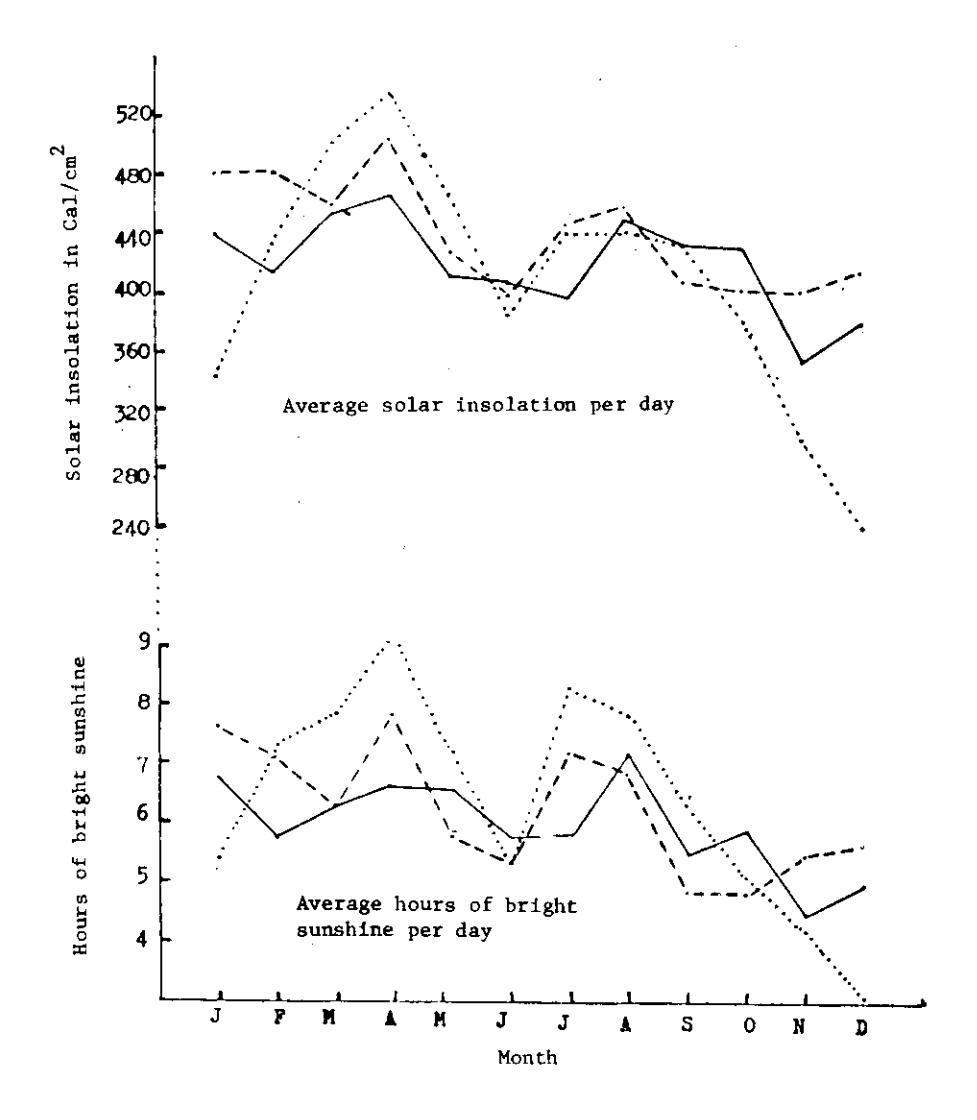
Fig. 1. Solar radiation data for Kuala Lumpur, Penang, and Kota Bahru for the year 1975. (Kuala Lumpur ———, Penang ---—, Kota Bahru .....)
2. The need for solar drying
Solar drying of crops has been practised since the beginning of agriculture. It is one of the largest direct uses of solar heat. The removal of moisture requires only low-temperature which can be readily supplied by solar radiation. present, a large portion of the world's supply of dried crops are sun-dried in the open, unprotected from unexpected rains, wind-borne dirt and dust. The rate of drying depends very much on weather conditions and the quality of some crops may be seriously degraded as a result of slow dehydration. view of this, perhaps, greater use of solar radiation by means of a simple solar drying equipment can be used to hasten agricultural drying, reduce spoilage and improve quality of products. Of course due consideration should be given to the aspect of cost versus effectiveness and benefit when such solar drying equipment is developed. Greater speed of drying and improved quality of products could justify the extra expense of solar drying equipment.
3. Solar drying equipment
The solar drying equipment consists of a flat plate thermal collector, a thermal storage system and a drying bed.
3.1. Flat Plate Thermal Collectors
The flat plate thermal collector has proved to be quite an efficient solar thermal collector capable of providing a temperature of about 150°F above ambient at 30 - 50% collector efficiency 4,5,6. Two types of flat plate collectors are described here, one using water as a heating medium (here called collector I) and another using air as a heating medium (collector II). Both collectors consist of four panels each, connected in parallel. Cross-sectional design for a panel in collector I is shown in Fig. 2. It consists of a wooden frame \((4\frac{1}{2} \text{ ft x } 2\frac{1}{2} \text{ ft x } \frac{3}{4} \text{ ft)}\) with a flat, black absorber plate inside with an area of 4 ft by 2 ft. This black absorber heats up the running water underneath, which circulates around the collector and storage system I via a 1 inch diameter piping system. The back insulation consists of 6" of sawdust and the side insulation 3" of sawdust. The two glass cover plates are 1/8" plate glass. A 1" air gap separates the two glass cover and inner glass cover from the collector plate. The design for a panel in collector II is shown in Fig. 3. Corrugated zinc sheet (painted black) is used to heat up incoming air which then flows beneath the zinc sheet to be heated again before going out to the storage system II. A fan is used to assist air circulation.
3.2. Storage Systems and Drying Bed
A thermal storage system is used to store excess unused solar energy during periods of surplus sunshine for use at night and cloudy or rainy days. It could thus provide 24 continuous hours of heated air supply, or even 48 hours to take care of a cloudy or rainy day, depending on the size of the storage system.
Storage system I employs a 100 gallon water tank with a galvanised piping system connected to Collector I. To prevent heat loss due to reverse flow through the flat plate collector (black body radiation) at night time the two taps near the storage tank are closed at night to stop water circulation. Otherwise, this circulation would conduct away heat from the storage system to the flat plate collector. Atmospheric air is heated inside the storage tank before being sent to the drying bed. A fan is provided to regulate the flow rate and temperature of the heated air.
Storage system II uses a packed-bed of dry rocks to store the solar heat which is then passed to the dryer. A fan is again provided here. Both storage system are provided with 3" to 6" of sawdust insulation. Larger storage systems are required if more heat is to be stored.
The crop to be dried is placed in a batch drier, shown in Fig. 6. These systems are simple, moderately inexpensive and can also serve as storage units after drying is completed.
4. Performance of the equipment
The flat plate collector using water as the transport fluid (collector I) has been simulated on the U.P.M. PDP 8/e computer. An average of \(420 \text{ cal/cm}^2\)-day (horizontal surface) was broken up into hourly contributions using data from Corty 7. The total energy gain of the system is
\[Q_{T} = Q_{U} - Q_{S} - Q_{L}\]
Fig. 2. Flat plate collector I (water as medium)
Fig. 3. Flat plate collector II (air as medium)
Fig. 4. Storage system I
Fig. 6a. Batch drier
Fig. 5. Storage system II
Fig. 6b. Batch drier where \(Q_U\) is the net energy gain of the collector, \(Q_S\) is the loss from the storage tank, and \(Q_L\) is the load. The solar insolation received by the collector, S, was adjusted for tilt of the collector (10°), movement of the sun (factor R), and losses due to transmission through the glass covers, dust, and reradiation back to the atmosphere (factors \(\tau\alpha\)) (Duffie and Beckman \(^4\)):
\[S = HR T\alpha\]
(where H is the hourly radiation per area received on a horizontal surface). The net gain by the collector is
\[Q_{U} = (Area of collector) F_{R} (S - U_{L} (T_{p} - T_{a}))\] where \(\mathbf{F}_{R}\) is the collector efficiency factor; \(\mathbf{U}_{L}\) is the loss due to reradiation and conduction through the insulation; \(\mathbf{T}_{p}\) is the collector plate temperature; and \(\mathbf{T}_{a}\) is the ambient temperature.
The loss of heat in the storage tank,
\[Q_S = (Surface area of tank) U_S (T_S - T_a)\] was by conduction through the insulation (factor \(U_s\)).
The load on the system is
\[Q_L = \dot{m} C_{p,air} (43^{\circ}C - T_a)\] where \(\dot{\mathfrak{m}}\) is the mass flow rate of air, and C is the specific heat. The new temperature of the water in the storage tank is calculated from
\[T_{s,new} = T_{s,old} + Q_T/(M_s C_{p,water})\] where \(\rm M_{_{\rm S}}\) is the mass of water in the tank (453 kg).
For an air flow of 0.57 mph (average load of 85 watts or 7.3 cal/hr) the simulated system took \(1\frac{1}{2}\) days to heat the water to 43°C, and then could sustain the load through the night. After the third day (all three days with and average of 420 cal/cm day insolation), there was enough heat in the storage tank to enable the system to operate through another day without sunshine (cloudy or rainy day). For an air flow of 1.14 mph (170 watts) the model could function overnight, but could not store enough heat to last through a cloudy day. A moderate load of 0.67 mph (100 watts) could be sustained through a sunless day only after three consecutive days of sun (420 cal/cm day). Fig. 7 shows the simulated storage tank temperature for the above three loads.
5. Potential applications
Table II shows the main Malaysia crops that need drying. Except for tea withering and sheet rubber smoking, most of the crops are sum-dried traditionally in the open on a concrete floor, mat, or zinc sheet. This is slow, laborious, demanding of space or land and very much dependent on weather conditions. A simple solar drying apparatus providing hot air at 100°F to 140°F continously over a 24 hours basis will certainly reduce some of these problems, hasten the rate of drying, reduce spoilage and improve crop quality. It serves as a good suppliment to natural sun-drying and mechanical drying. In the case of tea withering and rubber sheet drying, there is an obvious economic advantage for this solar drying equipment as fuel costs can be lowered. In addition to the crops mentioned, this equipment can also be extended for use in seed drying and the drying of salted fish and shrimp.
6. Conclusions
There is a tremendous amount of solar energy in Malaysia that can be tapped for crop drying. Equipment including a flat plate collector and a thermal storage system providing circulating preheated air can be a simple and yet effective way to speed up solar dehydration of crops. A stream of heated air with low relative humidity (compared with ambient air) is passed through the crops to remove its high water content. Such an equipment has good potential to serve as a suppliment
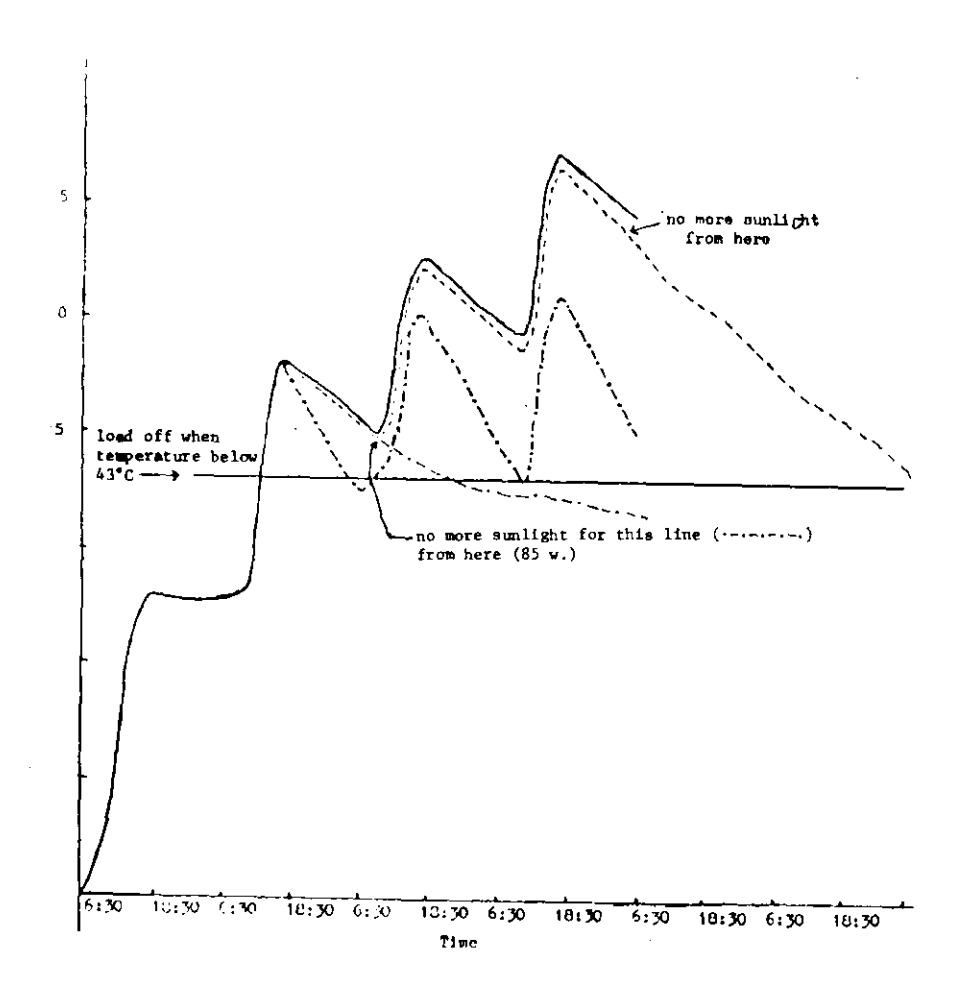
Fig. 7. Simulated storage tank temperature for three different loads. (-----------------------------------
Table II. Main Malaysian crops that need drying \(^{8}\) - \(^{15}\)
| Crop | Present drying conditions | Optimum drying conditions |
|---|---|---|
| 1. Padi | Mostly sun-dried, some using artificial dryer. | 110°F to 130°F gives the best milling yield. Actual drying time reduces by 50 to 66% using artificial heat compared to the case of natural sun-drying. Moisture content reduces from 22% to 13% - 14%. |
| 2. Rubber | "Smoking" by smoke from burning fire- wood or hot air from burning fuel. | Hot air/smoke under 120°F for 4 days. |
| 3. Tea | Tea Withering by a slow moving hot air generated by burning fuel. | 100°F for a few hours. |
| 4. Groundnut | Sun-dried on zinc sheet or mat. | \(120^{\circ}\text{F} - 140^{\circ}\text{F}\) for 24 hours to reduce moisture content from 25% to \(10\%\). |
| 5. Tapioca chips | Sun-dried. | Not available. Hot air drying will certainly hasten drying process. |
| 6. Coffee | Mostly sun-dried, there is a general tendency to use artificial dryers. | 104°F for 24 hours, 122°F for 4 to 10 hours and 140°F for 1 hour without damage to flavour. |
| 7. Cocoa | Sun-dried for 6 - 7 days. | Hot air at \(135^{\circ}F - 140^{\circ}F\) at \(30 - 35\) ft/min for \(10 - 18\) hours, followed by \(12\) hours resting and final high temperature rate of \(180 - 185^{\circ}F\) for \(24 - 30\) hours. |
to the present methods of drying many Malaysia's agricultural products.