

a. Absorption of <sup>32</sup>P by rice seedlings (Pelita I/1)
The specific activities of <sup>32</sup>P (Carrier free) applied to the two week old seedlings were 1, 2, 4, 6, 8, 10, 15, and 20 uci/cc. The radioactivity count of hoppers and leaf tips were made 48 hrs. after submersion of the seedlings in the radioactive solution.
b. Absorption of <sup>32</sup>P by BPH
The radioactive seedlings were offered to BPH after being washed thoroughly with water. A single BPH is fed on a single rice seedlings kept in a glass tube. Count of the whole body and dissected gonads were made 24, 48, 72, and 96 hours after feeding. Sterility effects were observed from the mating of <sup>32</sup>P treated hoppers.
ABSTRAK
Radioisotop <sup>32</sup>P telah dipergunakan secara luas dalam bidang ekologi dan fisiologi serangga. Telah diketahui secara luas bahwa <sup>32</sup>P merupakan salah satu dari beberapa isotop yang telah dipergunakan untuk penandaan serangga guna menunjang studi migrasi, pengambilan cairan tanaman ataupun ekskresi dari serangga penghisap ataupun studi tentang transfer dari sperma.
* Research Centre for Nuclear Tehniques, Bandung. Departement of Biology-ITB, Bandung.
Di dalam ruang lingkup Teknik Serangga Mandul, studi dari pengambilan <sup>32</sup>P oleh gonad dari wereng coklat (Nilaparvata lugens Stal) dapat mempunyai arti penting mengingat bahwa produk ini merupakan salah satu hasil yang mudah diperoleh dari PPTN dan mempunyai prospek yang baik sebagai sumber sterilisasi internal mengingat pengaruh akumulatipnya.
Berikut adalah hasil penelitian tentang pengambilan 32P oleh seluruh tubuh dan gonad wereng setelah diberi makan benih padi yang radioaktip.
a. Absorbsi <sup>32</sup>P oleh benih padi (Pelita I/1) Aktivitas jenis dari <sup>32</sup>P (bebas pengemban) yang dipergunakam untuk penandaan benih padi berumur 2 minggu adalah 1,2,4,6,8,10,15 dan 20 uci/cc. Pencacahan terhadap ujung daun dan wereng dilakukan setelah akar benih padi direndam dalam larutan radioaktip selama 48 jam.
b. Absorbsi 32P oleh wereng coklat
Benih padi yang telah radioaktip diumpankan kepada wereng coklat setelah dicuci
bersih dengan air suling.
Satu wereng coklat dewasa diberi makan satu benih padi di dalam sebuah tabung kaca. Pencacahan dari tubuh dan gonad wereng yang telah dikeluarkan dilakukan 24, 48, 72, dan 96 jam setelah makan. Efek pemandulan diamati dari perkawinan wereng yang telah mendapat perlakuan <sup>32</sup>P.
INTRODUCTION
The Advisory Group on the use of Isotopes in Pest Management (Joint FAO/ IAEA, Bangkok, 1976) stressed the necessity to study BPH from the aspects of biotopes and resistency, dispersal, prey/predator and pesticide resistance. A study on the effect of <sup>32</sup>P on the insects sterility could give important information on bionomy of this pest which may lead to the use of <sup>32</sup>P as an internal irradiation source.
Research on the effects of gamma radiation on the development and reproduction had also been done (1).
Within the scope of sterile Insects Tehniques, the study on the uptake of <sup>32</sup>P by brown planthoppers gonads and its sterility effect could be important to support the effort to control this insect.
Aside from the fact that <sup>32</sup>P has been one of the most available products of the Centre, this study will be useful for the study of sperm transfer, food uptake and also as a possible source for sterilization due to its accumulative effects (2).
Materials and Methods
a. <sup>32</sup>P intake by females and males
Rice seedlings (Pelita I/1), 15 days old, as much as 50 per batch were dipped into 50 cc aquadest containing KH<sub>2</sub> <sup>32</sup>PO<sub>4</sub> (carrier free) with the following
specific activities: 0.5; 1.5; 2; 4; 6; 8; 10; and 20 uci/cc. After 24 hrs., the seedlings were removed from the solution and washed throughly with aquadest. Tagging of the hoppers was done individually within a glass tube (2 x18 cm) containing a single radioactive rice seedling. The total number of tubes used were 50 tubes for male and 50 tubes for female hoppers. After 48 hrs., the hoppers were anesthetized and dried within an oven for 4 hrs. at 80°C. Leaf tips of the seedlings were also prepared the same way. Counting was done with a GM counter for a duration of 1 minute per sample.
b. Gonadal intake <sup>32</sup>P
The same procedure was used for this study but with higher specific activities of <sup>32</sup>P, namely 1, 100 and 200 uci/cc.
Gonads were taken in Ringers solution, dried and counted.
Observations were also made on the longevity of the treated female and male hoppers. Feeding periods were 24, 48, 72 and 96 hrs.
Results and discussion
As expected, the increase of the specific activity of the <sup>32</sup>P given to the seedlings produced increased radioactivity of the rice seedling as counted from the leaf tips. It was apparent that the radioactivities of the hoppers depended on the radioactivity of the food given. For tagging purposes, the specific activity of <sup>32</sup>P as large as or even lower than 10 uci/cc will give satisfactory results. It is an interesting case that female hoppers absorbed more radioactive materials from the rice seedlings than males (Fig. 1). We are looking forward to see the prospect
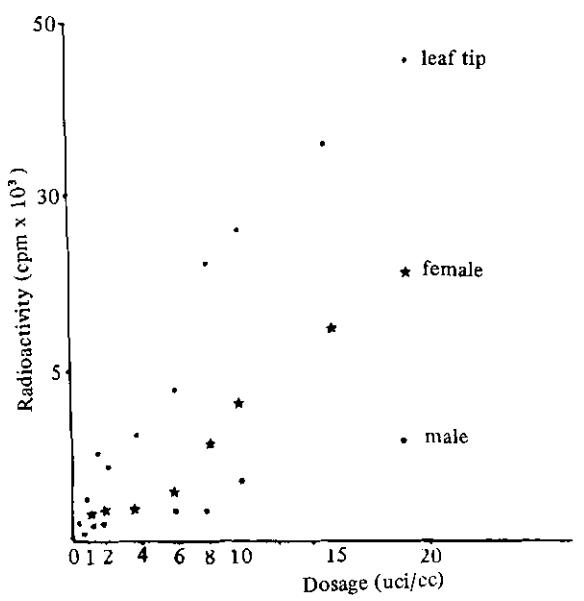
Fig. 1. Relationship between leaf tip <sup>32</sup>P absorption and the uptake by male/female body count of BPH
of using this internal radiation as a source to sterilize BPH in the field especially for the females. For comparison, we can quote Hasset and Jenkins (3) experimental result on mosquitoes tagging. For a concentration of <sup>32</sup>P in water of 0.1 uci/cc, females took up three times as much as males and averaged 15.858 counts/minute each which was 75 times the specific activity of the medium.
In the hoppers case, the radioactivity of the whole body and gonads do not exceed the rice seedlings <sup>32</sup>P concentration within 48 hrs. of contact. With low specific activities of <sup>32</sup>P, the <sup>32</sup>P uptake by hopper gonads are low.
Therefore higher specific activities are used for the gonadal uptake study (100 and 200 uci/cc).
Since the work had not been entirely completed, only the results of the female hoppers could be forwarded here (Table 1, Fig. 2).
| Table 1. The average of 32P by 2 | 20 female brown planthoppers from rice seedlings within a |
|---|---|
| contact time of 48 hrs. |
| 32P | Time of feeding after single 32P application | Radioactivity (cpm) | |
|---|---|---|---|
| application (uci/cc) | Whole body | Gonad | |
| 100 | 24 | 3488 ± 158.6 | 483 ± 141.2 |
| 48 | 6913 ± 103.2 | 2892.± 3,2 | |
| 72 | 8838 ± 128.9 | 4607 ± 136.8 | |
| 96 | 6139 ± 102.3 | 1331 ± 49.9 | |
| 200 | 24 | 9959 ± 674.2 | 647 ± 13.6 |
| 48 | 16 669 ± 345.7 | 8994 ± 45.7 | |
| 72 | 30 966 ± 119.9 | 8738 ± 244.8 | |
| 96 | 11 741 ± 163.9 | 4895 ± 109.1 | |
Single application of <sup>32</sup>P to the medium of rice seedlings produced optimal results of hoppers absorption during 72 hrs. The declining condition of the single rice seedlings offered to the hopper may have caused the decrease of sap uptake. From the aspect of control effort, the results of the study on sterility and longevity could be interesting (Table 2).
It was our aim to come to a conclusion on the sensitivity of brown planthoppers gonads towards the uptake of <sup>32</sup>P, such as the work of Robertson (2) on scale insects although in the latter case the aim was on the aspect of safe insect tagging.
Because <sup>3 2</sup>P had been one of the most important and available products of the Centre, this basic sterility study on BPH was expected to have an important impact on the local conditions.
Histological study on the gonads have not shown any significant visible changes, although adverse changes had been on house flies fed with milk containing the enormous dose of 0.23 uci <sup>3 2</sup> P per gram (4).
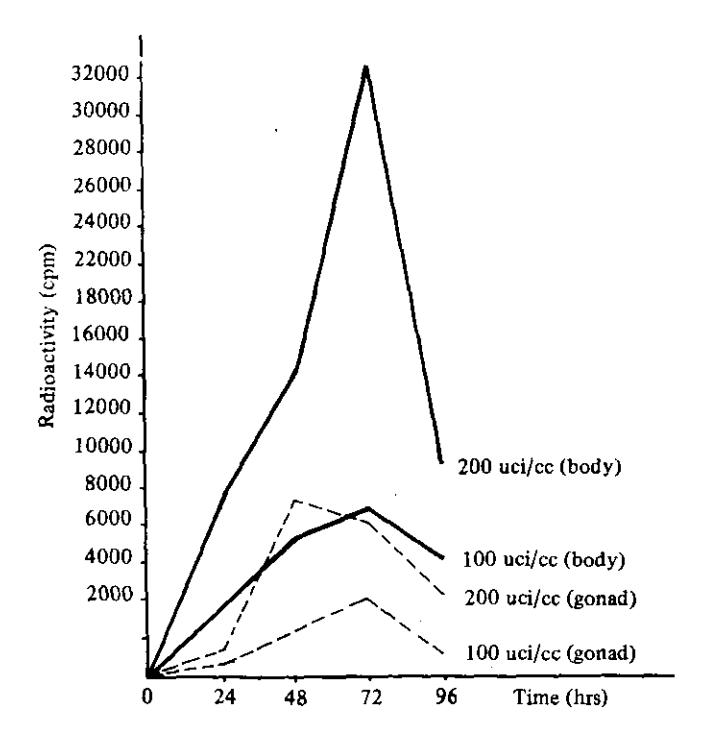
Fig. 2. The uptake \(^{32}\) P by brown planthopper body and gonad.
Table 2 Effect of <sup>32</sup>P absorption on hoppers fertility and longevity. Note: a = irradiated males X unirradiated females; b = unirradiated males X irradiated females.
| Adults longivity (day) | |
|---|---|
| Female | |
| 17.0 ± 2.1 | |
| \(17.8 \pm 4.0\) | |
| 11.6 ± 3.95 | |
| \(15.6 \pm 3.5\) | |
| \(5.4 \pm 0.9\) | |
- 1. BABERS, F.H., ROAN, C.C., Distribution of Radioactive Phosphorus in Susceptible and Resistant Houseflies, J. Econ. Entomol., 47 (1954) 973.
- 2. HASSET, C.C., JENKINS, D.W., Uptake and Effect of Radiophosphorus in Mosquitoes, Physiol. Zool., 24 (1951) 257.
- 3. MOCHIDA, O., Effect of gamma radiation on the development & reproduction of the brown planthopper, N. lugens (S) (Hom., Delphacidae), Appl. End., Zool., 8 (1973) 113.
- 4. ROBERTSON, G., The sensitivity of scale insects to <sup>14</sup>C particles and to <sup>60</sup>Cy-rays, Int. J. Radiat. Biol., 23.