

SARI
Telah dilakukan penelitian pengaruh perubahan suhu air terhadap pernapasan ikan mas, Cyprimus carpio L. Pengukuran penggunaan oksigen dilakukan dengan teknik air mengalir. Ikan yang dipakai dalam percobaan ini diaklimatisasikan pada suhu 20°C. Hasil percobaan menunjukkan bahwa kenaikan suhu air hingga 30°C menyebabkan pertambahan penggunaan oksigen pada ikan.
* This work was carried out at the Institute of Hydraulic Engineering, Delft, The Netherlands
** Lecturer, Dept Biology, FMIPA, Institute of Technology Bandung
1 Introduction
Toxicity values for aquatic pollutants determined by standard bioassay are frequently used to asses the industrial wastes and other pollutants. Measurement of physical parameters such as temperature, pH, BOD, COD together with toxicity values were often used to define acceptible effluent and stream quality standards.
Biological assessment should also become an important role for determining these standard values. Accurate and sensitive control techniques are urgently required to measure threshold levels. Alteration of metabolic activity of an organism may occur due to environmental stresses (O'Hara, 1968). Fish respiration rate can be used as a measure of metabolic activity of the organism. A precise technique for measuring oxygen consumption rate of a fish should therefore be established.
In this study, respiration of carp exposed to different water temperatures were observed, using the modified respiration apparatus introduced by O'Hara (1971).
The objective of this experiment is to develop an apparatus for measuring fish activity based on respiration rate, influenced by several kinds of pollutants.
2 Materials and methods
2.1 Preparation of test fish
Carp (Cyprinus carpio L.) was used as experimental fish, they were purchased from a fish farm in Lelystad, North of Holland. Fish stocks were kept in a small pond at the Biological Laboratory of the Institute of Hydraulic Engineering, Delft. Fishes used for the experiment were kept and acclimatized in an aquarium at 20°C and placed in the laboratory. They were fed regularly three times a week with commercial fish food. During the observation food was not given to the test fish. Each fish used has a body weight of less than 25 grams to ensure that it can move freely in the test chamber.
2.2 Experimental design
Equipment used in this experiment consist of: reservoir flask \((E_1)\), effluent flask \((E_2)\), fish chamber (FC), air lifting pump (ALP), oxygen meters and recorders (Fig. 1). Water from the reservoir flask was run through the fish chamber to the effluent flask and delivered back to the reservoir flask by using an air lifting pump (ALP). The water circulation was constantly run by means of steady air pressure through an air pressure controller (APC). The fish chamber and effluent flask were fully filled with water and free from air bubble. To maintain the water at a desired temperature the fish chamber was placed in a waterbath. The oxygen content in the reservoir flask and effluent flask was measured separately by using two different Dissolved Oxygen Meters (Model Equation experiment)
15A Electronic Instrument LTD, Surrey, England) and each were connected to a one-chanelled recorder. When the rate of flow is known, then the difference of the oxygen content in the reservoir flask and effluent flask is the oxygen consumption of the test fish in the fish chamber.
2.3 Experimental procedure
After the oxygen meters were calibrated, adjustment should be done. Oxygen probe no. 1 (P<sub>1</sub>) and no. 2 (P<sub>2</sub>) were immersed into the water in the reservoir flask and effluent flask respectively. In the first step water was circulated without any fish in the chamber. After some time the two meters should indicate the same readings. If necessary correction on the oxygen meter reading and adjustment on the position of the probe no. I should be done. For each observation only one fish was placed in the fish chamber. The fish chamber was covered to avoid interference from moving objects and other activities outside the chamber. The test fish was allowed to adapt for one night before the measurement. The flow rate was adjusted so that the oxygen content reading between the reservoir flask and effluent flask at the same time was significantly different. The measurement was conducted within four hours a day during daytime. During the period of observation the experimental fishes were kept in the chamber for several days. Circulation flow rate was measured by means of a graduated cylinder placed close to the outflow. During the flow rate measurement water was caught into the graduated cylinder. The water level in the reservoir flask was maintained by adding water from the tap at the same rate as the outflow.
2.4 Calculation
The respiration rate of the fish:
\[\frac{\Delta DO (mg. 1^{-1}) \times Q (1. hr^{-1})}{bw (gr)} = A (mg. hr^{-1} . gr^{-1})\]
\(\Delta\) DO (= DO<sub>E<sub>1</sub></sub> - DO<sub>E<sub>2</sub></sub>): the difference between the oxygen content in E<sub>1</sub>
and E<sub>2</sub>
Q : the water circulation flow
bw : the fish body weight
3 Results and discussion
During acclimatization all fishes were alive. They give no symptoms of disease or abnormalities and were considered suitable for laboratory experiment.
The apparatus design for this experiment is very sensitive. Fluctuation of dissolved oxygen as small as one percent saturation could be recorded. The air lifting pump used has two advantages; first, it pushes the water upward to the reservoir flask, secondly the pressurized air causes the water in the reservoir flask to become saturated with oxygen. Total volume of water used in this model was not more than four liters: two liters in the reservoir flask \((E_1)\), less than one liter in the fish chamber and one liter in the effluent flask \((E_2)\).
During a period of observation (four hours a day) the respiration rate of the fishes tested was not constant even though it was measured at a constant temperature (Table 1). The oxygen consumption tended to decrease during the following days—when compared with that of the first observation days (Fig. 2). This was also mentioned by Waiwood and Johansen (1974) in his investigation on White Sucker, namely that the oxygen consumption of untreated fish gradually decreased during the first twenty-four hours of their experiment.
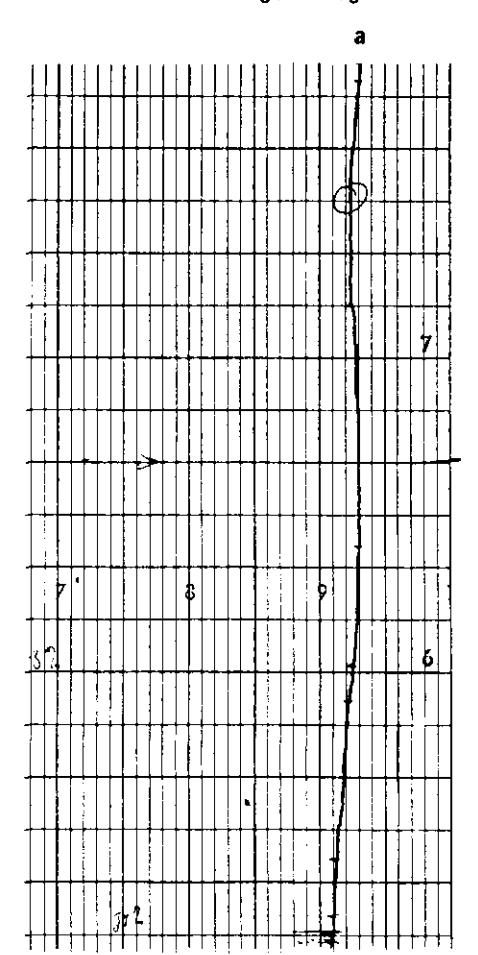
Higer respiration rate was recorded on higher water temperature (26°C – 30° C) comparing with that of lower water temperature \((20^{\circ}\text{C} - 25^{\circ}\text{C})\)(Fig. 3). Jones (1964) mentioned that, at rest as well as in activity the oxygen consumption of a fish increased rapidly as the temperature went up. The increase of water temperature caused depletion of oxygen content and might influence the oxygen consumption of a fish. In this experiment water in the reservoir flask was almost saturated with oxygen due to the airation by the air lifting pump, so that the increase of fish respiration was directly influenced by the increase of water temperature. The high water temperature caused the test fish to be restless and tried to move away from the unfavourable condition. O'Hara (1968), found that in Sunfish the increase in oxygen consumption rates was due to the increase of water temperature and greater response was shown by larger fishes. Carps which were originally acclimatized to 20°C were able to survive for at least four hours in water of about 30°C, but the oxygen consumption was high and irregular (Fig. 3 and Fig. 4). Schaumburg et al. (1967) in his investigation on the influence of pollutants on fish, found respiratory irregularities and fluctuation on Coho Salmon exposed to some pollutants. The avoidance of test fish against high temperature was shown by the increasing and irregularities of oxygen consumption. One of three fishes tested at high water temperature (29°C) collapsed during observation, but recovered gradually when transfered immediately to ambient water temperature of 20°C. It seems that 30°C was the optimal temperature for the test fish to survive and temperature higher than 30°C was most likely lethal. Cherry et al. (1977) found that the upper lethal temperature limit for 15 fish species ranged between 24°C to 36°C. He also mentioned that the upper avoidance temperatures increased with rising acclimation temperature, but the difference between upper avoidance and the acclimation temperatures was greater at cold than at warmer levels of acclimation temperatures.
When the water temperature was lowered from 29°C to 22°C the respiration rate of the test fish decreased (Fig. 5).
It could be concluded that this apparatus is sensitive enough to measure fish
activity based on respiration rate, influenced by several kinds of pollutants. Circulation-flow technique used in this model is to minimize water sample required. By this procedure a great deal of observations on fish activity can be furnished.
4 Acknowledgments
The author wishes his gratitude to Prof. dr. ir. J. W. M. la Riviére and Dr. J. Klein for their supervision and also to the Institute of Technology Bandung for giving the opportunity to study at the Institute of Hydraulic Engineering, Delft, The Netherlands.
5 References
- 1 Cherry, D. S., K. L. Dickinson, J. Cairns Jr. and J. R. Stauffer, 1977, Preferred, avoided and lethal temperatures of fish during rising temperature conditions, J. Fish. Res. Board Can., 34, 239-46.
- 2 Jones, J. R. E., 1964, Fish and river pollution, Butterworth, London.
- 3 O'Hara, J., 1968, The influence of weight and temperature on the metabolic rate of sunfish, Ecology, 49, 159-61.
- 4 O'Hara, J., 1971, A continuously monitored respiration chamber for fish, Water research, 5, 143-5.
- 5 Schaumburg, F. D., T. E. Howard and C. C. Walden, 1967, A method to evaluate the effect of water pollutants on fish respiration, Water research, 1, 733-7.
- Waiwood, K. G. and P. H. Johansen, 1974, Oxygen consumption and activity of the white sucker (Catostomus commersoni) in the lethal and non-lethal levels of the organochlorine insecticide, methoxychlor, Water research, 8, 401-6.
Table 1. Respiration rate of Cyprinus carpio L. on different water temperature.
| Date | Sample no. | Body Weight (gr) | Time Obsr. | Ave. (4 hrs) resp. rate at t°C (O2 mg.hr-1.gr-1) | ||||
|---|---|---|---|---|---|---|---|---|
| (day) | 20-21.9 | 22-23.9 | 24-25.9 | 26-27.9 | 28-29.9 | |||
| 30-6 | l | 12,75 | 1st | _ | _ | 0.22 (σ=0.03) | - | _ |
| 1-7 | 2 | 21.75 | 1st | _ | \(0.31\) \((\sigma=0.03)\) | _ | _ ' | |
| 27 | 3 | 6.98 | 1st | _ | _ | 0.20 (σ=0.17) | - | |
| 9–7 | 4 | 6.61 | 1st | _ | *** | _ | 0.46 (σ=0.10) | _ |
| 10-7 | 6.54 | 2nd | _ | _ | _ | 0.40 (σ=0.04) | ||
| 14-7 | 5 | 7.84 | 1st | _ | 0.26 (σ=0.10) | _ | _ | _ |
| 15-7 | 7.91 | 2nd | - | _ | _ | 1.02 (σ=0.19) | ||
| 16-7 | 7.70 | 3rd | _ | 0.87 (σ=0.17) | ||||
| 17-7 | 7.53 | 4th | 0.18 (σ=0.07) | _ | _ | _ | - | |
| 217 | 6 | 7.19 | 1st | _ | - | 0.26 (σ=0.0) | _ | |
| 22–7 | 7.50 | 2nd | — | _ | _ | _ | 0.48 (σ=–)* | |
| 23-7 | 7 | 6.55 | 1st | _ | _ | _ | 0.28 (σ=0.06) | _ |
| 24-7 | 6.45 | 2nd | 0.22 (σ=0.04) | _ | _ | _ | ||
| Average respiration rate | 0.20 | 0.26 | 0.25 | 0.38 | 0.79 | |||
* collapsed after one hour of measurement
Figure 1. A scheme of apparatus set up for measuring fish respiration rate. ALP = air lifting pump; APC = air pressure controller; DO-M = dissolved oxygen meter; \(E_1\) = reservoir erlenmeyer; \(E_2\) = "effluent" erlenmeyer: FC = fish chamber; GC = graduated cylinder; MS<sub>1</sub> and MS<sub>2</sub> = magnetic stirrer; \(P_1\) and \(P_2\) = oxygen probe; T = thermometer; WB = water bath.
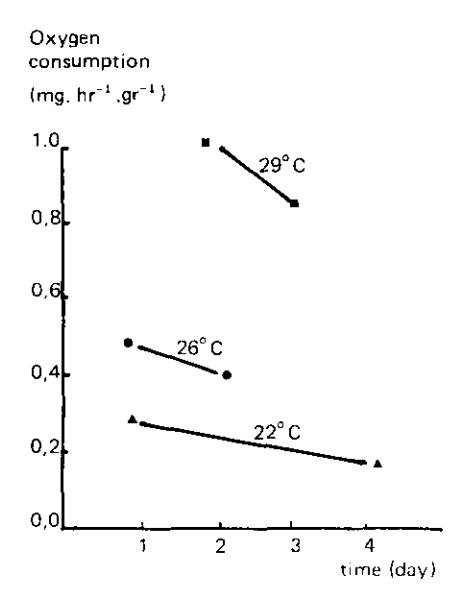
Figure 2. The influence of observation time on daily respiration rate of Cyprinus carpio L. at different water temperature.
\(\blacksquare\) = sample no. 5; \(\blacksquare\) = sample no. 4; \(\triangleq\) = sample no. 5.
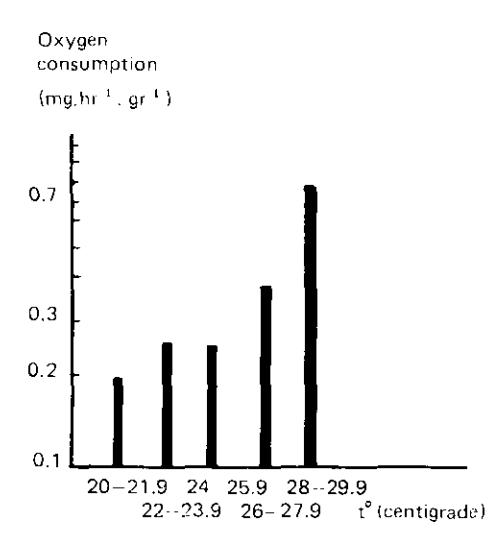
Figure 3. The influence of temperature on respiration rate of Cyprinus carpio L.
Date | 14/7 Temperature:22'C Fish Weight : 7.84 gr
Ave. Resp.
rate : 0.26 mg . hir . g-r
Date | 15/7 temperature :Ju u Fish Weight : 7.91 gr
Ave. Resp.
rate : 1.02 mg . hr-r . g-!
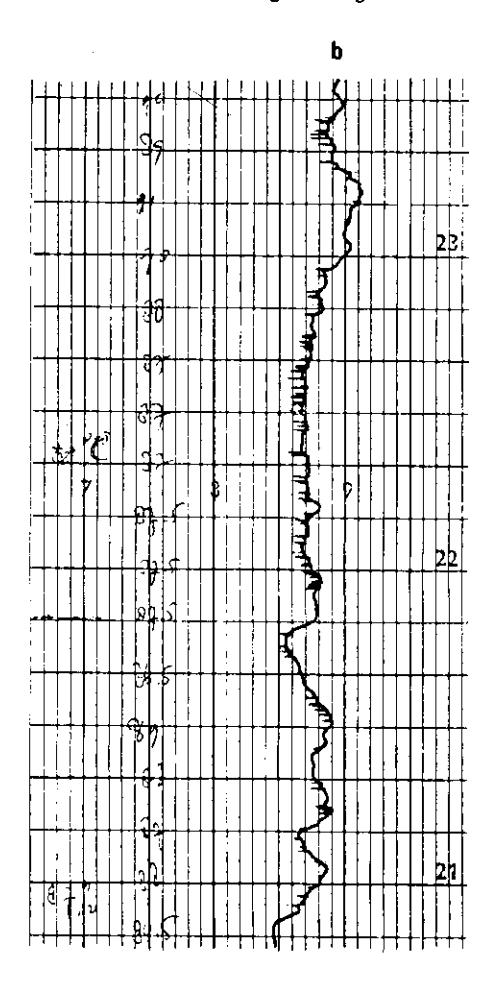
Figure 4, Recorded oxygen content in the effluent flask (after consumed by a test fish); (a) steady respiratio nat 22o C, (b) fluctuation and irregularity of respiration at 3OoC.
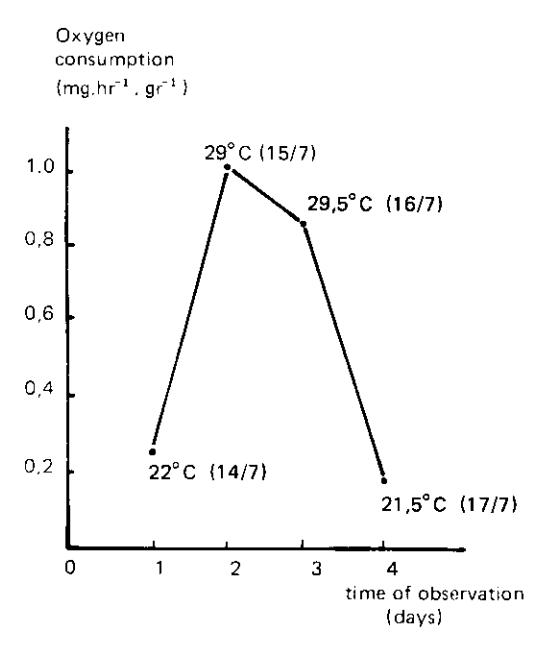
Figure 5. The influence of different water temperature on daily average respiration rate of a carp.