

1. Introduction
It is often thought that the uniform climate in the tropics would allow continuous growth of the tree and consequently of its cambial activity. Only a few trees, however, show continuous cambial activity (Alvim, 1964. Fahn, 1977). Most trees show a sharp periodic activity of the cambium. The seasonal activity of the cambium in tropical trees has not often been investigated unlike those of temperate species, in spite of its importance in understanding tree physiology. There have been several efforts to investigate factors controlling the activity of the cambium in tropical and subtropical climates (Amobi, 1974; Paliwal and Prasad, 1975; Ghouse and Hashmi, 1983). The present work aims to study seasonal activity of the cambium in Swietenia macrophylla King which grows in the Bandung area and views its relationship with some climatic factors.
2. Materials and methods
Four Swietenia macrophylla or mahoni trees at the Bandung Institute of Technology campus, each about 15 years old and 15 meters tall, were selected for similar phenological behaviour to be used as source material. Portions of side branches in their second year of growth were collected in the morning at forthnight intervals from August 1983 to July 1984, fixed in FAA (formaline, acetic acid and ethyl alcohol), and then aspirated. Ten twigs were used at each collection date. They were later sectioned with a sliding microtome at 25–40 microns and stained with safranin and fast green (Johansen, 1940). Seasonal changes with regard to external morphology were also recorded. Climatic data were obtained from the local meteorological station in Bandung which is geographically located at 6°55" S. latitude, 107°36" E. longitude, and 791 m above mean sea level.
3. Observations
3.1 Cambial activity
In spite of the precautions taken to ensure uniformity of the material by selecting trees of similar phenological behaviour there were differences in growth of different branches which were reflected in the activity of the cambium.
It was found that periclinally dividing cambial cells were not always found in complete tangential layers but may occur at different times in cells within the radial series produced by the cambium. Therefore the cambial initials and their immediate derivates which have not yet expanded radially are referred as the cambial zone in this work. Figure 1 shows a 4–5 layered cambial zone in August 1983. Tangential layers of tannin filled cells in the phloem often mark
Figure 1-+ Transverse s€ctions of the cambium of Swietenia macrophylla.
Figure I Ouerall view showing cambial zone (cz) in the area between phloem (ph) and xylem (xi). A tangential row of tannin filled cells is indicated by an arrow. August 1983 collection. x 200.
Figure 2 Paft of figure lenlarged showing fusiform initial (fi),rayinitial (ri), trachea (ta), and sieve element (se). The vertical line indicates width of cambial zone. as in all other figures where it appears. X 400.
Figurc 3 Dotmant cambium in September 1983 consisting oftangentidlly flattened cells with thick walls. Arrow points to a prismatic type of crystal. x 400.
Figure 4 Cell layers in the cambial zone have increased innumber in December. Arrow points to druse filled cell. x 375.
Figure 5 Delic,te radjal walls of the cambial cells are widening radially, January collection. x 400.
Figure 6 Na.rcw cambial zone in l\4arch 1984 collection. x 400.
division is shown in fieurc 10.
the boundary of a growth increment. lmmaturc xylem elcments are shown abutting the lignified xylem cells which constitute the diffuse porous wood. One to two layers of immature phloem cells are present at the outer side of thc cambium (figure 2). In September a dormant cambium is seen consisting 01' l-3 layers of tangentially flattened cells with thickcncd walls (flgure 3). Imrnature vascular cells are foLrnd at both sides of the cambium. Tannin filled cells are found scattered but nrorc pronounced in rays. Crystals of dmsc or prisnratic type arc oftcn found. mostly in the yrhloem cells. Starch €lrains are found in tlie last fbrmed lignified xylem cells. In the nonths tltat lbllow. the cambial zone consists of cells which are of nrore rectangular shape lnd is mlnl' laycred. indicating ircrcascd activity. In Dccember 3 7 laycrs of cclls form thc cambial zone rvith sl'cral of thcnr in pairs (figLrrc 4). l'hosc ncrvly tornrcd cells will dilfcrcntiatr' rs slrorvn ir {-igrrre 5 uhcre cclls rvitlt rvavy radill rvllls are sr'en clLre to thc still intdcqLrrtc r-igidity ol thcir $llls (ligurc 5).
Starch grains in lignificd xylem tend to drssolve with increasecl cambial activity. Crlstals and tannin arr found less fiequc.ntly. Tht canrbial activity slows down again in March whe re it shows a 3 4 cell layercd zonc with more la1'e rs of unlignificd xylem elements (figure 6). In April. sonrc cautbium cells have swollut radially ancl prricJinal divisions occurcd followed by othcr cclls in the tirrgcntial layer of canbiunt rvhich tlten divicle ntorc frequently producing rrrany la- -vcrs in this grand pcriocl o1- canrbial activity (figurt' 7 ancl 13). N'lore cclls are lormed to tlie xylem than to tirc phloem side. NIost of the vcsscls ofa grouth irrcrcurent are fornrcd at this time. In July canbial activiry has declincd wltile earlicr tornred xylenr elements arc in the process of differentiation (figure 9). Pltloem cells seem to l.ravc matured earlier. Divisions in the cambial zone concems mostly fusifbrm initials while ray initials usually only lengthcn radiaily. Periclinal division in the ray initials llso occur but much less liequently. Such a
Figure 7-10 Transverse sections of the cambial mne ol Swietenia macrophylla. Figure 7 Active cambial zone in April 1984. Arrows point to swelling of cambial cells.
x 400.
Frgure 8 Radial widening of delicate cambial cells in May. x 400.
Figure I DecliF'ed activity of the cambium in July with a large number of ditferentiating elements (de) in the xylem. X 225,
Figurc lO Paft ol f igure I enlarged to show dividing ray initial (arrow). x 400.
3.2 Cambial activit! in relation to phenolog)
Swietenia macrophylla is a deciduous tree which sheds its leaves entirely or partially. In the Bandung area, during August 1983 through March 1984 the trees under obscrvation did not fomr new leaves. The leaves instead became dark green and tended to droop at the end of the period. Meanwhile the shoot apex showed many bud scales covcring the apical meristem resulting in a distal end with a diameter of about 8 mm. In April 1984, bud scales start to grow in height indicated by the pale yellow scale bases. Drop of tlte now yellowish brown coloured old lcaves takes place while young leaves emerge. The new shoot axis produces a ncw crop of leaves and most of the extension growth of thc axis is tlnished in May. Meanwhile the colour of the new leaves changes tiom red to light grcen and during the following months will tum dark green. Cambial activity is resumed in April after a decline in March. The grand period of cambial activity in April coincides with the formati,on of a new crop of leaves. The relation between cambial activity and phenology is presented in tablc l .
TaHe 1 Relation b€tween cambial activity and phenology
| Month | Phenolog/ | Cambial layers |
|---|---|---|
| August 1983 | Full foliage | 3- 5 |
| September | Full foliage | |
| October | Fullfoliage | 3- 5 |
| November | Full loliage | 3- 5 |
| December | Full foliage | 3- 7 |
| January 1984 | Fullfoliage | 3- 5 |
| February | Full toliage | 3- 5 |
| March | Full foliage | 3- 4 |
| April | Leaf fall follolved by development of new | |
| leaver and f lowers | I -12 | |
| May | New leaves have reached full size | 4- I |
| JUne | Full foliage | 7 4- |
| July | Full foliage | 3- 6 |
3.3 Cambial activity in rehtiott to climatic factors
Rainfall during the period of investigation showed a peak in October and in April (figure I l). Relative hurnidity was high during those two occasions. The number of sunshine hours also showed some relationship with rainfall, being higher when rain was meagre such as in August 1983 or July 1984. The minimum temperature fluctuated around l8"C while the maximum was around 30'C with ar average of about 24"C. Dormant cambium was seen in the dry September month. Resumption of activity occurred in October and the foliowing months when rain was plentiful. Decline of cambial activity was seen in March, when rainfall was relatively less. The cambium was most active in April, coinciding with the second peak of rainfall. Thereafter cambial activity declined while the rainfall also decreased.
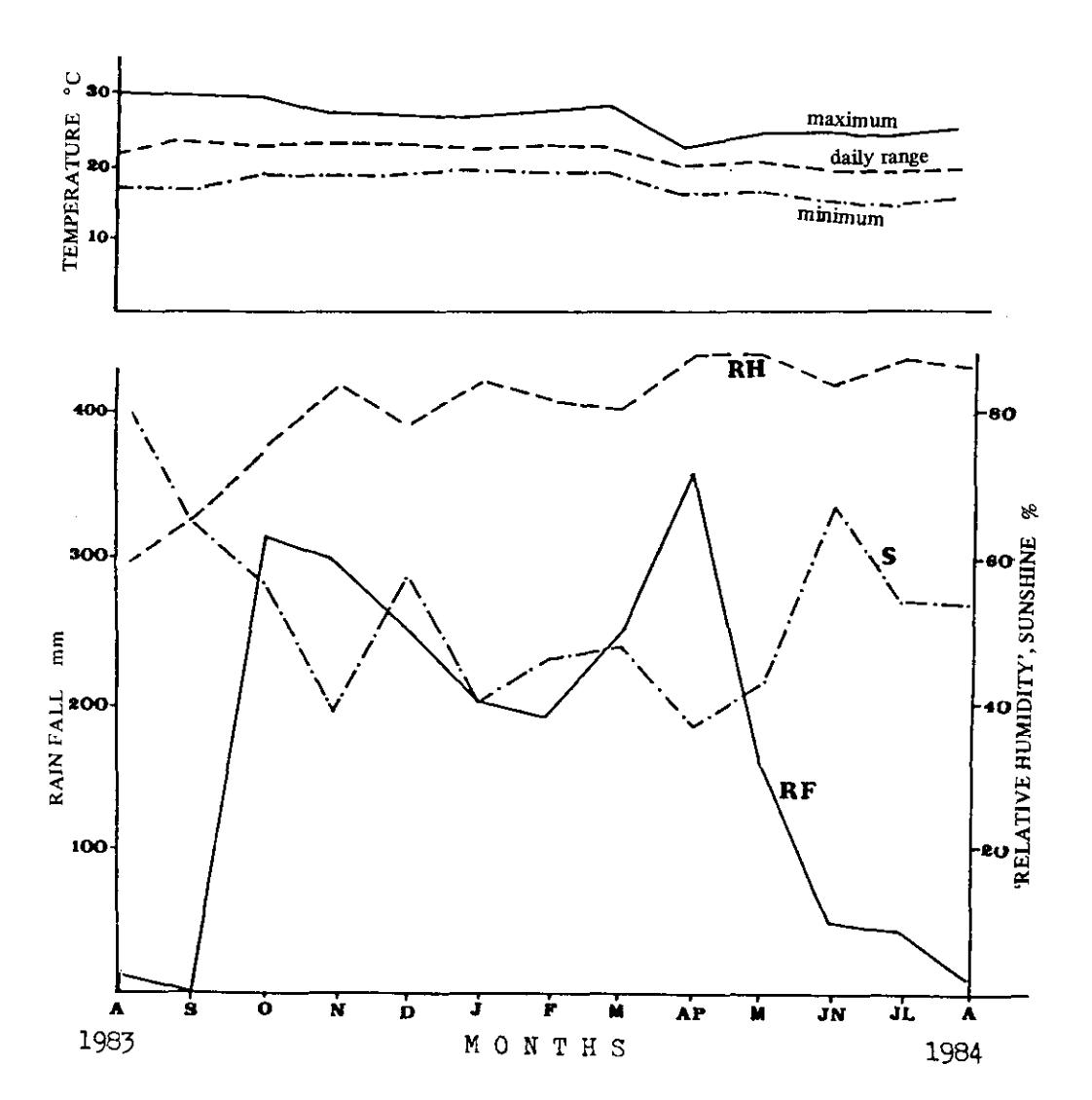
Figure 11 A graphic representation of meteorological data of Bandung from August 1983 to August 1984. Above: Temperature. Below: Rainfall (RF), Relative humidity (RH), and Duration of sunshine (S).
4. Discussion
In the nearly ideal and uniform climate of Bandung, West Java, Swictenia nncroph.vlla shows a long period of cambial activity. A cambium with dorllant fealures i:r Scptember resunres activity in the tollowing months and declincs it in March before the grand active period occurs in April. A long pcliod of activity was reported for Psidiurn guajava in Taiwarr (Chou and Chiang, 1973), for Gmeliua arborea ir India ( Dave and Rao. 1982). and was lbund to be the case in many tropical spccies (Philipson et al. l91l). Some species may have a shorter period of activity sLrch rs 5% nronths for llimusoTts c/?ngi in India (ChoLrse and Hashmi, 1983). Dornlant featurcs of the canlbiunr such as tangentially flattencd cells rvith relatively thicker walls as shown lor Swit:tenia ntacroph|lla in the present work has been reported also tbr other species. Only solnc cells show dense cytoplasm such as mentioned for dornant cambium (Philipson et al. l97l). Swelling of cells at resumcd activity could be observed only in some cells 1n Swietenia nacrophylla but slipping of the bark was evident. This swelling is taken as an indication of the first sign of canrbiunr reactivation and is also found rn Polyalthia longilblia (Ghouse and Hashnri, 1979a) andG rclina arborea (Dave and Rao. 1982).
The pattern of radial growth is paralleled by thr: width of the cambjal zone which increases and then declined according to thr' ratc of cell production (Philipson el al. 197l). During the most active or grand period of cambial activity in Swietenia macrophylla most of the wood vcsscls of thc increment arc produced fronr the xylem mother cells. This was reported also for twigs of Swletenia mahdgotli but was not the case in the trunk (Coster. 1927, 1928). Others reported that the young branch shorved sinrilar bchlvioLrr of growth as the 1runk. although not with the same ilrtensity (Dave rrnd Rao, l98l). More studies are needed to show whether the twigs would reflect similarity of br,-hlviorrr with tire trunk, since using twig samples would be rtrore fcasible with rcgard to the tree under investigation.
It is known that the environment plays a controlling part in cambial development thror€h the production of aurin by developing buds and leaves (Rontbcrger, 1961 ). ln Srtietenio nacrophylla there is a close association between e'rrergence ol ncw leaves and the grand activity of the cantbiunr. Canrbial activity, however. was detected as scales elongate just before- thc young leaves enterge while the old leaves are shedding. Reactivation of cambiunt at the time of leaf fall was also reported for Dalbergia srisoo in New Delhi (Paliwal and Prasad, 1970). On the other hand, ircreased cambial activity long bcfore leaf enrergcnce was rcported for Psidium gwjava (Chou and Chiang, 1973) whilc in,llr-. musops cletryi the cambial activity commenccd 4 wceks after new leaf enrergence (ChoLrse and Hashmi, l9ll-1). Correlation of budbreak and the initiation of cambial activities was found in twigs of Drepanocarpus lunatus and. Onnacarpum selrucosum (Anlobi, 1974). More studies are needed before a general conclusion can be reached.
Arnong the clinratic factors observed, it seenrs likely that in S'wietenia macrophylla the peak of rainfall, in October and in the lbllowing rnonths, influences cambial activity even though no new leaves were formed. Gmelina arborea also showed maximum cambial activity while new leaves were at full maturity and rainfall was high (Dave and Rao, 1982). An additional activity of cambium of Swietenia macrophylla after a period of nroisture stress was found in the dry months of August ard September 1983. This phenomenon was also reported for cacao (Alvim and Alvim, 1978). The renewed activity associated with leaf lall and emergence of new leaves which occurs in Aplil and May 1984 for Swietenia macrophylla investigated here may be explained by the existence of an individual cycle of the tree and perhaps the short drier period in the rainy season in February and March l 984. It could be a trigger mechanism as for cacao (Alvim and Alvim, 1978). From casual obseryations on other jndividuals, it was noted that many trees show emergence of new leaves in October 1983 which also is the month of healy rainfall following a dry period in the Bandung area. Such different times of flushing was also noted for Swietenia mahagoni rn Bogor (Coster, 1927,1928). Temperature does not seem to influence cambial activity in the material used. This was also true for Gmelina arborea (Dave and Rao. 1982).
In view of the discussion above, it seems likely that differences in genetic constitution and diffcrences in the environmental condition of the individuals each by itself will influence cambial activity in Swietenia nacrophylla aside front the availability of moisture.