

SARI
Organisme air seperti zooplankton dan ikan telah sering digunakan untuk menafsirkan kehadiran senyawa kimia yang terlarut dalam air sehubungan dengan masalah kualitas air. Kriteria untuk menyatakan kehadtuan tersebut dapat dinyatakan dalam bentuk tC56, hdeks populasi, d,an gQala fisiologis. Uji hayati yang menggantungkan pada gejala fisiologis ini mernpunyai sasajan uDtuk mengukur dampak subletal suatu senyawa terhadap organisme.
Perkembangan lebih lanjut adalah penggunaan laju penyaringan da:j Daphnia cnriruta (Cooley, 1977; McMahon 1966) untuk menafsirkan kehadiran sejenis detergen. Dalam hal ini laju penyaringan diukur dengan menghitung jumlah ragi yang bertanda 32p yang termakan oleh udang ters€but. Dilakukan pembandingan anta(a lajt! petya \gan Daphnia yang terada pada medium tanpa dan dengan detergen.
. Department of Biology, lnstitut Teknologi Bandun8
INTRODUCTION
Water quality monitoring has been developed quite extensively side by side with the physico-chemicals methods (Swartz, 1972 Caims & Dickson, 1973).
It was mentioned that there werc several approaches in the development of biological monitoring methods for water quality such as bioassay, condition indices, population dynamics. conrmunity structure, and contmunity metabolism (Swartz, 1972).
Within the framework of water quality assessmenl, especially in connection with the development of quantitative lneasurement of chemicals such as detergent and pesticides, we are interested in usng Daphnia cainata as a tool.
Aside from the fact that Daphnia (Crustacea: Cladocera) has been widely used in several advanced countries in toleration studies, this species are available in our vicinities and could be cultured witJiout difficulties.
The material to be tested has been a certain type o[ detergent that was often discussed by several environmental people lately. It is expected that this cn:stacean could be used as rcliable assay aninals especially for sublethal bioassay.
This work has been based on two papers by McMahon (1968.1 and Cooley (\971).
MATERIAIS AND METHODS
Daphnia cainata King has been kept for several generations in the Biology Department of ITB. The original stock came fronl the Departnent of Civil Works, a department dealing witb watcr management (DPMA); the daily food consist of yeasts.
The chemical to be tested was'AD pasta unbleached', i.e. the nraterial used for a certairr kind of detergent (surfactatrt). It belongs to the group of alkylbenzene sulfonate (ABS).
a Acute (LC-s)
To start a sublethal assay, a lethal experiment was carried out, usirlg tlie following pasta concentrations (48 hrs); 0; l0; I3,5; 18 24;32l-42:56; and I00 ppm.
b Sublethal
Cooley (1977) has shown the relationship between filt!'ring rale of Dapltnia retrocurva and pulp nlill effluent. The measurement of filtenng rat"- is based on the quantity of tagged yeasts (3 2P) taken by individrral Daphnia retrocurw.
ln our experiment, yeasts are tagged wirh 5 mci i 2 P (frorn National Atontic Energy Agency) within 50 cc of culture. Incubated 48 hrs at l0'C. it rvas centrifuged afterwards, and rinsed with aquadest four times.
The number of cells in the culture was 2.10<sup>5</sup> cell/cc, 5 cc of yeast suspension was used to measure its radioactivity after filtered through millipore.
Culture of female Daphnia aged 9 days are used for the assay. For acclimation, untagged yeasts are added for the first 30 minutes after Daphnia has been treated with 'AD pasta unbleached'. They are then filtered and returned to the aquarium, but this time the food added are tagged yeasts for as long as 10 minutes. Once again they are filtered and returned to the aquarium without tagged yeasts. A certain number of Daphnia are taken, killed with 10% ure than and fixed in 4% formalin; the individual lengths are measured and the radioactivity are counted with G. M. Counter.
Treatments of 'AD pasta unbleached' are 0 ppm (control), 10 ppm, 50 ppm, and 100 ppm. Time exposures are 1, 2, 4, and 24 hrs.
Formula for the filtering rate:
\[Y = \frac{\text{radioactivity/1 Daphnia}}{\text{radioactivity/ml yeast suspension}} \times \frac{1440}{\text{feeding time}} \text{ cc/animal/day}\]
RESULT AND DISCUSSION
While it was mentioned (Abel, 1974) that 'ABS' could kill Idus idus, of which the 48 hrs \(LC_{50}\) also depended on the chains length, 'AD pasta unbleached' also caused a certain mortality on Daphnia carinata; 48 hrs \(LC_{50}\) was 17.55 ppm. (fig 1).
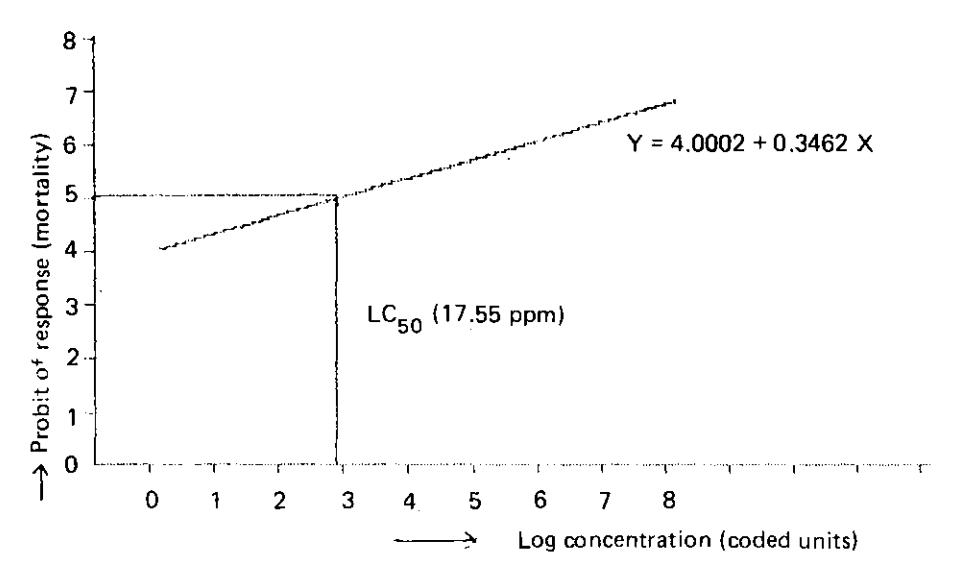
Figure 1 LC<sub>50</sub> of 'AD Pasta Unbleached' on Daphnia carinata King
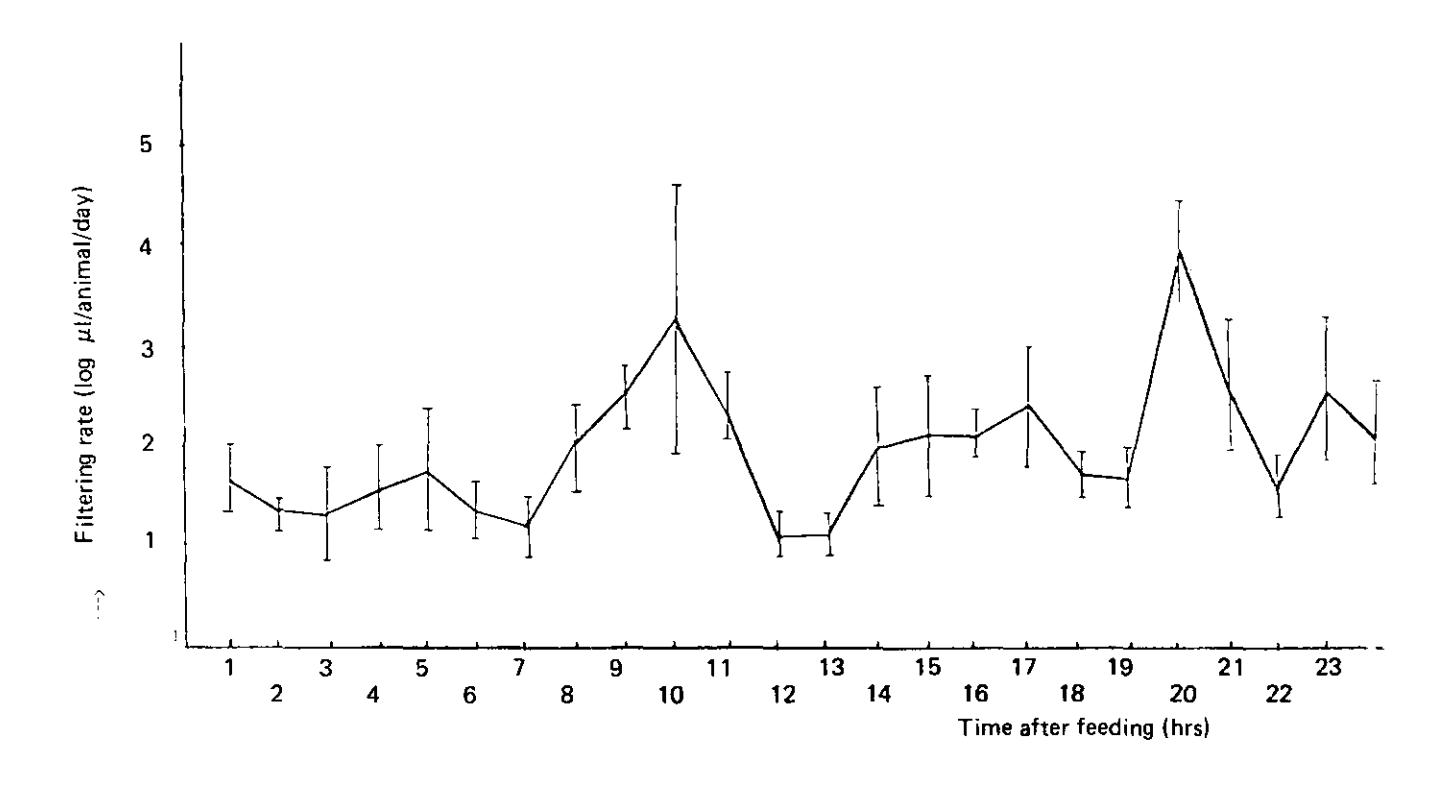
Figure 2 The variation of food filtering process of Daphnia carinata
As was expected in hourly measurements of tagged food taken within a period of 24 hours. the filtering process of this cntstacean varies with minimum value of 1.147 cc/animal/day and maximnm ot2.692 cc/dxy (fig 2). There seems to be a peak of filtering activity for every l0 hours. ln measuring the effect of AD pasta. it was decided to cxecute thc experiments at l,1.4 and24hoursafter lhe treatment.
For I hour observation, thc treatnlents with 10, 50, and 100 ppm AD pasta lorvered the filtering process by 91.20. 8?.65, and 87.4 pcrcetit respcctively. The result of 2 hours observation showcd thc decrease of the filtcring process were 86.32, 57 .54, and 86.66 percent for the respective treatments.
For I hour observation, the treatments with 10.50 and 100 ppm AD pasta lowered the filtering proces by 91 .20 and 87.4 percent respectively. The result of 2 hours observation showed that the decrease of the liltedng process were 86.32, 57 .54, and 86.66 percent for the respectivc treatrnents. In the 4 and 24 hours observations. the 100 pprn killed the aninrals and tlie lowering of the filtering process were 87.31. 88.11 and 65.43, 60.51 perceni for l0 and 50 ppm treatments respectively.
Apparently l0 ppnr AD pasta deprcssed the filtering proccss of Daphnia tor a period up to 24 hrs. The reduction of the filtering process by AD pasta at the colrcer.rtration higher tltan l0 ppnt killed the treated anintals.
While the size ol the experimcntal animals is important in this bioassay works, a correlation was made between thc length of Da2[nia and the filtcring process of the treated animals. For 1.2.4, and 24 liours observations at l0 pprn treatment. the results were respectively (Y = food filtering process, X = body length):
\[Y = 20.7 X^{-1.32} (1 hr)\]
\(Y = 9.54 X^{-1.45} (2 hrs)\)
\(Y = 28.4 X^{-1.45} (4 hrs)\)
\(Y = 3.94 X^{-6.08} (24 hrs)\)
Thc overall picture on the conclation between the body length. the consentration of AD pasta. and the time of obscrvation did not sholv ary clear cut resu{ts (fig 3, 4, 5 and 6). However. Cooley (1977) reported that therc was a corr€llation between the bodl' length of Daphtir, retlocu a and the food filtering proccss which were Y =2.;16 Xt63 fo, c.rntrol and Y= 1.92 X126 for treatnlent.
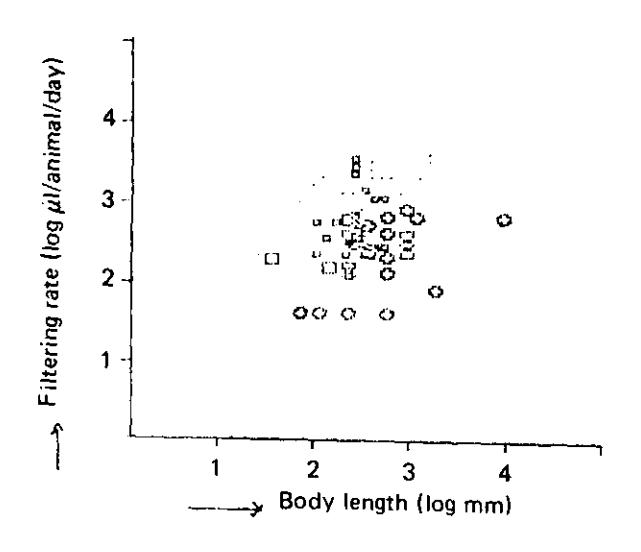
' = Control $= l0ppm ! = 50ppm n = 100 ppm
Figure 3 Filtering rates oI Daphnia carinata King after one hour treatmenr with AO Pasta Unbleached'
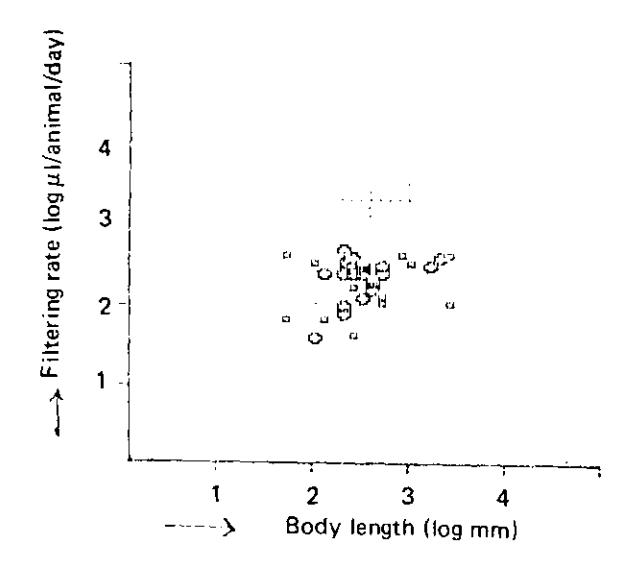
Figure 4 Two hours treatment
= Control ='10 ppm = 50 ppm = 100 ppm ..i
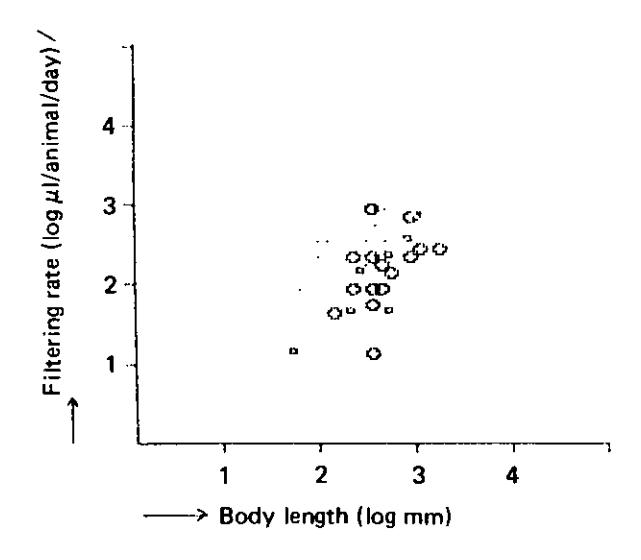
Figure 5 Four hours treatment
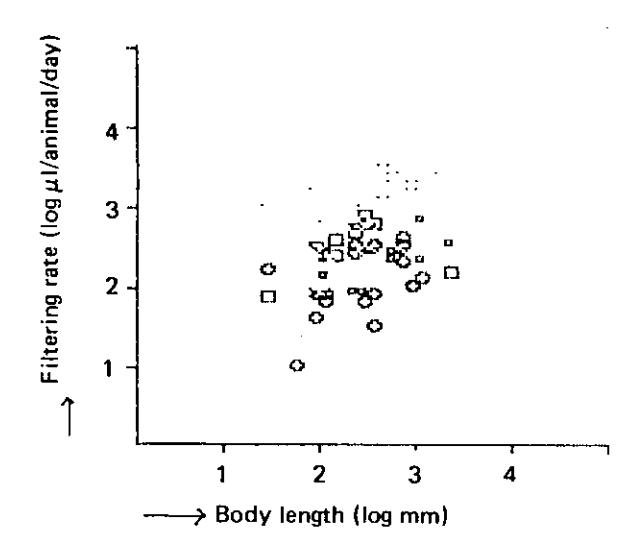
Figure 6 Twenty four hours treatment
• = Control • = 10 ppm • = 50 ppm • = 100 ppm
• = Control • = 10 ppm • = 50 ppm • = 100 ppm