

L.H. Wiryanto
Department of Mathematics, Institut Teknologi Bandung Jln Ganesha 10 Bandung 40132; E-mail: leo@dns.math.itb.ac.id; Telp: (022) 250 2545; Fax: (022) 250 6450
Received: September 1998; revision received: February 1999; accepted: February 1999
Sari
Gravitasi nol dari aliran permukaan bebas yang melewati bendung
Solusi eksak dari aliran permukaan bebas yang melompati bendung pada suatu saluran dengan kedalaman-hingga disampaikan dalam tulisan ini, yaitu untuk bendung tipis dengan ketinggian bervariasi. Solusi ini dapat diperoleh dengan mengabaikan pengaruh gravitasi. Hal ini merupakan kasus ekstrem yang dapat digunakan untuk menjawab pertanyaan: mengapa kita harus memiringkan dinding bendung untuk mendapatkan solusi dengan jet yang membalik tetapi alirannya meninggalkan dinding dengan mulus.
Kata kunci: Persamaan Bernoulli; rumus integral Cauchy; aliran permukaan bebas; variabel hodograph; persamaan Laplace; gravitasi nol.
1 Introduction
A free-surface flow producing a jet can be seen in many engineering problems. An example for this flow is the problem here, i.e. when water flows over a weir. Since a free boundary is the character of the jet, and this boundary expresses a nonlinear condition, the boundary value problem of the weir flow is difficult to solve analytically, even for a steady flow. This major difficulty increases by the elevation of the free surface which is unknown before.
In this paper, we present an exact solution of flow over a weir by assuming that the influence of gravity relative to inertia is negligible. Physically, the jet asymptotes downstream to a uniform stream which is straight and inclines upward at the same unique angle to be determined. The mathematical solution can be obtained exactly via the hodograph transformation. This neglect of gravity simplifies the problem of determining the free-surface angle, since the velocity magnitude is then constant along these free surfaces. The same result, but only for a vertical wall, can be seen in the paper by Dias & Tuck [1]. In the present work, we solve the problem for a general angle \(\beta\) of the wall (see the sketch of the flow in Figure 2(a)). Other references for zero-gravity solutions of different problems can be read in works such as Goh [2] for a jet emerging from a nozzle, and recently Tuck & Vanden-Broeck [3] for ploughing flows.
The extreme case of flow over a weir can contribute to answer a question in Dias & Tuck [1], i.e. transitional solutions between flows over a weir (Figure 1(a)) and a back-turning jet (Figure 1(b)). Note that Figure 1(a) and (b) are from Dias & Tuck [1] and Wiryanto & Tuck [4] respectively. The transitional solution is a back-turning jet with a smooth separation of the free surface leaving the wall (see Wiryanto & Tuck [5]). The zero-gravity solution indicates that the last type of solutions, such computed by Wiryanto & Tuck [5], can be obtained by inclining the wall as described at the end of this paper.
2 Boundary value problem of zero-gravity case
Let us consider the steady two-dimensional flow of an inviscid incompressible fluid in a channel of finite depth. A uniform stream is generated far upstream with velocity U and depth D, and an inclined wall with height W disturbs the stream. Therefore, the flow rises up continuously when the effect of gravity is neglected. This rising stream tends to become a uniform one with angle \(\theta_{\rm jet}\). The sketch of flow is shown in Figure 2(a).
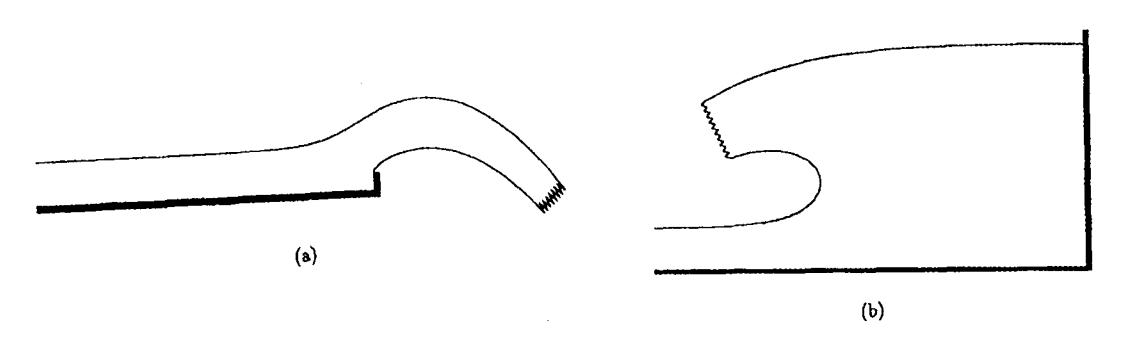
Figure 1 (a) A free-surface profile of flow over a vertical weir for \(g \neq 0\). (b) Flow producing a back-turning jet
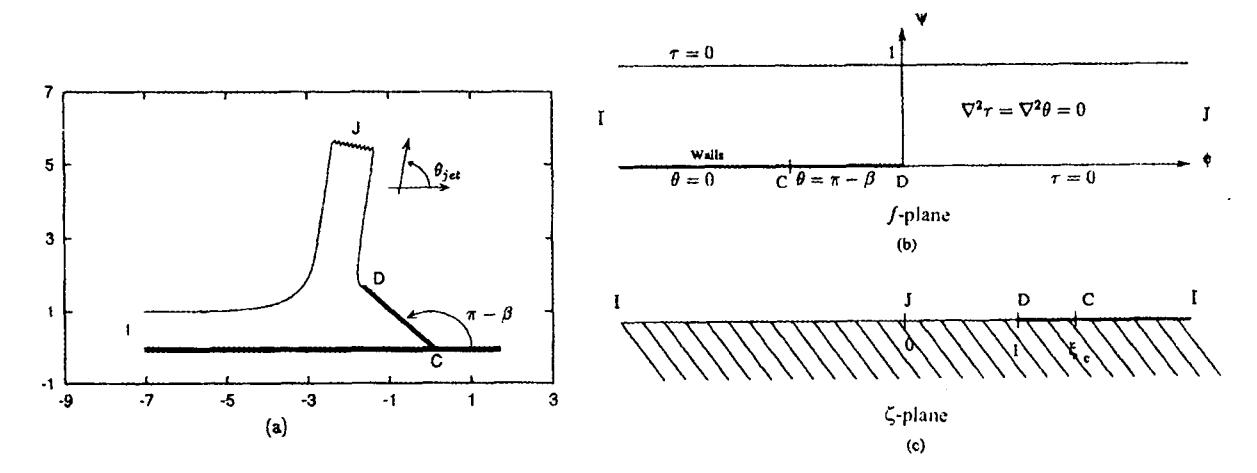
Figure 2 (a) Sketch of flow. (b) f-plane. (c) g-plane
For convenience, we nondimensionalize the problem by taking U as the unit velocity and D as the unit length. In addition, we denote the potential function by \(\phi\) and the stream function by \(\psi\), so we can introduce the complex potential \(f = \phi + i\psi\) and the complex velocity u - iv = df/dz, where z = x + iy represents the flow domain in the physical plane. u and v are the x and y components of the velocity. Without loss of generality we choose \(\phi = 0\), \(\psi = 0\) at the separation point D. The free surface IJ is a streamline \(\psi = 1\).
On the free surfaces IJ and DJ, where the pressure is constant, the Bernoulli's equation yields
\[u^2 + v^2 = 1. (1)\]
Meanwhile, the kinematics conditions on IC and CD yield
\[\frac{\partial \phi}{\partial \bar{n}} = 0, \tag{2}\] where \(\vec{n}\) is the normal vector of the wall. The mathematical model is to determine the potential
function \(\phi\) satisfying Laplace's equation subject to the conditions (1) and (2).
In solving the boundary value problem of \(\phi\), we introduce a hodograph variable \(\Omega = \tau - i\theta\) having a relationship
\[\frac{df}{dz} = e^{\Omega},\tag{3}\] and an artificial plane \(\zeta = \xi + i\eta\) satisfying
\[f = -\frac{1}{\pi} \log \zeta. \tag{4}\]
The relationship (4) represents a mapping of the flow domain from the f-plane to the \(\zeta\)-plane. This artificial plane is a half plane lower where C, D and J are mapped to \(\zeta = \xi_c\), 1 and 0 respectively. In the case where the hodograph variable \(\Omega\) is related to \(\zeta\), our boundary value problem is
\[\nabla^2 \theta = 0\] or \(\nabla^2 \tau = 0\) (5) subject to
\[\tau = 0 \quad \text{for } \xi < 1, \tag{6}\]
θ alc
cor Th Fig
The sec defi
Thi beh exp (7), χ(ξ
forn real plan We
On χ(ξ<sup>*</sup>
whe The be d For redu side imag
give
\((\pi -\)
\(\tau\) and
\(\theta(\xi^*)\)
\[\theta = \begin{cases} 0 & \text{for } \xi > \xi_c \\ \pi - \beta & \text{for } 1 < \xi < \xi_c, \end{cases}\] (7)
along the real \(\zeta\)-plane. A condition (6) is the consequence of the Bernoulli's equation (1) and condition (7) expresses the kinematics condition (2). This boundary value problem is shown in the f-plane in Figure 2(b), and the flow domain in the \(\zeta\)-plane is shown in Figure 2(c).
3 Exact solution
The boundary value problem described in the previous section is solved analytically in this section. We first define a complex quantity \(\chi\) related to \(\Omega\)
\[\chi(\zeta) = \Omega(\zeta)(1 - \zeta)^{-1/2}.\] (8)
This quantity takes into account the square root behaviour at the separation point D of the flow. We then express (8) along the real \(\zeta\)-axis by substituting (6) and (7), giving
\[\chi(\xi) = \begin{cases} \frac{-i\theta}{\sqrt{1-\xi}} & \text{for } \xi < 1 \\ \frac{i\tau + \pi - \beta}{-\sqrt{\xi - 1}} & \text{for } 1 < \xi < \xi_C \\ \frac{-i\tau}{\sqrt{\xi - 1}} & \text{for } \xi > \xi_C. \end{cases} \tag{9}\]
On the other hand, \(\chi\) is an analytic function and tends to be zero as \(|\zeta| \to \infty\). Therefore, the Cauchy's integral formula can be applied to \(\chi(\zeta)\) on a path consisting of the real \(\zeta\)-axis, a semi-circle at \(|\zeta| = \infty\) in the lower half plane, and a circle of vanishing radius about the point \(\zeta'\). We then let \(\text{Im}(\zeta') \to 0^-\) giving
\[\chi(\xi') = -\frac{1}{i\pi} \int_{-\infty}^{\infty} \frac{\chi(\xi)}{\xi - \xi^*} d\xi,\tag{10}\] where \(\xi^* = \xi^* + i0\).
The tangential of the streamline along free surfaces can be determined by substituting (9) into both sides of (10). For any point \(\xi\) in \((-\infty, 1)\), the left hand side of (10) reduces to \(-i\partial(\xi^*)/\sqrt{1-\xi^*}\). Meanwhile, the right hand side of (10) contains a complex form of integral. The imaginary part of this integral is a definite integral of \((\pi-\beta)/\sqrt{\xi-1}\) in the interval \((1, \xi_c)\), the terms containing \(\tau\) and \(\theta\) are the real part. Therefore, these imaginary parts give
\[\theta(\xi^*) = \frac{\sqrt{1 - \xi^*}}{\pi} \int_1^{\xi} \frac{\pi - \beta}{\sqrt{\xi - 1}(\xi - \xi^*)} d\xi \quad \text{for } \xi^* < 1. \quad (11)\]
The integral in (11) can be determined by a substitution method, and (11) becomes
\[\theta(\xi^*) = \frac{2(\pi - \beta)}{\pi} \arctan \sqrt{\frac{\xi_c - 1}{1 - \xi^*}} \quad \text{for } \xi^* < 1.\] (12)
The rising uniform stream forms a jet with angle
\[\theta(\xi^*) \to \theta_{jet} = \frac{2(\pi - \beta)}{\pi} \arctan\sqrt{\xi - 1}\] (13)
as \(\xi' \to 0\). The jet angle (13) depends on the inclining wall \(\beta\) and the height of the wall presented by artificial parameter \(\xi_c\).
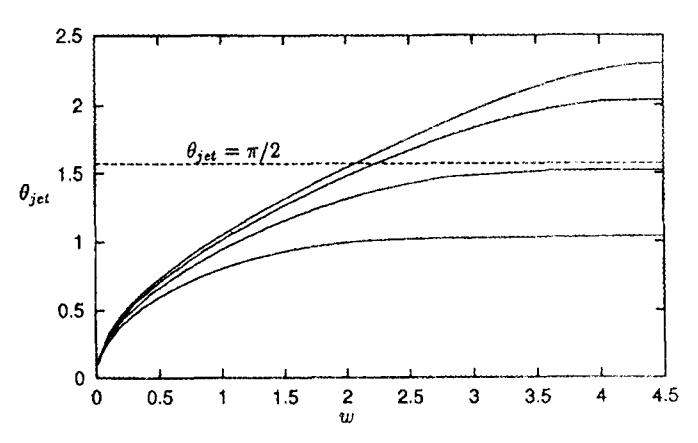
Figure 3 Plot of \(\theta_{jet}\) versus w for \(\beta = \pi/4\), \(\pi/3\), \(\pi/2\), and \(2\pi/3\) (from top to bottom)
Similarly, the function \(\tau(\xi)\) can be derived by substituting (9) into (10) for \(1 < \xi < \xi_c\) and \(\xi > \xi_c\). Since \(\tau(\xi)\) appears only in the imaginary part of the left hand side of (10), we equate the same part of the right hand side in the form of a definite integral. The integration of this form gives
\[\tau(\xi) = \frac{\pi - \beta}{\pi} \log \left| \frac{\sqrt{\xi_c - 1} - \sqrt{\xi - 1}}{\sqrt{\xi_c - 1} + \sqrt{\xi - 1}} \right| \quad \text{for } \xi > 1.\] (14)
The results (12) and (14) are then used to evaluate the coordinates of the free surfaces from the relationship
\[\frac{dz}{d\xi} = \frac{e^{-\Omega}}{\pi \xi}.\] (15)
Note that (15) is obtained from (3) and (4). If w = W/D is the nondimensional height of the top edge of the wall, this height satisfies the relation
\[w = -\frac{\sin\beta}{\pi} \int_{1}^{\xi} \frac{e^{-r}}{\xi} d\xi \tag{16}\]
For a fixed value \(\beta\), the height w increases on increasing \(\xi_c\). Therefore, a plot of \(\theta_{jet}\) versus w can be made for various values of \(\xi_c\). We show this plot in Figure 3 for \(\beta = \pi/4\), \(\pi/3\), \(\pi/2\) and \(2\pi/3\). We found that the jet emerges
upward with a larger value \(\theta_{jet}\) as we increase the wall. But \(\theta_{jet}\) never exceeds \(\pi - \beta\). Therefore, the jet always crosses the wall for \(\beta \ge \pi/2\). This explains why solutions with a jet curving back do not exist for a vertical wall, as expected in Dias & Tuck [1].
On the contrary, we can expect to obtain solutions with a jet curving back for non-zero gravity if \(\theta_{jet} > \pi/2\). Two physical quantities play an important role to obtain this condition. They are the wall angle \(\beta\) and the wall height w. For the first quantity, \(\beta\) must be less than \(\pi/2\). Then, the relation between w and \(\theta_{jet}\) is given by the curve in Figure 3. Only for points lying above the dashed line \(\theta_{jet} = \pi/2\) can the jet curve back.
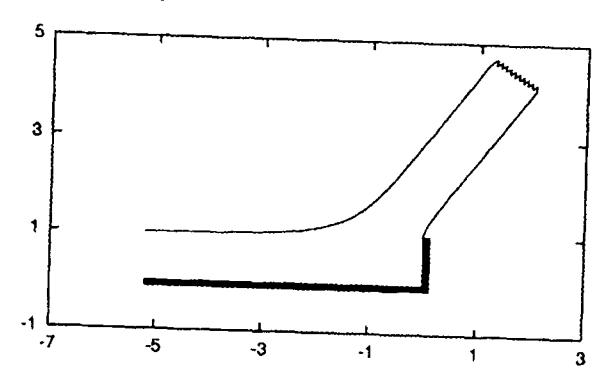
Figure 4 A typical zero-gravity free-surface profile for \(\beta = \pi/2\).
Figure 2(a) and 4 are typical free surface for different values of \(\beta\). We computed these figures for \(\beta = \pi/4\) and \(\beta = \pi/2\) with the same value \(\xi_c = 3\). We obtain that the height of the wall is w = 1.712 for Fig.2(a) and w = 1.015 for Fig.4.
4 Conclusion
We have solved the extreme case of free-surface flow in a channel of finite depth, and blocked by an inclined wall. In the absence of gravity, the jet emerges upward asymptotically to a uniform stream with angle \(\theta_{jet}\) depending on the height w and the angle \(\beta\) of the wall. The plot of \(\theta_{jet}\) versus w can be used to indicate when solutions with a jet curving back exist.
5 References
- Dias, F. and Tuck, E.O., Weir flows and waterfalls, J. Fluid Mech. 320, 525-539, (1991).
- 2. Goh, K.H.M., Numerical solution of quadratically nonlinear houndary value problems using integral equation techniques, with applications to nozzle and wall flows. Ph.D. thesis, Department of Applied Mathematics, The University of Adelaide, (1986).
- 3. Tuck, E.O. and Vanden-Broeck, J.-M., Ploughing flows, Euro. J. Applied Math., 9, 463-483, (1998). (accepted).
- 4. Wiryanto, L.H. and Tuck, E.O., A back-turning jet formed by a uniform shallow stream hitting a vertical wall, in Proc. Int. Conf. On Differential Equation: ICDE'96 editors: E. van Groesen and E. Soewono, Kluwer Academic Press, 371–379, (1997).
- Wiryanto, L.H. and Tuck, E.O., A boundary-element solution of a free-surface flow in a blocked channel, in Proc. of Computational Techniques and Applications Conference: CTAC'97 editors: J. Noye, M. Teubner and A. Gill, World Scientific, 743-750, (1998).
Abs
Mode Muar 1994 coasts by di (winc coasts about comp verific Key w
Sari
Pemoo
Jakart (Nove masing 35,1 m pasang musim surut, musim
In the of Ma aims the pl been p is a path the strinteredeveloplant.
progra yet da