

Sari
Studi voltametri penyapuan potensial linier dikaitkan dengan voltametri siklus amplitudo kecil untuk sistem flotasi elektrokimia kalkopirit-xantat
Penelitian ini memberikan gambaran reaksi elektrokimia pada antarmuka elektroda platina, tembaga, dan kalkopirit di dalam larutan encer xantat. Penelitian dilakukan dengan metode SACV (Small Amplitude Cyclic Voltammetry), dengan rentang eksitasi potensial segitiga yang sangat kecil, yaitu 10 mV sampai 20 mV eksitasi dipakai untuk menganalisis mekanisme reaksi flotasi mineral kalkopirit. Untuk mempertegas hasil SACV penelitian dilanjutkan dengan metode LPSV (Linear Potential Sweep Voltammetry). Voltammogram yang diperoleh menggambarkan terbentuknya dixantogen di permukaan elektroda platina, dan terbentuknya senyawa tembaga-xantat karena adanya reaksi permukaan antara ion xantat dengan tembaga.
Katakunci: elektrokimia, flotasi, platina, tembaga, dixantogen, kalkopirit, small amplitude cyclic voltammetry, linear potential sweep voltammetry, sel flotasi mikro.
1 Introduction
Potassium ethyl xanthate (KetX) is an organic substance commonly used as flotation collector. Although the basic objective of the addition of KetX is to alter the behavior of the particle surfaces from hydrophylic to hydrophobic, chemical and electrochemical reactions occur in the flotation pulp cannot be avoided. Progress in the flotation theory has been rapid and during recent years research on the chemistry of the interaction between sulfide minerals and KEtX has been directed to the study of the electrochemical reactions taking place and the products formed that confer hydrophobicity.
In the present investigation, SACV (Small Amplitude Cyclic Voltammetry) measurements are carried out on
Cu-sulfide mineral chalcopyrite (CuFeS<sub>2</sub>). Platinum and copper have been chosen as references to elucidate the formation of dixanthogen and Cu-EtX species. The last part of experiments treats flotation test in a microflotation-electrochemical cell to analyze the influence of potential on the flotability. From a comparison between electrochemical data with flotation data the mechanism of collection is further elucidated.
This study was undertaken to further investigate the electrochemical aspects of reactions on platinum and copper electrodes dipped in aqueous xanthate solutions. It is anticipated that the observed cyclic current responses can be used to elucidate surface reaction mechanisms in the flotation of sulfide minerals. The comparison of the interaction of xanthate ions with metal surfaces and with sulfide minerals is an indicated way of approaching to the problem.
2 Measurements of polarization resistance
In the SAVC-technique, the value of the polarization resistance can be calculated from the steady-state current-potential hysteresis loop which is obtained by applying a triangular potential wave. Typical SACV curves obtained on an electrode are shown in Fig. 1 (Roos et. al, 1988).
The characteristic parameters of the hysteresis loop are calculated from the simulated curve (see Fig. 1). The term apparent polarization resistance (Rapp) is used for the slope of the hysteresis loop determined by the tangent at the maximum potential (or maximum current). The diagonal resistance Rd is defined as the slope of the line joining the maximum and minimum points of the hysteresis loop with \(I_{\text{max}} = \text{maximum}\) current density, and \(I_{\text{min}} = \text{minimum}\) current density.
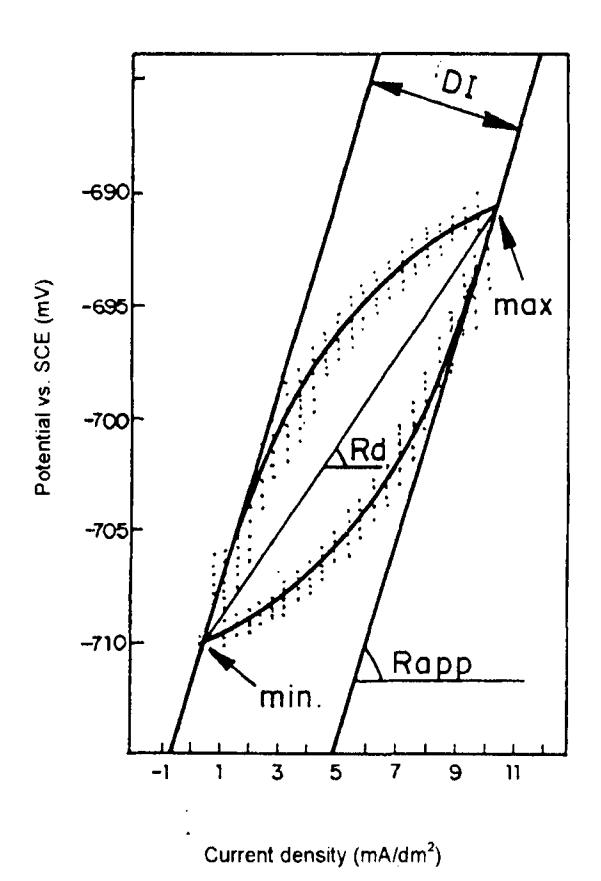
Figure 1 Typical SACV current-potential hysteresis loop. Solid lines are obtained by curve fitting technique (Roos et. al, 1988)
3 Experimental procedures
Small amplitude cyclic voltammetry (SACV) were performed on copper wire and chalcopyrite. Sulfide electrodes of about 0.5 cm<sup>2</sup> area were hand-selected to be free as far as possible from inclusions, cracks and voids. Before each SACV-experiment a new surface was produced by wet grinding on 600 grade paper and the electrode was immediately transferred to the test cell.
Test solutions were prepared from \(Na_2B_4O_7\) and distilled water. A 10 g/l borate solution was used as electrolyte, its natural pH was 9.2. Potassium ethyl xanthate (KEtX) was prepared from a high purity ethyl alcohol, \(CS_2\) and KOH.
The chemical composition of the chalcopyrite mineral was 32.22% Cu, 30.30% Fe, 35.11% S and 2.37% as others. A three-electrode system was used for the electrochemical measurements. The counter electrode was a platinum electrode. All potential values in this work were given with respect to a saturated calomel electrode (SCE).
For SACV test, a Princeton Applied Research Electrochemistry system and a Synthesizer/Function Generator HP 3325A were used for programming and controlling the electrode potentials. A triangular potential waveform of 20 mV peak-to-peak was applied to the working electrode. The waveform was then recorded on a Nicolet Instrument corporation model 206 oscilloscope. The data was then transferred to a MINC VT 105 computer for further treatment. The SACV-test was performed at different potentials from -1.2 V up to +1 V in successively intervals of +50 mV.
For LPSV test, a Princeton Applied Research Electrochemistry system (Model 175 Universal Programmer, Model 173 Potentiostat/Galvanostat and Model 176 current follower) was used for programming and controlling the electrode potentials. The potential was swept linearly with time generally at a potential sweep rate of 10 mV/s.
The platinum and copper electrodes had diameters of 0.8 and 1.7 mm respectively and the length immersed in the solution was 45 mm. After a couple of experiments the electrolyte was replenished. Stock of xanthate solutions was prepared just before the experiment to ensure minimum decomposition.
A conventional three-electrode system was used for the electrochemical measurements. The electrodes were inserted into the solution through appropriate holes in a glass lid which covered a 1 liter glass vessel. All measurements had been carried out at room temperature without agitation of the solution. The counter electrode was a platinum electrode.
A Shematic representation of the microflotationelectrochemical cell is shown in Figure 2. A slightly different flotation set-up was used by Gardner and Woods (1973) and by Walker et. al (1984) and Richardson and Walker (1985).
- A. Fritted glass dics
- B. Plantinum wire electrode
- C. Platinum counter electrode
- 0. Calomet relerencelectrode tube
- E. Air inletube
- F. Fresh water tube
- G. Floted product receiver
Figure 2 Schemalic representalionf microflotalion- €leclrochemicalel (Sudarsono, 1988a)
Copper particles of -160+45 micromcters were used for floation experirnents. They were initially rinsed with a 57o HNO. solution for l0 min and then filtercd several
times with distilled water to remove traces of contaminants. The size fraction used in the flotation of chalcopyrite was -l 80+45 micrometers.
The micro-flotation cell was hrst loaded with 10 g particles and then filled with a xanthate containing borate solution. After sedirnentation on a fretted glass disc of 1540 micrometers porosity the particles were connected to a potentiostat through a coiled single platinum wire electrode of 4 cr* surface area. Finally the electrochemical preconditioning was perfonned by applying the desircd potential for 10 minutes.
Air was fcd to the cell at a constant rate of 1.6 liter/min through the base, and the flotation tests were carried out a[ room temperature fclr I to 2 minutes of flotation time.
No frother was used in any of the microflotation experimen$. Froth was removed by the addition of distilled watcr through thc head of the column.
4 Bxperimental results and discussion
Platinum clectrode in xanthate - free borate solutions
\[O_2 + 2 H_2 O + 4 e \rightarrow 4 O H^-\] (1)
The prcsent experimental results (Fig. 3) indicated a possibility of .the one-path oxygen reduction process since only one clear cathodic curren[ peak in the xanthate-free solution is observed at ca. -250 mV.
As was suggested by Fcldberg er. al. (1963), the oxidation of a platinum surface which is not necessarily the formation of oxides procecds along two consecutive stcps as indicatcd by rcactions:
\[Pt + x H2O \rightarrow Pt (OH)_x + xH^+ + xe\] (2)
\[Pt (OH) \rightarrow Pt (O)_x + xH^+ + xe\] (3)
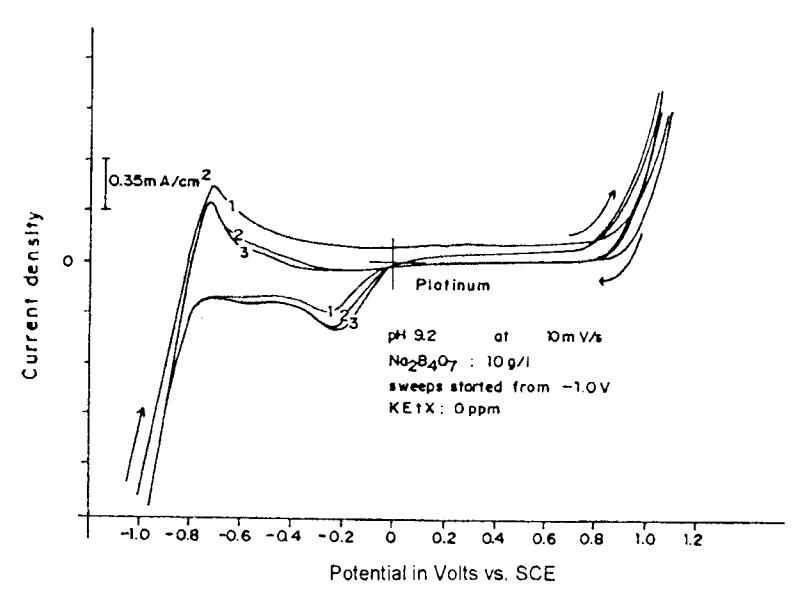
Figure 3 Voltammograms oblained on a platinum el€clrodo dipped in xanlhale{ree borate solutions for a potenlial sw€ep ral€ of 10 mV/s
From the phenomenon shown in Fig 3, that is the appearance of positive potential plateau (from 0 to 800 mV), it seems that the LPSV test performed on platinum electrodes does not allow to distinguish between chemisorption of substances OH and O on the platinum surface.
Observation in the positive regions of Fig. 3 suggests that the oxygen evolution proceeds in one step, namely the reverse of reaction (1).
Since the reversible potential of reaction:
\[2H^{+} + 2e \rightarrow H_2 \tag{4}\] is -789 mV the hydrogen overvoltage at platinum is negligible, it is evident that at pH 9.2 hydrogen evolves at platinum electrodes at potentials more negative than -800 mV. As the potential is increased from -1000 mV, current begins to increase crossing the potential axis at -800 mV, which is close to the equilibrium potential of reaction (4).
5 Platinum electrode in aqueous xanthate borate solutions
The voltammograms presented in Fig. 4 which are obtained by sweeping the potential of the platinum electrode between -1000 mV and +1200 mV, indicate the decrease of the anodic oxidation peak at ca. -750 mV with increasing xanthate concentration. It seems thus that the hydrogen adsorption is inhibited in the presence of xanthate ions. The inhibition of hydrogen adsorption is probably due to the adsorption of xanthate ions without charge transfer.
Since the current density for the oxygen evolution decreases with increasing xanthate concentration, the oxygen desorption is inhibited in the presence of xanthate ions. This is probably due to the presence of dixanthogen on the surface of the platinum electrode, according to:
\[2 \operatorname{EtX}^{-} \to \operatorname{EtX}_{2} + 2e \tag{5}\]
In Fig. 4 as a potential increases, the current begins to increase rapidly, giving rise to a very well defined at ca. +750 mV. This peak which is observed only in the presence of xanthate ions can be envisaged as a further possible reaction between xanthate ions and chemisorbed OH at the surface of platinum according to:
\[Pt (OH)_x + 2EtX^- \rightarrow Pt + EtX_2 + xOH^- + (2-x)e\] (6)
A similar behavior was reported by Sudarsono (1988b), studying the current reversal chronopotentiometric responses of electrochemical interaction of platinum-xanthate, that the formation of dixanthogen may involve the following reactions in addition to reaction (5):
\[Pt (OH)_x + EtX^- \rightarrow PtEtX + xOH^- + (1-x)e\] (7)
\[PtEtX + EtX^{-} \rightarrow Pt + EtX_{2} + e\] (8)
The overall reaction combining reactions (7) and (8) is equivalent to reaction (6).
6 Copper in xanthate-free borate solutions
It is generally agreed that in alkaline solutions Cu<sub>2</sub>O, CuO and Cu(OH)<sub>2</sub> are formed on the surfaces of copper electrode upon anodically polarized, namely:
\[2 Cu + H2O = Cu2O + 2H+ + 2e Eo = 0.226 V\] (9)
\[Cu_2O + H_2O = 2 CuO + 2H^+ + 2e E^\circ = 0.424 V\] (10)
\[Cu_2O + H_2O = Cu(OH)_2 + 2H^+ + 2e E^\circ = 0.502 V\] (11)
For a pH value of 9.2, the equilibrium potentials of reactions (9), (10), and (11) are -318 mV, -120 mV, and -42 mV respectively. These values reveal that the formation of Cu<sub>2</sub>O, CuO and Cu(OH)<sub>2</sub> is possible from -318 mV to before oxygen evolution potential.
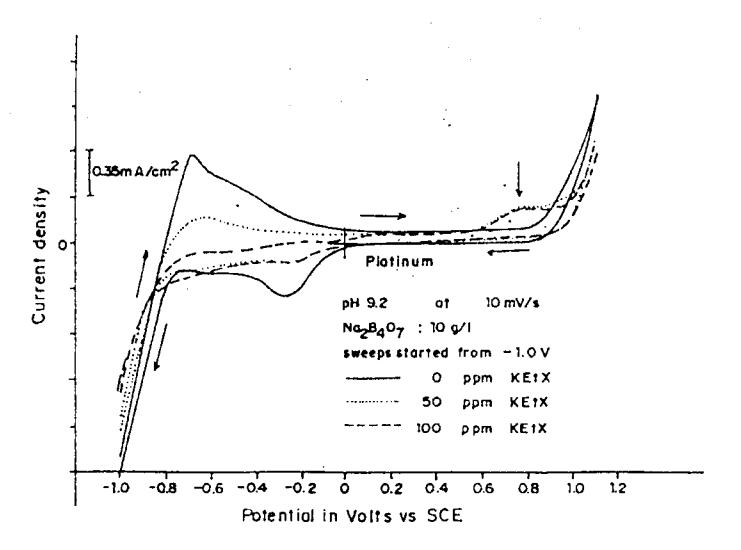
Figure 4 Voltammograms obtained on a platinum electrode dipped in xanthate containing borate solutions for a potential sweep rate of 10 mV/s
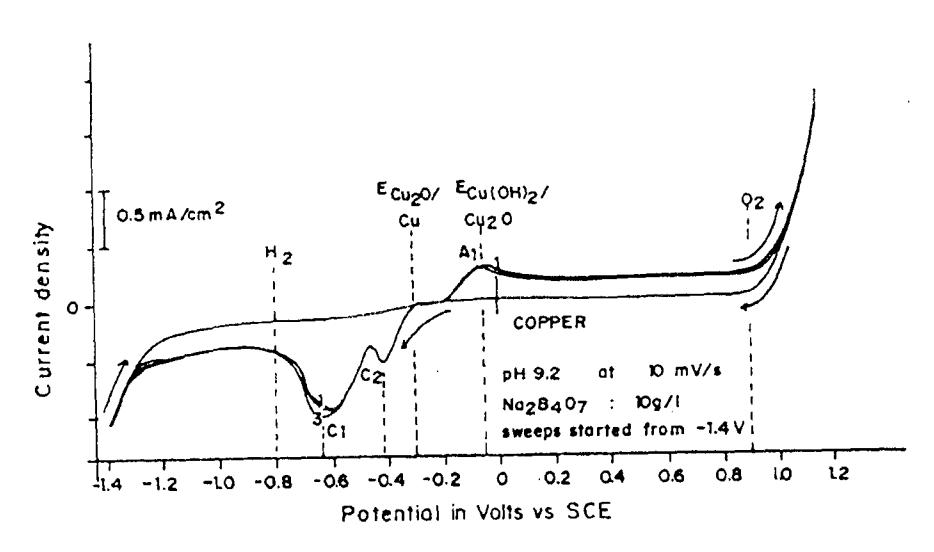
Figure 5 Voltammograms of a copper electrode dipped in xanthate-free borate solutions
Fig. 5 shows voltammograms of copper electrode dipped in a borate solution at pH 9.2 for a potential sweep rate of 10 mV/s. The potentials were positively polarized from the hydrogen evolution potential region to +1200mV and were reversed back to the negative potentials.
As the potential is raised during a sweep cycle, a peak related to the oxidation of copper is observed on the positive current region followed by potential plateaus which may be associated with the passivation effect. On the negative current region two peaks are observed. It can be seen that one of the peaks on the negative current region is much broader than the other, this suggests that there is a two-stage reduction of the products formed during anodic potential sweep, namely reduction of CuO to Cu<sub>2</sub>O and Cu<sub>2</sub>O to Cu and the peak which is narrower can be assimilated to the reduction of Cu(OH)<sub>2</sub> to Cu<sub>2</sub>O.
To gain further insight into the processes of oxidation and reduction of copper, a potentiodynamic measurement was conducted with successively increased of the reversing potential. The potential of a copper electrode was positively polarized at a potential sweep rate of 10 mV/s from -1400 mV and then negatively reversed at -300, -200, -100, 50, 400, 600 and 1200 mV. The results are shown in Fig. 6.
Voltammograms shown in Fig. 6 reveal the sensitivity of the cathodic current peaks to the reversing potential. The increase in the value of the reversing potential increased the current in the negative potential region between -700 mV and -200 mV. There are two cathodic current peaks in this potential region, which are identified as C1 and C2 peaks. The C1 peak is observed firstly when the reversing potential is equal to -100 mV (curve 3); since the equilibrium potentials of reactions (10) and (11) are smaller than -100 mV and C1 peak is much broader than C2 peak, is likely that C1 peak may be associated with the reduction of both CuO to Cu2O and Cu2O to Cu. Moreover, when the reversing potential is increased to 50 mV which is higher than the equilibrium potential of Cu(OH)<sub>2</sub> formation as indicated by reaction (11), the first cathodic current peak, C2 appears at ca. -200mV, this behavior suggests that reduction of Cu(OH)2 to Cu<sub>2</sub>O takes place at C2 peak.
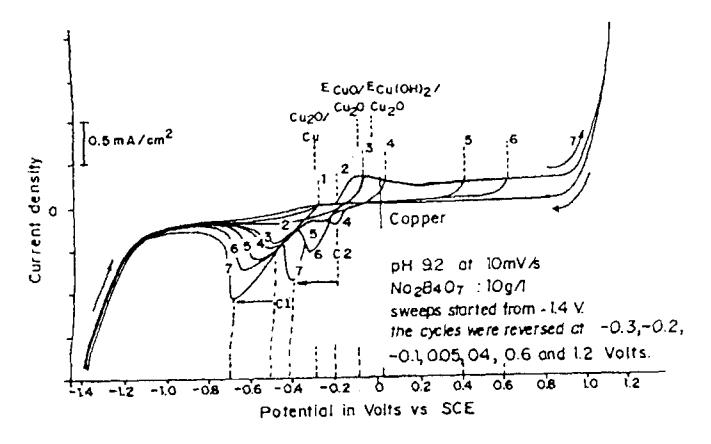
Figure 6 Voltammograms of a copper electrode dipped in a xanthate-free boratesolution for a potential sweep rate of 10 mV/s showing the influence of reversing potential
7 Copper in xanthate containing borate solutions
Figure 7 shows the potentiodynamics traces of a copper electrode dipped in borate solutions containing from 50 ppm up to 200 ppm KEtX.
The potential sweep rate was 10 mV/s. The shape of the voltammograms changes considerably compared to those shown in Fig. 6. As potential is raised from -1400 mV, four anodic current peaks are observed, namely, A1, A2, A3 and A4. On reversing the potential sweep at +1200 mV only three cathodic current peaks are observed i.e. C1, C2 and C3 in the negative potential region.
The thermodynamic data of Hepel and Pomianowski (1977) suggest that xanthate ions may react spontaneously with copper surfaces lead to the formation CuEtX and Cu(EtX)<sub>2</sub>:
\[CuEtX + e = Cu + EtX^{-}E^{\circ} = -0.864 V\] (12)
Cu \[(EtX)_2 + 2e = Cu + 2EtX^- E^{\circ} \approx -0.588 V\] (13)
The voltammograms in Fig.7 display a quite well defined peak at ca. -650 mV. This peak which is labeled as A1 can be related to the formation of CuEtX as indicated by reaction (12). For a xanthate concentration of 50 ppm this reaction has an equilibrium potential at -657 mV. The second peak in the polarization curves, indicated by A2 peak at ca. -500 mV, is expected to represent the formation of Cu(EtX)<sub>2</sub> as indicated by reaction (13). The height of A2 peak is greater than that of A1 peak showing a difference of charge transfer, one electron for reaction (12) and two for reaction (13).
As previously mentioned, dixanthogen may be formed by the oxidation of xanthate ions according to equation (5). For a xanthate concentration of 200 ppm the equilibrium reaction of dixanthogen formation may occur at -150 mV. There is no peak in Fig.7 that can be related to the formation of dixanthogen. It seems thus that according to the results of potentiodynamic method, there is no clear indication that reaction (5) may occur on copper electrodes, although quite a small potential sweep rate has been used.
The height A4 peak is almost constant but it is shifted to more positive values with increasing xanthate concentration. Since there is no cathodic current peak, decomposition of CuEtX species as oxidation reactions are suggested to occur at this peak.
It can be seen that the onset of A4 peak is shifted to more positive value with increasing xanthate concentration.
It can be seen from Figure 7 that the height of A3 peak which related to the oxidation of copper electrode decreases at increasing xanthate concentration. This suggests that the oxidation of copper electrode is inhibited with the presence of xanthate ions in the solution.
A similar phenomenon is shown by C3 peak, its current density decreases with increasing xanthate concentration. It is reasonably therefore to relate A3 peak with C3 peak representing the oxidation-reduction of copper electrode in aqueous xanthate borate solutions.
Observation at C1 and C2 reduction peaks suggests to relate with reactions (12) and (13) since their cathodic current densities increase with increasing xanthate concentration indicating the increase of the amount of copper-xanthate species formed previously. The A1 peak is related to C1 peak while A2 peak to the one of C2 peak.
The SACV-test results in xanthate containing solutions (Fig.8) reveal a sharp decrease of the Rapp-value between -800 and -450 mV with a minimum value at -650 mV. This potential region may correspond to the formation of CuEtX as expressed by reactions:
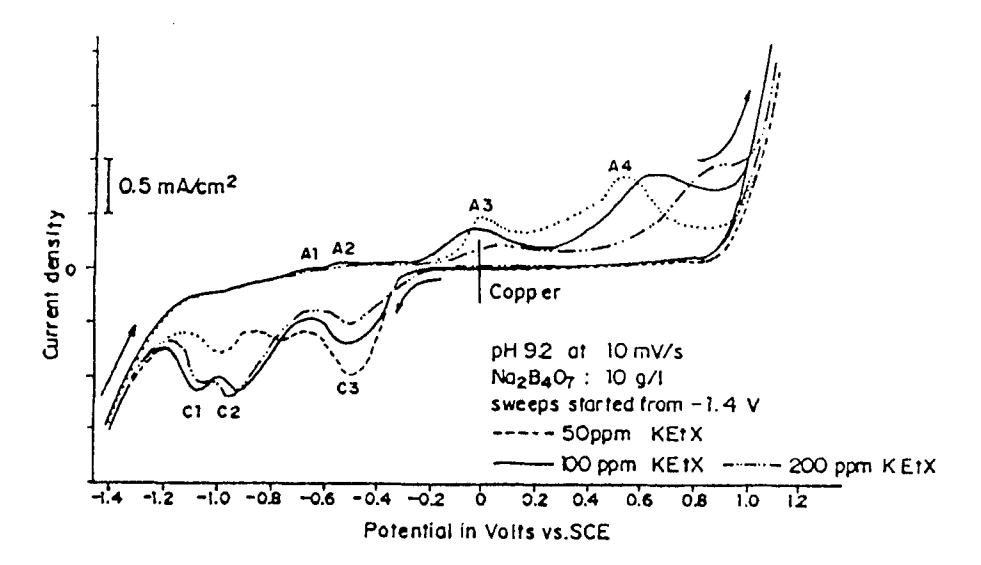
Figure 7 Voltammograms of a copper dipped in borate solutions containing different xanthate concentrations for a potential sweep rate of 10 mV/s
PROC. ITB, VOL. 31, NO. 3, 1999
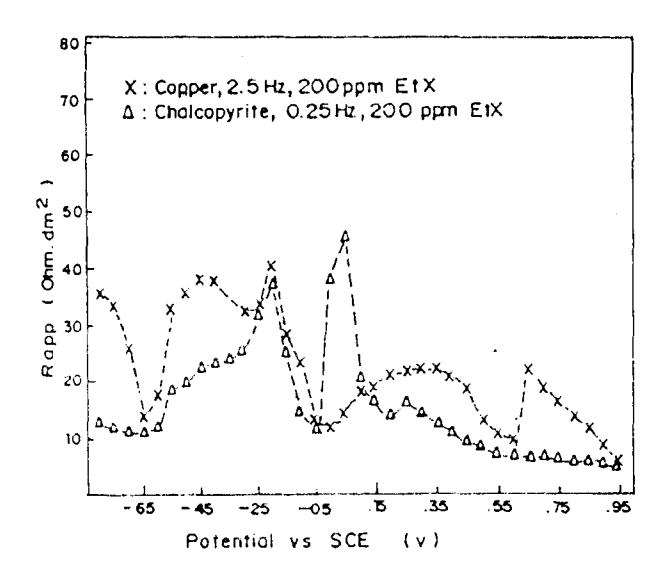
Figure 8 SACV-test results of copper and chalcopyrite
\[CuO + (EtX)_2 + 2H^+ + 2e = Cu(EtX)_2 + H_2O\]
\(E^\circ = 0.612 \text{ V}\) (15)
Between –200 and 0 mV, Rapp decreases with increasing potential. This phenomenon can be linked to the possible formation of dixanthogen mentioned by Roos et. al (1988) and indicated by reaction:
\[2 \text{ EtX}^- = (\text{EtX})_2 + 2e \quad \text{E}^\circ = -0.3306 \text{ V}\] (16)
with regard to the minimum values of Rapp in the range of +500 up to +800 mV and above +800 mV. A link with oxygen evolution can be made. A similar phenomenon was observed in SACV-tests on platinum at a frequency of 2.5 Hz for potentials at +700 and +950 mV reportes by Roos et. al in 1988. However, in case of copper, the Rapp-value decreases above +550 mV with increasing xanthate concentration (Ross et. al 1990). This indicates that besides the oxygen evolution additional reactions do occur. The decomposition of Cu-EtX species according to the reactions (12) and (13) (Hepel and Pomianowski, 1977) is such a posibility.
The microflotation-electrochemical cell results on copper particles are shown in Fig. 9. The flotability of copper is strongly potential dependent. The onset of flotability is observed at -800 mV and may thus be related to the formation of CuEtX according to reaction (12). The flotability raises up to 40% between -600 and -300 mV. This effect can be related to the formation of Cu(EtX)<sub>2</sub> according to reaction (13). A small decrease in flotability is observed at -100mV which is followed by a remarkable increase at +100 mV. It is anticipated that a competition between the oxidation of copper resulting in the formation of Cu<sub>2</sub>O according to reaction (9) and oxidation resulting in Cu-EtX species, e.g. reactions (14) and (15), may reduce the flotability at -100 mV. This is further substantiated by HAVC voltammograms shown in Fig.6, from which a decrease of the A3 peak height related to reaction (12) with xanthate addition can be seen. The voltammograms shown in Fig. 7 display quite well defined peaks (A1 and A2) at ca. -650 mV that can be related to reaction (14).
The remarkable flotability at +100 mV indicates that dixanthogen which can be formed above -150 mV greatly influences the flotability of copper. When the potential is further raised above +200 mV, flotation is suppressed. It is believed therefore that Cu-EtX species may undergo decomposition above +200 mV. Furthermore, this is confirmed by the appearance of current peaks, labeled as A4 in the voltammograms of copper dipped in xanthate solutions, shown in Fig. 7.
8 Chalcopyrite-xanthate interaction
Electrochemical micro-flotation tests for chalcopyrite are shown in Fig. 9. The onset of this flotability is observed at -400 mV. It is clear that the onset of flotability coincides well with the equilibrium potential of the reaction proposed by Richardson and Walker in 1985:
\[CuFeS_2 + EtX^- \rightarrow CuEtX + FeS_2 + e\] \[E^\circ = -0.618 \text{ V}\] (17)
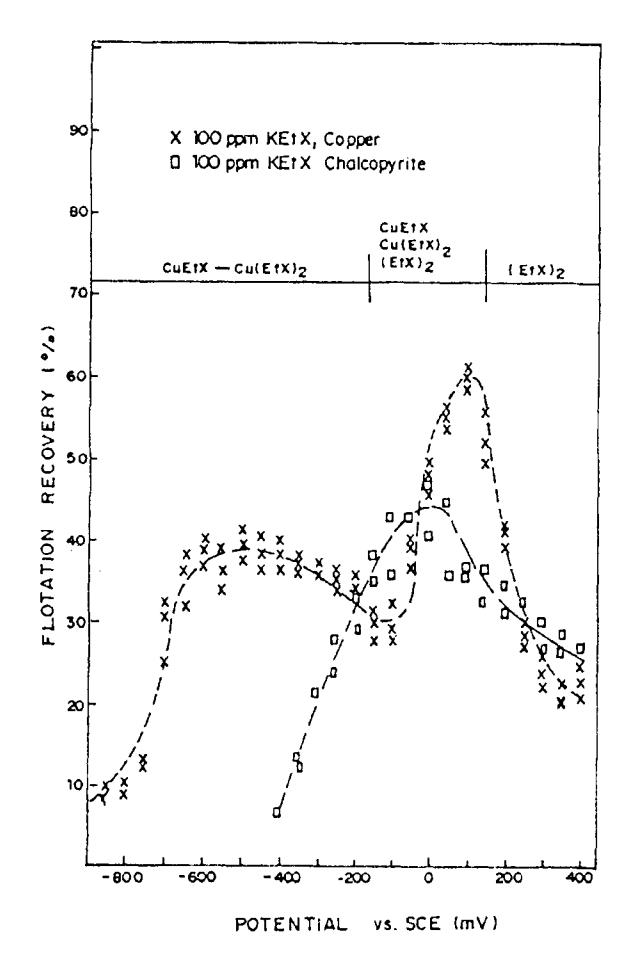
Figure 9 Flotation-test results in microflotation-electrochemical ceil (Roos et.al 1990a)
wftere chalcopyrite reacts directly with xanthate ions. Since equation (17) derives CuEtX and, as shown previously, that CuEtX is a species responsible for the hydrophobization of copper particles, CUEIX seems also to be responsible for the onset of flotation of chalcopyrite at -400 mV. Reaction (17) can occur before the dixanthogen formation, and there is no doubt that CuEtX participates inthe hydrophobization of chalcopyrite. This conclusion is in agreernent with the Rapp value of chalcopyrite shown in Fig. 8 (Roos et. al. 1988),
Thc recovery of chalcopyrite increases further at increasing potential and rcaches amaximum at ca. 0 mV. In analogy with the copper flotation, this can be related to thc dixanthogen formation at potentials above -150 mV. Indecd the Rapp-values measured in a 200 ppm KEI.X solution at a frequency of 0.25 Hz. show a sharp decrease at-200 to 50 mV (Fig. 8).
From a lirrthcr observation of the Rapp values between +150 up to +250 mV, there is evidence that Cu-EtX species decornpose in this potential rcgion. The Rapp value decreases with increa.sing potential.
9 Conclusions
The formation of dixanthogen at platinum electrode besides due to the oxidation of ethvl xanthate ions according to:
\[EtX^{-} = EtX_{2} + 2e\]
\(E = -0.3261 - 0.0591 log [EtX^{-}] Volt\)
may also be formed by an exchange reaction between OH chemisorbed on the platinum surfaces and xanthate ions at highly positivc potentials:
Pt \[(OH)_x + 2EtX^- \rightarrow Pt + EtX_2 + xOH^- + (2-x) e\]
From the electrochemical study carried out on copper electrodes in aqueous xanthate borate solutions, it becomes apparenthat Cu-EtX species such as CUEIX and Cu(EtX)z may be responsible for the hydrophobization of copper surfaces. The formation of these species by direct reactions between copper surfaces and xanthate ions is expected to occur above -700 mV according to reactions
\[Cu + EtX^{-} \rightarrow CuEtX + e\]
\(Cu + 2 EtX^{-} \rightarrow Cu(EtX)_{2} + 2 e\)
However, although the use of a fairly slow linear potential sweep to rnodulate an electrochemical process has received a wide application to interpret the phenomena observed in the electrochemical system, LPSV studies on the anodic oxidation of copper in xanthate alkaline solutions have not showed a fundamental understanding concerning the reaction mechanisms of dixanthosen formation.
It is shown that besides Cu-EtX species, dixanthogen also influences the flotability of copper particles. However, dixanthogen alone is not sufficient to render copper partrcles floatable. Further it is shown that flouability is suppressed above +200 mV, and this can be related to the decomposition of Cu-EtX species.
From SACV-tests on chalcopyrite, itbecomes evident that besides dixanthogen, CuEtX may also be fonned by a direct reaction betwecn chalcopyrite and xanthate ions at potential above -300 rnV. The flotation-tests conhrmed that dixanthogen alonc is not sufhcient to render chalcopyrite mineral floatable since the flotability decreases atpotentials whcre thc decomposition ofCu-EtX species occurs namely above +100 mV.
10 References
- l. Feldberg, S.W., Enke, C.G. and Bricker, C.E., Fonnation and Dissolution of Platinum Oxide Film : Mechanism and Kinetics, J. Electrochen. Soc., 11L (7).826-834 ( 1963).
- 2. Roos, J.R., Celis, J.P., Sudarsono, A.S., Investigation of Xanthate Interaction on Platinum and Chalcopyrite by Small Amplitude Cyclic Voltammetry, Int. J. of Mineral Processing, 24,91 l10 0988).
- 3. Roos, J.R., Celis, J.P., Sudarsono, A.S., Electrochemical Control of Merallic Copper and Chalcopyrite-Xanthate Flotation, Int. J. of Mineral P ro c e ssing, 28, 23 l -245 ( I 990).
- 4. Gardner, Jr., Woods, R., The Use of A Particulate Bed Electrode for The Electrochemical Investigation of Metal and Various Sulphide Flotatron, Aust. J. Chenu, 26, 1635- l&4 (197 3).
- 5. Hepel, T. Pomianowski, A., Diagrams of Electrochemical Equilibria of The System Copper-Potassium Ethyl Xanthate-Water at25o C, Int. J. of Mine ral P roc ess, 4. 345 -361 ( 1977).
- 6. Richardson, P.E., Walker, G.W., The Flotation of Chalcopyrite, Bornite, Chalcocite and Pyrite in An Electrochemical-Flotation Cell, XVth Int. Mineral Process. Congr., Cannes, France, Tome II, 198-210 098s).
- 7. Sudarsono, A.S., 1988a., Small Amplitude Cyclic Voltammetric Study of Xanthate Flotation of Copper-Sulphide Minerals, Ph. D. Thesis, Katholieke Universiteit Leuven, Belgium, January 1988.
- 8. Sudarsono, A.S., 1988b., Analisis Kronopotensiometrik Arus Balik pada Interaksi Elektrokimia Platina-Xanthate, P ro c. ITB, 1988.
- 9. Walker, G.W., Stout III, Richardson, P.8., Electrochemical Flotation of Sulfides: Reactions of Chalcocite in Aqueous Solutions, Int. J. of Mineral. P ro c e ss. 12. 55 -7 Z ( 1984).