

Studi pembuatan semen campur (blended cement) dari campuran terak tanur tiup dan klinker semen portland
Sari
Paper ini menyajikan hasil percobaan laboratorium yang meneliti pengaruh kehalusan terak dan komposisi terak yang ditambahkan ke dalam klinker semen portland. Hasil percobaan menunjukkan bahwa terak dengan kehalusan 4260 cm²/gram dapat ditambahkan ke dalam klinker sampai maksimum 30%, untuk meningkatkan kuat tekan dari semula 28 Mpa menjadi 40 MPa. Foto SEM menunjukkan bahwa kekosongan antarbutir partikel terak dengan partikel pasir terisi dengan baik oleh pasta halus CaO-SiO<sub>2</sub>-H<sub>2</sub>O setelah pengamatan selama 28 hari. Untuk klinker tanpa terak, pasta masih mempunyai pori meskipun setelah 28 hari pengamatan. Kehalusan terak lebih penting daripada komposisinya di dalam semen campur.
Kata kunci: hidrasi semen, kehalusan, klinker semen portland, kuat tekan, terak tanur tiup
1. Introduction
A slag is formed in the pyrometallurgical processes, from the fusion of limestone with the siliceous and aluminous residue remaining in the ore after the reduction and separation of the metal. The slag rises to the surface and is tapped off from time to time. The composition of the slag varies with the kind of impurities in the ore being processed, limestone or dolomite added, and ash in the reducing agent. The oxides found in slag are CaO, SiO<sub>2</sub>, Al<sub>2</sub>O<sub>3</sub>, MgO, FcO, and MnO, with the main constituents being CaO, SiO<sub>2</sub>, Al<sub>2</sub>O<sub>3</sub>, and MgO, which can formed up to 98% by weight.
Considering the slag composition compared to the cement composition, and referring to the environment conservation, there has been brought to light the possibility of using slag as a blending component mix with clinker portland cement to make a blended cement, or a pozzolanic portland cement.
The objective of this research is to study the effect of different parameters on the consistency and strength development of mortars, such as the percentage of slag mixed with clinker portland cement and the fineness of the slag.
In this investigation the clinker portland cement is obtained from PT. Indocement Tunggal Prakarsa, and the slag is received from PT. Krakatau Steel, originally from Thyssen Stahlag, Germany.
2. Experimental work
A series of suitable sets of slag cement mortars and pastes manufactured with different composition of slag were prepared using ground slag of different fineness. Table 1 shows the fineness and strength activity index of the slag. The slag is named as Slag A, Slag B, and Slag C showing their different fineness and strength activity index.
Table 1 Fineness and strength activity index of the slag powder
| Fraction (mesh) | Weight (%) | Fineness (cm²/gram) | Strength activity index | Specimen's name |
|---|---|---|---|---|
| + 325 # | 8.50 | 3120 | 102.50 | Slag A |
| + 325 # | 7.00 | 3630 | 117.55 | Slag B |
| + 325 # | 5.00 | 4260 | 125.84 | Slag C |
Table 2 Clinker and slag chemical compositions
| Constituent | % Weight | |
|---|---|---|
| Clinker | Slag | |
| CaO | 67.20 | 44.80 |
| SiO₂ | 21.47 | 34.30 |
| Fe2O3 | 1.17 | 0.05 |
| MgO | 1.61 | 5.91 |
| Al2O3 | 5.17 | 4.21 |
| K₂O | 0.52 | 0.37 |
| MnO | 0.62 | 1.44 |
| SO3 | 0.83 | - |
| IR | 0.29 | - |
| Free CaO | 1.49 | 0.99 |
Table 3 Clinker and gypsum properties
| Parameter | Clinker | Gypsum |
|---|---|---|
| Density | 3.17 gram/cm3 | 2.53 gram/cm3 |
| Fineness | 2950 cm²/gram | 6400 cm²/gram |
| Mean diameter | 6.41 μm | 3.71 μm |
| Fraction + 325 # | 8.70 % weight | 3.53 % weight |
Table 4 Sieve analysis of Bangka Sand
| Size (mesh) | % Weight |
|---|---|
| - 14 + 28 | 62.34 |
| - 28 + 35 | 25.16 |
| - 35 + 48 | 9.23 |
| - 48 + 65 | 1.77 |
| - 65 | 1.50 |
Table 5 Mixture proportion of slag with clinker for normal consistency and setting time tests
| Slag (% weight) | Clinker (% weight) | Gypsum (% weight) | Water volume (m liter) |
|---|---|---|---|
| 0 | 97 | 3 | 157 |
| 5 | 92 | 3 | 157 |
| 10 | 87 | 3 | 157 |
| 15 | 82 | 3 | 156 |
| 20 | 77 | 3 | 155 |
| 25 | 72 | 3 | 155 |
| 30 | 67 | 3 | 154 |
| 35 | 62 | 3 | 153 |
| 40 | 57 | 3 | 153 |
Table 6 Mixture proportion of slag with clinker for strength activity index and compressive strength tests
| Slag (% weight) | Clinker (% weight) | Gypsum (% weight) | Sand (gram) |
|---|---|---|---|
| 0 | 97 | 3 | 2035 |
| 5 | 92 | 3 | 2035 |
| 10 | 87 | 3 | 2035 |
| 15 | 82 | 3 | 2035 |
| 20 | 77 | 3 | 2035 |
| 25 | 72 | 3 | 2035 |
| 30 | 67 | 3 | 2035 |
| 35 | 62 | 3 | 2035 |
| 40 | 57 | 3 | 2035 |
* the total weight of slag, clinker, and gypsum is 740 gram
For comparison purposes Table 2 shows the chemical composition of clinker and slag used in this investigation. It can be seen that the quantity of CaO and \(SiO_2\) in the slag is about 79% by weight. Therefore, the blended cement is useful for effective utilization of wastes from pyrometallurgical plants, and can save resources in the cement manufacturing plant.
Table 3 shows the main parameters of clinker and gypsum. For normal consistency and setting time tests the amount of gypsum is kept constant at 3% by weight. Table 5 shows the mixture proportion of slag, clinker, and gypsum for the tests. The amount of slag is ranging between 0 up to 40% by weight. The test is in accordance with ASTM C187-86 and ASTM C191-92.
For strength activity index and compressive strength test, the amount of sand added is kept constant at 2035 gram. According to the ASTM C109-92 the ratio of cement to sand is 2.75 and since the amount of cement (slag, clinker, gypsum) used in this test is 740 gram then the amount of added sand is 2035 gram.
Slag with specified fineness (Table 2) are blended together and then mixed either with water (Table 5) or with sand (Table 6) in accordance with ASCM C311-96 From each mix, 50x50x50 mm cubes are cast and store in a moist room, and then tested at 3, 7, and 28 days old.
To study the influence of slag content on the behaviour of blended cement paste, the various tests such as specific area, compressive strength, setting time, and expansion tests have been carried out.
Scanning electron microscope (SEM) studies of slag particles in cement - slag paste will be carried out to elucidate the interaction of those particles.
3. Test results and discussion
According to ASTM C618-96 a possessione portland cement has strength activity index of at least 75. Table 1 shows that the slag has snength activity index above 102.50 which is very smable as partial replacement of clinker portland cement in blended cement or in pozzolanic portland cement manufacturing.
Figure 1 shows the influence of slag fineness at different slag composition to the normal consistency which in general decreases with increasing slag content. The normal consistency is almost constant at 24.15% for pastes with up to 10% slag, and suddenly decreases from 24.15% down to 23.85% for pastes with 20% slag, and 23.54% for pastes with 40% slag. From this observation, the use of slag can reduce the water consumption, since the number and volume of pores are reduced. However, the normal consistency is not influenced by slag fineness.
Figure 2 shows the influence of slag fineness at different slag composition to the initial setting time (=IST), while in Figure 3 to the final setting time (=FST).
In general, the IST and FST increase with the increase of slag content. It is well known that the slag component reacts more slowly than ordinary portland cement. This fact is substantiated by the results shown in Figures 2 and 3. The figures show also that the IST and FST are influenced by the slag fineness. In general the slag has IST and FST smaller than those of slag A and slag C.
Figures 4 to 6 show the compressive strength test results at 3 different ages. It can be seen that in general the addition of slag can increase the compressive strength. The formation of C<sub>3</sub>S (3 CaO · SiO<sub>2</sub>) determines the initial strength since it reacts with water, releasing high enthalpy hydration according to the following cementation reaction:
2 (3 CaO · SiO2) + 6 H2O \[\rightarrow\] 3 CaO · 2 SiO2 · 3 H2O + 3 Ca (OH)2
The added slag can react with Ca (OH)<sub>2</sub> and the production of CaO S<sub>1</sub>O<sub>2</sub>·H<sub>2</sub>O gel can therefore also increase, which finally corresponds to the increase of its compressive strength.
At 3 days old (Figure 4) the highest compressive strength of 13.5 MPa is observed for 15% slag C, and at 7 days (Figure 5) and 28 days (Figure 6) old the highest
compressive strengths are 22.9 MPa and 40.2 MPa respectively, both for 30% siag C. This results show that at early ages the cementitious reaction of slag tends to delay the reaction of cements, and this may be due to the reaction of slag which consumed part of the calcium hydroxide formed during earlier ages of hydration.
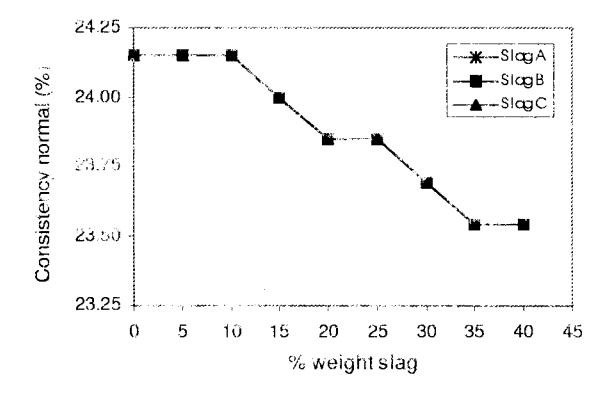
Figure 1 The effects of siag fineness and weight percent stage on the normal consistency
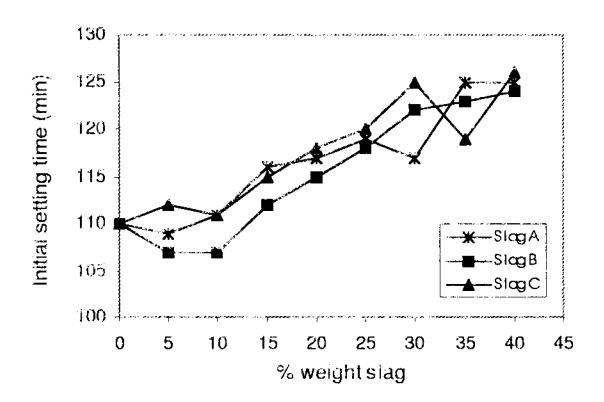
Figure 2 The effects of slag fineness and weight percent slag on the initial setting time
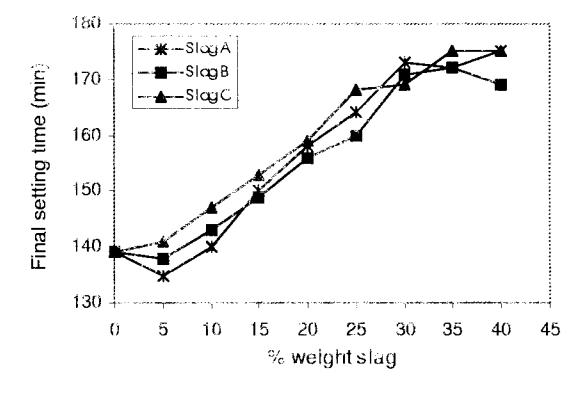
Figure 3. The effects of stag fineness and weight percent stag on the final setting time.
Figure 4 The effect of slag fineness and weight percent slag on the compressive strength at 3 days old
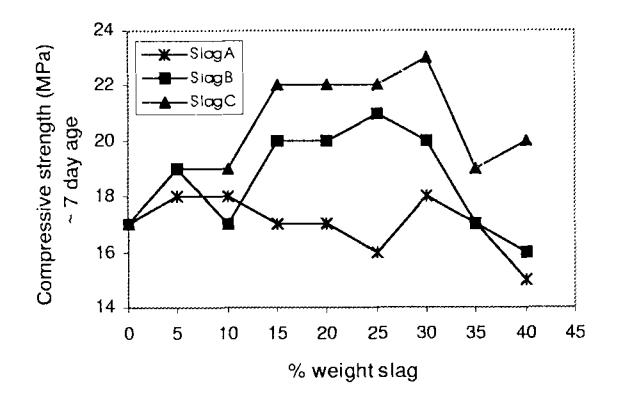
Figure 5 The effect of slag fineness and weight percent slag on the compressive strength at 7 days old
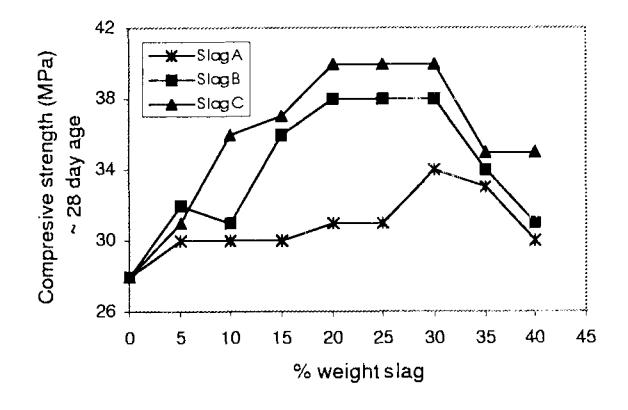
Figure 6 The effect of slag fineness and weight percent slag on the compressive strength at 28 days old
In general, higher compressive strength is obtained from paste containing slag C which is 95% finer than 325 mesh. It seems that the finer the slag particles, the more active the reaction with Ca(OH)<sub>2</sub> released by clinker, and the slag can fill the intergranular voids.
However, pastes with more than 30% slag tend to decrease their compressive strength, both for pastes of 7 days old and 28 day old. This decrease may be due to the Ca (OH)<sub>2</sub> produced by cementation reaction which is all consumed by added slag. Above 30% slag, it seems that no Ca(OH)<sub>2</sub> is left and the added slag only act as fine
aggregates. The more Ca (OH), is a adult the more slag can be added, and the higher the compressive strength of the paste is at later age.
Figure 7 SEM microstructures of clinker paste without slag addition at 28 days old (P = Pore; CSH = CaO.SiO<sub>2</sub>.H<sub>2</sub>O; 4000x)
Figures 7 to 10 show SEM micrographs taken from hydrated pastes. In case of clinker without slag (Figure 7), densification of CaO-SiO<sub>2</sub>-H<sub>2</sub>O gel still left pore, even after 28 days old.
However, the \(C_3S\) is the most important constituent in determining the initial strength. The \(C_2S\) shows similar behavior to \(C_3S\), but it is slower to react. The \(C_2S\) continues to hydrate late in the setting period, and may then contributes to the strength of the cement according to
\(2 (2CaO.SiO_2) + 4H_2O \rightarrow 3CaO.2SiO_2.3H_2O + Ca (OH)_2\)
When slag is used, needle-like ettringite starts actively growing between slag particles at an early age of curing with simultaneous formation of fibrous CaO-SiO<sub>2</sub>-H<sub>2</sub>O gels (Figure 8). At 28 days old, the inter granular voids between slag particles and sand particles are densely filled with fine CaO-SiO<sub>2</sub>-H<sub>2</sub>O gel (Figure 10).
Figure 8 SEM microstructures of clinker paste with 30% slag addition at 3 days old (T = slag; E = Ettringite; 2000x)
It can be seen that the stag particles can fit the intergranular ords it so to deat the linene's of stag particles is more important than the stag composition in the blended cement
Figure 9 SEM microstructures of clinker paste with 30% slag addition at 7 days old (6000x) (CSH = CaO.SiO<sub>2</sub>.H<sub>2</sub>O; T = Slag; 6000x)
Figure 10 SEM microstructures of clinker pasts with 30% slag addition at 28 days ora (4000%)
4. Conclusions
The whole of the experimental results indicate that slag can be used as a separate cementitious material added to a portland cement clinker to produce blended cement. The slag can react with the Ca (OH)<sub>2</sub> produced during cementation reaction, giving rise to the production of C-S-H gel, and finally increased its compressive strength. The finer the slag in the blended cement, the higher is its compressive strength.
5. References
- Ashed, H., "Kontribusi Nikel Slag-Cement terhadap kekuatan dan durabilitas beton kinerja tinggi", Thesis, Magister Rekayasa Struktur, Teknik Sipil, ITB, 1998.
- 2. Frigione, G., and Sersale, R., "Blast furnace cement mortars manufactured with fresh granulated and weathed slags", Cement and Concrete Research, 24, 3, (1987)
- Kosasih, K. M., "Studi pemanfaatan terak tanur tiup sebagai bahan substitusi parsial klinker dalam pembuatan semen portland pozzolan", Tugas Akhir, Jurusan Teknik Pertambangan, FIKTM, ITB, 1999.
- Lea, F. M., "The chemistry of cement and concrete", London, 1970.
- 5. Sudarsono, A., and Zamani, A., "Study on the making of blended cement by mixing slag with ordinary portland cement type \(\Gamma\)", (in preparation).
- Zamani, A., "Studi pembuatan semen pozzolan portland dari campuran terak tanur tiup dengan semen portland tipe I", Tugas Akhir, Jurusan Teknik Pertambangan, FIKTM, ITB, 1999.