

Sari
Efek doping boron (B) terhadap struktur kristal dan sifat optik lapisan tipis ZnO untuk divais optoelektronik
Telah dilakukan studi tentang pengaruh doping B<sub>2</sub>H<sub>6</sub> terhadap struktur kristal dan sifat optik lapisan tipis ZnO. Orientasi kristal lapisan tipisnya dievaluasi dengan difraksi sinar-x. Diperoleh bahwa puncak refleksi (110) mendominasi seluruh film dan berkurang sejalan dengan penambahan laju aliran B<sub>2</sub>H<sub>6</sub>. Ukuran butir kristal dari film juga berkurang sejalan dengan penambahan laju aliran B<sub>2</sub>H<sub>6</sub>. Transmitansi pada daerah panjang gelombang ultra violet bergeser ke arah energi yang lebih tinggi sejalan dengan penambahan laju aliran B<sub>2</sub>H<sub>6</sub>. Ditemukan pula bahwa indeks bias lapisan tipis ZnO bertambah sejalan dengan penambahan laju aliran B<sub>2</sub>H<sub>6</sub>. Efek-efek doping tersebut harus diminimalkan agar dapat diperoleh lapisan ZnO beresistivitas rendah dengan sifat optik yang baik untuk aplikasi pada divais fotonik.
Kata kunci: doping, struktur kristal, sifat optik, transmitasi, indeks bias.
1 Introduction
Zinc oxide (ZnO) as a semiconducting, photoconducting, piezoelectric, and optical waveguide materials show a wide range of scientific and technological applications. The properties of ZnO include the optical transparency in the visible region, high refractive index, the anisotropy in crystal structure, the nonstoichiometric defect structure, the wide-band gap, large piezoelectric constants, and strong acoustooptical electrooptical and nonlinier optical coefficients<sup>1)</sup>.
Undoped ZnO thin films usually show a low resistivity. However, the donor-like states are thermally unstable<sup>2</sup>. To obtain films with a stable and low resistivity, doping process is necessary. The addition of dopant may influence the structural and optical properties of the films. This paper reports the result of a study on the effect of boron (B)-doping on the crystal structure and the optical properties of ZnO thin films.
2 Experimental
Metalorganic chemical vapor deposition (MOCVD) method was used to grow the film. Figure 1 shows a schematic diagram of the ZnO deposition system. Diethylzinc (DEZ) and H<sub>2</sub>O as reactant gases. The B<sub>2</sub>H<sub>6</sub> gas was used as n-type dopant gas. The DEZ and H<sub>2</sub>O were contained in bubblers and were kept in temperature-controlled bath. The reactant gases were bubbled with Ar as carrier gas. The flow rates of DEZ/H<sub>2</sub>O transported to the growth chamber were kept at 20 secm. ZnO films were grown on a Corning 7059 glass substrate. Total pressure during the growth was kept at 1 Torr.
Figure 1 Schematic Diagram of the ZnO Deposition System.
The crystal orientation of the films were evaluated by X-ray diffraction and the optical properties were measured by the double-beam monochromator in atmospheric ambient.
3 Results and discussion
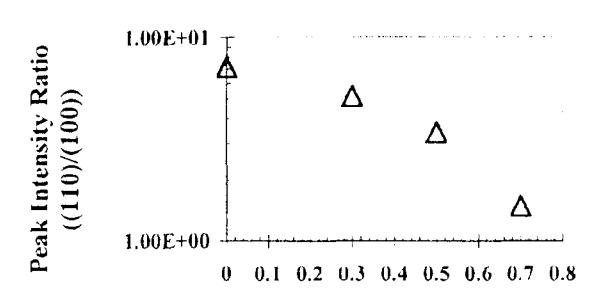
Figure 2 shows X-ray diffraction pattern of the undoped ZnO thin films. It can be seen that the (110) reflection peak was dominant for all the film, suggesting that the caxis of the crystal was parallel with substrate surface. The effect of boron-doping process on crystal orientation was examined. Only (110) and (100) reflection peaks appear in all of those films. Figure 3 shows X-ray diffraction intensity ratio of the ZnO thin films ((110)/(100)) as a function of B<sub>2</sub>H<sub>6</sub> flow rate. The (110) reflection peak became less pronounced as B<sub>2</sub>H<sub>6</sub> flow rate was increased. This result indicates that the c-axis orientations are still parallel to the substrate surface with a different crystal orientation <sup>3)</sup>.
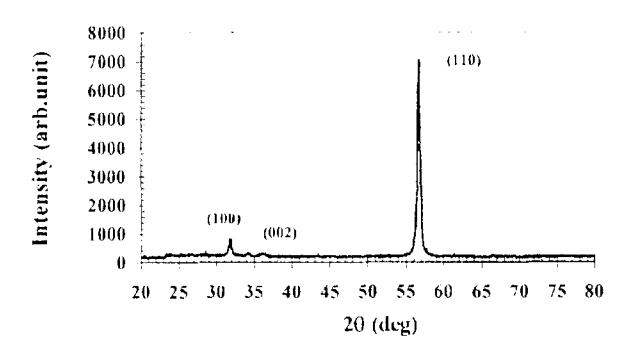
Figure 2 X-ray Diffraction Pattern of the Undoped ZnO Thin Films.
B,H, Flow Rate (seem)
Figure 3 X-ray Diffraction Intensity Ratio of the ZnO Thin Films as a Function of \(B_2H_6\) Flow Rate.
The grain size of films was also calculated from X-ray diffraction pattern data by using Scherrer's formula. As shown in fig. 4, the grain size changes with the B<sub>2</sub>H<sub>6</sub> flow rate. It is found that the grain size of thin films decreases as B<sub>2</sub>H<sub>6</sub> flow rate was increased. This result indicates that the grain size of crystal are affected by addition of boron atom into ZnO lattice, as a result of a change in the crystal orientation of the film.
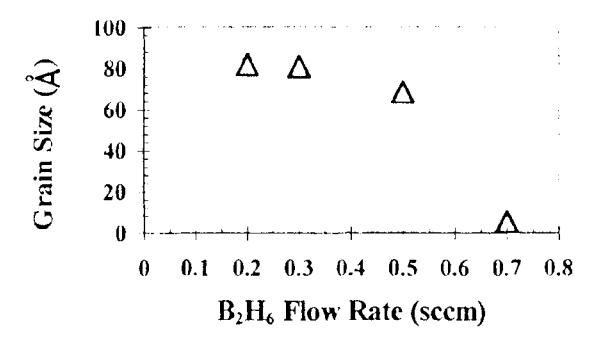
Figure 4 The Grain Size of ZnO Thin Films as a Function \(B_2H_6\) Flow Rate.
For application to the photonics devices, ZnO thin films should have a high transparency. Therefore, the optical properties of the doped ZnO thin films were observed from the transmittance data measured at wavelengths region of ultraviolet, visible to near infra-red and the result is shown in Fig.5. It was found that the transmittance of ZnO thin films is transparent and has a high transmittance of around 90% at visible wavelength range. It can also be seen that the transmittance of the film in ultra-violet wavelengths region shifts to higher energy as \(B_2H_6\) flow rate is increased. This phenomenon is known as Burstein-Moss shift<sup>4)</sup>.
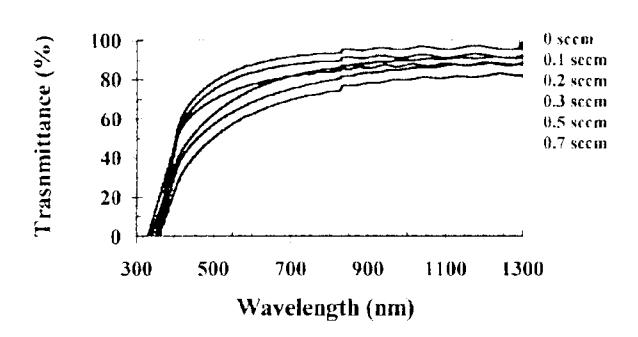
Figure 5 Transmittance of ZnO Thin Films Deposited at Various \(B_2H_6\) Flow Rate.
The refractive index of the films is also evaluated from transmittance data. The refractive index is one of the important parameters which determines the reflectance of the film when they are used as window layer in photonic devices. The result of the estimated refractive index is shown in Fig 6. It is clear that the refractive index increases as \(B_2H_6\) flow rate is increased.
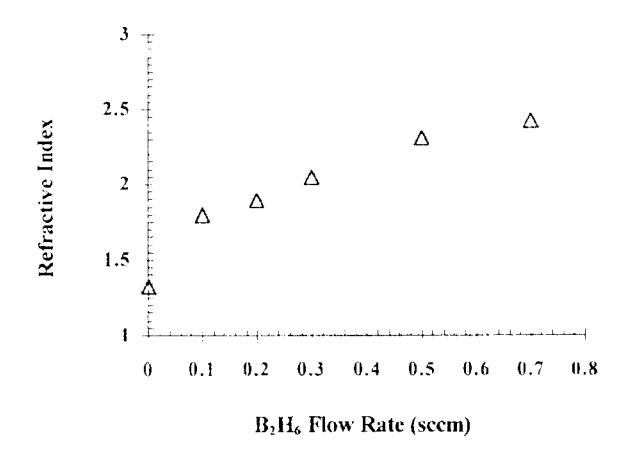
Figure 6 Refractive Index of ZnO Thin Films as a Function B<sub>2</sub>H<sub>6</sub> Flow Rate.
4 Conclusions
Effect of B-doping on the crystal structural and optical properties of zinc oxide (ZnO) thin films has been studied. It was found that the (110) reflection peaks was dominant for all the films and became less pronounced as the \(B_2H_6\) flow rate was increased. This result indicated that the c-axis orientations were parallel to the substrate surface. It was also found that the grain size of the film became smaller as the B2H6 flow rate was increased. The obtained film showed a high transparency at visible wavelength region, suggesting that they are suitable for being used as a transparent material in photonics devices.
5 Acknowledgement
This research was supported in part by Domestic Collaborative Research Grant (DCRG) / URGE, contract number: 019/DCRG/URGE/2000, Directorate General of Higher Education, Ministry of National Education, Indonesia.
6 References
- 1. Minigeshi, Kazumori. dkk., "Growth of p-Type Zinc Oxide Films by Chemical Vapor Deposition", Jpn. J. Appl. Phys, 36(11A), 1997, L1453.
- Wenas, Wilson W, Study of Transparent Conducting ZnO Grown by Metalorganic Chemical Vapor Deposition and Its Applications to Amorphous Silicon Solar Cells. Dissertation of Doctor, Tokyo Institute of Technology, Tokyo, 1996.
- Wenas, Wilson W, A. Setiawan, F. Adriyanto, and H. Sangian, "High Growth Rate Transparent Conducting Zinc-Oxide Thin Films Prepared by Metalorganic Chemical Vapor Deposition Technique for Device Apllications", 1998 Conference Optoelectronic and Microelectronic Materials and Devices, Perth, Western, Australia, 14<sup>th</sup> to 16<sup>th</sup> December 1998.
- 4. Schubert, E.F., Doping in III-V Semiconductors, Cambridge University Press, London, 1993.