

1 Introduction
Quinine is an alkaloid obtained from the bark of cinchona tree. It is a levorotatory diastereomer of quinidine. Quinine is used for the treatment of malaria, the prevention of nocturnal leg cramps, and the reversal of multidrug resistance during chemotherapy [1].
In the last two decades, cinchona alkaloids have gained very interest because of their successful applications in asymmetric synthesis [2]. For their prominent role as chiral bases, ligands, phase-transfer catalysts, and surface modifiers, they were even considered as belonging to a privileged catalyst class [3]. The most often used selective synthetic modifications of cinchona alkaloids were based on the replacement of C-9 hydroxy group by other functionalities, including those with nitrogen [4] and halogen [5].
A variety of combination systems of a hard Lewis acid and a thiol or a sulfide functional groups as a soft nucleophile have been developed for C-O bond cleavages of methyl ethers, benzyl ethers, esters, and lactones. In principle, it is possible with these systems to cleave a specific C-O bond in the presence of other type of C-O bond by shifting the balance between a Lewis acid and a soft
nucleophile [6]. Aluminium trichloride is well known as a Lewis acid, it can avoid the addition reaction to the double bound. However, this selectivity is not easily obtained and depends on the nature of the different functions handled by the ligand. Thus, the choice of reagent capable of cleaving the methyl aryl ether bound is very important. Many agents of O-demethylation of ethers mostly in the homogenous phase have been reported. They are classified as Bronstead acid such as hydrogen halogen, pyridine, amine salts (pyridinium chlorydrate and bromhydrate) or as Lewis acids [7-9].
In the present paper, we report demethylation of quinine under relatively mild conditions using anhydrous aluminium trichloride. The early attempts to prepare demethylation of quinidine (one of cinchona alkaloids) using hot concentrated mineral acids were unsuccessful and demethylation of quinine using boron tribromide at -78oC for 24h has been reported [10]. According to the literature search, this is the first report on demethylation of quinine using anhydrous aluminium trichloride. The demethylated quinine product would be used as novel chiral base reagent for separation of racemic mixture by means of diastereomic salt formation.
2 Experimental
2.1 General
The reaction was carried out in oven-dried glassware with magnetic stirrer and performed under nitrogen atmosphere in dried solvents. 1H and 13C NMR spectra (400 and 100.6 MHz, repectively) were recorded on a JEOL JNM-LA 400 spectrometer using Me4Si as the internal standars (0 ppm). IR spectra were measured with a FTIR Jasco-4200 spectrophotometer. For HPLC analysis, a Perkin-Elmer PE 200 binary pump was used. A Perkin-Elmer SCIEX (Concord, ON, Canada) API 150 MCA mass spectrometer equipped with a Turbo ion interface was used.
2.2 Materials
Aluminium trichloride was obtained from Fluka, quinine was obtained from PT Sinkona Indonesia Lestari. Thin-Layer Chromatography (TLC) was carried out on Merck-25 TLC aluminium sheets silica gel 60 F254. The other reagents and solvents (ACS certified grade) were used without further purification.
2.3 Demethylation of Quinine
Quinine 1 (3.24 g, 10 mmol) was dissolved in 50 mL of methylene chloride and cooled to 0 oC (Ice/NaCl bath) under nitrogen atmosphere. Aluminium trichloride (40 mmol) in 50 ml of methylene chloride was then added drop wise to the stirred solution for 4 h. After the reaction mixture reached room temperature, the mixture was further stirred up to 48 h. Water was carefully added to decompose excess aluminium trichloride. The reaction mixture was transferred into a separating funnel and after adjusting the aqueous phase with 1 N sodium hydroxide to pH of 11-12, the mixture was then shaked. The organic phase was discarded and the aqueous phase was re-adjusted with 1 N hydrochloric acid to pH of 8-9 which affords precipitation. The precipitate was dissolved in methylene chloride, dried over anhydrous sodium sulphate and dried in vacuum to dryness.
3 Results and Disscusion
The plausible mechanism of demethylation of 1 is proposed in Figure 1. The initial complexation of the basic quinoline N atom, quinuclidine bicyclic N atom and the ethereal oxygen atom in 1 by aluminum trichloride is followed by elimination of chloride from the resultant complex to generate a chloride salt 2. The Al-quinolinium cation of 2 is expected to be highly reactive in a nucleophilic displacement reaction at the methoxy position in which chloride acting as a nucleophile. This reaction step produces methylchloride and a Alquinolinimine 3. The Al-quinolinimine 3 then occur hydrolysis to complete demethylation of quinine to generate 4.
\[\text{[rumus tidak dapat ditampilkan dengan baik — lihat PDF asli]}\]
Figure 1 Mechanism of demethylation of quinine
The demethylation of 1 was greatly affected by the ratio of starting material. We examinated the demethylation reaction of 1 with several difference ratio of AlCl<sub>3</sub> in methylene chloride and the results are summarized in Table 1. Treatment of 1 with 1 equivalent of aluminium trichloride for 4 hours gave no product and then reaction was continued for overnight but no any product was found (Run 1). Treatment of 1 with 3 equivalent of aluminium trichloride for 48 hours was O-demethylated product 4 was obtained in a poor yield with a large amount of starting material 1 recovered (Run 2). Treatment of 1 with 4 equivalent of AlCl<sub>3</sub> for 24 hours gave an O-demethylated product 4 in 68.12% yield (Run 3). Demethylation of quinine using boron tribromide was prepared in 60% yield [10].
Table 1 Mole ratio of reactants, condition and yield of demethylation of quinine.
| Run | Quinine, mole | Aluminium trichloride, mole | Conditions | Yield of 4 | Analysis (%) Calcd, (found)a | Rfb | Mp. |
|---|---|---|---|---|---|---|---|
| 1 | 1 | 1 | 0°C, 4h up to 24h | nd | - | - | - |
| 2 | 1 | 3 | 0°C, 48h | Poor | - | - | - |
| 3 | 1 | 4 | 0°C, 48h | 68.12% | C, 68.41 (68.96) H, 7.25 (7.30); N, 8.39 (8.24) | 0.15 | 160- 165 |
Note:
nd= not found any product of 4
It was found that 4 equivalent of the anhydrous aluminium trichloride are necessary to produce 4 in good yield.
From the IR spectra (Figure 2), it was found that the absorption peak intensity of hydroxyl group at wave number of 3367.1 cm<sup>-1</sup> broaded with increasing of hydroxyl group, whereas the absorption peak intensity of –CH– group at wave number of 2923-2854cm<sup>-1</sup> decreased with the loss of the methyl of methoxy group during the reaction.
<sup>a</sup>Elemental analysis of C<sub>19</sub>H<sub>22</sub>N<sub>2</sub>O<sub>2</sub>·1.3H<sub>2</sub>O
<sup>b</sup>TLC on Silica gel; mobile phase: MeOH-CHCl<sub>3</sub> = 1:10
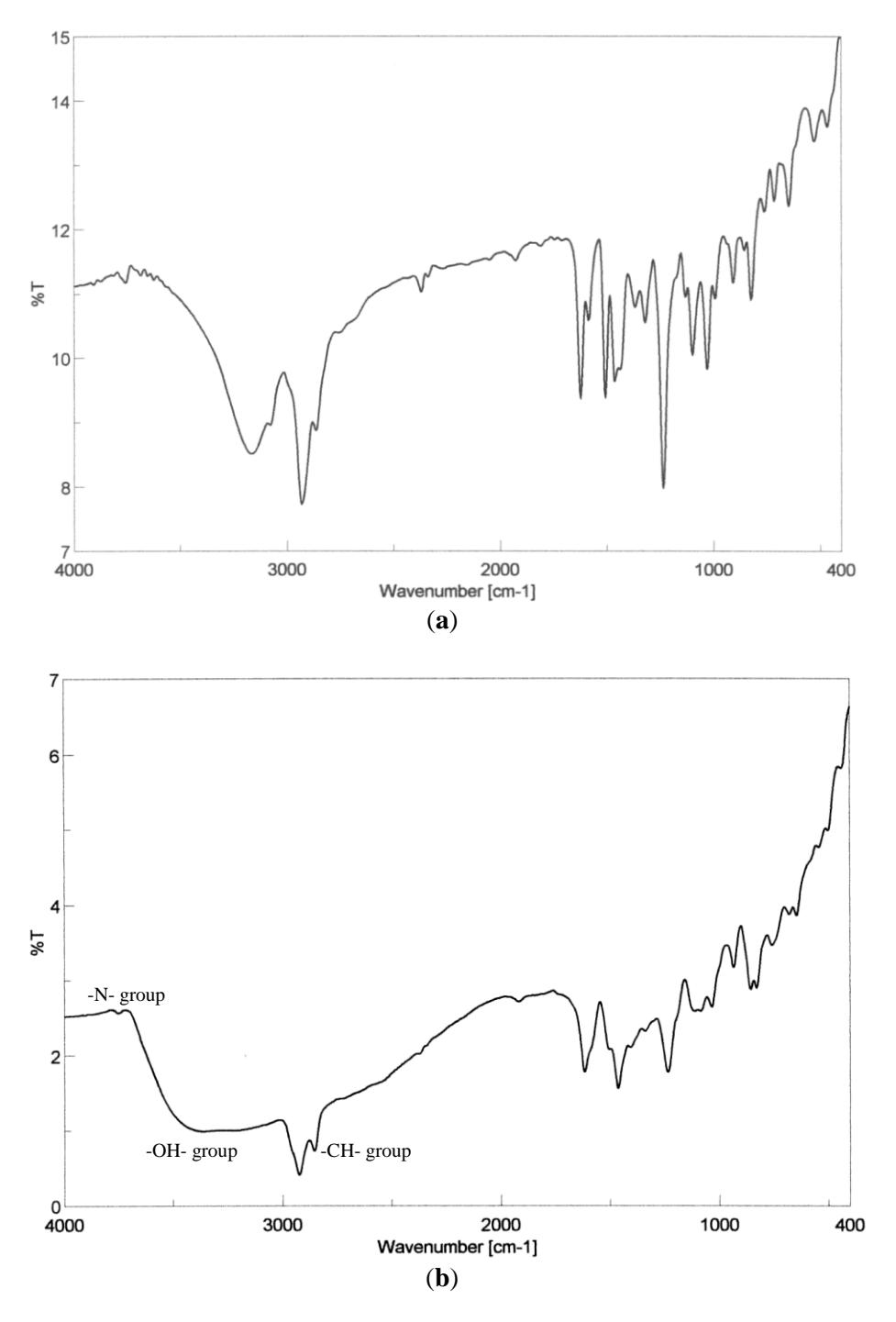
Figure 2 FT-IR spectra of (a) quinine, and (b) O-demethylatedquinine.
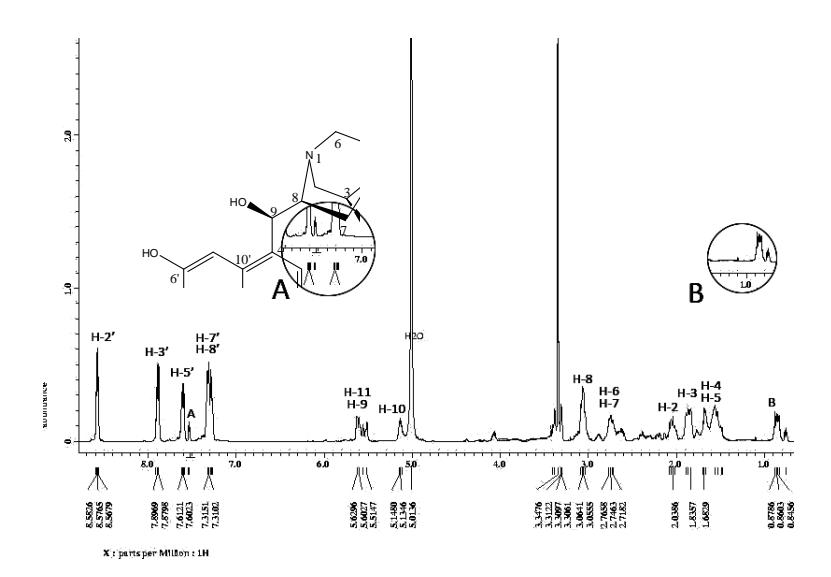
Figure 3 1H-NMR spectra of O-demethylatedquinine (in CD3OD; A and B are impurities).
Table 2 Chemical shift of proton and carbon resonances of O-demethylated quinine.
| Protona | 1H-NMR ( | Carbonb | 13C-NMR ( |
|---|---|---|---|
| H-2 | 2.01 (m, 2H) | C-2 | 60.14 |
| H-3 | 1.86 (m, 1H) | C-3 | 45.07 |
| H-4 | 1.83 (m, 1H) | C-4 | 34.46 |
| H-5 | 1.68 (m, 2H) | C-5 | 30.83 |
| H-6 | 2.71 (m, 2H) | C-6 | 58.18 |
| H-7 | 2.74 (m, 2H) | C-7 | 28.32 |
| H-8 | 3.06 (m, 1H) | C-8 | 71.90 |
| H-9 | 5.60 (dq, 1H) | C-9 | 105.29 |
| H-10 | 5.14 (t, 1H) | C-10 | 140.68 |
| H-11 | 5.55 (m, 1H) | C-11 | 119.79 |
| H-2' | 8.58 (d, 1H) | C-2' | 147.47 |
| H-3' | 7.89 (d, 1H) | C-3' | 120.00 |
| H-5' | 7.61 (dd, 1H) | C-4' | 149.73 |
| H-7' | 7.28 (d, 1H) | C-5' | 116.18 |
| H-8' | 7.32 (d, 1H) | C-6' | 158.07 |
| C-7' | 123.47 | ||
| C-8' | 131.53 | ||
| C-9' | 143.93 | ||
| C-10' | 128.35 |
a Spectrum in CD3OD; 400 MHz
b Spectrum in CD3OD; 100.6 MHz
The 1H NMR spectra of (4) showed the disappearance of the methyl signals at 3.93 ppm, indicating the loss of the methyl of methoxy group during the reaction.
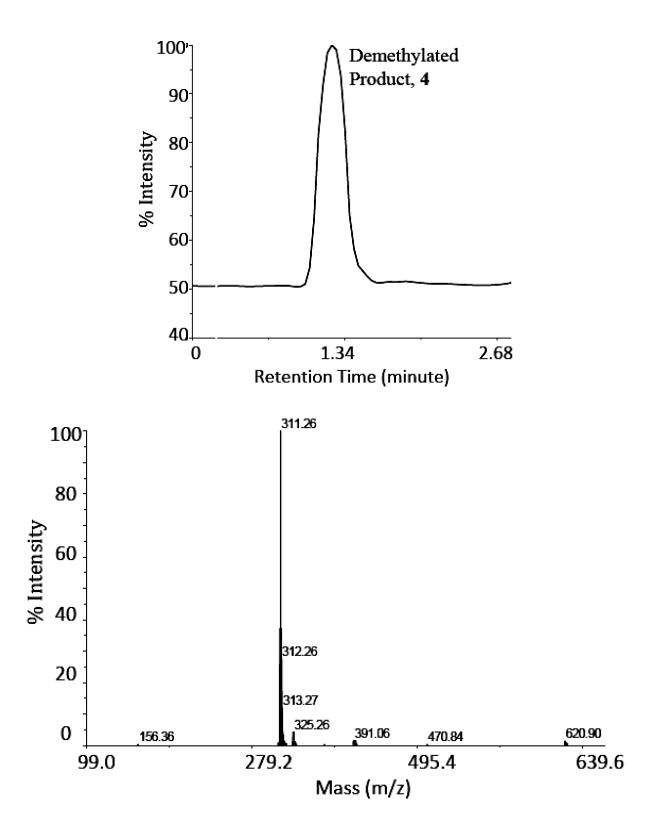
Figure 4 Chromatogram and mass spectrum of O-demethylated quinine (LCMS-ESI positive mode; injection volume: 20 L, flowrate: 1 mL/min, mobile phase: methanol-water = 80:20, v/v)
Liquid chromatographic-mass spectrometry-electro spray ionization (LCMS-ESI) was applied to determine the molecular weight of the demethylated product. The chromatogram showed only a single peak and its mass spectrum showed a persist peak with the mass of 311.26 (Figure 4). This m/z (M+1) was identical with the molecular weight of 4 (310.39). This result confirmed that the product contains 4. However, some weak signals which have no relation to H atoms of 4 appeared in the 1H-NMR spectrum of the product, indicating the presence of impurities in the product. All efforts to purify the product were unfortunately unsuccessful. Consequently the differences in elemental analysis result of the product for C, H and N were more than 0.5% between calculated and measured results.
4 Conclusions
4-((R)-Hydroxy((2S,4S,8R)-8-vinylquinuclidin-2-yl)methyl)quinolin-6-ol was successfully synthesized by demethylation of quinine under mild condition applying aluminium trichloride as reagent with the yield of 68.12%. The presence of impurities in the final product needs a further purification to obtain high purity for its application as reagent for stereoselective reaction.
Acknowledgement
The authors greatefully acknowledge funding support from the Riset KK ITB under the institute of research-LPPM, Institut Teknolgi Bandung with Contract No. 010D/K01.15/PL/2009.