

1 Introduction
Isatin 3-thiosemicarbazone derivatives and their metal complexes have a broad range of biological activities namely antimicrobial [1], antiviral [2,3], antitumor, anti-inflammatory and antibacterial activities [4]. The investigation of the structure-activity relationships of isatin β-thiosemicarbazones for antiviral chemotherapeutic activity revealed that the substitution at the C=O position of the side-chain by another atom or group should result in loss of activity [2]. Recently, structure-activity relationship of 5-fluoro-1H-indole-2,3dione-3-thiosemicarbazones and 5-fluoro-1-morpholino/piperidinomethyl-1Hindole-2,3-dione-3-thiosemicarbazones evaluated were for antituberculosis activity against Mycobacterium tuberculosis H37Rv and studied using ETM-ANN method [5,6]. Antimicrobial activity of Schiff and Mannich bases derived from isatin derivatives has been reported. N-[4-(4'chlorophenyl) thiazol-2-yl] thiosemicarbazide and dimethylaminomethyl]-5-bromo isatin-3'-{1'-[4"-(p-chlorophenyl)thiazol-2"-
Received September 8<sup>th</sup>, 2011, Revised April 30<sup>th</sup>, 2011, 2<sup>nd</sup> Revision May 6<sup>th</sup>, 2011, 3<sup>rd</sup> Revision October 6<sup>th</sup>, 2011, Accepted for publication November 4<sup>th</sup>, 2011.
Copyright © 2012 Published by LPPM ITB, ISSN: 1978-3043, DOI: 10.5614/itbj.sci.2012.44.1.4
yl] thio semicarbazone showed the most favorable antimicrobial activity [1]. 1- (1-((Substituted)methyl)-5-methyl-2-oxoindolin-3-ylidene)-4-(substituted pyridine-2-yl)thiosemicarbazide has been reported to show significant antiinflammatory and analgesic activity [1].
There are a number of studies on the synthesis of isatin -thiosemicarbazone derivatives. We have reported synthesis, characterization and mechanistic of 5 methoxyisatin 3-[N-(4-chlorophenyl)thiosemicarbazone] [7]. In the present study, zinc(II) and nickel(II)-complexes of 5-methoxyisatin 3-[N-(4 chlorophenylthiosemicarbazone) have been synthesized. The structures of complexes have been determined by 1H-NMR, IR and UV spectra and elemental analysis (C, H, N, S). Moreover, electronics parameters of H2MICP and its zinc(II) and nickel(II)-complexes have also been calculated using B3LYP with the basis set of 6-31G(d,p), 6-311G(d,p), 6-311++G(d,p), 6- 311++G(2d,2p). Natural Bond Orbital (NBO) analysis is also reported.
2 Experimental
2.1 Material and Methods
5-methoxyisatin was purchased from Sigma Aldrich. Metal salts were purchased from E. Merck and used without further purification. Infrared spectrum of 5-methoxy isatin and its complexes were measured using KBr pellet on Shimadzu FT-IR 8201 spectrometer. The elemental analysis was carried out on CHNS-932 (LECO) and 1H-NMR spectra were measured at 400 MHz on a BRUKER DPX-400 spectrometer at the TUBITAK ATAL instrumental analyses laboratory. The electronic spectra of UV–visible zone (200–600 nm) of all the compounds were measured (1 cm quartz cell, 0–2.5 absorbance values range) using Shimadzu UV-1601PC spectrophotometer.
2.2 Synthesis
H2MICP ligand molecule was synthesized according to literature procedure [7].
Bis{5-methoxyisatin-3-[N-(4-chlorophenyl)thiosemicarbazonato]}zinc(II) [Zn(HMICP)2.H2O]
[Zn(HMICP)2] were synthesized by dissolving 1 mmol (0.361 g) H2MICP and 0.5 mmol (0.106 g) zinc(II) acetate in warm ethanol. Subsequently, the solution was refluxed for 3 hours. Brown solid was isolated by filtration and washed with 95% ethanol, diethylether and dried in vacuum at room temperature. [(calc. (%): C = 48.95, H = 3.08, N = 14.27, S = 8.16, found. (%):
C = 49.09, H = 3.18, N = 14.24, S = 8.84). 1H-NMR (DMSO-d6, ppm): 3.55 (s, CH3-methoxy), 6.85-7.66 (aromatic C-H), 10.65 (, NH), 10.81 (s, indole-NH)].
Bis{5-methoxyisatin-3-[N-(4-chlorophenyl))thiosemicarbazonato]}nickel(II) [Ni(HMICP)2.H2O]
[Ni(HMICP)2] were synthesized by dissolving 1 mmol (0.361 g) H2MICP and 0.5 mmol (0.088 g) nickel(II) acetate in warm ethanol. Subsequently, the solution was refluxed for 2 h, and stirred for two days at room temperature. A brown solid was isolated and washed with 95% ethanol and diethylether [(calc. (%): C = 48.26, H = 3.29, N = 14.07, S = 8.05, found. (%): C = 48.13, H = 3.22, N = 13.86, S = 7.31)].
3 Theoretical Calculations
All calculations were carried out by employing density functional theory (DFT) with the basis set levels [8-10] of B3LYP/6-31G(d,p), B3LYP/6-311G(d,p), B3LYP/6-311++G(d,p) and B3LYP/6-311++G(2d,2p) for the ligand and B3LYP/6-31G(d,p), B3LYP/6-311G(d,p) for the zinc(II) and nickel(II) complexes. UV calculation for H2MICP ligand was also performed by DFT at the level of BP86/CEP* using 3/76=1000003000, 3/77=0720007000, 3/78=0810010000, 3/74=406 iop values.
4 Results and Discussion
The B3LYP/6-311G(d,p) optimized structures of H2MICP and its zinc(II) and nickel(II)-complexes were shown in Figure 1.
The possible tautomeric structures for H2MICP were calculated using B3LYP/6-31G(d,p), B3LYP/6-311G(d,p), B3LYP/6-311++G(d,p) and B3LYP/6-311++G(2d,2p) basis sets. There is no negative imaginary frequency observed for possible tautomeric forms, indicating that all structures are true minima. The B3LYP/6-311G(d,p) optimized structures of possible tautomeric forms were shown in Figure 2. As summarized in Table 1, the A form was found to be most stable than the other forms with all calculation methods like the study in [11].
The energy differences between most stable and unstable tautomeric forms were found as 34.78 kcal/mol; 21.21 kcal/mol; 32.50 kcal/mol; 31.16 kcal/mol at B3LYP method with 6-31G(d,p), 6-311G (d,p), 6-311++G(d,p) and 6- 311++G(2d,2p) basis sets respectively. The dipole moment of A form is the highest of all calculated basis sets while EHOMO of A form is the lowest one.
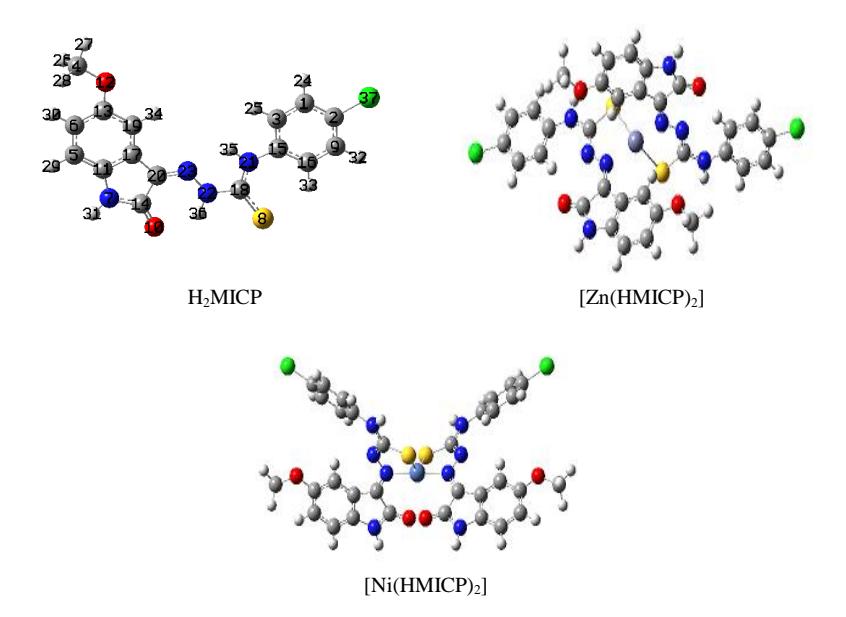
Figure 1 The structures of H2MICP and its zinc(II) and nickel(II)-complexes optimized with B3LYP/6-311G(d,p).
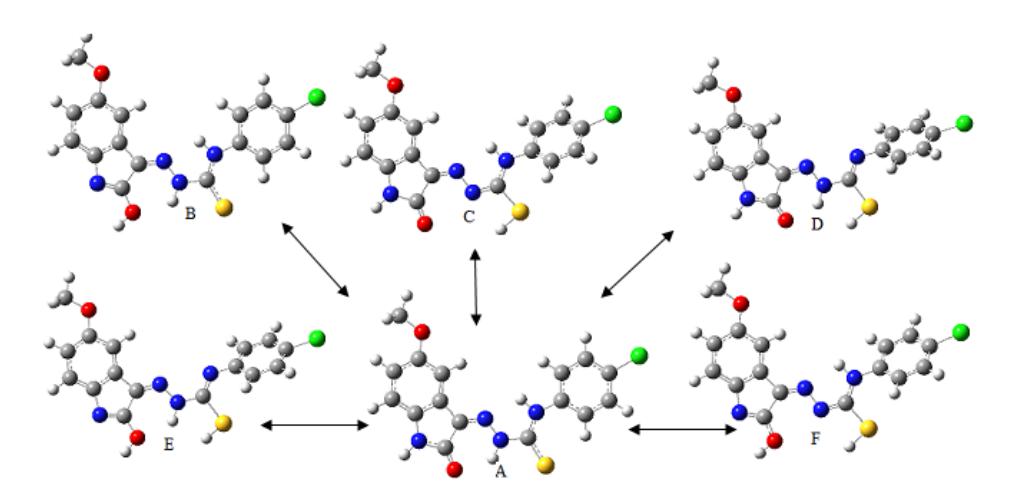
Figure 2 The possible tautomer structures of H2MICP optimized with B3LYP/6-311G(d,p).
Table 1 The sum of the zero point and electronic energies (au), polarizibility (\(\alpha\)), dipole moment (\(\mu\)), \(E_{HOMO}\), \(E_{LUMO}\), hardness (\(\eta\)) and softness (\(\sigma\)) for the possible tautomer structures of \(H_2MICP\).
| Tautomer | 6-31 | G(d,p) | 6-311G(d,p) | 6-311+ | 6-311++G(d,p) | 6-311++G(2d,2p) | |||
|---|---|---|---|---|---|---|---|---|---|
| structures | Su | m of the z | ero point an | (an) | |||||
| A | -1845 | 19402 -1845.396917 | .414918 | -1845.451098 | |||||
| В | .092834 | .370541 | .389447 | -1845.425976 | |||||
| C | -1845.423678 | ||||||||
| D | -1845.087848 -1845.087842 | -1845.342684 -1845.371603 | -1845.387149 -1845.391259 | -1845.429274 | |||||
| E | -1845.342684 | -1845.363113 | -1845.429274 -1845.401429 | ||||||
| F | -1845.063968 -1845.067024 | -1845.345660 | -1845.366705 | -1845.404319 | |||||
| Г | -1643. | .007024 | .300703 | -1843 | -1043.404317 | ||||
| A | 0.2 | 1650 | 0.2 | EHOMO (au) -0.22428 -0.22803 | 0.7 | 22688 | |||
| B | -0.21650 | 2142 | 2558 | ||||||
| C | -0.21305 -0.19856 | -0.22430 -0.20994 | |||||||
| D | -0.21499 -0.21901 | -0.21096 -0.22329 | -0.22234 | ||||||
| E | -0.19856 | -0.21901 -0.21499 | -0.22329 | -0.21868 | |||||
| F | -0.20648 -0.19656 | -0.20484 | -0.20951 | -0.20844 | |||||
| Г | -0.1 | -0.19030 | -0.20731 (au) | -0.20044 | |||||
| A | -0.09655 | -0.10433 | -0.10921 | -0.10823 | |||||
| В | -0.09633 -0.09932 | -0.10701 | -0.10921 | -0.10823 -0.11031 | |||||
| C | -0.10701 | -0.09371 | -0.09308 | ||||||
| D | -0.08034 | -0.09319 | -0.09371 | -0.09872 | |||||
| E | -0.08039 | -0.09519 | -0.10075 | )9992 | |||||
| E F | -0.08754 -0.08412 | ||||||||
| Г | -0.0 | 00412 | -0.09166 | -0.09695 | -0.0 | )9575 | |||
| η (au) | σ (au-1) | η (au) | σ (au-1) | η (au) | σ (au-1) | η (au) | σ (au-1) | ||
| A | 0.060 | 8.337 | 0.060 | 8.337 | 0.059 | 8.416 | 0.059 | 8.428 | |
| В | 0.057 | 8.793 | 0.057 | 8.740 | 0.057 | 8.783 | 0.057 | 8.773 | |
| C | 0.059 | 8.459 | 0.060 | 8.347 | 0.059 | 8.529 | 0.058 | 8.557 | |
| D | 0.059 | 8.462 | 0.063 | 7.955 | 0.062 | 8.053 | 0.062 | 8.089 | |
| E | 0.059 | 8.408 | 0.060 | 8.347 | 0.059 | 8.409 | 0.059 | 8.420 | |
| F | 0.056 | 8.894 | 0.056 | 8.835 | 0.056 | 8.884 | 0.056 | 8.874 | |
| α | μ (D) | α | μ (D) | α | μ (D) | α | μ (D) | ||
| A | 282.02 | 9.22 | 294.54 | 9.22 | 316.48 | β (B) 8.98 | 324.25 | 8.85 | |
| В | 285.15 | 5.64 | 297.80 | 5.68 | 320.43 | 5.36 | 327.28 | 5.19 | |
| C | 284.49 | 4.22 | 289.70 | 4.75 | 317.05 | 4.14 | 324.34 | 4.03 | |
| D | 284.58 | 4.22 | 286.02 | 7.52 | 307.21 | 7.27 | 314.30 | 7.22 | |
| E | 279.10 | 4.64 | 289.70 | 4.75 | 311.12 | 4.49 | 317.38 | 4.39 | |
| F | 287.68 | 0.98 | 298.93 | 1.01 | 320.54 | 1.22 | 326.97 | 1.20 | |
| 207.00 | 0.70 | 270.73 | 1.01 | 320.34 | 1.22 | 320.71 | 1.20 | ||
Fukui functions of H<sub>2</sub>MICP were calculated using AOMix program [11,12]. Fukui functions give information about the reactive regions for nucleophilic and electrophilic attack. \(f_k^+ = \rho_k(N+1) - \rho_k(N)\) measures the changes as the molecule gains electrons which indicating the reactivity for nucleophilic attack, while \(f_k^- = \rho_k(N) - \rho_k(N-1)\) measures the changes as the molecule losses
electrons which indicating the reactivity for electrophilic attack. Table 2 summarizes the Fukui functions for the HOMO and the LUMO of the molecules.
| Table 2 | Neutral and protonated Fukui functions for the HOMO and the LUMO |
|---|---|
| of the H2MICP using the different basis sets. |
| H2MICP | 6-31G(d,p) | 6-311G(d,p) | 6-311++G(d,p) | ||||
|---|---|---|---|---|---|---|---|
| Atoms | f k | f k | f k | f k | f k | f k | |
| C2 | - | - | - | - | 1.05 | - | |
| C5 | 3.40 | - | 3.71 | - | 2.90 | - | |
| C6 | 11.86 | 5.68 | 12.13 | 5.86 | 11.06 | 5.81 | |
| N7 | 8.07 | 1.64 | 8.35 | 1.57 | 6.61 | 1.63 | |
| S8 | 15.07 | 8.37 | 13.40 | 8.55 | 19.78 | 9.01 | |
| O10 | 6.82 | 8.12 | 6.75 | 7.65 | 5.95 | 7.45 | |
| C11 | 14.66 | 3.10 | 14.98 | 3.01 | 13.25 | 2.79 | |
| O12 | 9.03 | - | 9.31 | - | 7.32 | - | |
| C13 | 9.97 | - | 10.29 | - | 8.93 | - | |
| C14 | 1.73 | 8.22 | 1.88 | 9.07 | 1.80 | 10.03 | |
| C17 | 6.26 | 3.43 | 6.32 | 3.77 | 5.66 | 3.58 | |
| C18 | - | 5.86 | - | 5.76 | 1.04 | 5.13 | |
| C19 | - | 6.31 | - | 6.61 | - | 6.86 | |
| C20 | 2.18 | 13.97 | 2.15 | 14.25 | 2.31 | 14.09 | |
| N21 | - | 1.83 | - | 1.75 | 1.62 | 1.95 | |
| N22 | 4.38 | 4.14 | 4.32 | 3.96 | 1.95 | 4.11 | |
| N23 | 1.76 | 25.01 | 1.73 | 24.47 | 1.55 | 24.30 | |
Although the compositions of the HOMO and the LUMO for H2MICP depend on the basis set, the changes are not significant. For the HOMO, the contributions are mainly from thiosemicarbazone group (S8: 19.78%, N22: 4.32%, N23: 1.73%) and isatin group (C5: 3.71%, C6: 12.13%, C11: 14.98%, C13: 10.29%, C14: 1.73%, C17: 6.32%, C20: 2.15%, N7: 8.35%, O10: 6.75%, O12: 9.31%).
The NBO program performs the analysis of a many-electron molecular wavefunction in terms of localized electron-pair bonding units. The program carries out the determination of natural atomic orbitals (NAOs), natural hybrid orbitals (NHOs), natural bond orbitals (NBOs), and natural localized molecular orbitals (NLMOs). These parameters are applicable to perform natural population analysis (NPA) [13]. Bond orbital coefficients as well as the hybrids (percents of s and p character) for H2MICP, Zn(II) and Ni(II)-complexes are summarized in Tables 3 and 4.
As shown in Table 3, C6-C13, C5-C11, C17-C19 bonds belonging to the benzene ring of isatin group of H2MICP have double bond character and the NBO bonds calculated with B3LYP/6-311++G(2d,2p) are 0.7054 C6(sp1.86) +
\(0.7088 \ C_{13} \, (sp^{1.60}) + 0.7249 \ C_6 \, (p) + 0.6889 \ C_{13} \, (p) \ for \ C6\text{-}C13 \ bond; \ 0.6966 \ C_5 \, (sp^{1.85}) + 0.7175 \ C_{11} \, (sp^{1.53}) + 0.7087 \ C_5 \, (p) + 0.7055 \ C_{11} \, (p) \ for \ C5\text{-}C11 \ bond; \ 0.7196 \ C_{17} \, (sp^{1.62}) + 0.6943 \ C_{19} \, (sp^{1.80}) + 0.7187 \ C_{17} \, (p) + 0.6953 \ C_{19} \, (p) \ for \ C17\text{-}C19 \ bond. While the calculations which carried out using B3LYP/6-311G(d,p) basis set is <math>0.7074 \ C_6 \, (sp^{1.81}) + 0.7068 \ C_{13} \, (sp^{1.60}) + 0.7252 \ C_6 \, (p) + 0.6885 \ C_{13} \, (p), \ 0.6986 \ C_5 \, (sp^{1.79}) + 0.7156 \ C_{11} \, (sp^{1.55}) + 0.7090 \ C_5 \, (p) + 0.7052 \ C_{11} \, (p) \ and \ 0.7163 \ C_{17} \, (sp^{1.64}) + 0.6978 \ C_{19} \, (sp^{1.75}) + 0.7195 \ C_{17} \, (p) + 0.6945 \ C_{19} \, (p).\) It was shown that there are no significant changes in the calculation results using both the 6-311++G(2d,2p) and 6-311G(d,p) basis sets. Therefore, further calculations were then performed by only the 6-311G(d,p) basis set for the Zn(II) and Ni(II)-complexes. From the NBO analysis, C6-C13, C5-C11, C17-C19 bonds of the benzene ring of isatin group of H<sub>2</sub>MICP have same character for pair bond (Table 4).
NBO bonds of C6-C13, C5-C11, C17-C19 which calculated by B3LYP/6-311G(d,p) basis set are \(0.7072 \text{ C}_6(\text{sp}^{1.81}) + 0.7070 \text{ C}_{13}(\text{sp}^{1.61}) + 0.7220 \text{ C}_6(\text{p}) + 0.6919 \text{ C}_{13}(\text{p}), 0.6893 \text{ C}_5(\text{sp}^{1.79}) + 0.7158 \text{ C}_{11}(\text{sp}^{1.55}) + 0.7147 \text{ C}_5(\text{p}) + 0.6994 \text{ C}_{11}(\text{p}), 0.7162 \text{ C}_{17}(\text{sp}^{1.65}) + 0.6979 \text{ C}_{19}(\text{sp}^{1.78}) + 0.7242 \text{ C}_{17}(\text{p}) + 0.6896 \text{ C}_{19}\)(p), respectively for [Zn(HMICP)<sub>2</sub>] complex and 0.7078 \(C_6\) (sp<sup>1.80</sup>) + 0.7065 \(C_{13}\)\(\text{[rumus tidak dapat ditampilkan dengan baik — lihat PDF asli]}\)\(0.7310 \text{ C}_{17}\) (p) + \(0.6824 \text{ C}_{19}\) (p), respectively for [Ni(HMICP)<sub>2</sub>]. There are no significant changes in these bonds for either Zn(II) nor Ni(II)-complexes. C20-N23 NBO of the thiosemicarbazone group of H<sub>2</sub>MICP ligand, and its Zn(II) and Ni(II)-complexes are \(0.6326~C_{20}~(sp^{2.00}) + 0.7745~N_{23}~(sp^{1.30}) + 0.6778~C_{20}~(p) + 0.7353~N_{23}~(p),~0.6254~C_{20}~(sp^{1.99}) + 0.7803~N_{23}~(sp^{1.34}) + 0.6363~C_{20}~(p) + 0.7714~N_{23}~(p)\) and \(0.6370~C_{20}~(sp^{2.02}) + 0.7794~N_{23}~(sp^{1.35}) + 0.6370~C_{20}~(p) + 0.7714~N_{23}~(p)\)0.7708 N<sub>23</sub> (p), respectively. The percentage of C20 atom for H<sub>2</sub>MICP ligand and its Zn(II) and Ni(II)-complexes is 40.02, 39.11 and 39.26. In the formation of σ, s% character of C20 for them is 33.32, 33.40 and 33.13 respectively. s% character of C20 atom for H<sub>2</sub>MICP ligand does not change significantly in the formation of Zn(II) and Ni(II)-complexes. C20% of \(\pi\) NBO bond for H<sub>2</sub>MICP ligand, and its Zn(II) and Ni(II)-complexes is 45.94, 40.49 and 40.58, while those of N23 are 54.06, 59.51 and 59.42, respectively. In the complex formation, bond is polarized (about 59.51% for Zn(II)-complex and about 59.42% for Ni(II)-complex) toward N23. S8-C18 bond having double bond character in the H<sub>2</sub>MICP ligand calculated with B3LYP/6-311++G(2d,2p) method, however it shows single bond character in the Zn(II) and Ni(II)complexes (NBO bond of S8-C18 is \(0.6353 \text{ S}_8 (\text{sp}^{4.38}) + 0.7723 \text{ C}_{18} (\text{sp}^{1.57}) +\)0.8278 \(S_5\) (p) + 0.5611 \(C_{18}\) (p) for \(H_2MICP\), 0.6994 \(S_8\) (sp<sup>4.80</sup>) + 0.7429 \(C_{18}\) (sp<sup>2.04</sup>) for Zn(II)-complex, and 0.6638 \(S_8\) (sp<sup>4.96</sup>) + 0.7479 \(C_{18}\) (sp<sup>2.02</sup>) for Ni(II)complex)
\(\begin{tabular}{ll} \textbf{Table 3} & Calculated & NBO & analysis & data & for & $H_2MICP$ & calculated & with & 6-311++G(2d,2p) & and & 6-311G(d,p) & basis set. \\ \end{tabular}\)
| ] | H2MICP | |
|---|---|---|
| Atom | Hybrids | |
| numbers | B3LYP/6-311++G(2d,2p) | B3LYP/6-311G(d,p) |
| C3-C15 | \(0.6991 \text{ C}_3(\text{sp}^{1.85}) + 0.7151 \text{ C}_{15}(\text{sp}^{1.83})\) | \(0.7005 \mathrm{C}_3 (\mathrm{sp}^{1.80}) + 0.7137 \mathrm{C}_{15} (\mathrm{sp}^{1.84})\) |
| C15-C16 | \(0.7183 C_{15}(sp^{1.66}) + 0.6957 C_{16}(sp^{1.95})\) | \(0.7163 \text{ C}_{15} (\text{sp}^{1.64}) + 0.6978 \text{ C}_{16} (\text{sp}^{1.75})\) |
| \(0.7125 C_{15}(p) + 0.7017 C_{16}(p)\) | \(0.7195 C_{15}(p) + 0.6945 C_{16}(p)\) | |
| C1-C3 | \(0.7068 C_1 (sp^{1.80}) + 0.7074 C_3 (sp^{1.73})\) | \(0.7071 \text{ C}_1 (\text{sp}^{1.78}) + 0.7071 \text{ C}_3 (\text{sp}^{1.72})\) |
| \(0.6978 C_1(p) + 0.7163 C_3(p)\) | \(0.6975 C_1(p) + 0.7166 C_3(p)\) | |
| C9-C16 | \(0.7080 \mathrm{C_9}(\mathrm{sp}^{1.79}) + 0.7062 \mathrm{C_{16}}(\mathrm{sp}^{1.80})\) | \(0.7084 \text{ C}_{9} (\text{sp}^{1.77}) + 0.7058 \text{ C}_{16} (\text{sp}^{1.78})\) |
| C1-C2 | \(0.7048 \text{ C}_1(\text{sp}^{1.84}) + 0.7094 \text{ C}_2(\text{sp}^{1.60})\) | \(0.7068 \text{ C}_1 \text{ (sp}^{1.78}) + 0.7075 \text{ C}_2 \text{ (sp}^{1.58})\) |
| C2-C9 | \(0.7109 C_2 (sp^{1.58}) + 0.7033 C_9 (sp^{1.83})\) | \(0.7109 \text{ C}_2 (\text{sp}^{1.56}) + 0.7033 \text{ C}_9 (\text{sp}^{1.78})\) |
| \(0.6978 C_2(p) + 0.6806 C_9(p)\) | \(0.7338 C_2(p) + 0.67.94 C_9(p)\) | |
| C2-C137 | \(0.6766 C_2 (sp^{3.42}) + 0.7363 Cl_{37} (sp^{4.68})\) | \(0.6997 C_2 (sp^{3.52}) + 0.7426 Cl_{37} (sp^{4.40})\) |
| C6-C13 | \(0.7054 \mathrm{C}_6 (\mathrm{sp}^{1.86}) + 0.7088 \mathrm{C}_{13} (\mathrm{sp}^{1.60})\) | \(0.7074 \mathrm{C_6 (sp^{1.81})} + 0.7068 (\mathrm{C_{13} sp^{1.60}})\) |
| \(0.7249 C_6(p) + 0.6889 C_{13}(p)\) | \(0.7252 C_6(p) + 0.6885 C_{13}(p)\) | |
| C13-C19 | \(0.7100 \mathrm{C_9} (\mathrm{sp}^{1.73}) + 0.7042 \mathrm{C_{19}} (\mathrm{sp}^{1.88})\) | \(0.7066 \mathrm{C_9} (\mathrm{sp}^{1.75}) + 0.7076 \mathrm{C_{19}} (\mathrm{sp}^{1.84})\) |
| C5-C6 | \(0.7087 \text{ C}_5 (\text{sp}^{1.78}) + 0.7055 \text{ C}_6 (\text{sp}^{1.77})\) | \(0.7056 \text{ C}_5 (\text{sp}^{1.78}) + 0.7056 \text{ C}_6 (\text{sp}^{1.76})\) |
| C5-C11 | \(0.6966 \text{ C}_5 (\text{sp}^{1.85}) + 0.7175 \text{ C}_{11} (\text{sp}^{1.53})\) | \[0.6986 C_5 (sp^{1.79}) + 0.7156 C_{11} (sp^{1.55})\] |
| \(0.7087 \text{ C}_5 \text{ (p)} + 0.7055 \text{ C}_{11} \text{ (p)}\) | \(0.7090 C_5(p) + 0.7052 C_{11}(p)\) | |
| C17-C19 | \(0.7196 C_{17} (sp^{1.62}) + 0.6943 C_{19} (sp^{1.80})\) | \(0.7163 \text{ C}_{17} (\text{sp}^{1.64}) + 0.6978 \text{ C}_{19} (\text{sp}^{1.75})\) |
| \(0.7187 C_{17}(p) + 0.6953 C_{19}(p)\) | \(0.7195 C_{17}(p) + 0.6945 C_{19}(p)\) | |
| C11-C17 | \(0.7060 \mathrm{C_{11}} (\mathrm{sp^{1.97}}) + 0.7082 \mathrm{C_{17}} (\mathrm{sp^{2.27}})\) | \(0.7054 \text{ C}_{11} (\text{sp}^{1.95}) + 0.7088 \text{ C}_{17} (\text{sp}^{2.24})\) \(0.7850 \text{ N}_7 (\text{sp}^{1.77}) + 0.6195 \text{ C}_{11} (\text{sp}^{2.75})\) |
| N7-C11 | \(0.7849 \text{ N}_7 (\text{sp}^{1.80}) + 0.6196 \text{ C}_{11} (\text{sp}^{2.77})\) | \(0.7850 \text{ N}_7 (\text{sp}^{1.77}) + 0.6195 \text{ C}_{11} (\text{sp}^{2.75})\) |
| N7-C14 | \(0.7910 \text{ N}_7 (\text{sp}^{1.88}) + 0.6118 \text{ C}_{14} (\text{sp}^{2.33})\) | \(0.7919 \text{ N}_7 \text{ (sp}^{1.80}) + 0.6107 \text{ C}_{14} \text{ (sp}^{2.322})\) |
| C14-C20 | \(0.6984 \mathrm{C}_{14} (\mathrm{sp}^{1.86}) + 0.7157 \mathrm{C}_{20} (\mathrm{sp}^{2.16})\) | \(0.6975 C_{14} (sp^{1.85}) + 0.7166 C_{20} (sp^{2.17})\) |
| C17-C20 | \(0.7106 \mathrm{C}_{17} (\mathrm{sp}^{2.21}) + 0.7036 \mathrm{C}_{20} (\mathrm{sp}^{1.84})\) | \(0.7088 \mathrm{C}_{17} (\mathrm{sp}^{2.20}) + 0.7054 \mathrm{C}_{20} (\mathrm{sp}^{1.86})\) |
| O10-C14 | \(0.8010 \text{ O}_{10} (\text{sp}^{1.51}) + 0.5987 \text{ C}_{14} (\text{sp}^{1.94})\) | \(0.8045 \text{ O}_{10} (\text{sp}^{1.44}) + 0.5939 \text{ C}_{14} (\text{sp}^{1.96})\) |
| \(0.8415 \mathrm{O}_{10} (\mathrm{p}) + 0.5402 \mathrm{C}_{14} (\mathrm{p})\) | \(0.8376 \ O_{10}(p) + 0.5463 \ C_{14}(p)\) | |
| O12-C13 | \(0.8010 O_{10} (sp^{1.99}) + 0.5987 C_{14} (sp^{3.03})\) | \(0.8213 O_{12} (sp^{1.97}) + 0.5705 C_{14} (sp^{3.00})\) |
| C4-O12 | \(0.5605 C_4 (sp^{3.54}) + 0.8281 O_{12} (sp^{2.47})\) | \(0.5846 \text{ C}_4 (\text{sp}^{3.42}) + 0.8254 \text{ O}_{12} (\text{sp}^{2.56})\) |
| C20-N23 | \(0.6328 \text{ C}_{20} (\text{sp}^{2.07}) + 0.7743 \text{ N}_{23} (\text{sp}^{1.32})\) | \(0.6326 \mathrm{C}_{20} (\mathrm{sp}^{2.00}) + 0.7745 \mathrm{N}_{23} (\mathrm{sp}^{1.30})\) |
| \(0.6791 \text{C}_{20}(\text{p}) + 0.7341 \text{N}_{22}(\text{p})\) | \(0.6778 \mathrm{C}_{20} (\mathrm{p}) + 0.7353 \mathrm{N}_{23} (\mathrm{p})\) | |
| N22-N23 | \(0.7233 \text{ N}_{22} (\text{sp}^{2.27}) + 0.6906 \text{ N}_{23} (\text{sp}^{2.93})\) | \(0.7202 \text{ N}_{22} (\text{sp}^{2.25}) + 0.6938 \text{ N}_{23} (\text{sp}^{2.80})\) |
| C18-N22 | \[\begin{array}{l} 0.6138 \ C_{18} \ (sp^{2.45}) + 0.7723 \ N_{22} \ (sp^{1.65}) \\ 0.6353 \ S_{8} \ (sp^{4.38}) + 0.7723 \ C_{18} \ (sp^{1.57}) \end{array}\] | \(0.6153 \text{ C}_{18} (\text{sp}_{2.41}^{2.41}) + 0.7883 \text{ N}_{22} (\text{sp}_{1.62}^{1.62})\) |
| S8-C18 | \(0.6353 \text{ S}_8 (\text{sp}^{4.38}) + 0.7723 \text{ C}_{18} (\text{sp}^{1.57})\) | \(0.6349 \text{ S}_8 (\text{sp}^{4.02}) + 0.7651 \text{ C}_{18} (\text{sp}^{1.63})\) |
| \(0.8278 S_5(p) + 0.5611 C_{18}(p)\) | \(0.8291 \text{ S}_5(p) + 0.5591 \text{ C}_{18}(p)\) | |
| C18-N21 | \(0.6144 \text{ C}_{18} (\text{sp}^{2.10}) + 0.7723 \text{ N}_{21} (\text{sp}^{1.69})\) | \(0.6146 C_{18} (sp^{2.05}) + 0.7888 N_{21} (sp^{1.67})\) |
| C15-N21 | \(0.6126 C_{15} (sp^{2.70}) + 0.7904 N_{21} (sp^{1.66})\) | \(0.6133 \text{ C}_{15} (\text{sp}^{2.68}) + 0.7899 \text{ N}_{21} (\text{sp}^{1.64})\) |
| O12 | \(1.96357 \ O_{12} \ (sp^{1.63})\) | Unpaired electrons |
| 1.84823 O12 (p) | \(1.96232 \text{ O}_{12} (\text{sp}^{1.61})\) | |
| S8 | \(1.98378 S_8 (sp^{0.22})\) | \(1.84485 O_{12} (p)\) |
| \(1.86980 S_8 (sp^{99.99})\) | \(1.98517 \mathrm{S_8 (sp^{0.24})}\) | |
| O10 | 1.97581 \(O_{10}(sp_{00.00}^{0.66})\) | \(1.8/21/S_8\) (sp) |
| \(1.85808 O_{10} (sp^{99.99})\) | \(1.97502 O_{10} (sp^{0.70})\) | |
| N7 | 1.66393 N7 (p) | \(1.85401 \text{ O}_{10} (\text{sp}^{99.99})\) |
| N23 | \(1.92026 \text{ N}_{23} (\text{sp}^{2.15})\) | \(1.66484 N_7 (p)\) |
| N22 | 1.58580 N22 (p) | \(1.92038 \text{ N}_{23} (\text{sp}^{2.29})\) |
| N21 | 1.63011 N21 (p) | 1.58989 N22 (p) |
| C137 | 1.99201 \(\text{Cl}_{37}(\text{sp}^{0.21})\) | \(1.62631 N_{21}(p)\) |
| 1.97125 Cl37 (p) | \[1.99224 \text{ Cl}_{37} (\text{sp}^{0.22})\] | |
| 1.93017 Cl37 (p) | 1.97100 Cl37 (p) | |
| · · · · · | 1.93049 Cl37 (p) |
\(\begin{tabular}{ll} \textbf{Table 4} & Calculated & NBO & analysis & data & for & Zn(II) & and & Ni(II)-complexes \\ calculated & with 6-311G(d,p) & basis sets. \\ \end{tabular}\)
| Atom numbers | [Zn(HMICP)2] | [Ni(HMICP)2] |
|---|---|---|
| C3-C15 | \(0.7007 \text{ C}_3 (\text{sp}^{1.80}) + 0.7134 \text{ C}_{15} (\text{sp}^{1.84})\) | \(0.7004 \text{ C}_{15} (\text{sp}^{1.80}) + 0.7137 \text{ C}_{16} (\text{sp}^{1.82})\) |
| C15-C16 | \(0.7177 C_{15} (sp^{1.65}) + 0.6963 C_{16} (sp^{1.94})\) | \(0.7153 \text{ C}_3 (\text{sp}^{1.69}) + 0.6988 \text{ C}_{15} (\text{sp}^{1.88})\) |
| \(0.7183 C_{15} (p) + 0.6957 C_{16} (p)\) | \(0.7070 C_{15}(p) + 0.7072 C_{16}(p)\) | |
| C1-C3 | \(0.7072 \text{ C}_1 \text{ (sp}^{1.78}) + 0.7070 \text{ C}_3 \text{ (sp}^{1.72})\) | \(0.7074 \text{ C}_1 \text{ (sp}^{1.78}) + 0.7068 \text{ C}_3 \text{ (sp}^{1.73})\) |
| \(0.6981 \text{ C}_1 \text{ (p)} + 0.7160 \text{ C}_3 \text{ (p)}\) | \(0.6967 \text{ C}_1 \text{ (p)} + 0.7174 \text{ C}_3 \text{ (p)}\) | |
| C9-C16 | \(0.7095 \text{ C}_9 (\text{sp}^{1.77}) + 0.7047 \text{ C}_{16} (\text{sp}^{1.82})\) | \(0.7083 \text{ C}_9 (\text{sp}^{1.77}) + 0.7059 \text{ C}_{16} (\text{sp}^{1.77})\) |
| C1-C2 | \(0.7069 \text{ C}_1 \text{ (sp}^{1.78}) + 0.7073 \text{ C}_2 \text{ (sp}^{1.58})\) | \(0.7066 \text{ C}_1(\text{sp}^{1.78}) + 0.7076 \text{ C}_2(\text{sp}^{1.58})\) |
| C2-C9 | \(0.7095 \text{ C}_2 (\text{sp}^{1.55}) + 0.7047 \text{ C}_9 (\text{sp}^{1.79})\) | \(0.7086 \text{ C}_2 (\text{sp}^{1.56}) + 0.7056 \text{ C}_9 (\text{sp}^{1.78})\) |
| \(0.7347 C_2 (p) + 0.67.84 C_9 (p)\) | \(0.7354 \text{ C}_2 \text{ (p)} + 0.6777 \text{ C}_9 \text{ (p)}\) | |
| C2-C137 | \(0.6881 \text{ C}_2 \text{ (sp}^{3.55}) + 0.7441 \text{ Cl}_{37} \text{ (sp}^{4.38})\) | \(0.6990 \text{ C}_2 \text{ (sp}^{3.53}) + 0.7432 \text{ Cl}_{37} \text{ (sp}^{4.40})\) |
| C6-C13 | \(0.7072 \text{ C}_6 (\text{sp}^{1.81}) + 0.7070 \text{ C}_{13} (\text{sp}^{1.61})\) | \(0.7078 \text{ C}_6(\text{sp}^{1.80}) + 0.7065 \text{ C}_{13}(\text{sp}^{1.61})\) |
| G12 G10 | \(0.7220 C_6 (p) + 0.6919 C_{13} (p)\) | \(0.7210 \text{ C}_6 \text{ (p)} + 0.6930 \text{ C}_{13} \text{ (p)}\) |
| C13-C19 | \(0.7055 C_9 (sp^{1.75}) + 0.7087 C_{19} (sp^{1.86})\) | \(0.7210 C_6 (p)^{1.76} = 0.0330 C_{13} (p)\) \(0.7078 C_9 (sp^{1.74}) + 0.7064 C_{19} (sp^{1.87})\) |
| C5-C6 | \(0.7084 \text{ C}_5 (\text{sp}^{1.78}) + 0.7058 \text{ C}_6 (\text{sp}^{1.76})\) | \(0.7083 \text{ C}_5(\text{sp}^{1.79}) + 0.7059 \text{ C}_6(\text{sp}^{1.76})\) |
| C5-C11 | \(0.6893 \text{ C}_5 (\text{sp}^{1.79}) + 0.7158 \text{ C}_{11} (\text{sp}^{1.55})\) | \(0.6988 C_5 (sp^{1.78}) + 0.7153 C_{11} (sp^{1.56})\) |
| G17 G10 | \(0.7147 C_5(p) + 0.6994 C_{11}(p)\) | \(0.7165 C_5 (p) + 0.6976 C_{11} (p)\) |
| C17-C19 | \(0.7162 \text{ C}_{17} (\text{sp}^{1.65}) + 0.6979 \text{ C}_{19} (\text{sp}^{1.78})\) | \(0.7175 C_{17} (sp^{1.63}) + 0.6965 C_{19} (sp^{1.80})\) |
| C11 C17 | \(0.7242 C_{17}(p) + 0.6896 C_{19}(p)\) | \(0.7310 C_{17}(p) + 0.6824 C_{19}(p)\) |
| C11-C17 | \(0.7042 \text{ C}_{11} (\text{sp}^{1.97}) + 0.71.00 \text{ C}_{17} (\text{sp}^{2.26})\) | \(0.7050 \text{ C}_{11} (\text{sp}^{1.96}) + 0.7092 \text{ C}_{17} (\text{sp}^{2.27}) 0.7837 \text{ N}_7 (\text{sp}^{1.76}) + 0.6212 \text{ C}_{11} (\text{sp}^{2.71})\) |
| N7-C11 | \[\begin{array}{l} 0.7833 \ N_7 \ (sp^{1.74}) + 0.6216 \ C_{11} \ (sp^{2.71}) \\ 0.7940 \ N_7 \ (sp^{1.88}) + 0.6079 \ C_{14} \ (sp^{2.29}) \end{array}\] | \(0.7837 \text{ N}_7 \text{ (sp} ) + 0.6212 \text{ C}_{11} \text{ (sp} )\) \(0.7933 \text{ N}_7 \text{ (sp}^{1.88}) + 0.6088 \text{ C}_{14} \text{ (sp}^{2.27})\) |
| N7-C14 | \(0.7940 \text{ N}_7 \text{ (sp} ) + 0.6079 \text{ C}_{14} \text{ (sp} )\) \(0.6946 \text{ C}_{14} \text{ (sp}_{1.85}^{1.85}) + 0.7194 \text{ C}_{20} \text{ (sp}_{2.18}^{2.18})\) | \(0.7933 \text{ N}_7 \text{ (sp.)} + 0.0088 \text{ C}_{14} \text{ (sp.)}\) |
| C14-C20 C17-C20 | \(0.0940 C_{14} (sp^{-}) + 0.7194 C_{20} (sp^{-})\) \(0.7103 C_{17} (sp^{2.17}) + 0.7039 C_{20} (sp^{1.85})\) | \[\begin{array}{c} 0.6928 \ C_{14} \ (sp^{1.85}) + 0.7211 \ C_{20} \ (sp^{2.41}) \\ 0.7099 \ C_{17} \ (sp^{2.18}) + 0.7043 \ C_{20} \ (sp^{1.68}) \end{array}\] |
| O10-C14 | \(0.7103 C_{17} (\text{sp}^{-}) + 0.7039 C_{20} (\text{sp}^{-})\) \(0.8056 O_{10} (\text{sp}^{1.38}) + 0.5925 C_{14} (\text{sp}^{1.91})\) | \(0.7039 \text{ C}_{17}(\text{sp}^{-}) + 0.7043 \text{ C}_{20}(\text{sp}^{-})\) \(0.8046 \text{ O}_{10}(\text{sp}^{1.41}) + 0.5939 \text{ C}_{14}(\text{sp}^{1.93})\) |
| 010-014 | \(0.8298 \text{ O}_{10} \text{ (sp}^{-}) + 0.5581 \text{ C}_{14} \text{ (sp}^{-})\) | \(0.8319 O_{10} (sp^{-}) + 0.5549 C_{14} (sp^{-})\) |
| O12-C13 | \(0.8207 \text{ O}_{12} (\text{sp}^{1.98}) + 0.5713 \text{ C}_{14} (\text{sp}^{2.98})\) | \(0.8214 \text{ O}_{12} (\text{sp}^{1.98}) + 0.5703 \text{ C}_{14} (\text{p})\) |
| C4-O12 | \(0.5643 \text{ C}_4 (\text{sp}^{3.42}) + 0.8255 \text{ O}_{12} (\text{sp}^{2.55})\) | \(0.5655 C_4 (sp^{3.40}) + 0.8247 O_{12} (sp^{2.56})\) |
| C20-N23 | \(0.6254 C_{20} (sp^{1.99}) + 0.7803 N_{23} (sp^{1.34})\) | \(0.6370 \text{ C}_{20} (\text{sp}^{2.02}) + 0.7794 \text{ N}_{23} (\text{sp}^{1.35})\) |
| \(0.6363 C_{20} (p) + 0.7714 N_{23} (p)\) | \(0.6370 \mathrm{C}_{20} (\mathrm{p}) + 0.7708 \mathrm{N}_{23} (\mathrm{p})\) | |
| N22-N23 | \(0.884 \text{ N}_{22} (\text{sp}^{2.85}) + 0.7253 \text{ N}_{23} (\text{sp}^{2.60})\) | \(0.6870 \text{ N}_{22} (\text{sp}^{3.02}) + 0.7266 \text{ N}_{23} (\text{sp}^{2.77})\) |
| C18-N22 | \(0.6369 \text{ C}_{18} (\text{sp}^{1.81}) + 0.7709 \text{ N}_{22} (\text{sp}^{1.60})\) | \(0.6368 \text{ C}_{18} (\text{sp}^{1.85}) + 0.7711 \text{ N}_{22} (\text{sp}^{1.60})\) |
| \(0.5880 \mathrm{C}_{18} (\mathrm{p}) + 0.8089 \mathrm{N}_{22} (\mathrm{p})\) | 22 (1 ) | |
| S8-C18 | \(0.6994 S_8 (sp^{4.80}) + 0.7429 C_{18} (sp^{2.04})\) | \(0.6638 \text{ S}_8 (\text{sp}^{4.96}) + 0.7479 \text{ C}_{18} (\text{sp}^{2.02})\) |
| C18-N21 | \(0.6125 C_{18} (sp^{2.17}) + 0.7904 N_{21} (sp^{1.61})\) | \(0.6132 \text{ C}_{18} (\text{sp}^{2.16}) + 0.7899 \text{ N}_{21} (\text{sp}^{1.62})\) |
| C15-N21 | \(0.6125 \text{ C}_{15} (\text{sp}^{2.71}) + 0.7904 \text{ N}_{21} (\text{sp}^{1.63})\) | \(0.6154 \text{ C}_{15} (\text{sp}^{2.67}) + 0.7883 \text{ N}_{21} (\text{sp}^{1.65})\) |
| O12 | 1.96168 O12 (sp1.61) | 1.96204 O12 (sp1.60) |
| 1.84425 O12 (p) | \(1.84653 O_{12} (p)\) | |
| S8 | \(1.97855 S_8 (sp^{0.35})\) | 1.97355 \(S_8\) (sp0.33) |
| \(1.77965 S_8 (sp_{15.72}^{32.32})\) | \(1.75694 S_8 (sp^{94.52})\) | |
| \(1.75906 S_8 (sp^{13.72})\) | ||
| O10 | \(1.97489 \mathrm{O}_{10} (\mathrm{sp}^{0.72})\) | \(1.97486 \mathrm{O}_{10} (\mathrm{sp}_{0.085}^{0.71})\) |
| \(1.84876 \mathrm{O}_{10}\mathrm{(P)}\) | \(1.84603 \text{ O}_{10} (\text{sp}_{99.85}^{99.85})\) | |
| N7 | \(1.67306 N_7 (p)\) | \(1.67574 \text{ N}_7 (\text{sp}^{99.99})\) |
| N23 | \(1.86726 \text{ N}_{23} (\text{sp}^{2.38})\) | \(1.74252 \text{ N}_{23} (\text{sp}^{2.22})\) |
| N22 | \(1.89774 \text{ N}_{22} (\text{sp}^{1.70})\) | 1.90168 \(N_{22}\) (sp1.71) |
| N21 | 1.62448 N21 (p) | \[1.65347 \text{ N}_{21} (\text{sp}^{99.99})\] |
| C137 | 1.99230 Cl37 (sp0.23) | 1.99228 \(\text{Cl}_{37} (\text{sp}^{0.23})\) |
| 1.97162 Cl37 (p) | 1.97125 Cl37 (p) | |
| 1.93191 Cl37 (p) | 1.93215 Cl37 (p) |
4.1 UV Studies
H2MICP ligand was optimized at the basis set levels of B3LYP/6-31G(d,p), B3LYP/6-311G(d,p), B3LYP/6-311++G(d,p) and B3LYP/6-311++G(2d,2p). Excitation energies were obtained with time-dependent B3LYP (TDB3LYP TDHF) with the basis set of 6-31G(d,p), 6-311G(d,p), 6-311++G(d,p) and 6- 311++G(2d,2p). Excitation energies of it is Zn(II) and Ni(II)-complexes optimized with B3LYP/6-311G(d,p) were obtained at the level of TDB3LYP/6- 311G(d,p). The experimental and theoretical UV data of H2MICP ligand and its Zn(II) and Ni(II)-complexes are summarized in Table 5, while the excitation energies (eV) and oscillator strengths (f) are summarized in Table 6. Using calculation with the 6-311G(d,p), 6-311++G(d,p), 6-311++G(2d,2p) basis set, the peak which observed experimentally at 370 nm were obtained at 366, 367, 373 and 378 nm, respectively. This absorption is due to 1(HOMO) -1(LUMO) and 4-1 electronic transition. HOMO(1) is composed of + 9.6% (S8) 3pz - 9.2% (C11) 2pz + 6.7% (C6) 2pz - 6.4% (O12) 2pz + 6.3% (C13) 2pz + 5.4% (S8) 4pz, while LUMO(1) is composed of + 16.6% (N23) 2pz + 8.4% (N23) 3pz - 7.4% (C20) 2pz - 6.0% (C20) 3pz + 5.4% (O10) 2pz - 5.1% (C14) 2pz, and HOMO-3(4) of + 10.7% (N22) 2pz - 9.7% (S8) 3pz + 9.3% (C19) 2pz - 6.9% (C20) 2pz + 6.4% (C19) 3pz + 5.4% (N22) 3pz atomic orbitals.
Table 5 The experimental and theoretical UV data of H2MICP ligand and its Zn(II)-complex.
| UV-visible spectrum data (nm) | |||||||
|---|---|---|---|---|---|---|---|
| H2MICP | |||||||
| Experimental | - | - | 258 | - | 270 | 370 | - |
| B3LYP/6-31G(d,p) | 247 | - | 262 | - | 264 | 366 | - |
| 260 | |||||||
| B3LYP/6-311G(d,p) | 247 | - | 263 | 264 | 267 | 367 | - |
| 241 | |||||||
| B3LYP/6-311++G(d,p) | 245 | - | 265 | 267 | 270 | 373 | - |
| 267 | |||||||
| B3LYP/6-311++G(2d,2p) | 248 | - | 238 | 269 | 272 | 378 | - |
| 267 | |||||||
| B3LYP/6-31G(d,p) (DMSO) | 256 | - | - | - | 263 | 370 | 397 |
| 261 | |||||||
| B3LYP/6-311G(d,p) | 248 | - | - | - | 269 | 376 | - |
| (DMSO) | 327 | ||||||
| CEP | 250 | - | - | - | 256 | 350 | - |
| [Zn(HMICP)2] | |||||||
| Experimental | 261 | - | - | - | - | - | 425 |
| B3LYP/6-31G(d,p) | 248 | 274 | - | - | - | 428 | 475 |
| 245 | 265 | 409 | 470 | ||||
| 243 | 251 | 405 | 455 | ||||
| B3LYP/6-311G(d,p) | 248 | 275 | - | - | - | 434 | 476 |
| 246 | 256 | 409 | 473 | ||||
| 252 | 408 | 450 | |||||
| 251 | |||||||
Table 6 The excitation energies (eV) and oscillator strengths (f).
| H2MICP | ||||||
|---|---|---|---|---|---|---|
| B3LYP/6-31G(d,p) | 3.39(0.74)E4 | 4.70(0.12)E9 | 4.72(0.28)E10 | 4.77(0.15)E11 | 5.02(0.11)E16 | |
| B3LYP/6-311G(d,p) | 3.38(0.75)E4 | 4.64(0.16)E9 | 4.70(0.25)E10 | 4.71(0.12)E11 | 5.01(0.09)E17 | 5.14(0.12)E18 |
| B3LYP/6-311++ G(d,p) | 3.32(0.73)E4 | 4.59(0.21)E9 | 4.63(0.11)E10 | 4.64(0.13)E11 4.68(0.11)E13 | 5.05(0.11)E19 | |
| B3LYP/6-311++G(2d,2p) | 3.27(0.75)E4 | 4.54(0.22)E9 | 4.60(0.17)E11 | 4.64(0.10)E13 | 5.00(0.10)E19 | |
| B3LYP/6-31G(d,p) (DMSO) | 3.12(0.29)E3 3.34(0.69)E4 | 4.70(0.13)E10 4.75(0.38)E11 | 4.85(0.24)E12 | 1 | ı | ı |
| B3LYP/6-31G(d,p) (DMSO) | 3.29(0.64)E3 3.79(0.19)E5 | 4.60(0.30)E8 | 4.99(0.12)E15 | ı | ı | |
| CEP | 3.54(0.74)E4 | 4.84(0.25)E9 | 4.94(0.17)E31 | 1 | 1 | 1 |
| \([Zn(HMICP)_2]\) | ||||||
| B3LYP/6-31G(d,p) | 2.61(0.14)E6 2.66(0.18)E7 | 2.90(0.18)E11 3.06(0.16)E14 | 4.52(0.12)E32 | 4.67(0.17)E36 | 4.93(0.23)E50 4.99(0.14)E53 5.06(0.43)E55 | 5.10(0.11)E57 |
| B3LYP/6-311G(d,p) | 2.60(0.23)E5 2.61(0.12)E7 2.75(0.14)E10 | 2.86(0.12)E11 3.06(0.25)E13 3.04(0.18)E14 | 4.50(0.15)E32 | 4.84(010)E45 4.90(0.17)E50 4.93(0.21)E53 | 5.00(0.33)E55 5.04(0.17)E56 | , |
4.2 NMR Studies
B3LYP/6-31G(d,p), B3LYP/6-311G(d,p), B3LYP/6-311++G(d,p) and B3LYP/6-311++G(2d,2p) proton chemical shift calculations at both gas phase and DMSO solution were performed for H2MICP, while B3LYP/6-31G(d,p), and B3LYP/6-311G(d,p) proton chemical shift calculations at gas phase were conducted for [Zn(HMICP)2] (Table 7). The peak due to N22-H36 in the 1H-NMR spectrum of H2MICP disappears in the spectrum of [Zn(HMICP)2], both in experimental measurement and theoretical calculation. The correlation between theoretical and experimental data was calculated as minimum 97% without chemical shifts of H31 and H35 which are N-H protons. The calculated chemical shifts have increased with basis set, and minimum values were observed with 6-31G(d,p), while maximum values were observed with 6- 311++G(2d,2p) methods. The chemical shift values have increased in DMSO phase.
Table 7 Experimental and theoretical proton chemical shifts for H2MICP, and [Zn(HMICP)2].
| Atoms | Gas phase | DMSO | ||||||
|---|---|---|---|---|---|---|---|---|
| Exp.a | 6-31G | 6-311G | 6-311++ | 6-311++ | 6-31G | 6-311G | 6-311++ | |
| (d,p) | (d,p) | G(d,p) | G(2d,2p) | (d,p) | (d,p) | G(2d,2p) | ||
| H2MICP* | ||||||||
| H34 | 7.35 | 7.20 | 7.39 | 7.51 | 7.59 | 7.38 | 7.58 | 7.59 |
| H30 | 6.80 | 6.56 | 6.56 | 6.77 | 6.87 | 7.00 | 6.98 | 7.19 |
| H29 | 6.90 | 6.58 | 6.70 | 6.66 | 6.81 | 7.18 | 7.32 | 7.14 |
| H25 | 7.51 | 6.64 | 6.82 | 6.98 | 7.15 | 7.22 | 7.70 | 7.50 |
| H33 | 7.51 | 9.79 | 9.90 | 9.95 | 10.31 | 9.62 | 7.74 | 8.76 |
| H24 | 7.45 | 7.19 | 7.34 | 7.50 | 7.60 | 7.67 | 7.88 | 7.75 |
| H32 | 7.45 | 7.28 | 7.44 | 7.52 | 7.61 | 7.64 | 7.86 | 7.79 |
| H35 | 12.82 | 9.38 | 9.41 | 9.70 | 10.00 | 9.53 | 9.02 | 9.96 |
| H36 | 11.05 | 12.66 | 12.44 | 12.63 | 13.18 | 12.98 | 12.90 | 13.24 |
| H31 | 10.76 | 6.06 | 6.07 | 6.36 | 6.66 | 8.04 | 8.10 | 7.32 |
| H26 | 3.75 | 3.58 | 3.59 | 3.66 | 3.74 | 3.70 | 3.66 | 3.84 |
| H27 | 3.75 | 4.01 | 4.08 | 4.14 | 4.09 | 4.04 | 4.07 | 4.11 |
| H28 | 3.75 | 3.58 | 3.59 | 3.66 | 3.74 | 3.69 | 3.67 | 3.84 |
| Regr. | - | 0.97 | 0.97 | 0.97 | 0.97 | 0.98 | 0.99 | 0.98 |
| [Zn(HMICP)2] | ||||||||
| H34 | 6.85-7.66 | 7.14 | 6.88 | - | - | - | - | - |
| H30 | - | 6.37 | 6.14 | - | - | - | - | - |
| H29 | - | 6.38 | 6.27 | - | - | - | - | - |
| H25 | - | 6.50 | 6.45 | - | - | - | - | - |
| H33 | - | 10.20 | 10.03 | - | - | - | - | - |
| H24 | - | 7.11 | 7.01 | - | - | - | - | - |
| H32 | - | 7.50 | 7.42 | - | - | - | - | - |
| H35 | 10,81 | 6.87 | 6.92 | - | - | - | - | - |
| H31 | 10.65 | 6.03 | 5.86 | - | - | - | - | - |
| H26 | 3.70 | 3.62 | 3.46 | - | - | - | - | - |
| H27 | 3.62 | 3.28 | 3.04 | - | - | - | - | - |
| H28 | 3.30 | 3.25 | 3.00 | - | - | - | - | - |
*without H31 and H35 for H2MICP, a: in [14]
Table 8 Experimental and theoretical vibrational assignments of \(H_2MICP\) carried out with B3LYP method and 6-31G(d,p), 6-311G(d,p), 6-311++G(d,p), and 6-311++G(2d,2p) basis sets.
| Exp. | 6-310 | G(d,p) | 6-3110 | G(d,p) | 6-311 | 6-311 | Assignments | ||
|---|---|---|---|---|---|---|---|---|---|
| Freq. | Int.1 | Freq. | Int. | (d,j | Int. | (2d, Freq. | 2p) Int. | - | |
| 3284 | 3663 | 75 | 3644 | 75 | 3642 | 78 | 3648 | 77 | \(V(N_7H)_{indole}\) |
| 3254 | 3513 | 100 | 3500 | 108 | 3504 | 104 | 3517 | 98 | \(V(N_{21}H)_{thio}\) |
| 3230 | 3426 | 104 | 3422 | 98 | 3421 | 96 | 3431 | 100 | \(v(N_{22}H)_{thio}\) |
| - | 3252 | 16 | 3236 | 14 | 3232 | 16 | 3238 | 18 | \(v(C_{15}\text{-H})_{ringC}, v(C_{9}H)_{ringC}\) |
| - | 3200 | 12 | 3182 | 12 | 3181 | 10 | 3187 | 10 | \(\nu(C_6\text{-H})_{ringA}, \nu(C_5\text{H})_{ringA}\) |
| - | 3178 | 10 | 3162 | 9 | 3161 | 9 | 3168 | 8 | \(\nu(C_1\text{-}H)_{ringC}\), \(\nu(C_3H)_{ringC}\) |
| - | 3153 | 22 | 3136 | 21 | 3137 | 19 | 3142 | 17 | \(\nu(CH_3)_{met}\) |
| - | 3078 | 41 | 3058 | 42 | 3062 | 37 | 3071 | 33 | \(\nu(CH_3)_{met}\) |
| - | 3016 | 69 | 3000 | 68 | 3004 | 69 | 3015 | 64 | \(\nu(CH_3)_{met}\) |
| 1697 | 1789 | 252 | 1773 | 284 | 1758 | 325 | 1747 | 307 | \(v(C-O), \delta(N_{22}H)\) |
| 1621 | 1690 | 8 | 1678 | 10 | 1674 | 9 | 1671 | 8 | \(\nu(CC)_{ringA com.}^{2}, \delta(N_7H),\) |
| \[\delta(OCH_3)_{met,} \nu(N_{20}C_{23})\] | |||||||||
| - | 1654 | 9 | 1640 | 4 | 1636 | 4 | - | - | \(\nu(CC)_{\text{ringC com.,}} \delta(N_{14}H),\) |
| 1595 | 1649 | 98 | 1636 | 112 | 1633 | 99 | 1636 | 14 | \(v(N_{20}C_{23})\) \(v(CC)_{ringA\ com.}, \delta(N_8H),\) |
| 1373 | 1042 | 70 | 1030 | 112 | 1033 | ,, | 1030 | 17 | \(v(OCH_3)_{met}, v(N_{20}C_{23})\) |
| 1573 | 1644 | 133 | 1635 | 199 | 1633 | 174 | 1632 | 188 | \(\nu(CC)_{ringC\ com.}, \delta(N_{21}H)\) |
| 1541 | 1641 | 232 | 1626 | 196 | 1620 | 218 | 1630 | 65 | \(v(CC)_{com.,}\delta(N_7H),\) |
| \(\nu(N_{20}C_{23}), \delta(N_{22}H)\) | |||||||||
| - | - | - | - | - | - | - | 1610 | 213 | \(\nu(CC)_{ringA\ com.,}\delta(N_7H),\ \nu(N_{20}C_{23})\) |
| 1487 | 1590 | 771 | 1582 | 675 | 1578 | 680 | 1577 | 634 | \(v(CC)_{ringC \text{ com.},} \delta(N_{21}H),\) |
| 1.401 | 1526 | 151 | 1507 | 100 | 1524 | 172 | 1520 | 170 | \(v(N_{21}C_{18})\) |
| 1481 | 1536 | 154 | 1527 | 186 | 1524 | 172 | 1529 | 178 | \(\nu(CC)_{ringC \text{ com.,}} \delta(N_{21}H),\) \(\delta(N_{22}H)\) |
| 1430 | 1532 | 97 | 1521 | 218 | 1518 | 213 | 1517 | 38 | \(V(CC)_{ringC com.}, \delta(N_{21}H), \delta(N_{22}H)\) |
| 1397 | 1527 | 240 | 1518 | 166 | 1514 | 157 | 1516 | 221 | \(\nu(CC)_{ringA}\), \(\delta(N_{22}H)\), |
| s-cis-methoxy, \(\nu(C_{18}S_8)\) | |||||||||
| 1383 | 1516 | 270 | 1504 | 215 | 1502 | 246 | 1508 | 304 | \(v(CC)_{ringA}\), \(\delta(N_{22}H)\), |
| _ | 1505 | 6 | 1493 | 8 | 1493 | 10 | 1500 | 9 | s-cis-methoxy s-cis-methoxy |
| 1308 | 1500 | 31 | 1489 | 30 | 1487 | 31 | 1488 | 30 | v-isatin, \(\delta(N_{22}H)\), s-cis \((CH_3)_{met}\) |
| 1293 | 1485 | 91 | 1475 | 77 | 1472 | 63 | 1476 | 67 | \(\nu(CC)_{ringA\ com.}\), s-cis-methoxy |
| - | 1446 | 13 | 1437 | 7 | 1433 | 6 | 1436 | 7 | \(\nu(CC)_{ringC\ com.,}\) |
| 1070 | 1.426 | 22 | 1.407 | 2.4 | 1.40.4 | 22 | 1.420 | 25 | \(\delta(N_{21}H)\), \(\delta(N_{22}H)\) |
| 1273 1240 | 1436 1405 | 32 323 | 1427 1394 | 34 383 | 1424 1391 | 32 385 | 1420 1388 | 35 414 | \(v(CC)_{ringC com.}, \delta(N_7H)\) |
| 1240 | 1403 | 323 | 1339 | 363 7 | 1338 | 363 8 | 1341 | 10 | \(\delta(N_{21}C_{18}), \ \nu(N_{22}C_{18}N_{21}) \ \nu(CC)_{ringC com.}\) |
| 1195 | 1339 | 176 | 1327 | 164 | 1325 | 148 | 1327 | 151 | V(CC)ringC com. V(CC)ringC com., |
| 11,0 | 1007 | 1,0 | 102, | 10. | 1020 | 1.0 | 102. | 101 | \(\delta(N_7H)\), s-cis-OCH3 |
| - | 1330 | 3 | 1324 | 5 | 1322 | 8 | 1320 | 28 | v(CC)ringC com. |
| 1155 | 1324 | 83 | 1311 | 61 | 1309 | 57 | 1310 | 35 | Δ-isatin |
| 1112 | 1306 | 77 | 1293 | 73 | 1290 | 78 | 1289 | 65 | v-isatin, \(\delta(N_{22}H)\), s-cis-OCH3 |
<sup>1</sup>Intensity, <sup>2</sup>combination
4.3 IR Studies
Experimental and theoretical vibrational assignments of H<sub>2</sub>MICP were carried out with the aid of B3LYP method and 6-31G(d,p), 6-311G(d,p), 6-311++G(d,p), and 6-311++G(2d,2p) basis sets as shown in Table 8. For studied basis sets, correlation coefficients were found as 0.971, and 0.969. Absorption bands at 3650, 3294 and 3192 cm<sup>-1</sup> were identified. B3LYP results showed that the vibrational modes of \(v(N_7H)_{indole}\), \(v(N_{22}H)_{thio}\), and \(v(N_{21}H)_{thio}\), are as follow: 3663, 3513, and 3426 cm<sup>-1</sup> for 6-31G(d,p); 3644, 3500, and 3422 cm<sup>-1</sup> for 6-311G(d,p); 3642, 3504, and 3421 cm<sup>-1</sup> for 6-311++G(d,p); 3648, 3517, and 3431 cm<sup>-1</sup> for 6-311++G(2d,2p). The band at 3294 cm<sup>-1</sup> belonging to \(v(N_{22}H)\)disappears in its zinc(II) and nickel(II)-complexes. The other two bands nearly remained unchanged in both zinc(II) and nickel(II)-complexes. According to theoretical result, the absorption between 3252 and 2936 cm<sup>-1</sup> can be assigned to the vibrational modes of \(v(C-H)_{ringC}\), \(v(C-H)_{ringA}\), \(v(CH_3)_{met}\). In the infrared spectrum of C=O for H<sub>2</sub>MICP, we observe the band at 1697 cm<sup>-1</sup>. By means of the DFT procedure with B3LYP/6-31G(d,p) (1789 cm<sup>-1</sup>), B3LYP/6-311G(d,p) \((1773 \text{ cm}^{-1})\), B3LYP/6-311++G(d,p) \((1758 \text{ cm}^{-1})\), and B3LYP/6-31G(2d,2p) (1747 cm<sup>-1</sup>) basis sets, we can assign the band experimentally observed at 1697 \(cm^{-1}\) (IR) is the v(C= O) vibrational mode. The band observed at 1697 cm<sup>-1</sup> for H<sub>2</sub>MICP appeared at 1694 cm<sup>-1</sup> for its zinc(II)-complex, indicating that the C=O group is not involved in coordination and at 1670 cm<sup>-1</sup> for its nickel(II)complexes indicating that C=O group is involved in coordination. The absorption at about 850 cm<sup>-1</sup> for H<sub>2</sub>MICP is assignable to the vibrational modes involving the C=S group. This absorption is assigned at about 820 cm<sup>-1</sup> for its Zn(II)-complex and 818 cm<sup>-1</sup> for its Ni(II)-complex due to transfer of charge from sulfur atom to the metal.
5 Conclusions
New Zn(II) and Ni(II)-complexes of \(H_2MICP\) heve been synthesized, and its theoretical study has also been conducted. For the HOMO, it was found that the main contributions due to the thiosemicarbazone group and isatin group. Vibrational study using B3LYP calculations showed that the disappearance of the \(\nu(N22H)\) band of \(H_2MICP\) ligand indicates the deprotonation of the group in coordination. Analysis of experimental and theoretical UV, IR and NMR data of \(H_2MICP\) ligand and its Zn(II) and Ni(II)-complexes showed that theoretical calculations are in line to supporting the experimental results.
Acknowledgement
Authors thank TUBITAK ULAKBIM, High Performance and Grid Computing Center (TR-Grid e-Infrastructure) for performing the numerical calculations.