

1 Introduction
A large number of the transition metal oxides have been found to exhibit unique behaviors such as the high temperature superconductivity discovered in Cubased oxides, the colossal magnetoresistance observed in Mn-based oxides, and the giant thermoelectric effect found in Co-based oxide compounds. These unusual and highly promising functional properties have been widely understood to have their origins in the intricate interplays among the spin, orbital and charge degrees of freedom in the strongly correlated d-electron system of the associated transition metal ions [1,2]. A rich variety of layered structures is known in these compounds. The compounds generally show, upon appropriate doping, the occurrence of multivalence of oxidation states
associated with different electron configuration of the d-orbitals, which are supposed to be largely responsible for the observed properties [3].
Following the discovery of a large thermoelectric power (100 \(\mu\)V/K) at 300 K in NaCo<sub>2</sub>O<sub>4</sub> [4], the Bi<sub>2</sub>Sr<sub>2</sub>Co<sub>2</sub>O<sub>x</sub> compound [5] as well as its Pb doped species [6,7] have become the object of considerable research interest. These compounds have been shown to offer potentially even larger thermoelectric power \((S^2/\rho\kappa)\) at about the same elevated temperature, due to the increased Seebeck coefficient (S) and the decrease of electric resistivity (\(\rho\)) with increasing temperatures [5-7]. The hole doping induced by the partial substitution of the trivalent Bi<sup>3+</sup> by the divalent Pb<sup>2+</sup> is supposed to be related to the further enhancement of the thermoelectric performance of the doped compound. These compounds have also been found to feature a misfit-layer structure and the Co<sup>3+</sup>-Co<sup>4+</sup> mixed-valence states [8]. Subsequently, the thermal conductivity (\(\kappa\)) measurement of the Pb-doped compounds was performed, both for the in-plane [9] and out-of-plane [10] directions, showing significantly lower \(\kappa\) for the latter due to the strong phonon scattering by the lattice misfit. In the mean time an X-ray absorption study of the (Bi,Pb)-Sr-Co-O compounds further indicated the presence of \(\mathrm{Co^{3+}-Co^{4+}}\) mixed-valence states with \(t_{2g}^{6}\) and \(t_{2g}^{5}\) low-spin configurations, respectively [11], in agreement with the very small magnetic moment of about \(0.1\mu_B\) [12].
In subsequent efforts to further explore new thermoelectric materials, both (Bi,Pb)-Sr-Co-O and (Bi,Pb)-Ca-Co-O compounds with additional doping of trivalent Y, and other trivalent elements (Sc,La), were reported to exhibit favorable temperature dependent electric transport behaviors [13,14]. However, no explicit information was offered on the spin state of Co<sup>3+</sup> and Co<sup>4+</sup>. In this experiment we focused on the Y-doped (Bi,Pb)-Ca-Co-O compound and the analysis of the Co ions spin states on the basis of the magnetization data.
2 Experiment
The magnetic thermoelectric materials of \(Bi_{1.5}Pb_{0.5}Ca_{2-z}Y_zCo_2O_8\) (\(z=0,\,0.1,\,0.2,\,\) and 0.3) have been prepared from precursors of \(Bi_2O_3\), PbO, \(SrCO_3\), \(CaCO_3\), \(Y_2O_3\) and \(Co_3O_4\) by a conventional solid-state reaction method. The precursors were pulverized by ball milling for several hours, followed by calcination in air at a temperature of about 800 °C for 10 hours. After being ground carefully and mixed well, the powders were pressed into pellets and finally sintered in air at a temperature of about 840 °C for 12 hours. The XRD measurements were done using standard \(CuK\alpha\) radiation from a Philips machine. The magnetic
susceptibility measurements were performed using PPMS in the ZFC mode with an applied field of 1000 Oe in a temperature range between 5 and 300 K.
3 Results and Analysis
The results of the XRD measurement of the Bi1.5Pb0.5Ca2-zYzCo2O8 polycrystalline samples with z = 0, 0.1, 0.2 and 0.3 are shown in Figure 1. Structural analysis or refinement of the XRD data was performed using the Rietica 2007 program. Assuming the misfit structure like in the case of the undoped Bi2Sr2Co2O8 parent compound [15], the data were fitted using a monoclinic structure with space group C2/C and two-phase parameters for the rocksalt and CoO2 sublattices. The results show that the misfit character of the structure was revealed by the difference between the lattice parameters b1 and b2 that belong to the two sublattices. We found that with an increasing z value some additional peaks occur that cannot be refined, which might be due to some impurity phases.
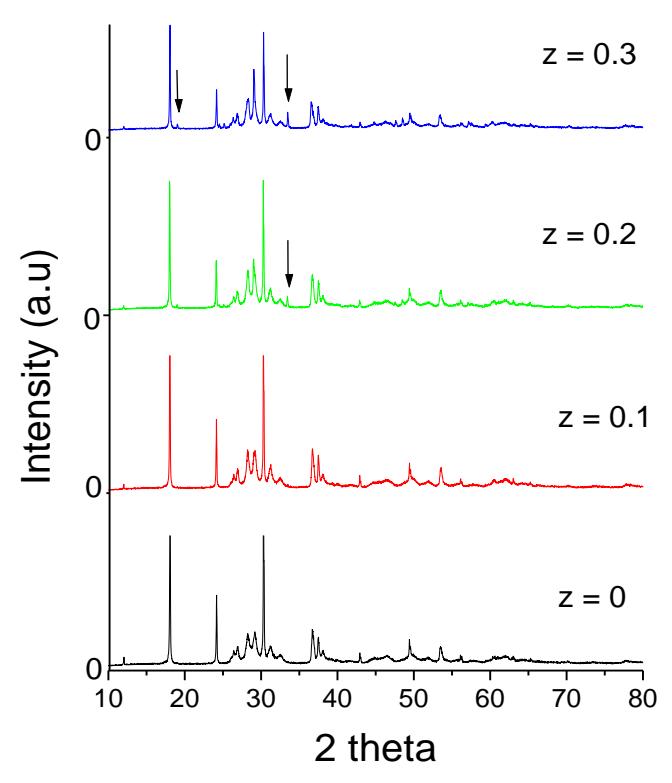
Figure 1 XRD patterns for Bi1.5Pb0.5Ca2-zYzCo2O8(z = 0, 0.1, 0.2 and 0.3) samples. The arrows indicate the additional peaks which might be due to some impurities.
Table 1 shows the evolution of lattice parameters a, \(b_1\), \(b_2\), c, and the \(\beta\) angle with respect to z. We note that except for the z=0.3 samples, which contain some impurity phases, the lattice parameters a, \(b_1\), \(b_2\), and c tend to decrease with an increasing z value, in agreement with the smaller ionic radii of the \(Y^{3+}\) ion compared to the \(Ca^{2+}\) ion. One can remark that the \(\beta\) angle has increased with increasing Y content, while the value of \(b_2/b_1\) that measures the degree of the misfit structure is approximately equal to 0.537.
Table 1 The variations of lattice constants with Y concentration (z).
| Z | a (Å) | \(b_1\) (Å) | c (Å) | b2 (Å) | \(\beta\) (deg) | \(b_2/b_1\) |
|---|---|---|---|---|---|---|
| 0 | 5.1267 | 5.217 | 29.498 | 2.8006 | 92.8186 | 0.537 |
| 0.1 | 5.1217 | 5.2161 | 29.4522 | 2.7975 | 92.8246 | 0.537 |
| 0.2 | 5.1202 | 5.2062 | 29.4310 | 2.7971 | 92.8703 | 0.537 |
| 0.3 | 5.1398 | 5.2436 | 29.5260 | 2.8024 | 92.829 | 0.534 |
The magnetic susceptibility versus temperature curves of the \(Bi_{1.5}Pb_{0.5}Ca_{2-z}Y_zCo_2O_8\) (z = 0, 0.1, 0.2, and 0.3) samples are presented in Figure 2(a). Apparently no sign of magnetic transition is observed in the temperature range down to about 5 K. We note that the nonmonotonous value of \(\chi\) with Y doping is clearly visible in this figure. The associated \(\chi^{-1} - T\) curves are presented in Figure 1(b). It is seen that the high temperature part (T > 200 K) of the data that show straight lines, obeys the Curie-Weiss law
\[\chi^{-1} = \frac{T - \theta}{C} \tag{1}\] where \(\chi\) is the molar magnetic susceptibility, C the Curie constant, and \(\theta\) the Weiss temperature. Finally, the effective magnetic moment per Co ion, \(\mu_{eff}\), can be obtained from the Curie constant, extracted from the \(\chi^{-1}-T\) curve as given by
\[\mu_{eff} = (3kC/N)^{1/2} = (8C)^{1/2} \mu_B \tag{2}\] where k is Boltzmann's constant (1.38 × \(10^{-16}\) erg/K), N is Avogadro's number, and \(\mu_B\) is Bohr magneton.
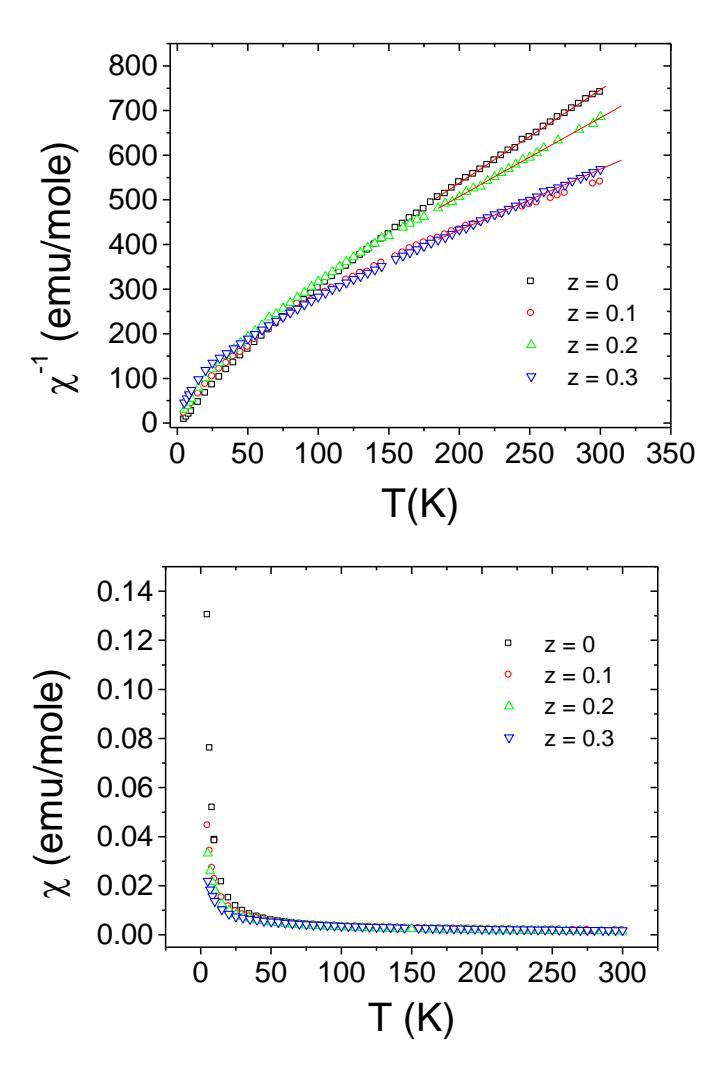
Figure 2 (a) The molar susceptibility (\(\chi\)) versus temperature of Bi<sub>1.5</sub>Pb<sub>0.5</sub>Ca<sub>2-z</sub>Y<sub>z</sub>Co<sub>2</sub>O<sub>8</sub> (z = 0, 0.1, 0.2, and 0.3) samples. (b) The associated inverse molar susceptibility (\(\chi^{-1}\)) versus temperature. The lines are the linear fit of the high-temperature part of the data.
From analysis of the data using Eqs. (1) and (2) we found that both the values of C and \(\mu_{eff}\) vary nonmonoutonously with z. Indeed, the negative values of the Weiss constant \(\theta\) give the sign for the anti ferromagnetic interaction of the Co ions in the \(CoO_2\) plane. The plot of \(\mu_{eff}\) versus z, as depicted in Figure 3, shows an almost constant value along the doping content. We note that this behavior is somewhat different from that reported by Iguchi, et al. [13], performed on similar samples, although they didn't reported the exact value. Despite of this fact, we note also that in general the resulted effective magnetic moment values are smaller than the effective moment of the free ions, namely \(6{,}70\mu_B\) for \({\rm Co}^{3+}\)ions and \(5.92\mu_R\) for Co<sup>4+</sup> ions [16]. Based on this finding we argue the importance of the crystal field effect in this system, as commonly found in transition metal oxide compounds. Due to this effect, the 5-fold degenerate 3d orbitals of the Co ions will split into \(t_{2g}\) and \(e_{g}\) orbitals with orbital energy levels of \(t_{2g}\) lower than the \(e_g\) orbital, due to the fact that the Co ions are in the octahedral electrostatic field of oxygen ions with symmetry \(O_h\). In addition, the competition between the repulsive interaction energy of electrons U (Hund's rule coupling) and the crystal field splitting \(\Delta = 10D_q\) will determine the population distribution of the 3d electrons in the \(t_{2g}\) and \(e_g\) orbitals. Hence, three different spin-states are denoted, low-spin (LS), intermediate-spin (IS), and high-spin (HS), according to the resulted total spin value (S). For instance, \(\text{Co}^{3+}\) ions with a \(3d^6\) configuration can in principle exist in low-spin state (LS: \(t_{2\sigma}^6\), S=0), intermediate-spin state (IS: \(t_{2\sigma}^5 e_{\sigma}^1\), S=1), and high-spin state (HS: \(t_{2a}^4 e_a^2\), S = 2). On the other hand, \(Co^{4+}\) ions in a \(3d^5\) configuration can also exist in LS state (\(t_{2g}^5\), S = 1/2), IS state (\(t_{2g}^4 e_g^1\), S = 3/2), or HS state (\(t_{2g}^3 e_g^2\), S = 5/2).
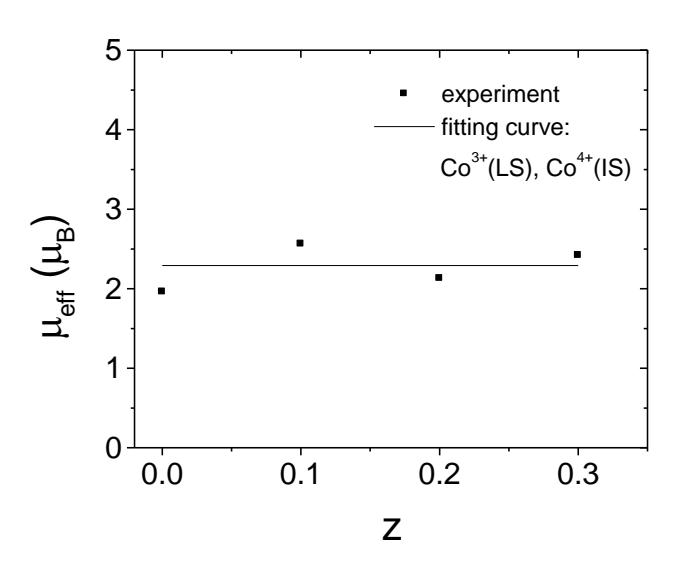
Figure 3 The experimentally obtained effective magnetic moment \(\mu_{eff}\) that shows an almost constant value along the Y doping content.
Subsequently, we fitted the experimental data of the effective magnetic moment with the theoretical values, assuming the different spin-state configurations of the \(\text{Co}^{3+}\) and \(\text{Co}^{4+}\) ions. Hence the theoretical \(\mu_{eff}\) can be calculated according to the formula [16]
\[\mu_{\text{eff}} = g [J(J+1)]^{1/2} \mu_{R} \tag{3}\] where J is the total spin quantum number and g = 2 is the Lande's g factor. Assuming the orbital quenching as commonly found for most transition metal ions, the total spin quantum number J is equal to the total spin S, according to the formula [8,17]
\[J = S_{\text{spin}} = (2 - z)S_3 + zS_4 \tag{4}\] where \(S_3\) and \(S_4\) represent the spin of the \(\mathrm{Co}^{3+}\) and \(\mathrm{Co}^{4+}\) ions, respectively. As shown as a solid line in Figure 3, we found that the experimental result is best fitted by assuming the LS spin state of the \(\mathrm{Co}^{3+}\) ions and the IS spin state of the \(\mathrm{Co}^{4+}\) ions.
At this point, it is important to compare our results with those of the (Bi,Pb)<sub>2</sub>Sr<sub>2</sub>Co<sub>2</sub>O<sub>y</sub> parent compound system in order to investigate the doping effect [18]. From a structural point of view, the effect of Ca and Y doping leads to a significant reduction of lattice parameter c in the present system, due to the smaller ionic radii of the Ca<sup>2+</sup> ions compared to the Sr<sup>2+</sup> ions, although the misfit degree almost keeps the same value. The magnetic spin states of the Co<sup>3+</sup> and Co<sup>4+</sup> ions in the parent compound system are both low-spin, as deduced from the magnetic data [18] and X-ray absorption spectroscopy (XAS) measurement results [11]. Based on the correlation study, we argue qualitatively that in the Ca and Y doped (Bi,Pb)<sub>2</sub>Sr<sub>2</sub>Co<sub>2</sub>O<sub>y</sub> thermoelectric materials the decrease in lattice parameter c leads to a reduction of the ionic spaces between the Co and O ions, and leads to a shrinkage of the charge transfer energy gaps between the O 2p and Co \(e_{\sigma}\) levels. This phenomenon can induce the spin-state transition across the gap. We further note that additional measurements of XAS and X-ray magnetic circular dichroism (XMCD) are important to clarify the abovementioned analysis.
4 Conclusion
In this paper, the effects of Ca and Y doping on the (Bi,Pb)<sub>2</sub>Sr<sub>2</sub>Co<sub>2</sub>O<sub>8</sub> parent compound have been investigated from the analysis of the structural and magnetization data. Besides the misfit structure, the shrinkage of the lattice is shown by the reduction of the lattice parameters along the doping. The effective magnetic moment value of the Co-ions is almost constant toward the doping content and they are much smaller than the free ion values. Further analysis on the basis of the crystal field and the effect of quenching the orbital moment shows that the Co-ions persist in mixed valence states and different spin states, namely Co3+ in the low-spin state and Co4+ in the intermediate-spin state.
Acknowledgements
This work is supported by the Indonesia Toray Science Foundation (ITSF) Research Grant 2008 and Riset and Inovasi ITB 2011 under contract No. 223/I.1.C01/PL/2011. The XRD data were taken in Japan. The magnetic susceptibility measurements were performed in Cologne, Germany.