

1 Introduction
Rice is the main agricultural product in Indonesia and other agrarian countries. The milling of rice yield about 72% of rice, 5-8% of bran, and 20-22% of husk [1]. Although rice husk is an abundant by-product of rice milling, it is only used as material for burning bricks or just thrown away. Rice husk contains 20-22% ash and 78-80% volatile organic material (lignin, cellulose, sugar) [2]. Krishnarao, et al. [3] reported various ranges of rice husk ash (RHA), from 13 to 29%, depending on the rice variety, climate and geographical location. The most common valuable component of rice husk ash is silica (SiO2), about 90- 98%, with a small amount of alkali and metal impurities.
Silica is widely utilized in the fields of electronics, mechanics, arts, as well as the manufacture of chemical compounds, including the manufacture of zeolite. One zeolite, ZSM-5 (Zeolite Socony Mobile-5), is widely used as heterogeneous catalyst in the petroleum industry and for fine chemicals production. It is usually synthesized using commercial silica in the form of silica gel, silica sol and fumed amorphous silica. However, waste materials with a high silica content such as rice husk ash (RHA) or coal fly ash (CFA), are potential alternative silica sources for zeolite synthesis.
Previous studies have shown that rice husk ash in amorphous and crystalline forms can be used as a source of silica for the synthesis of zeolite, either with or without templates [4-6]. Ramli and Bahruji [7] reported the synthesis of ZSM-5 using rice husk ash as silica source with tetrapropylammonium (TPA) as an added organic template. Kim, et al. [8] and Cheng, et al. [9] reported the synthesis of nanosize ZSM-5 in the absence of an organic template with a fast crystallization time. The use of an organic template such as TPA in the synthesis of ZSM-5 means higher production costs, liquid waste contamination by the organic template, and possible air pollution from the product of thermal decomposition of the organic template. Therefore, it is preferable to synthesize the zeolite without organic templates [10-14].
Budianto [15] has reported the synthesis of ZSM-5 from rice husk ash without organic template, by adding 1% of seed to help the crystallization process. The use of a seed crystal to help crystallization has also been reported by Weitkamp and Puppe [16] in the synthesis of the MFI type of zeolites. According to Vempati, et al. [17], the seed accelerated the crystallization process and improved the structure of the resulting ZSM-5.
Although ZSM-5 was successfully synthesized from RHA without organic template, as reported by Budianto [15], no study has been done on the phase transformation of the solid sample during crystallization for a longer period of crystallization time. This work reports a study of the phase transformation of an amorphous gel mixture containing silica of rice husk ash during the synthesis of ZSM-5 without addition of an organic template.
2 Experiment
2.1 Materials Preparation
The rice husk (obtained from Surabaya, East Java) was first washed with distilled water and then dried at 100 oC for 24 h before burning at 600 oC for 4 h in air. The resulted rice husk ash was characterized using XRD technique. Synthesis of ZSM-5 without organic template was done by the addition of a seed crystal. The reaction mixture contained NaOH (99wt%; Merck), sodium aluminate (technical grade, Al as Al<sub>2</sub>O<sub>3</sub> 50-56wt%, Na as Na<sub>2</sub>O 40-45wt%; Sigma Aldrich), rice husk ash (SiO<sub>2</sub>, 93wt%) and calcined silicalite-1 as seed crystal. The reaction mixture was prepared with molar composition: 10Na<sub>2</sub>O: 100SiO<sub>2</sub>: 2Al<sub>2</sub>O<sub>3</sub>: 1800H<sub>2</sub>O. Initial silica and alumina mixtures were prepared separately in two teflon beakers, A and B. Beaker A contained a mixture of NaOH, water and rice husk ash, while beaker B contained sodium aluminates and water. Both beakers were stirred for two h. The reaction mixture in beaker B was added to beaker A, and stirred for 6 h. The resulting gel mixture was aged for 12 h at room temperature before being transferred to a stainless steel autoclave. Then calcined silicalite-1 seed (1wt%), which was previously prepared in our laboratory [18] was added to the mixture. Subsequently, the mixture was heated at 175 °C with a variation of the crystallization times i.e. 6, 12, 24, 48, and 96 h. The autoclave was then cooled to room temperature to stop the crystallization process. The solid was filtered and washed with distilled water until the washing water became neutral. Finally, the solid was dried at 110 °C for 12 h. and characterized with XRD, FT-IR spectroscopy and SEM techniques.
2.2 Characterization
The phase of the samples was determined by X-ray diffraction (Philips PN-1830 X-ray Diffractometer) using Ni-filtered CuK\(\alpha\) radiation (\(\lambda\) = 1.5406 Å) at 40 kV and 40 mA. The pattern was scanned in the 2\(\theta\) ranges 5-50° at a step size of 0.010° and a step time of 1 s. The infrared spectra of the samples were recorded on a Shimadzu FTIR, with scans 20 s using the KBr pellet method, in the wavenumber range of 1400-400 cm<sup>-1</sup>. Scanning Electron Microscopy was monitored on a JEOL 6303 LA to determine the surface morphology of the samples.
3 Results and Discussion
The rice husk sample was burned at \(600^{\circ}\)C and the as-synthesized solids at different crystallization times were characterized by X-ray diffraction technique in the range of \(2\theta = 5-50^{\circ}\), as shown in Figure 1. The XRD pattern of the rice husk ash sample (Figure 1(a)) shows a hump in the region \(2\theta = 15-30^{\circ}\). This indicates that the ash contains amorphous material [19,20].
Figures 1(a-e) present the XRD patterns of the synthesized samples at various crystallization times. The XRD pattern of the sample crystallized for 6 h, (Figure 1(b)) also shows a hump at \(2\theta = 15-30^{\circ}\), indicating that the sample still
contained amorphous material. This suggests that the sample had not yet been converted to zeolite phase. We have reported earlier that the transformation of rice husk ash involves the dissolution of silica ash in the early stages of crystallization [6].
The XRD pattern of the sample crystallized for 12 h (Figure 1(c)) shows a very small peak at 2θ = 22.97˚ indicating an early formation of ZSM-5 crystal [21]. However, the sample still contained amorphous material as the hump still appeared in the diffractogram of the sample. Meanwhile, the sample crystallized for 24 h (Figure 1(d)) shows full crystal phase with diffraction peaks at 2θ 7.88, 22.97, 23.23, 23.63, 23.85 and 24.33˚. This XRD pattern matches well with the XRD of reference of ZSM-5 [21], indicating that ZSM-5 type zeolite has been formed. The XRD pattern of the sample shows a high intensity of the signal with the absence of a hump, suggesting that only ZSM-5 crystal is present in the sample, with good crystallinity.
Figure 1(e-g) show the XRD patterns of the samples that have been crystallized for 48, 72 and 96 h respectively. The XRD of the sample crystallized for 48 h (Figure 1(e)), shows additional peak at 2θ = 21.97˚. This peak is assigned to the disordered α-cristobalite phase [21]. The intensity of the highest peak characteristic for ZSM-5 at 2θ = 22.97˚ of this sample is lower than that of the peak of the sample crystallized for 24 h. This observation suggests that the crystallinity of ZSM-5 has decreased, while some of the ZSM-5 crystal phase has undergone dissolution. The silicate rich solution and the high alkali media of the reaction mixture that was used in this experiment havefacilitated the growth of disordered α-cristobalite, a type of silica crystal phase.
With a prolonged crystallization time, several phase transformations were observed. The XRD pattern of the sample crystallized for 72 h is shown in Figure 1(f). All peak patterns for ZSM-5 phase have completely disappeared in this sample, with only two peaks at 2θ = 20.8 and 26.59˚. The peaks match well with the quartz phase [21], which suggests that the ZSM-5 phase has completely transformed to the more stable quartz phase [21]. However, in the sample crystallized for 96 h, a reappearing of the ZSM-5 phase is visible in the XRD in Figure 1(g). The reappearing of a small peak at 2θ = 7.9 and 22.97 indicates that some quartz crystal has re-dissolved into the reaction mixture, while the available aluminate species in the reaction mixture have facilitated the reformation of ZSM-5 crystals. After 72 h of crystallization, the peak intensity of I100 at 2θ = 26.59˚ of quartz has decreased from 7111 cps in the sample crystallized for 72 h to 3493 cps in the sample crystallized for 96 h, which indicates the decrease crystallinity of the quartz phase (also shown in Figure 2).
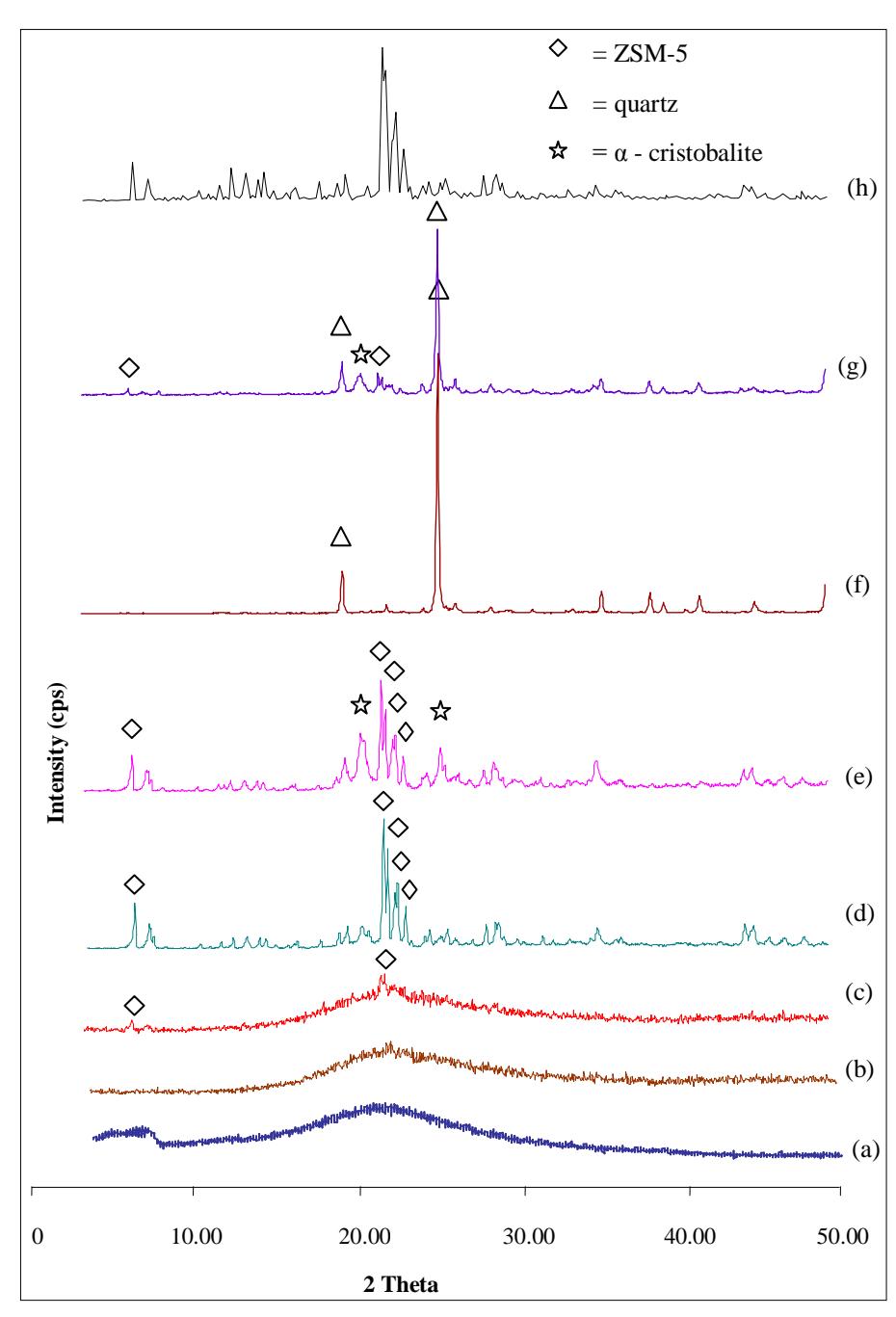
Figure 1 XRD patterns of (a) rice husk ash, and samples at various crystallization times: (b) 6 h, (c) 12 h, (d) 24 h, (e) 48 h, (f) 72 h, (g) 96 h, (h) ZSM-5 from TEOS-TPABr.
All the findings indicate that phase transformations have occurred in the solid samples in which crystallization proceeded, from the amorphous phase of the aluminosilicate gel mixture to the ZSM-5 phase, continued to the disordered αcristobalite phase, and to the more stable quartz phase. The transformation of the amorphous aluminosilicates gel to the crystalline phases is presented in Figure 2, showing a plot between the crystallization times versus the total intensity of each phase. On the basis of the XRD results, we can conclude that pure ZSM-5 can be obtained in 24 h crystallization time with the gel ratio used in this study and the help of seed crystals. In the reaction mixture used in this experiment, which was highly alkaline, and with the absence of an organic template as structure-directing agent, the formed ZSM-5 crystal is metastable and prone to re-dissolve and facilitate the formation of a more stable silica crystal such as quartz, with a prolonged crystallization time. Different findings of silica transformation were also reported by Barrer [22] in at different system solution at high temperature, where the transformation of amorphous silica followed the sequence: amorphous → α-cristobalite → keatite → quartz.
Assuming the ZSM-5 phase in the sample crystallized for 24 h to 100%, the relative crystallinity of the ZSM-5 phase formed in samples at 12, 24, 48, 72 and 96 h crystallization time have been calculated, the results are shown in Table 1. The difference in intensity observed in the XRD patterns is due to the difference in crystallinity of the ZSM-5 samples, which can also indicates the amount of ZSM-5 contained in the solid sample.
Table 1 XRD peak intensity and crystallinity of the samples with various crystallization times.
| 2θ | Intensity, cps | |||||||
|---|---|---|---|---|---|---|---|---|
| 12 h | 24 h | 48 h | 72 h | 96 h | ||||
| 7.88 – 8.75 | 44.92 | 483.42 | 319.50 | - | 112.07 | |||
| 22.51 – 22.97 | 89.53 | 1479.68 | 932.52 | 38.26 | 382.41 | |||
| 22.99 – 23.23 | - | 1131.99 | 702.71 | - | - | |||
| 23.48 – 23.63 | - | 557.98 | 406.83 | - | - | |||
| 23.83 – 23.85 | - | 751.09 | 488.44 | - | - | |||
| 24.31 – 24.46 | - | 476.28 | 290.29 | - | - | |||
| ZSM-5 | ||||||||
| Crystallinity | 2.75 | 100 | 64.54 | 0.79 | 10.13 | |||
| (%) | ||||||||
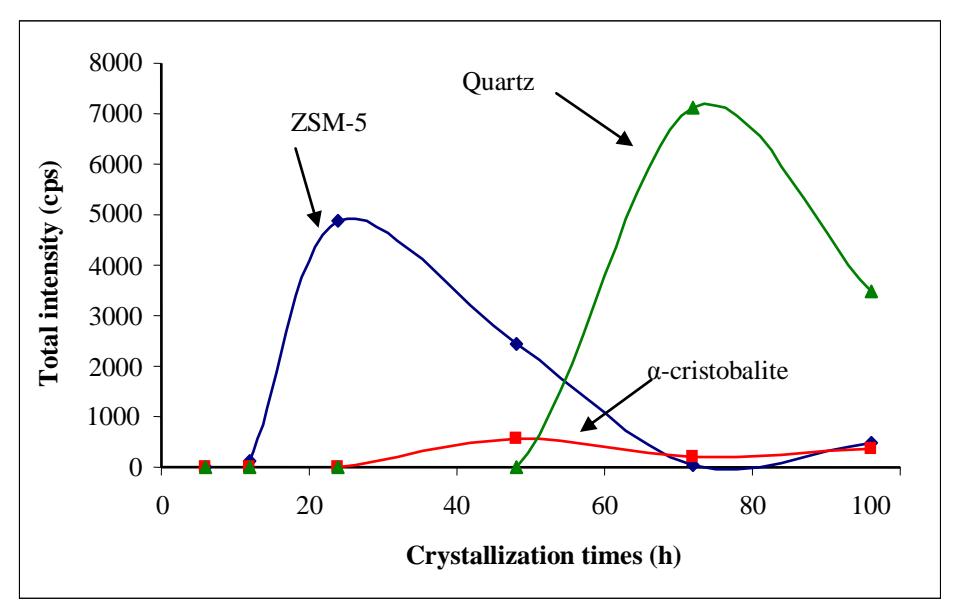
Figure 2 Transformation of amorphous silica to ZSM-5, disordered \(\alpha\)-cristobalite and quartz phase.
The infrared spectra of the rice husk ash and the samples at various crystallization times were recorded at wavenumber in the range of 1400-400 cm<sup>-1</sup> as shown in Figure 3, the wavenumbers of each peak are tabulated in Table 2. The infrared spectrum of the rice husk ash in Figure 3(a) shows the characteristics of the asymmetric stretching of the tetrahedral SiO<sub>4</sub> peaks at wavenumber 1099 cm<sup>-1</sup>, the symmetry stretching of SiO<sub>4</sub> at ca. 799 cm<sup>-1</sup> and the bending of Si-O at 467 cm<sup>-1</sup> [23,24]. The third peak of the rice husk ash spectrum, at 467 cm<sup>-1</sup>, indicates that the rice husk ash is in the form of amorphous phase [25]. Figure 3(b) and (c) represent the infrared spectra of the solid samples crystallized for 6 and 12 h respectively. The spectra of these samples appear almost the same as the spectrum of the rice husk ash. This indicates that the ZSM-5 crystal has not yet been formed in these samples, which agrees well with the XRD finding.
The infrared spectrum of the sample crystallized for 24 h (Figure 3(d)) shows a vibrational peaks pattern in the ZSM-5 framework. Peaks at around 1102, 796 and 456 cm<sup>-1</sup> are characteristic for the asymmetric stretching of the tetrahedral TO<sub>4</sub> (T=Si,Al) and the T-O bending, respectively. The appearance of a shoulder peak at 1218 cm<sup>-1</sup>, which is assigned to the asymmetric stretching of the external framework and at 542 cm<sup>-1</sup>, which is assigned to five-membered ring vibration, are characteristic for an MFI zeolite framework, ZSM-5 belongs to this group of zeolite [25,26]. These two vibrational peaks are sensitive to the framework changes while the appearance of five-membered ring vibration at 542 cm<sup>-1</sup> confirms the ZSM-5 structure because the ZSM-5 framework structure is made of such 5-membered rings of TO<sub>4</sub> tetrahedral building units. The IR spectrum of the sample supports the data from the XRD. The spectrum is also in accordance with the result reported by Flanigen, et al. [23], and also with the spectrum of ZSM-5 synthesized from commercial silica (tetraethylorthosilicate, TEOS) in the presence of an organic template (tetrapropyl ammonium bromide, TPABr) as is shown in Figure 3(h).
The sample crystallized for 48 h had a similar infrared pattern (Figure 3(e)) to the infrared spectrum of the sample crystallized for 24 h, which indicates that the sample still maintained the ZSM-5 structure. However the peaks that are sensitive to the structure change in ZSM-5 (ca. 1218 and 542 cm<sup>-1</sup>) started to decrease in intensity and disappeared in samples crystallized for longer than 48 h (Figure 3(f and g)). This observation agrees well with the XRD results in which there samples consist of quartz as the dominant phase. By looking at the asymmetric stretching peak for the samples crystallized for 24 and 48 h, both of which consist of ZSM-5 phase, the sample crystallized for 24 h is suggested to be more siliceous than the sample crystallized for 48 h because the peak appears at a higher frequency, i.e. at 1102 cm<sup>-1</sup> rather than 1096 cm<sup>-1</sup>. This means that the sample crystallized for 24 h contains more silica due to the substitution of aluminium atoms with silicon atoms in the framework. According to Armaroli, et al. [27], the ZSM-5 with high aluminum content shows an asymmetric stretching band at around 1090 cm<sup>-1</sup>.
Table 2 Stretching and bending vibration of the samples.
| Samples | T O handing | |||||
|---|---|---|---|---|---|---|
| Asymmetric | Symmetric | — T-O bending | ıng | |||
| Rice husk ash | - | 1099 | 799 | - | 467 | - |
| 6 h | - | 1089 | 796 | - | 468 | - |
| 12 h | - | 1088 | 798 | - | 468 | - |
| 24 h | 1218 (sh) | 1102 | 796 | 542 | 478 | 456 |
| 48 h | 1218 (sh) | 1096 | 793 | 546 | - | 457 |
| 72 h | - | 1086 | 800 | 581 | 473 | - |
| 96 h | - | 1098 | 799 | - | 473 | - |
| ZSM-5 from TEOS-TPABr | 1228 | 1109 | 800 | 550 | 457 | - |
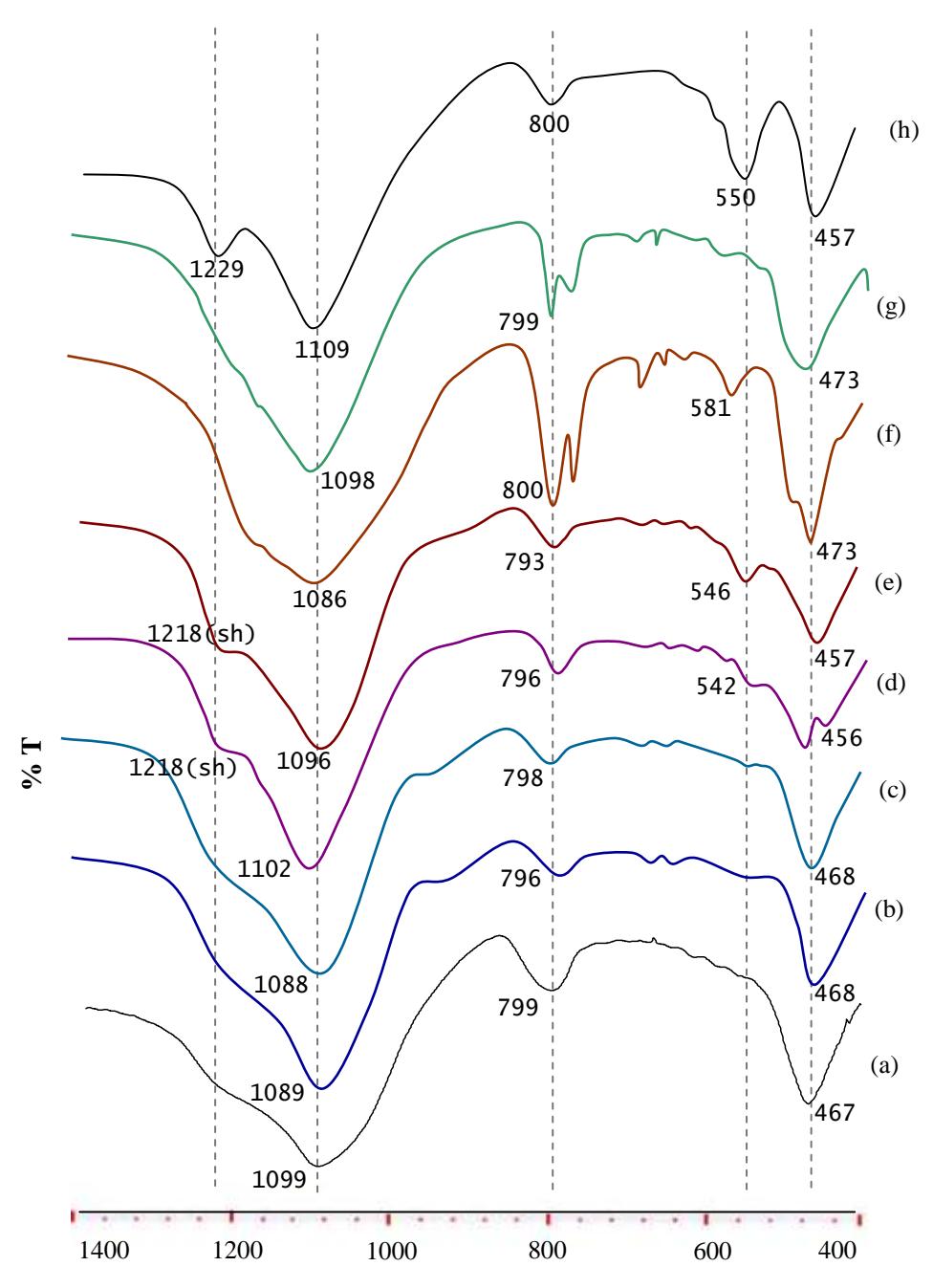
Figure 3 Infrared spectra of the samples: (a) rice husk ash (b) 6 h (c) 12 h (d) 24 h (e) 48 h (f) 72 h, (g) 96 h and (h) ZSM-5 from TEOS-TPABr.
The SEM of the rice husk ash sample crystallized for 24 h, and the ZSM-5 synthesized using TEOS and organic template TPABr are shown in Figure 4. The morphology of the rice husk ash appears as aggregates in various size around 50-100 µm with no definite structure, suggesting the presence of amorphous material. Some flaky layers with a needle-like structure can be observed at the aggregate particle (Figure 4(a)). The flaky morphology of the sample of amorphous silica aggregates, as seen in the SEM images, shows a reactive surface that can easily make bonds [19]. The morphology of the sample crystallized for 24 h is shown in Figure 4(b). In general, this sample displays an almost uniform, grubby, hexagonal like crystal, spread evenly with a varying particle size, ranging between 1-5 µm. For comparison, the morphology of the ZSM-5 synthesized using TEOS as silicon source and TPABr is shown in Figure 4(c). It can be observed that the morphology of the crystals consists of layers of agglomerated hexagonal crystal-shapes resulting in a much larger crystal, with an average size of 20 µm as compared to 5 µm for the ZSM-5 synthesized from rice husk ash.
Figure 4 SEM of (a) rice husk ash, (b) sample with 24 h crystallization time (c) ZSM-5 from TEOS-TPABr.
4 Conclusion
Pure ZSM-5 with a particle size between 3-7 µm can be synthesized from rice husk ash as silica source within 24 h of crystallization time without an organic template and with the addition of silicalite-1 as seed crystal. The ZSM-5 phase started to form after 12 h of hydrothermal crystallization and reached maximum crystallinity and purity at 24 h of crystallization. The ZSM-5 crystal formed is metastable since with a longer crystallization time the ZSM-5 crystal was transformed into the more stable quartz phase.
Acknowledgments
The authors gratefully acknowledge the financial support from Institut Teknologi Sepuluh Nopember (ITS), Surabaya.