

1 Introduction
β-Alkoxyalcohols are versatile precursors in organic synthesis and pharmaceuticals. The synthetic route for such compounds commonly proceeds via ring-opening of oxiranes (epoxides) [1-24] using traditional Lewis acids such as Cu(BF4)2 [2,21], Sn(OTf)2 [11], BF3 [22], Sc(OTf)3 [24], and traditional solid acids such as amberlyst-15 [10]. Modified Lewis acid complexes based on salen [5,12] and porphyrin [23] ligands have also been reported. Some heterogeneous catalysts such as zeolites [1,18], monmorillonite K-10 [4], silica gel [6], mesoporous aluminosilicate [9,12,14,15,20], CuO/SiO2 [19], and sulphated yttria-zirconia [25] have been reported as catalysts in the ring-opening of oxiranes. An alternative reaction method using a microwave technique has also been examined [13], even though such a method still experiences difficulties in scale-up processes. In continuation of our research on oxirane ring-opening reactions [3,7,8] we report herein a new methodology for oxirane ring-opening using clay-supported Zr(IV) diketonates. The clay selected as a host was lithium Taeniolite, denoted as Li-TN [26]. Lewis acidity at the metal center in the complex was improved by utilization of phenyl and fluoro diketone ligands and was observed from its homogeneous state [7,8]. We have previously discussed an immobilization effect of a zirconium complex into clays [3,8] and observed the enhancement in catalytic activities likely due to a desolvation
phenomenon of metal complexes in clay layers [27,28]. We have also observed a selectivity enhancement when a zirconium complex was immobilized into Taeniolite and natural Bentonite, which was possibly due to constrained clay layers (the clays were notably swollen poorly in alcohols) [3]. In this work, we found that the trend in the selectivity of the heterogeneous catalysts was, unlike that of the homogeneous catalysts, independent on the functional groups of ligands, and the activity of the heterogeneous catalysts was dependent on the size of the substrate. Nevertheless, the effort to immobilize \(tris(\beta\)-diketonato)zirconium(IV) into clay is still important, regardless of common requisites of selectivity and activity, as such efforts may provide an alternative method to prepare a robust and easily separable ionic zirconium catalyst for liquid phase reactions.
\[O = \begin{pmatrix} R^1 \\ O = \begin{pmatrix} R^2 \\ 2 \end{pmatrix} & Li-Taeniolite \\ R^2 & R^2 \end{pmatrix}\] \[A: R^1 = R^2 = Me\] \[b: R^1 = Me; R^2 = Ph\] \[c: R^1 = R^2 = Ph\] \[d: R^1 = Ph; R^2 = CF_3\] \[anionic silicate layers\] \[anionic silicate layers\] \[anionic silicate layers\]
Scheme 1 Immobilization of Zr(IV) \(\beta\)-diketonates into Taeniolite layers.
2 Experiment
2.1 Materials and Reagents
Zirconium tetrachloride, \(\beta\)-diketone ligands, oxiranes and alcohols were purchased from Wako Pure Chemical Industries, Ltd. and used without prior treatment. The synthetic Lithium Taeniolite (Li[(Mg<sub>2</sub>Li)(Si<sub>4</sub>O<sub>10</sub>)F<sub>2</sub>]) used in this work was kindly supplied by Topy Industry Co. Ltd., Japan. Complexes of 2b-d and 2a/TN catalyst were prepared as in our previous report [3,8].
2.2 Preparation of Taeniolite Supported Tris(β-Diketonato) Zirconium
The 2b–d/TN catalysts were prepared in the following, slightly different manner. Lithium Taeniolite (cation exchange capacity, C.E.C, of 2.68 mmol Li<sup>+</sup>/g Taeniolite) of 0.1 g was swollen by deionized water (10 ml). Complexes 2b and 2c (50% of Taeniolite C.E.C) were dissolved in methanol (30 ml), and 2d (50% of Taeniolite C.E.C) in acetone (30 ml). The solution was added to the swollen Taeniolite, followed by stirring at 35 °C for 48 h and sonication for 1.5 h. Complex/Taeniolite compounds were characterized using PXRD (Bruker AXS MXP3V; Cu-K) and FT-IR (JEOL JIR-7000). The amount of loaded complexes was examined by calculating the remained concentration of complexes in the filtrate after ion-exchange using a simple UV-Vis technique (Shimadzu UV-2101PC).
2.3 Ring-Opening Reactions of Oxiranes with Alcohols
Methyl, ethyl and dimethyl oxiranes (3.55 mmol), respectively, were added into methanol in excess (10 ml), containing 1 mol% of active species of 2ad/TN catalysts. In another series of reactions, methyl oxirane (3.55 mmol) was added to methanol, ethanol, n-propanol and i-propanol, respectively, in excess (10 ml), containing 1 mol% of active species of 2a/TN catalyst. Reaction condition was 24 h, 60 °C and 1 atm. The products were analyzed by GC (Rt β-DEXsa column) and GC-MS (Rt β-DEXsm column).
3 Results and Discussion
3.1 Organic/Inorganic Hybrid Compounds
Tris(β-diketonato)zirconium(IV) complexes have been immobilized into clay structure by a facile ion exchange method (Scheme 1), affording a series of organic/inorganic hybrid compounds (2ad/TN). The immobilization of the complexes was confirmed by FT-IR, powder XRD, and UV-Vis analysis. XRD patterns of the compounds (Figure 1) showed a shift of initial d001reflection to lower angles, demonstrating an expansion of clay layers due to a complex immobilization. Unlike the 2a/TN catalyst, the 2bd/TN catalysts revealed a relatively weaker shift towards lower angles despite their theoretically bigger molecular size than 2a. Such a poor layer expansion will affect substrate diffusion adversely during a catalytic reaction. However, in contrast to 2a/TN, good crystallinity was observed in the case of immobilized 2bd (Figure 1). This may indicate a fair distribution of complexes 2bd in interstitial layers of Taeniolite.
The amount of immobilized complexes on Taeniolite was measured by UV-Vis analysis of the filtrate after ion-exchange processes and provided in mmol/g of Taeniolite. Loading amounts and PXRD parameters of Taeniolite layers after immobilization are presented in Table 1.
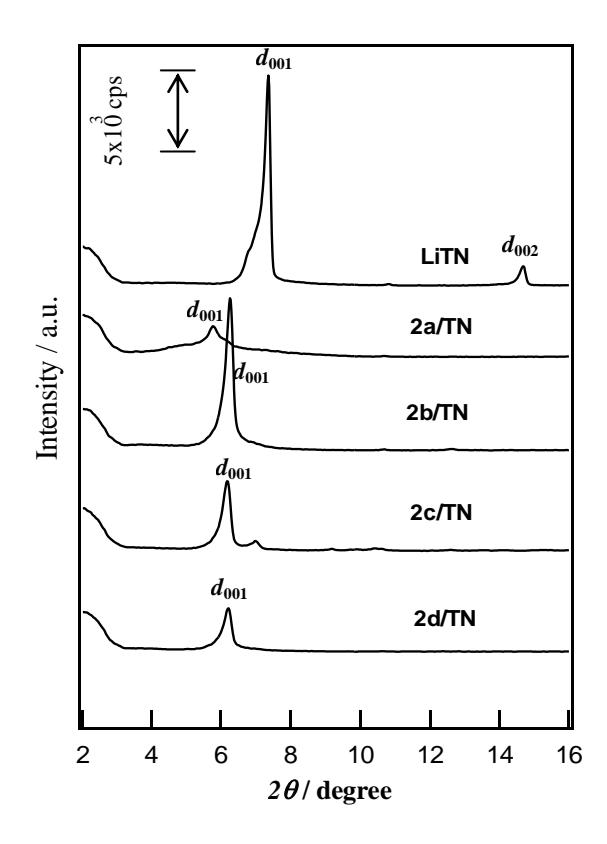
Figure 1 XRD patterns of initial clay (LiTN) and Zr/TN compounds.
Tabel 1 Loading amounts and PXRD parametersa of Taeniolite-supported tris(-diketonato)zirconium(IV) complexes.
| L.A.b (mmol/g) | d001 (nm) | C.S.c (nm) |
|---|---|---|
| 0.25 | ||
| 0.57 | ||
| 0.45 | ||
| 0.48 | ||
| 0.46 | ||
| - 1.12 1.10 1.02 1.10 | 1.21 1.53 1.41 1.44 1.42 |
a Cu-K. b Loading amount. c Clearance space = d001 – 0.96 nm (thickness of layer).
The loading amount data tell us that the complex substituted about 40% of the lithium host cations. Although no experiment intended to vary the feeding amount to see the influence on catalysis, all reactions conducted in this work employed the same amount of Zr complexes, i.e. 1 mol% of exchanged complexes, and thus a difference in activity due to a feeding amount parameter should be eliminated.
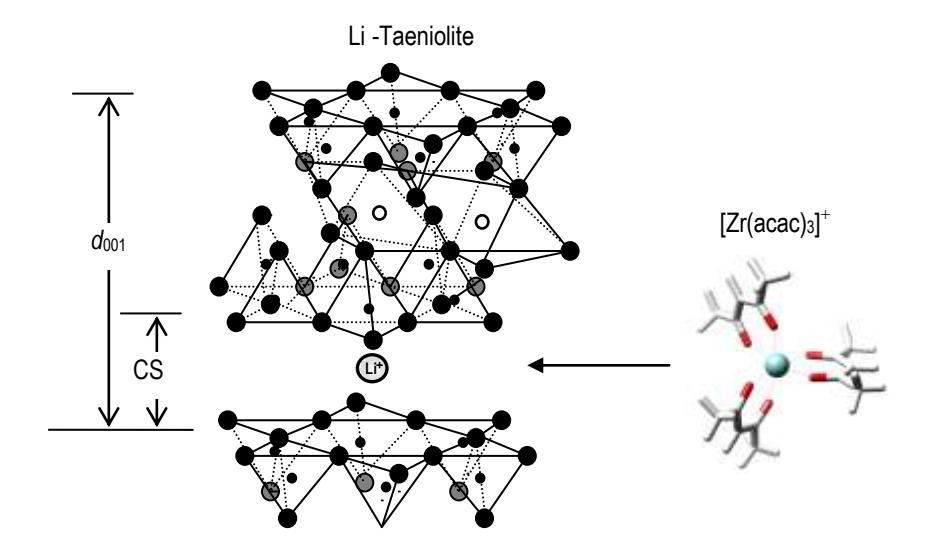
Scheme 2 Schematic illustration of an ion exchange process between exchangeable lithium cation and tris(acetylacetonato)zirconium guest cation (couter anion was omitted for simplification). Taeniolite structure is given as an idealized 2:1 (TetrahedralOctahedralTetrahedral) structure. C.S. = clearance space of interlayer. Large black balls are oxygen; large grey balls are fluorine; small black balls are silicon; small white balls are magnesium.
The appearance of characteristic bond vibrations of tris(β-diketonato)zirconium, i.e. C(arom)-H, C(sp2)-H, and C=O, in IR spectra of Taeniolite supported complexes clearly confirmed the presence of the complexes on the Taeniolite structure (Figure 2). There are two possible causes for the complexes' immobilization on clay. First, the complexes were immobilized in their salt forms (cations and anions were being incorporated into clay layers), and second, only cations were immobilized through an ion-exchange process with exchangeable lithium cations. Confirmatory evidence that cationic tris(βdiketonato)zirconium complexes successfully exchanged lithium host cations was observed from vibration disappearances of ClO from counter anions (i.e. perchlorate anion) in the IR spectra, which should appear around 10801130 cm (stretching vibration) and 620640 cm (bending vibration) in the original zirconium complex (Figure 2) [29].
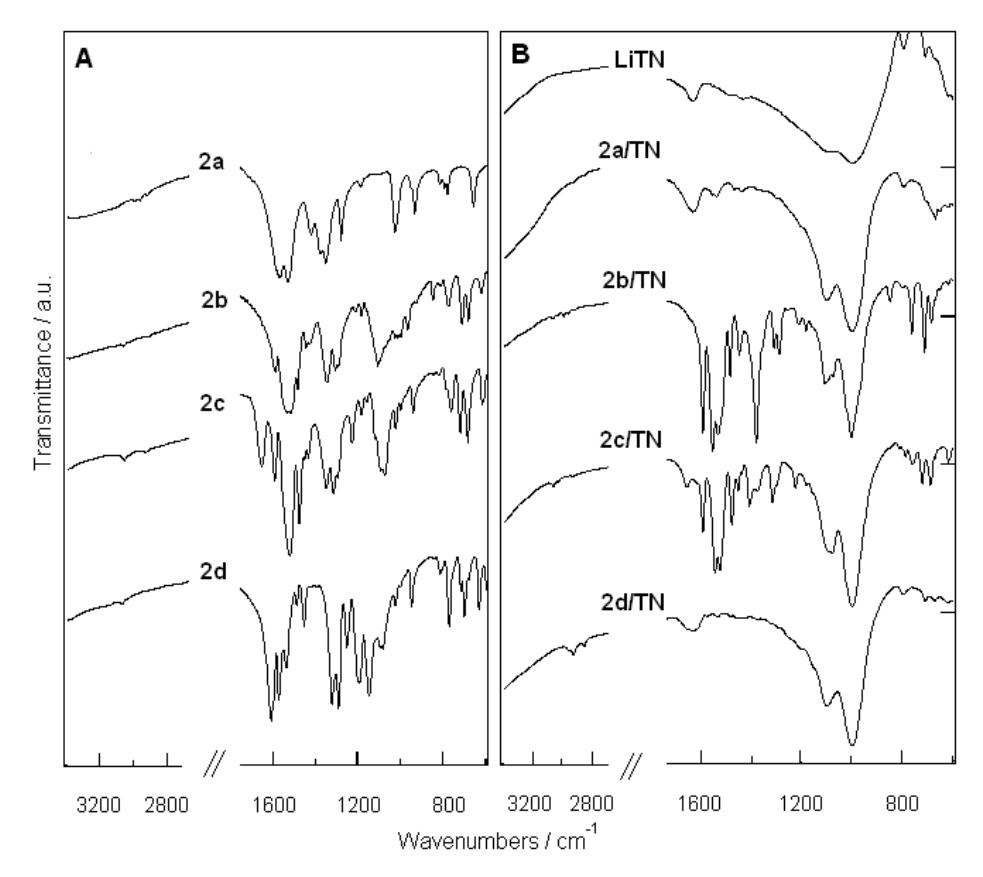
Figure 2 FT-IR spectra of (a) Zr-diketonates prior to immobilization (b) Taeniolite-supported Zr-diketonates. Vibrations were presented at selected wavenumbers for focused discussion (600–1800 and 2800–3200 cm1 ).
3.2 Ring-Opening of Oxiranes with Alcohols
Methyl, ethyl and dimethyl oxiranes were found to undergo smooth ringopening with alcohols, affording primary and secondary alkoxyalcohols when they were catalyzed by Taeniolite-supported Zr -diketonates (Table 2). The proposed mechanism of an SN1 mechanism is given in Scheme 3. The complex is predicted to initially provide a vacant space for oxirane-activation by a partial dissociation of coordinated diketone ligands (Scheme 3). A competitive SN2 mechanism (due to a weak oxirane-activation) is likely the reason for the formation of secondary alkoxyalcohols. A unique activity behavior of Taeniolite-supported Zr -diketonates is given in Table 2. Entries 25 of the table describe an improvement trend in activity, while entries 69 describe a significant decline trend. Entries 1013 describe a moderate decline trend. A factor to consider in rationalizing these phenomena is the clearance space
relative to the molecular size of complexes, as observed from the PXRD patterns of the catalysts (Figure 1).
\[\text{[rumus tidak dapat ditampilkan dengan baik — lihat PDF asli]}\]
Scheme 3 Proposed mechanism of a ring-opening reaction of oxiranes with alcohols in \(S_{\rm N}1\) fashion to afford primary alkoxyalcohols. Counter anions from Taeniolite layers not shown for simplicity.
In entries 2-5, a relatively small size of methyl oxirane provides good accessibility for the substrate to diffuse into clay layers, even though some of the clay-supported zirconium complexes possess a relatively low clearance space. The rate-determining step in such a case is likely the substrate diffusion step. In entries 6–9, a relatively large size of ethyl oxirane provides poor accessibility for the substrate to diffuse into clay layers, unless the clearance space of the catalyst is considerably high, such as that on 2a/TN, which in fact demonstrates the highest activity in this series. In entries 10–13, we found that a significant decline trend due to the bulkiness of the substrate was not observed. This can be explained by the fact that the intermediate compound resulted from dimethyl oxirane activation is a tertiary carbocation, which is more stable than a secondary carbocation resulted from monoalkyl oxiranes, such as methyl and ethyl oxiranes. Such an intermediate stabilization provides a longer lifetime of the intermediate to react with a nucleophile. Supportive evidence for this suggestion can be found in the higher selectivity of the primary isomers for the ring-opening of dialkyl oxiranes (Table 2, entries 10–13).
Table 2 Synthesis of primary methoxyalcohols (3) promoted by Taeniolite-supported \(tris(\beta\)-diketonato)zirconium(IV) in comparison with their homogeneous counterparts (given in parentheses).
| Entry | Oxiranes | Oxiranes Cat. Conversion | siona / % | Selectivityb (3)/ % | ||
|---|---|---|---|---|---|---|
| 1 | LiTN | 24 | 20 | |||
| 2 | 2a/TN | >99 | (41) | 58 | (34) | |
| 3 | 0 | 2b/TN | 100 | (93) | 56 | (46) |
| 4 | ✓Ĭ | 2c/TN | 100 | (>99) | 52 | (52) |
| 5 | Me´ ✓ | 2d/TN | 100 | (100) | 39 | (52) |
| 6 | 2a/TN | 98 | (9) | 47 | (24) | |
| 7 | _o | 2b/TN | 60 | (99) | 47 | (45) |
| 8 | Et | 2c/TN | 17 | (>99) | 31 | (45) |
| 9 | _, | 2d/TN | 18 | (>99) | 46 | (45) |
| 10 | 2a/TN | 78 | (66) | >99 | (87) | |
| 11 | √ _0 | 2b/TN | 91 | (93) | 100 | (>99) |
| 12 | \(\nearrow \bigvee\) | 2c/TN | 55 | (100) | >99 | (100) |
| 13 | 2d/TN | 69 | (>99) | 96 | (100) | |
<sup>a</sup> Conversion was calculated by GC. <sup>b</sup> Selectivity was confirmed by GC-MS.
We have seen the effect of alcohol nucleophiles on the catalysis of oxirane ringopening using homogeneous Zr(IV) in one of our previous reports [7]. Here we have attempted to investigate the same effect when the reactions were catalyzed by immobilized Zr(IV) complexes. The reactions taken as models were the ringopening reactions of methyl oxirane with methanol, ethanol, n-propanol, and ipropanol, which were catalyzed by the 2a/TN catalyst. The catalytic data of these reactions are given in Table 3. The data show that the ring-opening reaction of methyl oxirane was independent of the type of alcohol when 2a/TN was employed in the reaction. This was likely due to a desolvation property inside the Taeniolite layers, which consequently enhanced the Lewis acidity of the complex, as it was poorly solvated [3,27,28]. Such a property is uniquely important because the same reaction with bulky nucleophiles demonstrates a considerably lower activity when catalyzed by the homogeneous counterparts (Table 3, entry 4).
Table 3 Ring-opening of methyl oxirane with various alcohols using the 2a/TN catalyst in comparison with 2a (given in parentheses).
ROH 2a/TN 5 O OH OR OR OH
| Entry | Alcohol | Conversiona | / % | Selectivityb | (5) / % |
|---|---|---|---|---|---|
| 1 | MeOH | >99 | (41) | 58 | (34) |
| 2 | EtOH | >99 | (80) | 42 | (17) |
| 3 | n-PrOH | 97 | (15) | 52 | (24) |
| 4 | i-PrOH | 98 | (6) | 43 | (30) |
aConversion was calculated by GC. bSelectivity was confirmed by GC-MS. Reaction conditions were 60 C, 1 atm, 24 h.
4 Conclusion
A series of organic/inorganic compounds prepared by immobilization of tris(βdiketonato)zirconium(IV) complexes into Taeniolite has been synthesized. The compound serves as a good catalyst for the ring-opening reactions of methyl, ethyl, and dimethyl oxiranes with various alcohols to generate primary alkoxy alcohols in appreciable selectivity. While bulky nucleophiles proceed in a very low activity of oxirane ring-opening in a homogeneous state, such nucleophiles show a significantly higher activity when the zirconium active species is immobilized into Taeniolite.
Acknowledgements
YP acknowledges Riset KK ITB, IMHERE-ITB and Hibah Kerma LN DIKTI for partial support of the work.