

1 Introduction
Catechol and hydroquinone are used in a large number of applications in the modern chemical industry, such as pharmaceuticals, photography and polymer production [1]. Catechol and hydroquinone are commonly synthesized by a phenol hydroxylation reaction using H<sub>2</sub>O<sub>2</sub> as an oxidant [2]. H<sub>2</sub>O<sub>2</sub> has many advantages, such as having a high active oxygen content and being a stable reagent and a green compound that only results in water as waste product from the reaction [3]. TS-1 was first synthesized by Taramasso, et al. in 1983 [4] and showed excellent catalytic activities in organic oxidation reactions using hydrogen peroxide as oxidant under mild conditions. On the subject of organic oxidation reactions such as the hydroxylation of phenol, many experiments have been carried out to enhance phenol selectivity due to the importance for industry of producing hydroquinone and cathecol. The ability of TS-1 to catalyze a wide
variety of oxidation transformations, including phenol hydroxylation with aqueous hydrogen peroxide, has led to extensive research worldwide on synthesis related to heterogeneous catalysts for liquid phase oxidation [4-8].
TS-1 has a relatively high phenol conversion activity and it can lessen the production of tar and other side products that are potential pollutants [2]. However, TS-1 has a low reaction rate and catalytic selectivity in oxidation reactions because of its hydrophobic nature [9]. Meanwhile, in the reaction mechanism of phenol hydroxylation, TS-1 will decompose H2O2 (the oxidation agent), which has a hydrophilic character, to form titanium-peroxo radicals (initiation step), followed by propagation in solution [10]. Therefore, one way to increase the phenol hydroxylation reaction rate of TS-1 catalyst is by making it more hydrophilic.
Hydrophilic improvement of TS-1 catalyst can be carried out by addition of metal oxide, which leads to an increase of acidity. The existence of metal oxide in TS-1 catalyst can generate acid sites, which are capable of increasing catalyst hydrophilicity. In earlier research, epoxydation of 1-octene with H2O2 has shown that the presence of metal oxide in TS-1 catalyst can generate acid sites and thus increase the hydrophilic nature of the catalyst, so that the adsorption of reactants to the catalyst becomes faster [11,12]. Acid sites can be found in some metal oxides, such as V2O5, Nb2O5, MoO3, WO3, Re2O7, TiO2 and Cr2O3/Al2O3 [13]. As for TiO2, many researchers have reported that TiO2/SiO2, TiO2/clay and TiO2/Al-MCM-41 nanocomposites can increase catalytic activity in many organic syntheses [14-16]. The activity of TiO2 depends on the calcination temperature, which is correlated to phase transformation (anatase to rutile), surface area, crystallite size, acidity, water sorption and hydroxyl groups [17- 19].
In this research, TS-1 catalyst was modified by addition of titanium oxide on the surface. Also, the effect of the calcination temperature of titanium oxide on the structure and properties of the catalyst was investigated.
2 Experiment
2.1 Synthesis of TS-1
TS-1 containing 1 mol% of titanium was prepared according to the procedure described by Taramasso, et al. [4], using tetraethyl orthosilicates (TEOS, Merck, 99%), tetraethyl orthotitanate (TEOT, Merck 99%), 2-propanol (Merck, 99%), tetrapropylammonium hydroxide (TPAOH, Merck, 40% in water) and distilled water. The gel was charged into a 150 mL autoclave and heated at 175°C under static conditions. The material was recovered after 4 days by centrifugation at 3000 rpm for 30 min and washed with excess distilled water. White powder was obtained after drying in air at 100°C overnight. The solid material was then calcined in air at 550°C for 4 h.
2.2 Preparation of TiO2/TS-1
TS-1 sample loaded with titanium oxide (TiO2/TS-1) was prepared using the impregnation method, where tetraethyl orthotitanate is used as a precursor. The calcined TS-1 was dried in an oven at 110°C for 24 h. The necessary amount of TEOT (0.122 g) was then dissolved in 10 mL of 2-propanol to obtain the desired metal loading; the required quantity of pre-dried TS-1 (3.612 g) was immediately added. The obtained mixture was stirred at room temperature for 3 h, the solid was recovered by evaporation of the 2-propanol at 80°C. The acid hydrolysis was performed by addition of 20 mL solution of 0.5 M HNO3 in distilled water and the solution was aged overnight, followed by heating at 100°C until dry. The solid was then washed three times with distilled water and finally dried at 110°C for 24 h. The white solid was calcined at 400, 500, 600 and 700°C for 4 h at a heating rate of 2°C/min. Titanium oxide was prepared by hydrolysis of tetraethyl orthotitanate at room temperature for 24 h. The white solid was recovered by filtration, washed with water, and dried at 100°C overnight. Finally, the solid produced was calcined at 550°C for 4 h. The samples were denoted as xTiO2/TS-1, where x refers to the calcination temperature.
2.3 Characterization
All samples were characterized by X-ray diffraction with a Bruker Advance D8 diffractometer with CuKα (λ = 1.5405 Å) using a diffracted monochromatic beam at 40 kV and 30 mA. The pattern was scanned in 2θ ranges from 5-50° in steps of 0.02° and with a step time of 1 s. The infrared (IR) spectra of the samples were collected with a Shimadzu Fourier Transform Infrared (FTIR) spectrometer with a spectral resolution of 2 cm-1 and a scan speed of 10 s, with the KBr self-supported wafer method. The infrared spectra of the samples were recorded at room temperature in the framework region of 1400-400 cm-1. The acidity of the samples was determined by FTIR using pyridine as the probe molecule [20]. The wafer of the sample (10-12 mg) was locked in a cell and evacuated at 400°C for 4 h, followed by adsorption of pyridine at room temperature. After evacuation at 150°C for 3 h, the infrared spectra of the samples were recorded at room temperature in the region of 1400-1700 cm-1. In order to directly compare the surface coverage of the adsorbed species, all spectra were normalized after activation using the overtone and combination vibration of the MFI at around 1800 cm-1 [21]. The number of Brønsted or
Lewis acid sites was calculated using the equation proposed by Emeis [20], as follows:
Number of acid sites \[(mmol/g) = \frac{B \times L}{k \times g} \times 10^{-3}\] where:
B is peak area of Brønsted or Lewis acid absorption band (cm<sup>-1</sup>)
L is area of sample disk (cm<sup>2</sup>)
g is weight of sample disk (g)
k is molar extinction coefficient values of 1.67 cm \(\mu\)mol<sup>-1</sup> for the 1545 cm<sup>-1</sup> band characteristic of pyridine on the Brønsted acid sites or 2.22 cm \(\mu\)mol<sup>-1</sup> for the 1455 cm<sup>-1</sup> band of pyridine on the Lewis acid sites.
The nitrogen adsorption-desorption isotherms were performed using a Micromeritics ASAP 2010 instrument. The samples were previously outgased at 200 °C under vacuum. The surface areas of the samples were determined by BET equation. The catalyst hydrophilicity was analyzed by the sample dispersion method using a mixture of water and xylene based on the method by Wang, et al. [22]. In a typical experiment, the catalyst is dried in an oven at 110°C for 24 h to remove all the physically adsorbed water. After dehydration, the sample is poured into the mixture of xylene and water. The catalyst motion in each phase is visually monitored.
2.4 Catalytic Study
The phenol hydroxylation reactions were carried out in a 50 mL round bottom flask equipped with condenser and magnetic stirrer. In every run, 1.3 g of phenol (Merck, 99%) was mixed with 5 mL of methanol, 0.16 g of catalyst and 0.5 g of \(H_2O_2\) (Merck, 30 wt% aqueous). All reactions were run at 70°C. The products were taken out periodically after 1, 2, 3 and 4 h reaction time, and analyzed by gas chromatography with an FID detector.
3 Results and Discussion
3.1 Structural Characterization and Properties
The XRD patterns of the \(TiO_2\), TS-1 and \(xTiO_2/TS\)-1 samples are shown in Figure 1. The diffraction patterns for the samples with a calcination temperature of 400, 500, 600 and 700°C were found to be similar to those of the parent TS-1, as indicated by the diffraction peaks at \(2\theta = 7.92^\circ\); \(7.94^\circ\); \(8.80^\circ\); \(23.06^\circ\); \(23.08^\circ\); \(23.10^\circ\); \(23.24^\circ\); \(23.26^\circ\); and \(23.28^\circ\). The presence of all the typical XRD peaks in the samples containing TS-1 indicates that the framework structure was still retained even after calcination. Meanwhile, the XRD pattern of the \(TiO_2\)
sample exhibited a rutile structure of TiO2. In addition, samples xTiO2/TS-1 in Figure 1 show that no diffraction lines for the anatase-rutile phases of titanium oxide were observed. This suggests that the TiO2was highly dispersed on the surface of TS-1. It was found that the MFI structure of TS-1 was maintained after the impregnation of titanium oxide and calcination preparation.
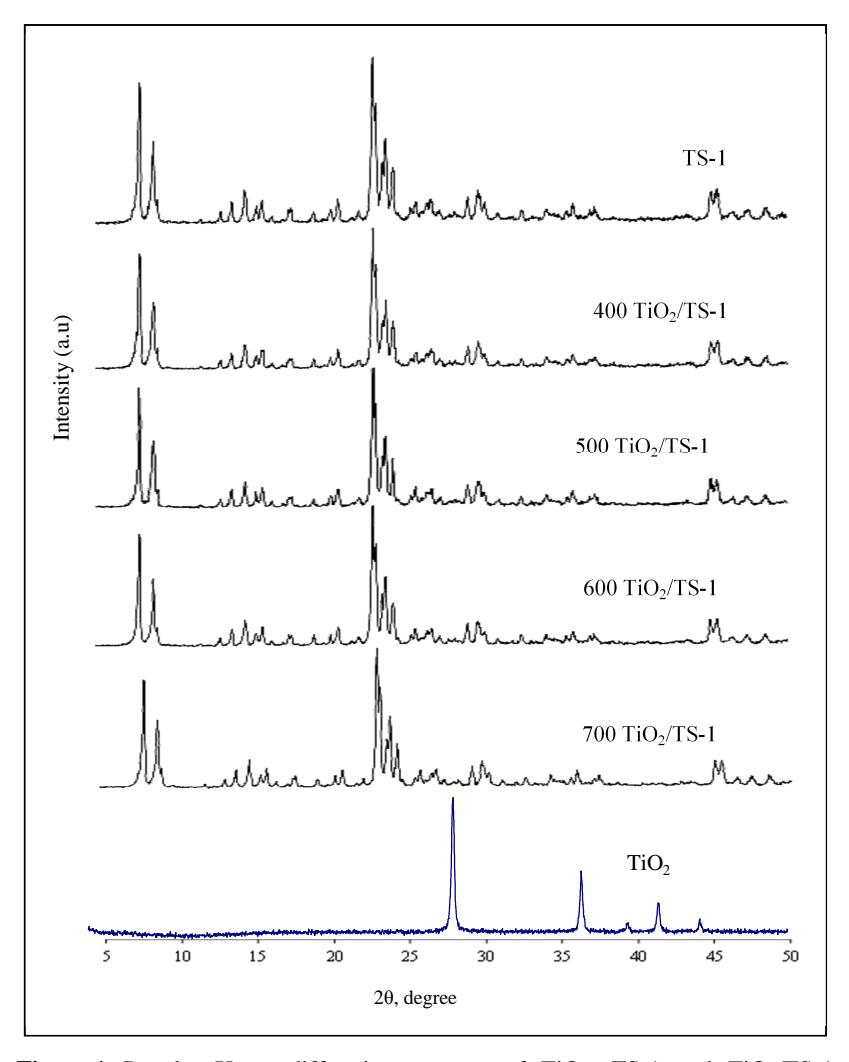
Figure 1 Powder X-ray diffraction patterns of TiO2, TS-1 and TiO2/TS-1 calcined at different temperatures (400, 500, 600 and 700°C) for 3 h.
However, the diffraction peak intensities of TS-1 decreased along with the increase in calcination temperature. This finding also suggests that either titanium oxide was located on the surface of TS-1, or crystalline phase of TiO2 covered the surface of TS-1. Since the source of TiO2 is TEOT, which has a molecular size (11.22 Ǻ) larger than that of the pore entrance of TS-1 (0.55 Ǻ), the TiO2 should be attached to the external surface of TS-1.
The infrared spectra of the zeolite lattice vibrations between 1400 and 400 cm-1 are depicted in Figure 2.
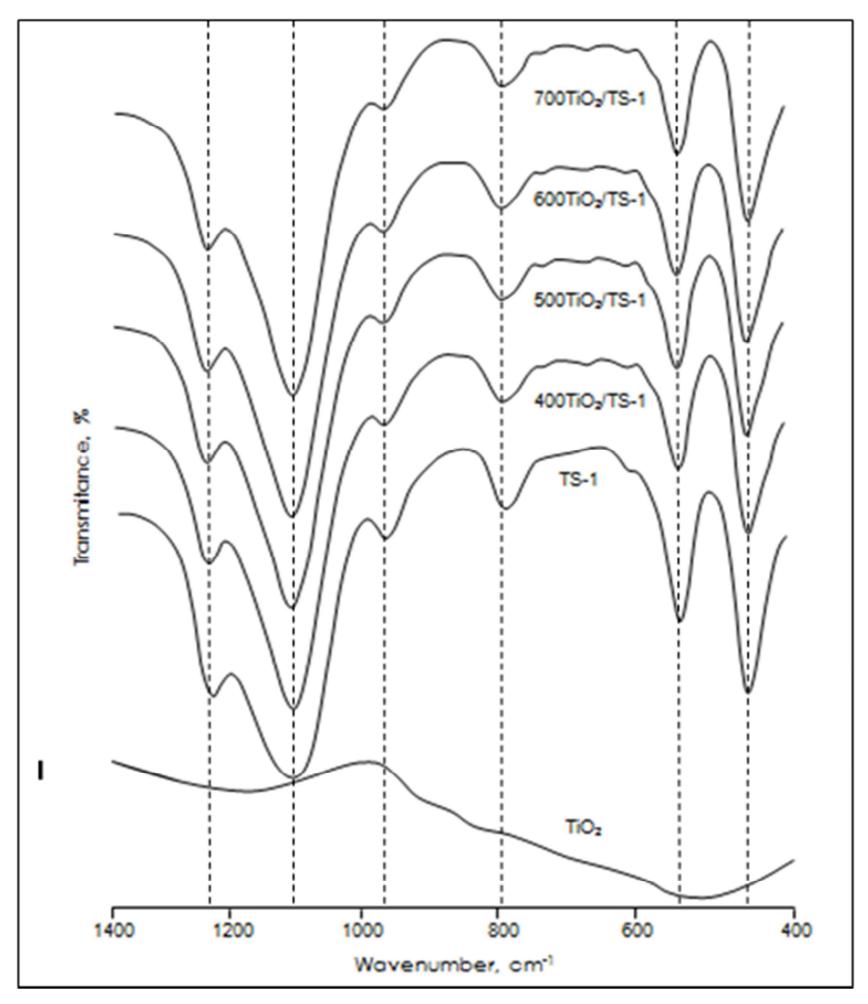
Figure 2 Framework infrared spectra of TiO2, TS-1 and TiO2/TS-1 calcined at different temperatures (400, 500, 600 and 700°C) for 3 h.
The absorption bands at around 1100, 800, and 450 cm<sup>-1</sup> were of lattice modes associated to internal linkage in SiO<sub>4</sub> or AlO<sub>4</sub> tetrahedral, and were insensitive to structural changes, whereas the absorption bands at around 1230 and 547 cm<sup>-1</sup> were characteristics of the MFI type zeolite structure and were sensitive to structural changes [23]. In addition, all samples revealed a band at around 970 cm<sup>-1</sup>. The vibration modes around this frequency maybe the result of several contributions, such as the asymmetric stretching modes of Si-O-Ti linkages, terminal Si-O stretching of Si-O-H-(HO)Ti 'defective sites' and titanyl (Ti=O) vibrations [8,24-25]. However, the band at around 970 cm<sup>-1</sup> could also be attributed to the titanium in the framework, since silicate, a Ti free zeolite, did not show any band around this frequency. Furthermore, impregnation of titanium oxide on TS-1 followed by calcination at various temperatures resulted in no significant change of the band at around 970 cm<sup>-1</sup>. Therefore, it is concluded that the TS-1 sample contained Si-O-Ti connections. There was no band shifting or additional band observed after impregnation of titanium oxide on TS-1. This finding suggests that both the MFI structure and the titanium framework remained unchanged after both the impregnation and the calcination.
The surface acidity of the samples was determined by infrared spectroscopy after adsorption of pyridine on the samples and evacuation at 150°C (Figure 3). As is shown in Figure 3, only characteristic absorption bands due to adsorbed pyridine coordinated to the Lewis acid sites appearing at 1448 cm<sup>-1</sup> were observed in all samples, while the peak characteristic of the Brønsted acid sites at around 1545 cm<sup>-1</sup> was absent. The acid sites are associated to coordinatively unsaturated surface metal ions [26]. The numbers of the Lewis acid sites determined through the integration of the peak at around 1448 cm<sup>-1</sup> are listed in Table 1.
| Table 1 | Physical and chemical properties of the TiO2/TS-1 samples. |
|---|
| Surface area (m²/g) | Number of Lewis acid sites (µmol/g) | Hydrophilicity | |||
|---|---|---|---|---|---|
| Sample | Character | Index | Water submerged time (s) | ||
| TS-1 | 431 | 13 | Partially hydrophobic | 5 | 98 |
| \(TiO_2\) | n.d.(a) | 8 | Partially hydrophilic | 5 | 107 |
| 400TiO2/TS-1 | 394 | 14 | Partially hydrophilic | 5 | 66 |
| 500TiO2/TS-1 | 407 | 16 | Partially hydrophilic | 5 | 64 |
| 600TiO2/TS-1 | 389 | 20 | Partially hydrophilic | 5 | 89 |
| 700TiO2/TS-1 | 373 | 35 | Partially hydrophilic | 5 | 92 |
(a) Not determined
Thermal treatment has been reported to affect the acidity of the material in which the acidity generally decreases with the increase in calcination temperature [27]. Our finding, however, proved to be contrary to the general tendency reported by Maldonado-Hódar, et al. [27].
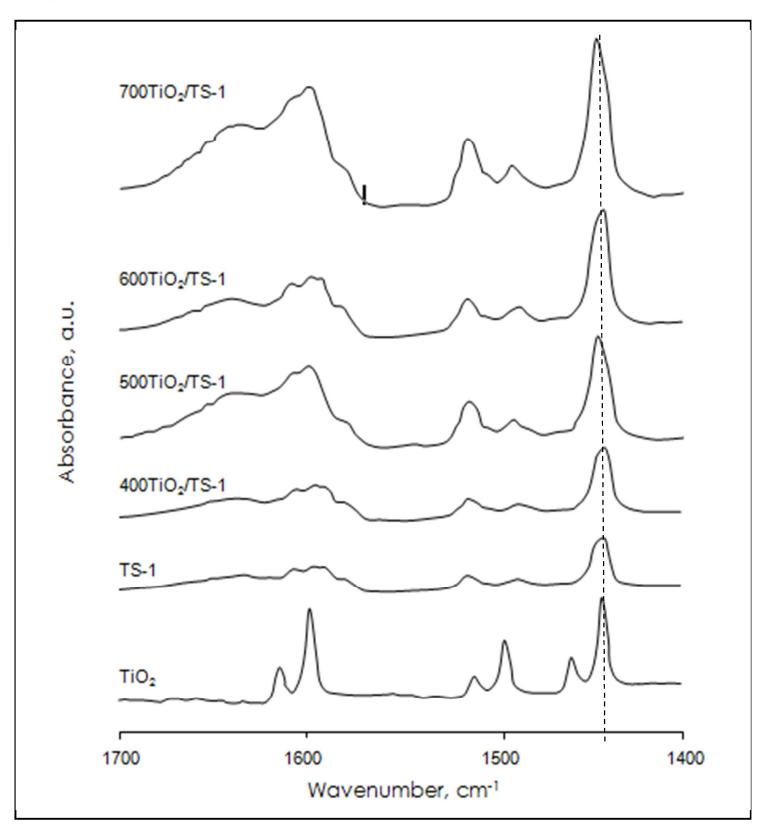
Figure 3 Infrared spectra of adsorbed pyridine of the TiO2, TS-1 and TiO2/TS-1 samples calcined at different temperatures (400, 500, 600 and 700°C) for 3 h.
As is shown in Table 1, the acidity of the catalysts increased with the increase in calcination temperature. This phenomenon could be attributed to a polymorphic transformation of TiO2from anatase phase to rutile phase as the calcination temperature increased from 500 to 700°C. Machado and Santana [17] have reported that the acidity of the anatase phase is much lower as compared to the rutile one. In this study, the acidity was correlated to the TiO2 structure because the position of TiO2was on the surface of TS-1, whereas the structure of TS-1 remained unchanged after calcination up to 700°C, as observed by XRD and infrared spectroscopy.
The hydrophobicity of the samples was monitored by dispersion of the samples in a mixture of xylene and water. The powder distribution of both TS-1 and 500TiO2/TS-1 suspended in the mixture after stirring is illustrated in Figure 4(a) and Figure 4(b), respectively. In general, all samples (the TiO2, TS-1 and TiO2/TS-1 catalysts) showed partially hydrophobic behavior in which each catalyst was dispersed in the interlayer and suspended in the bottom of the aqueous phase. The rates of sample dispersion, however, were different, as is shown in Table 1. The dispersion behavior of TiO2/TS-1 shown in Table 1 indicates that there was a correlation between the hydrophilicity and the calcination temperature. The 400TiO2/TS-1 sample took longer to disperse in the aqueous phase than the 500TiO2/TS-1. This may be due to the low interaction between titanium oxide and TS-1. The dispersion rate of the TiO2/TS-1 sample in the aqueous phase decreased with the increase in calcination temperature from 500 to 700 °C. This may be due to the phase transformation of amorphous titanium oxide to the anatase and rutile phase, or the alteration in the percentage of titanium oxide crystalline phase on the surface of TS-1 [14,26,28].
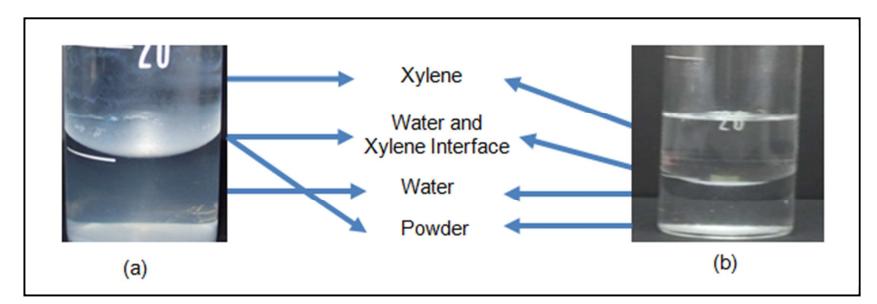
Figure 4 Hydrophobicity testing results for sample after stirring: (a) TS-1 and (b) 500TiO2/TS-1.
The calcination at 700°C resulted in a longer dispersion rate in the aqueous phase as compared to the calcinations at 500-600°C. According to Machado and Santana [17], this is mainly due to partial transformation of anatase to rutile phase. In addition, as shown in Figure 4, it can be clearly seen that the amount of adsorbed water in the TS-1 samples was significantly lower than that of the 400 and 500TiO2/TS-1 samples. This may indicate the anatase to rutile phase transformation in the samples with a higher calcination temperature. Based on the infrared data at the absorption band of around 960-970 cm-1 and by using a standard curve, it was found that the Si/Ti was 0.8% [29]. The high rutile phase of the samples at high calcination temperatures may result in the agglomeration of titanium oxide on the surface of TS-1 [8]. Meanwhile, the TS-1 was not well dispersed in the water phase, which indicates that the behavior of the TS-1 was naturally hydrophobic. Impregnation of titanium oxide on the surface of the TS-1 enhanced its hydrophilic character.
Textural analysis of the catalysts was carried out using N2 adsorption– desorption at 77 K using Quantachrome Nova 1200 equipment. Surface area measurement was made according to the BET method. The surface area of the samples decreased with the increase in calcination temperature, as listed in Table 1. This finding supports the hypothesis that there are sintering phenomena when samples are calcined at a high temperature. Figure 5 displays the nitrogen adsorption-desorption isotherms of the catalysts.
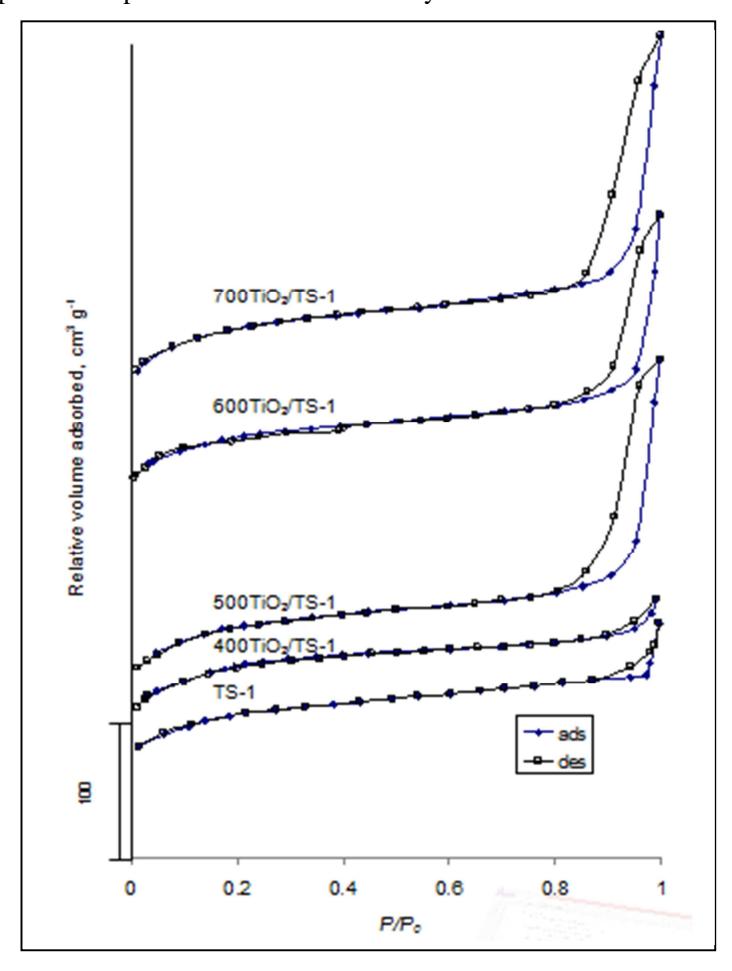
Figure 5 Nitrogen adsorption-desorption isotherms of TS-1 and TiO2/TS-1samples calcined at different temperatures (400, 500, 600 and 700°C) for 3 h.
It can be seen that the TiO2/TS-1 samples calcined at 400 to 700°C exhibited a type I of nitrogen isotherm with nitrogen uptake at relative pressure P/Po below 0.1 indicative of their microporosity. In addition, the hysteresis loop was observed at P/Po higher than 0.9. The hysteresis phenomenon in the isotherms is related to capillary condensation of N2in mesoporous structures, in which the adsorbed volume tends to reach a finite maximum value, corresponding to a complete filling of the capillary.
3.2 Catalytic Activity
The catalytic activity of the TS-1 and the TiO2/TS-1 samples was evaluated using hydroxylation of phenol with H2O2 as the oxidizing agent. The products were analyzed by gas chromatography. In general, according to the literature, the main products usually observed in the hydroxylation reaction are catechol, hydroquinone, benzoquinone, and tar [16,28,30]. In this study, however, apart from hydroquinone and catechol, no other products were observed, while in the reaction without catalyst, no hydroquinone product was obtained. The amounts of hydroquinone obtained using TiO2, TS-1, and TiO2/TS-1 catalysts at various reaction times are depicted in Figure 6.
Generally, all catalysts exhibited catalytic activity for the hydroxylation of phenol. The amount of hydroquinone product was higher at longer reaction times. The TiO2catalyst revealed the lowest amount of hydroquinone product for all reaction times, while the highest amount of hydroquinone product was observed when the 500TiO2/TS-1 catalyst was used. In addition, the TS-1, 400TiO2/TS-1 and 700TiO2/TS-1 catalysts produced similar amounts of hydroquinone, which were lower than those of the 500TiO2/TS-1 and 600TiO2/TS-1 catalysts. Moreover, the 400TiO2/TS-1 catalyst revealed the lowest activity among the TiO2/TS-1 catalysts, which may be a result of incomplete organic removal or deposition of carbon on the surface of the catalyst due to the lower calcination temperature of the catalyst. Consequently, the amount of reactant accessing the active sites inside the pore system of the catalyst was limited, because those sites were covered by the carbon deposit. Meanwhile, the activity of the TiO2/TS-1 catalysts calcined at temperatures higher than 500°C decreased. Machado and Santana [17] have reported that a higher calcination temperature of TiO2results in the production of a rutile solid structure in which the TiO2is less effective as a catalyst for the oxidation of most organic compounds than in that of the anatase phase. Therefore, the decrease in catalytic activity at the higher calcination temperatures was due to the TiO2 structure. The sintering mechanism of TiO2calcined at high temperatures, which affects the properties of the catalyst, such as lowering the crystallinity and the surface area, can also decrease the catalytic activity of the TiO2/TS-1 catalyst. The better properties displayed by the 500TiO2/TS-1
catalyst were correlated to both the high surface area and high hydrophilicity, leading to a high hydroquinone production.
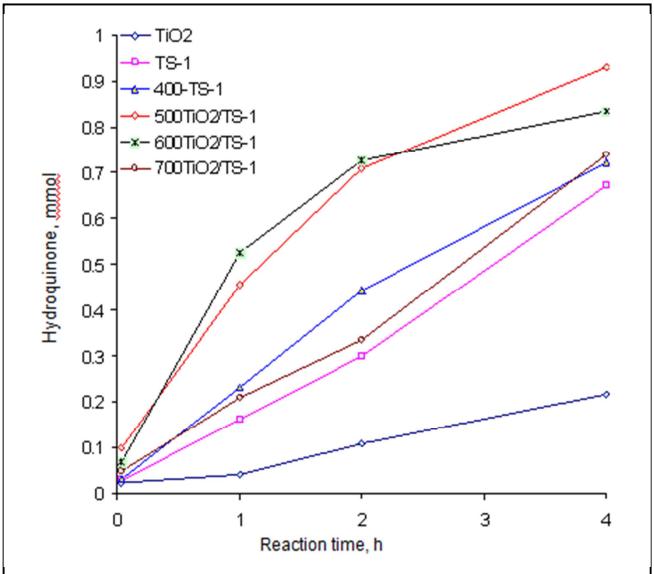
Figure 6 Catalytic performance of TiO2, TS-1, and TiO2/TS-1 catalysts for hydroquinone production from phenol hydroxylation reaction with H2O2 at 70°C.
4 Conclusions
The hydrophylic character of TS-1 catalysts was successfully improved by the dispersion of titanium oxide on the surface of TS-1. The titanium located in the silicate framework of the catalysts resulted in the existence of oxidative sites, while octahedral titanium played a role as a hydrophilic site. The analysis of the structure and properties of the TiO2/TS-1 catalysts suggests that there are correlations between the calcination temperatures and the anatase to rutile phase transformation and the sintering behavior that influences the catalytic activity. The 500TiO2/TS-1 catalyst showed optimum hydroquinone formation.
Acknowledments
We gratefully acknowledge funding from the Directorate General of Higher Education Indonesia under the Academic Recharging Program, Grant 2011 No. 3021/E4.2/2011.