

2 Materials and methods
2.1 Strand Preparation
Strands were prepared from moso bamboo (Pyllostachys pubescent Mezel) that was collected from a bamboo forest in Tenryu city, in the western region of Shizuoka Prefecture, Japan. Each bamboo pole, from bottom to top approximately 8 m high, was stranded using a disk-type flaker in a local strandboard mill. Target sizes of the strands were 50 mm and 80 mm in length, 0.5 mm in thickness, and 5 mm to 20 mm in width. The strands were screened on a 10-mesh sieve prior to drying to a moisture content of less than 3% in a rotary oven at a temperature of 60°C [9]. One hundred pieces of strand were randomly chosen for measurement of their actual dimensions.
2.2 Board fabrication
Bamboo strandboard with nominal dimensions of 37 mm by 37 mm by 12 mm and target density 0.65 g/cm3 were manufactured using a MDI resin. Wax or any other additives were not applied. Hand-formed mats were pressed at a temperature of 180°C for 10 minutes. The maximum pressure applied was 8 MPa and no surface sanding was conducted. A resin content of 6% was applied to the strands using a pressurized spray gun in a rotary type blender [9]. Specifications for board manufacture were as shown in Table 1. For the UNID and 3LAY-boards, a set of thin plates with 20 mm spacing was employed in mat forming.
| Strand length (mm) | Board type | Replications | Adhesive | RC (%) | Target density (g/cm3) |
|---|---|---|---|---|---|
| 50 | RND | 2 | MDI | 6 | 0,68 |
| 80 | RND | 2 | MDI | 6 | 0,66 |
| 80 | UNID | 2 | MDI | 6 | 0,66 |
| 80 | 3LAY | 2 | MDI | 6 | 0,70 |
Table 1 Specification for board manufacture.
RAND: randomly oriented homogenous board, UNID: uni-directionally oriented homogenous board, 3LAY: three-layered board with cross-oriented core layer.
2.3 Evaluation of mechanical properties
Prior to testing, the boards were conditioned in a room at a relative humidity of 65% and a temperature of 25°C. Bending and internal bond strength tests were conducted in accordance with the Japanese Industrial Standard (JIS) for particleboard [11]. Five replication samples were made for measuring modulus of elasticity (MOE) and modulus of rupture (MOR) in bending, and seven replication samples were made for measuring internal bond (IB) strength. All variables were measured under air-dried and wet conditions.
For dimensional stability, thickness swelling (TS) was determined in water immersion after 2 and 24 hours. Linear expansion (LE) was evaluated using two specimens with dimensions of 300 mm by 50 mm, based on initial dimensions obtained after drying at 60°C for 22 h. The change in length was measured using a dial gauge comparator [12] at intervals during treatment in humid conditions of 40°C and 90% RH for 150 h, followed by dry conditions of 60°C for 150 h.
3 Results and Discussion
3.1 Bending Properties
The modulus of rupture (MOR) of the bamboo strandboard with a strand-length of 50 mm was slightly higher than that of the bamboo strandboard with a strand-length of 80 mm in a smaller standard deviation (Table 2). This indicates that the distribution of strands at a 80 mm strand-length was not uniform. This is shown by the high standard deviation of the MOR and the low internal bond strength. Moreover, the JIS-B treatment at strand-lengths of 50 and 80 mm did not meet the JIS standard.
As for the board types using a strand-length of 80 mm: the bending properties of the uni-directionally oriented board (UNID) were better than for the RAND and 3LAY-boards, the alignment of the strands in the strandboard having a greater potential to increase the parallel MOE [13]. An interesting point was that the standard deviation of the UNID board was higher than the standard deviation of the random board. The simplicity of the RAND board mat forming influences the standard deviation of the RAND board, and shorter strandlengths were more easily oriented [8].
Compared with RAND and 3LAY boards (Table 2), the MOR of the UNID board in parallel direction scored higher for the dry-condition test (45, 105, and 132 MPa respectively). However, the value was low in perpendicular direction [14]. The strand direction caused differing strengths for RAND, 3LAY and UNID-boards. To achieve good bending properties, the strand-direction should be parallel to the direction of the board, but the opposite was the case.
| Table 2 | Bending properties and internal bond strength of bamboo strandboard | |
|---|---|---|
| for different board types and strand-lengths. |
| Strand length (mm) | Board type | Test conditions | Reach density (g/cm3 ) | MOR (MPa) | MOE (GPa) | IB (MPa) |
|---|---|---|---|---|---|---|
| 50 | RND | CNTL 0.68± 0.03 | 57± 12 | 4.6± 0.6 | 0.44± 0.07 | |
| JIS-B | 0.67± 0.04 | 14± 4 | 1.2± 0.2 | 0.15± 0.06 | ||
| Retention (%) | 25 | 27 | 34 | |||
| 80 | RND | CNTL | 0.66± 0.02 | 45± 21 | 4.1± 0.7 | 0.22± 0.08 |
| JIS-B | 0.65± 0.02 | 16± 3 | 1.5± 0.1 | 0.08± 0.05 | ||
| Retention (%) | 36 | 35 | 40 | |||
| 80 | UNID | Para | 0.66± 0.03 | 132± 31 | 10.5± 1.4 | 0.48± 0.18 |
| Perp | 0.73± 0.03 | 24± 9 | 2.2± 0.3 | |||
| 80 | 3LAY | Para | 0.70± 0.04 | 105± 37 | 9.6± 1.4 | 0.35± 0.08 |
| Perp | 0.71± 0.01 | 41± 4 | 2.9± 0.2 | |||
CTRL: board test in dry conditions, MOR: modulus of rupture, MOE: modulus of elasticity, IB: internal bond, JIS-B: board test under wet condition, Para: parallel direction, Perp: perpendicular direction, Retention: ratio JIS-B and CTRL.
3.2 Internal Bond (IB) Strength
The values of internal bond strength of the samples for different board types and strand-lengths are presented in Table 2 and Figure 1. The internal bond strength varied between 0.22 and 0.44 MPa in the dry condition test and 0.08 and 0.15 MPa in the wet condition test. The difference in IB strength was also found in short-strand board and the long-strand boards. The IB strength of the shortstrand board was higher than that of the long strand boards (Figure 1). The internal bond strength was influenced by the distribution of the glue. Uneven distribution of the glue can decrease the internal bond strength [15]. Based on this statement, the low value for IB 80 mm strandboard was probably due to the difference of resin distribution on the strands. A significant difference was found between the boards made of 50 mm and 80 mm strands. The resin was distributed more uniformly on the 50 mm strands than on the 80 mm strands. Uniform resin distribution can increase IB strength.
Generally speaking, the value of IB strength shows the bonding strength of the board. Based on the results, the board using short strands had higher values of IB than the boards using long ones. Under this condition, a glue blending technology needs to be applied to increase the IB strength for boards with longer strands.
The internal bond strengths of UNID and 3LAY boards were better than for RAND-board. The IB values met the JIS requirement (0.3 MPa), except for RAND board (Figure 1).
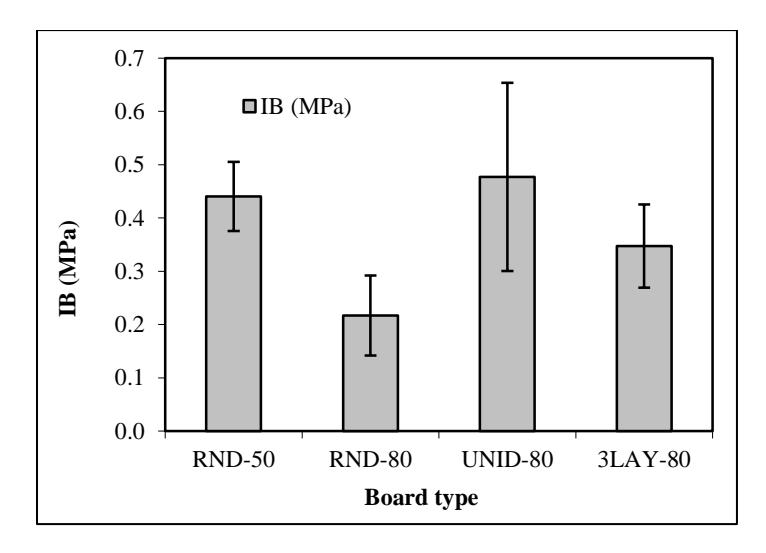
Figure 1 Internal bond strength of bamboo strandboard.
The result suggests that strandboard made from bamboo has low internal bond strength. The tissue of the bamboo culm consists of fiber-like structural features known as vascular bundles and parenchyma cells. The parenchyma cells can inhibit surface attachment of the glue to the bamboo cells. Furthermore, the wax layer of the epidermis can also affect the bond strength of bamboo strandboard.
3.3 Thickness swelling
Generally, the RAND board showed greater swelling than the 3LAY- and UNID boards after 2 and 24 hours soaking in water (Table 3).
| Strand length (mm) | Board type | Density (g/cm3 ) | TS 2h (%) | TS 24h (%) | WA 2h (%) | WA 24h (%) | TS 24/WA 24 |
|---|---|---|---|---|---|---|---|
| 50 | RND | 0.71 ± 0.03 | 1.08 ± 0.31 | 5.78 ± 0.92 | 13.03 ± 0.77 | 37 ± 3.27 | 0.156 |
| 80 | RND | 0.65 ± 0.03 | 2.95 ± 0.84 | 7.78 ± 0.67 | 22.34 ± 3.21 | 51.24 ± 3.04 | 0.152 |
| 80 | UNID | 0.72 ± 0.05 | 2.2 ± 1.24 | 5.66 ± 0.74 | 18.22 ± 7.02 | 39.06 ± 8.43 | 0.145 |
| 80 | 3LAY | 0.72 ± 0.04 | 1.88 ± 0.67 | 6.3 ± 0.48 | 17.61 ± 4.83 | 40.41 ± 5.26 | 0.156 |
Table 3 Thickness swelling and water absorption for different types of board.
TS 2h; Thickness swelling after 2 hours of immersion in water, WA 2h: water absorption after 2 hours of immersion in water.
Thickness swelling (TS), measured after 24 hours of soaking, ranged from 5.78 to 7.78% and was practically unaffected by strand-length or board type. However, changes of TS per moisture content of the random board and the shorter strand-length board were slightly higher than those of the oriented board. This result is not enough to indicate that the oriented board had better dimensional stability. The TS of the strandboard was not clearly improved by the application of strand alignment (UNID board), thus it is necessary to find an effective method to improve TS.
Water resistance was evaluated by water absorption (WA) after 2 and 24 hours of water-soaking. The WA value of bamboo strandboard is shown in Table 3 for different board types and strand-lengths. The values range from 13.03% to 51.24% after 2 and 24 hours of water-soaking respectively. The RAND board had a higher WA than the other boards and the highest WA was close to the TS of these. The highest compaction ratio is achieved by the strands of the RAND board compared to the other boards [16], which also affects TS and WA.
3.4 Linear Expansions
Dimensional stability in the in-plane direction is an important property for strandboards. Differences in dimensional stability are caused by fiber direction [9] and its level is indicated by the linear expansion ratio of the perpendicular to parallel direction.
During the first 50 h, the LE increased rapidly; it almost leveled off after 150 h, producing values of 1%, 0.39% and 0.25% for the UNID, 3LAY and RAND boards, respectively. At the dry stage, the LE values became negative (Table 4).
| Strand | Board type | Humid to dry | Humid conditions | |||||
|---|---|---|---|---|---|---|---|---|
| length (mm) | MC (%) | dLE (%) | LE/MC (%/%) | LE (%) 150 h | Ratio (Perp/para) | Ratio (UNID/RND) | ||
| 50 | RND | 9.51 | 0.35 | 0.037 | 0.28 | |||
| 80 | RND | 9.10 | 0.31 | 0.034 | 0.25 | |||
| 80 | UNID | |||||||
| Para | 8.06 | 0.13 | 0.017 | 0.12 | 0.5 | |||
| Perp | 9.55 | 1.61 | 0.168 | 1 | 8.3 | 3.9 | ||
| 80 | 3LAY | |||||||
| Para | 9.16 | 0.21 | 0.023 | 0.18 | 0.7 | |||
| Perp | 7.59 | 0.45 | 0.059 | 0.39 | 2.2 | 1.5 | ||
Table 4 Linear expansion of bamboo strandboard for various board types.
MC: moisture content change, LE: linear expansion in plane direction, Para: parallel direction, Prep: perpendicular direction.
Linear expansion in the parallel direction was smaller than in the perpendicular direction for both the UNID- and the 3LAY-board. Linear expansion per moisture content change for random board was almost the same, ranging from 0.034 to 0.037 %/%.
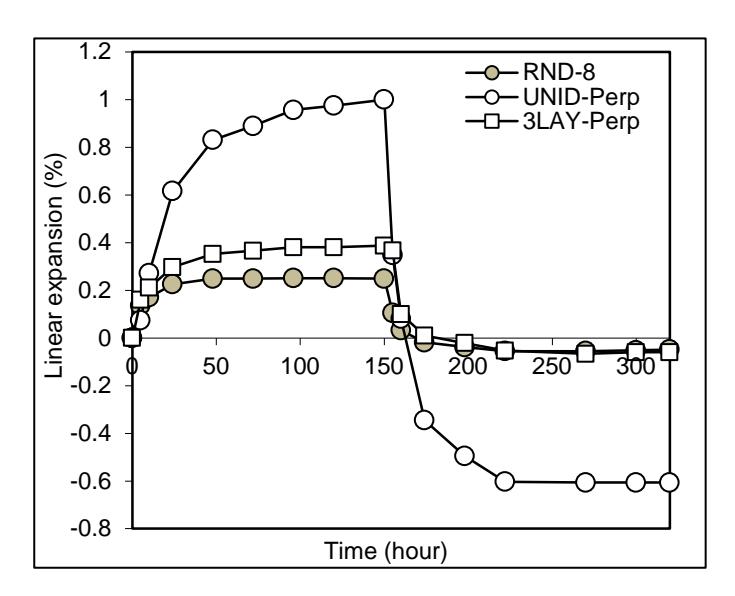
Figure 2 Linear expansion behavior of bamboo strandboard.
The ratio of the perpendicular to parallel direction of the UNID boards was 8.3:1. This value is smaller than that for sugi wood [14], which is 20:1 for a strand-length of 50 mm. This indicates that bamboo strandboard is more stable than wood-sugi strandboard, because at a small ratio a restraining of the linear
expansion occurs that can reduce dimensional changes, producing a more stable strandboard.
Generally speaking, linear stability is affected substantially by strand alignment, as shown in Figure 2. The linear expansion valuess for the 3LAY-Perp and the RAND boards were almost the same, ranging from 0.15 to 0.4% in humid conditions. However, the LE of the UNID-Perp board reached 1% in humid conditions and decreased by 0.6% in dry conditions. It is thought that RAND board and cross-oriented 3LAY board effectively restrain the LE in the perpendicular direction. It seems that a cross-oriented core may be the most effective way to reduce this dimensional change and improve bending properties in the perpendicular direction.
4 Conclusion
The results of this research revealed that the bending properties of bamboo strandboard increase from random board to uni-directionally oriented board. The bending properties and internal bond strength were affected by board type and strand-length. Resin distribution at 50 mm was more uniform than at 80 mm strand-length, producing better bending properties. However, the results are insufficient to assume that oriented board has better dimensional stability. Linear stability is affected substantially by strand alignment and board type.
Acknowledgements
The authors gratefully thank Dr. Kojima from Shizuoka University for his valuable suggestions throughout the course of this study.