

1 0BIntroduction
Diabetes mellitus (DM) has been an important metabolic disorder over the past few decades [1]. It has been estimated that about 285 million people were affected by DM in 2010 [2], which could reach the staggering number of 439 million people in 2030 [3]. DM is characterized by hyperglycemia over a long period of time [4], indicated by an increase of oxidative stress caused by reactive oxygen species (ROS) [5-8]. Oxidative stress is known to inhibit insulin secretion [9,10] and reduce insulin receptor sensitivity at the cellular level [11-14].
DM patients are usually treated with drugs, diet, and therapy, which put an economic burden on the patient due to the cost of treatment and the inability to carry out work, especially in the Indonesian context. Therefore, an alternative treatment of DM that is effective and affordable, such as herbal treatment, is needed. Among herbal products, polyphenol has been highly recommended for DM treatment [15-17]. A high polyphenol content is found in green tea, which is not native to Indonesian culture, thus it could cause problems in the future with regards to continuity of supply and production cost of imported materials. Another alternative that has been applied by herbalists in Indonesia is propolis produced by local bees, Trigona sp. Previous research has shown that propolis has a high flavonoid content, which could act as antioxidant [18-20] with a similar function as polyphenol. Propolis has been used for DM treatment, but scientific research on this subject is scarce. Therefore, in this research we tried to find a possible explanation for the influence of propolis in the treatment of DM.
2 Methods
2.1 Experimental Animals
Fifty five (55) male mice (Mus musculus SW.), aged 8 weeks and with body weight ranging from 30 to 45 gram, were used as test animals in this study. All mice were reared under standard hygienic conditions and fed a balanced diet. Water was available ad libitum. All cages were kept in a room with dark:light period 12:12 hour, temperature 24-28 °C and average humidity 60-75%.
2.2 Antidiabetic Agents
2.2.1 Propolis
Propolis was obtained from an Indonesian Trigona beekeeper located in North Bandung. Even though information about the chemical contents of the local propolis used in this study was unavailable, previous research by Margeretha [21] showed that some bioactive material of Trigona's propolis originates from Banten, mostly derivatives of flavonoid, morpholine, and aloenine, which are known as antioxidants.
2.2.1.1 Propolis Extraction
The propolis obtained from the Trigona beekeeper was raw, unpurified propolis. The raw propolis was cut into small pieces, mixed with 500 mL propylene glycol, kept in a closed bottle and shaken twice a day for two weeks. After two weeks, it was centrifuged at 150 rpm for 5 min to obtain the supernatant. This method is based on Sosnowski [22].
2.2.2 Alloxan Monohydrate
Alloxan monohydrate applied in this research was purchased from SIGMA ALDRICH in white crystal form. Alloxan solution was made by diluting crystal alloxan with 0.9% NaCl.
2.3 Experimental Design
Fiftyfive male Winstar mice were divided randomly into five groups of equal size (11 mice per group). Prior to application, all treated groups were injected with 200 mg/kg body weight alloxan. Group 1 was kept as normal control (KN), group 2 was kept as diabetic control (KDM), group 3 was treated with propolis at a dose of 50 mg/kg body weight (P1), group 4 was treated with propolis at a dose of 100 mg/kg body weight (P2), group 5 was treated with propolis at a dose of 175 mg/kg body weight (P3). All propolis treatments were carried out by oral gavage.
2.4 Reactive Oxygen Species (ROS) Density Measurement
Pancreas of the treated mice was isolated every 7 days. It was washed using PBS, dried with Whatman paper No. 40, frozen in liquid nitrogen, and kept inside a freeze drying refrigerator prior to measurement of ROS. ROS density was measured by electron paramagnetic resonance. This method is based on the work of Dikalov, et al. [23]. ROS density was measured every week for 4 weeks.
2.5 Insulin Plasma Measurement
Insulin plasma was measured from blood samples collected from the orbital sinus. Insulin plasma was determined by mouse insulin ELISA Kit USCN and microplate reader Bio-Rad at 450 nm wavelength.
2.6 Statistical Analysis
The data obtained from these investigations were analyzed by One Way ANOVA with a confidence level of 95%. Significant values then became subject of further analysis using Tukey's test. All analyses were carried out using SPSS 20.0.
3 Results and Discussion
3.1 Effect of Propolis Treatment on Reactive Oxygen Species Density
Alloxan administrated 7 days prior to the propolis treatment changed ROS density on the pancreas compared with normal mice (KN \(-8.6~\text{mm}^2/\text{mg}\) tissue) with the highest density found in KDM (105.0 \(\text{mm}^2/\text{mg}\) tissue), followed by P2 (78.9 \(\text{mm}^2/\text{mg}\) tissue), P3 (77.5 \(\text{mm}^2/\text{mg}\) tissue), and P1 (73.0 \(\text{mm}^2/\text{mg}\) tissue) (Figure 1). The alloxan itself oxidized sulfihidril at the –SH complex through inhibition of the glucokinase enzyme, which alters calcium homeostasis [1,24], which further causes destruction of pancreatic \(\beta\) cells.
Mice treated with propolis showed a significant decrease of ROS density in the pancreas compared to untreated diabetic mice (KDM, 129.1 mm²/mg tissue) (Figure 1). Mice treated with 175 mg propolis/kg body weight (P3) experienced the highest decline in ROS density (47.1 mm²/mg tissue), followed by P2 (46.4 mm²/mg tissue) and P1 (11.2 mm²/mg tissue), while the total ROS density of the normal mice increased with 3 mm²/mg tissue (Figure 1).
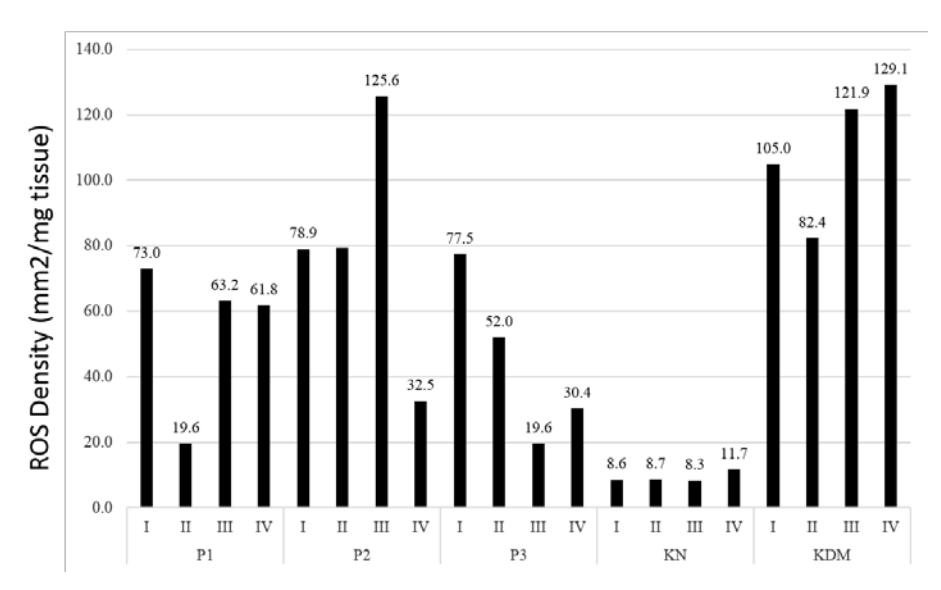
Figure 1 Average ROS density change inside pancreas cells for three weeks (Note: each value I is the initial density prior to any treatment). Propolis was not administrated to the normal mice (KN) or the diabetic control mice (KDM). P1 was treated with propolis at a dosage of 50 mg/kg body weight, P2 treated with propolis at dosage of 100 mg/kg body weight, P3 treated with propolis at a dosage of 200 mg/kg body weight.
This significant decrease of ROS is probably caused by antioxidant activity of flavonoids, a main component of propolis that eliminates ROS [25]. Flavonoid inhibits the change of superoxide into hydrogen peroxyl by binding with the -OH complex [26]. This process reduces the total number of available free radicals and prevents further destruction of pancreatic β cells by ROS [27].
3.2 Effect of Propolis Treatment to Insulin Production
Propolis treatment improved insulin production by the pancreas of the diabetic mice. On average, the highest improvement was shown by group P3 (1.52 µg/mL from 1.41 µg/mL after diabetic treatment) followed by P2 (1.30 µg/mL from 0.76 µg/mL after diabetic treatment) and P1 (1.52 µg/mL from 1.65 µg/mL after diabetic treatment), while the plasma insulin of the diabetic mice was 0.46 µg/mL (from 1.08 µg/mL after diabetic treatment) and of the normal mice 2.01 µg/mL (from 2.24 from 1.41 µg/mL, first measured 21 days before the research) (Figure 2).
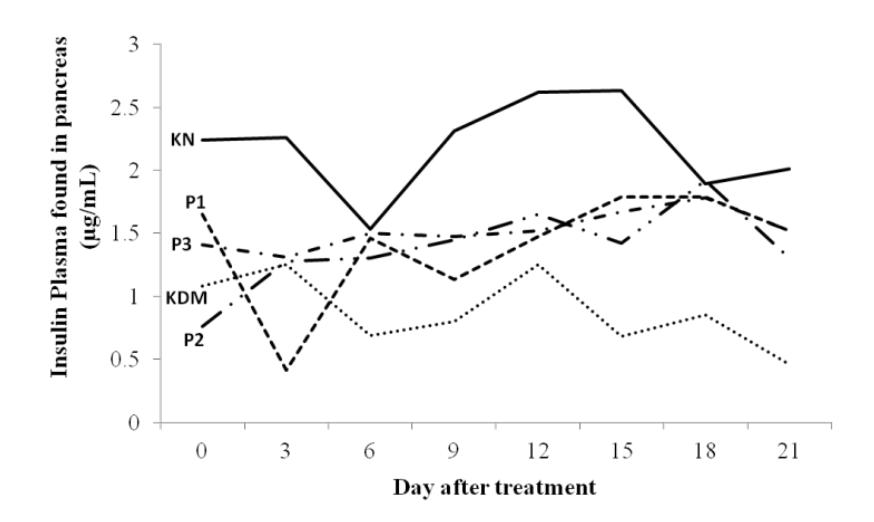
Figure 2 Changes in total number of insulin plasma found in pancreas. Propolis was not administrated to the normal mice (KN) and diabetic control mice (KDM). P1 was treated with propolis at a dosage of 50 mg/kg body weigth, P2 was treated with propolis at a dosage of 100 mg/kg body weight, P3 was treated with propolis at a dosage of 200 mg/kg body weight.
This research has shown that propolis treatment enhances insulin production after diabetic treatment. Testing the role of propolis towards plasma insulin levels of mice (DM 50 mg/kg bw (P1), 100 mg/kg bw (P2) and 175 mg/kg bw (P3) for 21 days) showed that the propolis had a positive effect on the DM
mice. This is in accordance with the opinion that states that flavonoids and other phenolic derivatives are a major component in propolis that has biological activity as antioxidant agent [18-20,23]. Flavonoids work by donating a hydrogen atom to free radicals quickly, thus changing it to a stable form [24]. With the reduction of ROS in pancreatic β cells, insulin secretion may re-occur.
4 Conclusion
Propolis has great potential for application in diabetes mellitus treatment. Its high flavonoid content reduces reactive oxygen species (ROS) that are produced due to the hyperglycemic condition of diabetics. A propolis concentration of 50- 175 mg/kg bw improved insulin production in diabetic mice and this study showed better results when propolis was administrated at higher doses.
Acknowledgements
This research was partly funded by Strategic National Grant of Department of Education and Culture Indonesia No. 132/SP2H/PL/DIT.LITABMAS/V/2013 granted to REP. We thank PATIR for their permission for and help during reactive oxygen species measurement by electron paramagnetic resonance.