

1 Introduction
Compton scattering occurred from the gamma photon encounter to the target. The extinct fraction of the multiple scattered photons was in the range of the singly scattered photons. In fact, in the experiment, the measurement of the single scattered photon energy could not be separated from the multiply scattered photon energy in the spectrum at all. Singh, et al. [1] mention that in the case of a free electron collision by a photon there are some higher-order forms, in spite of the single photon Compton scattering. These higher-order forms occur because of the substantial amount of auxiliary radiation created in the duplicate Compton-scattered gamma beams. In the multiply scattering processes, the correlation between energy of photon and momentum of electron is similarly lost, bringing about inaccurate assessment of the Compton profile. An important situation for studying the Compton profile is when the scattered photon for example ought to have experienced only one elastic collision. The detection of ionizing radiation [2] by the scintillation light delivered in specific materials is one of the most established methods on record. The scintillation process is obviously still a valuable strategy for the identification and spectroscopy of a wide grouping of radiations. When ionized radiation passes through a scintillator, the light should be sparked or scintillated [3]. The first material that the particles should detect is the scintillator. A single scintillator of bismuth germanate, BGO (Bi4Ge3O12), is generally used in the field of medicine. Lutetium yttrium oxyorthosilicate, LYSO (Y:Lu2SiO5), is a promising cutting-edge scintillation crystal, since it consolidates great scintillation qualities. There is no information available on multiple scattering gamma photons in single crystal scintillators. In the current study, the multiple Compton scattering interaction between BGO and LYSO single crystal scintillators was investigated.
2 Methods and Materials
The BGO (Bi4Ge3O12) and LYSO (Y:Lu2SiO5) single crystal scintillators examined in this study were supplied by Nuclear System Co., Ltd., Bangkok, Thailand. Both crystals had dimensions of 10 mm × 10 mm × 10 mm (width × height × depth). These crystal scintillators were used as the scatterer samples.
Figure 1 Compton scattering setup and apparatus.
The Compton scattering experiments were set up with the arrangement for energy variation in the range of 224.92 to 564.08 keV. Figure 1 shows the Compton scattering setup [4]. The distance between gamma source and scatterer, R1, was 12.3 cm. The distance measured from the center of the crystal that scattered light to the surface of the NaI(Tl) detector, R2, was 20 cm. A container, shielded from the gamma source with a cylindrical collimator on the front's surface, limited the area of the collimator for protecting the light
scattered from the gamma rays that illuminate the center of the crystal scintillator. In the collimator, an 11 mCi 137Cs source was installed. The detector area was 2" x 2" NaI(Ti) with 8% energy resolution at 662 keV (BICRON model 2M 2/2), based with a CANBERRA photomultiplier tube, model 802-5. A CANBERRA PC-based multi-channel analyzer (MCA) recorded and showed the spectra. The MCA, which provided instance counts of 1024 channels, was lead shielded and mounted on an arm in order to adjust for the desired scattering angle. The angular dependence of the Compton scattering was measured at scattering angles from 30° to 120°, with increments of 15°. Each angle was recorded with a counting time of 25,000 sec. Then the photon spectrum was analyzed for each angle.
3 Result and Discussion
Typical observed scattering spectra from different single crystal scintillators at 45° are shown in Figure 2. The background data were subtracted. It can be observed that the data from the interactions of 662 keV incident photons with a single crystal scintillator are a mixture of singly and multiply scattered photons. In the Compton continuum of examined spectra identified with the BGO and LYSO single crystal scintillators, 96 peak channel numbers related to K X-ray peaks originating from the source and the NaI(Tl) detector. The singly scattered energy at a scattering angle of 45° was 479.86 keV from 662 keV incident photons. The FWHM of the experimental inelastic scattered peak increased more with the LYSO single crystal scintillator used as scatterer than with the BGO single crystal scintillators. The major reason for the last multiply scattering is that the incident light colliding with the target has lower energy in escaping in the direction of the NaI(Tl) detector.
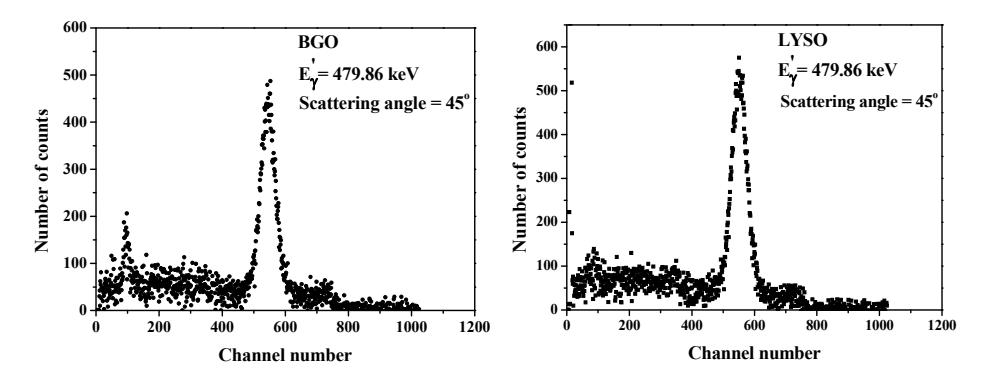
Figure 2 Typical pulse height spectra of 479.86 keV scattered rays with the use of BGO and LYSO single crystal scintillators at a scattering position, obtained after subtracting background events.
A typical observed spectrum of a BGO single crystal scintillator at a 45° scattering angle and a counting time of 25,000 sec is shown in Figure 3 (curve a). The background spectrum of the primary beams (curve b) without BGO in the primary beam. Moreover, the primary beam that spreads out from the 662 keV gamma photon source was not related to the scattered target. This is the reason to find out the energy of the scattered spectrum for the whole area (graph a), subtracting out subsequent scattered events – such as multiply Compton scattering, bremsstrahlung, Rayleigh scattering, etc. (graph b) – to obtain the scattered spectrum (graph c). Graph c shows the intensity distribution of the singly and multiply scattered photons. The singly scattered incident radiation under the maximum energy peak was as shown by Singh [5]. Figure 3 (curve d) shows the analytically reconstructed singly scattered peak.
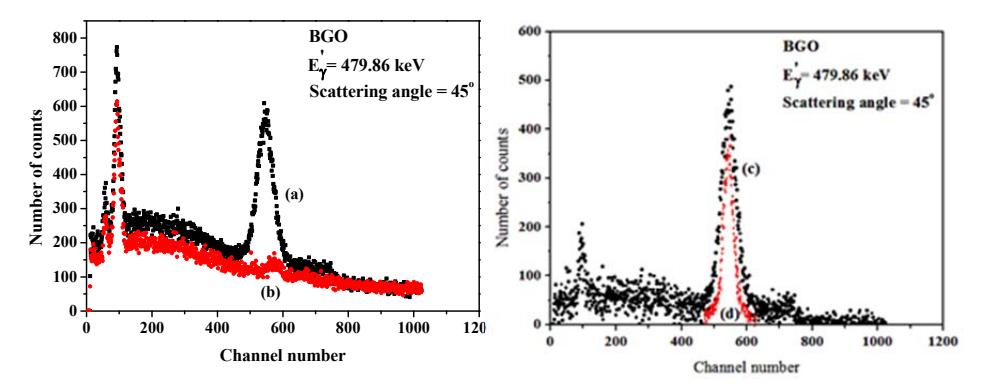
Figure 3 Curve (a): a typical experimentally observed spectrum with BGO single crystal scintillators at a scattering angle of 45° for a counting time of 25,000 seconds. Curve (b): an observed background spectrum without BGO in the primary beam. Curve (c): the distribution of intensity of singly and also multiply scattered photons without background. Curve (d): normalized analytically reconstructed singly scattered full energy peak.
Figure 4 shows the variations of multiply scattered events under the full energy peak as a function of scattering angle (for different single crystal scintillators), a BGO and LYSO single crystal scintillators as scatterer, the numbers of multiply scattered photons decreases from 30° to 75°, becomes lowest at 90° and again increases from 105° to 120°. The dip in the curves near about 90° occurs because of the way the scattering occurs at this specific angle. The multiply scattered incident angular distribution fits with the theoretical calculations by Dumond [6], which shows the obvious balance behavior of multiply scattered incidents nearby a scattering angle of 90°. From the experimental results, unbalanced behavior occurred at scattering angles from 30° to 75° compared to from 105° to 120°. The number of multiply scattered incidents increased gradually at scattering angles from 105° to 120°. Self-absorption of low-energy
photons occurred at large scattering angles. On the other hand, self-absorption of high-energy photons occurred at small scattering angles, from 30° to 75°.
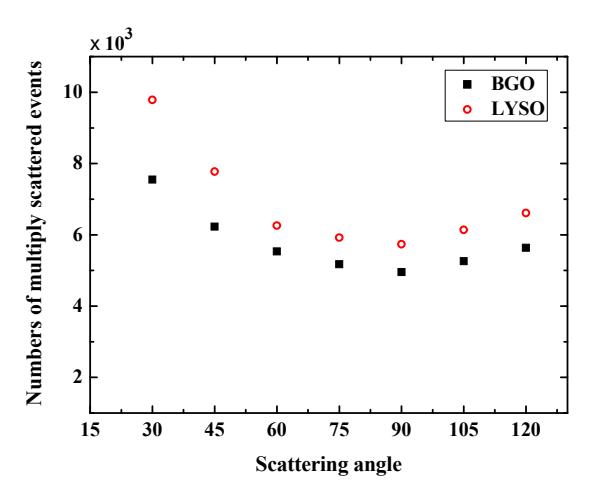
Figure 4 Number of multiply scattered incidents as a function of scattering angle of BGO and LYSO single crystal scintillators.
4 Conclusions
Multiple scatterings from BGO and LYSO single crystal scintillators were comparatively studied. The effect of multiple scattering of 662 keV incident photons in single crystal scintillators was observed for the first time in the present measurements. The current research also supports the work of Singh, et al. [5] in which targets of copper of varying thickness were used. No information is available for correlation with the present results. Our test results confirmed that for BGO and LYSO single crystal scintillator targets there is critical commitment of multiply scattered radiation rising up out of the target, having vitality equivalent to that of the singly scattered Compton process. The number of multiply scatterings diminishes on the grounds that self- absorption in the scatterer turns out to be more transcendent. More exploratory information on increased Compton scattering at various occurring photon energies in disseminating materials with diverse effective atomic numbers is required to better comprehend the procedure.