

1 Introduction
Phalaenopsis, also known as the moth orchid, is one of the most famous commercial orchids for potted plants and cut flowers. According to the American Orchid Society more than 75% of orchids in the market is from the genus Phalaenopsis [1]. Phalaenopsis has high aesthetic value and performs a good impression on consumers due to its attractive colors and shapes, as well as its long period of flowering time.
Efforts have been made to improve the quality of commercial orchids, especially through cross-pollination between selected plants. The hybrid will then regenerate through seed germination. This method has some disadvantages
since the hybrid will show very diverse variations of phenotypes. Further selection of hybrid with desirable traits needs to be conducted, although a long period for selection is required. In vitro culture, i.e. through micropropagation, can be used as an alternative method for the regeneration of selected orchids in order to obtain uniform plants over a short time period. The propagule usually has the same character as its parent.
Attempts to regenerate Phalaenopsis orchids have been conducted by several researchers [2-4]. Propagation through PLBs has been obtained for the same orchid genus [4-6]. Different types of plant growth regulators (PGRs) and sources of explants have been used to induce PLBs. PLB induction on MS medium with addition of BAP and NAA [7] or TDZ [4] using leaf explants from plantlets have been reported. The use of 5.4 µM NAA and 4.5 µM TDZ has been applied to induce PLBs and plantlets from flower stalks of Doritaenopsis orchids [8].
The present study was carried out to investigate the possibility of inducing PLBs from in vitro and in vivo root and leaf explants of Phalaenopsis 'Join Angle x Sogo Musadian'. This orchid is a hybrid of Phalaenopsis 'Join Angle' and Phalaenopsis 'Sogo Musadian', which has large and thick leaves, a long spike (around 80 cm) and 6-10 white flowers. The diameter of each flower is around 8-10 cm.
2 Materials and Methods
2.1 Plant Materials
The explants used in this study were leaves and roots from in vivo and in vitro cultures. Young leaves and roots from a 2.5-year old Phalaenopsis 'Join Angle X Sogo Musadian' were used as the source for the in vivo explants. Meanwhile, the inflorescent nodes (Figure 1A) of this orchid were initially induced to produce plantlets (Figure 1B) in MS media supplemented with 3 ppm BAP. The leaves and roots from these plantlets were then used as the source for the in vitro explants.
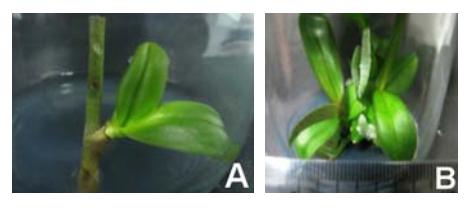
Figure 1 Plantlets from the inflorescent stalk. (A) The first shoot developed in the inflorescent node. (B) Regenerated pantlets.
2.2 Induction of PLBs
The in vivo leaf and root explants were surface sterilized with 10% NaClO for 8 min and rinsed with sterilized distilled water prior to culture in the in vitro condition. All explants (from both in vitro and in vivo source) were then cultured on half-strength MS [9] solid medium supplemented with various combinations of plant growth regulators, namely TDZ (1 or 3 ppm), 2,4-D (1 or 2 ppm), NAA (0.5 ppm), IAA (0.5 ppm), and BAP (1, 5 or 10 ppm) (Table 1). The pH of the media was adjusted to 5.6-5.8. The cultures were placed in the dark for 1 month and then transferred to an incubation room for incubation under a 16-hour photoperiod. Subcultures were conducted every 4 weeks.
| No. | Concentration of Plant Growth Regulator (ppm) | |||||
|---|---|---|---|---|---|---|
| TDZ | 2,4-D | NAA | IAA | BAP | ||
| 1 | 1 | 1 | - | - | - | |
| 2 | 1 | 2 | - | - | - | |
| 3 | 3 | 1 | - | - | - | |
| 4 | 3 | 2 | - | - | - | |
| 5 | - | - | 0.5 | 0.5 | 1 | |
| 6 | - | - | 0.5 | 0.5 | 5 | |
| 7 | - | - | 0.5 | 0.5 | 10 | |
Table 1 Composition of medium for PLB induction.
2.3 Regeneration of Plantlets from PLBs
Developed PLBs were inoculated individually; they were then transferred into half-strength MS medium without plant growth regulator. The pH of the medium was adjusted to 5.6-5.8. These cultures were then incubated under a 16 hour photoperiod and subcultured every 4 weeks.
3 Results and Discussion
3.1 The Effect of Plant Growth Regulator in PLB Induction
In this research, PLBs were formed in in vitro and in vivo root explants as well as in vitro leaf explants. Fresh hand section of the PLBs showed that the structure originated from epidermal and subepidermal cells of the in vitro leaf explants was divided actively to form protuberances (Figure 2). The in vivo leaf explants did not regenerate PLBs. Instead, these explants formed embryogenic cells (Figure 3A and 3B) when they were cultured in media containing TDZ and 2,4-D or NAA, IAA and BAP (Table 2). These protuberance(s) continued to multiply (Figure 3C, 3D and 3E) and developed to form PLBs after 16-24 weeks of culture (Figure 3F). The formed PLBs shot primordia after 18-24 weeks of culture (Figure 3G), and shoots and roots regenerated after 32 weeks of culture (Figure 3H). Similar results have been observed in Oncidium orchids [10], where the PLBs were directly differentiated from the leaf epidermal tissue. In Doritaenopsis orchids, PLBs have been developed from subepidermal tissue [11]. In some other orchids, regeneration of PLBs occurred indirectly through embryogenic callus culture [12,13]. PLB pattern formation, therefore, varies among Orchidaceae depending on the explant tissue used and the culture condition.
Table 2 Morphogenic response in various kinds of explants cultured in media supplemented with various combinations of growth regulators.
| Explant types | |||||
|---|---|---|---|---|---|
| Medium | In Vitro | In Vivo | |||
| Root | Leaf | Root | Leaf | ||
| 1 ppm TDZ + 1ppm 2,4-D | - | Embryogenic cells | - | Embryogenic cells | |
| 1 ppm TDZ + 2ppm 2,4-D | - | Embryogenic cells | - | PLBs | |
| 3 ppm TDZ + 1ppm 2,4-D | - | Embryogenic cells | - | Embryogenic cells | |
| 3 ppm TDZ + 2ppm 2,4-D | - | Embryogenic cells | - | Embryogenic cells | |
| 0.5 ppm NAA + 1 ppm BAP + 0.5 ppm IAA | - | - | PLBs | Embryogenic cells | |
| 0.5 ppm NAA + 5 ppm BAP + 0.5 ppm IAA | PLBs | - | PLBs | Embryogenic cells | |
| 0.5 ppm NAA + 10 ppm BAP + 0.5 ppm IAA | - | - | Embryogenic cells | ||
Figure 2 Fresh hand section of in vitro leaf explant with PLB (arrow) that is formed on its surface. Note: E – epidermis; M – mesophyll; P – protuberances; V – vascular tissue.
The in vitro leaf explants produced PLBs following culture in medium containing TDZ and 2,4-D. In medium containing NAA, BAP and IAA, these explants formed embryogenic cells (Figure 3A). A similar result is mentioned by Chen & Chang [4], where the combination of TDZ and 2,4-D could induce embryogenic callus in Phalaenopsis leaf explants. Cui, et al. [14] stated that TDZ is commonly used to induce PLB in orchids. Kuo, et al. [3], Chen & Chang [4] and Niknejad, et al. [6] obtained similar results when TDZ was used for PLB induction in leaf explants of Phalaenopsis orchids. When the existence of TDZ inside the cell is relatively stable compared to other growth regulators, it will not be degraded easily by cytokinin oxidase [14]. TDZ plays a role in regulating the endogenous hormone effect, providing nitrogen in the tissue and also stimulating the ROS compound that plays a role in somatic embryo formation [15,16]. Vasser, et al. [17] showed that TDZ can modulate endogenous auxins, which in synergism with cytokinins constitute the inductive signal for embryogenic expression to induce somatic embryogenesis in geraniums. In orchids, PLBs are considered somatic embryos because cytologically they produce a similar hydroxyproline-rich protein (HGRP), a cell wall marker protein, as zygotic embryo [18].
Table 3 Total average number of PLBs that arose from various explants.
| Number of PLBs | |||||
|---|---|---|---|---|---|
| Medium | In Vitro | In Vivo | |||
| Leaf | Root | Leaf | Root | ||
| 1 ppm TDZ + 1ppm 2,4-D | - | - | - | - | |
| 1 ppm TDZ + 2ppm 2,4-D | 2 | - | - | - | |
| 3 ppm TDZ + 1ppm 2,4-D | - | - | - | - | |
| 3 ppm TDZ + 2ppm 2,4-D | - | - | - | - | |
| 0.5 ppm NAA + 1 ppm BAP + 0.5 ppm IAA | - | 27.33 | - | - | |
| 0.5 ppm NAA + 5 ppm BAP + 0.5 ppm IAA | - | 49.33 | - | 2 | |
| 0.5 ppm NAA + 10 ppm BAP + 0.5 ppm IAA | - | - | - | - | |
In the present study, numerous PLBs were developed from in vitro and in vivo root explants following culture in medium containing 0.5 ppm NAA, 0.5 ppm IAA, and 1 ppm or 5 ppm BAP (Table 3). The ability of root explants to produce PLBs has been observed in Cyrtopodium paranaense [19]. The growth regulators used in those experiments, however, were different from the growth regulators used in our experiment. PLBs were developed after culture in medium containing 10.2 µM IAA and 9 µM TDZ. Meanwhile, research conducted by Tokuhara & Mii [7] showed that PLBs could be induced using 0.5 µM NAA and 4.4 µM BAP in Phalaenopsis shoot explants. Cytokinin (BAP) and auxin (IAA and NAA) are frequently used to produce somatic embryos as well as PLBs. Exogenous auxins (NAA and IAA) and cytokinin (BAP) can stimulate proliferation and cell differentiation to form somatic embryos or PLBs [19]. Pasternak, et al. [20] have stated that exogenous auxin and cytokinin can
activate kinase proteins that are related with cdc2 protein activity. It plays a role in activating and stopping the process of cell division. Utami, et al. [21] explained that more cdc2 proteins were found in the leaf explants of the Phalaenopsis orchid after culturing it in media containing 2 ppm NAA.
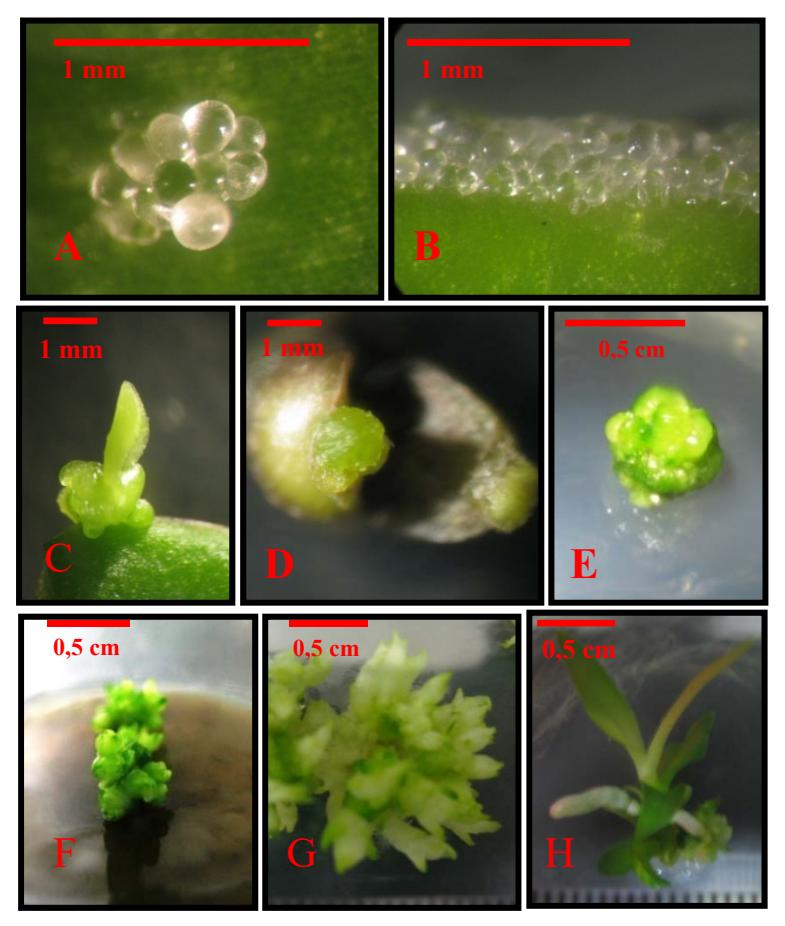
Figure 3 (A) Embryogenic cells on in vitro leaf explants; (B) embryogenic cells on in vivo leaf explants; (C) PLBs on in vitro leaf explants; (D) beginning of PLBs forming on in vivo root explants; (E) beginning of PLBs forming on in vitro root explants; (F) PLBs; (G) multiplicated PLBs; (H) plantlet.
3.2 Plantlet Regeneration from PLBs
In this study, all PLBs germinated into plantlets 8 weeks after being transferred into germination medium. Each PLB still developed additional shoots; about 3.5 ± 1.93 plantlets were formed in each PLB. A protocorm-like body (PLB) is a structure that possesses leaf and root primordia, so this structure still keeps its
ability to form new leaves, roots or even shoots when it is cultured in basal medium without growth regulators. The studies of Kuo, et al. [3], and Chen & Chang [4] and Young, et al. [5] also showed that PLBs can germinate to become plantlets when they are cultured in media without plant growth regulators.
4 Conclusions
In this study, PLBs could be induced from in vitro leaves and roots as well as in vivo roots. The highest number of PLBs was regenerated from in vitro root explants during culture in medium containing 0.5 NAA, 5 ppm BAP and 0.5 ppm IAA. All of the induced PLBs succeeded to germinate into plantlets in half-strength MS media without plant growth regulator.