

1 Introduction
Research interest in metal-organic frameworks (MOFs) has been growing enormously in the past two decades [1]. This is due to the unique features and interesting properties of MOFs for some applications [2]. Structurally, MOFs are constructed from metal cations or metal-oxide clusters connected with organic linkers and form infinite frameworks [3,4]. The flexibility in MOF design makes them highly tunable and enables a rich variety of structures. The occupancy of meso, micro and even nano-porosity in MOFs and organic functionalized ligands [5] as well as the existence of coordinative unsaturated metal centers is very interesting for increasing adsorption as well as storage capacities of some gases [6]. In addition, synthetic condition optimization and method innovation in view of producing high-quality MOFs are always a challenge to investigate [1].
MOFs have a very high potential in hydrogen storage applications [7]. The storage mechanism of hydrogen at low temperature into MOFs is based on the physical interaction at the molecular level, such as Van der Waals interaction.
Received April 30th, 2016, 1st Revision February 20th, 2017, 2nd Revision April 18th, 2017, Accepted for publication April 20th, 2017.
Copyright © 2017 Published by ITB Journal Publisher, ISSN: 2337-5760, DOI: 10.5614/j.math.fund.sci.2017.49.3.1
Effective enhancement of hydrogen storage in the volumetric density can be achieved through compression within the micropores [8]. MOF type HKUST-1 has been the most intensively studied for hydrogen and methane storage [9]. Typically, HKUST-1 applied for gas storage is solvo-hydrothermally synthesized [10,11]. However, these methods should be carried out at high temperature and pressure and produce low yields over a long reaction time. In addition, the utilization of metal salts containing nitrate and chloride anions tend to unsafe side reactions and are therefore neither efficient nor environmentally friendly [12]. One promising and efficient method, as well as a more environmental friendly one, is the electrochemical method, in which the metal ions source comes from the metal electrode. Moreover, using this method it is easier to scale up the product in high yields over a shorter reaction time. Therefore it is a good prospect for application at industrial scale [12,13]. Mueller, et al. from BASF have initiated electrochemical synthesis to prepare crystalline and porous metal-organic framework materials, including HKUST-1 [12,13]. In the electrochemical method some reaction parameters, such as solvent, electrolyte, voltage-current density and temperature, highly influence the textural properties and synthetic yield of MOFs, as reported by Martinez-Joaristi, et al. [14] and Kumar, et al. [15]. A combined method called sonoelectrochemical synthesis has been developed to produce nanoscale HKUST-1 [16]. Recently, HKUST-1 was also successfully synthesized on indium tin oxide (ITO) by a rapid electrochemical method, where an electrodeposited Cu film was used as the source of Cu ions [17]. In this paper, for the first time hydrogen storage on HKUST-1 obtained from electrochemical synthesis is presented and compared to the product from the solvothermal method.
2 Experiment
2.1 Materials and General Methods
All reagents were of analytical grade and were used as purchased. As the electrode, Cu-plates (99.9% purity) were used. Trimesic acid (1,3,5- benzene tricarboxylic acid) and tetrabutyl-ammonium-tetrafluoroborate (TBATFB), both from ABCR Germany, were applied as electrolytes and used as purchased. Ethanol (analytical grade, Merck) was used as solvent. Before conducting the electrosynthesis, the working electrode was immersed in 100 mL HNO3 (1 M) and then polished with sand paper until shiny for the activation process. Electrosynthesis was conducted using an electrochemical cell connected with a DC Power Supply ATTEN TPR 3005T-3C. The reagents were placed in teflon vessels covered with stainless-steel autoclaves for solvothermal synthesis. The temperature and reaction time were programmed using controlled oven MEMMERT (Type 67 UN30). The hydrogen sorption experiment was conducted in a Sievert system under high vacuum condition with a maximum operating pressure of 1.4 bar. The procedure used for the experiment has been published elsewhere [18].
2.2 Synthetic Procedure
The synthesis of HKUST-1 was performed with a slightly modified electrochemical cell and solvent composition according to the literature procedure [15], which was optimized by Lestari, et al. [19]. In brief, 1.06 g (5 mmol) of 1,3,5-H3BTC and 0.33 g (1 mmol) of tetra-butylammonium tetrafluoroborate (TBATFB) were dissolved in 50 mL of solvent mixture water:ethanol (1:1) and stirred for 15 minutes prior to electrolysis. After the formation of a homogenous solution, two copper electrodes (with the same area, i.e. 10.5 cm2 ) were placed into the electrochemical cell. The system was set up with regulated DC power supply ATTEN TPR 3005T-3C under a constant voltage (15 V) at room temperature and kept for 1.5 h for complete reaction. The obtained sky-blue precipitate of HKUST-1 [Cu3(BTC)2‧3H2O] (0.801 g – 53%, based on ligand) was then collected by filtration and washed three times with ethanol and dried at room temperature. For comparison, HKUST-1 was also synthesized through the solvothermal method according to Schlichte, et al. [20]. The compounds were then activated at 200 °C for complete removal of solvent content and coordinated water prior the hydrogen sorption experiment. IR (KBr pellet, υ/cm–1, electro-synthesized HKUST-1): 3489-3386 (br), 1619 (vs), 1567 (s), 1447 (s), 1373 (vs), 1246 (s), 1187 (m), 1112 (m), 730 (vs), 491 (w). IR (KBr pellet, υ/cm–1, solvothermal-synthesized HKUST-1): 3405-3247 (br), 1619 (vs), 1562 (s), 1445 (s), 1374 (vs), 1281 (w), 1113 (m), 730 (s), 491 (w).
2.3 Characterization
The powder X-ray diffraction data were collected with a JEOL JDX-3530 diffractometer using Cu Kα (λ = 1.5406 Å) radiation. The morphology of the synthesized materials was recorded using a scanning electron microscope (SEM) Inspect S50-FEI. The thermal analyses were performed with an STA Linseis PT-1600 under a continuous nitrogen flow from room temperature to 600 °C with a heating rate of 10 °C/min. Infrared spectra were obtained by using a Shimadzu IR Prestige-21 in KBr pellets. The nitrogen adsorption isotherms at 77 K of the solvothermal and electrosynthesized HKUST-1 were obtained from a Quantachrome Nova Win 1200e (Micromeritics) instrument. The hydrogen sorption experiment was conducted in a Sievert system.
3 Results and Discussion
The phase purity of the electrochemical synthesized HKUST-1 was analyzed using PXRD. The diffraction pattern of the obtained material fit well with the simulated pattern generated from CCDC number 112954 [21] (Figure 1) with three main peaks at 2θ: 6.73 ° (2 0 0); 9.47 ° (2 2 0); and 11.65 ° (2 2 2).
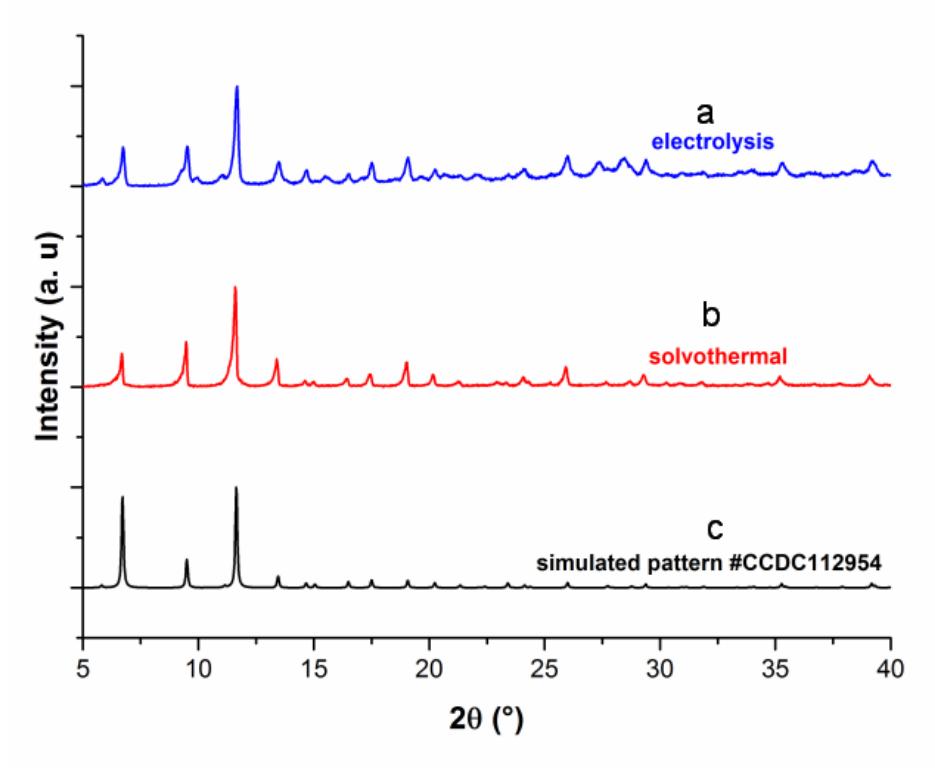
Figure 1 Diffractogram of (a) electrosynthesized and (b) solvothermalsynthesized HKUST-1 after activation up to 200 °C compared to (c) simulated pattern #CCDC 112954 [21].
Based on refinement using Rietica with Le Bail method, three phases were observed. Besides HKUST-1 as the main product, small peaks correlated with the remaining ligand and CuO as side product were detected respectively at 2θ 15-20° and 35.5-38.7° (Table 1, Figure 2). IR spectra of both synthesized products showed a broad peak in the range of 3489-3247 cm-1. This result represents the existence of coordinated water molecules in the structure and formed hydrogen bonding.
| Table 1 | Refinement | results | of | XRD | data | from | the | electrosynthesized | and | ||
|---|---|---|---|---|---|---|---|---|---|---|---|
| solvothermal synthesized HKUST-1 using Rietica with Le Bail Method. | |||||||||||
| Synthesis method | Predicted phase | Percentage (%) | Rp | Rwp | S |
|---|---|---|---|---|---|
| Electrochemical | Three phases: | ||||
| – HKUST-1 CCDC | 86.17 | ||||
| #112954 | 3.796 | 5.90 | 3.160 | ||
| 13.82 | ||||
| #45-1880 | |||||
| - CuO JCPDS #74-1021 | 0.01 | ||||
| Solvothermal | Three phases: | ||||
| - HKUST-1 CCDC | 96.17 | ||||
| #112954 | 6.834 | 8.73 | 5.42 | ||
| 3.82 | ||||
| #45-1880 | |||||
| - CuO JCPDS#74-1021 | 0.01 |
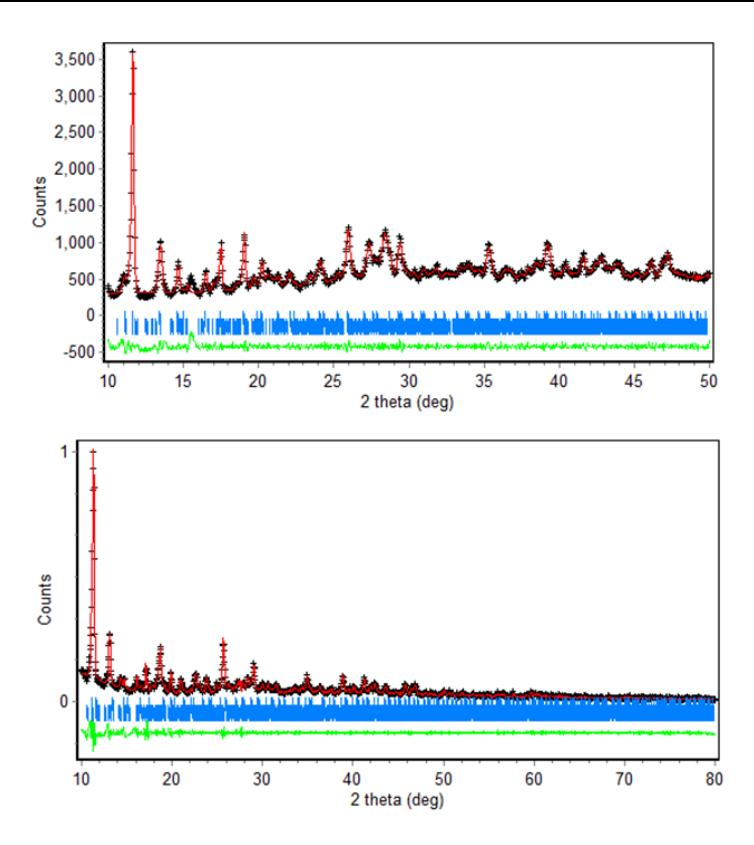
Figure 2 Refinement graph of diffractogram electrochemicals (top) and solvothermal (buttom) products.
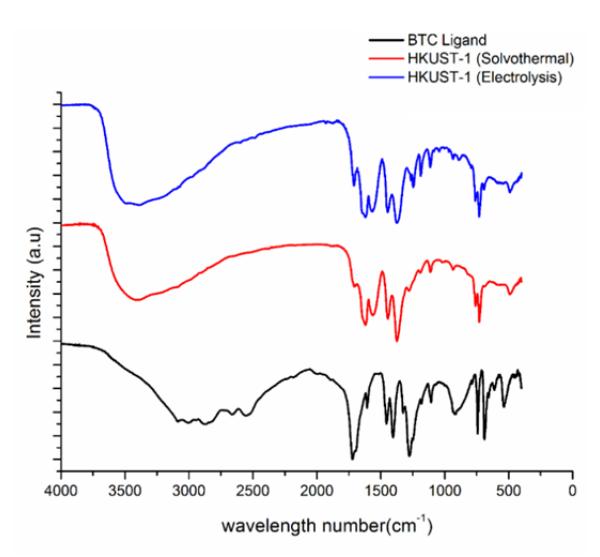
Figure 3 IR spectra of HKUST-1 synthesized by electrochemical and solvothermal method in comparison with H3BTC ligand.
Figure 4 SEM images of synthesized HKUST-1 using electrochemical (a & b) and solvothermal method (c & d).
A significant shift of C=O stretching vibration from 1715 cm-1 to 1665 cm-1 was also detected, indicating that coordination between Cu2+ and the carboxylic moieties of the linker occurred (Figure 3). Figure 4 shows SEM images of the HKUST-1 obtained from the electrochemical and solvothermal method. They clearly show that electro-synthesis of HKUST-1 resulted in more inhomogeneous particle size distribution and a smaller particle size (2-8 μm) than the solvothermal method (4-13 μm).
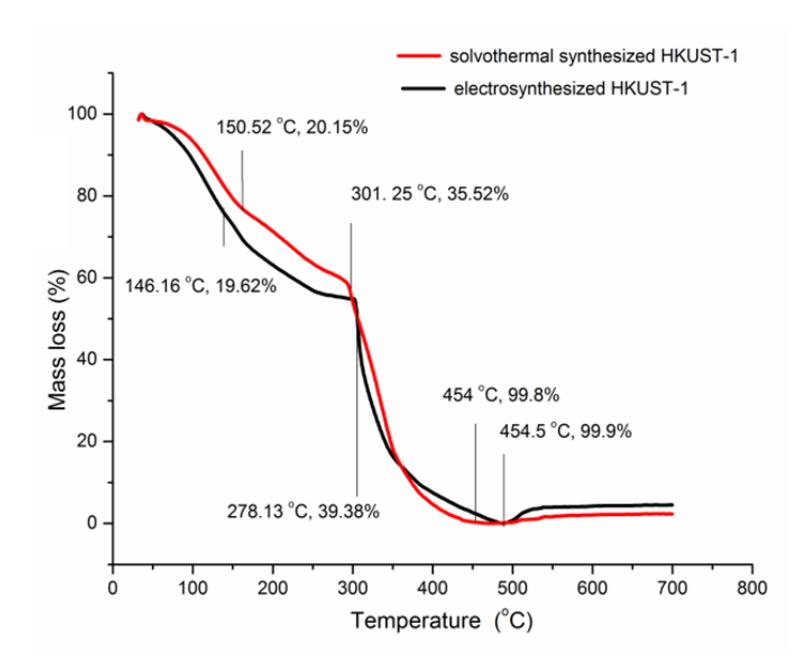
Figure 5 Thermogravimetric profile of HKUST-1 synthesized through electrolysis in EtOH:H2O (15 V, RT) and solvothermal method.
In general, the synthesized materials were thermally stable up to 300 °C according to thermogravimetric analysis and show three steps of mass loss from temperature 30 °C to 500 °C (Figure 5). The first step (ca. 20%), at temperatures from 80 to 150 °C, is attributed to the removal of the free ethanol and water molecules inside the pores. The second step, at temperatures from 150 to 300 °C (ca. 15%), comes from the loss of four water molecules that coordinated with the copper (II), which serves as a node at HKUST-1. Finally, at temperatures from 320 to 450 °C (ca. 64%), the decomposition of the framework and the ligand are observed, however, the total mass loss in this case is uncommon, which is probably due to the low amount of analyzed samples, whereas the literature shows the formation of copper oxide as CuO or Cu2O as residue as reported by Kumar, et al. [15].
According to the nitrogen sorption isotherm measurements, the solvothermal and electrosynthesized HKUST-1 occupy a BET surface area of 635.6 and 324.3 m²/g and total pore volume of 0.35 and 0.19 cc/g after activation until 200 °C, respectively. Moreover, the obtained materials displayed a type 1 adsorption isotherm curve and can be classified as micro-porous materials [22]. These values are comparable with the HKUST-1 synthesized by Chui, et al. [21] However, the product from electrolysis showed a 50% smaller BET surface
area and porosity compared to the results from the solvothermal method (Figure 6).
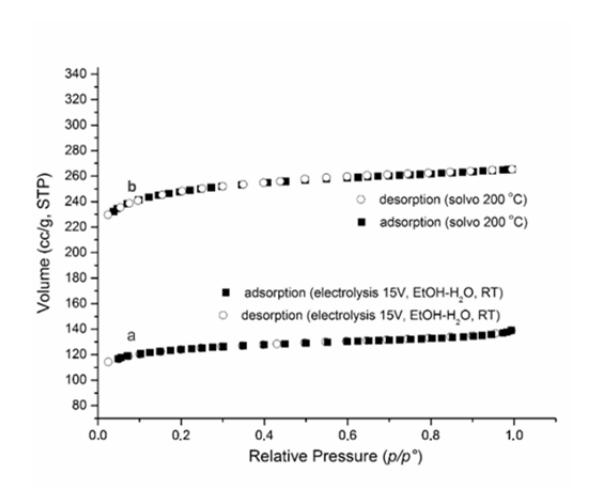
Figure 6 Nitrogen adsorption isotherm of the synthesized HKUST-1 produced from electrolysis (a) and solvothermal method after activation at 200 °C (b).
Hydrogen storage measurements have been performed at room temperature using a Sieverts apparatus designed by the authors for small masses. Figure 7 shows the hydrogen sorption results of the HKUST-1 at low pressure of up to 1.2 bar, presented together with the results obtained by other researchers [23- 25].
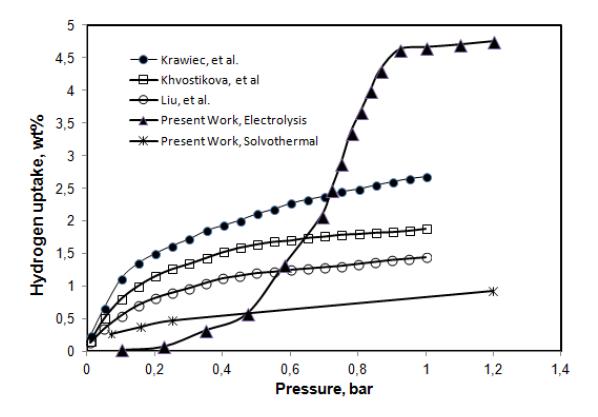
Figure 7 Hydrogen uptake of solvothermal and electro-synthesized HKUST-1 in comparison with data from the literature [23-25].
It can be seen that the maximum adsorption for solvothermal product was 1.19 wt%, while for the electrolysis product it was up to 4.75 wt%. The solvothermal synthesized HKUST-1 had the same tendency as in Kraewic, et al. [23], Liu, et al. [24] & Khvostikova, et al. [25]. In the case of the electrolysis product, the hydrogen adsorption increased sharply at elevated pressure, followed by a plateau after a pressure of 1 bar. The plateau pressure spreading out from about 0.3 to 1.0 bar explains the lowest energy interaction between hydrogen and the HKUST-1 material. Compared to the results from Kraewic, et al. [23], Liu, et al. [24] & Khvostikova, et al. [25], the present HKUST-1 made by electrolysis exhibited much higher hydrogen capacity. The reason could be that the smaller pores and agglomeration present in the electrosynthesized HKUST-1 have a stronger affinity towards hydrogen because of the overlap of potential fields of two opposing walls. Furthermore, the presence of a high number of Cu2+ as open metal sites in the electro synthesized HKUST-1 enhances its adsorption ability [26]. The hydrogen adsorption isotherm reveals that the electrolysis method leads to much higher storage capacity than the solvothermal method. This can be explained by the lower energy adsorption.
4 Conclusions and Outlook
In this paper, we report, for the first time, the hydrogen storage over HKUST-1 obtained from electrochemical synthesis, showing the highest hydrogen uptake capacity reported so far. This synthetic method is promising for large up-scaling processes and a good prospect for application at industrial scale. Another possible approach to enhance the hydrogen uptake could be to dope metal cations or supported metal nanoparticles into the pore or surface of HKUST-1 and to modify the node of HKUST-1 with other more electropositive metal ions such as Mg2+ and Ca2+, which is currently under investigation in our group. Continuous experimentation is compulsory in order to measure the enthalpy of adsorption for the solvothermal and electrochemical methods.
Acknowledgements
The authors thank LPPM Sebelas Maret University-Surakarta for providing the Mandatory Research Grant 2015 Project Number 624/UN27.11/PL/2015 and Hibah MRG 2016 Project Number 632/UN27.21/LT/2016.