

1 Introduction
In the classical general theory of relativity, a black hole is defined as a space-time region that exhibits such powerful and massive gravitational effects that nothing, not even light, can escape it. Therefore, if a black hole is analyzed as a thermodynamical object, it can be considered a dead thermodynamical object: it has neither temperature nor entropy. However, in the 1970s, using quantum field theory, Hawking proposed that a black hole is "not actually black". Black holes can radiate particles, a process similar to that in black-body radiation; in other words, they possess both temperature and entropy [1,2]. Through the analogy between black hole mechanics and the laws of thermodynamics, the temperature of a static black hole in connection with its surface gravity is expressed as:
\[T = \frac{\kappa}{2\pi} \tag{1}\]
Furthermore, the zeroth law of black hole thermodynamics suggests that for a static black hole, the surface gravity must be constant [3].
One way to understand Hawking radiation is by examining the creation of particle-antiparticle pairs near a black hole's event horizon. According to Heisenberg's uncertainty principle, the production of particle-antiparticle pairs occurs spontaneously and instantaneously, and after a very short time, these pairs will be annihilated. However, near the event horizon there is a possibility that either half of a pair passes through it before annihilation happens, making the other half escape the black hole. For Schwarzschild black holes this process can be illustrated using a conformal diagram as shown in Figure 1(a). There are several methods to calculate the temperature of a black hole, such as the Damour-Ruffini method [4], the Teukolsky perturbation [5], second quantization [6], the radial null geodesic [7], and the complex path method (the Hamilton-Jacobi method) [8]. In the complex path method, the temperature of the Hawking radiation is correlated with the probability of particle emission in which the radiation's spectral distribution is similar to that of black-body radiation.
The mechanism of Hawking radiation on a single-horizon black hole is reasonably simple. However, for multi-horizon black holes, such as the Reissner-Nordström black hole, a number of questions arise. Does the inner horizon also radiate particles? If the outer horizon radiates particles in a similar way as that of a Schwarzschild black hole does, does the inner horizon possess a similar mechanism? Using a conformal diagram as shown in Figure 1(b), Peltola and Makela [9] explained the mechanism of radiation in the inner horizon of a Reissner-Nordström black hole. Hawking radiation in the inner horizon occurs due to the production of particle-antiparticle pairs in the regions V' and VI', which are close to the inner horizon. When either half of the pair is swallowed into the inner horizon and the other half escapes and remains in the region V', the inner horizon is said to be emitting particles. However, since the inner horizon is located inside (deeper than) the event horizon, detailed information about this radiation in the inner horizon remains difficult to clarify: where does the particle radiation in the inner horizon drift to?
Similar to the behavior of particle radiation in the inner horizon, the temperature of the inner horizon has not yet been defined clearly. Wu [10] proposed that the inner horizon's temperature is negative because of its negative surface gravity. However, since this idea is considered contradictory to several laws of black hole thermodynamics, some other calculations define the inner horizon's temperature as minus its surface gravity so as to retain the positive value of the temperature [9].
Discussion on negative temperature has long been something familiar in physics. Using the definition of entropy, Ramsey [11], Purcell and Pound [12] suggested in the 1950s that negative temperature is derived from the negative
slope of an entropy change curve as an energy function. Extra energy in a system at a positive temperature increases entropy, while in a system at a negative temperature the opposite happens. Of course, some researchers, such as Hilbert and Dunkel [13,14], disagree with this definition of negative temperature. However, others take issue with their conclusion, advocating the existence of negative temperature and its consistency with the laws of thermodynamics [15,16]. Moreover, several experiments in ultracold atom systems have proved the existence of negative temperatures as proposed by Ramsey [17]. Thus, for the sake of this paper, without overlooking other definitions, Ramsey's definition will be considered the most suitable concept of negative temperature up to this point.
Figure 1 Mechanism of black hole radiation in: (a) conformal diagram of the maximally extended Schwarzschild space-time, and (b) conformal diagram of the maximally extended Reissner-Nordström space-time.
This paper re-discusses the temperature of the inner horizon of a Reissner-Nordström black hole. However, it should be kept in mind that what is discussed here may also be relevant to multi-horizon black holes. Using Ramsey's definition of negative temperature as the point of departure, the implications of negative temperature of the inner horizon are analyzed, which include the directions of particle radiation in the inner horizon, the entropy, the characteristics of extremal black holes, and the extension of black hole thermodynamics.
2 Reissner-Nordström Black Hole
A Reissner-Nordström black hole is a static black hole with mass and electric charge but no spin. The space-time metric of a Reissner-Nordström is defined as:
\[ds^{2} = -f(r)dt^{2} + f(r)^{-1}dr^{2} + r^{2}d\Omega^{2}\] (2)
where \(f(r) = 1 - \frac{2M}{r} + \frac{Q^2}{r^2}\). In the equation above M and Q correspond to the mass and charge of the Reissner-Nordström black hole, respectively. The metric indicates that the Reissner-Nordström black hole has two horizons that satisfy \(g_{00} = 0\), hence
\[r_{\pm} = M \pm \sqrt{M^2 - Q^2} \tag{3}\] in which \(r_+\) and \(r_-\) correspond to the outer horizon and the inner horizon respectively. Therefore, it appears that the radius of the outer horizon is greater than that of the inner horizon. Performing metric transformation on Eq. (2) into the ingoing Eddington-Finkelstein coordinate, we obtain the metric of the Reissner-Nordström black hole as follows:
\[ds^{2} = -\frac{h(r)}{r^{2}}dv^{2} + 2dvdr + r^{2}d\Omega^{2}\] (4)
where \(h(r) = (r - r_{+})(r - r_{-})\). The Reissner-Nordström solution is static, so in in the ingoing Eddington-Finkelstein coordinate, the stationary Killing vector field is \(k = \frac{\partial}{\partial v}\). At \(r = r_{\pm}\) we will have h(r) = 0, so \(k_a(dr)_a\), which is normal to the null hypersurfaces \(\mathcal{N}\), \(r = r_{+}\). Herein, Latin indices are used to denote tensor equations, i.e. equations that are valid in any basis. Hence, these surfaces are the Killing horizons. The surface gravity is defined by \(\nabla_a (k^b k_b) = -2\kappa k_a\)and can be calculated as:
\[\kappa = \kappa_{\pm} = \frac{r_{\pm} - r_{\mp}}{2r_{\pm}^2} \tag{5}\] while the area of the Reissner-Nordström satisfies the definition \(A_{+} = 4\pi r_{+}^{2}\) and is expressed as:
\[A_{\pm} = 4\pi \left( M \pm \sqrt{M^2 - Q^2} \right)^2 \tag{6}\]
3 Temperature of the Inner Horizon
In a static black hole, the temperature of the horizon is related to the horizon's surface gravity as expressed in Eq. (1). Hence, for a Reissner-Nordström black hole with two horizons, the temperature of both horizons is defined as:
\[T_{\pm} = \frac{\kappa}{2\pi} \bigg|_{r} \tag{7}\] in which \(T_+\) refers to the temperature of the outer horizon, while \(T_-\) refers to that of the inner horizon. In accordance with the definitions of surface gravity in Eq. (5) and of its horizon in Eq. (3), the temperature of each horizon is obtained through the following derivations:
\[T_{+} = \frac{1}{2\pi} \frac{\sqrt{M^2 - Q^2}}{\left(M + \sqrt{M^2 - Q^2}\right)^2} \tag{8}\]
\[T_{-} = -\frac{1}{2\pi} \frac{\sqrt{M^2 - Q^2}}{\left(M - \sqrt{M^2 - Q^2}\right)^2} \tag{9}\]
In a regular Reissner-Nordström black hole, the mass (M) is always greater than the charge (Q). If the black hole is in a condition in which M=Q, it is called an extremal black hole. Eqs. (8) and (9) clearly show that the temperatures of both horizons in an extremal black hole are zero. However, for regular Reissner-Nordström black holes, since M>Q, it is concluded that the temperature of the outer horizon is always positive, while that of the inner horizon is always negative.
As clarified above, to solve the problem caused by negative temperature, Ramsey's definition is taken into account. In his study, he suggests that negative temperature is a slope of entropy change on energy change. Hence,
\[T = \frac{\partial S}{\partial U} \tag{10}\]
In other words, a system at a positive temperature will increase in entropy when energy is added to the system. Meanwhile, a system at a negative temperature will decrease in entropy when energy is added to the system. Based on the relationship between energy levels or energy states and temperature, which is studied in statistical mechanics, the sequence of temperature from colder to hotter is +0, ..., 300, ..., \(+\infty\), ..., \(-\infty\), ..., -300, ..., -0. Therefore it is obvious that negative temperatures are hotter than any positive temperatures. If a contact
occurs between two systems that have positive temperature and negative temperature respectively, the energy will flow from the negative temperature system to the other.
The existence of temperature allows us to study a black hole the way we study black body radiation. Black holes radiate particles due to quantum fluctuations in the proximity of the horizon (either the inner horizon or the outer horizon), which are caused by its powerful gravitational field [18]. Since the inner horizon has a negative temperature, while the outer horizon has a positive temperature, the temperature of the inner horizon is higher than that of the outer horizon. Consequently, if the movement of particle radiation corresponds to the energy flow from negative temperature to positive temperature, the particle radiation from the inner horizon will definitely travel towards the outer horizon.
4 Entropy of Reissner-Nordström Black Hole
Entropy is a thermodynamic quantity frequently taken into calculation in Hawking radiation. While a black hole's temperature is associated with its surface gravity, the entropy is related to its area, i.e. the horizon's area:
\[S_{\pm} = \frac{A_{\pm}}{4} \tag{11}\]
The plus-minus sign denotes either the outer or the inner horizon. Using the definition of the Reissner-Nordström black hole's area in Eq. (6), the entropies of the inner and the outer horizons can be expressed as:
\[S_{+} = \pi \left( M + \sqrt{M^2 - Q^2} \right)^2 \tag{12}\]
\[S_{-} = \pi \left( M - \sqrt{M^2 - Q^2} \right)^2 \tag{13}\]
It appears that the entropy value of the outer horizon is greater than that of the inner horizon. In a regular black hole, since M > Q, the entropies of both horizons will always be positive. As a result, the product of multiplication between the temperature and the entropy of the inner horizon, \(T_-S_-\), is always negative, while that of the outer horizon, \(T_+S_+\), is always positive. These conclusions confirm the results obtained by Wei [19] in his extension of the first law of black hole thermodynamics, which is valid for multi-horizon black holes.
As stated before, since the temperatures of the outer and the inner horizons are different, there will be some energy transfer between them. If we assume the black hole to be a closed system, the scheme of such energy transfer can be represented as in Figure 2. Temperature always flows from higher temperature to lower temperature. So if the direction of the temperature flow is equal to the direction of the particle emission from the inner horizon (because the inner horizon has negative temperature that is always higher than the temperature of the outer horizon), it can be assumed that the emitted particles will move toward the outer horizon.
Entropy of a closed system can be defined as \(S = \Theta/T\), so using a similar definition, the entropies of the outer and the inner horizons can be expressed respectively as:
\[S_{+} = \frac{\Theta_{+}}{T_{+}} \qquad \text{and} \qquad S_{-} = \frac{\Theta_{-}}{T_{-}}\] (14)
According to the definition of entropy and temperature in Eqs. (12)-(13) and Eqs. (8)-(9), \(\Theta_{+}\) and \(\Theta_{-}\) satisfy condition \(\Theta_{+} = -\Theta_{-} \equiv \Theta\). However, since the temperature of the inner horizon is higher than that of the outer horizon, the heat energy will flow from \(T_{-}\) to \(T_{+}\). In other words, the entropy change (or the total entropy) for the system is:
\[\Delta S = \Theta\left(\frac{1}{T_{+}} + \frac{1}{T_{-}}\right) \tag{15}\]
According to Eqs. (8)-(9), it can be concluded that \(T_+\) is always positive and \(T_-\) is always negative. However, because \(T_+\) corresponds to denominator \(\left(M+\sqrt{M^2-Q^2}\right)^2\) and \(T_-\) corresponds to denominator \(\left(M-\sqrt{M^2-Q^2}\right)^2\), the denominator of \(T_+\) always has a value that is greater than the denominator of \(T_-\). Thus, from the result it can be concluded that the total entropy of a Reissner-Nordström (multi-horizon) black hole, due to temperature differences between its horizons, will stay positive in any condition, or \(\Delta S > 0\). This result satisfies both the second law of general thermodynamics and the second law of black hole thermodynamics, i.e. in a closed system the entropy of a black hole can never decrease. This conclusion ensures that the second law of black hole thermodynamics can be extended and is always valid for multi-horizon black holes. This is because the total entropy remains positive, even though the temperature of the inner horizon in multi-horizon black holes is negative.
The lowest value of entropy change is achieved when the temperature of the outer horizon equals that of the inner horizon, which can only happen in an extremal black hole. The relationship between the black hole's entropy and area will also take us to another conclusion: such condition also occurs when the areas of the inner and the outer horizons coincide.
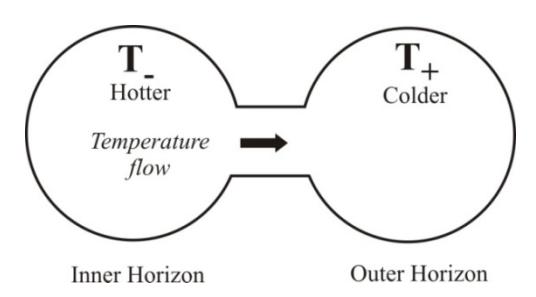
Figure 2 Temperature flow in a Reissner-Nordström black hole.
Taking the first law of black hole thermodynamics for a Reissner-Nordström black hole.
\[dM = \frac{\kappa}{8\pi} dA + \Phi dQ + \Omega dJ \tag{16}\] the relationship between the black hole's entropy and its mass can be calculated. The first term of the above equation correponds to the temperature and the entropy of the black hole. In the first law of thermodynamics, the relation between entropy, temperature, and heat is given by \(d\theta = TdS\). In the black hole thermodynamics, heat is related to the black hole's mass. Thus, using the definition of surface gravity in Eq. (1) and that of area in Eq. (11), we obtain:
\[\frac{1}{T} = \frac{\partial S}{\partial M}\Big|_{\Phi} \tag{17}\]
This relation can be easily checked according to a comparison between Eq. (12) and Eq. (13) for the black hole's entropy and Eq. (8) and Eq. (9), which describe the temperature. Because the outer horizon has positive temperature, adding more mass to the Reissner-Nordström black hole will cause entropy to increase. This fact can be understood using the relationship between entropy and area. Since \(A_+ = 4\pi \left(M + \sqrt{M^2 - Q^2}\right)^2\) it is apparent that the area of the outer horizon is directly proportional to the black hole's mass. As for the entropy of the inner horizon, since the temperature is negative, the entropy will be forced to decrease as the black hole's mass increases. Connecting this to the area of the inner horizon confirms that \(A_{-} = 4\pi \left(M - \sqrt{M^2 - Q^2}\right)^2\), which leads us to the following conclusion: the greater the mass, the smaller the area of the inner horizon. The relationship between the black hole's mass and its own entropy in both the outer and the inner horizons is described in Figure 3 below. From Figure 3, it can be seen that the entropy in both horizons depends on the black hole's mass. In the inner horizon the increase in mass will be followed by an increase in entropy, while in the outer horizon the increase in mass will be followed by a decrease in entropy. This happens because the entropy of a black hole is closely related to its area, where entropy is directly proportional to area. Furthermore, as for a Reissner-Nordström black hole that satisfies the condition \(M \gg Q\), the area of each horizon is given by:
\[\lim_{M \to Q} A_{+} = \lim_{M \to Q} 4\pi \left( M + \sqrt{M^{2} - Q^{2}} \right)^{2} = 16\pi M^{2}\] \[\lim_{M \to Q} A_{-} = \lim_{M \to Q} 4\pi \left( M - \sqrt{M^{2} - Q^{2}} \right)^{2} = 0\] (18)
This reveals that when \(M \gg Q\), the area of the inner horizon is zero and that of the outer horizon is reduced to the area of the Schwarzschild black hole. Consequently, it is concluded that in such condition, the black hole will behave much like a Schwarzschild black hole, which has only a single horizon: the event horizon. As for an extremal black hole, the areas of the outer and the inner horizons have coinciding sizes, \(4\pi M^2\), hence leading to the assumption that for an extremal black hole, \(\Delta S = S_+ - S_- = 0\).
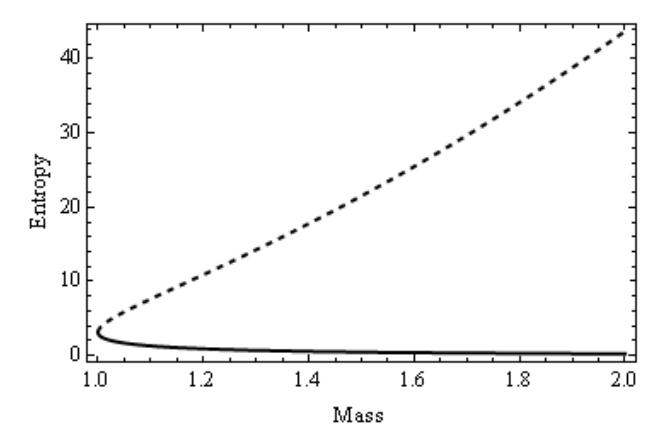
Figure 3 The relationship between mass and entropy (Q = 1) in the outer horizon (dashed line) and the inner horizon (solid line).
Concerning the relationship between temperature and mass, we can refer to Eq. (8) for the outer horizon and to Eq. (9) for the inner horizon. In Figure 4, it appears that in the outer horizon the temperature is inversely proportional to the black hole's mass and for extremely immense masses the temperature will fall to zero. However, both results imply that in both horizons, a greater mass of the black hole causes the temperature in each horizon to decrease. In the inner horizon, a greater mass will cause the temperature to drop towards \(-\infty\). If we use the temperature sequence as described previously, it is noticeable that \(-\infty\) is the boundary between positive and negative temperature. In an extremal black
hole it also appears that the temperature of the outer horizon is +0 and that of the inner horizon is -0. If we take the third law of thermodynamics into account (which can accommodate negative temperature as proposed by Ramsey), which states that "it is impossible by any procedure in a finite number of operations to reduce any system to the absolute zero of positive temperature or to raise any system to the absolute zero of negative temperature", we can extend the third law of black hole thermodynamics for multi-horizon black holes, where "it is impossible by any procedure to reduce a black hole's temperature to the absolute zero of positive temperature (the outer horizon) or to raise any system to the absolute zero of negative temperature (the inner horizon)". In other words, a non-extremal black hole cannot develop into an extremal black hole.
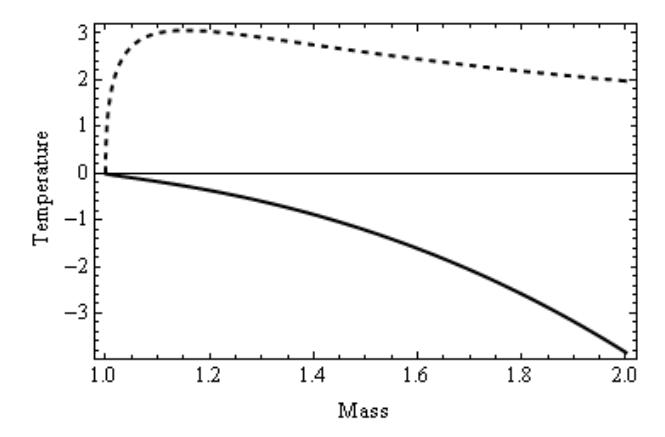
Figure 4 The relationship between mass and temperature ሺܳ ൌ 1ሻ in the outer horizon (dashed line, ×100) and the inner horizon (solid line).
5 Conclusions
Using the relationship between temperature and surface gravity, we can derive the equations for the temperatures of the outer and inner horizons in a Reissner-Nordström black hole. The temperature of the outer horizon will always stay positive, while that of the inner horizon will always be negative. If temperature is defined as a slope between entropy and energy in a system, it can be concluded that the temperature in the inner horizon is higher than any temperature in the outer horizon. Consequently, on the assumption that the direction of particle radiation is analogous with the direction of temperature flow, then the particle radiation from the inner horizon will move towards the outer horizon. In addition, the entropy in a closed-system black hole is always positive, confirming that the second law of thermodynamics remains valid even though the temperature of the inner horizon stays negative. As for an extremal black hole, the temperatures of both horizons are absolute zero: -0 in the inner
horizon and +0 in the outer horizon. Since the absolute zeros (-0 and +0) are the coldest and the hottest temperatures, the third law of black hole thermodynamics can be extended for both the inner and the outer horizons.
6 Acknowledgements
This work was supported by research funding from Universitas Bangka Belitung 2017.