

1 Introduction
The use of membrane technology has become increasingly diverse. It is used in traditional applications, such as electrodialysis, electrolysis of sodium chloride solution, and diffusion dialysis to recover acids, as well as in various fields as a polymeric film with ionic groups [1]. Therefore, various kinds of membranes with unusual characteristics are required.
In this report, the current-voltage (I-V) curve was used to study the electrical properties of a synthetic membrane. It also provides some information about the mechanism of ion transport [2,3]. When a current flows through a membrane
Received February 9th, 2017, 1st Revision November 21st, 2017, 2nd Revision February 17th, 2018, Accepted for publication March 6th, 2018.
Copyright © 2018 Published by ITB Journal Publisher, ISSN: 2337-5760, DOI: 10.5614/j.math.fund.sci.2018.50.2.6
system, then in the solution the current consists of anions and cations, while inside the membrane it consists of counterions. The differences in mobility between the counterions in the solution and in the membrane cause concentration depletion at the membrane surface. As a result, the concentration gradient grows in the thin film that connects the membrane's surfaces, a phenomenon known as concentration polarization [2]. The I-V curve of an ionexchange membrane has a typical form consisting of three regions (Figure 1) [2,3]. The first region is the region that follows Ohm's law, i.e. the increment of the current density is linearly correlated to the increment of the electrical potential difference; the resistance of the system is approximately attributed to the ionic transport of the ion-exchange membrane (Rohm). The second region is the region of limiting current, where the current density varies very slowly with the potential to form a pseudo-plateau, which is called the limiting current density (LCD). The third region is the region of electroconvection, where the slope of the I-V curve increases again (Rec). The shape of the I-V curve in an ion-exchange membrane changes with the external conditions, such as the physicochemical conditions of the membrane surface and solution concentration flow rate [2,3].
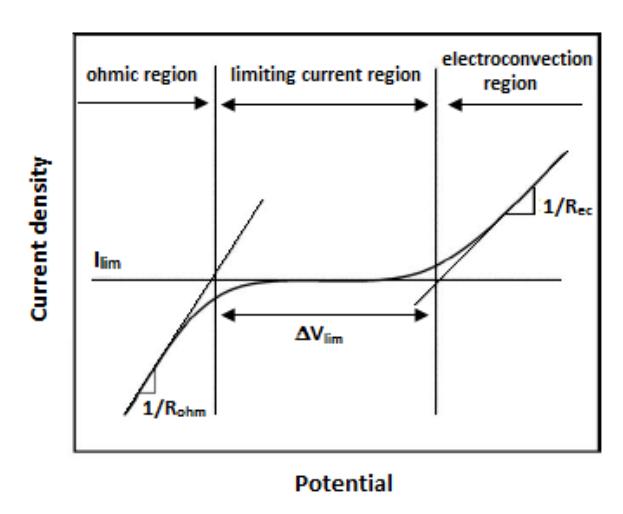
Figure 1 The I-V curve of a cation exchange membrane in contact with 0.025 M NaCl solution [2,3].
Chitosan is a biopolymer resulting from deacetylation of chitin [4,5]. Chitin is an abundant biopolymer found mainly in shellfish such as shrimps, crabs and prawn waste from the seafood industry. Chitosan has been widely explored in different processes and applications, among others as a membrane. Chitosan membranes can be used for active transport of chloride ions in aqueous solutions as a carrier and a selective barrier to control the transport rate of the substances involved [4,5].
The objective of this study was to investigate the properties of the current-voltage (I-V) curve of a chitosan membrane in different types of electrolytes, including di- and trivalent ions. Some effects on the molecular structure and hydrophilicity of the used membrane are also discussed.
2 Experimental Detail
2.1 Materials
Based on our earlier studies in Rupiasih , et al. [6], chitosan membrane 2% was used in this study. The membrane was made by a casting method using chitosan as matrix and acetic acid 1% as solvent. The characteristics of the membrane were: thickness \(0.134 \pm 0.002\) mm, pore size 2.585 nm and pores density \(2.06 \times 10^9\) pores/g. The electrolyte solutions used were KCl, HCl, MgCl<sub>2</sub>, CaCl<sub>2</sub> and AlCl<sub>3</sub> with concentration of 0.025 M; their physical properties are summarized in Table 1. Analytical grade chemicals and demineralized water were used in the preparation of the electrolyte solutions.
| • | |||
|---|---|---|---|
| Cations | Molar conductivity (104 S.m2.mol-1) [2] | Stokes radii (nm) [2] | Diffusion coefficient (105 cm2.s-1) [2] |
| \(H^{+}\) | 349.8 | 0.026 | 9.312 |
| \(Al^{3+}\) | 189.0 | 0.437 | 0.5587 |
| \(Ca^{2+}\) | 119.0 | 0.308 | 0.7920 |
| \(\mathrm{Mg}^{2^+}\) | 106.1 | 0.346 | 0.7063 |
| \(K^{+}\) | 73.55 | 0.125 | 1.957 |
Table 1 Molar conductivity and Stokes radii for cations used.
2.2 Current-Voltage (I-V) Measurement
The I-V experiments were done using a cell membrane model composed of two compartments, 1 and 2, as shown in Figure 2. The area of the membrane was 9.616 cm<sup>2</sup> and the electrodes used were made of platinum.
Figure 2 Diagram of current-voltage (I-V) measurement. Cathode and anode are connected to a potentiometer and Ag/AgCl electrodes to a multimeter.
The potential difference through the membrane was measured using Ag/AgCl electrodes. All measurements were conducted at an ambient temperature of 28.7 °C. The I-V experiments were done using a two-compartment measuring cell, which consisted of two platinum (Pt) electrodes as the working electrodes connected to the DC current source and two Ag/AgCl electrodes as the reference electrodes connected to a voltmeter. All experiments were conducted at an ambient temperature of 28.7 °C. Water uptake (hydrophilicity) and Fourier transform infrared (FTIR) measurement were also studies in this research.
2.3 Water uptake
Dry membrane was cut to pieces with a size of 1 cm × 1 cm, which were weighed (mdry) and kept in a beaker with 20 ml of demineralized water for 0.5- 8 h. After soaking, the membranes were taken out, the extra water was removed from the surface of the membranes and weighed (mwet) [4,5]. The water uptake was calculated using Eq. (1) [4,5,8].
Water uptake (%) = \[\frac{(m_{wet} - m_{dry})}{m_{dry}} \times 100\%\] (1)
3 Results and Discussion
3.1 Characteristics of I-V Curves
Figure 3 shows the I-V curves of the chitosan membranes that were obtained during ion transport in different electrolyte solutions, i.e. HCl, KCl, CaCl2, MgCl2 and AlCl3, with a concentration of 0.025 M. The curves show the ohmic characteristic, where the current increases linearly with the increase of the potential. The resistance (R) for each membrane was obtained from the slope of the I-V curve as shown in Table 2.
Table 1 Resistance (R) of chitosan membrane in different electrolyte solutions.
| Electrolytes | R (ohm.cm2 ) | ||
|---|---|---|---|
| HCl | 10.79 | ||
| KCl | 3.12 | ||
| CaCl2 | 10.80 | ||
| MgCl2 | 14.95 | ||
| AlCl3 | 16.42 | ||
The relationship between the resistance value and the diffusion coefficient (D) is presented in Figure 4a. It shows that the resistance of the membrane linearly decreased as the diffusion coefficient of the solution increased, except for the HCl solution. It indicates a value much higher than the linear relation. This is because of the high conductivity of hydrogen ions in water, as shown in Table 1; the conductivity of a proton is very high compared with the other cations. This is a model of Grotthuss-type conductivity [2]. Similarly, as shown in Figure 4b, the resistance was high in electrolyte solutions with large Stokes radii, except the HCl solution. A similar pattern has been reported by Jae-Hwan Choi et al. in cation-exchange membrane [2].
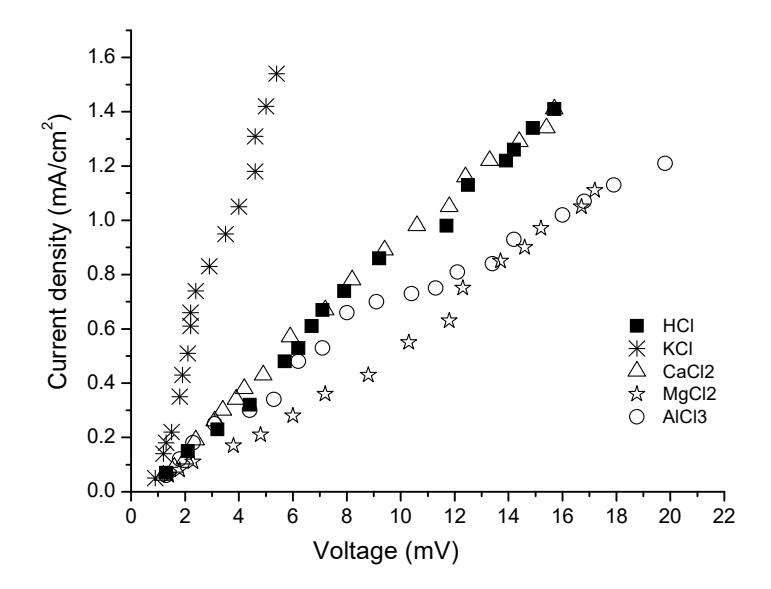
Figure 3 I-V curves of chitosan membrane in different electrolyte solutions: HCl, KCl, \(CaCl_2\), \(MgCl_2\) and \(AlCl_3\).
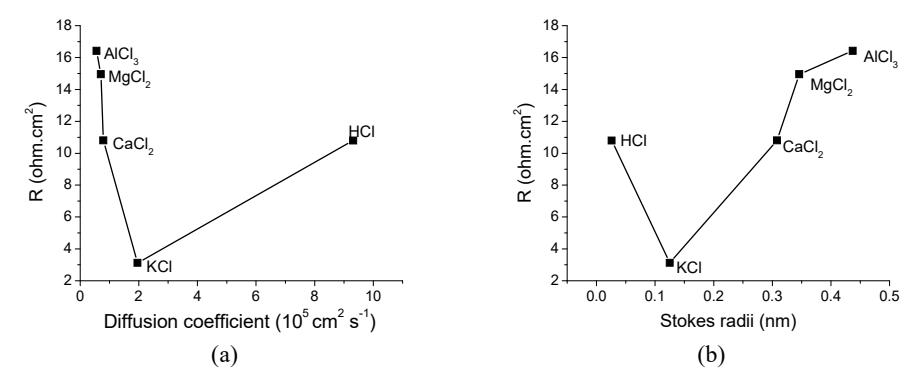
Figure 4 Relation between resistance (R) of chitosan membrane in contact with different electrolyte solutions, i.e. KCl, HCl, MgCl<sub>2</sub>, CaCl<sub>2</sub> and AlCl<sub>3</sub>: (a) different diffusion coefficient (D), and (b) different Stokes radii.
3.2 Spectrophotometer FTIR Analysis
Figure 5 shows the FTIR spectra of all initial and used chitosan membranes. For a better view of the FTIR spectrum of the initial membrane, the spectra are redrawn in Figure 6. The FTIR spectra obtained are similar to the spectra reported by other researchers [9,10]. Their analysis can be seen in Table 3.
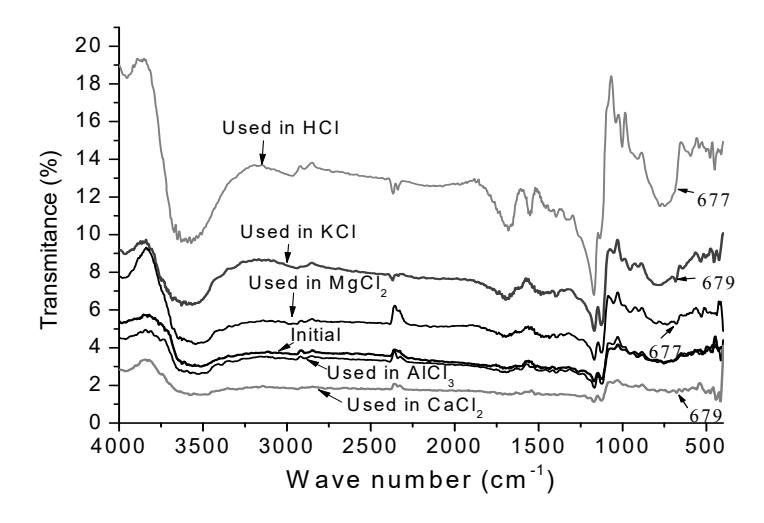
Figure 5 FTIR spectra of all chitosan membranes, initial and used.
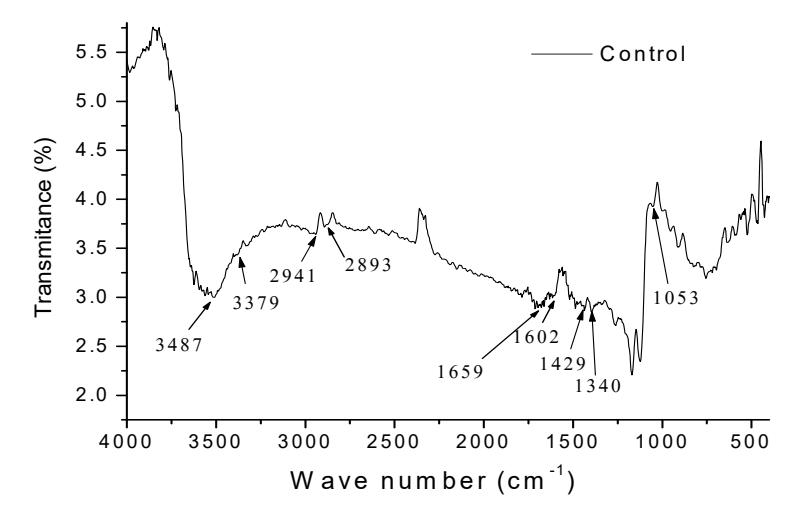
Figure 6 FTIR spectrum of the initial chitosan membrane.
For the initial membrane (Figure 6), the absorption bands at around 3487, 2941 and 2893 cm-1 are characteristic of stretching vibrations of the -OH, -CH<sub>2</sub>, and -CH<sub>3</sub> groups, respectively. The absorption bands at 3379 and 1602 cm<sup>-1</sup> represent stretching and bending vibrations of the -NH2 amine group. The absorption band at around 1659 cm<sup>-1</sup> corresponds to -C=O stretching of the carbonyl group. The peaks at 1429 and 1340 cm<sup>-1</sup> are related to the vibrations of the -OH and -CH groups in the pyranose ring. The strong peak at 1053 cm<sup>-1</sup> is associated with the anti-symmetric stretching of C-O-C glycosidic linkages. These results are in accordance with previous studies [5,8,9]. For the used membranes, a very weak new peak appears around 677 cm<sup>-1</sup>, except for the membrane used in the AlCl<sub>3</sub> solution. This new peak indicates the formation of C-Cl groups in the used membranes [11]. Some changes in the absorption bands of the stretching -OH group and the bending - NH<sub>2</sub> group were also found. Both bands were shifted to a higher or lower wavenumber. Figure 5a also shows that the percentage of absorption bands slightly increased or decreased. These observations indicate that some changes have occurred in the molecular structure of the used membranes.
| tional | Groups | Wavenumbers Observed in Each Chitosan Membranes (in cm |
|---|---|---|
| Tab | le 2 Ma | in bands observed in all chitosan membranes, initial and used. |
| Functional Groups | Wavenumbers Observed in Each Chitosan Membranes (in cm-1) | ||||||
|---|---|---|---|---|---|---|---|
| [9,10] | Initial | HCl | KCl | CaCl2 | MgCl2 | AlCl3 | |
| -OH stretch | 3487 | 3512 | 3523 | 3464 | 3479 | 3473 | |
| -CH2 stretch | 2941 | 2970 | 2935 | 2935 | 2935 | 2945 | |
| -CH3 stretch | 2893 | 2902 | 2891[9,10] | 2891 | 2895 | 2887 | |
| –NH2 amine group stretch and bend | 3379 and 1602 | 3315 and 1606 [9,10] | 3398 and 1606 | 3381 and 1604 | 3375 and 1606 | 3385 and 1606 | |
| -C=O stretch of carbonyl group | 1659 | 1654 | 1656 | 1651 | 1664 | 1685 | |
| -OH and -CH groups in the pyranose ring | 1429 and 1340 | 1402 and 1328 | 1436 and 1348 | 1427 and 1346 | 1427 and 1348 | 1431 and 1338 | |
| Anti-symmetric stretch of C-O-C glycosidic linkages | 1053 | 1039 | 1060 | 1058 [9,10] | 1056 | 1049 | |
3.3 Water Uptake
The water uptake (hydrophilicity) of all chitosan membranes, initial and used in the transport process, at various times was investigated; the results are shown in Figures 7(a) and 7(b). It can be seen that the dynamic of water uptake is highly affected by the type of electrolyte solution used for the transport. Figure 6a shows that initially the water uptake increased sharply, up to 1.5 h, and then slowed down as it seemed to reach a maximum. Figure 7(b) shows that the maximum percentage of water uptake (%) of the used membranes was greater than that of the initial membrane, except for the membrane that was used in the HCl solution. These observations prove that after exposure to various kinds of electrolyte solutions, the hydrophilicity of the membranes improved. This means that some changes occurred in the membranes. This result is in agreement with the analysis obtained by FTIR [3,9,11]. A new peak of the C-Cl group was formed in the used membranes, the bands were shifted to a higher or lower wavenumber, and the percentage of the absorption bands slightly increased or decreased.
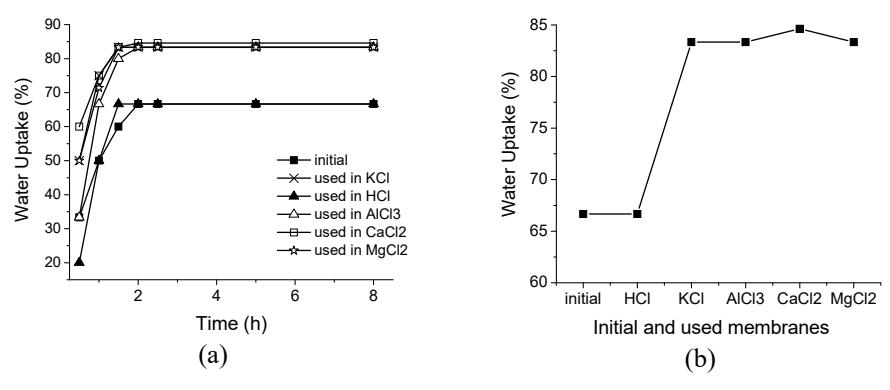
Figure 7 Water uptake of all chitosan membranes, initial and used: (a) water uptake as a function of time, and (b) maximum percentage of water uptake (%) of each membrane.
4 Conclusion
This study investigated the characteristics of the current-voltage (I-V) curve of chitosan membrane in different types of electrolytes. The I-V curves were determined in electrolyte solutions of KCl, HCl, MgCl2, CaCl2 and AlCl3. The obtained I-V curves show the ohmic behavior of the membrane. The resistance of the membrane was higher in electrolyte solutions with larger Stokes radii but lower in electrolyte solutions with a larger diffusion coefficient, except for the HCl solution. These results indicate that the I-V curve shape of chitosan membrane is affected by the type of electrolyte solution used in the ion transport. The water uptake (hydrophilicity) of the membrane increased after exposure to the electrolyte solutions. FTIR analysis discovered a new peak at about 677 cm-1, which indicates the formation of C-Cl groups in the membrane. Also some changes occurred in its molecular structure.
Acknowledgments
The funding of this research by the Ministry of Research, Technology and Higher Education, Republic of Indonesia under the basic research scheme of Udayana University 2017 is highly acknowledged.