

1 Introduction
Indonesia is predicted to have a rice deficit of 8,857,000 tons in 2020 [1]. Because of this, agricultural intensification is needed through regulating the use of irrigation water and the use of synthetic fertilizers and pesticides. Results of previous researches indicate that irrigation water is generally contaminated with organic matter and has etrophication due to human activity around it [2-5]. The issue of irrigation water pollution is complex due to the use of synthetic pesticides to control pests. Prevathon is a new chemical pesticide manufactured by DuPont and is one of the synthetic pesticides most commonly used by farmers to protect crops against white pest and rice stem borer. The active ingredient of Prevathon is chlorantraniliprole group of diamida with the molecular formula C18H14BrCl2N5O2. This type of pesticide is able to control insect pests from Lepidoptera orders such as Plutella xylostella and Spodoptera exigua as well as some species of Coleoptera, Diptera and Hemiptera. However, the use of synthetic pesticides can have a negative impact on the environment and non-target water organisms [6-8]. Chlorantraniliprole pesticides are highly toxic and have an impact on the behavior and respiratory response of the Channa punctatus fish [9,10].
In order to fulfill the requirements of organic agriculture, i.e. irrigation water of good quality that does not contain prohibited pollutants and is free of synthetic pesticide residues [11], it is necessary to apply phytoremediation technology before irrigation water is used for organic farming. Hydromacrophytes are expected to be utilized in the phytoremediation process to degrade toxic contaminants [12]. Portulaca tuberosa and P. oleracea are also able to accumulate more than one type of heavy metal, i.e. Cd, Cr and As, in very high concentrations [13].
Hydromacrophytes in phytoremediation ponds (Nymphaea sp., Ipomoea crassicaulis, Ipomoea aquatica, Acorus calamus, Fimbristylis globulosus, Limnocharis flava, Scirpus grossus, Typha angustifolia, Ludwigia sp., Cyperus alternatifolius, Colocasia esculenta, Alternanthera sessilis, Pandanus amaryllifolius, Coix lacrima-jobi, Hydrilla verticillata, Valisneria gigantea, and Cryptocoryne sp.) with plant coverage achieving 75-80% through a continuous culture system with water discharge about 0.3 L/seconds was able to improve the quality of irrigation water from heavy organic pollution to some organic pollution contributing to eutrophication [14]. Moreover, these plants are also known to act as remediator agent of polluted irrigation water, especially with regard to synthetic fertilizers in phytoremediaton through batch culture [15-17]. However, the effect of this phytoremediation process in reducing synthetic pesticides is not yet known.
The above description shows that previous researches did not consider the presence of pesticide residues in irrigation water. Based on this, the purpose of this research was to evaluate the effectivity of batch culture phytoremediation of emergent, submerged and polyculture hydromacrophytes to remediate irrigation water contaminated with a synthetic pesticide (Prevathon). The effectiveness of the phytoremediation model was reflected in a decreased value of water physico-chemical parameters and was also evaluated based on periphyton diversity and the biotic index of diatoms as bio-indicators of water quality.
2 Materials and Methods
2.1 Research Design
This research was conducted in the glass house of Universitas Brawijaya Malang. It was a true experimental research using a completely randomized design [18]. In the research treatment, four types of hydromacrophytes were used as independent variables in the phytoremediation process: (1) emergent macrophytes (Scirpus sp., Acorus calamus, Marsilea crenata); (2) floating leaf macrophytes (Ipomoea aquatica, Azolla sp.); (3) submerged macrophytes (Valisneria sp., Hydrilla verticilata); (4) a polyculture of the three hydromacrophytic groups. Treatment without hydromacrophytes was used as control. The dependent variables in this research were a number of water physico-chemical parameters and periphyton as bioindicator of water quality, including taxa richness, diversity index, trophic diatom index (TDI) and percentage of pollution tolerant values (%PTV).
The hydromacrophytes used in this research were planted in a bucket with a substrate from sand with a height of 5 cm and gravel with a height of 10 cm, added with ground water. The hydromacrophytes planted in each treatment covered 25% of the surface area. The hydromacrophytes were maintained until steady growth, after which the ground water was changed with 30 L of irrigation water from the Kepanjen Malang area that was contaminated with Prevathon at a concentration of 6.4 μL/L before being used for the research treatment. The control treatment was in the form of substrate without hydromacrophytes. Each treatment was repeated three times at the same time. In the experiment, simultaneously with planting of hydromacrophytes, 5 pieces of artificial periphyton substrate from ceramics 5 x 5 cm2 were laid in each treatment.
2.2 Monitoring the Effectiveness of the Phytoremediation Model
The effectiveness of each treatment in the phytoremediation model was determined by its ability to improve the water quality. The degradation of active pesticide ingredients (chlorantraniliprole) can be measured based on the organic matter components and chlorine [19,20]. Thus, the water physicochemical quality parameters were monitored in this study, i.e. pH, DO (dissolved oxygen), turbidity, nitrate, orthophosphate, TKN (total Kjeldahl nitrogen), TP (total phosphates), bicarbonate, BOD (biochemical oxygen demand), COD (chemical oxygen demand), and free chlorine. Water quality monitoring was performed on day 0 (shortly after the treatment with Prevathon), day 6, 13, 29 and 37 after incubation of the Prevathon. The measuring method used for each observed parameter can be seen in Table 1 [21].
| No. | Parameter | Unit | Method |
|---|---|---|---|
| 1. | pH | - | pH meter |
| 2. | Dissolved oxygen (DO) | mg/L | Digital oxygenmeter |
| 3. | Turbidity | NTU | Turbidimeter |
| 4. | Nitrate | mg/L | Brucine method |
| 5. | Dissolved phosphates (orthophosphate) | mg/L | Stannous chloride method |
| 6. | Bicarbonate | mg/L | Titration |
| 7. | BOD | mg/L | Potensiometry |
| 8. | COD | mg/L | Spectrophotometry |
| 9. | Free chlorine | mg/L | Titration |
| 10. | Total Kjeldahl nitrogen (TKN) | mg/L | Macro Kjeldahl method |
| 11. | Total phosphates (TP) | mg/L | Ascorbic acid method |
Table 1 Water physico-chemical parameters measured in this research.
The success of the phytoremediation process can also be seen from the taxa richness and diversity index of periphyton and a number of biotic indices from diatoms as bioindicators of water quality. Periphyton and diatoms were obtained from artificial substrate. Diatom sampling was done by cleansing each side of the artificial substrate with a brush and water and then inserting it into a flacon bottle with 10 drops of 4% formaldehyde and 5 drops of saturated CuSO4 presevative. Diatom identification was done based on [22] and [23].
2.3 Data Analyses
The results of physicochemical parameter measurement were compiled, after which the mean value for each treatment and sampling time was calculated. The data of periphyton were then used to determine Shannon's diversity index [24] with the following formula:
\[H' = -\sum_{i=1}^{S} (Pi * \ln Pi)\] \[\tag{1}\] where: H' = Shannon's diversity index
Pi = proportion of all individuals in a sample that belong to species i
S = total number of species in a sample
∑ ൌ sum of species 1 to species S
Data of diatom composition and abundance were used to calculate the trophic diatom index (TDI) to indicate the nutrient status of the water and the percentage of pollution tolerant values (%PTV) to estimate the organic pollution. These biotic indices were calculated as bioindicators of irrigation water quality after phytoremediation [25,26] with the following formula:
\[TDI = (WMSx25) - 25, \tag{2}\] where TDI = trophic diatom index and WMS = weighted mean sensitivity [25,26], calculated as follows:
\[WMS = \frac{\sum_{j=1}^{n} a_{j} s_{j} v_{j}}{\sum_{j=1}^{n} a_{j} v_{j}}\] (3)
where \(a_j\) = abundance (proportion) of species j in the sample, sj = pollution sensitivity (1-5) of species j and vj = indicator value (1-3). %PTV was calculated based on the proportion of taxa generally regarded as particularly tolerant to organic pollution, such as Gomphonema parvalum, Navicula spp., Nitzschia spp. and Sellaphora spp.
The differences in all parameters of water quality (physical, chemical and biological) between the phytoremediation treatments in this research were seen from clustering and biplot from principal component analyses using the PAST software program. The water quality classification of each treatment and observation time was known through average linkage clustering by the Unweighted Pair-Group Method [18].
3 Result and Discussion
3.1 Effectivity of Phytoremediation Based on Evaluation of Physics-chemical Parameters
Phytoremediation using some type of hydromacrophytes included emergent (Scirpus sp., Acorus calamus, Marsilea crenata), floating leaf macrophytes (Ipomoea aquatica, Azolla sp.), submerged (Valisneria sp., Hydrilla verticilata) and polycultures of these hydromacrophytes on batch culture systems effectively improved the quality of irrigation water contaminated by fertilizers already in the treatment water and Prevathon that was added at the beginning of this research's treatment.
The pH value of the irrigation water used in the treatment ranged from 7.95 to 8.14. Planting of hydromacrophytes in a batch culture for 6-37 days tended to increase the pH to 8.12-8.89, except in the polyculture treatment, where it decreased to 7.73. The increase of pH occurs because the plant and Periphyton both use CO<sub>2</sub> (as a result of respiration) in photosynthesis [27]. However, the pH value of irrigation water, both before treatment and after phytoremediation, still fulfilled the quality standard of water based on Regulation No. 82/2001 of the Indonesian government on water quality management and water pollution control (classes I to III ranging between 6-9). Increasing pH is also correlated with decreased values of bicarbonate content. Bicarbonate levels at days 6 and 13 after incubation decreased from 2.29-2.60 meq/L to 0.94-1.53 meq/L. However, there was a slight increase on day 29, after which it declined again on day 37 (ranging from 0.93 to 1.92 meq/L). The photosynthesis activity of hidromacrophytes and also plankton or periphyton in the water is responsible for the high or low value of bicarbonate or alkalinity. Alkalinities at or above 0.33 meq/L trap \(CO_2\) and increase the concentrations available for photosynthesis. This activity decreases the \(CO_2\), which then increases the pH value. In this condition, phytoplankton and hydromacrophytes can combine bicarbonates (\(HCO_3^-\)) to form \(CO_2\) for photosynthesis and carbonate (\(CO_3^-\)) is released [27].
\(2HCO_3^- + phytoplankton/hydromacrophytes \rightleftharpoons CO_2 (photosynthesis) + CO_3^- + H_2O (4)\)
The release of carbonate converted from bicarbonate by plant life can cause pH to climb dramatically and this release of carbonate then will also combine \(H_2O\) to form bicarbonate \(CO_3^-+H_2O \rightleftharpoons 2HCO_3^-+OH^-\) (strong base). A value of pH of about 8.40 has the highest or maximum bicarbonate (HCO<sub>3</sub>) value. If the value of bicarbonate is lower, it will affect the pH value, which will also be higher or lower [28]. However, the water bicarbonate value in this research met the standard of water quality for agricultural purposes according to FAO, which is 0-10 meq/L [29].
Planting hydromacrophytes in irrigation water contaminated with Prevathon was able to significantly increase dissolved oxygen (DO) levels on the 29th day after incubation because of the photosynthetic process. The DO levels at the beginning of the treatment ranged from 3.44-3.79 mg/L and increased to 4.64-5.78 mg/L on day 29 after incubation. The minimum DO required for class II agricultural activity is 4 mg/L. Thus, the results of the phytoremediation process after 29 days met the water quality standards. Nevertheless, the resulting DO level of the phytoremediation process fluctuated. This was probably due to the phytoremediation process being done in a batch culture. Based on this drawback it is necessary to try implementing the phytoremediation process using a continuous system, which can be done by planting hydromacrophytes as riparian vegetation in an irrigation channel [30].
All treatments were able to reduce suspended solids as reflected by the decrease in turbidity from 27.77-32.17 NTU to 0.97-2.47 NTU on day 6 after incubation. The turbidity value at the end of treatment (37 days after incubation) decreased to 0.47-1.22 NTU. The control treatment without hydromacrophyte cultivation, but with gravel and sand substrate, was able to reduce suspended solids after 13 days of incubation from 27.77 NTU to 7.53 NTU and decreased steadily up to 37 days after incubation to a value of 4.18 NTU.
The presence of organic matter in water is indicated by BOD (biochemical oxygen demand) and COD (chemical oxygen demand). BOD levels after batch culture phytoremediation using local hydromacrophytes for 6 days decreased from 8.13-11.67 mg/L to 5.04-8.84 mg/L. The treatment without hydromacrophytes increased from 9.11 mg/L to 20.29 mg/L. The BOD value in the phytoremediation treatment decreased steadily until day 13 after incubation, however on 29 day it increased to 6.41-15.89 mg/L and decreased again on day 37 to 3.8-5.02 mg/L. Based on the BOD value it can be stated that the planting of hydromacrophytes in the process of phytoremediation for 37 days succeeded in improving the quality of the irrigation water from class IV to class III, which requires a maximum BOD 6 mg/L. The COD concentration at the beginning of the treatment ranged from 36.5-45.08 mg/L and was decreased significantly after 13 days of phytoremediation to 11.31-27 mg/L. This value decreased steadily until the end of the phytoremediation process.
Phytoremediation in a batch culture system for 6 days was able to significantly reduce the residues of synthetic fertilizers and pesticides present in the irrigation water, especially the levels of nitrates, TKN, total phosphates, orthophosphates and chlorine (Figure 1). The initial concentrations of these parameters were not identical because the quality of the irrigation water used for treatment was different, even though it had been stirred before the addition of Prevathon as treatment. The nitrate content in the treatment decreased significantly from 0.76-1.79 mg/L to 0.003-0.020 mg/L, while the orthophosphate decreased from 0.16-0.37 mg/L to 0.027-0.062 mg/L. TKN levels decreased significantly after 13 days of incubation, from 0.31-0.65 mg/L to 0.17-0.30 mg/L. The level of free chlorine at the beginning of treatment ranged from 0.09-0.18 mg/L. The phytoremediation model in a batch culture in this research with an incubation time of 6 days was able to decrease the level to 0,02-0,06 mg/L. The decrease of all these parameters continued steadily until the end of the phytoremediation process (Figure 1).
Total phosphates decreased from 0.65-1.35 mg/L to 0.08-0.15 mg/L in the hydromacrophyte treatment and to 0.28 mg/L in the control treatment without hydromacrophytes after incubation for 6 days. However, the concentration increased to 0.11-0.97mg/L on day 13 and 29 and declined again on day 37, ranging from 0.008 to 0.08 mg/L. This increase in phosphate concentration on the 13th and 29th days after incubation was caused by the abundance of phytoplankton from the Mougeotia genus in all treatments. One component of total phosphates in waters is organic phosphate, which is bound to hydromacrophyte tissue and is also an important component of the DNA, RNA, and ADP of phytoplankton [31]. This total phosphates concentration decreased again on day 37 due to Mougeotia harvesting on day 29.
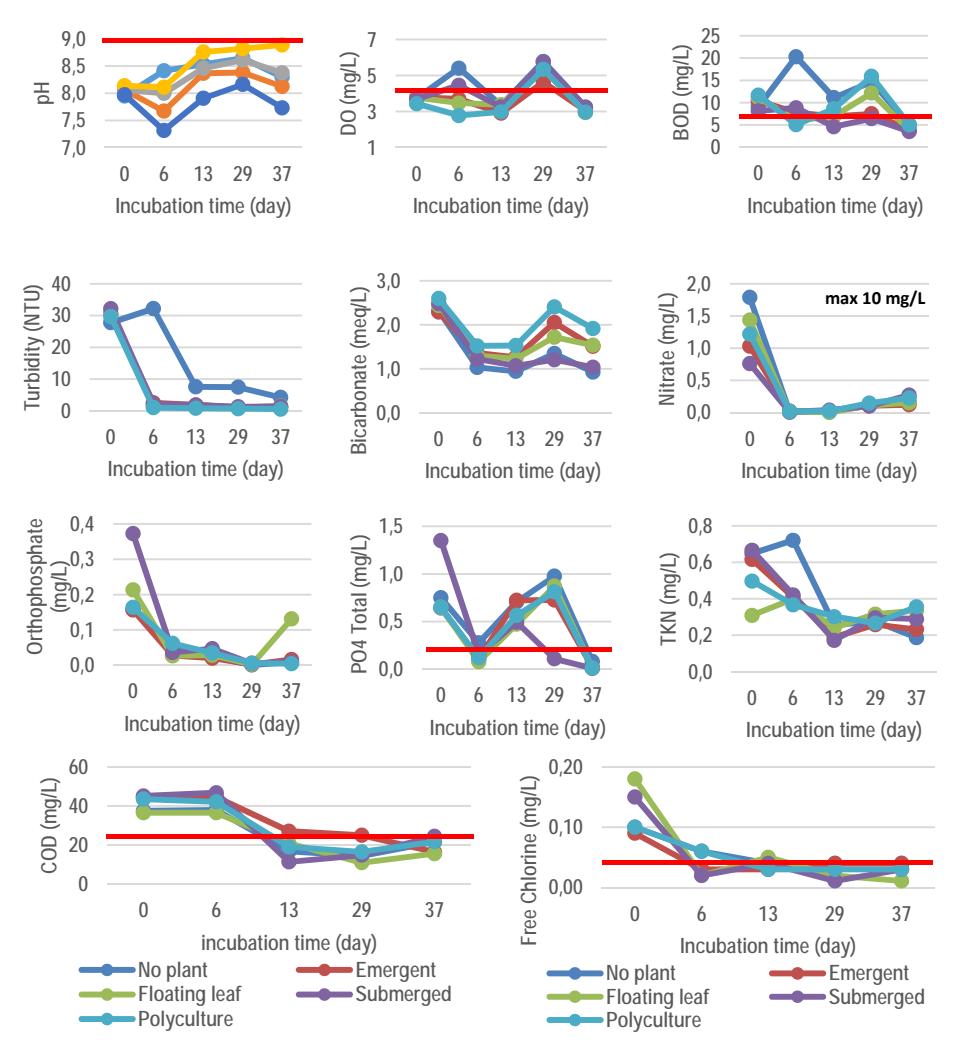
Figure 1 Monitoring result of the physicochemical quality of water during phytoremediation of irrigation water contaminated with Prevathon for 6-37 days in a batch culture system through planting of emergent, submerged, and floating leaf hydromacrophytes.
(Note: _____ indicates the Indonesian government's standard for agricultural class II based on Regulation No. 82/2001, while no line for some parameters indicates that there is no regulation.)
3.2 Effectivity of Phytoremediation Based on Evaluation of Periphyton Diversity and Biotic Index of Diatoms as Bioindicator of Water Quality
Improving the quality of irrigation water resulting in phytoremediation can also be seen from periphyton diversity and some biotic indices of diatoms as bioindicators of water quality [14,17,24-26]. Periphyton monitoring in this research showed that its taxa richness increased from 14-23 taxa at the beginning of the treatment to 24-28 taxa at the end of the treatment. The taxa richness of periphyton found in each treatment affects the diversity index value of periphyton, which can be used as a toxic pollutant bioindicator. From Shannon's diversity index score on periphyton grown on the substrate during the phytoremediation process it can be seen that the phytoremediation process of irrigation water given the addition of a pesticide significantly increased the diversity of periphyton (Figure 2).
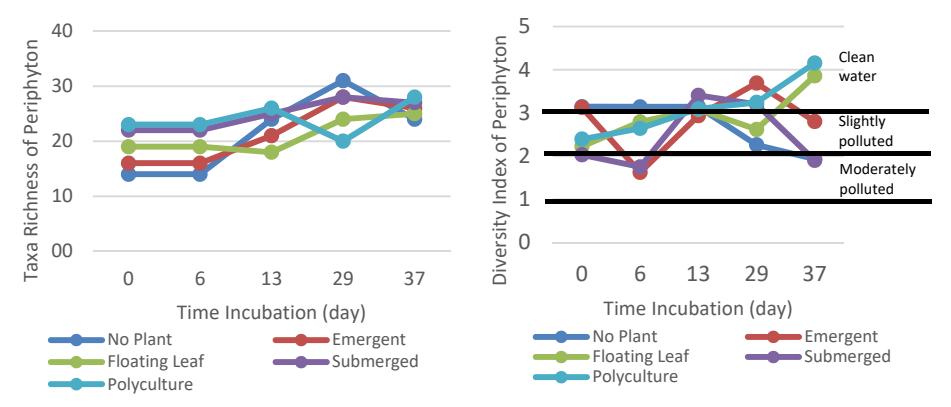
Figure 2 The taxa richness and Shannon's diversity index (H') of periphyton found during the phytoremediation process for each treatment using emergent, floating leaf, submerged, polyculture and control without hydromacrophytes on days 0, 6, 13, 29 and 37 after incubation.
The addition of pesticides in the irrigation water in the experiment caused a low value of the Shannon's diversity index, which ranged from 2.03-3.10 at the beginning of incubation, which indicates the presence of toxic substances in the medium. However, planting of various hydromacrophytes, especially floating leaf and polyculture of hydromacrophytes, increased Shannon's diversity index of periphyton to 3.9 and 4.2 after incubation for 37 days (Figure 2). This increase in diversity was due to the increased taxa richness from 19 and 23 species in the floating leaf and polyculture treatments to 25 and 28 species at the end of observation (Figure 2). The species diversity value at the beginning ranged from 2.0-3.0. This value is categorized as 'good', or lightly polluted, while a value of diversity index > 3 means 'very good', or clean water [24].
Thus, the increase of the periphyton diversity index value and taxa richness in the batch culture system shows that when irrigation water is contaminated with toxic substances, phytoremediation using various hydromacrophytes was able to improve the water quality by one category, from lighty polluted to clean water. This water quality improvement mainly occurred in the treatment of floating leaf hydromacrophytes and polyculture (Figure 2).
One of the periphyton groups that is often used as a bioindicator are algae from the diatom group. An indication of water quality can be seen from several biotic indices that have been developed. The trophic diatom index (TDI) and percentage of pollution tolerant values (%PTV) are biotic indices of diatoms commonly used to determine eutrophication and organic contamination levels in waters such as rivers [24-26,32,33] and also irrigation water quality [14,17].
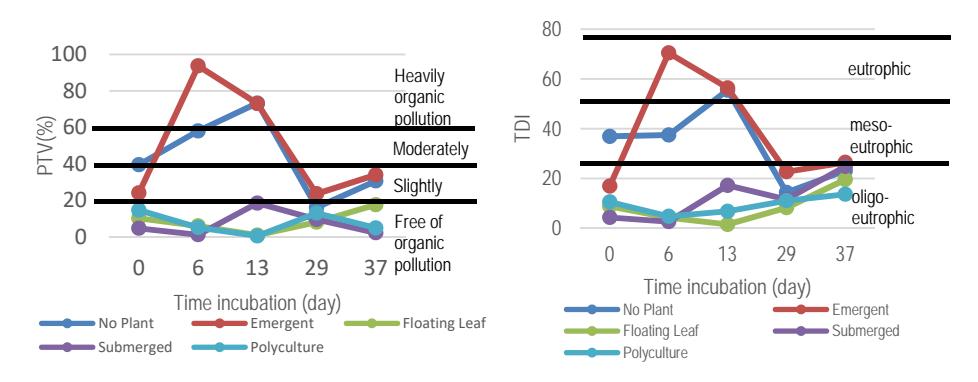
Figure 3 The level of organic pollution (PTV%) and trophic status of irrigation water (TDI) during phytoremediation for each treatment using emergent, floating leaf, submerged, polyculture and control without hydromacrophytes on days 0, 6, 13, 29 and 37 after incubation.
The result of calculation of the %PTV values during the phytoremediation process in this study showed that the water quality at the beginning of the treatment was in the categories 'not polluted', 'slightly polluted', and 'moderately polluted'. The addition of a synthetic pesticide (Prevathon) in this research caused degradation of the quality of the irrigation water to become 'heavily polluted by organic matter', especially in the emergent hydromacrophytes and control treatments. This water quality increased to 'slightly contaminated by organic matter' after 29 days of phytoremediation (Figure 3). Meanwhile, in the other treatments, the use of submerged hydromacrophytes, floating leaf and polyculture from the beginning to the end of observation was able to maintain the water quality as 'uncontaminated by organic matter'.
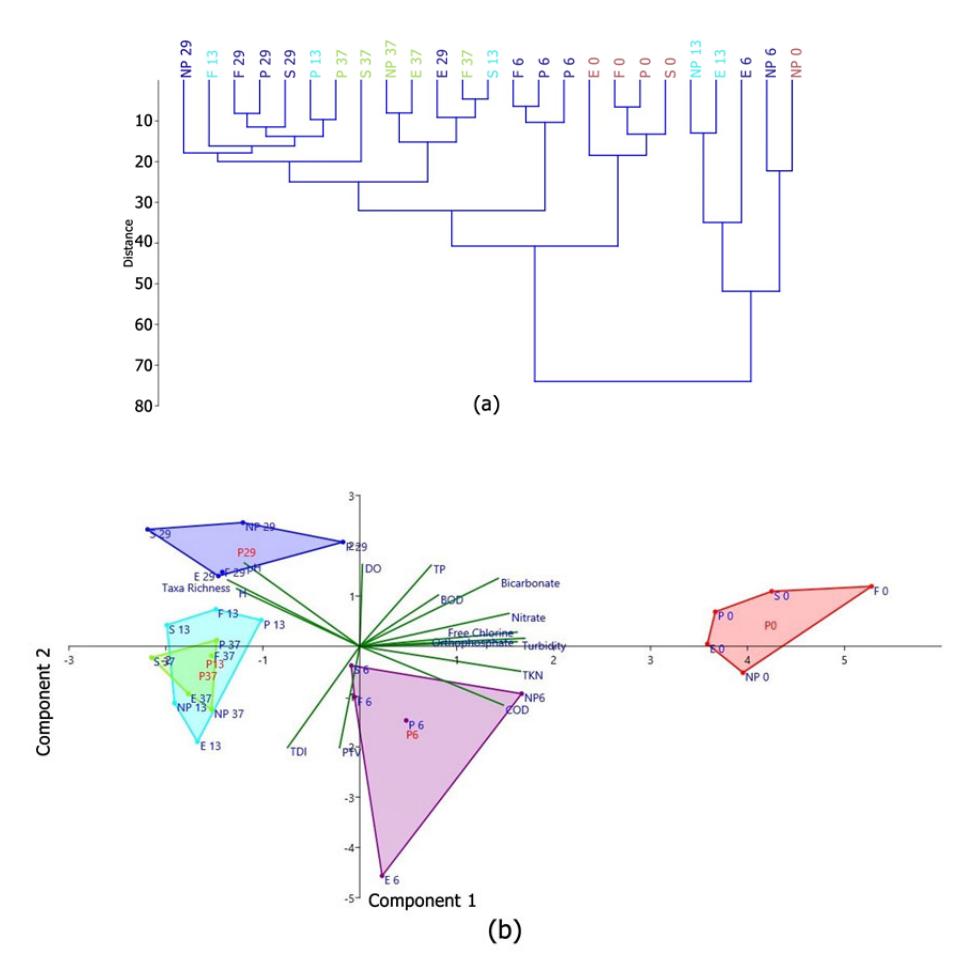
Figure 4 Improvement of irrigation water contaminated by Prevathon during phytoremediation for each treatment of emergent (E), floating leaf (F), submerged (S), polyculture (P) and control without hydromacrophytes (NP) on days 0, 6, 13, 29 and 37 after incubation based on some physico-chemical parameters (pH, DO, turbidity, nitrate, orthophosphate, TKN, TP, bicarbonate, BOD, COD, and free chlorine), periphyton diversity (taxa richness and Shannon's diversity index/H') and diatom biotic indices (TDI and %PTV) using clustering (a) and biplot from principal component analysis (b).
The results of the TDI calculations showed that the irrigation water used for phytoremediation could be categorized as oligotrophic to meso-eutrophic. The addition of synthetic pesticide to the irrigation water used for the polyculture, submerged and floating leaf hydromacrophyte treatment only slightly increased the TDI value so that the water's status was still oligotrophic. The addition of synthetic pesticide to the treatment of emergent hydromacrophytes and control without hydromacrophytes for the phytoremediation process initially caused a deterioration in water quality, as can be seen from the water status changing from oligotrophic and mesotrophic to eutrophic on days 6 and 13 after incubation. However, phytoremediation for 29 days improved the water quality with the water's status becoming oligotrophic (Figure 2).
The differences in water quality resulting from some of the phytoremediation treatment processes can generally be seen from clustering of the water quality based on clustering and biplot from principal component analysis, as shown in Figure 4. Phytoremediation for 6 days was able to slightly improve the water quality and after incubation for 13 days a significant increase in water quality could be seen. This water quality improvement was characterized by the decreasing value of several water quality parameters, such as BOD, COD, free chlorine, nitrate, turbidity, orthophosphate, TKN, TP and bicarbonate, as well as increased DO values. Water quality improvement could also be seen from the increase in the Shannon Wiener diversity index value as well as the decline in the value of TDI and %PTV. Based on PCA biplot it was found that the water quality on day 37 was not significantly different from the water quality on day 13. Thus it can be concluded that 13 days of incubation is an effective time period to conduct phytoremediation of irrigation water contaminated with synthetic pesticide through a batch culture system using hydromacrophytes of emergent, floating leaf and submerged monocultures or polycultures. Based on principal cluster analysis it was found that the phytoremediation process using submerged and polyculture plants was more effective in improving the quality of the irrigation water compared to the other treatments. This was shown by the water quality clustering of submerged and polyculture treatments starting on day 13, which did not significantly differ from the water quality after a longer phytoremediation process (29 and 37 days).
4 Conclusion
In this study, phytoremediation using a batch culture system through planting emergent, submerged, floating leaf hydromacrophytes and polyculture for 6-13 days, was capable of improving the quality of irrigation water contaminated by Prevathon. The improvement could be seen from a decreased turbidiy value, decreased levels of organic pollution (BOD and COD), decreased residue of synthetic fertilizer (nitrate, orthophosphate, TKN and TP) and also decreased toxic pollution levels from pesticide (free chlorine and COD). Increased levels of DO to meet water quality standards of class II occurred after phytoremediation for 29 days. Submerged hydromacrophytes and polyculture were more effective in phytoremediation than the other treatments. The phytoremediation process, based on monitoring periphyton as well as diatoms as bioindicators of water quality, was able to improve the water quality from moderately contaminated to lightly contaminated by toxic materials (based on the periphyton diversity index), from moderately/severely to lightly/moderately contaminated by organic matter (based on %PTV), and from mesoeutrophic/eutrophic to oligotrophic/meso-eutrophic (based on TDI).
Acknowledgments
This research was part of the institutional research grant PTUPT 2017 budget year funded by the Directorate General of Higher Education of Indonesia through the Universitas Brawijaya. The authors would like to express their gratitude to the Ministry of Research, Technology and Higher Education of Indonesia and the Rector of Universitas Brawijaya for this support.