

1 Introduction
Proton beams accelerated in cyclotrons have been employed to study material erosion [1] as well as to produce medical radionuclides such as F-18 [2], Cu-64 [3], Tc-94m [4], etc. One of the most important radioisotopes applied in nuclear medicine procedures is Tc-99m, which emits gamma rays at 140 keV and decays at a half-life of 6 hours. The relatively low gamma ray energy and short half-life make Tc-99m suitable as a radioactive tracer for medical diagnostic
Received March 1<sup>st</sup>, 2017, Revised February 1<sup>st</sup>, 2019, Accepted for publication June 16<sup>th</sup>, 2020 Copyright © 2020 Published by ITB Institute for Research and Community Services, ISSN: 2337-5760, DOI: 10.5614/j.math.fund.sci.2020.52.2.6
procedures by means of Single Photon Emission Computed Tomography (SPECT) modality. The most widely applicable technique for Tc-99m production is by bombarding natural molybdenum targets consisting of Mo-98 using neutrons generated from nuclear reactors \(^{98}\)Mo(n,\(\gamma\))\(^{99}\)Mo\(\rightarrow\)\(^{99m}\)Tc nuclear reaction. The direct result of the bombardment is Mo-99, which immediately decays into Tc-99m; thus, an Mo-99/Tc-99m generator is required for extracting Tc-99m properly to meet radiochemical purity requirements. Nevertheless, due to the declining number of available nuclear reactors capable of such production and tight regulations related to uranium enrichment, reports on Tc-99m supply shortages have emerged [5-6]. The supply shortages have caused the price of Mo-99/Tc-99m generators to soar. A new method of cyclotron-based Tc-99m production has therefore been proposed to tackle these Tc-99m supply shortages [7-8].
Recent theoretical calculations [9] suggest that as much as 42.18 GBq/uA.hr can be produced from 11-MeV proton irradiation of enriched 100 Mo targets at the end of bombardment, while experimental studies highlighted the possibility of generating high yields of Tc-99m using medium- and high-energy cyclotrons [10-11]. Nevertheless, no reports have been published on the commercial use of cyclotron-based Tc-99m radionuclide due to the low Tc-99m yield as well as radionuclide impurities produced during bombardment.
Gaining a better understanding of all radionuclides produced during proton irradiation of molybdenum targets is therefore of paramount importance. In this experimental study, the temporal evolution of the post-irradiated MoO<sub>3</sub> spectrum was evaluated in order to observe changes in the presence of all produced radionuclides. Furthermore, in this paper we only concentrated on the analysis of the Tc-99 spectra produced from an 11-MeV proton bombardment. Further studies, particularly on the produced Tc-99m in the form of pertechnetate, Tc O4 (including its practical use), will be discussed in another paper. To the best of the authors' knowledge, there no publication has yet reported a detailed spectral analysis of the produced Tc-99m and the impurities following 50 days of irradiation. The outcomes of this research are useful for Tc-99m production as well as for safety concerns regarding long-lived radionuclides. In addition, no Tc-99m has previously been produced using an 11-MeV cyclotron.
2 Experimental Set-up
2.1 Target Preparations
As much as 1.1 gram MoO<sub>3</sub> powder (purchased from Sigma-Aldrich Germany) was pressed into a solid disk of 1.8 cm in diameter and 0.3 cm thick using a 30-
N hydraulic presser. The solid MoO3 target was then heated in a furnace at a constant temperature of 600 °C for 3 hours to remove vapors and other possible watery impurities. The final product of this target preparation was a clear white disk of MoO3. In this experiment, the natural molybdenum consisted of several Mo atoms, including Mo-92 (14.84%), Mo-94 (9.25%), Mo-95 (15.92%), Mo-96 (16.68%), Mo-97 (9.55%), Mo-98 (24.13%), and Mo-100 (9.63%).
2.2 Target Irradiation
The disk target of MoO3 was placed in an aluminum-based target holder so that the proton beam would hit the target perpendicularly during irradiation of the target, which was performed using an 11 MeV cyclotron at Dharmais Cancer Hospital in Jakarta. The 11 MeV proton beams bombarded the MoO3 target at a constant beam current of 20 µA. During the bombardment, the proton dose was varied by varying the irradiation time from 2 minutes to 5 minutes, resulting in proton doses between 0.67 and 1.67 µAh. The general proton irradiation procedure was performed using an 11 MeV cyclotron has been discussed previously in [12].
2.3 Target Dissolving
The post-irradiated MoO3 target was dissolved in a solvent containing 6M NaOH, followed by mixing the solution using a magnetic stirrer at a speed of 1000 rpm for 15 minutes. The final solution after dissolving was visibly clear.
2.4 Target Analysis
The radioactivities of the solid MoO3 as well as the NaOH-dissolved MoO3 target were measured using a portable gamma ray spectroscopy system, which had been described elsewhere [12-13]. The measurement was performed by sampling 10 µL of the NaOH-dissolved MoO3 solution for a counting time of 5 minutes for each sample, and each spectrum was analyzed after background subtraction. For radioactive impurity measurement, gamma ray detection was carried out from 2 hours after the end of bombardment (EOB) to 50 days after the EOB to obtain the temporal evolution of the NaOH-dissolved MoO3 spectrum.
3 Results and Discussion
3.1 Spectral Analysis of Post-Irradiated MoO3
The gamma ray spectrum of the proton-irradiated solid MoO3 target observed 2 hours after the end of the bombardment is shown in Figure 1, which indicates that apart from the intensity, there was no significant difference in the energy of the gamma rays recorded for two different proton doses (0.67 and 1.67 \(\mu\)Ah). The relatively strong gamma rays at 0.181 MeV correspond to the Mo-99 peak. Two possible nuclear reactions for Mo-99 production in this experiment can be explained as follows:
- 1. Direct Mo-99 production via \(^{100}\)Mo(p,d)\(^{99}\)Mo nuclear reactions. According to the TALYS code calculations performed previously [9], while the proton threshold energy for such a nuclear reaction to occur is only 6.1 MeV, this typical nuclear reaction is very likely undetectable due to very low nuclear cross-section at the 11 MeV proton beam, which is theoretically only \(7.5 \times 10^{-3}\) mbarn. The presence of a \(^{100}\)Mo(p,d)\(^{99}\)Mo nuclear reaction has been suggested by Lebeda and co-workers [14] since they employed 18-MeV proton beams in their investigation. For 18-MeV proton beams, the nuclear cross-section is theoretically 107.6 mbarn, which potentially causes a \(^{100}\)Mo(p,d)\(^{99}\)Mo nuclear reaction to occur.
- 2. Since secondary neutrons are also generated during the proton bombardment of the \(MoO_3\) target, Mo-99 could also potentially be produced via a \(^{98}Mo(n,\gamma)^{99}Mo\) nuclear reaction. Again, based on the TALYS calculated results [9], such a nuclear reaction is very likely to occur due to high nuclear cross-sections for slow to fast neutrons. Thus the most possible nuclear reaction for Mo-99 generation in this experiment was \(^{98}Mo(n,\gamma)^{99}Mo\).
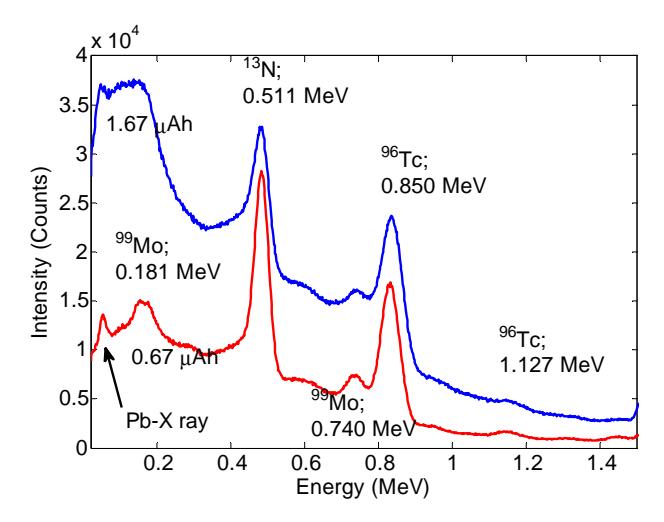
Figure 1 The gamma ray spectrum of the proton-irradiated solid MoO<sub>3</sub> after 2 hours of decay for proton doses of 0.67 (red line) and 1.67 \(\mu\)Ah (blue line).
Another pronounced peak, at 0.511 MeV, is presumably due to gamma rays emitted by nitrogen-13 (N-13) radionuclide. The presence of N-13 relates to the oxygen-16 (O-16) content in the MoO<sub>3</sub> target, which undergoes a \(^{16}O(p,\alpha)^{13}N\)
nuclear reaction when proton beams hit the target. The unstable N-13 emits positron (\(\beta^+\)) particles that immediately interact with free electrons around them and then are annihilated by emitting gamma rays at 0.511 MeV. With a half-life of 9.97 minutes, the N-13 impurity is expected to vanish after a few hours decay.
Also in Figure 1, slightly weak intensity can be observed at 0.739 MeV, which is emitted by Mo-99, while the very strong peak at 0.850 MeV is presumably due to Tc-96 radionuclide following \(^{96}\text{Mo}(p,n)^{96}\text{Tc}\) and \(^{97}\text{Mo}(p,2n)^{96}\text{Tc}\) nuclear reactions. Both nuclear reactions are possible since their threshold energies are 3.830 MeV for the \(^{96}\text{Mo}(p,n)^{96}\text{Tc}\) reaction and 10.687 MeV for the \(^{97}\text{Mo}(p,2n)^{96}\text{Tc}\) reaction, respectively. The identified Tc-96 is also supported by the weak gamma ray intensity at 1.127 MeV. This result agrees with previous theoretical calculations [9] and a previous experimental investigation [14]. Note that at this point, Tc-99m is weakly detected due mostly to self absorption of the emitted gamma ray by the solid MoO<sub>3</sub>.
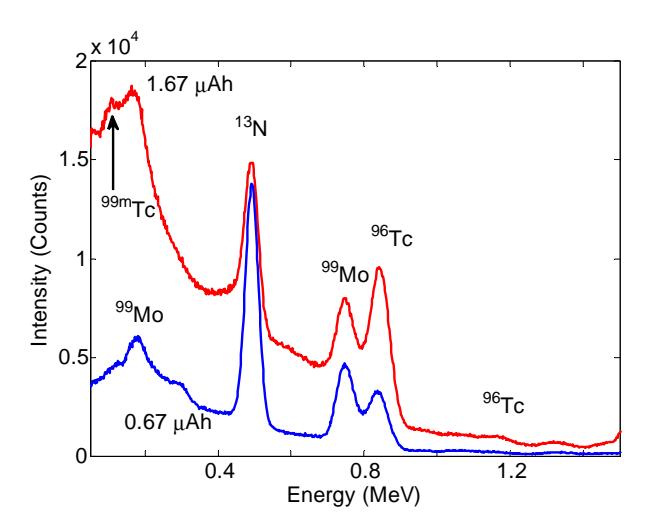
Figure 2 The gamma ray spectrum of the NaOH-dissolved MoO<sub>3</sub> after 2 hours of decay for proton doses of 0.67 and 1.67 \(\mu\)Ah.
Compared to the solid MoO<sub>3</sub> spectrum, there was a slight difference in the types of radionuclides detected in the NaOH-dissolved MoO<sub>3</sub>, particularly the presence of the Tc-99m spectrum at 0.140 MeV, as can be seen in Figure 2. Moreover, the intensities of Mo-99 at 0.181 and 0.740 MeV looked more pronounced in the solution. Self absorption of Mo-99 gamma rays clearly occurred in the solid MoO<sub>3</sub>, resulting in lowering Mo-99 intensity before the post-irradiated target was dissolved in the NaOH solution. Another interesting feature is that the Tc-96 intensity was higher with increasing proton dose.
At a proton dose of 1.67 \(\mu\)Ah, as much as \(0.84 \pm 0.05\) \(\mu\)Ci of Tc-99m was recorded 2 hours after the EOB, while \(0.87 \pm 0.04 \mu Ci\) of Mo-99 was detected at the same time. The almost identical amounts of Mo-99 and Tc-99m radioactivity observed in the experiment indicate that the Tc-99m measured comes from both Mo-99 decay as a result of a \(^{98}\text{Mo}(n,\gamma)^{99}\text{Mo} \rightarrow ^{99\text{m}}\text{Tc}\) nuclear reaction and direct production of Tc-99m via a <sup>100</sup>Mo(p,2n)<sup>99m</sup>Tc nuclear reaction.
According to the Mo-99/Tc-99m equilibrium equation, the radioactivity ratio of daughter radionuclide \((A_d)\) and parent radionuclide \((A_p)\) depends on the decay constants of the daughter \((\lambda_d)\) and the parent \((\lambda_p)\), which can be calculated as follows:
\[\frac{A_d}{A_p} = \frac{\lambda_d}{\lambda_d - \lambda_p} \left( 1 - e^{-(\lambda_d - \lambda_p)t} \right),\tag{1}\] where t is the decay time.
In the case of Mo-99/Tc-99m, by substituting \(\lambda_d = 0.1155 \text{ hour}^{-1}\), \(\lambda_p = 0.0105\)hour<sup>-1</sup>, and t = 2 hours, one can immediately obtain that the radioactivity ratio of Tc-99m to Mo-99 as a result of Mo-99 decay is theoretically 20.84%. However, the experimental ratio was found to be 96.55%, which indicates that the majority of the Tc-99m (75.71%) generated in the experiment reported here was due to direct production of Tc-99m via a <sup>100</sup>Mo(p,2n)<sup>59m</sup>Tc nuclear reaction.
3.2 Temporal Evolution of MoO<sub>3</sub> Spectrum
In order to better understand the produced Tc-99m and the radionuclidic impurities in the NaOH-dissolved MoO<sub>3</sub>, careful observations were carried out from day 1 to 50 after the end of the bombardment. The recorded spectra are shown in Figure 3 and 4, which surprisingly indicate significant amounts of another radionuclidic impurity not observed shortly after the EOB. As can be seen in Figure 3, the remaining radionuclides detected in the NaOH-dissolved MoO<sub>3</sub> solution were dominated by Mo-99 over weaker intensity of Tc-96. As predicted earlier, N-13 radionuclide was no longer observed after 1 day of decay since its half-life is 9.97 minutes.
The new radionuclidic impurity discovered in this investigation was Nb-96, which gave rise to the pronounced peak at 0.569 MeV, as shown in Figure 4. The Nb-96 peak emerged as a result of lower background radiation after several days of decay. The presence of Nb-96 (half-life = 23.35 hours) in this experiment agrees with previous investigation [14], which is possibly due to \(^{97}\)Mo(p,2p)\(^{96}\)Nb (threshold energy = 9.321 MeV), \(^{98}\)Mo(p,He-3)\(^{96}\)Nb (threshold
energy = 8.488 MeV), and 100Mo(p,αn)96Nb nuclear reactions (threshold energy = 3.575 MeV).
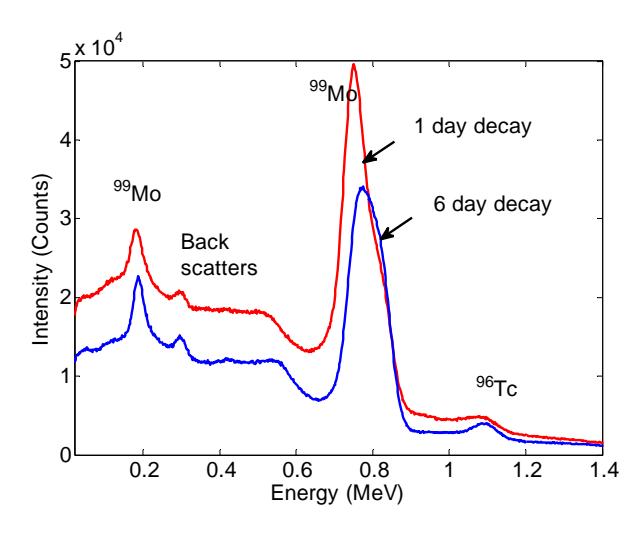
Figure 3 The gamma ray spectrum of the NaOH-dissolved MoO3 after 1 day and 6 days of decay.
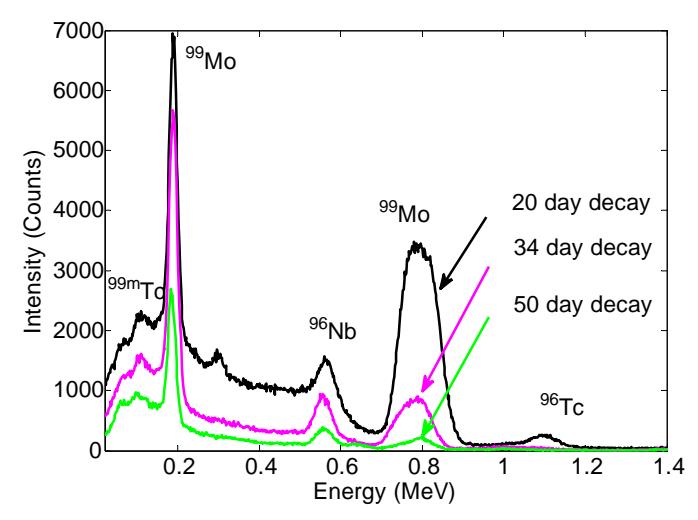
Figure 4 The gamma ray spectrum of the NaOH-dissolved MoO3 after 20, 34 and 50 days of decay.
After radioactive decay of over 20 days, 4 radionuclides (Tc-99m, Mo-99, Nb-96 and Tc-96) were detected in the NaOH-dissolved MoO3 solution, while N-13 had completely decayed, as can be seen in Figure 3. Details of the observed radionuclides following a 2-hour to 50-day cooling period of the NaOHdissolved MoO3 target is given in Table 1.
| Radionuclide | Gamma energy (MeV) | Half-life | Nuclear reaction | Threshold energy (MeV) |
|---|---|---|---|---|
| Tc-99m | 0.140 | 6 h | 100Mo(p,2n)99mTc | 7.793 |
| Mo-99 | 0.141 0.181 0.740 | 65.95 h | 98Mo(n,γ)99Mo | 6.126 |
| N-13 | 0.511 | 9.97 m | \(^{16}O(p,\alpha)^{13}N\) | 5.547 |
| Тс-96 | 0.850 1.127 | 4.28 d | 96Mo(p,n)96Tc; 97Mo(p,2n)96Tc | 3.795 10.687 |
| Nb-96 | 0.596 | 23.35 h | \(^{97}\)Mo(p,2p)\(^{96}\)Nb; \(^{98}\)Mo(p,He-3)\(^{96}\)Nb; \(^{100}\)Mo(p,\(\alpha\)n)\(^{96}\)Nb | 9.322 10.255 3.828 |
Table 1 Radionuclides recorded from proton-irradiated MoO<sub>3</sub> following 2 hours to 50 days of decay.
According to Polatom, the price of an imported Mo-99/Tc-99 generator is Rp 32 million (USD 2,265) for 400 mCi or Rp 80,000 (USD 57) per mCi. If it is produced locally at Dharmais Cancer Hospital in Jakarta it would cost Rp 37,500 (USD 2.65) per mCi. In order to produce a more competitive Tc-99m supply it is recommended that Tc-99m is locally produced using a cyclotron since the price of a new cyclotron is much lower than that of a new nuclear reactor. In addition, the new cyclotron should be a medium energy cyclotron (15-30 MeV).
4 Conclusion
Experimental production of Mo-99/Tc-99m radionuclide was carried out by bombarding a solid MoO<sub>3</sub> target with 11-MeV proton beams at variable proton beam currents. Using a portable gamma ray spectroscopy system, several radionuclides were detected, i.e. Tc-99m, Mo-99, N-13, Tc-96 and Nb-96. Due to the short half-life of only 9.97 minutes, the N-13 radionuclide decayed completely after a cooling period of 1 day, while the other radionuclides were still observed after 50 days of decay. The experimental data also indicate that nearly 75.71% of the Tc-99m detected in this experiment were a result of direct production of Tc-99m via a <sup>100</sup>Mo(p,2n)<sup>99m</sup>Tc nuclear reaction, while the rest of the Tc-99m radioactivity came from a \(^{98}Mo(n,\gamma)^{99}Mo \rightarrow ^{99m}Tc\) nuclear reaction. Instead of irradiating a natural Mo target, future research is suggested to use enriched 100 Mo target for a higher Tc-99m yield as well as reducing the number of radioactive impurities.
Acknowledgement
This research project is supported by The World Academy of Sciences (TWAS) under the principal investigator's research grant number: 15-020
RG/PHYS/AS_I – FR3240287075. In-kind funding from Dharmais Cancer Hospital and the Indonesian National Nuclear Energy Agency (BATAN) is also greatly acknowledged.