

1 Introduction
In the laser plasma interaction technique, the atoms in the path of the laser can emit harmonic signals when ultra-intense short duration laser pulses diffuse in plasmas. Harmonics generation in plasmas or highly ionized gases is a nonlinear optical approach wherein generated harmonic pulses depend on the reaction of atoms to a highly intense beam [1]. The duration of the created pulses is in the attoseconds range, which is considerably shorter than that of a propagated laser [2]. The generation of ultra-short new pulses by the harmonics creation process in this technique is a significant area of study and an attractive technology for ultraviolet and soft X-rays in many applications [3]. This type of plasma can be regarded as a valuable source of coherent signals in soft X-rays, in the femtosecond or attosecond timescales. The generated harmonics signals can be used for medical and biomedical high-resolution imaging and accurate spectroscopy.
Received January 22nd, 2024, Revised March 30th, 2024, Accepted for publication May 13rd, 2024 Copyright © 2024 Published by ITB Institut for Research and Community Service, ISSN: 2337-5760, DOI: 10.5614/j.math.fund.sci.2024.55.3.4th
In the harmonics generation process by ultra-intense laser fields, the phase velocity mismatch in the plasma medium is the main obstacle to the generated ultra-short pulses [4]. The laser phase velocity mismatch with the newly generated pulses in plasma can reduce the efficiency of the created pulses [5]. This occurs when the laser propagates in the plasma over a certain distance, called coherence length. The diffusion of high-intensity laser pulses in the plasma medium can increase phase mismatch along the diffusion distance [6]. The intensity of the created harmonic signals can be minimized by phase mismatch, which reduces the conversion of laser pulses into harmonics pulses. The laser guide medium, gas cells, can create a dispersion in the laser beam due to the plasma refractive index. A plasma generated by an ultra-intense beam can give rise to a cumulative plasma response that modifies the plasma index of refraction due to the creation of free electrons and other effects on the pulse phase mismatch. In addition, the defocusing effects on the propagated laser beam in the plasma induce a shape modification and intensity reduction on the laser pulse [7].
Many researchers have numerically and analytically studied laser propagation in plasmas and harmonics generation through quasi-phase matching techniques. Auguste et al. [8] numerically investigated the quasi-phase matching effect on harmonics creation in a gas, using spatial adjustment of the gas density. Their results confirmed that the periodic change of gas density can affect the production rate of harmonics pulses. Moreover, they proved that the QPM of the short and long path can improve the generated pulses' properties. The creation of harmonics pulses in multiple plasma jets of a five-jet configuration and the concept of QPM in laser-produced plasma of silver and manganese targets were investigated experimentally by Ganeev et al. [9,10]. They proved enhancement of the created pulses in the plateau and other spectrum regions by using multiplasma jets. Hage et al. [11] experimentally designed a dual gas of adjacent jets and studied the harmonics generation in a quasi-phase matching of multiple nozzles separated by 0.01 mm in each target. Wang et al. [12] investigated the effect of a dual gas multi-jet array by enhancing the yield of harmonics pulses. Their results showed the effects of QPM on the lower recombination crosssection of hydrogen and argon gas. Benedetti et al. [13] analytically and numerically studied the diffusion of high intensity light in a plasma by nonlinear paraxial wave equations. They investigated the distribution of Gaussian laser pulses to prove the effect of quasi-matched propagation with an initially uniform laser spot. Lewis et al. [14] proposed a new numerical scheme of quasi-phase matching harmonics pulses in a hollow core waveguide. They experimentally studied periodically modulated harmonics pulses and the intensity growth of the harmonics pulses. Manzoor et al. [15] numerically studied plasma density and laser self-focusing. They used the paraxial approximation to solve the laser wave equations and WKB equations to study the ionization effect on the laser beam. They confirmed that laser parameters can affect the self-focusing by the impact of electron density and linear absorption in the interaction medium. Wameedh Adress [16] numerically studied the effect of two high-intensity vertical linearlypolarized beams on harmonics generation in plasma using a 2D semi-classical model. The method considered adjusting the vertical drift of the electrons resulting from the effects of the magnetic field by utilizing two magnetic fields.
In the present work, the effect of laser defocusing by an induced plasma was numerically investigated. The laser beam divergence, the reduction in laser intensity, and the laser frequency blue shift were calculated. The harmonics were generated from the reduction of neutral atoms and multi-ionized argon ions (Ar+ and Ar++) and a singly-ionized hydrogen ion (H+ ). For comparison, the ionization in helium gas was calculated as well. The laser guide medium was spatially modulated along the axis of laser propagation by periodically using alternating argon and hydrogen gas cells. Highly ionized dual-gas-cells were employed by using argon and hydrogen cells. A quasi-phase matching was created by periodically alternating gas cells of high and low ionization rates, with a period equal to two coherence lengths. Moreover, the effect of electron density on the defocusing and QPM was studied. If the laser pulses and the ultra-short harmonics pulses are in phase in the plasma medium, high-intensity harmonics pulses can be generated in constructive-phase regions. The harmonics pulses grew sharply with laser propagation distance. However, the pulses created in the destructive phase regions can be neglected. The basic idea for this manuscript is to gradually describe the results, leading to the final objective of creating quasiphase-matching by dual-gas-cells. A summary of the effects on the laser beam properties by plasma is presented before discussing the impact of phase mismatching in the suppression of harmonics intensity and phase matching in increasing harmonics generation.
2 Numerical Model
A two-dimensional laser-plasma model was created and implemented. The MATLAB-based model describes the diffusion of a laser beam in highly ionized dual-gas-cells. This model was previously described in detail by Wameedh Adress [7]. Using this model, the effect of tunnelling ionization, multi-photon ionization, and the impact of plasma defocusing effects were investigated. The Ammosov, Delone, and Krainov approach was employed to estimate the ionization level values. Moreover, the effect of QPM and the creation of very short harmonic pulses was studied. In this model, a linearly-polarized Gaussian laser beam was adopted and the inhomogeneous Helmholtz wave equations were used to describe the laser fields.
The paraxial approximation was used to numerically solve the laser wave equations and the cylindrical coordinate was adopted to characterize the propagation of the Gaussian beam [7]. The laser properties used in this model were described previously by Adress [7]; they generally depend on the laser system experimentally used by Willner et al. [17]. In this model, the interaction length, or the laser propagation length in the gas cells, was about 1 mm. The model has been studied in two previously published papers. The previous works developed the model and studied the laser's propagation in different gas cells, the ionization rate, and the electron trajectories in two linearly polarized laser fields to enhance the generation of harmonics in plasmas. In the current work, the model was developed to study the defocusing effect, the QPM with dual-gas-cells, and the intensity of the harmonics generation [7,16]. Details of the tunnelling ionization and multi-photon ionization in the plasma defocusing model were described previously in [7].
In the model, the laser pulse can be defocused by plasma before the peak value of the laser intensity because the beam is centered at the center of the gas cells. The effect of ionization-induced defocusing by the created plasma can restrict the optimum laser intensity value [7]. This effect is significant when the defocusing lengths are smaller than the length of the confocal parameter. The defocusing length depends on the relative change of the plasma density and the laser path in the plasma, wherein the divergence of the laser beam becomes large [7]. In this context, with a highly focused optics geometry, the generated harmonics pulses can be reduced by the induced defocusing effects of the propagated laser beam. Generally, this effect can reduce the laser peak intensity compared to the laser peak intensity in a vacuum, which can reduce the harmonics pulses. The defocusing effects on the laser beam increase rapidly with an increase of the pressure in the medium, the beam intensity, and the focal geometry. In this work, the divergence in the propagated beam in gas cells was studied as a defocusing effect. Three effects of defocusing were studied in the model: the variation in laser spot size, the laser intensity reduction, and the laser blue shift.
The starting point of developing this model was the first-order paraxial approach of the inhomogeneous Helmholtz wave equation in Eq. (1):
\[\frac{\partial E(z,r)}{\partial t} = \frac{ic}{2k_o} \left[ \frac{\partial^2 E(z,r)}{\partial r^2} + \frac{1}{r} \frac{\partial E(z,r)}{\partial r} \right] - c \frac{\partial E(z,r)}{\partial z} \frac{ik_o c}{2} \frac{n_e}{n_c} E(z,r)\] (1)
where E is the electric field, t is the propagation time, c is the speed of light, and ko is the wavenumber of the laser. Here, r is the radial direction, z is the laser diffusion direction, ne is the density of free electron, and nc is the density of critical electrons.
The tunnelling ionization rate is in Eq. (2):
\[w(t) = \frac{l_p}{\hbar} \frac{\frac{2Z\sqrt{\frac{l_{ph}}{l_p}}}{2}}{Z[\Gamma_{n^*+1} - \Gamma_{n^*}]\sqrt{\frac{l_{pH}}{l_p}}} \exp\left(-\frac{4l_p}{3\hbar\omega}\right) \left[\frac{\sqrt{32m_e l_p^3}}{eh|E(t)|}\right]^{2Z\sqrt{\frac{l_{ph}}{l_p}} - 1}\](2)
where \(I_{pH}\) is the hydrogen atom ionization potential, \(I_p\) is the ionization potential of any atom, Z is the charge, and \(n^*\) is equal to \(Z(I_{pH}/I_P)^{0.5}\). Therefore, the electron density value in the created plasma is in Eq. (3):
\[n_e(t) = n_o [1 - \exp(-\int_{-\infty}^t w(t)dt)]\] (3)
Here, \(n_0\) is the density of a neutral atom. According to the model, the change in laser spot size can be described by the change in the beam waist during diffusion in the cell. Solving the following equation can be used to find the variation in the beam waist in Eq. (4):
\[\frac{\partial r_{s}}{\partial z} = \frac{4}{k_{o}^{2} r_{s}^{3}} \left[ 1 - \frac{\pi e^{4}}{2m^{3} c^{4}} \frac{E_{o}^{2} r_{o}^{2} n_{e}}{\omega_{o}^{2}} \delta(\omega_{o} - \omega_{s}) \right]\](4)
where, \(r_s\) is the spread of the beam waist, \(r_o\) is the initial value of the beam waist, e is the charge, and m is the electron mass. Here, \(\omega_o\) is the initial laser angular frequency, \(\omega_s\) is the spread in the angular frequency, \(E_o\) is the initial value of the electric field, E is the electric field in different positions. The Rayleigh range \(Z_R\) depends on initial beam waist \(r_o\) and wavenumber \(k_o\).
The effect of the ionization level on the intensity of the laser is given by Eq. (5):
\[\frac{\partial n_e}{\partial t} = 4\omega_o (n_e - n_o) e^{E_o/E} \sqrt{\frac{E_O}{E}}\] (5)
where \(n_o\) is the primary density of the gas. Therefore, the reduction of the laser intensity depends on the ionization level, \(\partial n_e/\partial t\).
When the laser propagates in the gas cells, the electron density increases rapidly with time during the creation of plasma. However, the plasma refractive index decreases. The dispersion effect of the plasma causes a decrease in the plasma refractive index, leading to a frequency shift of the laser pulse. Therefore, the time-dependent index of refraction in the plasma can be written as in Eq. (6):
\[\eta_{\text{plasma}}(t) = \sqrt{1 - \frac{\omega_p^2}{\omega_L^2}} \approx 1 - \frac{\omega_p^2}{2\omega_o^2}\] (6)
where \(\omega_p\) is the plasma angular frequency. Therefore, the instantaneous frequency shift of the laser pulse that results from the plasma defocusing effect is given by Eq. (7):
\[\omega(t) = \omega_0 + \frac{\pi L}{\lambda_0} \left( \frac{n_0}{n_e} \frac{\omega_p^2}{\omega_0^2} \right) \delta p \frac{\partial n_e}{\partial t}\] (7)
where L is the propagation length, \(\lambda_o\) is the fundamental laser wavelength, \(\delta p\) is the fractional pressure with regard to the atmospheric pressure. Here, the defocusing length depends on the ratio of \(n_o/n_e\). The blue shift of the laser frequency relies on the ionization rate, the plasma refractive index, and the laser propagation length. At low laser intensity, when the ionization rate is less than one, a dominant blue shift can be created. Conversely, if the gas cell is completely ionized by an intense laser beam, a strong frequency shift can be observed on the rising edge of the laser signal. Therefore, the increase in the plasma ionization is the main effect of this process.
The conversion of the propagated laser pulses into harmonics pulses can be reduced by the difference in the index of refraction between the incident laser and the generated pulses in Eq. (8):
\[\Delta k = qk_o - k_q \sim (2\pi q/\lambda_o) [N_o(\omega_o) - N_{plasma}(q\omega_o)]\] (8)
Here, q is the harmonic number, \(k_o\) is the beam vector number, and \(k_q\) is the vector number of the harmonic pulse, \(N_o\) is the laser refractive index, and \(N_{plasma}\) is the plasma refractive index, which is less than unity. The phase mismatch can be described by three effects: the laser propagation waveguide, the dispersion in the plasma, and the dispersion by neutral atoms. The change in vector number of the phase mismatch effect can be calculated according to Eq. (9):
\[\Delta k = \frac{q\lambda_o}{\pi\omega_o^2} + \lambda_o r_e n_o \delta P (q - q^{-1}) \frac{\partial n_e}{\partial t} + \frac{2\pi q}{\lambda_o} \delta P \delta N (1 - (\partial n_e)/\partial t)\] (9)
where \(r_e\) is the classical value of the electron radius, \(\delta N\) is the change of the refractive index. At strong laser intensity, there is another effect of phase mismatch, which is single-atom-induced dipole phase. This effect is due to the action accumulated by electrons during the excursion of electrons in the laser
beam [18-21]. The impact of the induced dipole phase on the whole phase mismatch is in Eq. (10):
\[\nabla \varphi_q = \nabla I \,\alpha_q = \frac{8(z - z_0)R^2}{[R^2 + 4(z - z_0)^2]^2} \alpha_q I_o \tag{10}\] where \(\varphi_q\) is the phase of the atomic dipole, I is the intensity of the laser, and R is the Rayleigh range, \(\alpha_q\) is the travel time along the plateau region, for short trajectories \(1 \times 10^{-14}\) rad cm<sup>2</sup> W<sup>-1</sup> and for long trajectories \(24 \times 10^{-14}\) rad cm<sup>2</sup> W<sup>-1</sup>. Meanwhile, along the cutoff area there is a single trajectory, \(13.7 \times 10^{-14}\) rad cm<sup>2</sup> W<sup>-1</sup> [18-21]. According to the phase mismatch effect, the intensity of the harmonics pulses along the plasma medium can be represented by Eq. (11):
\[I = I_{max} \frac{\sin^2(0.5 \,\Delta kL)}{(o.5 \,\Delta kL)^2} \tag{11}\] where \(I_{max}\) is the intensity of the maximum harmonics pulse in the full phase matching effect. The created pulse intensity depends on the phase matching between the incident light and the harmonics pulses.
3 Results and Discussion
Converting the fundamental laser pulses into harmonics pulses can be reduced by several phase mismatch effects. The index of refraction depends on the angular frequency of the diffused laser light pulse in the created plasma. The defocusing influence on the propagated beam can create a geometrical modification and dispersion in the incident beam. Moreover, the generation of electrons can be attributed to the diffusion of the laser, which was employed to drive the harmonic pulses.
Figure 1 shows the laser beam divergence along the laser diffusion path. The interaction medium was the argon plasma cell and the calculations were performed with different laser intensities. The laser beam radius increased between one to two times the value of the initial radius during diffusion in the positive direction. The variation in laser spot size or laser beam radius depends on the focus point in the gas cell. The beam radius decreased from the maximum point in the negative positions to the minimum value near z/ZR = -1.5, before the focus point. Near the focus point z = 0, the spot size increased and the divergence in the laser beam radius increased in positive positions.
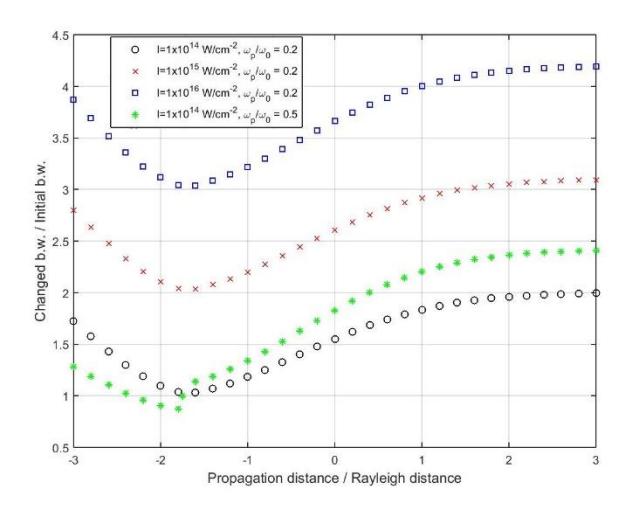
Figure 1 Laser beam divergence as a function of diffusion path in argon plasma at three different laser intensities.
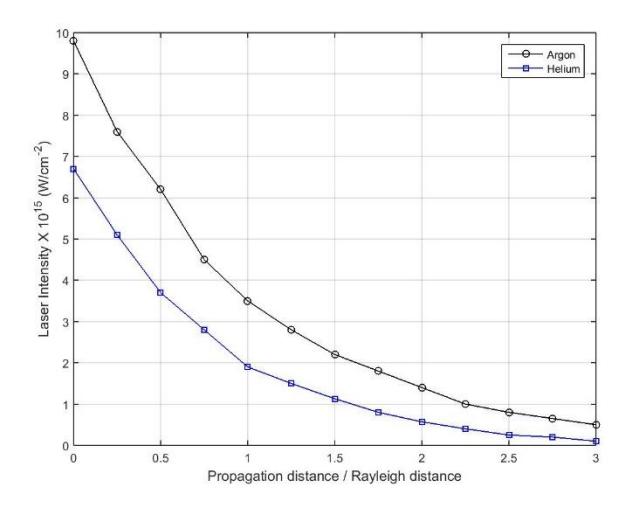
Figure 2 Reduction of laser light intensity as a function of diffusion distance. The initial laser beam focal spot was at 15µm and the initial gas density was 1×1018 cm−3 .
The optimum value of the laser beam radius can be determined according to the used gas cells and laser intensity. It can be noted that by changing the frequency of the plasma relative to the frequency of the fundamental laser, the laser beam divergence can take another turn in changing with the propagation distance. This issue can be attributed to the self-focusing of the laser beam due to the modulation in the refractive index and the absorption in the plasma. Figure 2 illustrates the defocusing impact on the beam intensity. Here, the intensity decreased along the propagation distance in two gas cells, hydrogen and argon.
Figure 3(a) shows the calculated laser spectra at a light intensity of 1 × 10¹⁵ W/cm2during the incident and propagation in the argon gas cell. The wavelength shift was about 10 nm with an ionization rate of about 7.5 × 1033 cm-3 s -1 . Figure 3(b) presents the third effect of the laser beam defocusing: a shift in the laser wavelength along the propagation length. Here, the shift in wavelength was between 1 to 12 nm for the argon plasma and between 1 to 9 nm for the helium plasma. The shift in laser wavelength depends on the interaction length and the ionization level of the plasma. The ionization level of argon is greater than that of helium at any laser intensity, therefore, the wavelength shift in argon plasma is greater than that of helium plasma. Generally, the defocusing effect can be attributed to the refractive index change in the plasma and the creation of free electrons. Moreover, the change in the ionization rate in plasma can induce the defocusing effect, hence the plasma can behave as a negative lens.
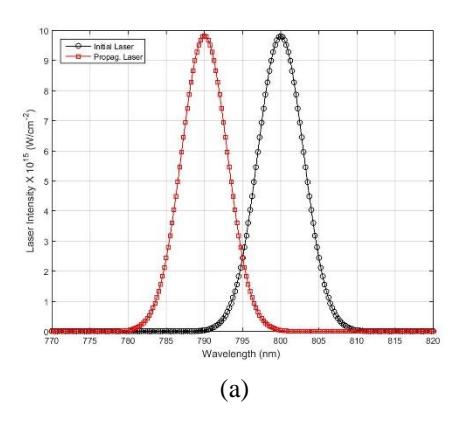
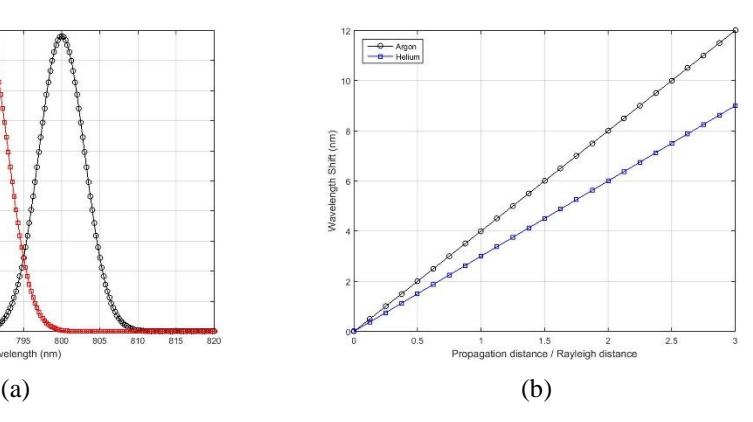
Figure 3 (a) Calculated spectra for laser pulse with an original wavelength of 800 nm in the argon plasma cell. The black peak is the incident initial laser spectrum, while the red peak is the shifted spectrum of the propagated laser beam. (b) The shift in the laser wavelength in the argon and helium plasma cells as a function of propagation distance.
Figure 4 illustrates the relationship between the harmonics intensities and the phase mismatch of the propagation length equal to 0.5 Lc δk. The harmonics intensity depends on the interaction length, or the laser propagation length, and the vector number. The harmonics intensity decreases from its maximum value with increasing propagation length. The maximum harmonics intensity is at the region of coherence length equal to zero. Then the intensity of harmonics
increases and decreases periodically in different regions relative to the coherence length. We can see that the intensity of the harmonic pulses is very low and can be neglected at integer values of the coherence length. In this case, the phase mismatch effect was very clear, because of the periodic change in the intensity of the generated pulses. Therefore, the yield of harmonics intensity is equal to zero, which means that the conversion efficiency is very low and not feasible. Figure 5(a) illustrates the ionization level of Ar plasma, He plasma, and H plasma with laser intensity. Here, the ionization rate of H plasma is still constant with increasing laser intensity. However, in the argon plasma the ionization rate increases rapidly with increasing beam intensity. The ionization levels in this model were estimated as a function to the tunnelling ionization level of hydrogen. Figure 5(b) shows the ionization level contour plots of the H, He, and Ar plasmas. At a laser light intensity < 4 × 10¹⁴ W/cm2 , the ionization level of argon was less than the ionization level of hydrogen. Meanwhile, at laser intensity value > 6 × 10¹⁴ W/cm2 , the ionization level of argon was greater than that of hydrogen at the same laser radius.
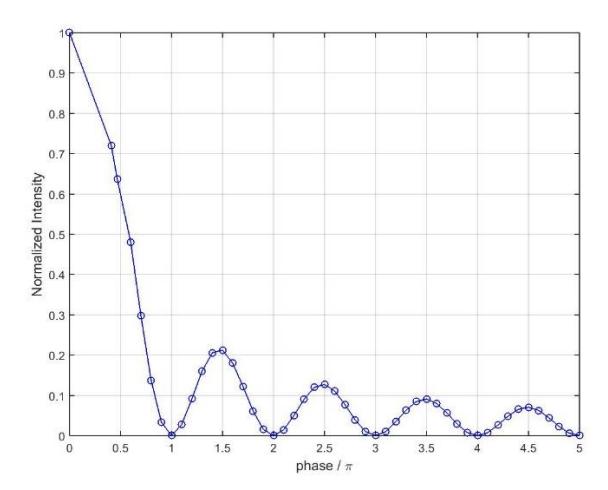
Figure 4 Harmonic intensity as a function of phase mismatch between laser and harmonics pulses. The harmonic generation was in argon plasma with an initial gas density of 1×1018 cm-3 and a laser intensity value of about 1×10¹⁵ W·cm−2 .
Full phase matching is a very ideal condition and cannot be obtained, in general, due to some effects limiting this condition, such as the effects of defocusing, the effect of absorption, and beam dispersion caused by the high ionization rate in the plasma. However, it is possible to reach a quasi-phase matching state. This case was numerically studied using two methods. The first was performed by using dual-gas-cells of argon plasmas with a high and low density, which were arranged periodically and sequentially. Accordingly, using this method, the intensity of the generated harmonics pulses was periodically modified. The gas density was changed between \(1\times 10^{17}\) cm<sup>-3</sup> and \(1\times 10^{19}\) cm<sup>-3</sup>, corresponding to removing the outer electron shell. Figure 6 presents the ionization distribution of the high- and low-density argon plasmas. Here, the beam intensity was \(1\times 10^{15}\) W·cm<sup>-2</sup> and the focal spot value of the initial beam was 15 µm. Cells with high and low ionization rates were alternated with a period equal to double the coherence length. The second method used successive cells or dual-gas-cells of argon and hydrogen gases. For hydrogen, the maximum ionization rate is 1, for helium it is 2, and for argon it is about 6. In the model, the laser beam was focused onto the center of fully ionized plasmas of hydrogen and argon, while the initial laser intensity was \(10\times 10^{14}\) W/cm<sup>2</sup>. Figure 7 illustrates the ionization profile of Ar and H plasmas organized sequentially as dual-gas-cells. In this calculation, a laser intensity of \(10\times 10^{14}\) W/cm<sup>2</sup> and a gas density of \(1\times 10^{18}\) cm<sup>-3</sup> were used. It is worth mentioning here that the ionization profile of the gas cell has the same distribution as the laser beam in the gas cell [7].
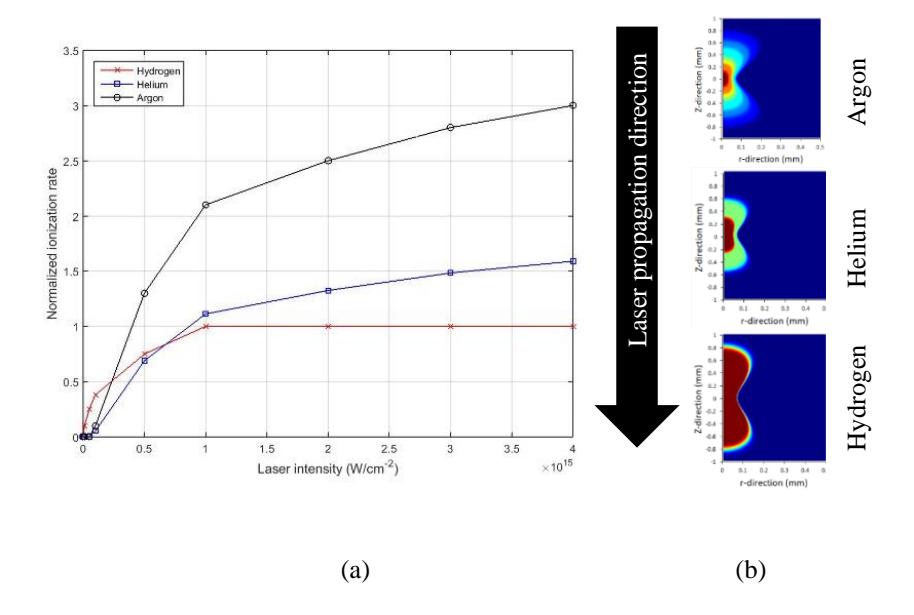
Figure 5 (a) (color online) The ionization rate of argon, helium, and hydrogen plasmas as a function of laser intensity, the initial gas density of argon was \(1 \times 10^{18}\) cm<sup>-3</sup>, and the value of the focal spot of the initial laser beam was 15 \(\mu\)m. (b) (color online) The ionization structure of argon, helium, and hydrogen plasmas.
Figure 8 illustrates the intensity of the harmonic pulses in the cells along the diffusion distance. The harmonics intensity increased in the argon plasma cell and remained constant in the hydrogen plasma cell. In the argon plasma cell, high
density plasma, the harmonics intensity increased due to constructive interference between the incident and the generated beams. However, in the hydrogen plasma cell, the destructive interference was suppressed successfully due to the low ionization rate. The harmonics intensity increased in the region of argon plasma and remained constant in the region of hydrogen plasma; no destructive effect could be found in this region. It may be possible to eliminate the emission of harmonics signals from the regions of the destructive phase. The hydrogen ionization level was about 1 unit with increasing laser light intensity. Therefore, a hydrogen gas cell can be embedded between neighboring argon cells to improve the value of phase matching. It can be seen that the increase of the harmonics was very poor or did not occur for the out-of-phase regions in phase 1 and phase 2 due to the phase matching at each coherence length.
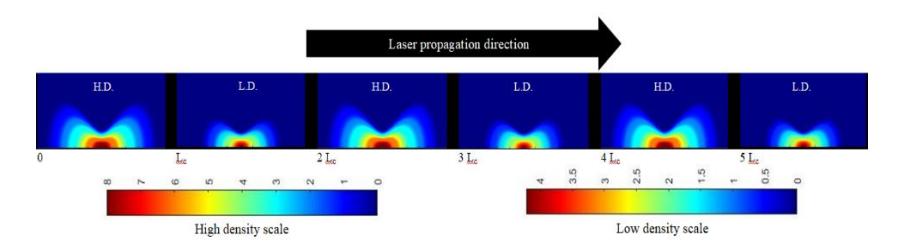
Figure 6 (color online) The ionization distribution of high- and low-density argon plasma cells.
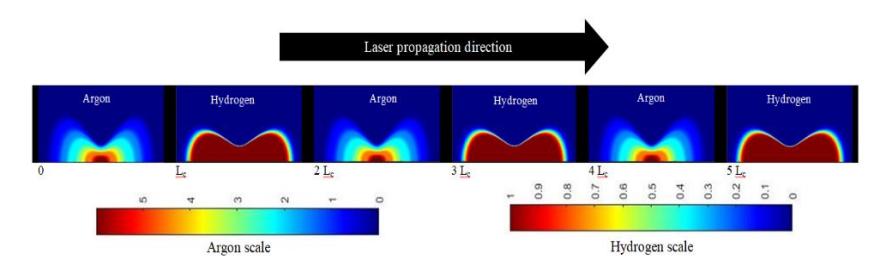
Figure 7 (color online) The ionization distribution of argon and hydrogen plasmas, dual-gas-cells were arranged periodically. The maximum ionization rate of argon is about 5.9 and the maximum ionization level of hydrogen is equal to 1.
The coherence length can be determined by the electron density and the order of harmonics by Lcoh = 1.4 × 10¹⁸(q × Ne) -1 . The value (q × Ne) should remain unchanged along the gas cells to optimize the harmonics generation in QPM medium. The periodic change of the electron density in the ionized gas cells can improve the quasi-phase-matching and consequently improve the harmonics generation. Therefore, this criterion of optimizing the intensity of harmonics generation can be performed by adjusting the density of plasma Ne and consequently the Lcoh value. In the dual-gas-cells, the harmonics generation was performed under identical conditions for the hydrogen and the argon. It is worth mentioning here that QPM was created by the low cross-section of hydrogen against the higher value of argon. Here, we used two gases with different photoionization recombination cross-sections, a high ionization rate in the argon, and a low ionization rate in the hydrogen to create an efficient QPM for harmonics generation. The harmonics generation intensity in the hydrogen cell was lower than in the argon cell. This effect can be attributed to the relatively low ionization cross-section in hydrogen. Therefore, the hydrogen cell in the quasi-phase matching structure in this model can be regarded as a passive medium to keep the harmonics conversion at a constant level.
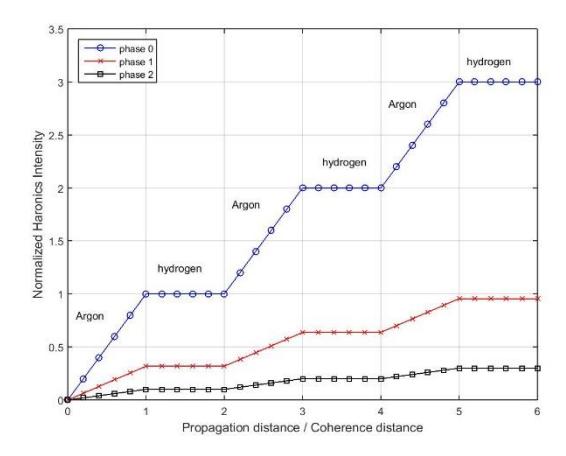
Figure 8 Normalized harmonic emission intensity as a function of diffusion path in dual-gas-cells argon and hydrogen. The initial gas density was 1×1018 cm-3 , the laser intensity was 10×1014 W/cm2 . The harmonics intensities were normalized to the maximum harmonic intensity value at L/Lc = 1.
The results presented by this model are consistent with Patil et al. [22] and Tarsem Singh Gill et al. [23] in the modulation of the laser properties and the normalized propagation path, although they used a laser beam with a cosh-Gaussian profile in their numerical analysis. Also, the data of the current model agree with the results presented by Navare et al. [24]. They used the paraxial approximation approach and the parabolic equation to describe the linear absorption of a self-focusing Gaussian laser beam. In addition, the results are consistent with numerical simulations by Pallavi Jha et al. [25], who studied the evolution of a laser spot in cold low-density plasma with a circularly polarized laser beam. The harmonics intensity results agree with the experimental results obtained by Ganeev et al. [10] and Xiaowei Wang et al., who used quasi-phasematching in dual argon and hydrogen cells with a length of 1 mm [12]. Finally, the results are also consistent with the simulation result of the harmonics intensity of QPM studied by Lewis et al. [14].
4 Conclusion
The impact of plasma-induced defocusing on a diffused laser beam was studied with the model used in this research. It was found that the beam waist diminished and increased along the propagation direction. The change in beam waist depends on the type of plasma, the focusing region, and the intensity values of the incident light. Moreover, the wavelength shift in plasma medium was also studied with the model. The wavelength shift relies on the level of ionization and the propagation distance. The impact of defocusing can minimize the generation of the new harmonics pulses. During the phase mismatch effect in the plasma medium, the energy of the generated harmonics pulses can be absorbed by the plasma. The process can be repeated after a period of a certain laser propagation distance. The phase mismatch effect occurs if the plasma is uniform along the distance of laser propagation. Here, the intensity of the harmonics pulses oscillates between the maximum value and zero. However, increasing the distance of laser propagation cannot increase the conversion to harmonics pulses. Creating a phase difference effect between the generated new pulses and the incident beam can reduce the intensity of the harmonics pulses along the propagation medium in the plasma.
In the constructive interference area of the plasma, the harmonics pulses increased efficiently, but in the region of deconstructive interference plasma, the harmonics pulses were out of phase with the laser beam and hence the harmonics pulses were very poor. The harmonic pulse had its highest value at ∆k not equal to an integer and the harmonic pulse was very low at ∆k equal to an integer. Modulation of the gas density can decrease the defocusing impact of the plasma and enlarge the intensity of the generated pulses by creating a quasi-phase matching. Two methods of quasi-phase matching were numerically studied using the model described in this work. First, dual-gas-cells of argon plasmas with a high and low density were used and dual-gas-cells of argon and hydrogen plasmas were also used. Two alternative gas cells were used, argon and hydrogen. Here, the gas cells were spatially modulated along the axis of the laser propagation. The changes in laser light propagation in the hydrogen cell differed from the laser that pre-ionized argon gas, where only one ionization step in hydrogen occurred. However, the multi-ionization steps in argon plasma were not uniform across the radial direction. Therefore, this effect can create a negative lens in argon plasma, defocusing the beam and reducing the intensity in the diffusion direction. In the region of high-density argon plasma, the harmonics intensity increased due to constructive interference in the phase velocity. However, in the region of lowdensity hydrogen plasma, destructive interference was successfully suppressed.
Therefore, the harmonics yield increased in the region of argon plasma and remained constant without any destructive effect in the hydrogen cell.
In the argon cell, the harmonics pulses grew linearly, whereas at low plasma density no growth in the pulses could be observed. However, the matching between the laser and the harmonics pulses was still constant. It is worth mentioning here that the harmonics conversion of using argon and hydrogen as dual-gas-cell was better than using high- and low-density argon plasma due to quasi-phase matching. This effect can be attributed to hydrogen's relatively low ionization cross-section compared with argon. Therefore, the periodic modulation of the ionization cross-section here was more efficient in creating harmonics signals than the periodic modulation of the plasma density. The results showed that the waveguide geometry of the dual-gas-cell can reduce the impact of laser defocusing and then improve the conversion to harmonics generation. This effect was performed by adjusting the coherence length in the gas cell with the electron density in the argon and hydrogen plasmas to create a QPM region and additionally employing two cells with high and low ionization levels to create a quasi-phase-matching medium with different harmonics yields.