

1 Introduction
Ferrite material, particularly M-type hexaferrite with the general formula MFe12O19 (M = Ba, Sr, or a Ba-Sr combination), is still attractive to many researchers because it is very applicable. At low frequencies, it has a high dielectric constant and a low dielectric loss tangent, so it is applicable in the radio frequency range [1] and as a microwave absorber [2,3]. For a microwaveabsorbent material, two conditions must be met. Firstly, it must have the same intrinsic impedance value as the vacuum, and secondly, it must have a high dielectric constant in order to weaken the interaction between the incoming electromagnetic energy and the material [4]. Thus, the microwave absorbing material must be in the medium-hard magnetic phase. An important parameter
Received April 29th, 2023, Revised August 23 th, 2023, Accepted for publication March 13th, 2024 Copyright © 2024 Published by ITB Institut for Research and Community Service, ISSN: 2337-5760, DOI: 10.5614/j.math.fund.sci.2024.55.3.1math for determining the size of the absorption ability is the reflection loss (RL) value of the absorbent material. The greater the value of reflection loss (negative value) as a function of frequency, the greater the ability to absorb microwaves of the material. Meanwhile, if the RL value = 0, it means that the material perfectly reflects the microwaves.
M-type hexaferrite, especially BaFe12O19, is a hard magnetic material, has high magnetic saturation, and a large coercivity field [5,6], so it is suitable to be applied as a permanent magnet [7]. To be able to be used as a microwave absorber, it needs to be engineered so that it still has high magnetic saturation while the coercivity field decreases so that it is in the medium-hard magnetic phase. Therefore, to increase the ability to absorb microwaves, substitutions can be carried out either on Ba [2], Fe [8], or simultaneously on Ba and Fe [3,4]. The Ti4+ ion substitution in the Fe3+ ion sample Ba0.6Sr0.4Fe12-xTixO19 has a reflection loss (RL) of ~-25 dB for the value of x = 1 [3]. If the Mn2+ ions are substituted for the Fe3+ ions, the reflection loss is about -10 dB [4].
Handoko et al. [9] obtained values of RL ~-12.67 dB and -15.49 dB by substituting Co2+ and Zn2+ ions for Fe3+ ions, while Alam et al. [10] used Zn2+ , Co2+, and Zr4+ ions to substitute the Fe3+ ions (BaZn0.5Co0.5ZrFe10O19) to obtain an RLof ~-14 dB with a sample thickness of 2.8 mm. Several synthesis methods can be used, such as sol-gel auto-combustion [11,12], synthesis via chemical route [13], solid-state reaction [8,14], and co-precipitation [15,16]. Of these methods, the solid-state reaction is the cheapest and most accessible.
From what was done in the present study, the magnetic saturation value of BaFez12O19 has Ms = 44.65 emug-1 with a coercivity field Hc = 4.51 kOe [5]. For Ba0.6Sr0.4Fe12O19, the magnetic saturation has been shown to be Ms = 76.62 emug-1 and it has an Hc coercivity field of 4.894 kOe with about 68% (-4.95 dB) of reflection loss (RL) [2] and is substituted for Ti4+ (Ba0.6Sr0.4Fe10Ti2O19), RL = -20 dB with a bandwidth (BW) of 1.2 GHz for a sample thickness of 2 mm [3], which is substituted for Mn2+ (Ba0.6Sr0.4Fe11MnO19), with a value of RL = -10 dB and BW = 0 GHz [4]. The Co and Zn substitution (BaCoZnFe10O19) with a 3-mm thick sample has a minimum RL = -15.54 dB, a BW of 0.37 GHz [8], and a composition of BaZn0.5Co0.5ZrFe10O19, with a BW of approximately 1.8 GHz and RL = -14 dB [9].
Based on the results that were obtained, a problem still remains, namely the narrow bandwidth obtained. The bandwidth is the frequency width obtained when the RL value is below -10 dB. In addition, Co is able to increase the bandwidth of the RL value, which is very significant for certain compositions. In another study, the anisotropy constant of the structure along the c-axis will be reduced by the presence of Co ions in the hexaferrite structure [17]. Therefore, there are still
challenges in decreasing the coercive magnetic force and increasing the RL value with a wide enough bandwidth.
This paper is a continuation of our previous research onBa0.6Sr0.4Fe10MnTiO19 [18,19]. In previous studies, the coercivity field of Ba0.6Sr0.4Fe10MnTiO19 was still very large, i.e., around 2990 Oe, producing an RL value of -8 dB with a bandwidth of 1 GHz. Thus, the substitution of Co2+ ions is expected to reduce the coercivity field and increase the RL value. This paper will discuss the impact of Co2+ ion substitution on the structure, magnetic magnitude and absorption capacity of microwaves (high RL and wide bandwidth) on BSFCMTO for x = 0.5, 1.0, and 1.5. The sample was processed using milling as part of the solidstate reaction procedure.
2 Experimental and Method
Stoichiometric calculations of raw materials such as BaCO3, SrCO3, Fe2O3, CoCO3, MnCO3, and TiO2 were delivered during preparation of the Ba0.6Sr0.4Fe10 xCoxMnTiO19 samples. Each of the raw materials was a product from Merck with 99% purity. This mixture of raw materials was put into a container made of stainless steel. Then, stainless-steel balls were added with the weight ratio between the material and the balls at 1: 1. The ingredients were milled for forty hours. The milling process was carried out in a wet state. Milling was carried out in stages, with every hour of milling interspersed with thirty minutes of rest. The samples were then sintered at 1000 °C for five hours. The stoichiometric calculation was based on the following reaction equation:
\[1.2BaCO_3 + 0.8SrCO_3 + (10-x)Fe_2O_3 + 2xCoCO_3 + 2MnCO_3 + 2TiO_2\]
2Ba0.6Sr0.4Fe10-xCoxMnTiO19
The M-hexaferrite type's most crucial crystal and magnetic structure is its unit cell containing four blocks of ten oxygen layers arranged sequentially as S (spinel), R (hexagonal), S*, and R*, respectively. The S* and R* blocks have the same atomic arrangement as the S and R blocks, but the arrangement is rotated 180° around the c-axis. Four O2 layers are in the S and S* blocks, each consisting of two layers. Six O2 layers are in the R and R* blocks, each with three layers. In the middle layer of the R and R* blocks, one oxygen site is replaced by Ba2+ ions. The lattice constants of the M-hexaferrite structure have lattice lengths a = 5.89 Å and c = 23.19 Å. The arrangement of oxygen and Ba atoms with Fe is in octahedral (12k, 4f2, and 2a), tetrahedral (4f1), and trigonal bipyramidal/hexahedral sites (2b) on a closed hexagonal structure. Thus, the characteristic feature of this M-hexaferrite structure is the ratio of c/a ≈ 3.98.
A Philips PW1710 X-ray diffractometer with a wavelength of 1.5406 Å was used to characterize the formed phase, crystal structure, and lattice parameters from an angel of 2 = 10 − 80 . A JEOL JED 2300 scanning electron microscope (SEM) was used to examine the surface morphology, including particle form and distribution. For magnetic characterization, a vibrating sample magnetometer (VSM) was utilized, capable of producing an external magnetic field as high as 15 kOe. In contrast, characterization of the capability to absorb microwaves was done using an Anritsu MS46322A vector network analyzer (VNA) in the frequency range of 8 to 12 GHz.
3 Result and Discussion
Henceforth, the Ba0.6Sr0.4Fe(10-x)CoxTiMnO19 samples with x = 0.1, 0.3, and 0.5, willed be called EG-01, EG-03, and EG-05, respectively. The XRD result diffraction patterns can be seen in Figure 1. The main phase of Ba-Sr hexaferrite (Ba0.6Sr0.4Fe(10-x)CoxTiMnO19) was formed and there was no visible shift in the peaks. This means that the Co2+ substitution can replace Fe3+. Co2+ substitution does not cause structural changes. All samples had a hexagonal structure (P63/mmc) and contained a tiny quantity (~ 5%) of hematite phase (Fe2O3) represented by a peak at an angle 2 = 33.2 , according to JCPDS 85-0987 [20]. The formation of the M-type structure can be seen from the parameter ratio c/a, which is less than 3.98 [2,6,10].
Table 1 presents an overview of the refining outcomes using the Rietveld program. The volume of the cells increases with the increase in the value of Co substitution. This can be explained by the ionic radius of Co2+ (0.74 Å) being greater than that of Fe3+ (0.64 Å) [21]. There is no significant change in the crystallite size after Co substitution. The Scherrer equation in Eq. (1) was used to calculate the crystalline size [5]:
\[D = k\lambda/(\beta\cos\theta) \tag{1}\] where D is the crystallite size, k is the Scherrer constant (= 0.89), is the wavelength (= 1.5406 Å), is the Full width at half maximum (FWHM), and is the Bragg angle of the peak position. From the high-intensity peaks in the diffraction pattern of each sample, the crystal size ranged from 72 to 76 nm.
The surface morphologies obtained by scanning electron microscopy (SEM) with magnification at 10,000x for samples EG-01, EG-03, and EG-05 is shown in Figure 2. Heterogeneous particle shapes and sizes are evenly distributed. The particle size ranges from 300 to 600 nm. The particle diameter was compared to the current line scales to arrive at this conclusion.
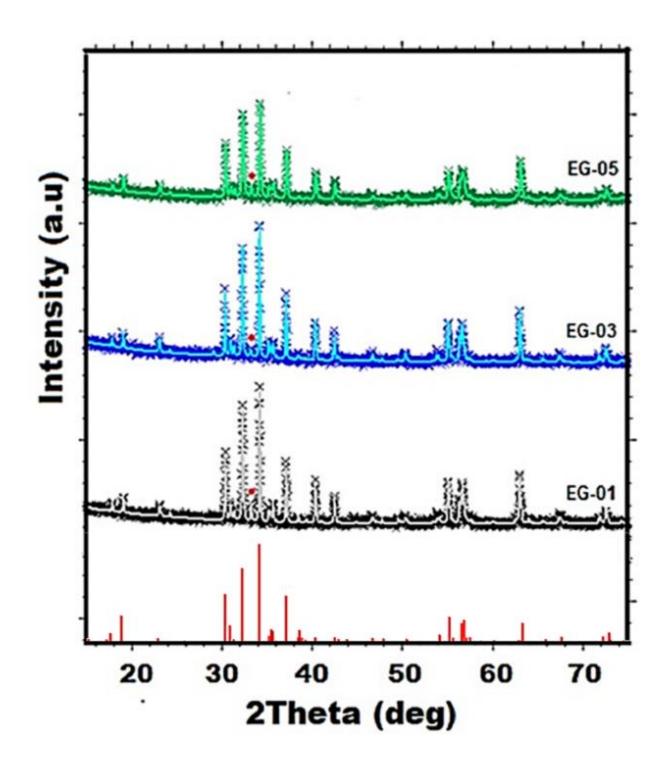
Figure 1 Rietveld refined powder XRD patterns of EG-01, EG-03, and EG-05. The red dot is the peak position of Fe2O3.
Table 1 Summary of the XRD refinement results with the Rietveld program.
| EG-01 | EG-03 | EG-05 | ||
|---|---|---|---|---|
| Space group | P63/mmc | P63/mmc | P63/mmc | |
| Cell mass | 2183.15(1) | 2183.15(1) | 2183.15(1) | |
| Cell volume (Å3 ) | 697.70(12) | 698.06(6) | 698.67(7) | |
| Crystal density (g/cm3 ) | 5.196(1) | 5.193(1) | 5.189(1) | |
| Crystallite size (nm) | 72(4) | 76(5) | 73(5) | |
| Lattice Parameters: | a (Å) | 5.8967(4) | 5.8986(2) | 5.9005(2) |
| c (Å) | 23.1601(12) | 23.1670(13) | 23.1719(14) | |
| c/a | 0.18958 | 0.18958 | 0.18958 | |
| Rexp | 3.24 | 3.17 | 3.16 | |
| Rwp | 3.50 | 3.45 | 3.58 | |
| GoF | 1.08 | 1.09 | 1.13 |
There appears to be agglomeration, which is thought to be due to magnetic interactions between particles [10]. All samples can be categorized as having a single-domain-wall structure because the mean particle size was smaller than the 650 nm critical size [21]. The porosity increases as the content of Co2+ increases.
This is related to the crystal volume of XRD results, where the radius of the Co2+ ions is greater than that of the Fe3+ ions, causing the crystal density to decrease.
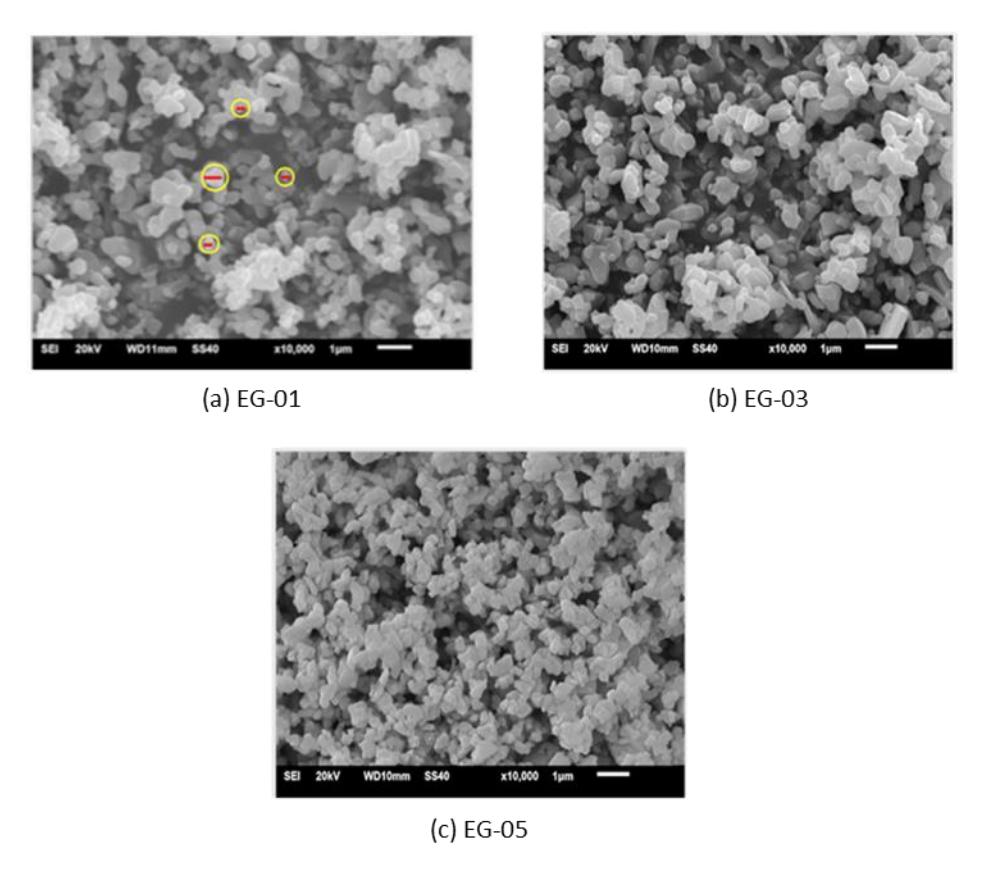
Figure 2 SEM results for samples (a) EG-01, (b) EG-03, and (3) EG-05 displaying the surface morphology.
A test on the magnetization properties was carried out at room temperature. The magnetic properties obtained in relation to the external magnetic field are represented by M-H hysteresis loops. The hysteresis curves of samples EG-01, EG-03, and EG-05 can be seen in Figure 3. The saturation, remanence, and coercivity of magnetic of all samples can be seen in Table 2. The larger cobalt Co2+ ion substitution reduces its magnetic magnitude, both Ms magnetic saturation, Mr magnetic remanence, and Hc coercivity. This is because the magnetic dipole moment for Co2+ ions (~ 3 µB) is smaller than for Fe3+ ions (~ 5 µB) [10, 22]. In addition, the decrease in Ms magnetic saturation is also due to the presence of the α-Fe2O3 phase, which is non-magnetic [21].
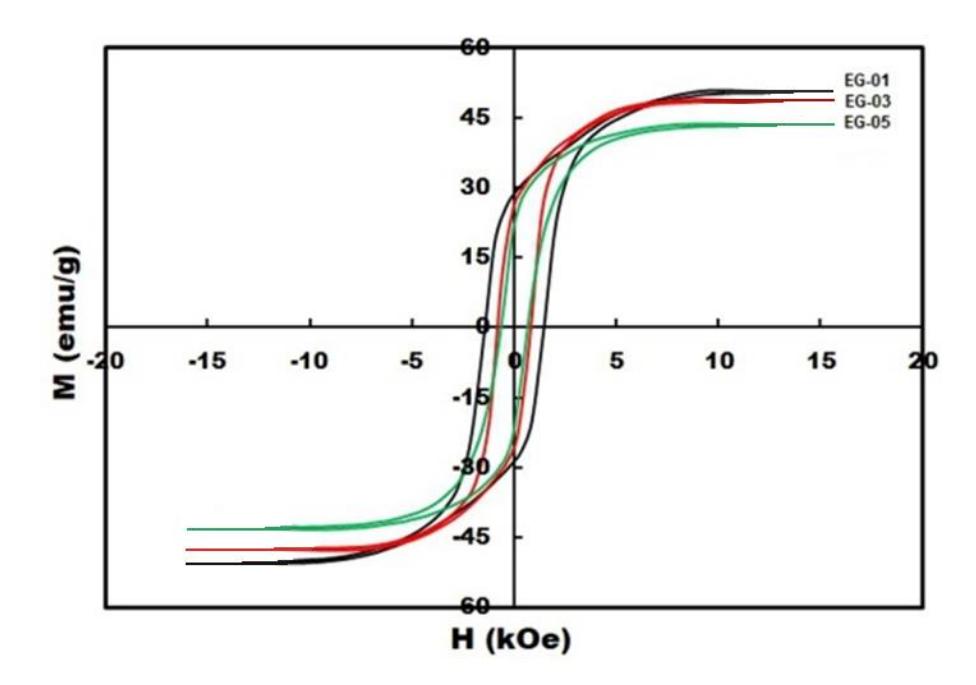
Figure 3 Magnetization hysteresis curve at room temperature for the sample Ba0.6Sr0.4Fe(10-x)CoxTiMnO19 with x = 0.1 (EG-01), 0.3 (EG-03), and 0.5 (EG-05), respectively.
Table 2 Magnetic saturation and coercivity of Ba0.6Sr0.4Fe(10-x)CoxTiMnO19 sample.
| Sample | Ms (emug-1 ) | Mr (emug-1 ) | Hc (kOe) |
|---|---|---|---|
| EG-01 | 50.55 | 28.57 | 1.50 |
| EG-02 | 48.85 | 26.01 | 1.20 |
| EG-03 | 43.56 | 25.58 | 1.01 |
Figure 3 shows a change in magnetic properties from hard magnetic [18,19] to softer magnetic. It appears that the magnetic coercivity field changes as well as the saturation magnetization are decreasing, which shows a tendency to decrease with the rise of the concentration of Co2+ doping ions in the material. In this experiment, refinement of the cationic distribution was not carried out, which can determine which sites are occupied by Co2+ ions. However, in this case, it is assumed that Co2+ ions occupy a portion of all Fe3+ sites, so that the reduction in magnetic properties is only determined based on the reduced number of magnetic dipole moments due to differences in the Bohr magneton content between Fe3+ and Co2+ .
The role of Co2+ ions is thought to be able to stimulate the growth of magnetic domains. This assumption was supported based on the results of X-ray diffraction pattern analysis, which showed that the value of the c-lattice parameter appears to increase with increasing Co2+ ion concentration, causing a decline in the value of anisotropy along the c-axis [23-26]. The magnetic domain is an area in a magnetic material where the magnetization is uniformly oriented. This means that the individual atoms have magnetic moments in parallel with each other in the same direction.
The materials' magnetic behavior is attributed to the structure of the magnetic domain. The crystal lattice of most magnetic materials has magnetic anisotropy, meaning that they have a direction of magnetization that is easily parallel to one of the crystal axes. In order to change the magnetization of the material in another direction, additional energy is required, which is referred to as magneto crystalline anisotropy energy. Based on the characteristics of the magneto crystalline anisotropy, in M-hexagonal ferrite, the plane on the crystallographic a-b axis is the hard-axis, and the crystallographic c-axis is known as the easyaxis. The intrinsic magnetic properties of these materials are completely dependent on the distribution of cations at the crystallographic sites. That is, the intrinsic properties of the magnetic material can be adjusted by adjusting the distribution of cations at the crystallographic site.
The explanation of which site is occupied by the Co2+ ions in substitution to Mtype hexaferrite is still subject of discussion. The presence of cations in Fe3+ ions (4f2/spin-down) results in an increase in the number of Fe3+ ions (spin-up), as per the results of previous studies using spin-orbit interaction (SOI) to calculate the electronic structure between Fe2+ ions and O2 ions that form clusters [27]. Additionally, the magnetic dipole moment for Co2+ ions is smaller than that of Fe3+ ions. This ion substitution tends to be at the tetrahedral site (4f1) [27,28], thereby weakening the super-exchange interaction between the octahedral and tetrahedral sites.
The Co2+ ions occupy two sites, namely 2a (spin-up) and 4f2 (spin down) [7], while the Fe3+ ions in the M-type hexaferrite occupy five sites, namely 12k, 2a, and 2b (spin-up) and 4f1 and 4f2 (spin-down) [14,27,29]. The magnetic moments of ions both spinning down and spinning up at the octahedral and tetrahedral sites cause this change, which is highly dependent on the Fe3+– O2- – Fe3+ [28] superexchange interaction. In general, the distribution of spin-up orientations is at 6 Fe3+ octahedral-site ions (12k and 2a) and 1 Fe3+ bipyramid ion (2b), while 2 Fe3+ ions are oriented to spin down at the tetrahedral (4f1) and octahedral (4f2) sites.
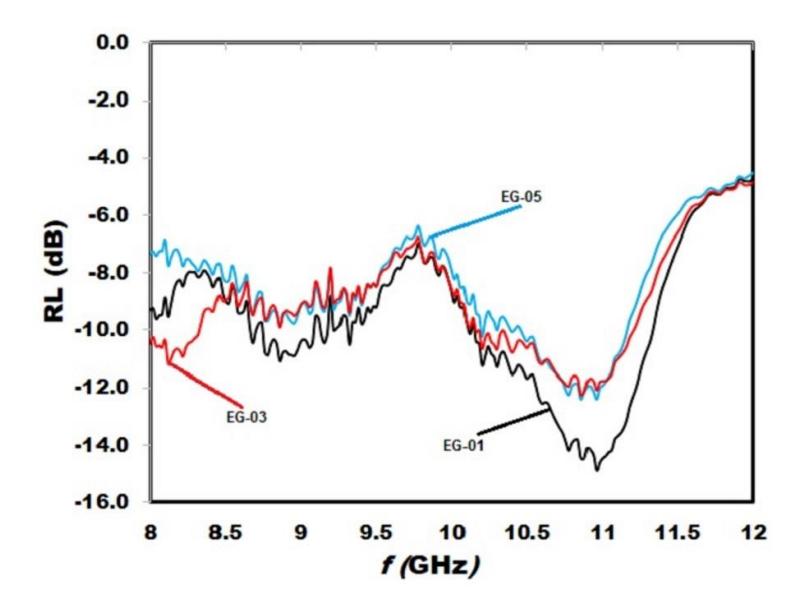
Figure 4 Frequency-dependent (f) reflection loss (RL) curves for samples EG-01, EG-03, and EG-05 at a frequency of 8 to 12 GHz.
Reflection loss (RL) is an indicator of microwave absorption. The value of RL (dB) is expressed by Eq. (2) [30]:
\[RL(dB) = 20 \log|(Z_{in} - 1)/(Z_{in} + 1)|\] (2)
with \(Z_{in}\) as the input impedance normalized by Eq. (3).
\[Z_{in} = \frac{Z_i}{Z_o} = \sqrt{\frac{\mu_r}{\varepsilon_r}} \tanh(\frac{j2\pi\sqrt{\mu_r\varepsilon_r}}{c}fd)\] (3)
Where \(Z_i\) represents the input impedance, \(Z_o\) the impedance of free space, d the thickness of the absorber, \(\mu_r\) the relative permeability, \(\epsilon_r\) the relative permittivity of the medium, and f and c the frequency and velocity of electromagnetic waves in a vacuum, respectively. If \(Z_i = Z_0\), then there will be an ideal condition because the microwaves are completely absorbed.
The frequency-dependent reflection loss (RL) for samples EG-01, EG-03, and EG-05 in the frequency range of 8 to 12 GHz is shown in Figure 4. In Table 3, the VNA measurement results for a sample thickness of 1 mm are written in detail. The best results were obtained for the EG-01 sample with a minimum RL value of -14.89 dB at a frequency of 10.96 GHz and a bandwidth of 1.24 GHz. The results with this Co<sup>2+</sup> ion substitution were better than those obtained
previously, with a sample thickness of 2 mm and a particle size of 20 to 30 nm for a silicon rubber composite with 20% Ba0.6Sr0.4Fe10MnTiO19 filler, i.e., RL = -15 dB, 1 GHz bandwidth [31]. The results obtained by a larger bandwidth (Sözeri et al. [32]), amounted to 4 GHz, but the value of RL was ~-10 dB with a sample thickness of 2 mm for the BaFe10MnTiO19 sample. The thickness of the sample influenced the RL value during the test and the processing temperature sintering of the material. A sample thickness of 2 mm and a sintering temperature of 800 °C, BaFe10CoNiO19, RL = -14.47 dB, was better than a sintering temperature of 600°C, RL = - 12 dB [33]. Thus, several factors affect the RL value, namely composition, sample thickness, and sintering temperature, which affect the particle size. It is known that the EG-01 sample with a thickness of 1 mm had better absorption compared to the results obtained from previous studies, which had a thickness of 2 mm. According to Eqs. (2) and (3), the absorption of microwaves is proportional to the thickness of the sample. However, in this study, it was found that with a thinner thickness, a higher absorption was able to be produced.
Table 3 Summary of microwave absorption result in the 8 to 12 GHz frequency range.
| Sample | RL (dB) | f (GHz) | BW (GHz) |
|---|---|---|---|
| EG-01 | -14.89 | 10.96 | 1.24 (-10 dB) |
| EG-03 | -12.39 | 10.86 | 0.80 (-10 dB) |
| EG-05 | -12.24 | 10.86 | 1.08 (-10 dB) |
This indicates, then, that the barium hexaferrite crystal structure with a composition of x = 0.1 is the ideal composition to provide the most optimal microwave absorption when Co2+ ions are partially substituted for Fe3+ ions. This significant absorption is caused by remanent magnetization at its ideal value, a drop in the coercivity field Hc, and a decline in the anisotropic field along the c axis [25,26]. This is because the movement of the domain walls and the rotation of the magnetization and spin resonance are easier with the presence of Co2+ ions [23-26,28].
4 Conclusion
For x = 0.1, 0.3, and 0.5, the lattice volume rises when Co2+ ions are substituted for Fe3+ ions (BSFCMTO), but the crystal structure remains the same. Each sample is hexagonally structured and the space group is P63/mmc. Because of the substitution of Co2+ ions, the magnitude of magnetic saturation and remanence as well as the coercivity field was reduced. According to these results, this Mhexaferrite type can be applied as a microwave absorber. The best RL value was -14.89 dB, with the f at 10.96 GHz with a bandwidth of 1.24 GHz.
Acknowledgement
This research was funded by the Menristek-Dikti through a Higher Education Basic Research Contract for the 2021 Budget Year with the contract number: 297/LPPM-UPH/IV/2021, in accordance with the Research Grant Implementation Assignment Agreement Letter Number 1218/LL3/PG/2021, April 1, 2021, through the Primary Research Scheme for Higher Education Fiscal Year 2021.