

1 Introduction
Chemical modification of superhydrophobic surfaces has become a popular research topic and has great application potential in daily life, notably in textiles and clothing for protection against the elements [1]-[12]. Such surfaces repel water with contact angles larger than 150° and the water rolls off easily when the surface is inclined to less than 10° [13],[14]. Nature, particularly the plant kingdom, make use of this particular ability for protection, inspiring the so-called "lotus effect" that was used for the first time when Wilhelm Barthlott and Ehler described the self-cleaning and ultrahydrophobic properties of micronanostructured surfaces in a paper published in 1977 [15],[16]. In general, low surface energy and a degree of roughness (micro to nano) on the surface of materials are important characteristics of superhydrophobic surfaces [17].
Yamamoto et al. [18] demonstrated this concept by reverse engineering. They removed the wax by dipping a lotus leaf in ethanol and evaluated the results and effects of the removal. The water contact angle decreased significantly from 161° for the original surface to 122° for the ethanol-treated leaf. Fractal analysis showed that the untreated original surface of the lotus leaf is divided into two fractal regions, which comprise a smaller-sized roughness region of 0.3 to 1.7 μm with a larger fractal dimension of D = 1.48 and a larger roughness region of 1.7 to 19 μm with a smaller fractal of D = 1.36. Dipping the leaf in ethanol led to the removal of the region with larger D, which is characterized by wax tubes, and left only the smaller D region. This analysis is in line with a dual-scaled model of the hierarchical structure on superhydrophobic surfaces [11],[14],[19]-[22].
Cotton is still the number one material of choice for clothing because it easily absorbs moisture/sweat and provides comfort. However, there are situations where water repellent and quick-drying properties are needed along with the comfort offered by cotton, particularly for sportswear and medical textiles (e.g. surgical gowns), which leads to the need for the modification of the cotton's surface properties from hydrophilic to hydrophobic and even superhydrophobic. Fluorochemical compounds, collectively known as PFAS (per- and polyfluoroalkyl substances), have long been primary choice and are regularly used for high-performance water repellent textiles. However, under strict regulations, out of environmental and consumer safety concerns, the use of PFAS has been banned in many countries. In the textile industry, these chemicals are known collectively as C8 (perfluorooctanoic acid or PFOA and perfluorooctane sulfonate or PFOS) and C6 (perfluorohexanoic acid or PFHxA). Finding substitute chemicals that are safe and still provide the same functionality is not an easy task, but alternative chemicals and different strategies are available.
Recently, a considerable interest has risen in the use of silica nanoparticles to produce nanostructured surfaces for strong water repellence in textiles [6],[23]- [31]. However, only a few studies were concerned with silica nanoparticles from rice husk ash (RHA), which is a form of agricultural waste and is abundantly available in Indonesia [32],[33]. Borah et al. obtained water contact angles of 101.7° on eri silk [24] and 145° on eri silk/wool fabrics [23] from the treatment with RHA nanosilica. Tavakoli et al. [25] obtained a water contact angle of 140° for cotton fabric treated with RHA nanosilica.
Inspired by the presence and role of nanostructured wax on the lotus leaf, researchers have studied and explored the use of waxes, including those from natural origin, to create a surface with low surface energy. Bashari et al. [34] reported the use of carnauba wax nanoparticles (CNP) from the carnauba palm tree (Copernicia prunifera) together with chitosan for a water repellent finishing of cotton fabrics. Five bilayers of CNP/chitosan produced a surface with a water contact angle of 130.9° before washing and 101.7° after washing. Forsman et al. [35],[36] obtained water contact angles of 138-152° on cotton fabrics by using two bilayers of carnauba wax and poly-L-lysin (PLL). By using a combination of carnauba wax and alkyl-silane modified (hydrophobic) silica nanoparticles Celik et al. [37] obtained a water contact angle of 175° with a sliding angle of 3° on a glass surface, thus creating a superhydrophobic surface. The hydrophobotization was carried out via silanization of silica nanoparticles by dodecyltrichlorosilane prior to the deposition, which turned the nanoparticles from hydrophilic to hydrophobic (Figure 1).
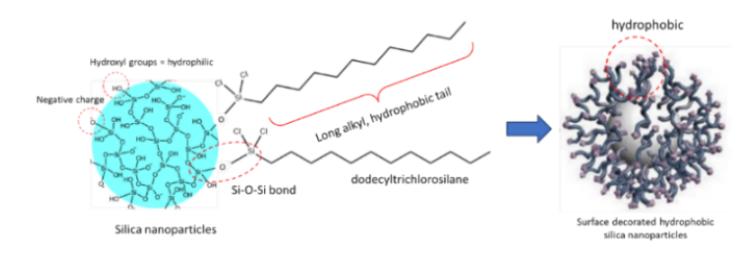
Figure 1 The silanization of silica nanoparticles by dodecyltricholorosilane.
In this study, based on the works of Bashari et al. [34], Forsman et al. [35],[36] and Celik et al. [37], a safe and environmentally alternative approach using a combination of silica nanoparticles, chitosan, and carnauba wax is presented. The study showsthe feasibility of LBL self-assembly deposition for use in the existing textile processing method (pad-dry) of superhydrophobic finishing of cotton fabric. The wetting properties, washing durability, and comfort aspects of the fabric were evaluated as a function of the number of coatings or layers seeking for its practical application in the industry.
2 Experimental Section
2.1 Materials
100% cotton fabric (100 g/m2 , 43 ends/cm 39 ends/cm, Ne1 30s) was donated by the Laboratory of Textile Printing and Finishing at Politeknik STTT Bandung. The fabric was ready for dyeing/printing, which means it had been through the process of desizing, scouring, and bleaching.
RHA silica nanoparticles were produced and donated by the Centre of Research for Post Harvest at the Ministry of Agriculture in Bogor, Indonesia. The silica nanoparticles were amorphous with an average crystallinity degree of 58.5% and a bulk density of 0.67 to 0.81 g/mL, and had particle sizes in the range of 25.1 to 40.6 nm [38].
Carnauba wax (CAS Number: 8015-86-9) and Tween 80 (polyoxyethylene-20 sorbitan monooleate, CAS No. 9005-65-6) nonionic surfactant were purchased from Sigma-Aldrich (Singapore). Rucoperse NPA is a polymeric dispersing agent based on acrylic acid homopolymer and was donated by Rudolf-Chemie Indonesia (Bandung, Indonesia). Food-grade chitosan with a deacetylation degree of 80% was purchased from Bio Chitosan Indonesia (Surabaya, Indonesia).
2.2 Methods
The general methodology employed in this research was as follows. The cotton fabric was first grafted with chitosan for surface cationization and then immersed successively in the dispersion of RHA silica nanoparticles (SNP), solution of chitosan (CHI), and dispersion of solid carnauba wax (SCW), creating a SNP/CHI/SCW trilayer on the chitosan grafted cotton (Figure 2). To create the next SNP/CHI/SCW trilayer, the cotton fabric was first immersed in chitosan prior to each layer in the repeating order of SNP, CHI, and SCW. Chitosan is required to provide a cationic bridge between each of the layers.
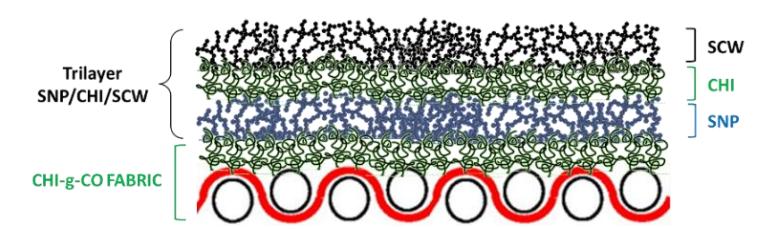
Figure 2 The layer structure of silica nanoparticles (SNP), chitosan (CHI), and solid carnauba wax (SCW) on the surface of chitosan-grafted-cotton fabric (CHIg-CO).
2.2.1 Preparation of Chitosan Solution (CHI)
Chitosan solution was prepared by stirring a dispersion of chitosan flakes (8.0 g) in 400 ml of 2% (v/v) aqueous acetic acid solution at pH 4 for 1 h at 60 °C. Two such solutions were prepared: one for the grafting of chitosan onto cotton fabric, the other for the layer-by-layer (LBL) deposition of silica nanoparticles and carnauba wax.
2.2.2 Preparation of Solid Carnauba Wax Particles (SCW)
SCW was prepared by the organic solvent-free method described by Bashari et al. [34]. Principally, the wax was heated to melting and then dispersed with the use of surfactant to form a stable emulsion of solid lipid particles in the submicron range (Figure 3). Firstly, 0.3 g of carnauba wax was put into a 250-mL beaker glass and heated in a water bath above its melting temperature at 90 °C. Separately, the polyoxyethylene-20-sorbitan monooleate (Tween 80) surfactant was added to 10 mL of water under magnetic stirring at 90 °C for 2 min, which was then transferred to the molten carnauba under magnetic stirring at 90 °C until the formation of a white mixture. To obtain a stable and fine emulsion, the mixture was sonicated in a sonication bath (Bransonic ultrasonic cleaner, Branson 2510EMTH) at a frequency of 30 KHz and 100 W power for 4 min. The obtained emulsion was poured under mild magnetic stirring into 100 mL of cold water (2- 5 °C) and then stirred for 3 min to facilitate the solidification of lipid nanoparticles. Lastly, the mixture was homogenized by ultrasonic homogenizer (Bandelin SONOPULS Digital Ultrasonic Homogenizer) at 20 W power in a pulse regime of 10 seconds on and 5 seconds off for 60 seconds. Extra water was removed by using a centrifuge at 6000 rpm 4 times for 15 min to obtain a more concentrated SCW suspension.
Figure 3 Step-by-step preparation of the solid carnauba wax.
2.2.3 Preparation of Dispersion of Silica Nanoparticles (SNP)
Alkali (NaOH) was added to 500 mL of water to adjust the pH to 11, where silica nanoparticles are negatively charged and repel each other, followed by the addition of 4 mL of Rucoperse NPA. 4.0 g (2 g/L) dispersing agent to RHA silica nanoparticles under magnetic stirring until a stable dispersion was obtained.
2.2.4 Grafting of Chitosan onto Cotton Fabric using Sodium Periodate
The grafting of cotton with chitosan follows the methods described by Ramadan et al. [40] and Winiati et al. [41]. A solution of 100 mL containing 50.0 g sodium periodate (NaIO4) (0.5 mg/ml) was added to the solution of chitosan prepared in 2.1.1, making up a 500-ml solution of chitosan and sodium periodate. Cotton fabric samples measuring 30 cm x 30 cm (approximately 9 g) were dipped in the solution of chitosan at 60 °C with constant stirring for 2 h. The samples were subsequently washed three times with Tween 80 (2 g/L) in deionized water, followed by soaking for 24 h in 500 mL of deionized water with constant stirring at ambient temperature to remove ungrafted chitosan from the cotton fiber surface and make sure that the grafted chitosan became durable to washing. The samples were then dried under vacuum at 60 °C for 6 h to produce chitosan grafted cotton fabric (CHI-g-CO in Figure 2).
2.2.5 Layer-by-Layer Deposition of Silica Nanoparticles and Carnauba Wax
The chitosan grafted cotton (CHI-g-CO) fabric was first dipped in a solution of HCl 0.1 N (pH 3.5) for 5 minutes, which was followed by drying in an oven at 60 °C for 15 minutes. The dried cotton fabric samples were alternately dipped for 5 minutes in a dispersion of silica nanoparticles (2.1.3), solution of chitosan (2.1.1), and aqueous solution (2% w/v) of carnauba wax (2.1.2). The fabrics were impregnated with a wet pick up (WPU) of 100% after each dipping procedure and subsequently dried in an oven at 70 °C for 15 min. This sequence of processes (Figure 4) was repeated to obtain two and three trilayers of SNP/CHI/SCW on each sample as shown in Table 1.
| Sample Code | Description |
|---|---|
| CHI-g-CO | Chitosan-grafted cotton fabric |
| SNP/CHI/SCW(1) | Cotton fabric coated with 1 layer of SNP/CHI/SCW |
| (silica nanoparticles/chitosan/ solid carnauba wax) | |
| SNP/CHI/SCW(2) | Cotton fabric coated with 2 layers of SNP/CHI/SCW |
| (silica nanoparticles/chitosan/ solid carnauba wax) | |
| SNP/CHI/SCW(3) | Cotton fabric coated with 3 layers of SNP/CHI/SCW |
| (silica nanoparticles/chitosan/ solid carnauba wax) |
Table 1 Sample description and codes (n = 3).
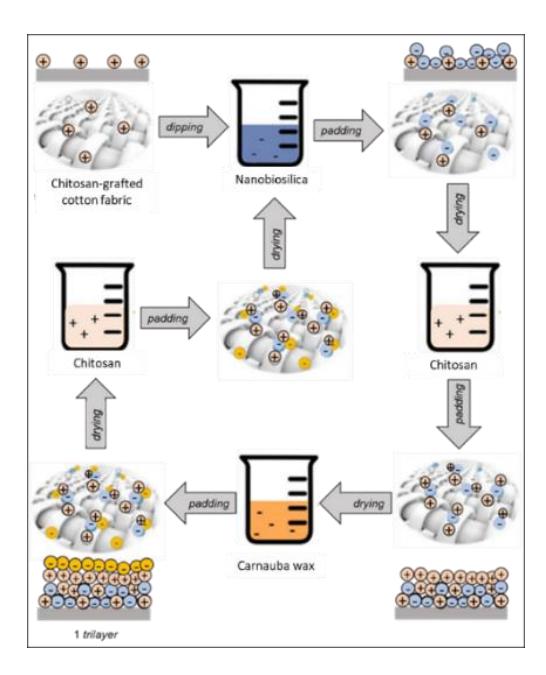
Figure 4 The LBL deposition of SNP/CHI/SCW trilayers onto chitosan-grafted cotton fabric samples.
2.3 Characterization of Treated Fabric
2.3.1 ATR-FTIR Spectroscopy
Attenuated total reflectance Fourier-transform infra-red (ATR-FTIR) spectroscopy was carried out on a IRAffinity-1S Shimadzu to identify the characteristic functional groups on the surface of the treated cotton fabric samples. Measurements of the fabrics were done with 32 scans and a resolution of 4 cm-1 .
2.3.2 Water Repellence Measurements
The water repellence of the treated samples was evaluated by the spray test method according to SNI ISO 4920:2012 (Figure 6), which is an Indonesian national standard adoption of ISO 4920:2012 Textile fabrics – Determination of resistance to surface wetting (spray test) and is similar to the AATCC Test Method 22 Water repellence test (spray method). In principle, under the specified conditions and procedures, water is sprayed through a funnel on a tight sample to form a wetting pattern on the surface, the size of which is related to the water repellence of the fabric (Figure 5). The evaluation result is determined by comparing it with a standard pattern (Figure 6). Higher ratings indicate greater water repellence.
Additionally, the water repellence was also quantified by measurement of the contact angle (CA) (Kyowa Contact Angle Goniometer DMs-401, Centre of Textile Research, Bandung). The static contact angle was measured by placing a droplet (5 µL) of deionized water on at least three positions on each sample. An image of each drop was taken with a 15-s delay after the drop. From the shape of the drop, the CA was analyzed and determined using the Low-Bond Axisymmetric Drop Shape Analysis (LBADSA) [42],[43] plugin for ImageJ, a free image analysis software package.
Figure 5 Spray test apparatus (left) and spray testing of fabric (right).
Figure 6 Standard spray test rating SNI ISO 4020:2012.
2.3.3 Air Permeability
Air permeability was measured following the ASTM D737-18(2023) Standard Test Method for Air Permeability of Textile Fabrics using an air permeability tester (Testex). The results were expressed in the amount of air (cm3 ) that penetrated and went through the fabric across a given area (cm2 ) in a unit of time (s) and also in terms of air permeability reduction according to Eq. (1):
Air permeability reduction (%) \[\frac{A_{U}-A_{LBL}}{A_{U}} X 100\] (1)
where AU and ALBL are the air permeabilities (cm3 /cm2 /s) of the untreated and the LBL samples, respectively.
3 Results and Discussion
3.1 FTIR Analysis: Surface Chemical Properties
Figure 7 shows the ATR-FTIR spectra of the untreated and the treated cotton fabrics (after grafting of chitosan and LBL deposition of SNP and SCW). For the untreated cotton fabric (Figure 7a), peaks characteristic of -OH groups were found at 3,336 cm-1 and 1,030 cm-1 in the cotton structure. It must be noted, however, that these two peaks can be seen in all other spectra because -OH groups are present in chitosan, silica nanoparticles (in the form of silanol), and in carnauba wax.
Figure 7(b) shows the spectrum of the cotton fabric after being grafted with chitosan as described in Sub-section 2.1.4. As shown in Figure 8, cotton undergoes ring opening via oxidation by NaIO4, leading to the formation of aldehyde (II), which is then available for the formation of a chemical bond with the amine (-NH2) groups of the chitosan (III) forming a Schiff base (-C=N). On chitosan grafted cotton fabric, the expected characteristic absorption band of chitosan must come from the Schiff base C=N double bond at 1,690 to 1,640 cm-1 . Closer examination of that area of the spectrum revealed an absorption band that constituted stretching of C=N at 1,684 cm-1 . Some of the aldehyde groups must still have been available so that the spectrum shows a peak that represents C=O stretching at 1,716 cm-1 . The FTIR spectrum of the chitosan grafted cotton after the deposition of silica nanoparticles (SNP) is shown in Figure 7c. The OH stretching vibrations of the SiOH group absorb in the same region as alcohols, 3,700 to 3,200 cm-1 . Strong Si-O bands are present in the region 830-1,110 cm-1 [6],[44]-[46]. Riaz et al. [6] observed two sharp peaks at 1,094 cm-1 and 807 cm-1 that correspond to symmetric and asymmetric stretching vibrations of Si–O–Si in cotton fabric treated with silica nanoparticles. As shown in Figure 7c, a peak corresponding to Si-O appears at 1,055 cm-1 in the treated chitosan grafted cotton.
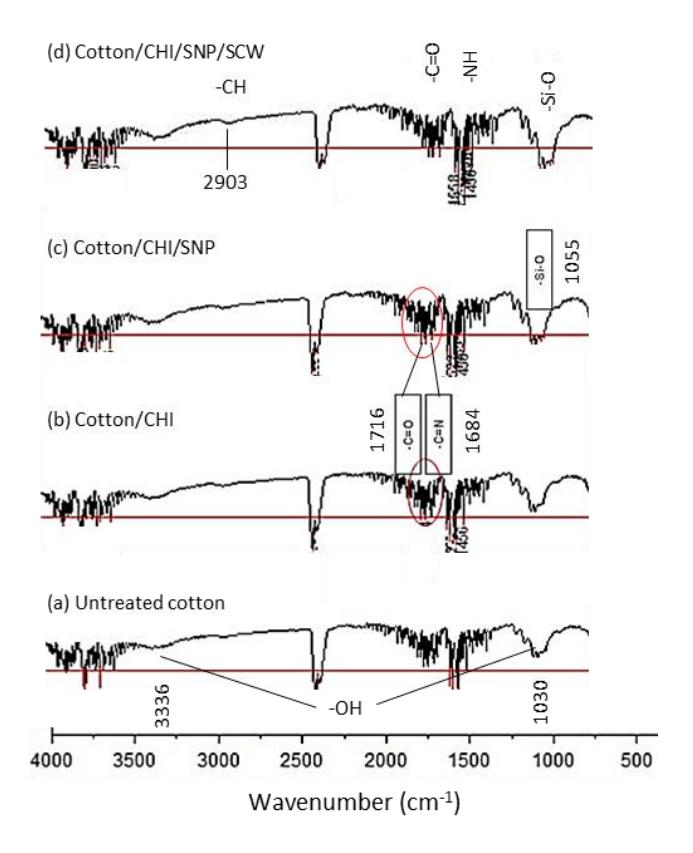
Figure 7 ATR-FTIR spectra of the untreated and the treated cotton fabric by LBL deposition of chitosan (CHI), silica nanoparticles (SNP), and carnauba wax (SCW).
Figure 8 The oxidation of cotton by NaIO4 (II) and grafting with chitosan (III) [47].
Carnauba wax is a mixture of at least three groups of long hydrocarbon compounds. The composition consists primarily of 80-85% C24 and C28 esters, 10-15% C32 and C34 straight-chained primary alcohols, and 3-6% hydroxy-fatty acids [34],[48]. Main spectral features of esters with a carbonyl (C=O) stretching at 1,735 cm-1 and C-C(=O)-O stretching at 1,165 cm-1 can be identified as the characteristic spectra of carnauba wax, whereas the peak at 1,604 cm-1 indicates the presence of carboxylate [46]. Additionally, the methylene vibration at 2,916 cm-1 and 2,848 cm-1 (stretching), 1,472 cm-1 and 1,463 cm-1 (scissoring), 729 cm-1and 719 cm-1 (rocking) are also present [48].
According to the scheme in Figure 2, the topmost layer of the treated cotton samples must be carnauba wax. Therefore, two strong peaks from methylene at 2,916 cm-1 (vibration) and at 2,848 cm-1 (stretching) should be visible in Figure 7. Close examination of the spectrum in Figure 7d reveals an almost unnoticeable but pronounced (compared to the other three spectra in Figure 7) presence of a weak peak of methylene vibration only at 2,903 cm-1 , confirming the presence of carnauba wax.
3.2 Water Repellence and Air Permeability
Table 2 shows a series of black-white images obtained from the greyscale images of the spray tests of the chitosan grafted cotton coated with different numbers of SNP/CHI/SCW trilayers. The black color within the circle boundary (the hoop diameter) represents the water pattern on the fabric after spraying. Increasing the number of coatings or SNP/CHI/SCW trilayers from one to three increased the water repellence rating of the unwashed samples from 70 to 90, which is normally expected from a good water-repellent finish. However, after washing (2.2.4), the rating dropped to 50 for all fabrics, which raises questionsregarding the durability of the treatment in relation to washing. However, the water repellence in terms of water contact angle (Table 3) was much more promising, with contact angles of 137.43°, 142.56°, and 152.19° before washing and 129.61°, 132.81° and 140.17° after washing for 1, 2 and 3 SNP//CHI/SCW trilayers, respectively.
The general consensus is that superhydrophobic surfaces must have a water contact angle > 150°. However, in a study that redefined the basic terminology in surface wetting, Law [49] proposed a lower threshold. A surface is superhydrophobic when its water contact angle is ≥ 145°. This is when the surface has practically no affinity with water. The water contact angle obtained from the three layers of SNP/CHI/SCW (140.2°) is close enough to the proposed new threshold showing a promising result toward superhydrophobicity. The most promising route to increase the contact angle is by adding more layers. However, even with three layers, the air permeability of the fabric was already reduced by as much as 31.44% from 19.42 cm3 /cm2 /s for the untreated cotton to 13.30 cm3 /cm2 /s for the treated cotton (Figure 9). Besides, as shown by Bashari et al. [34], the deposition of layers increases the fabric stiffness, which is not desirable.
Table 2 Results from spray tests of untreated and treated cotton fabrics.
| Number of Coatings | ||||||||
|---|---|---|---|---|---|---|---|---|
| Before/After Untreated Fabric SNP/CHI/SCW(1) SNP/CHI/SCW(2) SNP/CHI/SCW(3) Washing | ||||||||
| SPRAY TEST | ||||||||
| Before | ||||||||
| 0 | 70 (ISO 2) | 80 (ISO 3) | 90 (ISO 4) | |||||
| After | ||||||||
| 0 | 50 (ISO 1) | 50 (ISO 1) | 50 (ISO 1) | |||||
Table 3 Contact angles of treated cotton fabrics.
| Number of Coatings | |||||||||
|---|---|---|---|---|---|---|---|---|---|
| Before/After Washing | Untreated Fabric | SNP/CHI/SCW(1)SNP/CHI/SCW(2)SNP/CHI/SCW(3) | |||||||
| WATER CONTACT ANGLE (O ) | |||||||||
| Before | |||||||||
| 0 | 137.43 0.32 | 142.56 0.63 | 152.19 0.23 | ||||||
| After | |||||||||
| 0 | 129.61 0.79 | 132.81 0.88 | 140.17 0.25 | ||||||
Therefore, adding more layers beyond three in this particular case does not seem to be the solution for a larger contact angle of at least 145°. At this point, although not quite superhydrophobic by the formal definition, it is safe to conclude that the treated cotton fabric was in the transition region from high hydrophobic to superhydrophobic.
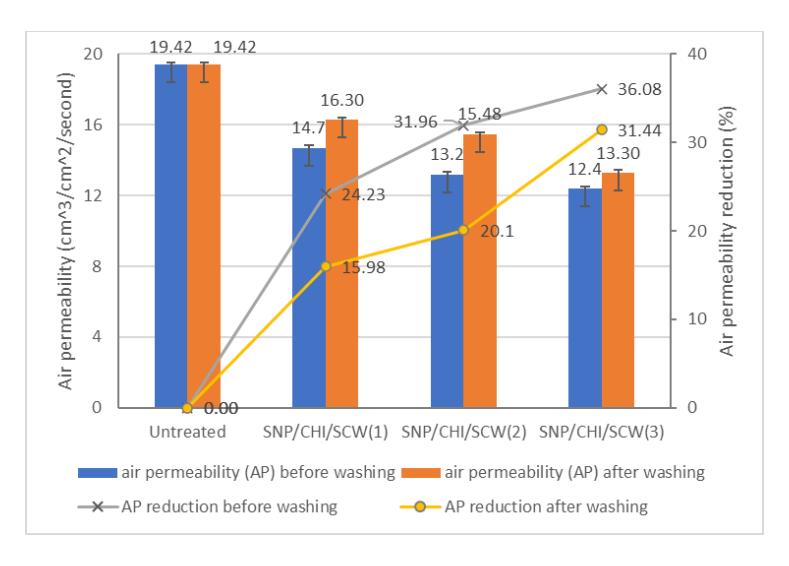
Figure 9 Air permeability of treated cotton with an increasing number of SNP/CHI/SCW layers. The bar refers to air permeability (cm3 /cm2 /s) and the lines refer to the air permeability reduction (%).
In this study, unless the carnauba wax was successfully broken down to nanosized particles and self-assembly took place as expected, the deposition of the carnauba wax, which was preceded by the deposition of chitosan, bore the risk of reducing the critical roughness factor brought about by the nanoscale structure underneath and failed to build the dual-scale hierarchy that is a prerequisite for superhydrophobicity. The high water repellence (140.2°) produced by the layer system of SNP/CHI/SCW is much larger than the contact angles reported by Bashari et al. [34] but comparable to those of Forsman et al. [35]. This supports the existence of a dual hierarchy in the nanostructure of layers on the surface of the cotton fabric. At this point, it is necessary to revisit the idea about the layering and the structure of layers that is responsible for the large contact angles.
The layer structure shown in Figure 2 follows the idea of layering continuous films one at a time on the substrate surface. With that structure, there is only onescale roughness, as shown in Figure 10a. Each of the layers is in fact not a continuous film but an array of solid (SNP and SCW) and polymeric particles (CHI). During deposition, in each of the successive layers, the particles that came later actually should cover an individual or a collection of particles deposited previously, creating a two-scale hierarchical structure like in fractal surfaces (Figure 10b). The method of LBL deposition employed in this study is dip-paddry (Figure 4), which tends more to create structure (a). However, it is also probable that the layering took the form of structure (b). The documentation from one of the preliminary experiments showed that cotton fabric covered with only one layer of modified hydrophobic silica nanoparticles (one-scale roughness) produced a water contact angle of 127°, suggesting that the layering may be somewhere between structure (a) and (b) or transition between them.
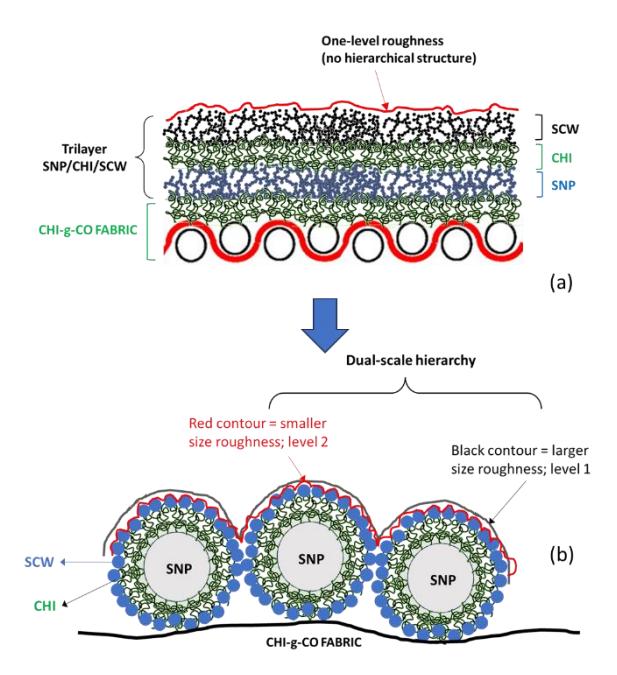
Figure 10 Structure of layers with (a) one-scale roughness and (b) two-scale roughness.
With that observation, it is suggested that a larger contact angle would be obtained when structure (b) is predominant. In the deposition method employed by Bashari et al. [34] and Forsman et al. [35], the fabric is dipped successively in separate solutions/emulsions of SNP, CHI, and SCW. This is not quite selfassembly and presumably leads to the formation of structure (a). Rather than using this dipping method, the route to superhydrophobic should start with the modification of silica nanoparticles by LBL self-assembly deposition of chitosan and carnauba wax, followed by the deposition of modified silica nanoparticles using the conventional pad-dry process on chitosan-grafted cotton (Figure 11).
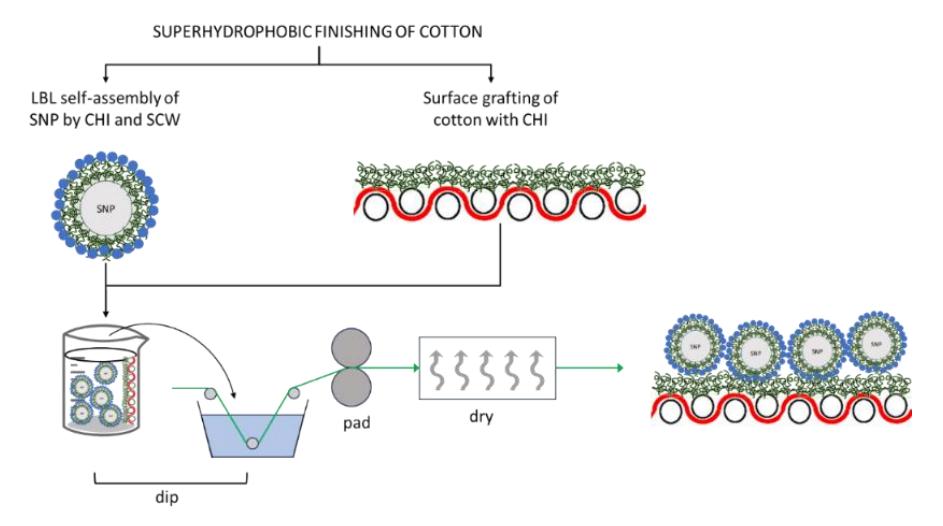
Figure 11 Alternative strategy/route for superhydrophobic finishing of cotton by silica nanoparticles and carnauba wax.
4 Conclusions
An environmentally friendly and safer process of superhydrophobic finishing of cotton fabrics with a static contact angle of 140.2° was successfully developed with naturally available materials from rice husk ash silica nanoparticles and carnauba wax using a layer-by-layer deposition self-assembly method. The contact angle increased with the number of trilayers and reached 140.2°with three trilayers. This was followed by 31.44% reduction of air permeability due to the blocking of fabric pores by the multiple layers. Washing decreased water repellence quite substantially in terms of spray testing from 70-90 down to 50 but remained highly hydrophobic to superhydrophobic based on the definition given based on contact angle from 137-152° to 129-142°.
5 Recommendations for Further Works
The route of improvement for a contact angle larger than 140° for a truly superhydrophobic water-repellent finish of textiles involves ensuring that the deposition creates a two-scale hierarchically nanostructure on the surface of the fabric. A recommendation for further study is to investigate the surface properties of the fabric after each of the successive depositions of silica nanoparticles, chitosan, and carnauba wax in order to better understand the transformation of the surface's chemical morphology following the coating and its relation with the wetting properties. Secondly, to investigate different process routes, i.e., surface modification of silica nanoparticles by chitosan and carnauba wax and silanization of silica nanoparticles looking at multifunctional groups that provide anchors for chemical bonding with cotton and superhydrophobicity.