

1 Introduction
Skin aging is an inevitable and progressive decline in both morphological and physiological functions. Nevertheless, studies have shown that only 10% of skin aging is intrinsic or caused by internal physiological factors such as genetics [1,2]. The rest is caused by external factors, also known as extrinsic aging. Multiple extrinsic factors have been identified as contributors to skin aging, including ultraviolet (UV) radiation, poor dietary habits, cigarette smoking, exposure to air pollution, alcohol consumption, and other detrimental lifestyle
Received August 19 th, 2024, Revised September 21st, 2024, Accepted for publication September 26th, 2024 Copyright © 2024 Published by ITB Institut for Research and Community Service, ISSN: 2337-5760, DOI: 10.5614/j.math.fund.sci.2024.56.2.1math
choices [2]. These factors are also known to cause premature aging. Premature aging happens when the body looks older than the actual age or when the biological age is older than the chronological age. Premature fine lines, wrinkles, and hyperpigmentation are signs of premature skin aging.
Hyaluronan, also known as hyaluronic acid (HA), is the primary molecule responsible for maintaining skin moisture; however, the levels of HA in the skin decrease with advancing age [3,4]. In addition, the aging process is also accompanied by immunological alterations. Immunosenescence of the skin may affect the cutaneous immunological defense [5]. It is known that macrophages, mast, and dendritic cells are skin-resident immune cells that prevent infection. Therefore, preserving skin health is crucial not only for maintaining its morphological appearance but also for supporting its physiological functions, such as immune homeostasis.
The use of topical anti-aging skincare has been acknowledged as a sustainable way to prevent premature skin aging [1]. Commercial anti-aging skincare products have different activity mechanisms regarding their active compounds. The products are beneficial for strengthening the skin's barrier function, encouraging epidermal rejuvenation, providing antioxidant properties, reducing age-related pigmentation, and boosting connective tissue production [1].
HA has been used as one of the active ingredients in many topical anti-aging skincare products. Therefore, HA is incorporated into skincare products to replenish the decreased HA in the skin. HA is a linear polysaccharide, a major extracellular component in the dermal layer of the skin. HA plays a critical role in regulating water balance within the skin, promoting keratinocyte differentiation, and maintaining cellular structure in the dermal layer [6]. In addition to its role in skin hydration, HA is essential for regulating immune responses, including angiogenesis stimulation [7]. HA is also injected as a joint lubricant to treat knee discomfort due to osteoarthritis [8].
Commercially sourced HA is obtained through extraction from rooster combs and human umbilical cords or via bacterial fermentation using Streptococcus equi and Streptococcus zooepidemicus. Another source of hyaluronic acid that has yet to be explored is eggshell membrane (ESM). According to BPS-Statistics Indonesia, the chicken and duck egg production in Indonesia was 4,753,382 and 352,939.13 tons/year in 2019, respectively [9]. Around 11% of these numbers represents the amount of eggshells, which end up as domestic and industrial waste [10].
ESM is present in eggs between the egg white and the inner eggshell surface. It is a protein-rich membrane that represents 5 to 11% of the total egg weight. ESM has traditionally been used for wound dressing in China and Japan for over 400
years. It is primarily composed of collagen types I, V, and X [11–14]. In addition, it also comprises polysaccharides, including chondroitin sulfate and HA [15]. To date, chicken eggs are the source of ESM used traditionally and published in most studies. To our knowledge, duck eggs have not yet been studied well.
Although raw ESM is known to have numerous beneficial effects, it is insoluble and contains many cross-linked disulfide bonds [16]. Therefore, ESM must first be modified into a soluble form to facilitate its incorporation into topical products.
Recently, consumers have become increasingly mindful of the cosmetic products they use. Consumers are seeking the inclusion of natural bioactive or functional ingredients in cosmetics and other formulations, perceiving them as a healthier and safer choice for their skin and overall well-being [1,17,18].
Taking everything into consideration, this research aimed to optimize the hydrolysis procedure for ESM and compare the ESMH obtained from duck and chicken eggs. The hydrolysate was tested for its antioxidant activity and activity on collagenase inhibition as part of the study on its anti-aging effect.
2 Materials and Methods
2.1 Materials
Chicken and duck eggshells were obtained from food industries in Cimahi, West Java, Indonesia, sodium sulfite (Pudak Scientific), papain (proteolytic activities of 2000 U/mg; Nanning Pangbo Biological Engineering; CAS: 9001-73-4), Coomassie Brilliant Blue R-250 (Merck), glacial acetic acid (Merck), distilled water, hydrochloric acid (Merck), bovine serum albumin (BioRad), Bradford reagent (BioRad), tris-HCl buffer (Merck), epigallocatechin gallate (Sigma-Aldrich), Azo-impregnated collagen (Sigma-Aldrich), collagenase enzyme (Sigma-Aldrich), sodium hyaluronate (Jinan Technology), carbazole (Sigma-Aldrich), copper (II) sulfate (Merck), Folin-Ciocalteu's reagent (Merck), sodium tetraborate (Merck), trichloroacetic acid (Merck), absolute ethanol (Merck), sulfuric acid (JT. Beaker), DPPH (2,2-diphenyl-1-picrylhydrazil) (Sigma-Aldrich), L-amino acid standards for L-cysteine, L-methionine, L-serine, Lglutamic acid, L-phenylalanine, L-isoleucine, L-valine, L-alanine, L-arginine, glycine, L-lysine, L-aspartic acid, L-leucine, L-tyrosine, L-proline, L-threonine, L-histidine, and L-tryptophan were obtained from Sigma-Aldrich, 0.1% formic acid in water and 0.1% formic acid in acetonitrile (for LC-MS; Merck), 6 aminoquinolyl-N-hydroxysuccinimidyl carbamate (AQC; Sigma-Aldrich), and acetonitrile (HPLC grade; Merck).
2.2 Hydrolysis of ESM preparation
2.2.1 ESM collection from waste
ESM was obtained from eggshell waste from a food industry in Cimahi, West Java. Waste was collected every two days for six months. The eggshells were cleaned thoroughly from dirt after each collection. The ESM separation method was adapted from Torres-Mansilla et al. [19] with slight modifications. The eggshells were soaked in diluted acetic acid solution (1:100) for 24 hours. After 24 hours, the eggshells were washed with water and ground with a blender. The ESM could then be easily collected after grinding because ESM floats in water while eggshells sink. The ESM was sun-dried for 5 to 12 hours, or until the moisture content was below 3%, and further hydrolyzed.
2.2.2 ESM hydrolysis optimization
The hydrolysis method was adapted from Zhao et al. [5] with slight modifications. The ESM was hydrolyzed using the enzymatic method with papain (0, 15, 30, 45, 60, and 75 U/mg). In addition, sodium sulfite (0, 10, 20, 30, 40, and 50 mM) was used to enhance the efficiency of the enzymatic hydrolysis of the ESM. The process was carried out for 4 to 6 hours at 60 °C. The reaction was terminated by heating the solution at 80 °C for 20 minutes. The solution was then centrifuged, and the supernatant was isolated.
2.3 Degree of hydrolysis (DH) estimation
DH was determined by using the modified Hoyle and Merritt method [20]. ESM was mixed with trichloroacetic acid and incubated at 25 °C for 30 min. After 30 minutes, the solution was centrifuged at 3,000 rpm for 15 minutes. The protein concentration in the supernatant was determined using the Lowry method, using bovine serum albumin as standard. DH was calculated as follows:
\[DH (\%) = \frac{Soluble protein concentration}{Total protein concentration} X100\]
2.4 Hyaluronic acid (HA) determination
HA concentration was determined by the carbazole method [21]. The reaction relies on the activity of carbazole reagents, which is indicated by a visible color change in the reagent. Initially, sulfuric acid containing 25 mM borate was mixed with the sample. After heating at 100 °C for 10 minutes and allowing the mixture to cool, 0.125% carbazole was added. The solution was then re-boiled for 15 minutes at 100 °C, followed by cooling. Absorbance was measured at 525 nm, and the HA content was quantified as milligrams of HA per milliliter of hydrolysate. Sodium hyaluronate served as standard.
2.5 Total protein content determination
The total protein concentration was determined using the Bradford method [22]. Bovine serum albumin was used as standard. The concentration was measured using a spectrophotometer at 595 nm.
2.6 Amino acid content determination
L-cysteine and L-methionine were quantified using liquid chromatographytandem mass spectrometry (LC-MS/MS). The analysis was performed on an LC-MS/MS system with an electrospray ionization (ESI) source in positive ion mode. Chromatographic separation was carried out using a C18 column, with the mobile phase composed of water containing 0.1% formic acid (A) and acetonitrile containing 0.1% formic acid (B). A gradient elution was applied over a total run time of 15 minutes. Calibration standards and quality controls were prepared using serial dilutions of the analytes in a matrix-matched solution. Samples were prepared by protein precipitation with acetonitrile, followed by centrifugation, and the supernatants were directly injected into the LC-MS/MS system. The transitions for L-cysteine and L-methionine were monitored in multiple reaction monitoring (MRM) mode, with optimized collision energies and dwell times for each analyte.
In addition, L-serine, L-glutamic acid, L-phenylalanine, L-isoleucine, L-valine, L-alanine, L-arginine, glycine, L-lysine, L-aspartic acid, L-leucine, L-tyrosine, L-proline, L-threonine, L-histidine, and L-tryptophan were analyzed using ultraperformance liquid chromatography (UPLC). The UPLC system utilized a reversed-phase C18 column with a flow rate of 0.4 mL/min. The mobile phase consisted of a gradient of solvent A (0.1% formic acid in water) and solvent B (0.1% formic acid in acetonitrile), with a total runtime of 10 minutes. Amino acid standards were used for calibration, and sample preparation involved derivatization with AQC to enhance detection. The detection was carried out using a UV detector at a wavelength of 254 nm. The samples were filtered using a 0.22 µm membrane before injection and the resulting chromatograms were processed to quantify each amino acid by comparing the retention times and peak areas with the corresponding standards.
2.7 Antioxidant activity by DPPH method
Antioxidant activity was tested on chicken and duck ESMH using 1,1 Diphenyl-2-Picrylhydrazyl (DPPH) [23]. The sample or standard was dissolved in ethanol and mixed with DPPH stock solution (ratio 1:1). Then, the mixture was incubated for 30 minutes at room temperature. The absorption was measured at a wavelength of 517 nm, after which the IC50 value of each sample was evaluated.
2.8 Collagenase inhibition activity test
The collagenase inhibition activity of ESMH was evaluated by using a method adapted from Wang et al. [24] with slight modifications. 1 mg of Azoimpregnated collagen was homogenized in 800 \(\mu\)l of Tris-HCl 0.1 M pH 7.4 and 100 \(\mu\)l of ESMH sample. Then, 100 \(\mu\)l of collagenase (200 U/mL) was added to the mixture and incubated at 40 °C for 1 hour. Subsequently, the mixture was centrifuged at 3,000 rpm for 10 minutes. The supernatant was transferred to 96-well plates and the absorbance was measured at 550 nm. The collagenase inhibition activity was calculated as follows:
Collagenase inhibition (%) = \[\frac{\text{Abs. control -Abs. sampel}}{\text{Abs. control}} X100\]
3 Results
The duck and chicken ESM obtained from the cleaning procedure used in this study was 4.94±0.80% and 3.21±0.33% from the eggshell weight, respectively. The hydrolysis method was optimized by varying the papain and sodium sulfite concentrations. The degree of hydrolysis was used as the parameter to determine the optimized concentration. The optimization result showed that hydrolysis increased significantly with an increased concentration of papain (Figure 1(a)). However, the hydrolysis degree decreased at a papain concentration of 75 U/mg. Thus, the papain concentration of 60 U/mg was used for further experiments.
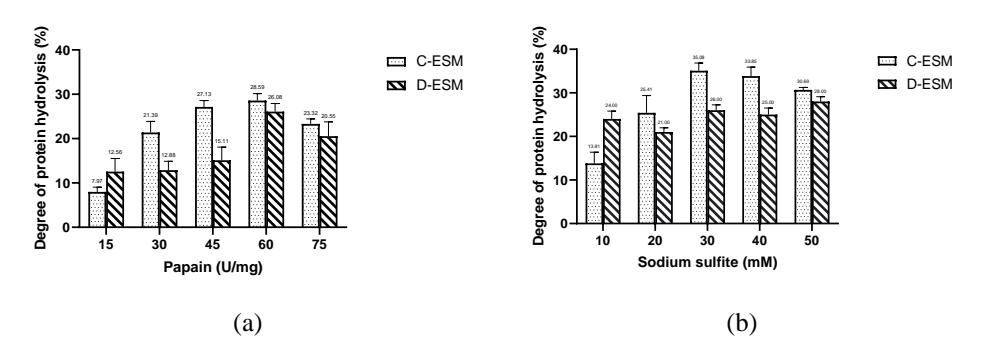
Figure 1 The influence of papain concentration (a) and sodium sulfite concentration (b) on the degree of protein hydrolysis of chicken ESM (C-ESM) and duck ESM (D-ESM). A fixed sodium sulfite concentration, 30 mM, was used to optimize the papain concentration. A fixed concentration of papain was used to optimize the sodium sulfite concentration, i.e., 60 U/mg.
Note: The values are means of three replications per sample \(\pm\,\text{SD}.\)
A fixed papain concentration of 60 U/mg was used to determine the optimized sodium sulfite concentration. The optimized sodium sulfite concentration of 30 mM yielded the highest hydrolysis degree (Figure 1(b)). The obtained hydrolysate solution was also clear and had no visible membrane, indicating the hydrolysis process was completed (Figure 2).
In addition to the degree of hydrolysis, chicken and duck ESMH obtained was analyzed by measuring total protein content and HA concentration. The duck ESMH showed significantly higher total protein and HA content (Table 1).
Figure 2 The hydrolysates of chicken (a) and duck (b) eggshell membranes resulted from different concentrations of sodium sulfite. From left to right, the used concentration of sodium sulfite was 0, 10, 20, 30, 40, and 50 mM.
Table 1 Characterization of chicken and duck ESMH.
| Parameter | Chicken | Duck | |
|---|---|---|---|
| ESMH | ESMH | ||
| Viscosity (cP) | 20.50±2.45 | 24.42±4.53 | |
| pH | 7.87±0.05 | 7.97±0.09 | |
| Total protein content (mg/g) | 71.41+2.13 | 80.18+1.47 | |
| Hyaluronic acid concentration (mg/g) | 49.60+0.11 | 58.40+0.05 | |
Note: The values are means of three replications per sample ± SD.
Table 2 shows the amino acid composition of ESM and ESMH. ESM and ESMH from chicken and duck have similar amino acid content but different concentrations. The hydrolysis process decreased the amount of lysine and some other amino acids, but the effect was relatively lower than that of arginine (Table 2).
Table 2 Amino acid compositions (wt%) of chicken ESM (C-ESM), chicken ESMH (C-ESMH), duck ESM (D-ESM), and duck ESMH (D-ESMH).
| Amino acid | C-ESM (%) | C-ESMH (%) | D-ESM (%) | D-ESMH (%) |
|---|---|---|---|---|
| L-cysteine | 2.69 | 2.29 | 4.09 | 3.64 |
| L-methionine | 1.97 | 4.19 | 1.62 | 3.06 |
| L-serine | 6.97 | 7.11 | 7.39 | 7.65 |
| L-glutamic acid | 7.92 | 10.27 | 7.78 | 8.92 |
| L-phenylalanine | 3.75 | 2.67 | 4.71 | 3.72 |
| L-isoleucine | 3.08 | 3.45 | 3.06 | 3.29 |
| L-valine | 6.23 | 6.84 | 6.26 | 6.92 |
| L-alanine | 2.04 | 2.46 | 2.49 | 2.89 |
| L-arginine | 14.92 | 8.9 | 11.92 | 8.32 |
| Glycine | 7.49 | 7.76 | 7.57 | 7.99 |
| L-lysine | 4.86 | 3.89 | 4.9 | 4.07 |
| L-aspartic acid | 4.77 | 6.36 | 5.7 | 6.56 |
| L-leucin | 4.6 | 4.85 | 4.62 | 4.84 |
| L-tyrosine | 3.92 | 2.98 | 5.68 | 4.7 |
| L-proline | 8.63 | 10.73 | 9.09 | 9.64 |
| L-threonine | 7.6 | 7.47 | 6.73 | 7.13 |
| L-histidine | 6.32 | 5.26 | 4.3 | 4.09 |
| L-tryptophane | 2.24 | 2.52 | 2.09 | 2.56 |
The antioxidant activities of chicken and duck ESMH were determined using the DPPH method. The results showed that the chicken ESMH had an IC50 of 1399.78±36.44 µg/mL, and the duck ESMH had an IC50 of 303.99±16.32 µg/mL.
The ESMH activity on collagenase inhibition was determined using azoimpregnated collagen, and epigallocatechin-3-gallate (EGCG) was used as positive control. The result from collagenase inhibition showed that at the lowest concentration, i.e., 7.81 µg/mL, EGCG showed the highest collagenase inhibition compared to C-ESMH and D-ESMH (Figure 3). D-ESMH and EGCG showed similar collagenase inhibition activity at 15.53 µg/mL. Nevertheless, starting from the concentration of 31.25 µg/mL onwards, D-ESMH showed the highest collagenase inhibition compared to EGCG and C-ESMH.
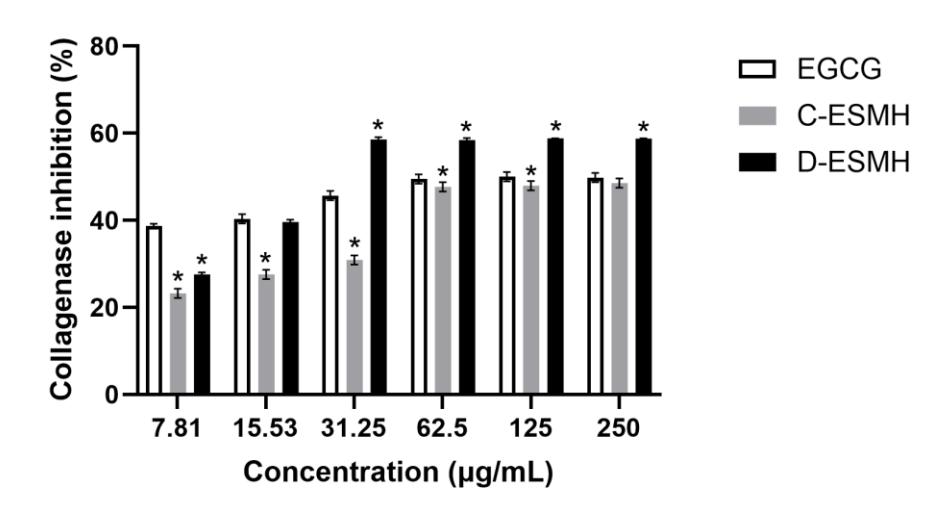
Figure 3 The activity on collagenase inhibition of chicken ESMH (C-ESMH ()) and duck ESMH (D-ESMH ()) was determined by using Epigallocatechin-3-gallate (EGCG ()) as positive control.
Note: The values are means of three replications per sample ± SD, with * indicating significant differences (p < 0.05).
4 Discussion
The demand for eggs has grown globally and in Indonesia over the last few years. In 2020, the per capita egg consumption in Indonesia was estimated to reach 28.16 kg. Consequently, chicken and duck eggshells are abundant industrial and household waste. According to European Union regulations, eggshells are considered hazardous waste because they generate odor and microbial growth [10]. In addition, eggshell waste requires high management costs because it is mainly sent to the landfill. Thus, transforming eggshell waste into a value-added product could contribute significant environmental and economic advantages [10]. This research evaluated the potential of eggshell membranes as an active ingredient in anti-aging cosmeceuticals. Eggshells can be obtained from food industry waste. Thus, an efficient cleaning procedure must be optimized to facilitate the technology transfer from laboratory to raw material industries.
The obtained eggshell waste was soaked in diluted acetic acid solution for 24 hours for cleaning. The cleaning procedure was more efficient and economical than manually separating the ESM from the eggshell [19]. Thus, this method is applicable for upscaling the industry process. Several methods have been developed for the hydrolysis of ESM to obtain HA, i.e., enzymatic method, alkali hydrolysis using sodium hydroxide/ethanol, and reductive cleavage using
3-mercaptopropionic acid in acetic acid solution [16,20,25]. The enzymatic process using papain in this study was chosen because papain is cheaper compared to other enzyme sources and can be obtained from halal sources. It is known that consumer demand for halal cosmetics and personal care products in Indonesia has been increasing in recent years. Furthermore, the study by Zhao et al. [25] has shown that ESM hydrolysates obtained from papain and sodium sulfite had higher antioxidant activities than ESM hydrolysates obtained from other proteases. The sodium sulfite concentration used in the aforementioned study was similar to this study. However, we used a higher concentration of papain because it yielded a higher degree of protein hydrolysis. Sodium sulfite is a highly effective agent for breaking disulfide bonds, offering advantages such as being more environmentally friendly, water-soluble, and more efficient than other organic reagents commonly used for disulfide bond disruption. Sodium sulfite improved the solubility of ESM and assisted the enzymatic hydrolysis of the ESM [25]. In addition, the ESMH resulting from papain and sodium sulfite had better color and smell and was less irritating than the hydrolysates obtained using alkali hydrolysis.
Arginine was remarkably decreased in both hydrolysates of chicken and duck ESM. This aligns with the well-established activity of papain, which targets peptide bonds between the carboxyl group of lysine or arginine and the adjacent amino acid residue [26]. Lysine and some other amino acids were also decreased in the hydrolysate, but the effect was negligible compared to arginine. Papain, a cysteine protease derived from the latex of the papaya plant (Carica papaya), has been employed as a defense mechanism to protect plants from insect damage [27]. Papain exhibits broad specificity and the capability of cleaving peptide bonds at phenylalanine, arginine, and lysine residues [28]. Thus, a higher arginine reduction in the hydrolysate due to the use of papain is predictable in this study.
The information on the amino acid composition could be used to predict the strength of antioxidant activities in peptides [25]. For instance, the antioxidant capacity of a peptide is enhanced when its amino acid sequence contains proline, histidine, or tyrosine or when valine or leucine is present at the N-terminal position [25]. Both chicken and duck ESM and ESMH contain all the amino acids that can enhance their antioxidant activities. The chicken and the duck ESMH contained relatively similar amounts of amino acids. However, the duck ESMH contained more tyrosine compared to the chicken ESM. This may explain why the duck ESMH showed better collagenase-inhibition activity than the chicken ESMH.
A notable anti-aging characteristic of active ingredients is their capacity to inhibit collagenase enzyme activity. In the aging process, collagen, elastin, and hyaluronic acid are the primary components of the dermis that play a crucial role in maintaining the skin's suppleness, smoothness, and elasticity [1]. The ongoing depletion of collagen I in aging skin not only leads to a disorganized and irregular collagen structure but also results in an elevated ratio of collagen III to collagen I [1].
Incorporating antioxidants into skincare products is a common strategy to mitigate the harmful effects of free radicals and support the maintenance of healthy skin [29]. Both topical and systemic antioxidants can be utilized, either individually or in combination with retinoids and sunscreens, to prevent wrinkle formation by reducing inflammation [30].
Eggshell membrane (ESM) contains a significant amount of hydrophobic amino acids such as leucine and valine, which may bind to the active site of the collagenase enzyme, thereby inhibiting its activity [31].
5 Conclusion
This study has shown the potential activity of ESMH from chicken and duck eggs. ESM is part of eggshells, which are considered organic waste. The hydrolysis process of ESM in this study generated soluble protein from ESM. ESMH contains soluble protein, peptides, and amino acids that can be formulated into various cosmetic products, including anti-aging skincare. This study showed that duck ESMH has higher antioxidant and collagenase inhibitor activities than chicken ESMH. To date, duck ESMH has not been explored well. In Indonesia, most people consume duck eggs for different types of cuisine. Using eggshell waste in the production of cosmetics will create added value for eggshells and reduce environmental waste.