

1 Introduction
Several years ago universities started to work with online learning, concentrating on online teaching materials delivery to their students distributed in different geographical areas, researchers tried always to find out solutions for the problems usually face the pedagogical process within the online education, starting from building web sites for courses, online exams, online feedback, etc, and finally adaptation of pedagogical process according to many factors take place within this environment, such that student learning style, preferences, constraints, etc. researchers in this field tried to find solution for two adaptive problems, one related to the way by which the teaching material will be presented to the student and the second to the way by which the student will follow web site links.
In our case study, open university needs exactly theses two techniques of adaptation, since it has students of diverse background, different learning style and preferences, but its not enough in such university, OU has other pedagogical methodologies beside online courses, OU generally conducts direct meeting and discussion among students as well as their teacher [20]. This approach is considered as one of the most important element in the online education structure in the university. In such collaborative discussion technique the teacher and also the students usually face many problems which can strongly make this technology loose its effectiveness and weaken its performance in achieving the objective of use. The following points summarize these problems:
1. Guiding the discussion and controlling it by the teacher within the whole session ay makes it difficult for him to answer all inquiries submitted by the students and thereby a lot of students will loose the right of debate and get the required information, this often
- leads to the loss of many questions raised by students because of the overloaded questions submitted in the discussion room.
- 2. Most students usually enter to the discussion room, without any kind of orientation and thus begin dealing with the discussion room as ordinary chat room, discussion is often without specific goals and this leads inevitably to a loss of required interest.
- 3. The debate in the discussion room does not have any kind of monitoring or even evaluation, therefore not possible to know the knowledge obtained by students through the discussion.
This research is looking for the appropriate methods and techniques to state the solutions for these problems, shouldn't that focus in the discussion on the teacher but making a collaborative discussion among students as well as the teacher, since the students in open education rarely have their own personal knowledge about other students. The proposed system should provide the suitable technical methods to guide the students to choose the right person in the discussion room. This person must have the necessary knowledge to be able to provide for other students and the system must give the student the appropriate interface in the discussion room by which the student can determine the level of knowledge of other students. For those students who do not have enough knowledge may be useful to the student, there is no importance to their presence in the discussion room but vice versa is not the same case, this student may appears to the other student discussion room whether he has the necessary knowledge to provide for others. The system must also specify the subject of discussion and not let the discussion be open in various topics. This may be under the control of the teacher who must be present in all discussion rooms that appear to all students.
2 Background and Related Work
2.1 Adaptive systems
Adaptive systems are systems which can alter aspects of their structure, functionalit y or interface, in order to accommodate the different needs of individuals or group of users and the changing needs of users over time [1], adaptive systems consider many factors such as user characteristics, user modeling techniques, tasks are being performed and information characteristics, these characteristics should be arranged in models in order to use them in the adaptation process, these models are different from system to system, but generally most systems use models like user model, domain model, and interface or interaction model [6]. Brusilovsky in 2001 devided the adaptive hypermedia into two parts, one is adaptive presentation and one is adaptive navigation, most of adaptive hypermedia systems built on this taxonomy, generally adaptive presentation is the most known adaptive systems, adaptive presentation means tailoring the user interface according to many factors related to the user and domain model, on the other hand, adaptive navigation tries to help the user to follow the suitable links which match his learning requirements and style, Brusilovsky in his taxonomy discussed many approaches for both adaptive presentation and adaptive navigation [3].
2.2 Examples of adaptation systems
Many adaptive systems are built within the last years, we will s urvey on the most important of them to find out their characteristics:
1. AHA!: Adaptive Hypermedia for All [7][8][11][12].
- 2. ALE: Adaptive Learning Environment is an environment or a toolset and framework for creating adaptive courses [13].
- 3. AMBAD: A tool that should simplify the creation and provide means for running adaptive courses on the base of information anthologies of domains [18].
- 4. ELSA (formerly known as Hezinet): An adaptive hypermedia system used for Basque language learning. [9][10].
- 5. InterBook: is a tool for creation and presentation of adaptive electronic textbooks [14].
- 6. SQL-Tutor: is an e-learning system for SQL language. It is built on a Constraint-Based Modeling [15].
Some other systems tried to involve intelligent agents to support adaptive hypermedia, for example ABAH framework.
By studying of the previous regimes we found that the best systems in conformity with the proposed system are AHA! and the system based on it, ABAH. We will discuss these systems in some detail so that we can conclude how the integration will be between these systems and the proposed system.
2.3 AHA! and ABAH
Since this system is the most widely used system in adaptive hypermedia we will use it as a base for our work [1].
AHA!, the "Adaptive Hypermedia Architecture", was originally developed to support an on line course with some user guidance through conditional (extra) explanations and conditional link hiding. It can be used to add different adaptive "features" to applications such as on-line courses, museum sites, encyclopedia, etc. The architecture of AHA! is heavily inspired by the AHAM reference model [6], the adaptive hypermedia methods and techniques presented in AHA! can be found in Brusilovsky's taxonomy [16] as seen in Figure 1. These techniques are presented by a user model based on concepts, which have attributes can be of arbitrary type Boolean, integer or string, adaptive techniques provided by AHA! are shown in Figure 2.
ABAH in its side which denotes to agent-based for adaptive hypermedia, is presented to define a loose architecture around which many types of AH applications can be created and which can also be used as a vehicle to implement formal models for AH. It formed a bridge between the two extremes found in existing framework design, a middle ground between formal modeling and fictional implementation.
Figure 1 Sketch of the architecture of AHA!
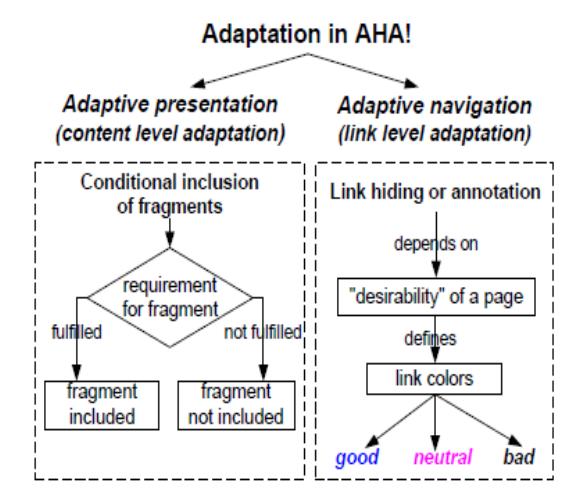
Figure 2 Adaptive techniques use in AHA!
2.4 The Munich Reference Model
The Munich Reference Model for Adaptive Hypermedia Applications is defined as an extension of the Dexter Hypertext Reference Model including user modeling aspects and rule-based adaptation mechanisms [5]. This model consists of the following three components:
- 1. The Adaptation Meta-Model: The adaptation is performed using a set of rules, such as in most adaptive hypermedia applications, typical examples of rule-based adaptation are supported by the frameworks AHA and SmexWeb [17]. These rules determine how pages are built and how they are presented to the user.
- 2. Session Management: The Run-Time Layer manages different sessions for the users generating and presenting the instances of pages. The Run -Time Layer describes how the components are presented to the user.
2.5 Overlay Model
Overlay model considers the user model as a subset of domain model [19]. It means that entries about the learner knowledge are related to each concept in the domain model, this way enables the system to evaluate the student knowledge level which can be used for adaptation techniques. Adaptive strategy consists of a set of rules like if-then rules; these rules can be used as the following syntax:
- 1. UM.DM.attribue for User Model attributes, for example UM.C1. Know= 70%, it means the learner's knowledge about C1 is 70% from the total knowledge in the domain model.
- 2. PM.DM.attribue for any attribute to be manipulated by the presentation model, example PM.C1 show= true. Figure 7 shows how domain knowledge is related to the user model through the relation concept-knowledge weight.
| Concept hierarchy | User Model | Certainty | |
|---|---|---|---|
| User's knowledge state | |||
| Multimedia types | Known | 100 | |
| Linear | Known | 100 | |
| Distributed | Not known | 100 | |
| Interactive | Known | 70 | |
| Non-interactive | Known | 90 | |
Figure 3 Model overlay example
2.6 Components of Adaptive Hypermedia
Basing on previous discussed models [2], most adaptive hypermedia systems include AHA! three components work together to provide adaptation, user modeler, adaptation engine, and interface components. Figures 3, 4, 5, and 6 describe each one of them, respectively.
3 Agent Based Adaptive Discussion Room (ABADR)
As discussed before the discussion or chat room is another facility used by the Open University, AHA! Or even any other adaptive system like ABAH can be suitable for online adaptive courses in such university, but we choose ABAH which is based on AHA! Because it provides both adaptive presentation as well as navigation, on the other hand the technologies used for the construction and manipulation for both User and Domain model basing on Munich and overlay models help us to integrate our proposed components easily with that system, in the following Figure 8, we can see the additional components related to the adaptive discussion room (in blue color) integrated with the original system of ABAH.
The proposed ABDR has three main objectives:
- 1. Invest the functions provided by ABAH and AHA! as adaptive online presentation and navigation in the open university.
- 2. Introduce a proposal to add a discussion room as another element of adaptive systems works to create customized user interface for each student according to his needs that allows making the collaborative discussion between students and not concentrated towards the teacher. The system must take into account the capabilities of other students in the discussion room and their knowledge about relevant topic of discussion.
3. Find the optimal solution for the representation of knowledge acquired by the student through discussion with other students or with the teacher in order to update the student Profile for that student and append the new knowledge in relation with concept discussion.
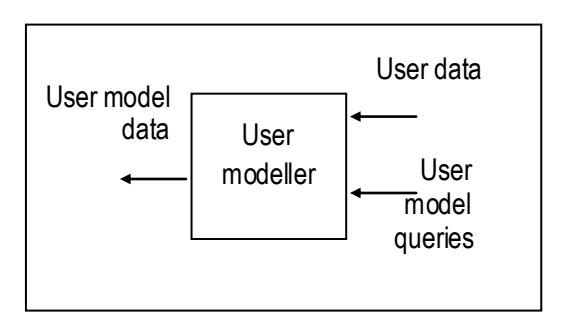
Figure 4 User modeller
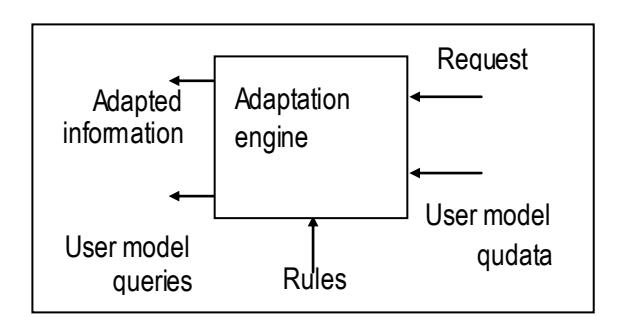
Figure 5 Adaptation engine
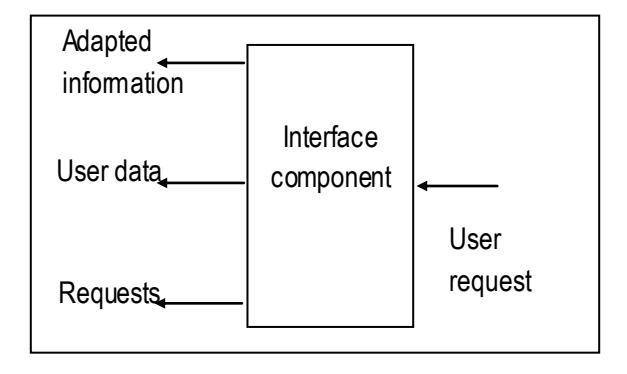
Figure 6 Interface component
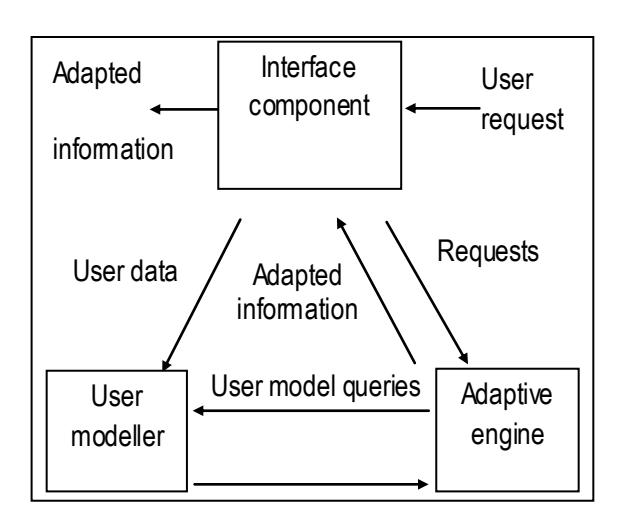
Figure 7 Components of an adaptive hypermedia
To find solutions to these objectives, the proposed system should have to work in integration with ABAH, this system should establish adaptive interface depending on the user and domain models which collect their information originally through the student attendance of adaptive online courses. This information is the key element in building the proposed system and determining the performance of the proposed system
User model data related to concepts are stored with its weight, for example C1.c1.know = 80, this means that the student knows about the sub concept c1 belongs to concept C1 80 points, this estimate reflects the degree of the knowledge obtained by the student during his study of the concept through online lessons . Table 1 shows an example for student X having a course of software engineering. This data about the student model are gathered and stored in the student profile during the ABAH online lectures using the suitable tools for user modeling, as shown in Figure 9, we have three agents work together to support the adaptive process, interface agent, user model agent and adaptation agent in the following we will discuss each one's roles in the system.
ABADR user model agent: this agent is responsible to access the user model for retrieving information about the current student knowledge related to the req uired topic as well as the knowledge of other students who participate in the discussion room. It will provide this information to the chat interface agent which is responsible for performing the adaptation strategy. It has similar function like user model agent the ABAH system. The need of knowledge retrieval is to compare students' knowledge and create the suitable adaptation sort and annotation in the discussion room.
Figure 8 General model for the extended discussion room integrated with ABAH framework
ABADR adaptation agent: this agent should have access to three different storage medias, domain structure, domain data and adaptation rules KB, this agent has the function of generating the adaptation strategy which should be applied depending on the domain model and stored adaptation rules, this strategy will extract the minimum weight required for each concept and the relation between concepts, to find out the required concepts for the current student that should discuss about, passing information from the interface agent about the current student knowledge and also about the other students in the discussion chat enable the adaptation agent to compare current student knowledge with other student knowledge creating concept knowledge vector for each concept like v (c1,70), using
similarity cosine function adaptation agent can find the students who have knowledge about concepts more or less than him .our aim in this stage is to find the students in the current discussion who can be useful for the current student in some concept by finding the distance between the current student and other students in that concept, after having the real idea about this difference in knowledge adaptation agent can access the adaptation rules to apply on the students knowledge, adaptation rules are described in the following section.
ABADR Adaptation rules used mainly in LAG grammar have direct adaptation techniques, rules in the form of If – then or condition-action. It is considered as adaptation language for both adaptation strategy and adaptation procedures. This language has a set of desired adaptive behavior, like while, for, break, generalize, specialize, conditions, enough, the LAG grammar as implemented in adaptive s ystems like the following:
PROG → STATEMENT.
STATEMENT → IFSTAT | WHILESTAT | FORSTAT | BREAKSTAT | GENSTAT | SPECIALSTAT | (STATEMENT) * STATEMENT | ACTION.
Example: let X be the current student and let Y, Z, and W are another students in the same discussion room. The following table describes the user model for each one of them based on example shown in Table 1:
Table 1 Example of student model
| Part of Domain Model for software engineering course : | Student Model part related to software engineering part for student X | ||
|---|---|---|---|
| Topic: software engineering | Attribute: knowledge (know) | ||
| C1: introduction | 62.5(average of topics) | ||
| c1: definition | 70 | ||
| c2: types | 50 | ||
| c3: usage | 60 | ||
| c4: commercial | 70 | ||
| C2: Types of software engineering | 16.5 | ||
| c1: waterfall | 66 | ||
| c2: spiral | 0 | ||
| c3: incremental | 0 | ||
| c4: prototyping | 0 | ||
Table 2 Domain and User model for students in the discussion room
| Topic: software engineering (SW) | |||||||
|---|---|---|---|---|---|---|---|
| DM | X | Y | Z | W | |||
| Concept | MR | weight | weight | weight | weight | ||
| C1 | 75 | 63 | 82 | 64 | 94 | ||
| c1 | 70 | 70 | 80 | 60 | 90 | ||
| c2 | 60 | 50 | 70 | 40 | 92 | ||
| c3 | 90 | 60 | 92 | 78 | 95 | ||
| c4 | 80 | 70 | 85 | 75 | 96 | ||
| C2 | 73 | 17 | 23 | 19 | 25 | ||
| c1 | 90 | 66 | 92 | 75 | 98 | ||
| c2 | 80 | 0 | 0 | 0 | 0 | ||
| c3 | 50 | 0 | 0 | 0 | 0 | ||
| c4 | 70 | 0 | 0 | 0 | 0 | ||
ABADR interface agent: this agent has mainly two rules:
- 1. Receive the adaptation strategy from the adaptation agent and apply it on the discussion room, it means sorting, annotating, and hiding the chat members list.
- 2. Receive data from monitoring agent related to the current student interaction details and also the concepts which are discussed within the current session pass these data to user model agent which will update the user model with the new data.
Interface agent will provide each student with one customized interface. Taking our previous example discussed in Table 2, screen snapshots for these different students is shown in Figure 9, 10 , 11, and 12 for student X, Y, W, and Z, respectively, as shown in the figures. Each student has different interface introduced by interface agent based on adaptation.
Strategy created by adaptation agent, student in green light has knowledge greater than the current student, while yellow has knowledge equal to him, red for those students who have knowledge less than the current student and all related to the underlying concept stated by the teacher, another adaptation should be followed is to sort the students either higher or lower according to their knowledge.
ABADR Monitoring agent: this agent will work in "one to one" discussion room. The agent is responsible to gather information about the current discussion between two students or even with the teacher. The data will be gathered and analyzed after the chat is terminated. It will deal with the discussion page as text page, analyzing it by porter streaming algorithm, which removes all words not related directly to the discussion like on, to, the, etc., then the algorithm will change the words to their root, for example broken, breaking and break will be all as break, these words will passed to the TFIDF algorithm to construct a vector for each word V (word, weight), weight will be a result of the occurrences of this word within the context, with similarity cosine function we can get a similarity between the words with the highest weight and the concepts in the domain knowledge, and then reflect the result to the user model for both student by increasing the weight of such concept.
Figure 9 Adapted interface for student X
Figure 10 Adapted interface for student Y
Figure 11 Adapted interface for student W
Figure 12 Adapted interface for student Z
4 Conclusion
Through this paper we tried to get solutions to the problems raised in the introduction, where we are trying to get support for the subject of direct discussion at the Open University, which is a fundamental element of pedagogy in such universities, after studying many adaptive systems we found that the system AHA! and the system based on it ABAH could be the pedagogic system for open education. These systems provide educational material in adaptive manner take into account levels of students and their preferred method of education and also their background knowledge on the subject. These systems also retain important information about student progress in a certain concept using a weight for that progress. Since these systems do not support the direct online meeting or discussion we found that the addition of a new part to support this discussion is a necessary issue in open education, but this addition should be integrated fully with the previous system and provide adaptive environment for the student discussion to solve the problems mentioned in the introduction, through the idea that the discussion would be a cooperative, that is, among students in general and not with the teacher only this intends to solve the first problem, while the second problem concerning the lack of students pre-knowledge about the subject of discussion, we found that setting the discussion for a single concept is an optimum solution, also the sort and color metaphor of the participant list in the discussion room according to the knowledge weight extracted from the student model and comparing with current student leads to help the student to determine quickly and easily other students who possess the necessary knowledge and is able to assist the student, in the third problem and final, which related to control of the discussion and to reflect the result on the student model. Proposed solution is through the analysis of the discussion text. All of these processes will be implemented by the creation of intelligent agents and without interference from any person.
5 References
- [1] De Bra, P., Ad Aerts, Berden, B., De Lange, B., Rousseau, B., Santic, T., Smits, D., Stash, N., "AHA! The Adaptive Hypermedia Architecture" Department of Computer Science Eindhoven University of Technology, 2003.
- [2] Bailey, C. P., "AN AGENT-BASED FRAMEWORK TO SUPPORT ADAPTIVE HYPERMEDIA", Department of Electronics and Computer Science, University of Southampton, United Kingdom, 2002.
- [3] F. Kareal* & J. Klema ,"Adaptivity in e -learning", Department of Cybernetics, Faculty of Electrotechnics, Czech Technical University, current development in technology -assisted education, 2006.
- [4] Kubes, T., "Overview of Existing Adaptive Hypermedia e-Learning Systems", 2006.
- [5] Koch, N., Wirsing, M., "The Munich Reference Model for Adaptive Hypermedia Applications ", Ludwig-Maximilians, University of Munich, 2003.
- [6] de Carrillo, C. P., "Intelligent agents to improve adaptive in a web-based learning environment", Department of Electronics, University of Girona, PHD thesis, 2001.
- [7] Calvi, L. & De Bra, P. "Using dynamic hypertext to create multi-purpose textbooks". In T.Muldner and T. C. Reeves (eds.) Proceedings of ED-MEDIA/ED-TELECOM'97 – World Conference on Educational Multimedia/Hypermedia and World Conference on Educational Telecommunications, Calgary, Canada, June 14-19, 1997, AACE, pp. 130- 135.
- [8] De Bra, P. "Teaching Hypertext and Hypermedia through the Web". Proceedings of WebNet'96, World Conference of the Web Society. San Francisco, CA, October 15-19, 1996.
- [9] Lopez-Cuadrado, J., Pěrez, T. A., Arruabarrena, R., Vadillo, J.A., Gutiěrrez, J. "Generation of computerized adaptive tests in an adaptive hypermedia system". In Educational technology - Information society and education: monitoring a revolution, A. Mendez Vilas, J.A. Mesa Gonzalez, and I. Solo de Zaldivar, Editors. Junta de Extremadura (CECT): Badajoz (Espana). pp. 674-678. 2002.
- [10]Lopez-Cuadrado, L., Armendariz, A. J., Perez, T. A. A supporting tool for the adaptive assessment of an e-learning system. In Recent Research Developments in Learning Technologies, 2005.
- [11]AHA! Adaptive Hypermedia for All. <http://aha.win.tue.nl/>.
- [12]AHA! Adaptive Hypermedia for All, project proposal. <http://www.nlnet.nl/project/aha/200106-aha-proposal.html>.
- [13]ALE (Adaptive Learning Environment)WINDS.<http://www.tk.informatik. tudarmstadt.de/SpotlightProjekt/04_04/Examples/ALE-Info>.
- [14]InterBook Home Page. <http://www2.sis.pitt.edu/˜peterb/InterBook.html>.
- [15]SQL-Tutor: an ITS for SQL programming.<http://www.cosc.canterbury.ac.nz/ tanja.mitrovic/sql-tut.html>.
- [16]Brusilovsky, P." Adaptive Hypermedia, User Modeling and User-Adapted Interaction", Vol.
- [17]Albrecht F., Koch N. & Tiller T. SmexWeb: "An Adaptive Web-based Hypermedia Teaching System". Journal of Interactive Learning Research. 2000.
- [18]Neto, W. C. B., Gauthier, F. A. O., Nassar, S. M. "A n adaptive e-learning model for the Semantic Web". In International Workshop on Applications of Semantic Web Technologies for E-Learning (SW-EL), 2005.
- [19]Carr, B. & Goldstein, I. (1977). Overlays:" A theory of modeling for computer-aided Instruction", AI Lab Memo 406. Massachusetts Institute of Technology, Cambridge, Massachusetts.
- [20]Wiley, D. The Current State of Open Education Resources. Paper presented at the OECD-CERI Expert Meeting on Open Educational Resources, Malmo, Sweden. 2006
6 Acknowledgement
The authors thank to goverment of Indonesia. This study is supported by "Beasiswa Unggulan" from MInistry of National Education of Indonesia to N.A.M.J (N.A.M. Jabari).