

1 Introduction
The Moslem year as a lunar based calendar contains twelve lunar months, each starting at least one day after the new moon, at sunset of the evening of the first sighting of the lunar crescent. While the mean lunar month (the synodic month) has 29.53 mean solar days, then if there are no clouds, the new crescent can always be seen 29 or 30 days after the previous one (a complete month), but in almost half of the cases, it is seen already on the 29th day (an incomplete month) [1]. Observation of lunar crescent near the sun at western horizon after sunset is indispensable important factor in determining important religious dates [2], [5], and [6]. However, the lunar visibility is so sensitive to the atmospheric condition and sky brightness that a thin cloud with a bright background can obscure it. To cope with this capricious problem, using telescope is unavoidable. The scientific and technology aspects of lunar crescent visibility do not have a strong focus, due to concentration to the social impacts than find the youngest moon age. In an extended scientific and technological based, the observation of lunar crescent near the sun can be undertaken in broad daylight, instead of waiting after the sunset. The daylight sighting
efforts will have a steep difficulty due to the extreme low contrast between lunar crescent and its daylight background. So, the idea is to develop some tools that enable one to observe the crescent in broad daylight to prove that one can see it at horizon after the sunset as this is the less stringent condition. The main problem is how to minimize the atmospheric and instrument stray light that can obscure the information from young crescent.
Since 2005 Bosscha Observatory has been appointed by the State Ministry of Communication and Telecommunication of the Republic of Indonesia, as the coordinator of national lunar crescent watching and observational network [4]. The Observatory actively dispatches its staffs to several locations throughout Indonesia to work together with local staff to set up instrument for observing lunar crescent. The results of crescent young moon image can be browsed from Bosscha's web site. One of the challenging images with the simple image processing for the youngest crescent moon record (~16 hours) in Indonesia was already performed [3]. This circumstance provides a very good opportunity to integrate its equipment toward the development of mobile and sophisticated yet user friendly lunar crescent observational system.
The telescope, equipped with an optimum detector supported by proper near real time image processing can be transported easily to catch the occurrence of lunar crescent in every place. We have made a special telescope baffle to reduce atmospheric and instrumental stray light. The observations of new moon have also been done from April to December 2010. This paper will report the progress of the observations of young crescent moon using the telescope baffle.
2 Instrumentation
2.1 Telescope Motorized Mounting
Telescope tripods and mounting that is stable and rigid on an equatorial system supported were chosen. It must be strong enough to overcome vibration caused by strong wind buffeting. It is a Celestron CGE tripod, as in Figure 3. We made a based adapter plate between tripods and motorized mounting (see Figure 3). The mounting will be supported by control system of a motorized telescope drive that enables high precision pointing and tracking. We select Vixen Sphinx motorized telescope mounting. This mounting can support up to 15 kg in weight that usually consists of telescope, finder telescope and eye-piece or detector (digital camera, CCD, video CCD, etc.).
This specification is important for optimum balancing telescope. The mounting should also support the weight and balance of longer telescope baffle or additional equipments. The mounting can be controlled by using a laptop via UTP cable. The mounting system can be plug into AC or DC electric power supply, so that it can be transported to the remote place for observations. We used Takahashi refractor type telescope with a focal length of 820 mm and 102 mm objective diameter lens. Selecting short focal length will determine the field of view and resolution of resulting image which is also depend on the pixel size and number of pixel of CCD sensor. Software for controlling the motorized mounting is provided as free software. The mounting can be controlled via internet, since it has UTP cable connection.
2.2 Baffle for Optical Tube Assembly (OTA)
We designed and made a simple OTA's baffle that will reduce the strong stray li ght entering the aperture of telescope from the brightness background of the evening Sun. The baffle will reduce the background or surrounding incoming light. Consequently, limiting the angle of incoming light will increase contrast of young lunar crescent. The length of baffle depends on the objective or aperture diameter and angle of incoming light (alpha). The simple formula is tan (alpha) = aperture diameter / length of baffle (1)
So if the aperture diameter is 102 mm and the angle of incoming light is 5 degree, then length of baffle will be 116 cm. For 2 degree angle, the baffle length is about 300 cm. We have made a 150 cm long baffle from a thick paper and incoming light angle in about 4 degree. When using the full 150 cm long baffle, the OTA could not be balanced and it should be manually arranged. We need a more heavy weight motorized mounting. The second design has an external occulting plane for the coronagraph effect. The advantage of this design is easier for focusing, tracking and image recording/stacking than the first design.
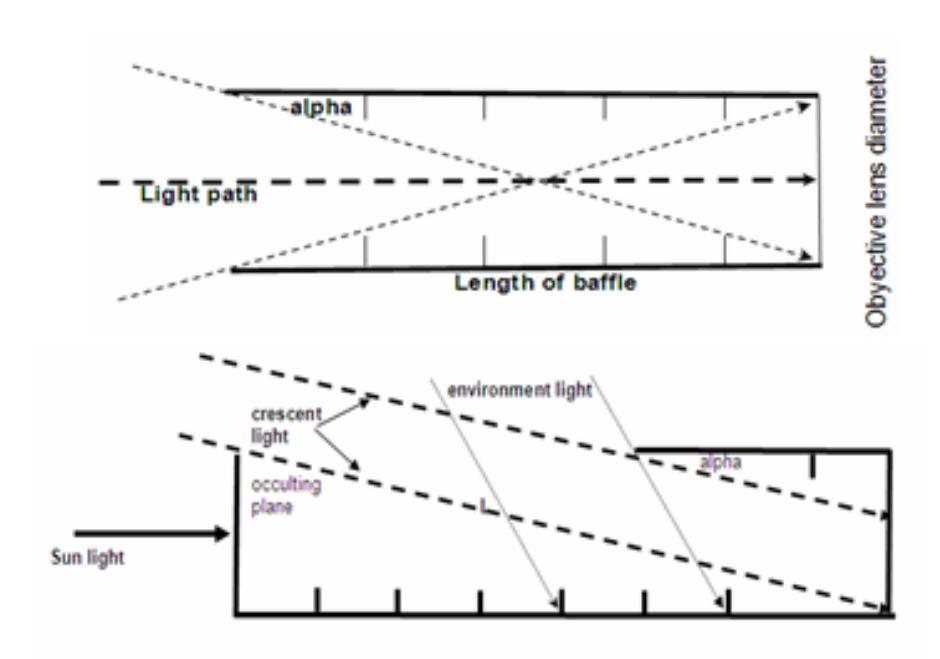
Figure 1 Two baffle designs. The external occulting plane is used in second design to give coronagraph effect (lower panel)
2.3 Analyzer and Detector
The digital single lens reflects (DSLR) camera that has already RGB Bayer's filters was used to record the images. The colour separations of green and red channels are selected, since they have a better contrast than blue channel. Field of view of DSLR would be at least about 60% of full moon diameter (32 arc minutes) which determined by pixel size and telescope's
focal length. Many people will mostly have experiences in using DSLR camera, so it is easier to disseminate how to observe young crescent moon using DSLR.
2.4 Image Calibration, Aligning and Stacking
Advanced astronomical imaging requires the "calibration" of the raw original images. Calibration means removing unwanted fixed signals (such as thermal current and bias), and correction for signal modifications (such as igniting) so that the raw image accurately represents the intensity of light incident on the sensor during the exposure. This will be done by taking dark image and flat image, respectively. The image stacking or shift-and-add method is a form of speckle imaging commonly used for obtaining high quality images from a number of short exposures with varying image shifts. It has been used in astronomy for several decades, and is the basis for the image-stabilisation feature on some cameras. The method involves calculation of the differe ntial shifts of the images. The images are then shifted back to a common centre and added together. This provides an image with higher resolution (higher signal-to-noise at high spatial frequencies) than a conventional long exposure image. We will also need to align all images so that the point or extended source in the images line up perfectly. Whatever software that use for image calibration will almost certainly also do aligning and image stacking. This method will apply when there is planet, as a reference target, at about 5 degree near the crescent.
2.5 Design of Robotic and Mobile Observing System
Telescope 1 to N consist of a collection of an integrated hardware and software that can control a robotic telescopes and imaging system, like CCD cameras and other astronomyrelated devices over a network (LAN or WAN) that are located next to your computer, a simple home network of two computer, a university/college/school network or on the other side of the Earth, or virtually anywhere!. The typical microcomputer controller design can refer to Trueblood, Genet [7]. A server will have the "Scheduler" application work together to allow remote control of to the telescope's or observatory's equipments. The Scheduler application provides a mechanism to allocate "teles cope" time to remote clients. A Client will used to gain access to the remote observatory or telescope via Server and can control the observatory's hardware and software. However, the server's side security settings cannot be overriding by client calls. So, Client is like a "virtual observer" on the Internet. With the click of your mouse, Client then instructs the telescope to slew to an object. While the telescope is in motion, cross hairs that show the telescope's progress across the onscreen star field. Once the telescope reaches the target, Clients can take a digital CCD image that is downloaded to their computer at home from Server. We have still developed and tested this system.
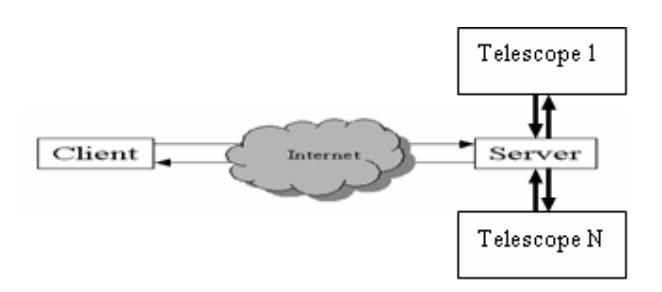
Figure 2 Topology of robotic and remote mobile observing system
3 Results and Discussions
Observations of young crescent moon have been performed for each month from April to December 2010 from Bosscha Observatory. The cloudy and bad weather were main constraint and the observations failed on April, May, September, November and December 2010. See Table 1. Figure 3 shows the observing system that has been made for searching the young crescent moon. In Figure 4, young crescent moon was obtained with camera lens of 105 mm focal length (left side) and with telescope with 920 mm focal length and baffle in front of the telescope. Variations of focal length cause different crescent size. In the former case, camera lens did not use baffle, so that crescent moon can be observed after the sunset which has more contrast. The advantage of using baffle can be seen that we can record the crescent moon at 17:05:28 local time (WIB) or about 50 minutes before the sunset. The first case, the conjunction occurred at 18:15 WIB on June 12, 2010. We have not image on June 13, 2010 due to thick cloud. On June 14, 2010, the sunset was at 17:47 WIB and the moon age at sunset was 47h 33m. The altitude of the Moon was 2402' and crescent width was 01'23" with 5% illumination. The crescent moon with this illumination is easily found by naked-eye. The second case, the conjunction was at 02:40 WIB on July 12, 2010. Bad weather stopped the observation on July 12 and 13, 2010. At sunset 17:54 WIB on July 14, 2010, the moon age was 63h13m and altitude was 34010'. The crescent width was 3'18" with 10% illumination. In this case, the earliest time of daylight crescent was at least one hour before sunset. The crater on the Moon can be easily identified. The next observations will also seek the earliest time of daylight crescent.
4 Conclusion
The narrow angle of incoming light by using telescope baffle can reduce incoming stray light and increase the contrast of crescent moon. Therefore, the observation can be performed to find the daylight crescent Moon which appears before sunset. However, it was well detected using carefully selected qualified telescope and detectors. The robotic telescope can be done on the direct and single connection. Although the observations were failed to detect crescent moon less than 20 hours young, the integrated system using baffle, qualified telescope and detector, as well as real time image acquisition data processing has the potential to detect the young crescent moon in daylight.
Figure 3 The observing system with robotic capability
Table 1 The Observational Date
| No | 2010 Month | Conjunction date | Observation Date | Observed Crescent Moon | |
|---|---|---|---|---|---|
| 1 | April | Apr-14 | 19:19 WIB | Apr 13-16 | Cloud |
| 2 | May | May-14 | 08:04 WIB | May 13-16 | Cloud |
| 3 | June | Jun-12 | 18:15 WIB | Jun 11-14 | Jun-14 |
| 4 | July | Jul-12 | 02:40 WIB | Jul 11-14 | Jul-13-14 |
| 5 | August | Aug-10 | 10:08 WIB | Aug 9-12 | Aug-11-12 |
| 6 | September | Sep-08 | 17:30 WIB | Sep 7-10 | Cloud |
| 7 | October | Oct-08 | 01:44 WIB | Oct 7-10 | Oct-9 |
| 8 | November | Nov-06 | 11:52 WIB | Nov 6-9 | Cloud |
| 9 | December | Des-06 | 00:36 WIB | Dec 5-8 | Cloud |
Figure 4 Crescent moon on June 14th 2010 at 18:03:06 (Left) and July 14th 2010 at 17:05:28 local time (Right). The lower panels are the edge profile
5 Acknowledgement
This work is supported by Research Grant - Multi Disciplinary based Research IMHERE ITB – 2010
6 References
- [1] Bruin, F., The First Visibility of Lunar Crescent, Vistas in Astron., 21, p. 331, 1977
- [2] Dogget, R.E. and Schaefer, B.E., Lunar Crescent Visibility, Icarus, 107, p. 388, 1994
- [3] Herdiwijaya, D., Prosedur Sederhana Pengolahan Citra untuk Pengamatan Hilal, (Simple Image Processing Procedures for Young Crescent Moon), Seminar Nasional Kriteria Visibilitas Hilal dan Penyatuan Kalendar Islam dalam Perspektif Sains dan Syariah, p. 109, 2009
- [4] Hidayat, T., Putra, M., Dermawan, B., Herdiwijaya, D., Setyanto, H., Irfan, M.,Suhardiman, B., Santoso, A., Developing Information System on Lunar Crescent Observations, ITB J. Science, 42A, p. 67, 2010
- [5] Hoffman, R.E., Observing New Moon, Mon. Not. R. Astron. Soc., 340, p. 1039, 2003
- [6] Schaefer, B.E., Astronomy and the Limit of Vision, Vistas in Astron., 36, p. 311, 1993
- [7] Trueblood, M., Genet, R., Microcomputer control of telescope, Willmann-Bell, Richmond, 1985