

1 Introduction
BATAN R&D on nuclear fuel has been started in eighteen decade. Significant achievement has been conducted in mastering U3Si2 fuel technology in order to self-supply of refuelling the 30 MW RSG-GAS reactors. The work was conducted with the assistance of the IAEA through a technical assistance program starting in 1989 and ceased in 1995. Under the Agency's technical assistance program came a German and several US experts providing direct assistance and supervision. The program had successfully brought Indonesia to such a capability to produce U3Si2 fuel elements for our multipurpose 30 MW research reactor.
Research activities on HTR fuel was started 4 years following the appointment of HTGR team in 1993, as its job and organization was expanded into five general areas of HTGR development including reactor technology and optimization of electricity and steam cogeneration, safety and environmental, coal liquefaction and desalination, instrumentation and control and the HTR fuel cycle. The study of HTR fuel mainly conducted by the Nuclear Fuel Centre that located in Serpong and the Yogyakarta Nuclear Center. Research in CFP production is conducted in Yogyakarta, and the modelling for fuel safety and fuel behaviour is conducted in Nuclear Fuel Center. Experimental study has been initiated on fuel kernels manufacturing, design and installation of laboratory scale Fluidized Bed Reactor for kernel coating. Research Activities have been conducted on kernel fabrication, chemical and metallurgical characterization, kernel coating, uranium recovery from GCR-spent fuel, graphite purification, graphite coating, modelling of CFP safety and behaviour, mechanical performance of spherical fuel of HTR, and modelling fission product release under LOCA. These activities have been carried out prior to 2004 [1]
In recent years, following sufficient basic research on sols preparation and manual casting, a mechanical casting system for sol-gel process has been installed; it is equipped with instrument and control of casting parameters: pressure and frequency, and sols temperature. Design and construction of furnace for kernel calcinations and sintering has been done. Test run will be carried out this year [2].
HTGR study has been revived and it has been decided as major activity in research development of reactor technology. It may be considered has lowest restriction for acceptance both from domestics (higher reactor safety and simpler waste management) and industrial countries for higher resistance to proliferation.
Coated fuel particle is firstly designed to obtain robust performance of nuclear fuel element for high temperature reactor. The TRISO coatings are responsible for the enhanced safety of nuclear reactors fuelled by this type of system, as all radioactive fission products remain quarantined within the coated particle. However, ensuring that this containment remains effective throughout a wide range of temperatures and material irradiation levels requires extensive testing and thorough characterization at all stages of production [3-5]
Among properties of coated particles to be controlled during fabrication to assure its high in reactor performance is its geometry. Particle size is related to neutronic property, while particle sphericity is related to mechanical property, in addition to physico -chemistry.
To achieve very low tolerable CPF failure of 10-4, 10-5, all individual control of geometry has been considered. The size distribution and sphericity of coated particle produced by kernel casting is generally far better in homogeneity than other industrial particle. In addition, its size is bigger. These impose different problem in size sorting and classification than conventional powders [4].
The design and evaluation of equipment for computation, geometry characterization kernel fuel sorting and CPF for HTGR-Fuel has been provided. It was followed by procurement, construction and application to optimize the micro spheres sorting. Advanced inspections technologies provide potential to give on-line acceptance or rejection.
This eliminates the assumption of statistical sampling that is considered higher reliability more suitable to fulfill low failure acceptance of 10-4 or lower (10-5)
2 Method
Quality Control for kernel and TRISO fuel includes : Size (diameter), Sphericity, layer thickness and homogeneity, density, chemical composition [4][7]. The diameter related to neutronic property of fuel and sphericity related to failure probability which lower as sphericity approaching unity and for kernel fuel it related to homogeneity in coating thickness that in turn related to mechanical strength or failure probability. Approach: feeding the spheres to transport, lighting observation cell/chamber, when sphere passing will affect / disturb light pass the chamber, detect light pass the chamber disturbed by spheres passing it, analyzing the detected signal.
Coated fuel particle is firstly designed to obtain robust performance of nuclear fuel element for high temperature reactor, mainly in form of spherical or cylindrical. Among properties of coated particles to be controlled during fabrication to assure its high in-reactor performance is it geometry. Particle size is related to neutronic property, while particle sphericity is related to mechanical property, in addition to physico -chemistry. To achieve very low level of fuel failure 10^-4, 10^-5 per fuel element that contains approximately 12,000 fuel particles, full individual control of geometry property has been considered.
The size distribution and sphericity of coated particles fabricated by casting of sols into kernel gellation (kernel casting) generally far better in size homogeneity and sphericity, in addition it is bigger in size compared to powder produced by atomization process. It poses different problems in geometrical sizing and classification from conventional powders
An extensive review looking for existing commercially available optical inspection systems was completed. This review established that commercial, high -speed particle size and shape characterization systems are inadequate for TRISO fuel particle inspection [7].
The basic concept of particle counting and sizing by laser obscuration is illustrated by Fig.1. In Fig 1a a flowing (falling) particle approach the laser beam [8]. The form of laser beam at photo detector during particle obscuration is showed by Fig 1b, while a plot of signal strength variation during particle obscuration is showed in Fig 1c as parabolic. The curve can be related to the shape of detected particle.
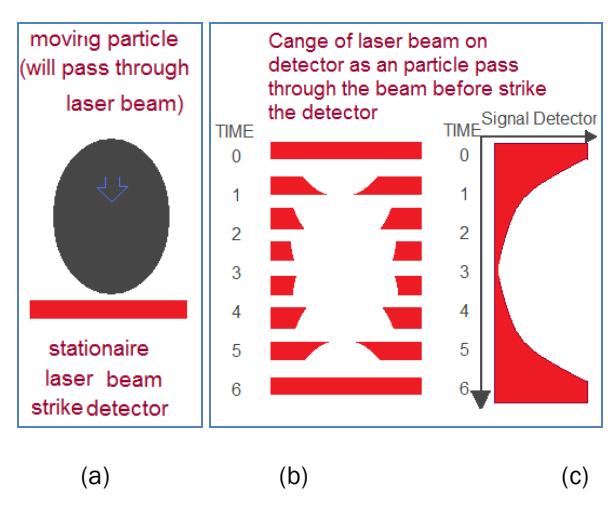
Figure 1 Interaction between sheet shaped laser beam and a moving microsphere passing through the beam (a), the sequence of beam captured by light detector (b), and signal intensity resulted by the detector (c) [8]
3 Experiment of Particle Counting Sizing
The design of equipment as illustrated in showed in Fig. 2 or shown in Fig. 3a (located in laser laboratory P2F-LIPI) consists of a continuous-laser line illumination of flowing particles through mind owed part of particles transport, a detector of laser intensity pass the windowed particle passage that is disturbed by particle in movement and its relative position to the line laser beam and system for pulse analysis of million sampling per second.
The thickness of line beam about 30 um (< 7% of particle diameter). Assumed the linear velocity of particle is constant (its terminal fall velocity) the change of capture intensity can be related to the thickness of part of particles that reflected or absorbed of laser, then particle geometry can be reconstructed.
We used a Stocker-Yale Microfocus laser, part number MFL-650S-10-15-185-SD as the optical source. This unit operates at a visible wavelength of 650 nm and has a 15 degree fan angle, with an ideal focal distance of 185 mm. At this focus point, the laser beam has a thickness of approximately 35 microns.
Figure 2 Simplified diagram of device for particle size and shape measurement and eventually for sorting, and photograph of spherical fuel particles [8]
The laser detector is a New Focus Model 2032 wide-area, free-space visible light photo receiver. To match the quantized gains of our ADC unit we used the middle gain setting and also incorporated a neutral density filter with an optical density of 0.6. This filter fits into a holder on the 2032.
A National Instruments 6111E general -purpose data acquisition card has been chosen for our ADC unit with a sampling rate of 5 MHz. The unit offers DAC outputs, which proved useful for testing and debugging the data acquisition software. The ADC is a 12 bit unit but is bipolar only. Because our signal is positive-valued, we only have 11 bits available. For data acquisition purpose, the photo detector was connected to an oscilloscope (Fig 3a) during experiment. A cylindrical lens is used to collimate the laser expanding beam. This keeps the beam at a constant width and also helps prevent the fan angle p roblem discussed later.
4 Result and Discussion
In Fig. 3b a typical of detected laser obscuration by a spherical polymer of 850 um diameter which was captured on the oscilloscope is presented. The curve of voltage of laser obscuration detected versus time is apparently parabolic. The diameter maybe directly accessed from the time elapsed by the curve if the flow velocity is measured or recorded, which is the time multiplied by the particle velocity passing the observation cell. Otherwise the particle diameter may be computed by geometry modeling of laser obscuration by passage of particle [Suwardi 2010]. There are 3 methods for the diameter evaluation: negative peak or minima, average, and square of the obscuration curve.
Figure 3 Experimental configuration for testing the laser obscuration design in laser laboratory P2F-LIPI (a) system measurement (b) measurement of laser obscuration by a passage of a fuel particle.
Evaluation of particle diameter by analyzing the obtained curves of voltage – time monitored by the oscilloscope is presented in Table-1. The minima method has been used to determined particle diameter.
The resume of the diameter determined by minima method is presented in Table-2. The samples average diameter has been found comparable to the data of a 10 g certified sample.
Table 1 Measured 100 Samples of Polymer Opaque Microspheres
| Statistical Parameter | Computed Minima | Measured Diameter,um | Sample certificate,um |
|---|---|---|---|
| Mean | 53.7732 | 779.7120952 | 780 |
| Standard deviation | 2.5027 | 36.28866439 | 14 |
| Maxima | 63.4178 | 919.5581943 | 850 |
| Minima | 49.6899 | 720.5042426 | 710 |
| Sample Number | 100 | 10 gram |
Some of the preliminary test sample particle from the 10 g sample particle is presented in Figure-4. The left side picture is a frontal photograph polymer opaque sample, while the right side is a binary conversion of frontal photograph of magnification M=40 (right).
Figure 4 Optical macrograph of some polymer opaque particle samples of 710-850 um left frontal photograph polymer opaque sample (left), and right binary conversion of frontal photograph of magnification m=40 (right)
| Curve-1 | Curve-1 continuous | Curve-2 | Curve-2 continuous | ||||
|---|---|---|---|---|---|---|---|
| Time | Voltage | Time | Voltage | Time | Voltage | Time | Voltage |
| -0.1235 | 2.273 | 16.79 | -11.36 | 0.6173 | -36.36 | 6.173 | -459.1 |
| -7.11E-15 | -38.64 | 0.6173 | -36.36 | 0.8642 | -59.09 | 6.42 | -454.5 |
| 0.2469 | -59.09 | 0.8642 | -59.09 | 0.8642 | -81.82 | 7.284 | -436.4 |
| 0.8642 | -118.2 | 0.8642 | -81.82 | 0.8642 | -127.3 | 7.901 | -415.9 |
| 1.605 | -140.9 | 0.8642 | -127.3 | 0.8642 | -159.1 | 8.148 | -395.5 |
| 1.605 | -227.3 | 0.8642 | -159.1 | 0.9877 | -161.4 | 8.148 | -381.8 |
| 2.099 | -111.4 | 0.9877 | -161.4 | 0.9877 | -184.1 | 8.765 | -365.9 |
| 2.346 | -286.4 | 0.9877 | -184.1 | 0.9877 | -181.8 | 9.259 | -343.2 |
| 2.346 | -327.3 | 0.9877 | -181.8 | 0.9877 | -202.3 | 9.383 | -327.3 |
| 2.593 | -370.5 | 0.9877 | -202.3 | 0.9877 | -270.5 | 9.383 | -227.3 |
| 2.716 | -370.5 | 0.9877 | -270.5 | 1.111 | -100 | 9.506 | -300 |
| 2.716 | -429.5 | 1.111 | -100 | 1.111 | -229.5 | 9.506 | -252.3 |
| 3.21 | -438.6 | 1.111 | -229.5 | 1.111 | -288.6 | 9.506 | -143.2 |
| 3.704 | -463.6 | 1.111 | -288.6 | 1.235 | -252.3 | 9.63 | -277.3 |
| 5.062 | -486.4 | 1.235 | -252.3 | 1.358 | -311.4 | 9.63 | -263.6 |
| 7.037 | -452.3 | 1.358 | -311.4 | 1.481 | -350 | 9.63 | -200 |
| 7.901 | -409.1 | 1.481 | -350 | 1.481 | -359.1 | 9.63 | -184.1 |
| 9.012 | -365.9 | 1.481 | -359.1 | 1.605 | -329.5 | 9.63 | -170.5 |
| 9.383 | -295.5 | 1.605 | -329.5 | 1.605 | -381.8 | 9.753 | -118.2 |
| 9.383 | -231.8 | 1.605 | -381.8 | 2.469 | -406.8 | 9.877 | -97.73 |
| 9.63 | -170.5 | 2.469 | -406.8 | 2.84 | -411.4 | 9.877 | -56.82 |
| 9.63 | -104.5 | 2.84 | -411.4 | 2.84 | -438.6 | 9.877 | -38.64 |
| 9.877 | -54.55 | 2.84 | -438.6 | 3.457 | -452.3 | 10.25 | -29.55 |
| 10.25 | 18.18 | 3.457 | -452.3 | 3.951 | -463.6 | 12.1 | -22.73 |
| 11.23 | -15.91 | 3.951 | -463.6 | 4.691 | -470.5 | 14.2 | -20.45 |
| 13.95 | -11.36 | 5.556 | -465.9 | ||||
5 Resume
The paper presents an experiment of geometrical sizing for kernel and coated particle which is based optical characterization. The system consists of a continuous -laser line illumination of flowing particles through windowed part of particles transport, a detector of laser intensity that pass the windowed particle passage that is disturbed by particle in movement and its relative position to the line laser beam and system for signal analysis of million sampling per second. The digitalized signal of light detector which detects captured beam with obscuration of light by interception of flowing particle consecutively to the beam is correlated to the shape of the moving particle. It was suggested to connect the detector to a PC via DAQ for analyzing the detected laser for geometry of particle.
6 Acknowledgement
The authors acknowledge the Indonesian Minister of Research and Technology for awarded grant for this study and staffs of modelling and laser study groups for supporting the set-up of experiment.
7 References
- [1] Suwardi, Sudarmadi, and Karyono Hs, ".BATAN Activities Research and Development Activities", in Proceedings of two IAEA meetings on Status and Prospects for Gas Cooled Reactor Fuels, June 2004 and June 2005, IAEA-TECDOC-CD-1614, IAEA, 2009
- [2] Indrati, T. et al., Private Communication, 2010
- [3] R. Hockey, L.J. Bond, C. Batishko, J.N. Gray, J. Saurwein, and R. Lowden, "Advances in Automated QA/QC for TRISO Fuel Particle Production," Proceedings of ICAPP '04, Pittsburgh, PA USA, Paper 4213, 2004
- [4] K. Wallisch and P. Koss, "Automatic size analysis of coated fuel particles," Nucl. Tech. 35, 279-283 , 1977
- [5] J. Price, J. Hunn. "Optical Inspection of Coated Particle Nuclear Fuel ," in Proceedings of Machine Vision Applications in Industrial Inspection XII, SPIE vol. 5303, pp. 137-149, 2004.
- [6] R.N. Morms, D.A. Petti, D.A. Powers, and B.E. Boyack, "TRISO-Coated Particle Fuel Phenomenon Identification and Ranking Tables (PIRTs) for Fission Product Transport Due to Manufacturing, Operations, and Accidents (NUREG/CR-6844)", http://www.nrc.gov/reading-rm/doc-collections /nuregs/contract/cr6844/ , 2004
- [7] R. Hockey, L.J. Bond, C. Batishko, J.N. Gray, J. Saurwein, and R. Lowden, " Advances in Automated QA/QC for TRISO Fuel Particle Production," Proceedings of ICAPP '04, Pittsburgh, PA USA, Paper 4213, 2004
- [8] Suwardi, "Pemodelan untuk Analisis Data Pencacahan dan Penentuan Diameter Partikel Bahan Bakar Sferis Berbasis Peredupan Laser ", Jurnal Teknologi Bahan Nuklir 6(2) 2010.