

Introduction
Indonesia aims to achieve a 23% mix of renewable energy (RE) in primary energy produced by 2025. Consequently, RE will be massively integrated into Indonesia's dominant fossil-fuel grid in the upcoming years, including photovoltaics (PV). However, due to the intermittent nature of PV energy generation, grid reliability will likely decrease owing to congestion and atypical power flows [1]. Abundant electricity generation from PV systems in the middle of the day and the subsiding generation at dusk urge conventional grids to ramp up their capacity to serve the total grid demand.
One solution to increase grid reliability is to increase PV self-consumption (SC). SC is the percentage of PV power directly consumed compared to the total energy produced by PV. There are two ways to increase SC, which are Demand Side Management (DSM) in the form of load shifting and the addition of an Energy Storage System (ESS) [2].
A large percentage of a university building's total load can be attributed to its air conditioning system. Therefore, a substantial increase in energy savings can be achieved by applying load shifting to heating, ventilating, and air conditioning (HVAC) load [3], [4]. However, university buildings have distinct characteristics from other types due to their uncertain patterns and activities. The rooms have random daily occupancy [5], [6] or instance, classroom occupancy depends on the class schedule. This characteristic makes identifying the room's thermal model challenging. They also have diverse room functions and levels of activity, which will result in different HVAC load demands depending on the thermal comfort target for each room. All these
factors result in complex dynamics and uncertain building power consumption. Complex dynamics in a building increase the risk of inaccuracies during the modeling. The complexity poses a significant challenge in applying model-based control for conducting demand response, opening an even greater possibility of supply and demand mismatch. Therefore, a suitable building management system that can satisfy its distinct characteristics is required to tackle the challenges of maximizing SC.
This paper presents an integrated review of efforts to increase SC in university buildings. Moreover, this paper proposes a system architecture recommendation based on the literature review.
Methodology
This research began by evaluating the case study object's existing condition. This evaluation provided an overview of the pre-installed building system, and the next step was to review studies about efforts to increase self-consumption in university buildings. From the literature review, information regarding strategies implemented would be collected, which would be used to propose an enhanced system architecture aiming to integrate the solutions discovered. This research also discussed how the proposed system operated and its feasibility to be implemented in the case study object. This feasibility analysis was presented using a Smart Grid Architecture Model (SGAM) diagram.
1 System architecture proposal
SGAM was developed to find existing technical standards applicable to smart grids and identify gaps in the state-of-the-art and standardization [7]. The SGAM comprised three axes: Domains, Zones, and Interoperability layers [8]. Figure 1 shows the visualized SGAM.
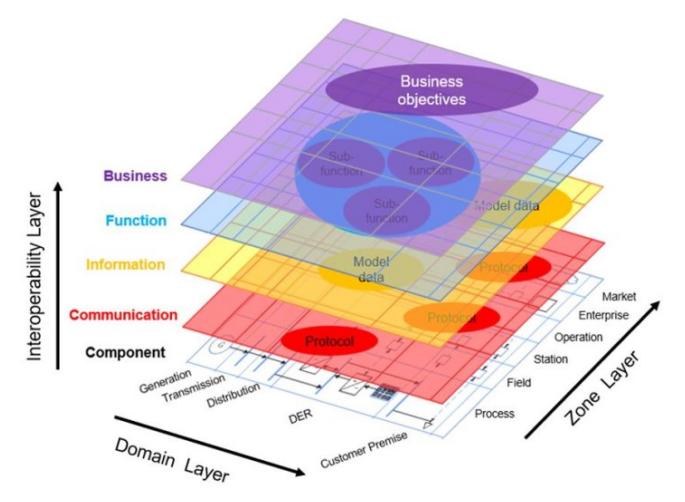
Figure 1. Overview of the Smart Grid Architecture Model (SGAM)
The system's architecture, which covers components required to develop the controller, will be proposed in the Component aspect of Interoperability layers, which covers the smart grid plane. The intelligent grid plane separates the electrical process aspect, which breaks down into the physical domains of the electrical energy conversion chain, and the information management aspect, which breaks down into the hierarchical zones or levels for the management of the electrical process [8].
2 Case study object
The object used in this study was the Labtek XIV Freeport Indonesia Business Research Centre (FIBRC) building at the School of Business and Management, Institut Teknologi Bandung, Ganesa Campus. It was located in Bandung, West Java, Indonesia, at an elevation of approximately 780 m. The building consisted of 6 stories with a height of 28.3 m, containing 3880.45 m2 total floor space. The ground floor was primarily filled with office spaces. Floors 1–5 shared similar floor plans, which housed instructional, laboratory, meeting, administration, utility rooms, and library.
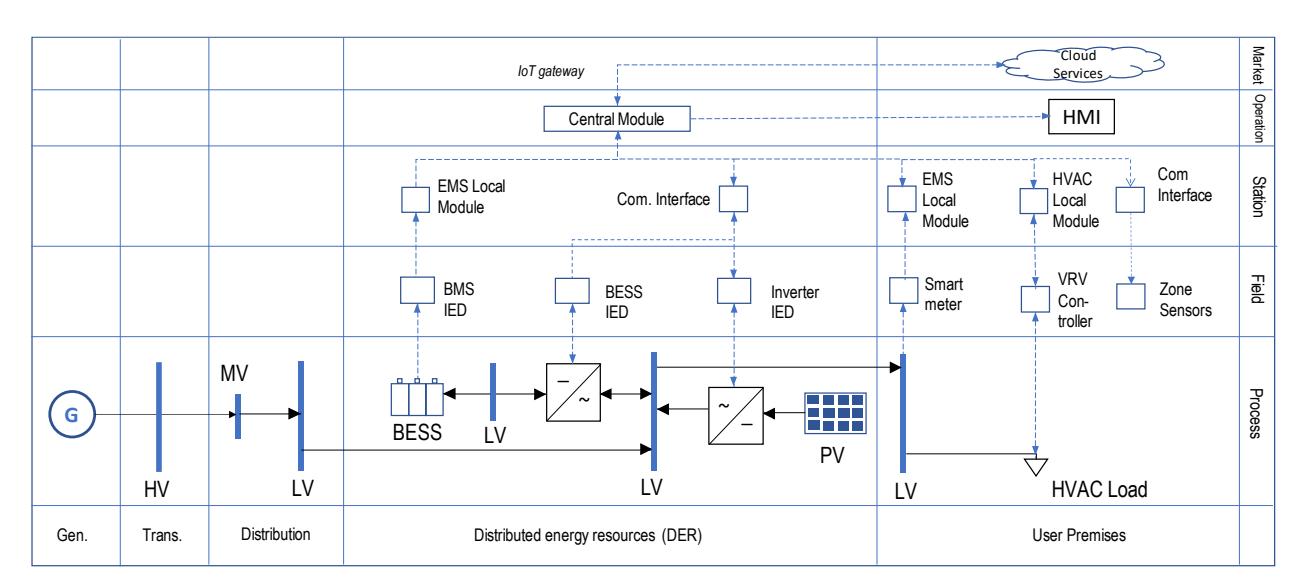
Figure 2. Component interoperability layer for FIBRC building
The FIBRC Building operates as a microgrid. Figure 2 is made to visualize the component layer of this microgrid. Main power is provided by the State Electricity Company (PLN), supplemented by a rooftop 57.6 kWp solar PV system. The PV system is set up with four SMA Tripower grid-tied PV inverters. A battery energy storage system (BESS) is also installed alongside the PV system, which can store 192 kWh of electricity. Two clusters of SMA Sunny Island battery inverters maintain the BESS as grid followers.
Air conditioning of the building is handled by 13 Variable Refrigerant Flow (VRF) outdoor units, which serve the individual indoor units in the air-conditioned spaces within the building. The whole system can be managed using Daikin's implementation of BACnet through the iTM DCM601A51 interface. DTA116A51 modules have been installed in the outdoor units to complement the vendor-specific system and enable control via Modbus protocol.
An energy monitoring system has already been developed for the building, which includes a network of smart energy meters and sensors. Energy meters are installed in the building's main distribution panel (MDP), subdistribution panels (SDP) on each floor of the building, critical infrastructure elements (lift motors, water pumps, HVAC outdoor units), as well as main contact points for several rooms. Room occupancy sensors or motion detectors and temperature and relative humidity sensors are also installed in specific rooms on floors 1 through 5. Although these sensors are initially installed to control the area's lighting, they may also be accessed for occupancy monitoring for HVAC control.
3 Literature selection
The literature research will be divided into two main aspects: energy storage system and HVAC demand response. The keyword "university buildings" would be used in both aspects to maintain consistency of the results. The next step was researching suitable control methods while considering university building characteristics. From the papers selected and reviewed, the methods used in the implementation will be investigated for further review.
Literature research
1 Building-Integrated Microgrid
It was previously mentioned that using PV in buildings increases the risk of decreasing grid reliability due to the intermittent nature of its source. There is also the risk of wasted energy production, especially mid-afternoon. Building-integrated microgrid (BIM) provides more flexibility, allowing the PV production to match the demand. A general microgrid schematic is displayed in Figure 3, including the power flow among the grid, transformer (TRF), loads, and sources. Generally, BIMs are equipped with energy storage systems, demand response, and Vehicle-to-Building and Building-to-Vehicle (V2B/B2V) systems [9]. BIM is equipped with only BESS and demand response in our case study object.
Figure 3. General Building-Integrated Microgrid schematic
The use of BESS has been proven to increase self-consumption in buildings. [9] calculated that BESS enhanced PV self-consumption in the University of Coimbra, Portugal, from 94.4% to 96.3%. The percentage increase was considered small because almost all PV generation was directly used in the building. However, another example [10] studied the implementation of BESS in educational buildings, assuming it had similar complexity to typical university buildings. The implementation of BESS resulted in an improvement in selfconsumption from 39.5% to 62.6%. This improvement shows that energy storage can be used to increase selfconsumption drastically.
2 Load shifting: Air conditioning system
Shifting flexible loads such as HVAC in occupied buildings is bound to constraints arising from technical aspects, such as the duration of the shift and occupants' thermal comfort [11]. In the context of maximizing self-consumption, the amount and duration of load shifting is highly dependent on PV production. Another hurdle is defining boundaries for the load shifting on thermal comfort.
The definition of thermal comfort is not straightforward. Researchers have tried to quantify it using various models, such as Predicted Mean Vote (PMV) and Predicted Percentage Dissatisfaction (PPD), which were developed by Fanger [12]. Fanger has prescribed several factors affecting human thermal comfort, such as air temperature, mean radiant temperature, air velocity, humidity, occupants' clothing insulation, and activity level.
In practice, some aspects affecting thermal comfort are hard to measure. Despite these challenges, researchers have tried to predict and model the thermal sensation of building occupants and incorporate it into HVAC control systems using various methods. Some past studies included direct human participation in the control system. In this approach, thermal sensation scores could be solicited from the occupants through either direct voting using an auxiliary software [13] or sensing the thermoregulation state of occupants [14]–[17]. Although involving the occupants in the HVAC control system improved energy efficiency [18], such a system was thought to be hard to upscale [19]. Moreover, using physiological sensors to predict the occupants' thermoregulation state raised privacy concerns [20].
Another widely adopted approach was the use of environmental sensors. [17] argued that these sensors were more affordable and had fewer privacy concerns. The most used sensors to approximate occupants' thermal comfort were temperature sensors (indoor and outdoor) [21], [22], relative humidity sensors [23], occupancy sensors [21], [22], and, in some cases, CO2 sensors [24]. [25] used environmental sensors to approximate occupants' thermal comfort and fed the university HVAC control system score. The result demonstrated the system's capability to keep thermal sensation neutral during 92% of the evaluation period.
3 Types of controllers
Most building control systems in the current literature still adopt on/off or simple rule-based controllers to save energy [26], [27]. Although rule-based controllers are easy to implement, they cannot control buildings whose dynamics have a significant time delay or large thermal inertia [28]. Controlling buildings with high thermal inertia using on/off controllers often results in instability. To tackle these issues, PID controllers are commonly deployed in HVAC systems. However, parameter setup for the controllers could become difficult, and the controllers' performance might decline when the operating condition is different from the starting point or when high uncertainty disturbance is present. Different operating conditions are commonly caused by disturbances such as changes in outdoor temperature, incoming sunlight through windows, and increasing
occupant activity levels [29]. Therefore, designing a control system that can work under complex building dynamics and uncertainties is crucial.
One of the controllers that works well under complex dynamics is model predictive control (MPC) [28]. In MPC, prediction and optimization features are embedded in its architecture. It has been widely used in the latest research on maximizing self-consumption [30], [31]. The advantage of using MPC lies in formulating the mathematical model of the building system, thus allowing users to predict its state in the future. Based on this prediction, MPC can produce control actions optimally in accordance with the objectives while also considering optimization constraints, such as comfort, efficiency, and weather forecast [32].
In developing an MPC-based controller, a physical approach is used to develop a building system model [30], [31]. The physically based model uses mathematical expressions that experts in practical applications widely understand, and the model is closer to human language [33]. The downside of the physical model is the requirement of complex mathematical formulation to model a complex system, especially to be implemented in real-time.
Another method is to use a data-driven model. Data-driven modeling is built upon a group of historical records, from which a machine-learning method is implemented to produce a model. Specifically, all parameters in the data-driven model will be chosen and modified through systematic comparison between model outputs and historical data, namely the training process. The data-driven model satisfies the requirements for practical application with new input only when the produced output error is inside the required threshold [34].
Upon using a data-driven controller, sensor readings are fed into the controller. The data is then used to train the neural network in the controller, providing control actions to the building system. The control actions can be in the form of charging and discharging schedules for the BESS or temperature setpoints for the HVAC system. The application of a data-driven controller for either BESS or HVAC control has been demonstrated in [35], [36]. Table 1 shows the data-driven control method used in the paper and the data required to build a controller. From the research done in the control method, it is also apparent that there has not been any research on how the data-driven controller could be implemented to manage both BESS and HVAC systems.
Table 1. Data-driven control on DSM and BESS and the data required
| Work | Control Method Used | Control Target | Data Required |
|---|---|---|---|
| [35] | Long-Short Term Memory (LSTM) | DSM (HVAC) | Occupants • |
| Weather data • | |||
| • Cooling power | |||
| • Temperature | |||
| [37] | Reinforcement Learning | DSM (HVAC) | • Zone mean air temperature |
| Zone thermal comfort value • | |||
| • Demand response signal (DDR or UDR) | |||
| • Solar radiation | |||
| • Outdoor dry bulb temperature | |||
| • HVAC demand power | |||
| • Total building electric demand power | |||
| [36] | H∞ | BESS | • Frequency response |
| • Voltage | |||
| [38] | Reinforcement Learning | BESS (with additional turbine system) | • Energy load profile |
| • PV power | |||
| • Power purchase price | |||
| • Gas purchase price (for the additional turbine system) |
Proposed System Architecture
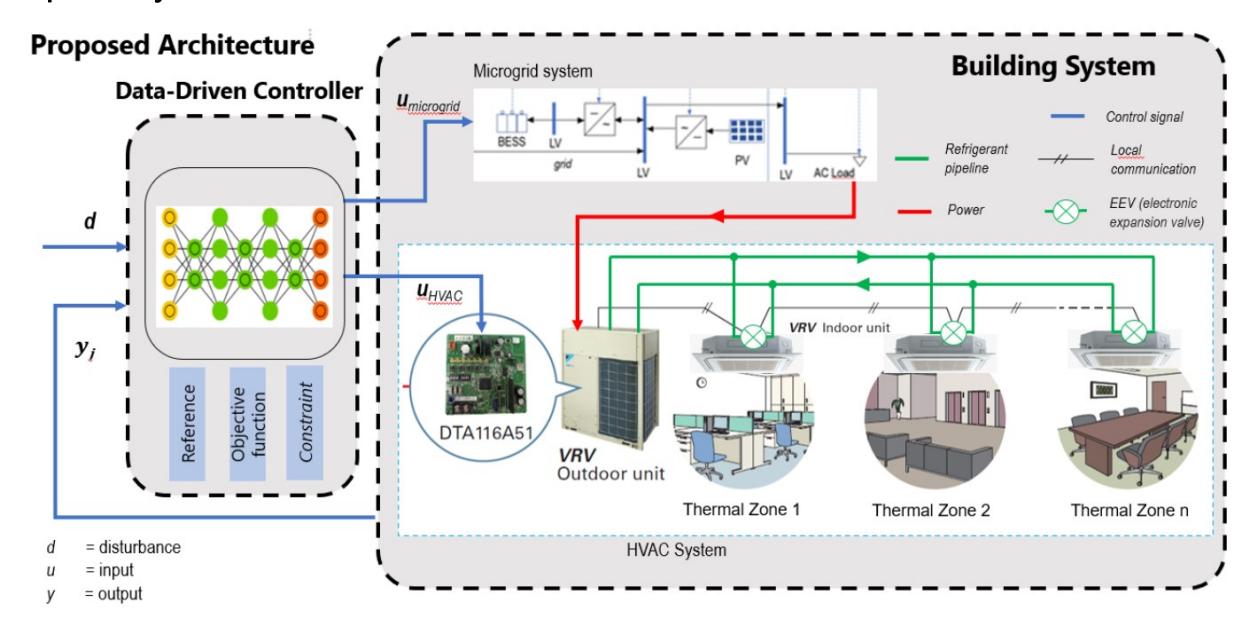
Figure 4. Proposed system architecture
A system architecture is proposed from the literature review done in section 3. Using a data-driven controller in the system is suggested that it does not need an explicit definition of the building model, thus being able to work under complex dynamics [4]. The controller receives input from both the building system environment and disturbance from external factors. The microgrid system feeds the battery's state of charge (SoC) data and the PV production to the controller. In contrast, the HVAC system provides the environment state to predict the occupants' thermal sensation and the HVAC load. The proposed system architecture is shown in Figure 4.
The Function Interoperability layer is then used to specify the functions of existing components to build the controller. From the layer proposed in Figure 5, it can be summarized that the sensors readily available are sufficient to feed data from both energy storage and demand side management to the controller, making it feasible to implement the controller.
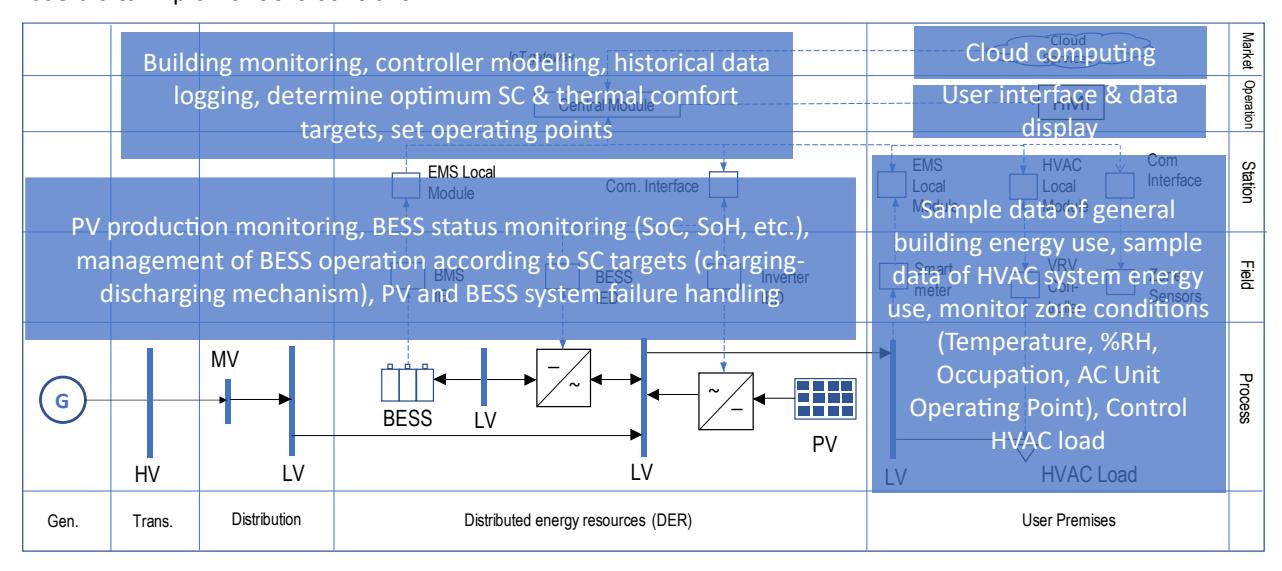
Figure 5. Proposed system architecture in the SGAM Function Interoperability layer
Conclusion
BESS and demand response are necessary to maximize university building self-consumption, and a controller will be added to act as a bridge and integrate information from microgrid and HVAC systems. In order to satisfy the building's complex dynamics, the suitable type of controller is the data-driven controller, which requires data readings from sensors. All required components are readily available in the case study object. Therefore,
the controller can be implemented. The proposed system shown in the functional interoperability layer of SGAM can be used as a baseline to develop the controller within the case study object on top of the existing components and how each component will communicate to provide data for the controller. The following research will implement the proposed configurations directly in the case study object.
Acknowledgements
Research Grant ITB and Research Grant from the Ministry of Education, Culture, Research, and Technology partially supported this research. The authors would also like to thank the Educational Fund Management Institution scholarship from the Ministry of Finance, Indonesia, and the Ganesha Talent Assistantship scholarship for supporting this research.