

I. Project Mission and Description
The Mission
The Rebirth of Jayakarta is a mission to revitalize and develop the waterfront of Jakarta and to resume its place as the front door to the city and the nation. The continuation of fragmented development short term vision is considered unacceptable in a city where urban infrastructure and development have long term consequences.
The Jakarta Waterfront Integrated Structure Plan provides an opportunity for Jakarta to havea new waterfront, in keeping with its status as a major service city in Southeast Asia, and the capital city of the fourth most populous nation in the world. This will be achieved through a long term programme and by a new organizational mechanism involving a series of partnerships between the public and private sectors and the community at large.
The Jakarta Waterfront Integrated Structure Plan covers almost the entire Jakarta Waterfront within DKI boundaries. It is an area of approximately 32 kilometers in length, stretching from just outside the airport in the west to Marunda in the east, encompassing an area of approximately 5,000 hectares, 2,700 ha of which will come from land reclamation. The new land will provide residential and commercial opportunities, including a new CBD.
The Waterfront project is not a mega-project, it is a co-ordinated plan which will integrate, under the Jakarta Waterfront Integrated Board one stop shop, a series of large and medium-sized project undertaken by numerous public and private sector partnerships.
Waterfront Objectives
The objectives of the Jakarta Waterfront Implementation Board are as follows:
- To revitalize the waterfront area which has become degraded and lost its potential to be the nerve center of national and regional economic life. A renewed Jakarta will be achieved by creating a new efficient, high quality and vital urban area on the waterfront. In keeping with its status, Jakarta will be ready to move into a period of increased international importance in the twenty first century.
- To address the existing problems of North Jakarta. At the present time, there are a number of problems occurring in North Jakarta which begin within and goes beyond the larger metropolitan area and ultimately has some impacts upon and concentrate along the waterfront. This applies to issues of drainage, flooding, water quality, transportation and accessibility. As a result, the area is suffering from increasing obsolence and environmental and social degeneration.
- To redirect the current growth of the city of Jakarta away from its recent push to the south and to provide investment
Jurnal PWK - 38 Nomor 21/Mei 1996
- opportunities that are more in keeping with the needs of the coming years.
- To establish a new basis and precedents for evaluating developments throughout Jakarta
Waterfront Goals
The Goals of the Waterfront programme are as follows:
- To implement an integrated land use/transportation strategy for the area in order to balance the development successfully and establish co-ordinated decision making and infrastructure provision
- To provide transparent organizational mechanisms to guarantee competitiveness, to maximize benefits to the community and to ensure effective implementation
- To improve the existing environmental quality and to create a better living environment in the new area. This will be achieved by the enforcement of high standards through integrated environmental assessments and management programmes. Wherever possible existing canal drainage and flood control systems will be improved.
- To provide low, medium and high density residential areas which include social and community facilities, local commercial services and open space. The provision of community and public access will be encouraged through private sector contribution. Existing poor housing areas will benefit from the improved infrastructure and new areas of affordable housing will be provided.
- To create rules, procedures and transportation infrastructure and engineering practices in relation to reclamation and infrastructure provision.
- To reinforce existing investment in transportation infrastructure and to provide opportunities for increasing the patronage and feasibility of the proposed MRT.
- To preserve and where appropriate to revitalize the historic areas of Kota, Sunda Kelapa and Luar Batang. A detailed urban design plan, conservation guidelines and
These opportunities will be realized through a series of individual projects, each carefully defined to maximize commercial and community advantages. This is an overall business plan that ensures the financial soundness of the development programme. A package of legislative and organizational arrangements will support the implementation of the programme. Thus a series of opportunities over many years will be available to those committed to the development process.
• The Description of the Plan
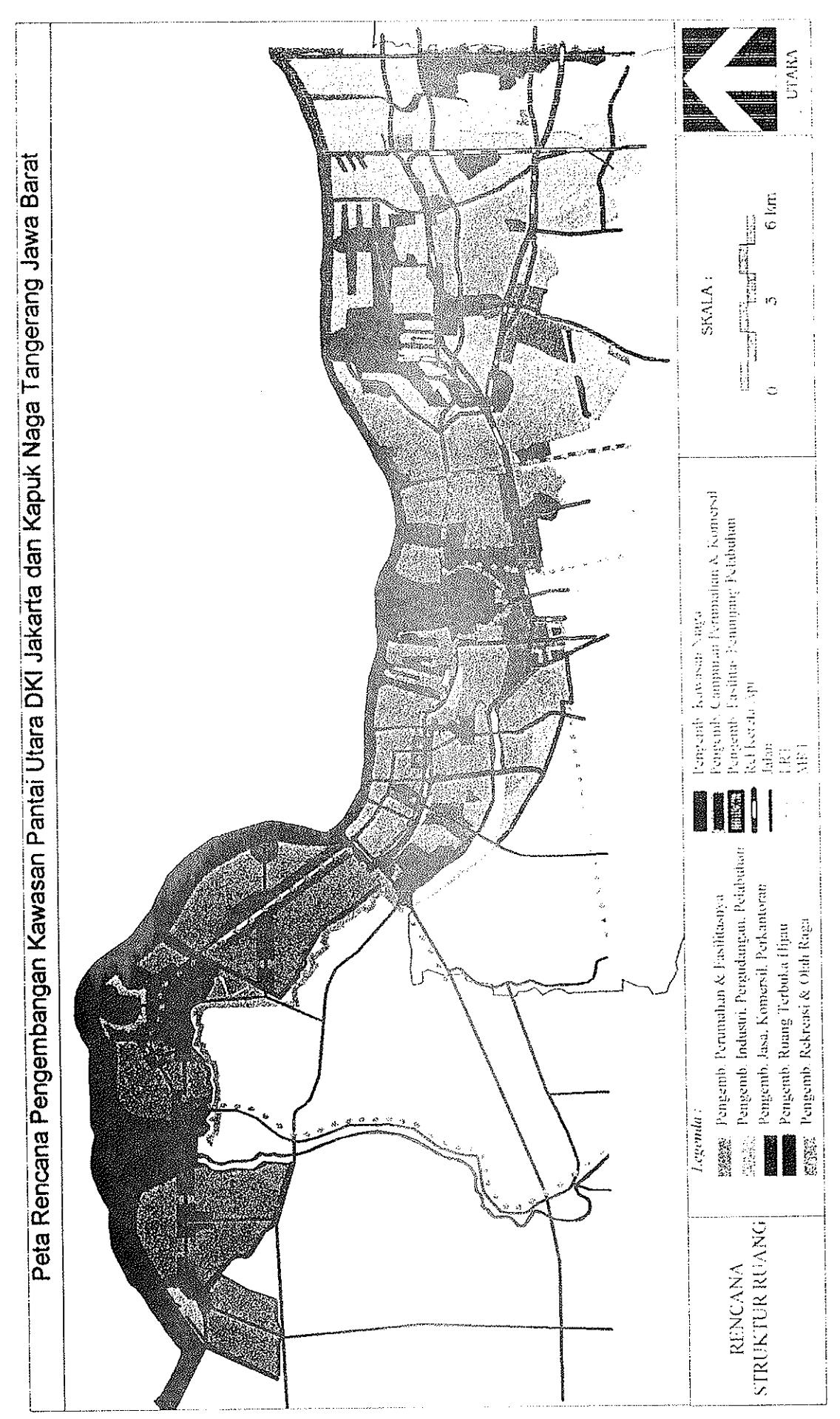
An integrated land-use or transportation plan, capital works program and financial evaluation has been prepared for the revitalization of existing waterfront areas and to create approximately 2,500 hectares of new land and development.
- 1. The new land is integrated with the existing urban area by a system of major east-west transport and service corridors and major north-south public transport proposals (the MRT).
- 2. A Central Business District (CBD) to accommodate international head offices and financial institutions is located at the intersection of the major north-south and east-west transportation corridors.
- 3. Directly adjoining this area is the existing historical, cultural and tourism area and an already highly active mixed retail and local business area.
- 4. To the East is medium to high density residential areas with lower density residential communities to the West.
- 5. Port operations and port related industries are relocated to and expanded around Tanjung Priok; freight transport linkages between the port and the region are
• Establishing a New Management Structure, Standards and Procedures
The development of a 'one stop service' management structure and procedures has been designed to facilitate development and to establish a new benchmark for development through high standards in environment, urban design and engineering.
Environmental, engineering and planning standards and procedures have been established to clarify requirements before the designs and financial offers are finalized by interested parties. The objective is to assure a greater certainty for developers and investors in the planning approval process and to assure transparency in the evaluation of project proposals and financial offers.
• Staged Private Sector Participation
Just as the City of Jakarta is the products of many people and corporations, so is The Rebirth of Jayakarta is a series of separate project finance and development packages that will be put to the market progressively over a period of twenty years. Development is to be principally undertaken by the private sector. Opportunities also exist for private sector to establish a partnership with the Government and Government Business Enterprises.
• Development Contributions and The Sale of Development Rights
Developers will be required to make contributions to engineering (services and transport) and social infrastructure that is the result of the additional population of residents and workers created by the development of Pantura. In addition, the proceeds of the sale of development rights will finance the upgrading of engineering and social infrastructure in the surrounding poor and environmentally blighted areas.
II. Management and Regulatory Structure
Presidential Decree -- The Keppres No. 52/1995
The KEPPRES identified the boundaries of the Jakarta Waterfront Area. It designated the extent of the reclamation area and the general nature of uses permissible in the area.
The signing of the Presidential Decree gave the Government of Jakarta (DKI) the responsibility to manage and control the development of the waterfront in consultation with other relevant central government agencies. A Ministerial Advisory Group was created to assist the Governor in this coordination task.
The JWIB 'one stop' service coodination and facilitation role
To create an effective management structure to manage the public private sector partnership process. The KEPPRES also established the Jakarta Waterfront Implementation Board (JWIB). A joint public private sector participation is processed under the BUMD (Local Government Enterprise).
• Development Approval and Environmental Assessment Procedures
The existing development approval and environmental procedures will be maintained. However, the creation of JWIB is designed to provide a 'one sop service' for application and consideration of development proposals. Instead of developers/investors having to submit applications and negotiate with numerous authorities, the JWIB will be responsible for this task.
III. Technical Standards
• Engineering/Environmental Standards
The reclamation of land, the total water cycle infrastructure, the provision of transportation and other infrastructure services will be subject to additional requirements mentioned
LAMPIRAN I KEPUTUSAN PRESIDEN 52/1995 TENTANG REKLAMASI PANTURA JAKARTA
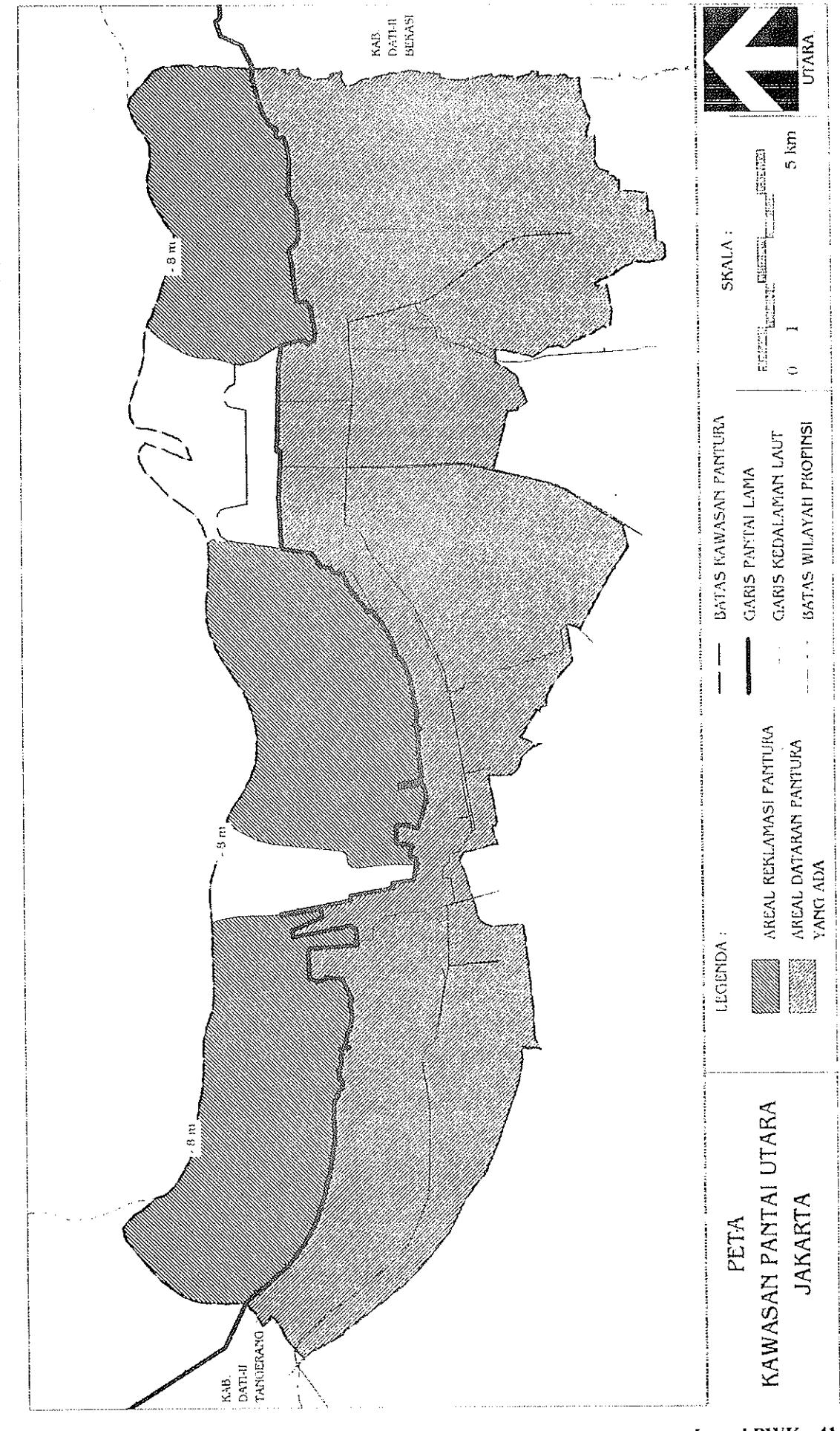
REKLAMASI PANTURA JAKARTA KAB. DATHI BEKASI UTAKA TENTANG SKALA: PEMERINTAHAN & PERUMAHAN CAMPURAN PERUMAHAN & INDUSTRI CAMPURAN PERDAGANGAN JASA/ BATAS KAWASAN PANTURA BATAS WILAYAH PROPINSI GARIS PANTAI LAMA PERDAGANGAN JASA/PEMERINTAHAN RUANG TERBUKA HIJAU PERUMAHAN PELABUHAN LEGENDA: PANTAI UTARA JAKARTA PETA PEMBAGIAN ZONA KAWASAN TAMOERANC KAB. DATI-II
Jurnal PWK - 42
KEPUTUSAN PRESIDEN 52/1995
LAMPIRAN II
Nomor 21/Mei 1996
in the existing regulations and the overall goal of environmental sustainability. The objective is to establish a new benchmark in development standards of the waterfront. These requirements are made explicitly in the Expression of Interest, Bidding, Briefing and others such as Documentation prepared by the JWIB/PUMD.
• Planning and Urban Design
The principle instrument defining rules relating to land-use and density development is the PERDA (Local Regulation) that has been approved by the Parliamentary Council. Proposals put forward by developers/investors will be evaluated with regard to planning and urban design considerations. Proponents will be required to demonstrate how their proposals will achieve the mission, goals and objectives underlying the statutory plan. Innovative designs and solutions are also sought.
Social and Community
The provision of social infrastructure will also be an important requirement. Existing rules and regulations require a basis of community infrastructure provision. Solutions proposed for community center development (the integration of shopping, educational, recreational, cultural and health facilities) will be considered for the evaluation of the development proposals.
IV. Capital Infrastructure and Staging
• Capital Work Program
An integrated capital work program has been prepared as parts of the staged release of projects finance and development parcels. This form the basis of the contributions' charges required for different development categories and scale of development.
Staging
The size of development parcels and the sequence of release of development parcels has been determined by efficiency
consideration. In the case of land to be reclaimed, parcels of more than 80 - 100 hectares will be put to the market. To minimize the risk, capital investment and competition development parcels will be released progressively. There will be a requirement on developers of these larger parcels to develop the land rather than put it on land bank. Hence just as the overall development will be staged so to there will be a requirement to subdivide and to develop the land within these areas
• Development Contributions Principles
Development generates populations increases -- residents, workers and visitors. In turn these create a demand for transportion and parking facilities, water and sewerage facilities, education, health and recreational facilities.
Developers/investors will be required to meet the cost of these demands. A scale of contributions, fees and charges will be provided in documentation prior to financial offers being made. The option will also exist in particular cases for developers/investors to provide part of these infrastructure requirements 'in kind' rather than by way of contributions.
V. Financial Development
• Development and Investment Opportunities
A series of financial models has been prepared to demonstrate the financial feasibility of the overall project. Each developer/investor is required to undertake their own analysis and be satisfied with the viability of their proposals and offers. This is one of the largest development projects in the Asia Pacific Region. Government commitment to the project is a major benefit.
Sale of Development Rights Principles and Staged Draw-downs
The sale of development rights provides the revenue stream to the JWIB to enable it to undertake capital infrastructure and maintenance work to solve some of the environmental and engineering problems in the surrounding areas. The sale of these development rights will be on a tiered basis with a proportion of up-front payment and further payment as developments proceed.
• Financial Evaluation
Proposals will be required to be completed according to specified formats and procedures. Offers will be weighted according to up-front payment versus staged payment based on programs and projections. Information of the financial strength and similar project experience will be required.
VI. Existing and Related Projects
Project in Progress -- public and private sector developments
Market interest in the waterfront is proven by the nature and scale of development already taken place. Continued interest in the project is demonstrated by ongoing deve-lopment (Pantai Indah Kapuk, Pantai Mutiara and P.T. Ancol Jaya) and the initiation of new projects to the East in the vicinity of Tanjung Priok (P.T. Manggala). Many of these projects will continue over the next short to medium term.
• Related Infrastructure Projects
Major new infrastructure projects such as the Harbor Link Road and the Jakarta Waterfront have recently been completed. Proposals for MRT, LRT/toll way/arterial way will further increase accessibility to the area. Development of the waterfront will provide much needed funding to improve drainage and minimize flooding in the surrounding locality. This will benefit both the old and new areas.
VII.New Projects To Be Put To The Market
Alternative for negotiation, bidding, and procurement processes
A series of alternative procurement procedures is contemplated. This ranges from join ventures with existing owners, negotiations with short listed invited parties and open tender procedures. This will vary depending on the procurement method selected by the JWIB for various project finances and development packages.
Option will be available to structure project finance and development packages on a sector and/or an integrated geographic area basis.
VIII.Ongoing Private Sector Participation
As described previously, there are already some projects in hand and further schemes will be brought forward in the near future. The Waterfront Programme will continue for many vears and a stream of opportunities suitable for a variety of organizations will be available in the near, medium and long term. These opportunities will require different means of ioint venture including achievement, Competitive mechanisms agreement. different sorts will be the main means of registration form, these forms will be available shortly and it is intended that the opportunity to register will be available throughout the life of the project.