

I. INTRODUCTION
According to Levy (2001), intervention in urban policy, urban planning, and urban management could have important meaning in several areas. In urban policy, it contributes to inclusive, equal and efficient urban governance through creating the institutional and legislative framework. Moreover, intervention in urban policy also contributes to redistribution of wealth by addressing role of central state. In urban planning, intervention adds improvement in plan making process through creating strategic frameworks to support collective and inclusive debate in the process, that finally generating better living condition in the city. In urban management, intervention gives contribution in provision and maintenance of infrastructure and basic services.
The intervention above becomes strategic because of three essential arguments as follows: (1) it expands room for manoeuvre to contribute to social justice; (2) it creates synergy between actors (stakeholders) in the pursuit of social justice; (3) it will creates a multiplier effect on the process affecting social justice. Hence, strategic intervention essentially means as a process of communicative interaction between actors (stakeholders), in which information, opportunities and constraints are transformed through the very process of dialogue (Levy, 2001).
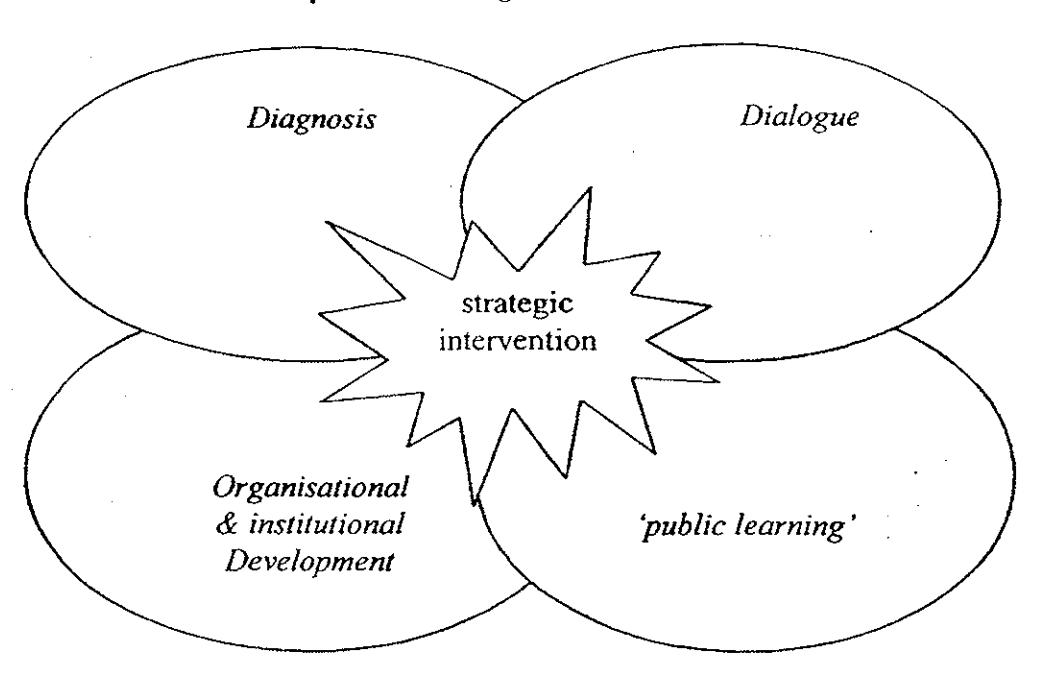
Central to the concept of strategic intervention is collaborative approach for inclusion of all stakeholders, in which diagnosis, dialogue, public learning, and organizational and institutional development took place. Through the collaborative approach, enablement of all stakeholders shall be achieved. Enablement of all actors will improve the process of conceptualising the objective, means, and implementation, even the evaluation and monitoring of plans. Furthermore, a good strategic intervention should contribute to a more socially just society.
This paper will apply this approach of strategic intervention in the field of housing policy situation in Indonesia. Housing policy in general is the source for designing housing provision for a country. Failure of housing provision system to provide adequate housing services shall be addressed to the central housing policy. The main failure of Indonesian housing policy lies in its inability to provide adequate housing needs for the people and its ignorance to current (and existing) potential non-conventional housing provision in the market. Besides, the centralize policy has been reducing local urban government and authority to participate in decision-making process in its own urban areas. Moreover, ignorance of other actors (stakeholders) in central and urban level beyond government bodies has resulted in centrally uniform implementation among various characteristics of cities (in terms of size, city agglomeration, living cost condition and social values, and cultural and local housing values). The Indonesian housing policy also has failure in supporting urban development process, that is the inability of local government (especially in middle and big cities) to incorporate the housing policy and development into each city plans for improving better living conditions in the city. Struyk, et al (1990) convinced that future housing policy in Indonesia should be framed by the government of Indonesia's current well-articulated urban policy, that figures prominently in achieving the national development objectives of equity, sustained national economic growth, and national stability. However, what Struyk, et al (1990) convinced has been over and should be academically questioned since the achievement of the above targets have been failed in the country.
This paper is about an analysis of housing policy in Indonesia from strategic intervention point of view in general. As there is no particular quantitative or qualitative data for the input of analysis, the result is mainly an academic exercise based on some articles on housing in Indonesia and other related materials. Moreover, this paper mainly deals with housing provision in urban areas.
The main component is to compare the housing provision model presented by Pough (1990, 1994) and Keivani & Werna (2001a; 2001b) to Indonesian housing situation. Extracting the main ideas from both models will result in a conclusion, which then is compared with the Indonesian situation. Further, new analytical approach to strategic intervention for housing policy in Indonesia is proposed.
Two models were used because the two clearly stated as models to elaborate the housing provision in developing countries. Besides, both models have different characteristics and approaches in dealing with problems of housing provision. Pugh model mainly deals with financial housing provision approach from strategic point of view, and Keivani & Werna model deals with elaborating existing structure of particular housing provision in developing countries using relationship between 'structure' and 'agency' as the analytical tool.
II. HOUSING POLICY AND THE CHANGING PARADIGMS
Debate on housing policy laid on two main considerations whether housing should be based on social policy or economic policy. These will be the main concerns of government involvement in deciding through which policy housing should be provided to achieve social justice. The failure or inability of the market to provide adequate housing is seen as reason for strategic intervention from the state. In socio-democratic model this intervention can be justified on the grounds of economic efficiency as the contribution for the labor productivity (Clapham, et.al, 1990). In Marxist point of view. this intervention can be considered as a way of the state to maintain the needs of community and government employers to prevent social chaos.
So far, there has been a changing paradigm in housing provision acquired by most developing countries. The changing has been supported by the World Bank as the main lending agency in supporting housing development throughout less developed countries. The changing paradigm as stated by Munjee (1992) is about removing the shelter sector from the social domain and placed squarely in the economic domain.
The old paradigm was the development of the shelter sector resulted in a serious call for government action and international donor support for improving housing and infrastructure conditions of the poorest families in less developed countries (Munjee, 1992: 2). It was the result of the first major meeting of the shelter professional in Vancouver in 1976 under the aegis of the United Nations. It was known as The Vancouver Action Plan, following the Vancouver Declaration.
The new paradigm was based on the Vienna Recommendations which moved considerably beyond the Vancouver Declaration. The new paradigm laid in re-emphasizing the role of the private sector in the development process; the need to form partnerships between public and private sector; to emphasize the role of the markets and to underscore the crucial role of the price mechanism; and to reintroduce the central role of resource mobilization, financial institutions and mechanisms as vital to any healthy development of the shelter and urban sector of the economy (Munjee, 1992: 4). Then, the Vienna Recommendations was followed by The Global Strategy (The UN Global Strategy for Shelter to the Year 2000), adopted by the General Assembly of the United Nations in 1988. The latter strongly reflected the view taken earlier by the Vienna Recommendations (Munjee, 1992: 5). This Global Strategy was adopted by UNCHS in 1988 (Keivani & Werna, 2001a: 66). According to the latest World Bank housing sector policy paper (1993), the main focus of World Bank housing policy in developing countries is the enablement of private housing markets. Similarly, the main focus of UNCHS shelter policies and recommendations are in enabling strategies for private markets, as stated in its 1996 Habitat II conference in Istanbul ("the adequate shelter for all and sustainable human settlements"), (Keivani & Werna, 2001a; 66). As for Sivam, et.al. (2001), the rationale for greater involvement of the private market in housing delivery would lead to more housing construction activity and would reduce the burden on public funds.
Central to the paradigm changing in the shelter sector is the new introduction of neo -liberalism by the World Bank. Critics on neo-liberal approach were presented by Keivani&Werna (2001a). They criticized the new approach to emphasize the housing provision totally on the private market as somewhat misplaced. They pointed out that private markets can and should be supported, but they did not agree to consider the private markets as the focus of attention in all or even the majority of cases in developing countries. Their arguments are based on the problems of operation and internal constrains private land and housing markets (Keivani & Werna, 2001a: 67).
"In the context of developing countries the operation of private land and housing markets are hampered by serious internal constraints which largely stem from severe institutional underdevelopment, scarce human and material resources and interaction with, and undue influence of, social, political and cultural factors which impinge on their efficiency. In most cases, such constraint are unlikely to allow the expansion of private markets to the degree that would satisfy the objectives for scaling up housing production to meet the needs of large sections of the low income urban households." (Keivani & Werna. 2001: 67-68).
The changing paradigm above cannot be separated from the classical debate between the two mainstreams of which state intervention should be based on, social or economic policy.
III. PREVIOUS STRATEGIC INTER-VENTION IN INDONESIAN HOUSING PROVISION
Following the old paradigm in housing provision, Indonesian housing policy had three different parts (see Winarso, 2000). First, to improve and maintain the existing settlements through Kampung Improvement Programme (KIP). S.Yeh (1984) defined "Kampung" as "predominantly residential area, often a previous village engulfed by urban expansion. These 'urban village', which include both low-and middle-income households, have generally inadequate physical infrastructure and social services. However, a great many of them were and are socially cohesive communities." Second, to construct new houses through government's funds and through mortgage system. Following this policy, the National Urban Development Corporation for Housing (Perumnas) and The State Mortgage Bank (BTN) were established. Third, to set up and implement the urban renewal system. Here, the government demolished deteriorated kampung areas and constructed new dwelling units, usually in the form of multi-storey house building (walking flats), with necessary infrastructure and facilities.
Critics to this policy have been widely elaborated in different areas. Some of the critics are: (1) The KIP involved no direct investment in housing perse (S.Yeh, 1984); (2) the urban renewal system created problems of housing condemnation and people displacement in urban areas. However, such programmes (The KIP and the urban renewal) were assisted by The World Bank, if not to mention that The World Bank participation was significant during the implementation of the programmes.
The new paradigm in Indonesian housing provision represented through formal housing development as the main means to achieve housing supply target (Silas, 1987). Although the formal housing sector has been totally liberalized, many of the segments in the process of its development are highly subsidized. The subsidy is through two main areas: first, low mortgage interest payment for middle and low-income group, and second, subsidy to developer (land developer and housing developer).
Emphasizing housing provision through formal housing development, at the same time, the central government has been ignoring other existing potential modes of housing provision. Currently, most housing provision in Indonesia has been provided by the individual household production. Proportion of houses provided by individual household production and formal housing production are 85%: 15%, based on 1985-1990 study (Struyk et. al, 1990).
Under the new paradigm, the housing market in Indonesia is guided by the central government through policy of housing provision for high-middle-low income group in proportion of 1:3:6. Looking from different point of view, this policy is the indirect instrument to ensure the provision of low-income housing for the low-income groups.
As a conclusion, the main failure of the previous strategic intervention in Indonesian housing policy are: (1) the commodification of housing has been created housing development as political indicator of housing development in general. While, at the same time most of housing supply by non-conventional means are not considered and treated properly; (2) Local government participation as well as other local agencies (stakeholders) have been a silence voice that have not been involved in setting up the housing policy. Central to this failure is the ignorance of local value on housing policy and urban master plan.
IV. BUILDING STRATEGIC INTER-VENTION FOR THE FUTURE
4.1 Pugh Model
Pugh (1990, see also Pugh, 1994) presented a housing model, as seen in a wider economy (Figure 1). There have been three areas characterized within the model. The first part is the production-consumption economy that divided into the formal and the informal sectors. The second part is the policy perspective, which are the intermediary roles of the private market and government. The third part is the housing system that linked to the intermediaries and to the production-consumption economy.
Central to this idea is the relationship between structural condition in a society (leaning onto the neo-Marxist analysis) and contingent condition in policy. The structural condition will set a framework of housing practice, while contingent conditions are things such as the expression of policy, the characteristic of housing market, the essential of housing finance, and the historical and cultural conditions of a country.
Taking a case study of India, he pointed out the 'strategic intervention' to a chronic housing supply shortage. He mentioned the social solution to the problem is to increase supplies throughout the housing system, by establishing good inter-mediation, and to tilt some of the saving-investment flow into housing in general, and low-income housing in particular. Furthermore, he emphasized that this solution should be interdependently connected to increasing supplies among all groups (Pugh, 1990: 29-30)
4.2 Keivani&Werna Model
Keivani & Werna (2001a; 2001b) proposing a model of housing provision that repre-
Figure 1 Housing and the wider economy
The Housing System luvesting Households Saving Capital Market Luxury: High-incomes Investing Good Spending Investing Formal Housing: Services Middle-incomes Government Public Housing Firms Infastructure Slum Dwellers: The Poor New housing: Renovations Squatters: The Poor Saving and Wealth Pavement Dwellers: The Building and Repairs Poor Informal Sector: Producers and Consumers
Source: Pugh, C. (1990) Housing and Urbanization, a Study of India. Sage Publication: New Delhi. See also Pugh, C. (1994) Development of Housing Finance and the Global Strategy for Shelter. Cities, II (6), pp. 384-392.
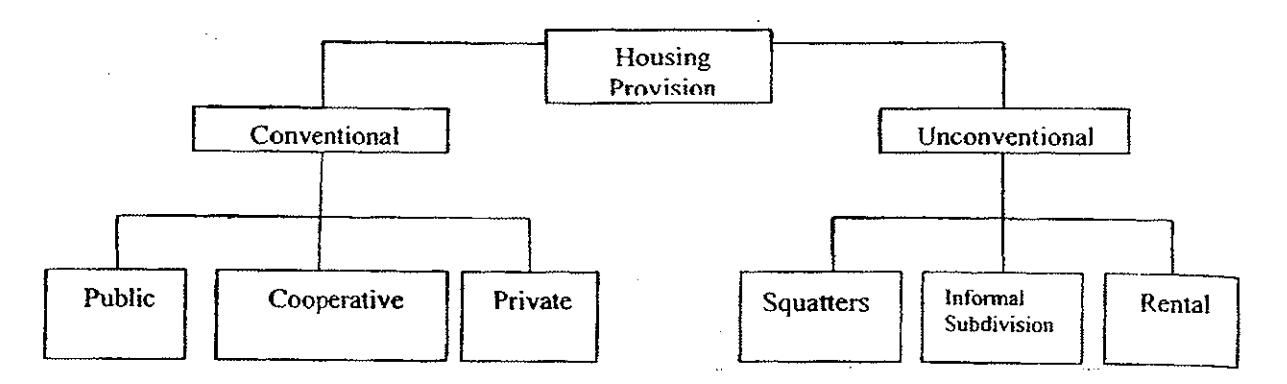
senting the contributions of all kinds of stakeholders in any developing countries (Figure 2). They defined systems or modes of housing provision by the process through which such provision is achieved. They proposed a model that emphasized on the relationship between 'structure' and 'agency' in a system as analytical tool for identifying and examining the process. Furthermore, they pointed out to that analytical tool as the concept of structures of provision which is based on the identification of social relations and interactions of agents involved in all aspects of housing provision (Keivani & Werna, 2001a: 69).
In their view, a conceptual model of the main modes of housing provision in developing countries can be developed by subdividing the two main structures (the conventional/formal and the unconventional/informal modes) into several secondary substructures (Figure 2). They suggested that the model could be elaborated even further by adding more components to the secondary substructures to represent any other modes of housing provision which may exist in particular city (Keivani & Werna, 2001a: 71). Their concept of conventional/formal and unconventional/informal basically has been respectively referred to the same concept of legal/regular and illegal/irregular (Keivani & Werna, 2001a: 72).
Based on their model, Keivani & Werna argued that private markets can not form the focus of the enabling strategy in most developing countries while having or being supported. Instead, they argued to apply a com-
Figure 2 A Conceptual Model of Housing Provision in Developing Countries
Source: Keivani, R., and Werna, E. (2001a) Modes of housing provision in developing countries. Progress in Planning, 55, pp.65-118, and Keivani, R., and Werna, E. (2001b) Refocusing the housing debate in developing countries from a pluralist perspective. Habitat International, 25, pp.191-208.
prehensive approach to enabling strategies which combines adjustments to overall supply and demand conditions. Their main consideration was the identification and inclusion of different modes and agents of housing provision in a holistic integrated policy (Keivani & Werna, 2001a: 65).
V. MODIFIED HOUSING PROVI-SION MODEL FOR INDONESIA
Pugh model and Keivani & Werna model have different emphasis in their respective analytical consideration. Pugh model has focused on the intermediary function as the main focus of the strategic intervention in housing provision. His model has led to more financial consideration in supporting the demand side to meet the supply side of housing (Pugh, 1994). The less elaborated in his model is the housing system elaboration as structured base. His model has more emphasised on the financial side of the existing modes of housing finance for different income groups. His model is rather different from Keivani & Werna model. The latter is more focusing on the relationship between 'structure' and 'agency' as the main analytical tool to represent a holistic picture of housing provision. As a conse-
quence, their model is more comprehensive however is still open to be added to represent any local structure condition in particular cities. In my point of view, the latter model is more applicable than the previous one in terms of identification and examining existing condition of housing provision in any developing countries before implementing further policy.
Based on the above models, the modified Indonesian housing provision model is likely as an incorporation of the relationship between 'structure' and 'agency' approach and the intervention in intermediary process between substructures and the agencies involved in housing provision.
In the modified model above, Keivani & Werna model is valuable as the framework to elaborate the structure of existing housing provision in Indonesia. My suggestion is to identify other substructures in Indonesian housing market that can be added up to this model. This elaboration is just as starting point before deciding the appropriate strategic housing intervention (including intervention in intermediary relationship) and releasing new proper housing policy for Indonesia. Pugh model is also valuable in contributing to the elaboration of various income groups to be integrated within new elaborated substructures in existing (and current) housing provision in Indonesia, and the ways intermediary process can be undertaken based on the new elaborated framework of the relationship between 'structure' and 'agency'.
Central to this modified model is the intermediary process between the new elaborated various income groups (in general terms and particular region/urban areas) and the new elaborated substructures and other agencies involved in existing and current housing provision in Indonesia. This proposed model does not follow totally to the new paradigm of emphasizing the role of the markets but to incorporate the role of the market and private sector as well as other stakeholders as part of holistic framework of the relationship between current 'structure' and 'agency'.
Arguments to this modified model are based on two particular conditions of private markets in developing countries as presented by Keivani & Werna (2001a; 2001b) and Pugh (1990). First, (Keivani and Werna, 2001a; 2001b) pointed out that the emphasis on the private markets is somewhat being misplaced due to problem that usually take place in developing countries. They said that the operation of housing markets in developing countries are hampered by serious internal constraints, which stem from institutional underdevelopment, scarce human and material resources and interaction with, and undue influence of social, political and cultural factors which impinge on their efficiency.
Second, as Pugh (1990) pointed out, that housing markets cannot be generalized as similar both in developed and developing countries. Efficiency in markets for the developing countries does not always occur naturally (Pugh, 1990). Furthermore he emphasized the differences as follows:
"In developed capitalist countries it is often assumed that markets will operate with a natural efficiency and effectiveness, bringing supply in close relationship to demand." Pugh (1990: 75).
"In developing countries it is not sound to assume that markets will function efficiently and smoothly. For housing, there is evidence of persistent bottlenecks in supply, causing price escalation, gaps in supply, and some significant impediments in the flow of resources to the building and construction industry." Pugh (1990: 75).
VI. MODEL FOR STRATEGIC IN-TERVENTION IN HOUSING PROVISION IN INDONESIA
Model for strategic intervention in housing provision is based on the framework of collaborative approach for inclusion of all stakeholders, in which diagnosis, dialogue, public learning, and organizational and institutional development took place (figure 3). As mentioned on the previous paragraphs, the modified model proposed as the framework for analysing the strategic intervention. There should be general pattern model that incorporates all substructure and agencies in housing provision and particular model that based on localised condition of region and urban areas. The general pattern model should be the basic framework for the central government to release new housing policy that appropriate to all markets segments generally. The particular model is as the model where the urban government, local authorities, and other direct stakeholders have voices in decision making for plans improvement.
So far, problems in Indonesian housing provision are (1) affordability of particular target group especially the lower-middle and low-income groups; (2) missed target groups (as a result of affordability problems); (3) commodification of housing that is not suitable with demand for houses (not to mentioned housing needs); (4) failure in infrastructure provision in urban housing areas including in formal housing provision. Those problems have been the major leading problems in urban areas, not to mention other problems resulting from particular case.
Figure 3 Component in Strategic Intervention
Source: levy, C. 2001. Strategic Intervention in Urban Development, Module on MSc in Urban Development, Development Planning Unit – University College London
Those problems are generally figured out as the basic to develop the housing policy based on the modified model, and further on to be applied as basis for identification of stakeholders and creating dialogue in the framework of strategic intervention (as presented in figure 3). Through the general and particular model of strategic intervention, improvement to search, create, and expand room for manoeuvre of existing housing provision structure should be possible. The room for manoeuvre locates in between the inclusion of (1) local value of particular housing (or the way local people develop their own housing, on the hands of popular housing development/informal development); (2) participation of all stakeholders in the process (including the targeted groups for housing provision); (3) participation of local urban government to decide model of housing provision, further on to develop their own local strategic intervention; (4) central government policy that should emphasize on the enablement of all stakeholders (not the private sector per se as the main focus, as formally supported by the World Bank); (5) public private partnership in housing provision that should createmore room for different income-groups to express their needs for housing and through what ways they preferred; (6) financial support for various target groups especially the middle and low income groups.
Problems that are usually still occurred are absenteeism (in urban areas) and housing speculation by the people (people as investor). Such problems should be encountered in the whole process of collaborative approach among different stakeholders, to precisely leading to appropriate strategic intervention released by the central and the local government.
Central to the development of particular model is the decentralization of authority.
Decentralizing authority in housing development decision to local urban government will increase the effectiveness of housing provision policy. Previous policy has been very centrally guided by the central government and eliminated authority of local urban government. The local government is just providing land subdivision and building permits without any controls to the process of housing development. So far, there has been no particular local government section to monitor and evaluate the housing development process. The involvement of local urban government intensively is in land release from previous ownership (agriculture used). After location has been released, then the next process is on the developer responsibility without any direct or indirect control during the housing development. Local urban government will be involved in the next process after the formal housing development has been finished. In which the new formal housing development should be handed over to the local/urban government for further physical and administrative responsibility, including maintenance of public infrastructure and services. In fact many developments have been delayed to be handed over for some reasons. Most of the reasons are that the development has not been completely finished although there is no development going on.
In the particular model development, identification of all stakeholders in its own urban areas is significant. Hence, particular model among different urban areas (administrative) is not necessarily similar.
Components of stakeholders that are significant either in general or particular model are: (1) central government (and related central government bodies in charge with the development of housing policies); (2) local/urban government (and related local/urban government bodies in charge with the development of housing policies); (3) the target groups (high-middle-low income groups); (4) the housing industry; (5) Non-Government Organization (NGO) and Community Based Organization (CBO); (6) financial sector (The State Bank for Housing Development, or the private ones).
Those components of stakeholders, whereever available in the central and local level. should be incorporated in diagnosis process of housing problems and provision and in the dialogue process. Although these ideas are too ambitious, however the main aims are how to decentralize the decision of housing provision that necessarily appropriate to the local urban condition, and not necessarily similar among different urban areas. As stated by Seong (1984) that "Participation in political decisions and in national planning is conceived by many to be an important aspect of social equity and political equality. With respect to the housing sector, without the participation of underprivileged groups, housing policies may veer towards benefiting the already privileged groups."
The difficulties in setting up the whole process are 'public learning' and how to define the necessities of 'organizational & institutional development'. As the whole process are cyclical, then either in central or local level, those problems should already be encountered during the problems diagnosis and stakeholders' dialogues.
Those elaboration is the whole ideas of the model for strategic intervention in housing provision in Indonesia. The particular contents of 'general and particular model of strategic intervention' as proposed are not completely presented in this paper, as it might need specific and particular data for analysis. The ideas mainly have been based on the observation of the housing provision process in the country and the ideas of: (1) model of housing provision for developing countries as proposed by Pugh (1990, 1994) and Keivani & Werna (2001a, 2001b), and (2) the model of strategic intervention proposed by Levy (2001).
VII. CONCLUSION
Strategic intervention in Indonesian housing policy should incorporate all kinds of stakeholders. The wide range and scopes of areas in housing development should be subdivided or decentralised in particular aspects. For the main housing policy the central government should be the responsible actor. However, due to various kind of average living cost in different cities and urban areas, the inclusion of local government and respective stakeholders in those areas are important. Therefore two kinds of models for strategic intervention are proposed. The first model is a general pattern model for national housing policy and the second one is a particular model that should be applied in urban/local government level. The model of strategic intervention is following the framework as suggested by Levy (2001). However, the content and richness of the case study are mainly based on the case study. The main important parts of the strategic intervention for the urban areas are inclusion of all stakeholders in developing particular model of housing provision to encounter problems of land provision (various cities have different land price); infrastructure provision; popular housing market; formal housing market; and financial housing market.