

I. BACKGROUND
Route choice is an essential part of traffic assignment model. Traditional assignment, in which all travelers are assumed to follow the shortest-travel-time or least-cost path, is unrealistic since decisions to choose the route are based on perceived travel times or costs, which may vary across individual travelers. Moreover some travelers perhaps do not know or judge incorrectly the shortest-travel-time or least-cost path, or choose a path for reasons not captured by the time and cost functions. Random error has been addressed in conventional approaches to accommodate this difference among travelers. It is evidenced by observations that stochastic assignment models provide a more realistic description of actual travel behavior than deterministic assignment models. The question is, however, can route choice behavior of the travellers be captured merely by stochasticity of the model?
Very interesting research findings have been reported by Golledge (1997a). There is a clear indication that travel time and cost do not always dominate the route selection process. Experiments by Ramming (2002) in Boston prompted that a majority of travelers fail to minimize travel time or distance.
Only about a third of the drivers in the Boston case study chose the least-travel-time path. Other experiment in Lexington evidenced that the actual travel path is often quite different from the shortest path. Few travelers took the same path as the shortest path; some have only minor deviation; and most travelers have major deviation from the shortest path (Jan et al., 2000). These could have important implications to the future development of route choice models. The important aspect raised here is: shortest or least-travel-time path the criteria used in travel behavior models are real and relevant, i.e. useful for explaining human travel choice behavior, or are only artifacts useful for obtaining normative statistical or mathematical solutions? Golledge (1997b) obviously showed that travelers are not shortest-path or least-time decision makers.
Another problem is: the most existing route choice models are random utility models with perfect rational assumption that all feasible paths are available for individuals. More recently, the new functional specifications of route choice models and explicit modeling of path choice set formation have been addressed. It contrast to the case where the traveler is objectively rational and makes a decision which is objectively optimum, there can be numerous rules and patterns of decision-making when the decision maker is bounded rational (cf. Simon, 1955; Conlisk, 1996; Mahmassani & Jou, 1998).
Further, static network equilibrium models are not suitable for analyzing and evaluating dynamic transportation systems which need the capability to solve problems in real time (Ran & Boyce, 1996). They are not suitable for time-dependent or dynamic assignment, especially because equilibrium is only realistic if demand and supply characteristics can be safely assumed constant over a reference period of sufficient length with respect to the journey times of the system. Since there are always changes in supply, demand and traffic propagation, in combination with the stochasticity of all the involved parameters, makes the conception of equilibrium debatable (Peetya & Ziliaskopoulos, 2001). Dynamic assignments models are also known as non-equilibrium models (Cascetta, 2001).
The results of a recent study in Japan supported the arguments above by showing that network flow does not necessarily converge to Wardrop's user equilibrium (Nakayama et al., 2000). A number of traffic assignment models developed in the recent years as models in their own right, rather than as a means of exploring equilibrium (cf. Watling, 1999). This category of traffic assignment models arises from a belief that the traditional equilibrium approaches are fundamentally insufficient. The assumption of long-term convergence to equilibrium is therefore no more as a central theme of these research activities. The researchers today work more intensively on the specification of complex models of behavior and traffic movement. New
insights can be gained about network behavior by examining the travelers' behaviors and cognitive processes undelying them in detail.
The original motivation for the development of a fuzzy preference based route choice model was to more realistically represent traveler's decision making. There has been substantial research in cognitive psychology showing that fuzzy sets are good representation for linguistic variables. The use of fuzzy tools in studying individual traveler behavior opens up an opportunity to consider the extent to which there are representation methods that complement existing transport modeling approaches. Driver's perception of route attributes are inaccurate, erroneous or inexact due to uncertainty. There are two main sources for this uncertainty, namely: randomness and vagueness. Randomness relates to uncertainty due to the non-deterministic nature of the problem. Vagueness, however, mainly relates to the way driver perceive information due to both intrinsic and information vagueness, and the fact that the drivers rarely have exact information. Randomness can be treated with a probability theory and vagueness can be handled with a theory of fuzzy set (Zadeh, 1965; Zimmermann, 1996).
Research in the field of soft computing has been exploring the application of fuzzy set theory as a framework within which many transportation problems can be studies. While several researchers have demonstrated the applicability of fuzzy logic to traffic control and management tasks (Zimmermann, 1999), application to traffic modeling in itself has remained a relatively unexplored topic. See also Hoogendoorn et al. (1998) and Teodorovic (1999) for comprehensive review, or Ridwan (2002) for review on route choice.
Most of the models found in the literature employ perfect maximization principle. If the travelers are not utility-maximizers, then such models have a less meaning. In this research we propose a model that represents decision structure in route choice, which does not only rely on optimizattion criteria such as shortest path and least time, but applies fuzzy preference relations to yield the actual choice of the travelers. We call the model based on Orlovsky's fuzzy choice function FiPV (Fuzzy-individuelle Praeferenzen von Verkehrsteilnehmern or fuzzy traveler preferences) which is concerned with discrete decision problems provided that pairwise comparisons between route alternatives are available with inherent subjectivity and imprecision of human thinking. FiPV is suitable to represent individual travelers at disaggregate level, e.g. in micro-simulation like TRANSIMS, more than random utility models, since the process of choosing the route in different traffic situations can be be observed, modeled and then manipulated at individual level, not aggregate level.
From theoretical point of view, modern economics could be restated in terms of people's preferences alone, without any reference to the concept of utility at all (Harsanyi, 1996). Economists do make use of the utility concept merely as a convenient mathematical representation of people's preferences. Since preferred choices will change with individual's historical experience, the new methodology, e.g. case-based decision theory (Gilboa & Schmeidler, 1999), tends to be both a general language for thinking about the components of choice, and a theory of how preferences are formed over time. Therefore, decision making process is about understanding the preferences and expanding the set of alternatives (Buchanan et al., 1998). FiPV has been derived from these theoretical foundations and considerations described above. Its structure consists of 4 basic elements:
- The set of available travel choice alternatives (i.e. routes/links/paths) of which travelers are aware,
- Fuzzy pairwise comparisons between alternatives obtained from empirical observation presented as matrix elements \(\mu_R(x_i, x_j)\) of Orlovsky's choice function,
- Inductive rule-based as analytical tool for forming preferences, updating process of the actual preferences, and representing context dependence preferences,
- Simple algorithm to solve those constructed Orlovsky's choice functions.
We will discuss at the conference some aspects of FiPV route choice model and its plausibility. We follow the view of fuzzy preference modeling community as classified by Bisdorff (2000).
II. STRUCTURE OF THE FIPV MODEL
Travelers commonly trade-off travel time to select routes that are more direct, beautiful landscape, free (non-toll road) or safer alternative. Route selection decisions of traveler often depend on what other travelers are doing. Route choice can depend on congestion caused by the aggregated behavior of others. This may cause a standstill, since nobody can choose a route because no one knows what everybody else will do. But travel decision (route choice) must be made. We skip themes, e.g. set of alternatives, network notations, effect of familiarity and travelers' knowledge of the transportation network, inductive reasoning, information processing and other technical details. We will present these aspects in our full paper.
Eigennetwork. Let us introduce a concept of Eigennetzwerk (eigennetwork). Travelers cannot have a perfect knowledge of the network, because of their limited cognitive capacity. A cognitive capacity of a traveler n is therefore not unbounded. Accordingly, in the traveler's mental map can be detected a unique network called eigennetwork, which contains the set of his own
cognitive nodes and links. This eigennetwork is extremely situational, i.e. depending on the actual network performance, and denoted by \(G_n = (N_m A_n)\), \(G_n \subset G\).
Three-stage decision making. A three-stage decision making process in selecting routes on networks will be proposed, namely: network recognition, selection the global decision nodes, and final decision activity within smallest decision segment. This current paper is more concerned with the third stage, specifically, the application of FiPV in decision activity to choose the routes. The travelers are not assumed to compare the utilities among allowable route alternatives and then to select a final route of the highest utility, but rather they are assumed to be using their own fuzzy preferences in selecting a path.
Desision nodes. To address the modeling of en route guidance acquisition and path switching, a subset \(B \subseteq N\) of nodes will be described as decision nodes.
Figure 1 Structure of travel path choice within smallest decision segment m (Routenentscheidungsabschnitt)
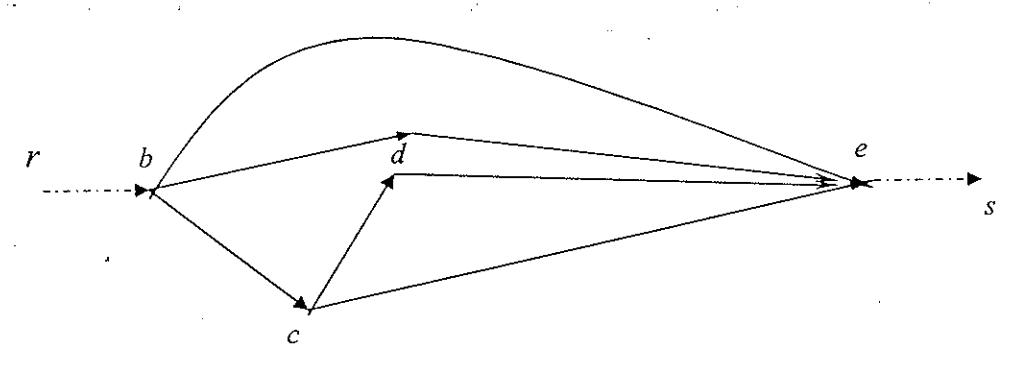
b, c are decision nodes
e is a big node, not absolutely a centroid d is a node but not a decision node d can be located at link b-e
Decision segment. Network recognition sets up the eigennetwork \(G_n\) of which the traveler selects, in his own capacity, the possible alternative routes for a travel from origin r to destination s. This can be formed through segmentation of eigennetwork in M sections of mental map called decision segment (Routenentscheidungsabschnitt), i.e. a sub-eigennetwork \(G_{mn} = (N_{mn}A_{mn})\), \(G_{mn} \subset G_n\).
Choice of the alternatives. The decision making process within a decision segment is modeled as a decision problem that can be solved with FiPV algorithm. Two phases are considered, namely: phase 1 includes the possible alternatives at node b and phase 2 consists of possible alternatives at node c. Let first discuss about FiPV.
III. FUZZY CHOICE FUNCTION (FiPV)
Mathematical model. Fuzzy sets adopted in this paper is based on fuzzy individual choice in discrete decision space (cf. Orlovsky, 1978; Zimmermann, 1987) named FiPV. Modeling preference relation in simple terms means expressing preferences for all possible pairs (x, y) of alternatives by providing answer to questions like: is alternative x not inferior to alternative y? (Fodor et al., 1998). binary relations of alternatives \(R(A^2)\) can be expressed by matrices with the properties: (a) the elements of the set A is a representation of available choice alternatives; (b) matrix element \(\mu_R(x_i,x_j)\) is a membership grade which represents pairwise comparison between alternatives \(A_i\) and alternative \(A_j\) by the individuals subject to the specified attributes or decision criteria. If a fuzzy pairwise comparison matrix exists, the choice of the best alternative can be solved with a standard procedure poposed by Orlovsky (1978). Ranking of all alternatives and more practical choice procedure are provided by Ridwan (2000). By definition, FiPV is a choice based on \(\mu_R(x_i, x_i)\) or
\[FiPV \equiv \text{choice procedure based on } \mu_R(x_i, x_j)\] (1)
Application. We adopt a stochastic network model normally used in the transportation literature (Sheffi, 1985; Ran & Boyce, 1996; Ridwan, 2002). We have
\[x_{a}(t) = \sum_{rsp} x_{ap}^{rs}(t) = \sum_{rsp} f_{p}^{rs} \delta_{ap}^{rs} \qquad \forall a\] (2)
Decision matrix. The FiPV function is represented by its preference structure as shown above. If the traveler prefers to choose a route over a decision node c, then we can express the decision function as
\[FiPV_{ap}^{be}(t) = [b \rightarrow c](t) + FiPV_{ap}^{ce}(t) \qquad \forall a, p, b, c, e\] (3)
Where \([b \rightarrow c]\) (t) is a well-defined selected path whenever traveler n is entering the decision segment over the decision node b at time t. The individual decision making process within the decision segment m (see Figure 1), -we skip the details- as shown in the example, can be solved with equation (1).
r
Inductive rule-based. In a transportation system, travelers experiment with alternative routes, listen to traffic information on radios, etc., and compare experiences with other travelers. Based on this evaluation, travelers settle on routes which are most preferred. This process can be captured in the FiPV model as inductive rule-based, which can be characterized by
If \[\kappa\] then \(\mu_{xy}>>>\) and \(\mu_{yx}<<<\) (4)
If \(\gamma\) then \(\mu_{xy}>>>\) and \(\mu_{yx}<<<\)
where \(\kappa\) and \(\gamma\) represent performance changes on the system or different circumstances of the traveler. The effects of \(\kappa\) and \(\gamma\) are reciprocal. If \(\kappa\) implies the value of \(x \succ y\) is increased, i.e. \(\mu_{xy}\) becomes greater (>>>); consequently the value of \(y \succ x\) will be decreased, i.e. \(\mu_{yx}\) is growing less (<<<), then \(\gamma\) causes the reverse. The \(\mu_{xy}\) and \(\mu_{yx}\) values formation is an inductive process. These form a new decision matrix \(\mu_R(x_i, x_j)\) in which \(x_i = x\) and \(x_j = y\). The new decision matrix may cause a new choice and the formation of the matrix elements \(\mu_R(x_i, x_j)\) continues.
IV. EXAMPLE
This example will demonstrate the FiPV \(\mu_R(x_nx_j)\)- choice function (1) that can be manipulated at the laboratory or compared with the real decision in the transportation system.
We present two examples to show the different between traveler who cannot maximize his behavior and traveler who is able to maximize his behavior. The maximizing is the behavior of individuals who optimize their travel criteria such as shortest path or least time. Their behavior can be predicted approximately with shortest path algorithm, minimizing impedance or disutility (travel time, cost, fuzzy cost, etc.) or maximizing utility function. However, the individual perceptions of perceived travel time are varied. In contrast, the non-perfect-maximizing behavior cannot be predicted from a general formulation like that. This kind of behavior must be observed empirically, and the behavior patern subsequently studied. We show feedback as preference formation and inductive rule-based as context dependence in the following example.
Given crisp travel time data (no information about distribution, the travelers only know about minimal and maximal travel times in uncongested network) as follows:
- alternative 1: 18 minutes (normal), 40 minutes (congested)
- alternative 2: 20 minutes (normal), 35 minutes (congested)
- alternative 3: 25 minutes (normal), 30 minutes (congested)
- alternative 4: 16 minutes (normal), 40 minutes (congested)
4.1. Non-perfect-maximizing behavior
At decision point b
| Favorite route | ||||||
|---|---|---|---|---|---|---|
| Stated response | ||||||
| 1 | 2 | 3 | 4 | |||
| 1 | 1,00 | 0,90 | 0,80 | 0,70 | ||
| 2 | 0,60 | 1,00 | 0,30 | 0,40 | ||
| 3 | 0,70 | 0,50 | 1,00 | 0,20 | ||
| 4 | 0,80 | 0,10 | 0,40 | 1,00 | ||
| → intransitive | ||||||
| Preference formation (feedback) | ||||||
|---|---|---|---|---|---|---|
| 1 | 2 | 3 | 4 | |||
| 1 | 1,00 | 0,90 | 0,80 | 0,80 | ||
| 2 | 0,60 | 1,00 | 0,30 | 0,40 | ||
| 3 | 0,70 | 0,50 | 1,00 | 0,20 | ||
| 4 | 0,80 | 0,10 | 0,40 | 1,00 | ||
| μND | 1,00 | 0,70 | 0,80 | 0,70 | ||
| → to be chosen: alternative 1 | ||||||
Travel information: congestion on path b-e
| 1 | 2 | 3 | 4 | |||
|---|---|---|---|---|---|---|
| 1 | 1,00 | 0,60 | 0,80 | 0,70 | ||
| 2 | 0,80 | 1,00 | 0,30 | 0,40 | ||
| 3 | 0,70 | 0,50 | 1,00 | 0,20 | ||
| 4 | 0,80 | 0,10 | 0,40 | 1,00 | ||
| μND | 0,80 | 0,80 | 0,80 | 0,70 | ||
| → no decision | ||||||
| Trave | eler re- | -evaluate | es the | |
|---|---|---|---|---|
| Decis | ion pr | ocess (ir | nductiv | e) |
| 1 | ? | 2 | ٠. |
| 1 | 2 | 3 | 4 " | |||
|---|---|---|---|---|---|---|
| 2 | 3 | 4 | ||||
| 1 | 1,00 | 0,60 | 0,80 | 0,70 | ||
| 2 | 0,80 | 1,00 | 0,50 | 0,40 | ||
| 3 | 0,70 | 0,50 | 1,00 | 0,20 | ||
| 4 | 0,80 | 0,10 | 0,40 | 1,00 | ||
| μND | 0,80 | 0,10 | 0,40 | 1,00 | ||
| to be chosen: alternative 2 | ||||||
At decision point c
The traveler changes his mind
\(\mu ND\) 0,90 1,00 \(\rightarrow\) to be chosen: alternative 3 or path c-d-e
Note: In this example we remove the condition \(\mu_R(x_i, x_j) + \mu_R(x_j, x_j) = i\)
If the traveler has a behavior that does not satisfy maximizing travel objections (e.g. because of unfamiliarity, lexicographic choice, etc.), the researcher may observe the behavior through fuzzy preference value \(\mu_R(x_i,x_j)\) in a decision situation with respect to which the traveler has made pairwise comparisons between available alternatives i and j in his decision segment.
The values are different from those of traveler who can maximize his travel objectives. Suppose we got some values from a real observation like the first matrix at the left that is obviously intransitive. Assume that the traveler will choose the alternative 1 or path b-e, but this matrix is not easy to interpret. We suggest therefore a feedback to form a transitive condition like the marix at the right. The new FiPV matrix gives a better interpretation about the traveler's choice. Yet, when the pre-trip information announced that congestion occurs on path b-e, the traveler will start to revise his preference, perhaps first with the result: no decision. After reevaluation he chooses alternative 2 or path b-e. En route information or other condition like incident can then affect the traveler to make another decision while he is on the route segment b-e, e.g. to choose path e-e-e as shown above.
4.2. Pure rational utility-maximizer without information
We will show first a simple problem where traveler as a utility-maximizer has to optimizze his travel objectives in uncongested network and then in congested network without information. We see the fact that in the normal (uncongested) network the chosen path is the least time. But we also see that in congested route, the traveler behaves other than normal. The rational traveler tries to seek a better alternative by guessing that the other route may be not over capacity. The traveler do not know about the traffic condition precisely, he only guesses and think about his habit or his current decision tha could be reasonable to be revised, he want to make a new comparison of possible alternatives. The process continues during the traffic jam. If he finally finds the other route better than his current route, he will change the route. The updating process consists of mere guessing. We will see the reality how in the congestion the actual best route (alternative 3 route b-c-d-e: 30 minutes) could not be found by the traveler. Conventional shortest path methods if apply here will result a fundamental error.
| Uncongested | Congested | ||||||||
|---|---|---|---|---|---|---|---|---|---|
| Stated response | Preference updating (guessing) | ||||||||
| ., | 1 | 2. | 3 | 4 | 1 | 2 | 3 | 4 | |
| 1 | 1,00 | 0,90 | 0,90 | 0,80 | 1 | 1,00 | 0,80 | 0,70 | 0,90 |
| 2 | 0.80 | 1,00 | 0,80 | 0,70 | 2 | 0,90 | 1,00 | 0,70 | 0,80 |
| 3 | 0,70 | 0,60 | 1,00 | 0,60 | 3 | 0,90 | 0,60 | 1,00 | 1,00 |
| 4 | 0,90 | 0,80 | 1,00 | 1,00 | 4 | 0,90 | 0,70 | 0,60 | 1,00 |
| μND | 0,90 | 0,90 | 0,60 | 1,00 | μND | 0,80 | 0,10 | 0,90 | 0,60 |
| → to be chosen: alternative 4 | → to | be chos | en: alte | rnative | 2 | ||||
4.3. Rational utility-maximizer with information
The problem is like that of the first example (non-perfect maximizing behavior), except the fact that the traveler can or will exact follow the maximum criterion designed/assumed by the researcher. Here the best route can be found by the traveler with traffic information. Both travelers' behaviors, perfect maximizing and non-perfect-maximizing, can be modeled in a one form FiPV matrix. The \(\mu_R(x_bx_b)\) values of the maximizing behavior correspond directly to the impedance/disutility, i.e. identical with fuzzy cost (Henn, 2002; 2000), but these fuzzy preference values of the non-perfect-maximizing behavior do not.
| Congested on the route b-e Light evaluation | Congested on the system | |||
|---|---|---|---|---|
| 1 2 3 4 1 1,00 0,80 0,90 0,80 2 0,90 1,00 0,80 0,70 3 0,70 0,60 1,00 0,60 4 0,90 0,80 1,00 1,00 | Total evaluation 1 2 3 4 1 1,00 0,80 0,70 0,90 2 0,90 1,00 0,60 0,80 3 0,90 0,80 1,00 1,00 4 0,90 0,70 0,60 1,00 | |||
| \(\mu\)ND 0,90 0,90 0,60 1,00 \(\rightarrow\) to be chosen: alternative 4 | \(\mu\)ND 0,80 0,80 1,00 0,60 \(\rightarrow\) to be chosen: alternative 3 | |||
V. CONCLUSIONS
The main purpose of the paper is to demonstrate that route choice can be modeled within FiPV framework. FiPV (fuzzy traveler preferences) model is a choice function based on fuzzy preference relations. This modeling approach has been developed by the author at the RWTH Aachen to improve travel demand analysis. This paper describes a new methodology for route choice based on FiPV. The model may be the first application of fuzzy individual (preference-based) choice in modeling route choice. This proposed methodology needs to be validated against empirical observations. When this test phase has been done, the model can be used as disaggregate representation of the observed population as input to any micro-simulation program to forecast travel demand.
We introduce a concept of decision segment (Routenentscheidungsabschnitt), which consists of decision nodes that may be expanded as necessary. Decision segment is a subset of eigennetwork that can be interpreted as individual awareness of the existing network. This is formulated while assuming limitation in the travelers' cognitive capacity. Decision segment is a preliminary concept that needs to be developed further. FiPV analyses the decision problem within this decision segment as shown in Figure 1. The example shows the model structure and the behavior distinction between two types of travelers. The fact that travelers do not always follow the shortest path or least travel time/cost can be explained in terms of the fuzzy choice model. The values of fuzzy preference relations \(\mu_R(x_hx_j)\) reflect the individual interpretation of the choice situation that absolutely independent from general principle of optimization or maximization. However, these can also handle situation in which the travelers maximize their travel objectives. In contrast, utility as overall criterion cannot always represent subjective criteria that may also depend on decision context.
Inductive rule-based (equation 4) introduced in this paper helps the researcher to obtain dynamic numerical value of the membership function \(\mu_R(x_b, x_j)\) that represents traveler's perception update as a result of his adaptation process in making travel decision. The structure of inductive rule-based is flexible so that dynamic reactions of individual traveler to continual change on transportation system performance and other factors influencing his travel decision can, therefore, be modeled realistically. The example shows that as rational utility-maximizer, traveler seems to have no possibilities in choosing the route. In other words, route choice models mainly developed on the basis of the assumption as if travelers are utility-maximizers cannot really describe behavior of all individuals under any circumstances. Parallel to the results in decision theory, economics and psychology, it appears that time has come to ask about the plausibility of alternative approach to extend the traditional model.
As shown in the example, FiPV represents all types of travelers' behavior and offers possibilities in modeling route choice without shortest-path and least-travel-time criteria.
VI. REFERENCES
- Bisdorff, R. 2000. Logical foundation of fuzzy preferential systems with application to the electre decision aid methods. Computers & Operations Research, 27(7-8), 673-687.
- Buchanan, J.T., E.J. Henig and M.I. Henig. 1998. Objectivity and subjectivity in the decision making process. Annals of Operations Research, 80, 333-345.
- Cascetta, E. 2001. Transportation Systems Engineering: Theory and Methods. Dordrecht: Kluwer Academic Publishers.
- Conlisk, J. 1996. Why Bounded Rationality? Journal of Economic Literature, XXXIV (June), 669-700.
- Fodor, J., S. Orlovsky, P.Perny, and M. Roubens. 1998. The Use of Fuzzy Preference Models in Multiple Criteria Choice, Ranking and Sorting. In Fuzzy sets in
- decision analysis, operation research, and statistics (pp. 69-101), ed. R. Slowinski. Boston: Kluwer Academic Publishers.
- Gilboa, I. and D. Schmeidler. 1999. A Theory of Case-Based Decisions. (Preliminary Draft February ed.). Tel Aviv: The Foerder Institute for Economic Research, Tel-Aviv University.
- Golledge, R. 1997a. Dynamics and ITS: Behavioral Responses to Information Available from ATIS (Resource Paper). Paper presented at the IATBR 8th meeting: Challenges and Opportunities in Travel Behavior Research and Application, The University of Texas at Austin, September 21-25.
- Golledge, R. G. 1997b. Defining the criteria used in path selection. In Activity-based approach to travel analysys (pp.151-169), eds. D. Ettema and H.J.P. Timmermans. Oxford, UK: Pergamon.
- Harsanyi, J.C. 1996. Utilities, preferences, and substantive goods. Paper presented at the third meeting of the Society for Social Choice and Welfare, Maastricht, June 22.
- Henn, V. 2000. Fuzzy route choice model for traffic assignment. Fuzzy sets and systems, 116(1), 77-101.
- Henn, V. 2002. What is the meaning of Fuzzy Costs in Fuzzy Traffic Assignment Models? Paper presented at the 13th Mini-EURO Conference Handling Uncertainty in the Analysis of Traffic and Transportation Systems. Bari, Italy, 10 12 June.
- Hoogendoorn, S.P., G. Copinga, and U. Kaymak. 1998. Perspectives of Fuzzy Logic in Traffic Engineering: Reviews and Annotated Bibliography. Research Report. Delft: TRAIL Research School.
- Jan, O., A.J. Horowitz, and Z.R. Peng. 2000. Using GPS Data to Understand Variations in Path Choice. Paper presented at the TRB 79th Annual Meeting, Washington, DC., January 9 – 13).
- Mahmassani, H.S. and R.C. Jou. 1998. Bounded Rationality in Commuter Decision Dynamics: Incorporating Trip Chaining in Departure Time and Route Switching Decions. In Theoretical Foundations of Travel Choice Modeling (pp 201-229, eds. T. Gaerling, T. Laitila and K. Westin. New York: Elsevier
- Nakayama, S., R. Kitamura and S. Fujii. 2000. Drivers' route choice heuristics and network behavior: a simulation study using generic algorithms. Paper presented at the 9th IABTR Conference, Sheraton Mirage Gold Coast, Queensland, Australia.
- Orlovsky, S. A. 1978. Decision-making with a fuzzy preference relation. Fuzzy Sets and Systems 1, 155-167
- Peeta, S. and A.K. Ziliaskopoulos. 2001. Foundations of Dynamic Traffic Assignment: The Past, the Present and the Future. Networks and Spatial Economics, 1(3/4) 233-265
- Ramming, M.S. 2002. Network Knowledge and Route Choice. Unpublished PhD Dissertation (forthcoming). Cambridge, MA: MIT
- Ran, B. and D. E. Boyce. 1996. Modeling dynamic transportation networks: an intelligent transportation system oriented (ITS) approach, 2nd rev. ed. Berlin: Springer-Verlag.
- Ridwan, M. 2000. Ranking and choice algorithm with fuzzy preference model (first draft version). Unpublished Manuscript (in German). Aachen: RWTH
- Ridwan, M. 2002. Fuzzy Preference Based Traffic Assignment Problem. Paper accepted for presentation in the ISTTT15 Workshop on Intelligent Transport Systems: Emerging technologies and methods in transportation and traffic. Adelaide, 19 July 2002 and will appear in a special issue of Transportation Research Part C: Emerging Technologies (guest editor: Michael A. P. Taylor).
- Sheffi, Y. 1985. Urban Transportation Networks: Equilibrium Analysis with Mathematical Programming Methods. Englewood Cliffs: Prentice-Hall.
- Simon, H.A. 1955. A behavioral model of rational choice. Quarterly Journal of Economics, 69, 99-118.
- Teodorovic, D. 1999. Fuzzy logic systems for transportation engineering: the state of the art. Transportation Research Part A: Policy and Practice, 33(5), 337-364.
- Watling, D. 1999. Stability of the stochastic equilibrium assignment problem: a dynamical systems aproach. Transportation Research Part B: Methodological, (33)4, 281-312.
- Zadeh, L.A. 1965. Fuzzy sets. Information and Control, 8, 338-353
- Zimmerman, H.J. 1987. Fuzzy Sets, Decision Making, and Expert Systems. Boston: Kluwer Academic Publishers.
- Zimmerman, H.J. 1996. Fuzzy set theory and its applications. (3rd ed). Boston: Kluwer Academic Publishers.
- Zimmerman, H.J. 1999. Intelligente Technologien un data Mining zur Unterstutzung des Verkehrsmanagements. Paper presented at the Heureka '99, Optomierung in Verkehr und Transport. Tagungsbericht, Karlsruhe: M. Boltze, H. Keller & et.al. (eds), Maret 3-4, FGSV Verlag.