

I. INTRODUCTION
Khulna is the third largest metropolitan city of Bangladesh where road is the main mode of transportation. Due to the macroeconomic impact of globalization, urbanization suddenly triggered up. Poorly managed urbanization is having greater social and environmental costs, most starkly evident is the increase of urban poverty. To meet the needs of the increasing population, the number of means of transportation has also increased. One of the basic characteristics of the city transportation is the dominance of the non-motorized vehicle (NMV). The main causes are as follows:
- a. The migrated unskilled rural labor force used to find their employment in the informal sector of the city, and transport is the best employment generating sector for them.
- b. The NMVs are really cheap and the rent is also relatively affordable for the urban poor people.
With the increment of the NMVs the number of two stroke three wheelers is also increasing. The causes are more or less similar to the NMV. There are some other factors as well.
- a. The urban poor people want to reduce their transport cost use to use these transports and as such the demand of this transport are increasing.
- b. The two stroke three wheelers are banned in Dhaka. For this, these baby-taxies have entered into Khulna too.
There are so many impacts of the increment of the baby-taxies, like the new baby-taxi route, environmental degradation in the sense of air and noise pollution, and deterioration of the life style of the taxi drivers due to the decrease of income. This paper is a modest approach of identifying the growth of two stroke three wheelers and its impact on the urban life.
II. OBJECTIVES
The study is to determine the growth pattern of the two stroke three wheelers with respect to the existing transport infrastructure. The main purposes of the paper are:
- (i) to identify the growth pattern of the two stroke three wheelers and thereof its reason
- (ii) to know the change of the transport routes due to the increase of the two stroke three wheelers
- (iii) to know the socio-economic effects of the increase of two stroke three wheelers on the transport workers
III. METHODS ADOPTED
Methodology is the complete crystallization of the research. This is a primary data based study. A survey format was administered to obtain information regarding the socio-economic conditions, demographic features, growth of two stroke three wheelers and its determinants. For analyzing the growth of routes, the detailed map prepared by Khulna Development Authority (KDA) and Space Research and Remote Sensing Organization (SPARRSO) was used.
The spatial and non-spatial data from the documents of Bangladesh Bureau of Statistics (BBS), Bangladesh Institute of Development Studies (BIDS), Khulna Structure Plan of KDA were also consulted.
While collecting the socio-economic data, questionnaire survey, focus group discussion (FGD), and participatory research appraisal (PRA) were adopted. Secondary data was collected from the Department of Environment (DoE), Bangladesh Road Transport Authority (BRTA), Bangladesh Road Transport Corporation (BRTC), Khulna Baby-taxi Driver's Union, Khulna City Corporation (KCC), and Khulna Development Authority (KDA). Spatial data is represented using GIS software like ArcInfo and ArcView. Non-spatial data is analyzed using Statistical Package for Social Science (SPSS) and MS Excel.
The collected data on socio-economic conditions and land use changes were processed. Different computer packages, such as Statistical Package for Social Science (SPSS) and MS Excel, Arc/info and Arc View GIS were used for data analysis and map preparation.
IV. STUDY AREA
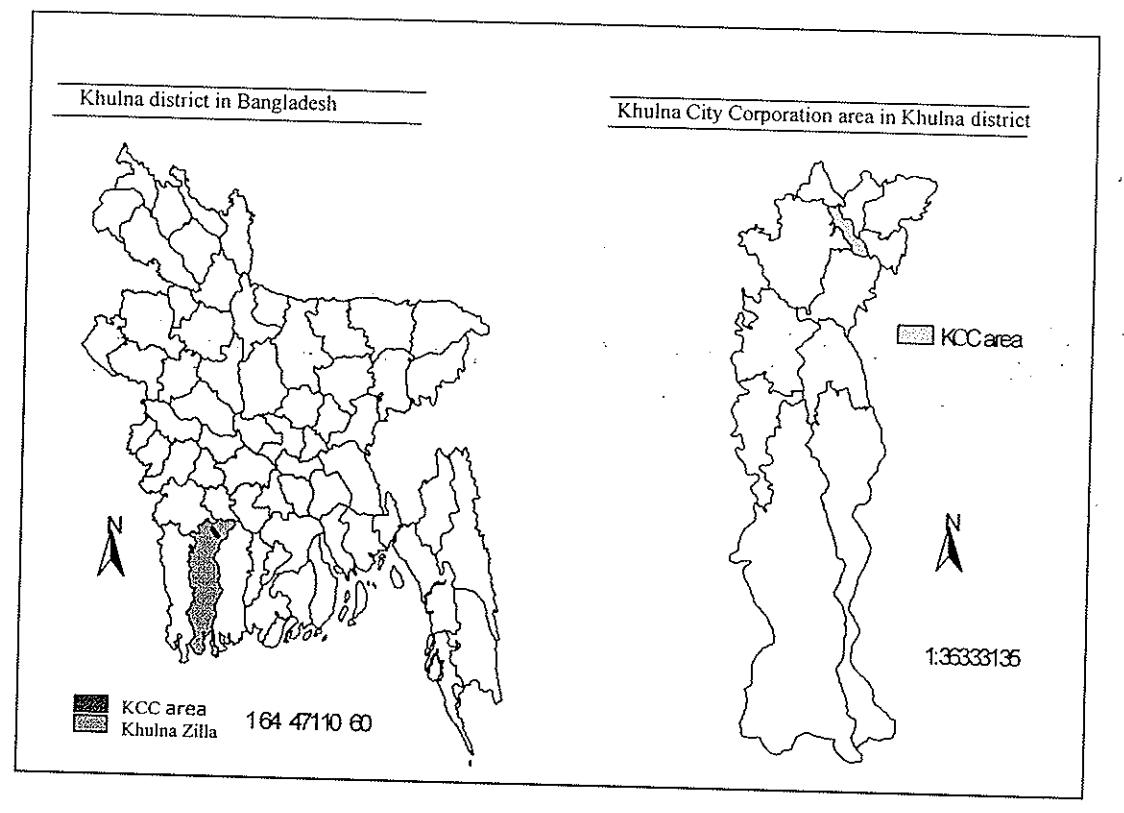
The study is conducted in Khulna city, the third largest metropolitan city of Bangladesh. It is situated below the tropic of cancer, around the intersection of latitude 22.49° north and longitude 89.34° east. It is in the southwestern side of Bangladesh near the Sundarbans, the largest mangrove forest of the world. Map 1 shows the location of Khulna city in the context of Bangladesh and Khulna District. The study area is 42.04 sq. km. In 1998, total population of Khulna city was 11,077,160 (Rahman, 2000). The population of the area is increasing with a rate of 3.8 percent (USAID, 1999). Gross population density of the study area is very high (about 18,000 persons per sq. km.) (USAID, 1999). The average monthly household income is Taka 5,543 (KDA, 2000).
According to the Khulna Structure Plan, KCC area is having total 257.5 km Bituminous, .88 km concrete, 84.48 km WBM, 80.61 km HBM, 87.61 km FBM, 669.37 km katcha road (KDA, 2000). Most of KCC roads are in good condition except those of kutcha and semi-pucca. The single lane pucca roads is narrow, often 3.6 meter in width, with unsurfaced kutcha shoulders and insufficient or no space for parking and pedestrian movement. Open roadside drain creates environmental problems for pedestrians. Map 1 portrays the study area i.e. Khulna City Corporation (KCC).
V. DISCUSSION
5.1. Growth pattern of the two stroke three wheelers
Two stroke three wheelers which is locally called baby taxi is basically a means of transportation for poor and middle income people. Hence there is a strong possibility that with the increment of poor and middle income people, the number of baby taxies would also increase. On average, slums area have grown 61.1 percent and the slums population has grown 58.7 percent during the last decade (Islam, 2002). However, according to the baby taxi driver's union, the rate of the growth of baby taxi is much higher than that of the population growth.
Map 1. Location of Khulna City in context of Bangladesh and Khulna District
The main reason of the recent sharp increase of the number of baby taxies is two fold. First, the baby taxies banned in Dhaka to protect environmental degradation and traffic jam are shifted to Khulna. Second, due to the availability of the Indian baby taxi from "Bazaz" in an affordable prize, people are taking the advantage of the weakness in the law enforcement authority. The number is increasing.
Total number of baby taxies before the ban of the same in Dhaka was not more than 350. But after the ban the number has almost doubled. Finding no way out, the drivers are exploring new routes. The increment of the number of registered auto-rickshaws has maintained a smooth trend. But the trend of non registered baby taxies shows a sudden jump after January, 2003.
Dhaka used to sustain approximately 18,000 three-wheelers prior to the ban. Of these, the government allowed 6,500 baby taxis, 500 auto-tempos and 350 auto-trucks to operate until December 31, 2002. All of these came to a halt as of January, 2003 (SANDEE, 2003). All of these three wheelers are somehow sent abroad which are creating wider impact on the urban environments of the other urban areas of Bangladesh.
Corruption of the government agencies is one of the major reasons of uncontrolled increment of the auto-rickshaws. Any body can prepare false license, route permit, driver's license or any other papers by giving some extra money. Even in preparing authentic papers, people have to pay almost three times more money. For example, the license tax of a auto-rickshaw is Tk. 1800 but the drivers have to pay almost 4000 taka.
Table 1. Motorized and Non-Motorized Registered Vehicles in Khulna (1992-2003)
| Year | Bus | Auto- rickshaw | Car | Motor Cycle | Truck | Others | Rickshaw |
|---|---|---|---|---|---|---|---|
| 1992 | - | 90 | 14 | 475 | 13 | 6 | 10000 |
| 1993 | 4 | 35 | 13 | 525 | 23 | 12 | 10000 |
| 1994 | 3 | 45 | 35 | 450 | 13 | 26 | 11206 |
| 1995 | 1 | 100 | 70 | 600 | 75 | 23 | 11300 |
| 1996 | _ | 90 | 8 | 400 | 100 | 16 | 11300 |
| 1997 | - | 50 | 250 | 250 | 13 | 13 | 11300 |
| 2002 | _ | 70 | - | - | _ | - | _ |
| 2003 | | - | 75 | _ | - | - | _ | - |
Source: BRTA, Khulna, and KCC 2003.
5.2. Transport cost
Auto Rickshaw is a means of transportation for the poor people. As usual the transport cost is also relatively cheap. It is estimated that on an average the people has to spend between 1.25 to 1.50 Taka for every kilometer. While traveling through the public bus, people have to spend Tk 0.25 to 0.35 per km. Again travel cost for the rickshaw is between Tk. 2.50 to Tk. 3.00.
The main causes of the increase of the transport cost are as follows:
a. use of low quality fuel
- b. lack of maintenance of the vehicles
- c. toll evasion by the baby taxi driver's union and local police authority
5.3. Effects on the income of the taxi drivers
Income is the basic determinant of the status of the lifestyle of the people. As stated in section 5.1 that the rate of the growth of baby taxies is much higher than that of the population growth. Hence, average number of passengers per baby taxi has decreased with the increment of the number of baby taxies. Consequently, average income of the drivers has decreased substantially. And the poverty status is worsening day by day.
One of the main reasons of environmental degradation is the use of excess quantity (~8%) and low quality (straight mineral oil/recycled engine oil) lubricants (Khaliquzzaman, 2001). On average, every two stroke three wheelers uses at least 4.5 litters of fuel, for which the drivers have to spend Tk. 180 per day. In addition, drivers have to pay Tk. 80 to 100 per day as rental cost of the baby taxi. The taxi drivers can only earn Tk. 60 to 80 per day or Tk. 1800 to 2400 per month.
With the decrease of per capita income, the drivers and their family member's access to medical service and other utilities and services has declined. Inflation has added itself as an extra burden, forcing people to live in the houses with relatively poor quality.
5.4. Effects on traffic jam of the city
Most of the roads in this area are very narrow for bus and truck movements. More over there is no additional space for pedestrian movement. Besides, due to lacking parking stand, rickshaws and auto-rickshaws are standing along the roadsides which reduce the effective width of the road for movement of vehicles. In the city road network, there is no any bus bay. Most of the public and private inter city buses takes passengers from the roadside without keeping sufficient space to allow movement for other traffic. As a result traffic congestion is a common phenomenon in this area (USAID, 1998).
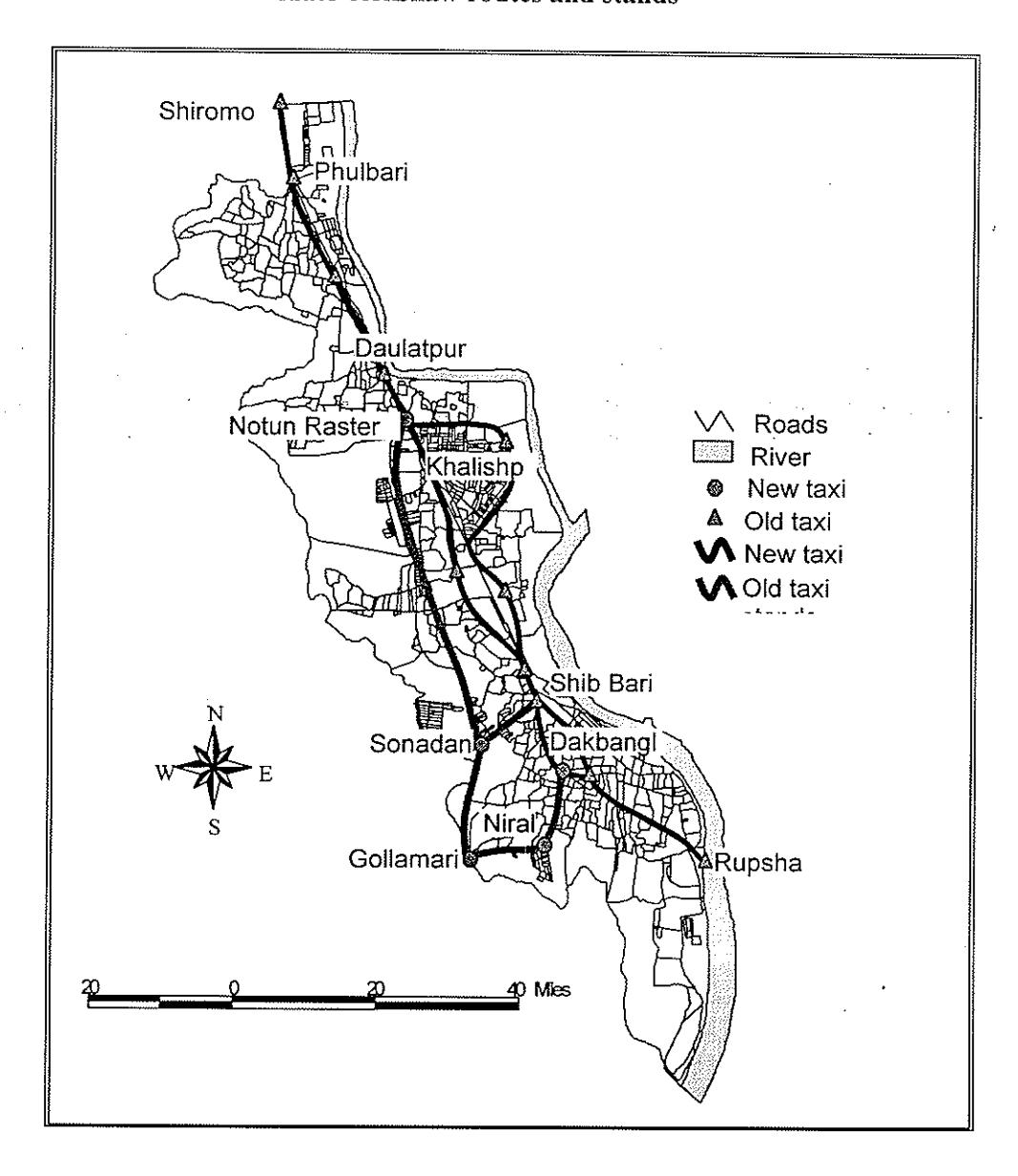
The intensity of traffic jam has increased substantially in the last couple of months. Finding no way out, the taxi drivers have explored new routes within and beyond the city. The baby taxi routes have increased almost 16 km within the city after the ban of two stroke three wheelers in Dhaka. The pressure of new auto-rickshaws on the existing traffic pressure points has also increased. Traffic jam is a common phenomenon for the Dakbanglow, Moilapota, Royal more, Gollamari, Rupsha area. This is influencing the noise and air pollution scenario of the city.
Auto-rickshaws are designed for three passengers only. But almost every auto-rickshaw is carrying at least five passengers at a time by taking the opportunity of the weakness of the law enforcing agencies. This scenario is accompanied by the lack of maintenance of the vehicles. These are creating higher possibilities for accidents. In general, traffic accident is not so acute in Khulna because of the slow movement of the traffics due to high traffic jam, but the scenario is worsening day by day. Now the time has come to take proper actions against the accidents.
5.5. Noise and air pollution scenario
The air pollution scenario is not so severe like all other metropolitan cities of the country. According to the structure plan of Khulna, air borne particles constitute major pollutants followed by lead and NOx, which were found in large quantities near bus stations and along the major transportation corridors. The concentration of NOx was found to be between 73 to 202 micrograms/m<sup>3</sup>. The use of Concentrated Natural Gas (CNG) is not yet popular enough to protect the air pollution of the city. Department of environment (DOE) is the only responsible organization to protect the environmental degradation of the city. But DOE's role in protecting transport related air pollution is questionable. According to the DOE, respirable and fine particulate matters like PM<sub>10</sub> (particles with an aerodynamic diameter less than 10 microns) and PM<sub>2.5</sub> (particles with an aerodynamic diameter less than 2.5 microns) are quite high (230±110 at low rainfall) (Khaliquzzaman,2001) near the babitaxi stands (Rupsha, PTI More, Royal more, Shantidhamer more, Freyghat, Dakbanglow, Powerhouse more, Shibbari more, New market, Boyra, Boikali, Goalkhali, Notun raster more, Daulatpur, Phulbarigate, Shiromoni, Alamnagar, Crecent jute mills Ltd.). The drivers to gain more profit, are using low quality fuel which is resulting in the form of high transport cost and higher air pollution.
Noise and air pollution has substantial impacts on the health of the citizens. Particulate matters can enter into our respiratory tracts and even into the air pockets of lungs causing throat infection, bronchitis, asthma and pneumonia. High level of air pollution is also linked with increased incidences of cancer and heart troubles in many parts of the world. Persistence of air pollution in a city for a longer period also lead to permanent disabilities among the infants.
About 20% people of the city think that vehicles are creating severe noise pollution. The auto rickshaws are not using any hydraulic horn; it's the sound of the engine which is creating noise pollution. Bad traffic management causes drivers to use horns when it is usually not required. Such management failures include non-compliance of rules related to pedestrian crossings, non-enforcement of lane disciplines and unawareness of the drivers. It has been observed that a large portion of drivers of smaller vehicles (like threewheelers) is becoming deaf due to high level of noise pollution. This will become a public safety concern in near future for travelers (CPD, 2001).
Table 2 Following table shows highlights of gaseous pollutants in Khulna city
| Location / Area | CO concentration (ppm) | Lead concentration | |||||
|---|---|---|---|---|---|---|---|
| April '98 | Jan'96 | Dec'94 | April '98 | Jan'96 | Dec'94 | ||
| Jora gate intersection | 1.602 | * | * | 0.476 | * | * | |
| Shibbari intersection | 4.569 | 0.81 | 0.73 | 0.729 | 0.39 | 0.38 | |
| Notun intersection | Rasta | 2.251 | 0.41 | * | 0.522 | 0.36 | * |
| Phulbari intersection | gate | 1.776 | 0.58 | 0.50 | 0.479 | 0.37 | 0.36 |
| Dackbangla intersection | 3.56 | 0.52 | 0.37 | 0.639 | 0.37 | 0.35 | |
| Moilapota intersection | 2,697 | 0.75 | 0.70 | 0.562 | 0.39 | 0.40 | |
Source: Draft report: Comparative Environmental Risk Assessment (CERA) for Khulna City (USAID 1998)
Table 3 Threshold limit of noise recommended by DOE
| Category of use | dB for day time | dB for night | |
|---|---|---|---|
| Sensitive use(e.g. hospital) | 45 | 35 | |
| Residential area | 50 | 40 | |
| Mixed use | 60 | 50 | |
| Commercial area | 70 | 60 | |
| Industrial area | 75 | 70 | |
Source: DOE, 1998
Noise pollution is relatively higher near the bus stands and the intersection points of two or more roads. Such situation is seen at Sonadanga Bus terminal, Shib Bari More, Daulatpur, Rupsha, Dakbanglow etc.
VI. CONCLUSION
The main causes of the problems created by the two stroke three wheelers are basically:
Weakness of the government organizations to control non-licensed two stroke three wheelers.
- Inappropriate traffic management and transportation planning
- Lack of people's awareness and mass poverty
Map 2. Auto-rickshaw routes and stands
No segregated approach can solve the problems created by the two stroke three wheelers. Government should take a long term package based on comprehensive program. Every development activity should be originated from the people. This will help the policy makers in conflict resolution.
The use of double deckers should be encouraged to reduce air pollution. Traffic rules must be imposed on all motorized and non-motorized vehicles plying in a city. Police should emphasis penalizing traffic rule violators more severely. Motor vehicle rules should be updated with heavier penalties on violators of traffic rules and forging of documents (driving licenses, fitness certificates, etc.). City planners must plan and establish a road network for the city. Plying of non-motorized vehicles along with motorized vehicles in the same lane, significantly slow down the traffic and contributes to the level of pollution. City should introduce some rickshaw-free roads each year. Good quality fuel, less use of lubricant, properly tuned engines can reduce such emissions. Smoke traps can be installed. However, the best alternative is to switch to CNG driven vehicles.
VII. REFERENCES
- Ahsan, Rosie Majid and Suriya Sinowar. 1980. Mobility of Dhaka city slum dwellers: the dynamics of inner city adjustment- a case study. The Oriental Geographer January and July, vol. 24. Number 1&2; p. 15.
- Anas, Alex, et al. 1997. Urban spatial structure. Berkeley, California: The University of California Transportation Centre, and University of California, Berkeley.
- CPD (Center for Policy Dialogue). 2001. Policy Brief on "Environmental Policy" CPD Task Force Report, Dhaka, Bangladesh
- Islam. K.S.. 2002. Spatial distribution of urban poverty, Urban and Rural Planning Discipline, Khulna University, Khulna, Bangladesh.
- Khaliquzzaman. M.. 2001. Reducing Emission From 3-Wheeler 2-Stroke Engine Taxis in Dhaka, Bangladesh. Workshop on Reduction of Emissions, Hanoi September 5-7.
- Khulna City Corporation (KCC). 1999. City Development Strategy. Khulna, Bangladesh
- Khulna Development Authority (KDA). 2000. Draft Structure Plan 2000. Khulna: Aqua-Sheltech Consortium and KDA
- Kojima, Masami, Carter Brandon and Jitendra Shah. 2000. Improving Urban Air Quality in South Asia by Reducing Emissions from Two-Stroke Engine Vehicles. December. Washington, D.C.: The World Bank.
- MECA (Manufacturers of Emission Controls Association). 1999. "Emission Control of Two-and Three-Wheel Vehicles." Washington, D.C.
- SANDEE (South Asian Network for Development and Environmental Economics). 2003. Newsletter, Kathmandu, Nepal.
- United States Agency for International Development (USAID). 1999. Environmental Mapping and Workbook for Khulna city. Khulna: Urban and Rural Planning Discipline, Khulna University.