

INTRODUCTION
During the economic boom in Indonesia between 19702 and 1990s housing development gained its momentum. Residential land development companies were mushrooming. Housing market was blooming. It was recorded that during the time the number of registered land development companies were almost tripled from 907 companies in 1990 to 2312 companies in 1997 (Simanungkalit, 2001) In Jabotabek a metropolitan area of Jakarta, for instance, the private sector has urbanised 16.6 thousand hectares of rural land far away from the built-up area of Jakarta, selling around twenty five thousand housing units annually (Winarso and Firman 2002: Winarso and Kombaitan, 2001).
The number of houses sold was remarkable from only 90.8 thousand units in 1990 increased to 250 thousand units in 1997 (Simanungkalit, 2001) Financial market also developed rapidly. But, this was followed by the increasing size of the loans for property development. It was recorded that the loan had reached almost 40 percent of total loan in Indonesia and was in potentially bad debt. This, combined with the other external factors, (I,e. the depreciation of Rupiah to US Dollars) has triggered the economic crisis in Indonesia (Winarso and Firman, 2002) and culminated in the social-political turmoil of the country in 1998. As the result, housing market was at the bottom with almost no activities detected. Effort to recover from the economic calamity has been developed; government has tried to intervene to gear up the housing market with several policies.
In light of the above background, this paper attempts to evaluate the effectiveness of the government intervention in the housing market particularly after 1998 crash. The paper argues that the government intervention has never been effective particularly because the socio-political and economic condition of the country is still uncertain. In these circumstances it seems that the intervention benefits only small minority developers and ignoring the large majority of low-income potential buyers. In doing so the paper is presented in five parts, part one is the introduction, part two discusses the housing market in Indonesia before the economic crisis. Part three highlights the effort of the Government to intervene the market; Part four discusses the effectiveness of the intervention; at the end, a conclusion is drawn out for the discussion.
II. HOUSING POLICY AND DEVELOPMENT IN INDONESIA BEFORE THE ECONOMIC CRISIS
In Indonesia, where the total population has reached 206.6 million (BPS, 2000) those living in urban areas, in 2000, were 42.0 per cent of the total population (BPS, 2000). Almost 71 per cent of the urban population were those from the middle-low and low-income groups The current median monthly household incomes (50<sup>th</sup> percentile) for urban areas with and without DKI Jakarta are Rp.950,000 and Rp.892,000, respectively. The median household income in rural areas is Rp.579,300. (Hoek-Smit, 2002). The urban population growth rate is estimated at 3.5 per cent per annum during 1990 to 2000 is considered high. It accounts for about two-thirds of the total population growth from 1980 to 2000. Meanwhile the population living bellow poverty line is estimated to reach 27% in late 1998 right after the crisis (World Bank 2001). And only around 15% of urban population afford to buy better house. The large majority 45% can only buy simple and very simple
house<sup>1</sup> in subsidies loan scheme. This pictures the significant of housing development to house the ever-increasing population.
Formal housing policy in Indonesia was just started some 20 years ago with the birth of the National Housing Authority in 1974<sup>2</sup>. This birth cannot be separated from the more powerful advent of World Bank into the field of urban development around the 1970s. The works of John Turner on the self help housing (Turner, 1976) and the works of Otto Koenigsberger (1964) in urban development planning have undoubtedly influenced the concepts for housing development and housing policy in Indonesia.
In 1974, following a National Housing Workshop, the Government created three important institutions to address housing problems systematically. These institutions are National Housing Authority (Badan Kebijaksanaan Perumahan Nasional) which is responsible for formulating the overall housing policy; National Urban Development Corporation (PERUM PERUMNAS) which is responsible for providing houses, particularly for lowincome people; and State Saving Bank (BTN) which was restructured to provide mortgage finance. The creation of these institutions was a response to the ever-increased demand for housing particularly for low-income people. For the middle and high-income people, the private sector had already been starting to provide houses since 1971 (Winarso, 2002). This marked the beginning of the creation of formal housing market in Indonesia. Private sector housing developers had also established an association in 1972 labelled REI (Real Estate Indonesia). A private mortgage institution, PT Papan Sejahtera (PTPS) was also established later in 1980 to serve the private sector housing development. To further co-ordinate the various agencies involved in housing production, the Ministry of Public Housing was created in 1977.
The work of Turner in Lima, Peru, and his famous book "Housing by People" (1976) has made Popular Housing Development become one of the accepted concepts for housing provision. This is what really has been happening in developing countries. In the case of Indonesia, the popular<sup>3</sup>
Simple house is a 36 square meter house constructed on 60 square meter plot priced at around Rp. 25 million. While very Simple house is a 21 square house constructed on 60 square meter plot priced at around Rp. 20 million
One of the reasons was the high economic growth experienced in those years. During 1971 to 1981 the Indonesian economy grew at an average rate of 7.7 per cent. In the second half of 1973 the international petroleum price quadrupled, conferring massive windfall revenue gain in Indonesia (Hill, 1996; Winters, 1991). The urbanisation rate also increased as an indirect cause of the economic growth. Private sector development flourished due to the increased demand for offices and houses for the employees.
In Indonesia, the production of urban housing is largely done by popular and professional house builders. Popular housing is the one being developed by individuals without reliance upon either Government or formal private sector institutions. While the professional are those created by private or Government owned companies (Struyk, Hoffman and Katsura, housing provision, the informal market, had, on the one hand, covered over 80 per cent of all housing needs (Struyk, Hoffman and Katsura, 1990). The formal system, on the other hand, had covered only the remaining 20 per cent. This latter system, which is often heavily subsidised, - through subsidised low interest in mortgage system-, provides housing for the moderate to high-income people.
Basically the Government of Indonesia has since 1974 adopted two policy tools to address housing shortages. First is the direct intervention by providing housing through development of new houses by PERUMNAS. Second is the indirect intervention by encouraging the people to build or upgrade their own houses through programmes like KIP, and mortgage finance by State Saving Bank (BTN) and the Housing Finance Corporation (PTPS - PT Papan Sejahtera). This latter strategy virtually had been ahead from what was known as 'enabling strategy' promoted by the World Bank in 1990 (UNHCS 1990).
Another indirect policy instrument to ensure the provision of low-income housing is by setting a requirement to have a ratio of 6 small houses and 3 medium houses for every large or luxury house built by a private developer, which is later became known as 1:3:6 ratio. The requirement was stipulated in the decree issued by the National Housing Authority on 12 September 1974. In 1992 the rule was further reinforced by an Inter-Ministerial Decree signed by the Minister of Public Works, Minister of Home Affairs and Minister of Public Housing. This Inter-Ministerial Decree stipulates that private developers who carry out land development on an area of 200 hectares or more, have to build houses in 1:3:6 ratio in their areas, whilst development of smaller than 200 hectares can develop the 6 portion in other areas, but in the same Kabupaten.<sup>4</sup>
With this strategy the Government sets a target to build 500.000 to 600.000 simple houses units in the sixth five-year Development Plan starting in 1995. In practice, however, this strategy has never been smoothly implemented. The fact that the regulation needs to be reinforced in 1995 also shows the difficulty in implementing the regulation. One survey indicates that REI Developers have long tried to resist this 1:3:6 requirement (Leaf, 1991). One of the reasons stated by a developer is:
"It is difficult to find land suitable for simple houses with the Government's fixed price..." (Properti Indonesia, August 1995).
These two policies were effectively started in 1974 and theoretically could address all levels of income: KIP, Land Consolidation, Inner city
1990). Formal housing development has to comply with certain building standards set up by the Government.
<sup>4</sup> Kabupaten is an administrative area under Province
redevelopment would provide housing for low-income level; PERUMNAS would provide housing for the low-middle income level. NGO and cooperation would provide housing for low and middle-income level; Private developer BTN would provide housing for middle-high income level and REI/PTPS would provide housing for the high-income level plus some for other levels.
Government's policy on housing finance is focused on the formal finance system, although it also encourages the informal system because this system obviously serves the majority of the homebuyers particularly the low-income people. The formal housing finance is basically relied on the BTN and PTPS. These two banks enjoy Government's support to obtain funds below market price so that these banks can provide mortgage at a subsidised interest rate to encourage the people to buy house through a Housing Ownership Loan (KPR - Kredit Pemilikan Rumah) Scheme. With this scheme the Government gives financial assistance with subsidy component to house buyer to acquire house in a regularised and serviced plot developed by PERUMNAS or private developers. BTN would finance up to 95 per cent of housing price, repayable within 5 to 20 years at subsidised interest rate lower than the market. The remaining 5 per cent is to be paid to PERUMNAS in instalments within 12 to 24 months without interest. Private developers who develop middle-high housing obtain short-term construction loan from commercial banks. Refinancing is done through BTN or PTPS. Buyers make down payment as equity at minimum 10 per cent of house price; the remaining 90 per cent is to be paid on mortgage at the subsidised interest rate. The emergence of financial market in the 1980s developed further the housing finance in Indonesia especially for formal housing development for middle to highincome levels. The financial market provides funds needed by the private residential developers to finance their large residential projects.
Together with the significant economic growth enjoyed by the country, the overall policies have geared the formal housing market. Later in the 80s, with a series of deregulation policies in Indonesia during the years 1983 – 1988<sup>5</sup>, housing market were started to flourish and massive development of housing began. The deregulation policies were aimed at improving domestic savings, improving resource allocation and developing a framework for monetary management, in particular through indirect intervention rather than direct regulatory control (Hill, 1996). The most important deregulation policy was perhaps the 1988 financial, monetary, and banking reform.<sup>6</sup> This was of
Winters (1991) dissertation provides a good account of this series of deregulations. He put it under "Jaman Deregulasi" in which he analysed the dynamics power involved in the deregulation. More detailed analysis of the reform can be seen in Hill (1996) and Booth (1992).
The package was aimed at increasing economic growth, non-oil export and to expanding job opportunities. This deregulation was also aimed at encouraging mobilisation of funds.
particular assistance to the development of real estate industries. The policy enabled the entry of more foreign banks in the form of joint ventures and thus encouraged genuine competition (Hill, 1996:36). The banking system expanded as a result of the competition. Hill (1996) noted that between March 1989 and June 1993, the number of private banks' branches almost doubled, while the state bank in the same period expanded only 24 per cent. (Winarso and Firman 2002)
To cut the story short, this policy had made the housing development, particularly for the middle and high income segments of the people, mushrooming. However, these developments were not managed properly. At the end this excessive housing development had been the trigger of the monetary crisis of the country (Winarso and Firman 2002) and caused calamity of the country as a whole.
The banking sector which was one of the important institutions contributed in the growing housing market was in disarray. These banks have made excessive loans to property firms, which many of the firms were their own business groups (Winarso and Firman 2002). Firman (2002) wrote that the total loans in 1998 was recorded as much as Rp. 545.6 trillion, out of this amount loan allocated for property development was Rp. 545.6 trillion (13.3%), and almost three-fourth of this were non performing loans. Adding with the foreign loan for the property which mostly short term and unhedged. Were made the situation very volatile.
The world knows now that economic crisis which started in Thailand had also swept away the promising high economic growth and blooming housing market enjoyed in Indonesia before the crisis. It undoubtedly created great losses to the Indonesian economy. Furthermore, the crisis has made a number of major banks collapse and have been closed down or put under the surveillance by the government (Firman, 2002, Rachbini, 2001). Suddenly the housing market is in chaos.
III. THE GOVERNMENT INTERVENTION
3.1 Model of Government intervention
Although neo-classicalist belief that market will resolve the problems in the market and that government intervention could distorted the market and its performance in the long run (Bradbury, et all, 1982), this belief is not without flaw. This is because a perfect market will never exists (Evans, 1985), Winarso (2000) argued that due to restricted information, developers in Jabotabek, Indonesia for instance, operate in a highly uncertain investment environment. Experimentation, monitoring and learning thus become important, and that makes a 'process view' more appropriate than a 'market view' on land development (Monk et al., 1991). The tendency of monopoly or efficiency of banks and non-banks institutions, and to developing capital markets (Winters, 1991).
oligopoly market is also the reality in the housing market (Mansfield. 1991, Winarso, 2002). Thus, Zhu (1997) argues that government regulations and interventions are necessary to ensure the well being of the market, particularly to solve conflicts and achieve desirable social goals. However, due to the lack of knowledge on the operation of residential market, intervention will, sometimes creates unjust and unfair residential market. It is also observed that government interventions are motivated by political target, to serve the interest of politically influential groups (Dunkerley, 1983; Gilbert and Ward, 1985; Thirkell, 1994).
To see the possible intervention scholars have tried to construct models to demonstrates the linkage between state and the others institutions involve in the land development process. (Kaiser and Weis, 1969; 1970; Evans, 1987; Drewet, 1973; Bryant et al, 1982; Massey and Catalano, 1978, Ambrose, 1986, Zhu; 1997). However, such a model should be looked at cautiously if it is to be used to explain the housing market in developing countries, particularly because the links among the state, the construction industry and the financial sector in developing countries are not as straightforward as implied by the model. The links will include formal and informal processes which hardly appear in the model. The informal processes may be the result of the immature planning and housing policy instruments (Rakodi, 1996, Baken and Van der Linden, 1992) and they enable market institution to take place outside the legal system. (Angel et al., 1983). It is acknowledged, however, that this informal process which produced an informal economic sector kept the developing economies affoat during the 1980s (Jones and Ward, 1994). Moreover, it was believed that this informal system housed millions of urban dwellers (Jones and Ward, 1994; Struyk, Hoffman and Katsura, 1990; Baken and Van der Linden, 1992). However, as noted by Jones and Ward (1994), the informal sector rising from institutional and political constraints on the formal sector, gave place to bribery, corruption, evasion of legal restrictions and the arbitrary use of power.
The relationships among the financial sector, the state and the construction industry and relationships within the construction industry itself could be established through informal processes, particularly when dealing with the regulation of land development. A formal action which is supposed to be conducted according to certain laws and regulations could became informal because of political interest, bribery and corruption. (Server, 1996). Lee (1994), for instance, argued that in developing countries people have three choices when dealing with the laws and regulations: to obey the law, and to incur the financial cost that implies; to pay bribes so that laws are suspended or ignored; or simple to break the law and, as a consequence often to be obliged to live outside it, permanently.
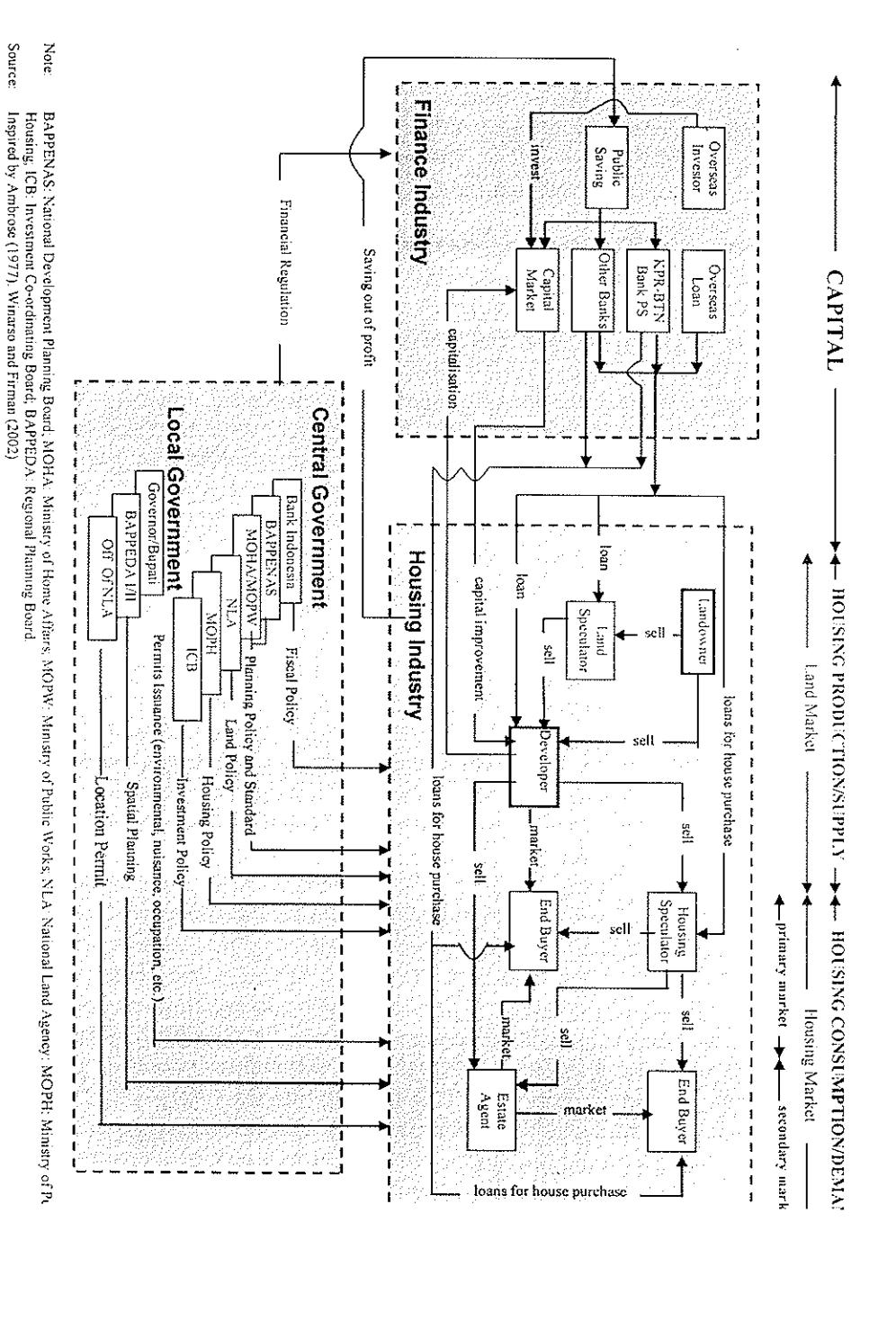
Figure 1. Formal Land Development Process in Indonesia
Source:
In Indonesia, such a model is constructed by Winarso (2002). Based on the Equlibrium models<sup>7</sup> the linkage between state action and market force can be demonstrated (see Figure 1). The model shows that residential land market is closely linked to finance industry and the Government. The Government provides regulations and policies to the housing industry and finance industry. Finance industry supports the housing industry with the needed capital. The growth of the housing industry, in return, will further develop the finance industry, particularly by selling the portfolio in money market. It should be noted here that, together with the formal process as pictured by the model, the informal processes also take place, particularly in the housing industry and in the relationships between the housing industry and the government. For this industry, the informal process, through lobbying is, in some cases, more important than the formal process itself.
As shown in the model, the government has the possibility to intervene the market through financial regulation, fiscal policy, housing policy, investment policy, land policy planning policy and standard, spatial planning and permit systems. However, these interventions tools are under the After several changes in the responsibility of different institutions. Indonesian administration since the economy and political turmoil in 1998, housing development is put under the responsibility of new department which and Regional Settlements Department of (KIMPRASWIL). Although this department, the only institution that formally has direct responsibility for housing development, has launched its housing and settlements policy and strategy for 2000-2004, (Departemen Permukiman dan Prasarana Wilayah, 2001) in practical, there have been no systematic integrated interventions made to recover the condition of formal housing market.
What have been done so far are partial interventions that could have impacts on the formal market. These interventions among others are the creation of IBRA and intervention to overcome the economic crisis trough a series of financial policy.
3.2 The creation of IBRA
There were no direct interventions of the government to speedy recovery of the housing market at least until the end of 1999. The government actions
Healey (1991), grouped models on land development process into four, E.g.: (1) Equilibrium models, which assume that the development activity is structured by economic signals about effective demand. This derives directly from the Neo-classical tradition of economy. (2) Event-sequence models, which focus on the management stages in the development process. (3) Agency models, which focus on actors in the development process and their relationship. These have been developed to describe the development process from a behavioural or institutional point of view. (4) Structure models, which focus on the forces, which organise the relationships of the development process and which drive its dynamics. These are grounds in urban political economy and are mostly used by Marxist theorists.
were focused in overcoming the negative impact of the economic crisis, particularly for social and political concern<sup>8</sup>. The important intervention made by the government that could have impact to the housing market is the creation of ad hoc Institution, insisted by the IMF, labelled Indonesian Banking Restructuring Agency (IBRA) in January 1998. Under the Presidential Decree No. 27 of 1998 on The Establishment of IBRA, IBRA main task is to restore the condition of national banking sector and to pay back the state fund formerly extended to the banking sector.
The idea of this policy is merely to deal with the substantial amount of non-performing loan. The Non-performing loans would be transferred from the falling financial institutions or banks to IBRA which would package and resell at a discount in the market. To accomplish its mission, IBRA is supported by a special mandate and authority with the Presidential Decree No. 34 of 1998 on the Duty and authority of IBRA, as the legal basis of operations. The Banking Law specifies three fundamental duties of IBRA, namely: restructuring the banks transferred to IBRA, recovering bank assets including both physical assets and loans, and recovering state fund formerly disbursed to the banking sector.
With such a power IBRA has taken over almost all unhealthy banks and their assets and up to March 1998 54 banks had been kept under IBRA's surveillance (Rachbini 1999), In 2001, total property assets under IBRA management is Rp. 70 trillion. (Simanungkaiit, 2001). Out of that Rp. 45 Trillion is a non-performing loans and Rp. 25 Trillion is in forms of land and buildings. So far the loan restructuring process is slowly progressing, it is predicted that out of Rp. 70 trillion property assets under IBRA management, only Rp. 15 Trillion could be returned to banking systems. The remaining Rp 55 trillion will be sold. This undoubtedly will influencing the formal housing market as most of the assets under IBRA are in form of land and buildings (including housing). In Its first Property Assets Disposal Program (Program Penjualan Aset Properti =PPAP), 4.994 bidders participated to buy real property assets such as lands, shop-houses and houses. (Property Indonesia, December 2002).
Under the last chairmanship <sup>9</sup>, through second PPAP, IBRA will sell part of its assets at the value of Rp. 2,4 Trillion in mid 2003 (Properti Indonesia, December 2002). This certainly will affect the housing market considering that the property offered are in various types including housing, apartments, and ready to build plots in strategic locations.
١.
<sup>9</sup> Within three years five persons have chaired IBRA.
s In particular, the government launching a social safety net program with the assistance of World Bank and the International Monetary Fund. (Firman, 2002)
Table 1. Non-performed Loan under the Asset Management Credit of IBRA in 2001
| Property Sector | Outstanding debt | % | ||
|---|---|---|---|---|
| Hotel | 17,553 | 37 | ||
| Housing | 9,320 | 20 | ||
| Office Buildings | 6,869 | 14 | ||
| Apartment | 5,107 | 11 | ||
| Land bank | 3,3287 | 7 | ||
| Others | 2,449 | 5 | ||
| Retail | 1,835 | 4 | ||
| Industrial Estate | 1,230 | 3 | ||
| Total | 47.678 | 100 | ||
Source IBRA, December 2001 quoted by Simanungkalit, 2002.
3.3 Financial Policy
Financial and bank sectors in Indonesia are the institutions hit severely by the economic crisis. Until March 1998 54 private banks had been in taken over by IBRA to be restructured. Non-performed loan in IBRA increased considerably. Form 9.021 billion Rupiah in 1997 increase up to 128.305 billion Rupiah in 1998 in 1998, (Rachbini, 2001) an increase of 1322,29 percent. The non-performing loan from property reached 67.55 percent of the total bad debt. This condition is certainly not conducive for the housing market.
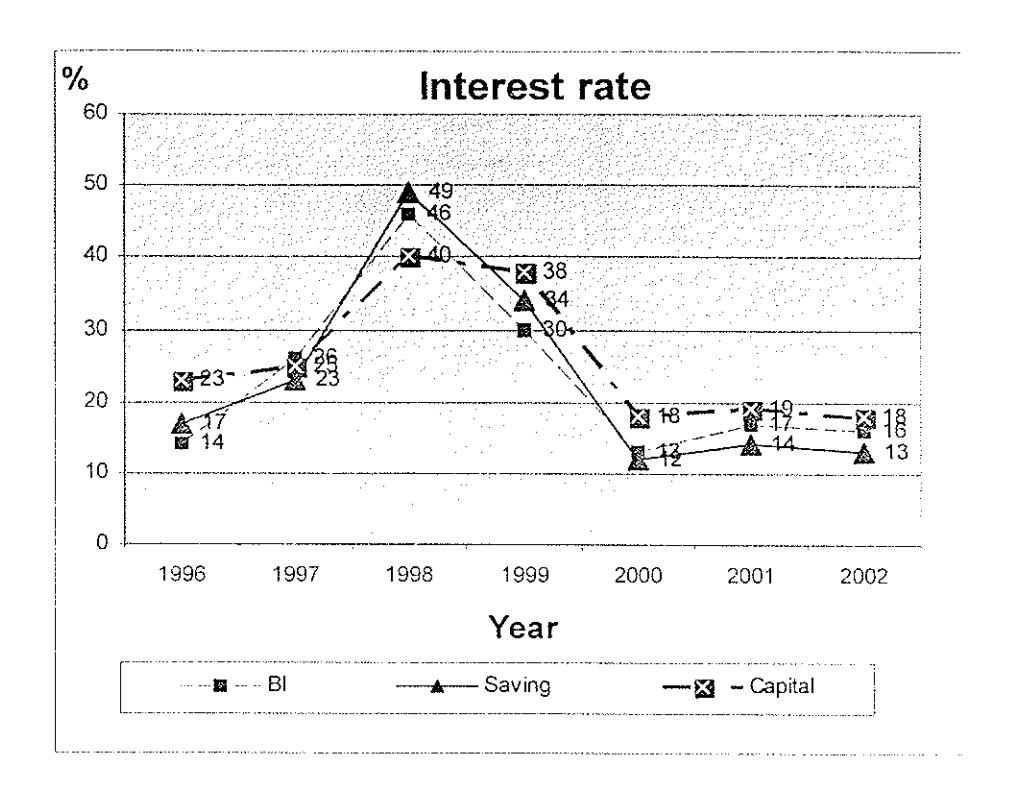
As it shown in the model, housing market is always influenced by finance, i.e. the availability of capital or funds for producing and buying houses. The availability of loans is important to induce the housing market. Parallel to the creation of IBRA the government has also been evaluating the macro economic condition of the country. The government increased the SBI (Sertifikat Bank Indonesia = Bank Indonesia Certificate) interest rate and controlling the supply of money. The interest rate for saving was at the peak at around 40% in mid 1998 right after the crisis then slowing down to reach 12 in the year 2000. Meanwhile the supply of money is also controlled in order to stabilise the money supply. (see Figure 2)
This apparent decreasing interest rate was the impact of government policies in financial sector. However as the crisis is a multi dimension one, the lowering interest rate did not caused the housing market worked well. Thus, to reduce the burden of the developers who develop simple houses, in April2001 (Kep.01/K.KKSK/04/2001) the government made a policy which enable developer who develop simple houses to cut up to 50% of their debt, However, at the same time the government also reduce the subsidy for simple house almost 50 %, from Rp. 956 billion in 2000 to Rp. 479 billion in 2001 (Simanungkalit, 2002) and as part of the IMF agreement, Bank Indonesia (BI) liquidity funding for housing loan (KPR) subsidies was ceased and the
Ministry of Finance had to carry the subsidy on its budget. It is supposed to be phased out by 2004. This means that in 2002 the government could subsidies the consumers of very simple house type 21 only for two years. This new policy would have impact in the housing market particularly the simple and very simple housing because the consumers has to get housing loan with market rate interest, which is beyond their affordability.
IV. THE EFFECTIVENESS OF THE INTERVENTIONS
What should be noted here is that all the government effort, if any, to recover the housing market is done in a condition that is not differ from that of the old 'new order". Corruption remains at the public concerns. In 2000 Indonesia was at 85<sup>th</sup> on the list of the country in relation with corruption incidences as surveyed by Transparency International (<a href="http://www.tranparency.org/">http://www.tranparency.org/</a> cpi/2001/cpi2001.html) In 2001 the position is even worst. It listed at the 88<sup>th</sup> out of 91 countries surveyed. The macro economic indicators also show un promising situations, It is said that in longer term perspective, the cumulative impact of the crisis on Indonesia's growth has been significantly greater than that for others countries in the area, except Thailand. (Athukorala, 2002). Politically, the condition is also still uncertain, within four years after the collapse of Suharto regime, three presidents have been in the Indonesian administration with a harsh transfer of power.
Although the spirit of the reformation era was to tackle down corruption problems, nevertheless, the new administration is unlikely to be less corrupt than the previous one (Dick, 2001). No hard evidences, that the public intervention in housing market now is contaminated by cronyism, collusion and corruption, however, as IBRA manage such a huge amount of government's assets. IBRA may have attracted for corruption. And as Redway (2002) said: Since IBRA lacks the operational expertises to manage the assets under its control, it must continue to rely upon the former owners and management loyal to the former owners. Such a condition could open for lobbies which will benefit the former owner.
The creation of IBRA is not directly intended to recover the housing market, it is much more intended to recover the banking sector which in turn it is hoped that the housing market will get the benefit from the recovery of banking sector. Critics have been addressed to this IMF's promoted programme. Mostly blamed IMF for not properly analysing the nature the economic and political problems of Indonesia. (For instance. Rachbini, 2001). If the 'culture' of lobbying and corruption were still intake, what ever the policy of the government are, they would always fail. A prominent business magazine "Investor" in its article reporting that there is a possibility that the debtors of the non performing loans which their assets are under the management of IBRA will get their own assets in much cheaper price. (Investor, July 2002). This will hampered the just and fair and sound housing market.
The financial policy that has direct impact on the housing market is the correction on the banks interest rate. If the interest rate is low, it will induce more investments in the housing and could attract potential individual lenders to buy house in a loan scheme. The policy that reducing housing loan subsidy, as insisted by IMF, has burdened the low-income people to buy house so that the construction of simple and very simple housing are far away from the target set by the government. Up to October 2002 only 23,123 units were constructed out of 130,000 units targeted. (Properti Indonesia, December 2002). A Recent housing studies in Indonesia (Hoek-Smith, 2001) reported that the high interest-rates (20 percent) and high down-payment requirements for mortgage lending will affecting the affordability line of the low-income people. Moreover, the borrower is constrained by the lack of down-payment support for mortgage lending.
The latest available data on the transaction of housing shows an unbalanced transaction between the simple housing and the large housing. The data shows that the value of transaction and the absorption of house for simple and very simple houses are still lower than before the crisis (See Table 2 and 3). The tables show that, although the total transaction is increase for 47% in 2002, which could be due to the inflation rate, the total housing unit sold in 2002 is still 32% under the total housing unit sold before the crisis.
Even worst the tables also show that the market for simple and very simple house is not recover yet. It shows that the market absorption for simple and very simple house is still decreasing, which implies that the majority of the low-income people are still untouched by the intervention of the government. Meanwhile, the medium and the large house have shown a trend for recovery which perhaps is a speculative move by large developer to gain profit in near future. The table clearly shows that the policy is more effective to push up the middle and large house for the minority people who could afford to buy such types of house. While the majority, which is the poor, could not afford to buy even for the very simple house.
Table 2. Housing Absorption by Market Segment in Indonesia 1998-2002.
| Market Segment | Sold (unit) x 1000 | Change in Selling (%) | |||||||
|---|---|---|---|---|---|---|---|---|---|
| 1998 | 1999 | 2000 | 2001 | 2002 | Total | % | 2001 | 2002 | |
| Very Simple house- BTN | 42.2 | 13.3 | 29.3 | 9 | 5 | 98.8 | 17% | -79% | -88% |
| Simple House -BTN | 72.6 | 40.4 | 68.5 | 32.2 | 20 | 233.7 | 41% | -56% | -72% |
| Other house - BTN | 8.5 | 1.5 | 5.6 | 18.2 | 27.6 | 61.4 | 11% | 114% | 225% |
| Simple House - Private | 15 | 14 | 22.3 | 29.1 | 45.5 | 125.9 | 22% | 94% | 203% |
| Medium House | 6.4 | 4.8 | 6.9 | 8.7 | 9.4 | 36.2 | 6% | 36% | 47% |
| Large House | 1.4 | 1.3 | 1.9 | 2.3 | 2.9 | 9.8 | 2% | 64% | 107% |
| Total | 146.1 | 75.3 | 135 | 99.5 | 110.4 | 565.8 | 100% | -32% | -24% |
Source: PSPI (2002).
Table 3: Housing Transaction by Market Segment in Indonesia 1998-2002
| Market Segment | Transaction Value (1 Billion Rupiah) | Change in Transaction (5) | |||||||
|---|---|---|---|---|---|---|---|---|---|
| 1998 | 1999 | 2000 | 2001 | 2002 | Total | % | 2001 | 2002 | |
| Very Simple house- BTN | 267.7 | 85.9 | 221 | 62.3 | 35 | 671.7 | 4% | -330% | -38% |
| Simple House -BTN | 789.2 | 511.1 | 1187 | 530.2 | 362.2 | 3379.2 | 19% | -49% | 4% |
| Other house - BTN | 200.9 | 36.4 | 176 | 631.6 | 1073 | 2117.6 | 12% | 68% | 94% |
| Simple House - Private | 472 | 457.8 | 803 | 1150 | 2025 | 4907.9 | 28% | 59% | 60% |
| Medium House | 871.1 | 591.3 | 705 | 915.7 | 1024 | 4107.2 | 24% | 5% | 35% |
| Large House | 431.9 | 310.5 | 405 | 494.7 | 630 | 2271.7 | 13% | 13% | 37% |
| Total | 3032.8 | 1993 | 3496 | 3785 | 5149 | 17455 | 100% | 20% | 47% |
Source: PSPI (2002).
V. CONCLUSION
Literature on housing market in developing countries mostly focuses on the low-income segment of the market including that which is informal (notably; Angel et al., 1983; Turner, 1967, 1972; Payne, 1977; Baros and van der Linden, 1990; Baken and Van der Linden, 1992), on the role of the state/Government and the issues of access to land for the poor (Angel, et al., 1983; Durand, 1990; Farvaque and McAuslan, 1991; Devas and Rakodi, 1993), or on policy instruments for land management (Archer, 1992, 1994; Devas, 1983, Yap and Angel, 1992; Dowall, 1991), it provides evidence that there are many informal activities and that the land development process can easily be subverted to serve the interest of politically influential groups (Dunkerley, 1983; Gilbert and Ward, 1985; Thirkell, 1994)
The literature also suggests that the informal processes in land development in developing countries may be the result of the immature planning and housing policy instruments (Rakodi, 1996, Baken and Van der Linden, 1992) This informality has been associated with those activities in the land development process which take place outside the legal system. (Angel et al., 1983). As noted by Jones and Ward (1994), the informal process often means bribery, corruption, evasion of legal restrictions and the arbitrary use of power.
In Indonesia this informal activities has influence the public intervention in housing market. In the beginning it speeds the growing of the market. But it is the informal activities that also caused the collapse of the market creating financial and political crisis. Now, four years after the crisis, this informal activities seem to be still intake in the relation between actors in housing market.
Under these circumstances, whatever government policies will not be effective and it will not achieve what it was intended. Not to mention that the fact of the mater there is no integrative policies aimed to recover the housing market. The government 's intervention by creating IBRA and lowering interest rate benefit only small minority developers and ignoring the large majority of low-income potential buyers.
VI. REFERENCE
"Acha Sugandhy: Target Pembangunan RS/RSS 2003 180 ribu unit" (Acha Sugandhy: Target for RS/RSS development in 2003 is 180 thousand units)., Properti Indonesia, Desember 2002, pp 21-22.
"Solusi Permukiman Kota Metropolitan" (Solution for Metropolitan Housing), Properti Indonesia, August 1995, pp. 30-31.
Ambrose, P. 1986. Whatever Happened to Planning, London: Methuen.
Angel, S., Archer, R.W., Tanphiphat, S. And Wegelin, E., Eds. 1983. Land for Housing the Poor. Singapore: Select Books..
Athukorala, P. 2002. Survey of Recent Development, in Bulletin of Indonesian Economic Studies, Vol. 38, No 2. pp 141-162.
- Baken, R.J. and Van der Linden. 1992. Land Delivery for Low-Income Groups in Third World Cities, Avebury, Aldershot.
- Baross, P and Van der Linden J, The Transformation of land Supply Systems in Third World Cities., Avenbury.
- Booth, A. 1992. "Implementing Monetary Policy", in Booth, A., Ed., The Oil Boom and After: Indonesian Economic Policy and Performance in The Soeharto Era. Oxford University Press, Singapore.
- BPS, Central Bureau of Statistics. 2002. Population Statistic.- Selected Table, Available from BPS Home Page <a href="http://www.bps.go.id/statbysector/population/tabel1.shtml">http://www.bps.go.id/statbysector/population/tabel1.shtml</a>
- Bradbury, K. L., Downs, A. and Small, K. A. 1982. Urban Decline and the Future of American Cities. Washington, DC: Brooking Institution,
- Bryant, CR, Russwurn, and McLellan, AC. 1982. The City's Countryside:Land Its Management in the Rural-Urban Fringe, Longman, London.
- Departemen Permukiman dan Prasarana Wilayah. 2001. Kebijaksanaan dan Strategy Penyelenggaraan Perumahan dan Permukiman 2000 2004 (Policy and Strategy for Housing Development and Settlements 2000 2004), Policy Paper, May.
- Devas, N. 1993. "Evolving Approaches" in Devas, N and Rakodi, C., Eds., Managing Fast Growing Cities: New Approaches to Urban Planning and Management in the Developing World. Singapore: Longman Scientific & Technical.
- Devas, N., and Rakodi, C., Eds. 1993. Managing Fast Growing Cities: New Approaches to Urban Planning and Management in the Developing World, Singapore: Longman Scientific & Technical.
- Devas, Nick. 1983. "Financing Urban Land Development For Low Income Housing" in Third World Planning Review, Vol. 5, No. 3.pp. 209-225.
- Dick, H. 2001. "Survey of Recent Development", in Bulletin of Indonesian Economic Studies, Vol. 37, No 1. pp7 42
- Dowall, DE. 1991, A Framework For Reforming Urban Land Policies In Developing Countries, Policy Paper.
- Drewett, R. 1973. "The Developers: Decision Processes" in Hall, P., Gracey, H., Drewett, R., and Thomas, R., Eds., The Containment of Urban England, Beverley Hills: Sage Publication.
- Dunkerley, HB., Ed. 1983. Urban Land Policy; Issues and Opportunities, Oxford: Oxford University Press.
- Durand-Lasserve, A. 1990. "Articulation Between Formal and Informal Land Markets in Cities in Developing Countries: Issue and Trends" in Barros, P., and Van der Linden, J., Eds.. The Transformation of Land Supply System in Third World Cities, Avebury, Aldershot.
- Evans, AW. 1985. Urban Economic: An Introduction. Oxford: Basil & Blackwell.
- Farvaque, C., and McAuslan, P. 1991. Reforming Urban Land Policies and Institutions in Developing Countries, Urban Management Programme.
- Gilbert, A and Ward, P. 1985. Housing, the State and the Poor, Policy and Practice in Three American Cities. Cambridge: Cambridge University Press.
- Healey, P. 1991. "Model of the Development Process: A Review" in Journal of Property Research, Vol. 8, No. 3, pp. 219–238.
- Hill, H. 1996. The Indonesian Economy Since 1966. Hong Kong: Cambridge University Press.
- Hoek-smit. 2001. Effective Demand for low and Moderate Income Housing, Homi Project, Kimpraswil, Government of Indonesia, December.
- Investor. 2002. Debitor Kuasai Aset Lewat Bank Rekap (Debtors Are Trying to Buy their Asset Via Restructured Bank), Vol. 58, Juli 2002 pp 13 16
- Jones, G., and Ward, P. 1994. "Tilting at Windmills: Paradigm Shifts in World Bank Orthodoxy" in Jones, G and Ward, P., Eds. Methodology for Land and Housing market Analysis, UCL Press, London
- Jones, G., and Ward, P., Eds. 1994. Methodology For Land & Housing Market Analysis. London: UCL Press, London.
- Kaiser, EJ. and Weiss, SF. 1969. "Decision Agent Models of the Residential Development Process: A Review of Recent Research" in Traffic Quarterly 23, October, pp. 597–632.
- Kaiser, EJ. 1970. "Public Policy and The Residential Development Process" in Journal of American Institute of Planner, January, pp. 30–37.
- Koenigsberger, O. 1964. 'Action Planning', in Architectural Association Journal, May.
- Leaf. M. 1991. Land Regulation and Housing in Jakarta, Indonesia: From 'Big Village' to 'Modern City', Unpublished PhD Dissertation, University of California Berkeley.
- Lee, M., (1994), The Cost of the Second Best: The Price of Land Regulation in Asia, DPU Working Paper No. 62. Development Planning Unit, University College London.
- Mansfield, E. 1991. Macro Economics Theory Application. 7<sup>th</sup> edition. New York: Norton and Co.
- Massey, P., and Cattalano 1978. Capital and Land: Land Ownership by Capital in Great Britain. London: Edward Arnold.
- Monk, S. 1991. Planning, Land Supply and House Prices the National and Regional Figure. Cambridge: University of Cambridge, Dept. of Land Economy, University of Cambridge.
- Payne, G. 1990. Informal Housing and Land Subdivision in Third World Cities: A review of the Literature. Oxford: Centre for Development and Environmental Planning (CENDEP),.
- Rachbini, DJ. 2001. Analisis Kritis Ekonomi Politik Indonesia (Critical Analysis of Indonesian Political Economy). Yogyakarta: Pustaka Pelajar,.
- Rakodi, C. 1996. "Urban Land Policy in Zimbabwe", in Environmental and Planning A, Vol. 28, pp. 1553–574.
- Redway, J. 2002. "An Assessment of the Asset Management Company Model in the Reform of Indonesia's Banking Sector", in Bulletin of Indonesian Economic Studies, Vol. 38, No 2. pp 241-250
- Server, OB. 1996. "Corruption: A Major Problem for Urban Management: Some Evidence from Indonesia" in Habitat International, Vol. 20 No. 1, pp. 23-41.
- Simanungkalit, P. 2002. Prospek Pasar Perumahan Nasional dan Bisinis Properti Jabotabek Tahun 20002 (The Prospect of National Housing Market and Property Bisnis in Jabotabek), in Jurnal Properti Indonesia ED VIII, Januari.
- Struyk, R.J., Hoffmann, M.L. and Katsura, H.M. 1990. The Market for Shelter in Indonesian Cities. Washington: The Urban Institute Press.
- Thirkell, A. 1994. The Informal Land market in Cebu City, The Philippines; Acessibility, Settlement Development and Residential Segregation, Unpublished PhD Thesis of London School of Economics and Political Science, University of London.
- Turner, J.F.C. 1976. Housing By People: Toward Autonomous in Building Environment. New York: Pantheon Books.
- Turner, JC. 1968. "Housing Priorities Settlements Pattern and Urban Development in Modernising Countries", in AIP Journal, November.
- UNCHS. 1990. The Global Strategy for the Year 2000. Nairobi: UNCHS.
- Winarso, H. 1999. "Private Residential Developers and Spatial Structure of Jabotabek" in Chapman, P., Dutt, AK., Bradnock, RW., Urban Growth and Development in Asia, Ashgate, Aldershot.
- Winarso, H. and Kombaitan, B. 1995. "Land Use Dynamic in Jabotabek Region: Isue Related to Land Use Changed and Their Magnitude In The Development Of Mega Urban Region" in Planning in A Fast Growing Economy, Selected Papers from The Third International Congress of The Asian Planning Schools Association, 1995. Singapore: School of Building & Estate Management Faculty of Architecture & Building.
- Winarso, H., and Kombaitan, B. 2001. The Large Scale Land Development Process in Indonesia, The Case of Jabotabek. Paper presented at the World Planning School Congress, Shanghai 11-15 July.
- Winarso, H and T. Firman. 2002. Residential land development in Jabotabek, Indonesia: trigerring economic crisis? In Habitat International, Vol 26. pp 487-506.
- Winarso, H. Forthcoming, "Access to main roads or low cost land? Residential land developers' behaviour in Indonesia" in Bijdragen tot de taal-, land- en volkenkunde; Journal of the humanities and social sciences of Southeast Asia and Oceania
- Winters, JA. 1991. Structural Power and Investor Mobility: Capital Control and State Policy In Indonesia, 1965 1990, Unpublished Ph.D. Dissertation, Yale University.
- World Bank. 1991. Urban Policy and Economic Development an Agenda for the 1990s Washington: World Bank.
- World Bank. 2001. Indonesia: Constructing a New Strategy for Poverty Reduction, Report No 23028-IND, October.
- Yap, KS. 1996. "Low-income Housing in a Rapidly Expanding Urban-Economy - Bangkok 1985-1994", in Third World Planning Review. 1996. Vol.18, No.3, pp.307-323.
- Yap, KS. 1992 Ed., Low-Income Housing In Bangkok A Review of Some Housing Sub-markets. HSD Monograph No. 25, Division of Human Settlements Development, AIT, Bangkok.
- Zhu. J. 1997., "The Effectiveness of Public Intervention in the Property Market.", in Urban Studies, Vol. 34 No 4., pp 627-646