

I. INTRODUCTION
Planning education has always been in the discussion of the planning educators due to its strategic position in developing and disseminating planning knowledge. Planning is said to be encompassed public as well as private domain, and has the potential for advancing society at all strata, be it in developing or in developed countries. With this believe, planning schools nowadays are delivering planning subjects in vast range of subjects, this is especially evident in the master degree programmes (see for instance, Friedman 2003; 1996; Nienback 1988). This certainly not the case when planning education was developed in the beginning, as Perloff (1957, as quoted by Friedmann, 1996) said "we train planners to be generalist with a speciality". Moreover he said that the subjects would include "the planning process, urbanism and the urbanization process, physical elements of planning, and socio-economic elements of planning".
It was the view in those days that planning was concerned with public/political decisions and had to be comprehensive, and on advanced decision making; therefore planning educations in the 1950s were only for master degree. Up to the present time, in fact, professional educations especially in the North America are sill concentrate on graduate studies (Friedman 2005). For the undergraduate programme the subjects for urban planning education were emphasised more on the physical aspects of planning, such as on the engineering side of urban development such as sanitary engineering. This view of planning was the result of the concern on the public health and beautification of cities as emanate the early planning legislation in Britain. Identification of planner with engineering and architectural profession were common, planning was then identified as environmental determinism (Rydin 1993).
The physical view of planning was reaching its peak after the World War II in European as well as in North American countries. In Britain and the Netherlands planning was used as tools to direct the reconstruction of the damaged cities. Town planning was seen as a neutral- value –free activity which aims to create a congenial built environment: as the word of Keeble (1969:1): " Town and country planning is the art and science of ordering the use of land and setting of building and communication routes so as to secure the maximum practicable degree of economy, convenience and beauty". Planning was then has to be rational based on the value-neutral analysis of cost and benefit analysis, planning-programming and budgeting systems (Sanyal 2005). This become the year of the rational comprehensive methods (Alexander 1992; Faludi 1973). As the consequences planning education was also concentrated in this field.
But planning is a life, there is no single coded procedure or practice for planning, it develops through time as a product of culture or as a product of theory. Booth (2005) for instance, asserted that that planning system is more as a product of cultural forces and he goes to argue that planning system is not a "single process" but more as an activity that is embedded in cultural traditions that form it. It sees that the recent planning activities which are too technocratic, elitist, bureaucratic and centralistic are alien to the local culture (Sanyal 2005). This approach looks at the different planning practice in countries in the world as a result of the different cultures (Friedmann 2005).
This awareness stem from the examination on the condition of the world today that shows the substantial gap between the rich and the poor countries and that there are problems in the distribution of wealth in the world. Thus the focus of planning educations in developed world is shifting towards more global view, addressing not only local western but also world issues. As the quote from DPU-UCL mission statement may show (DPU Website 2006)
DPU Vision
A just world in which men and women are equally able to choose, plan and manage their own lives and communities, and to influence local, national and global development in ways that are economically, socially and environmentally sustainable.
DPU mission
To build the capacity of professionals and institutions to design and implement innovative, sustainable and inclusive strategies at the local, national and global levels, that enable those people who are generally excluded from decision-making by poverty or their social and cultural identity, to play a full and rewarding role in their own development. The DPU
- challenges orthodox development agendas in its teaching and training in London and throughout the world;
- explores and tests enabling, participatory and gender aware approaches to development through action oriented research;
- promotes the formation of strategic partnerships for the integrated and inclusive management of cities and development through institutional advice and consultancy;
- supports the networking of individuals, community organisations, NGOs, and public sector institutions which share the DPU vision.
The global view in planning education is also built up by the fact that the number of students from developing countries who studying in planning education institutions in developed country turn out to be more significant (the Economist, 2005). The global view on planning education in the industrialized becoming more and more pronounce although local issues are still important, as it might be shown by the USC mission bellow (USC website 2006)
The mission of the USC School of Policy, Planning, and Development is to become the premier school for educating leaders and creating knowledge for innovative governance and place-based solutions for the betterment of communities worldwide. Toward that end, SPPD educates and trains leaders who can create multidisciplinary approaches to the challenging and complex issues of governing, managing, and building contemporary urban communities.
Meanwhile planning education in developing world which were started in the late 1950s were aimed at providing experts in planning for local problems, at that time, asking for assistance from the western universities to set up a degree programme in developing countries thus, could mean developing programme using western planning tools to be put into social and cultural specific of the developing countries as the western planning education were developed in the effort to tackle their local problems.
Nowadays as global education become trend as Wooldrigde puts it: "mass higher education is forcing universities to become more divers more global and much more competitive" (Wooldrige in The Economist, 2005). Collaboration between universities in the world is apparent. Planning education is in the front line for educational collaboration, not only because the field is now globally accepted but also because economic, environment, social and cultural development are now cross border, and this often involving conflict and alliance across ethno-national.
This paper discusses the development of curricula of the Department of Regional and City Planning, Institute Technology Bandung in Indonesia, and argues that the development of the curricula is in line with the development of planning thought and has been developed to enrich students not only with the analytical, technical and socio political knowledge of local content of developing countries but also the content of developed countries as these two knowledge will enhance understanding of global development problems, in so doing this paper will be presented in five parts.
Part one is the introduction, part two discussing the contexts of planning education in Indonesia; part three presenting the development of ITB"s curricula, part four presenting the development of The Double Master Degree Programme, at the end summary and conclusion is presented.
II. PLANNING TRADITION1 : THE CONTEXT FOR PLANNING EDUCATION IN INDONESIA.
As it has also happened in other developing countries, planning practice in Indonesia has experienced several changes influenced by the planning paradigms, which emanate globally, as seen by the development of planning theory and the involvement of the international donor agencies in third world"s development. 2
In the context of Indonesia the changes can be seen in three phases of development. The first is physical concern; the second is the economic concern, and the last is the decentralisation and globalisation concern.
Physical concern
The history of the "formal" planning in Indonesia dates back from the beginning of the 1800s when the Colonisation started and eventually still handed down some of the conflicts in the planning and housing systems in Indonesia. By the beginning of the 18th century, as the VOC (Verenigde Oost Indische Compagnie) held the majority of the coastal territories in the archipelago, there were some changes in the urban pattern. The setting up of a European administration, as the result of growth in trade, stimulated the change in urban pattern even more. The establishment of the Dutch colonial administration strengthened the position of Dutch families in town, while the majority of Indonesians had to live in Kampung3 with severe condition.
It was the promulgation of the public Health Act in Britain in 1848, which encouraged the promulgation of the physical-planning act in the Netherlands in 1901. This act of establishing municipal planning procedures, was a simple system concerned with planning and controlling the extension of towns. 4 This act was gradually shifting to the more complex system following scientific approach of planning developed in the British tradition of town planning. 5 The growing awareness of environmental problems of cities in Europe had its impact in Indonesia as well. The severe condition of Kampung areas received more attention as the number of Europeans living in Indonesia increased. This was expressed in the "Tenth International Housing Congress" held in Scheveningen in 1913 in a paper by HF Tillema entitled: "From Living And Habitation, From Building, House and Gardens" which examined the living
conditions in Semarang"s Kampung, a city in Central Java (Bogaers and de Ruijter in Nas ,1986).
In the 1900s, public health concerns had inspired some Europeans in Indonesia to make plans for their settlements including the enhancement of Kampung conditions by imposing regulations concerning sanitation, health and building regulation. This was further encouraged by the passage of Decentralisation Act in 1903 which enabled the local authorities to manage their own administrations including the construction and maintenance of roads, waterways, inspection of buildings and housing, housing improvement and town expansion. As a result of the Decentralisation Act, several cities issued regulations concerning physical or building development, including Bataviasche Plannenverordening 1941; Bataviasche Bestemingkrigene en Bouwtypenverordening 1941, and Bataviasche Bouwverordening 1919 -1941 in Jakarta which regulated the town development based on designated area.
All of those regulations constituted building construction provisions rather than urban planning. It was Ir. Karsten who shifted the focus to the urban planning during his work in Indonesia in 1914 - 1945. In 1920 he wrote a report entitled "Town Planning in Indonesia," which contains his concept of town construction and the role of Government in the town planning. His report encouraged the establishment of the Town Planning Committee by the Dutch Colonial Government. The important result of the committee was the Town Planning Bill, which later became the first Town Planning Act in Indonesia. The town planning at that time was strongly aimed at improving housing conditions, this type of planning had been matured in what is now called "town planning tradition". Thus the growing awareness on the effort to enhance the housing conditions focusing on the specific building techniques, sanitation and Kampung improvement influenced the planning model in Indonesia.
In the early years of the Independence the policy of the new Republic of Indonesia was focused on defending the independence in political and military way. In the first decade of the Independence period, Indonesia"s economic history was characterised by dislocation and declination. Under these conditions, most of the infrastructure left by the Dutch colonial ruler was neglected and became unusable.6 Between 1951-1960 with the assistance of a UN team, Singapore, the neighbouring country of Indonesia, prepared a master plan for its tiny city-state.7 This effort seemed to encourage the Indonesian Government to launch the first ever Five-year Development Plan (1956-1960) which was followed by the establishment of a National Planning Council in 1959. This Council then launched an Eight-year Development Plan
(1961-1968). Both plans set ambitious targets but provide scanty guidance on the matter of finance (Mackie in Glassburner ed. 1971: 49-50).
It was in this phase that the first planning school in Indonesia founded at the Institut Teknologi Bandung (ITB) in 1959 with the help of the United Nation (Oetomo 2003, Sujarto 1999) and proposal from Harvard Graduate School of Design (Doebele 1962). The founding of the school was clearly influenced by the thinking that was flourishing in that year as it is cited in the beginning of this paper.
The economic concern
In 1969, under Suharto"s presidency, the Government launched the first series of Five-year Development Plan, which was aimed at economic development as a national policy to overcome the problems, which emerged during Soekarno"s administration. The world also marked 1960 as the beginning of "development planning tradition" focusing in the provision of basic needs. Its objective is "development" in a broader sense since development planning can be defined as a continuing Government planning activity in cities, towns, and villages aiming to achieve economic growth and social progress.8
This phase is noted by its ability to push the economic growth, the economic condition, which was pictured as a "sustained economic growth" by Hill (1996). The average economic growth of 7.7 per annum had impacts on the development of the formal private sector. Together with the significant economic growth enjoyed by the country, the overall policies have geared the involvement of private sector, and Indonesia start to have role in global economic, it was said that Indonesia would be able one of the tigers in economic development in Asia together with Taiwan, South Korea, Hong Kong, and Singapore. Later in the 1980s, to gear up the economic development, a series of deregulation policies was implemented in Indonesia during the years 1983 –19889 . The deregulation policies were aimed at improving domestic savings, improving resource allocation and developing a framework for monetary management, in particular through indirect intervention rather than direct regulatory control (Hill, 1996). The most important deregulation policy was perhaps the 1988 financial, monetary, and banking reform.10 This was of particular assistance to the development of real estate industries. The policy enabled the entry of more foreign banks in the form of joint ventures and thus encouraged genuine competition (Hill, 1996:36). The banking system expanded as a result of the competition. Hill (1996) noted that between March 1989 and June 1993, the number of private banks" branches almost doubled, while the state bank in the same period expanded only 24 per cent. (Winarso and Firman 2002). However this significant economic development, as it has been well documented in some
studies (Winarso 1999, Firman 20002 ), triggered a political flaw and the fall of the government.
During this phase planning education were growing in Indonesia. The creation of local planning body in local level was one which triggered the growing of planning education in Indonesia. Started by the founding of Master programme in Regional and Urban Planning in 1990 at Gadjah Mada University, the other oldest university in Indonesia, today there are more than 30 planning schools in Indonesia, for graduate as well as for undergraduate programmes. The same year also witnessed the founding of the Indonesian Planning School Association in Indonesia, at ITB, which was declared by ten Planning schools with the help of GTZ from Germany.
The decentralisation and globalisation concern
This phase, started by the fall of the Suharto regime, has been focused in the issue of good governance and the decentralisation of power and planning. This view was a reaction of what has been experienced within 30 years of centralised planning. The second phase which was concentrated in the economic growth utilised centralised approached were criticised as fail, created unaccountable government full of corruption and nepotism. The impact of this regime has been well documented (Winarso, 1999; Firman 2002; Winarso and Firman 2002). It is worth however to highlight the condition at that time and illustrate the severe condition of the economic of the country; the banking sector which was one of the important institutions contributed in the economic growth of the country was in disarray hit by fall of Rupiah value against Dollars. These banks have made excessive loans to property firms, which many of the firms were their own business groups (Winarso and Firman 2002; Firman (2002) wrote that the total loans in 1998 was recorded as much as Rp. 545.6 trillion, out of this amount loan allocated for property development was Rp. 545.6 trillion (13.3%), and almost threefourth of this were non performing loans.
As it was presented in a report (Winarso, et al, 2002) the number of poor people in the country was suddenly increasing11, the severe economic crisis since mid 1997 has caused a clear deterioration in the people welfare. The number of people living in poverty has increased dramatically12. In December 1998, number of poor people (living in urban and rural area) reached 49.5 million (24.23 % of total population), or 27 million more than the pre-crisis figure. This figure was reached only within 18 months. The impact of the crisis on poverty in urban area was more severe than in rural area. From 1996- 1998 urban poverty increased by 8 million people (83 %), and by about 7 million people in rural area (28 %). Within very short period of time the gap between the rich and the poor was increasing tremendously, this condition
increases the tension of jealousy between the groups who live in different environment in the surrounding areas. This, combined with the economic factors, i.e. the collapse of the banking industry has triggered the economic crisis in Indonesia (Winarso and Firman, 2002) and culminated in the socialpolitical turmoil of the country in 1998.
The government actions were focused in overcoming the negative impact of the economic crisis, particularly for social and political concern13 . The important intervention made by the government that was the creation of ad hoc Institution, insisted by the IMF, labelled Indonesian Banking Restructuring Agency (IBRA) in January 1998. Under the Presidential Decree No. 27 of 1998 on The Establishment of IBRA, its main task is to restore the condition of national banking sector and to pay back the state fund formerly extended to the banking sector. Meanwhile in the political and governmental concern, democratisation in the form of more decentralised government was in the centre of discussion.
Regional autonomy was the key issue in the phase of decentralisation. A process that has not been easy, the transfer of power of what was a tradition of a strong central government power and control to local government which was traditional has no power and control over their resources take allot of energy. However this process has brought a new horizon for in the development of the country by laying down the decentralisation principle which will empower the grass root. The good governance and public participation and transparencies become important issues. In this era the role of planner was questioned, papers on planning around those days were discussing the new role of planners and the impact of the decentralisation (Winarso et al, 2002; Oetomo 2002; Zulkaidi 2002; Sofhani 2002). Planning education also taking these issues and promoted some new courses influenced by the post positivism way of thinking which sees that value is important in planning. Emphasise should be put to social justice, and planning should be collaborative (Healey 1997) to get more participation from communities.
The influence of global economy and culture that actually was started in the phase of economic concern is still high. Metropolitans in Indonesia become one of the global cities characterised by the increasing number of international offices and Foreign Direct Investment. This global influence is not only showed by the present of international offices, but also in education. Educations institutions from North America and Europe are opening their "branch" in Indonesia, by way of collaboration with Indonesian educational institutions, mostly private institutions, the Ministry of Education also supporting this trend by allowing a bi-lingual education system even starting from elementary school. Undergraduate double degree and exchange programme have also been mushrooming in these years.
III. THE DEVELOPMENT OF THE CURRICULA
Undergraduate programme
Looking into the development of the bachelor programme"s curricula one must be noticed that there are some basic courses important for planning education. At ITB, especially for undergraduate programme, students have to take Basic Sciences, Languages and Ethics in the first year. Planning courses are only delivered after the students pass the first year. The planning courses can be grouped as the following.
- Planning Theory (Introduction to Planning, History and Theory of planning)
- Basic Technical Skill for Physical Planning (Site Planning, GIS,)
- Communication Skills (Oral, and writing)
- Basic Knowledge for Planning, (Land use, Location Theory, Housing and Settlements, Natural resources and Environment, Economics, Geography, Demography, Planning Politics, Community Participation)
- Planning Law and Administration (Planning Law, Finance, Institutions,)
- Studio/Workshop
- Internship
- Research and Analytical skill
- Syntheses
Over the years the course grouping is still the same; however, as it will be discussed below, there are changes in the subject"s courses and in the credit loads, which was influenced by the changing of planning context in national as well as global level.
Planning education in ITB was founded in 1959 with the assistance of The United Nation and Harvard University under the collaboration with Department of Public Works (Sujarto 1999, Oetomo, 2003). The reason for the development of planning school was to train planner in line with the effort of the Indonesian Government to developed the country, concentration was put more on physical aspect of planning. Planning subjects before 1959 in ITB were taught in the Department of Civil Engineering, but these subjects were transferred to the newly developed Department of Regional and City Planning. The vision of the department as recalled by Doebele (2003) was very ambitious, Planning education in ITB was created to be the centre for planning education in South Asia as there were no planning schools in Asia and Africa in that year, at least for the undergraduate level (Viloria 1974).
This concentration on the physical aspect of planning is understandable as at that time planning theory was also still at the early stage of development, and was very much based on the instrumental rationality. Debate on planning theory was concentrated on the procedural point of view rather than substantial one. It was Perloff (1957) who lay down the credo generalist with specialisation. This credo was also used as the base of the Planning education in ITB. The concern to the physical aspects was very apparent as it showed by the curricula of 1959-1963, emphasised of physical aspects were clearly seen by the load of the courses. Nearly 50 % of the courses were dedicated to transportation planning, basic technical knowledge of planning and studio/workshop, only 20 % were dedicated to social and economic aspect of planning. Issues of inequality, housing and gender were not profound although there were courses in housing and urban sociology.
The awareness to the environment which was triggered by the Club of Rome in the 1970s seemed to influence the curricula of 1973 in which the load of the environment course was increased. Early 1960s to the early 1980s is the decades of physical planning in ITB"s curricula, the load for basic technical knowledge for physical planning was very high, almost 50% of the courses were concentrated in this area, this include skill for geodetic, sanitation and sewerages planning, cartography etc., however, In 1980s when the Ministry of Education issued a new regulation on the credits14 load for university degree which cut of the credit load from 174 to 158 and finally to 144 credit points for undergraduate degree, and from 48 credit points15 to 36 credit points for graduate degree, the curricula had a radical shift.
To fit the new regulation, several credits load had to be cut and this means several courses had also to be omitted. As it was the phase of economic concern in Indonesia, planning was seen as tools to gear the economic growth, this concerns then shifted the curricula to focus more on economic, social and administration aspects of planning, and this mean that the credit load for basic physical knowledge for planning had to be cut.
The new curricula in year 2003 were stems from the influence of the thinking that planning is both science and art and to implement a plan the planners
have to understand politics and social economic context (Allmedinger 2002; Healey 1998), as the consequence, load for economic and social aspect of planning get more deliberation. In the phase of decentralization concern, two new courses were added: Planning and Politics and Community Participation. This was the result of the new trend in planning thought which say planning has to be value sensitive, planning is not only an instrumental rational but it has to be value rational which mean giving more attention on how social justice and environmental quality can be upheld and therefore the appreciation of the indigenous knowledge or local wisdom.
Figure 1 bellow illustrates the development of the curricula between 1959 and 2005
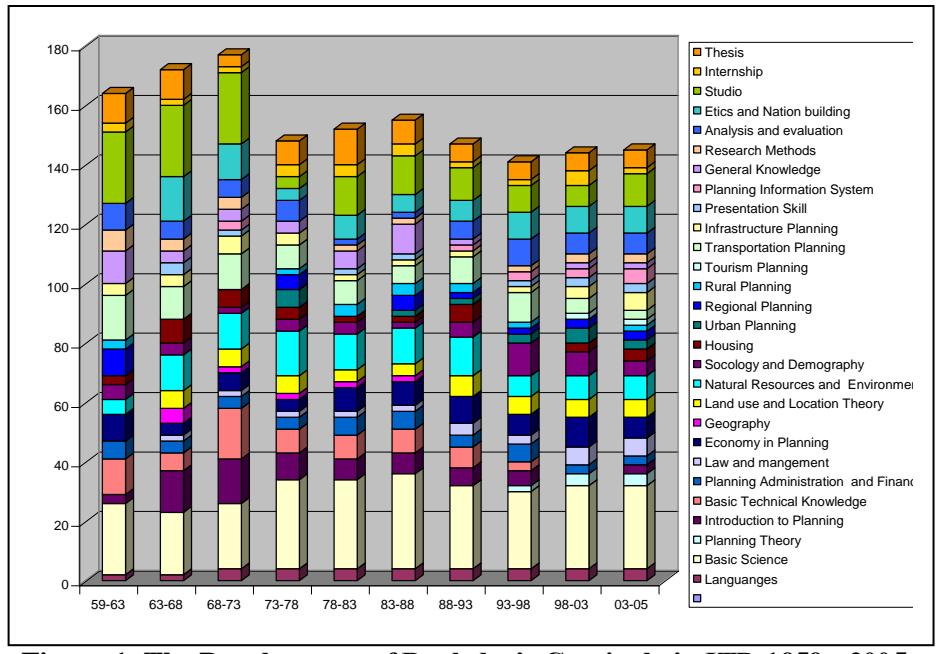
Figure 1. The Development of Bachelor's Curricula in ITB 1959 - 2005
The figure shows that physical aspect of planning is decreasing while the social economic and political aspects of planning become important in the recent year. This shift is not without debate. Balancing physical planning ability in very tight curriculum is not an easy task particularly when higher educations institutions are now pushed to produce much more graduates.
Graduate programme
Graduate programme in Regional and city Planning ITB was found in 1982 with the help of the Development Planning Unit, University College London in collaboration with Department of Public Works. The development of the master degree programme was aimed at training planners in line with the growing needs for qualified planners to work as private consultants or as government officials.
It was in the phase of economic concerns, Indonesia was enjoyed the fruit of the oil booms, physical development were everywhere; cities and towns were pushed to make master plan to guide the development although there were lack of planning capacity in the government"s officials. Each local government has to have development plan which had to be in line with the development plan of the higher level government and the central government.
Here the curricula were developed based on the experience of the DPU, UCL in the research and training in London. The courses were emphasised to train planners in four different specialities: i.e.: Housing and Land Development; Area Development and Location Study; Community Development; and Transportation Planning. These four specialisations were bound together with core curriculum which consists of 38 courses and total credit load of 43 credit points. It was not surprising that land and housing development were one of the specialisation offered in the ITB curricula as these subjects were among the expertise of the DPU. John Turner who is well known for his "Housing by People" and Oto von Koeningsberger who is known for his "Development Planning" were the founding fathers of DPU (Levy, 2006). The curricula developed with the help of the DPU kept changing almost in every year until 1985, it seemed that the changing was due to the availability of the experts. Most of the DPU"s teachers who developed the programme could not stay longer in Indonesia, and this made the courses has to be changed in accordance with the new experts who come to ITB.
After the first curricula, several other curricula were developed in response to the changing planning contexts and the streams in planning thought. The second master degree curricula which were developed in 1985 emphasised on three streams; i.e Urban Planning Streams; Transportation Planning Streams; and Regional Planning Streams. These three streams were actually a representation of the focus of development at that time.
In 1993, GTZ collaborated with ITB developed an idea of District Planning. The idea which was actually developed by University of Dortmund and The Asian Institute of Technology in their Spring programme were exported to ITB. After some deliberations, this collaboration came up with new stream labelled District Planning. The concept of district planning which was taken from African experience was not fit nicely in Indonesian context because of the different scale of the district. This stream was then faded away together with the end of the GTZ project in ITB.
In the 1986 after the establishment of Urban Management Programme in UN Habitat as an effort to overcome problems in implementing development projects and programmes in developing countries, urban management course became important issues. This urban management approach was adopted in the 1993 curricula as new stream labelled urban management stream together with General Planning Stream and District Planning Stream. In the General Planning Stream three options were offered; i.e. Regional Planning, Urban Planning and Transportation Planning. (see figure 2)
Unlike the undergraduate curricula which concentrated in training people to be a young "planner" who will be able to make a plan for a small cities, with simple problems based on coded practice, the graduate programme is focusing more on giving specialisation to students. In this circumstances core curriculum which would ensure that "student can acquire true mastery of specialisation which rest on a foundation that includes a knowledge of the urban habitat and its dynamics as well as the skills, methods, and approaches common to urban professionals". (Friedmann 1996), become an important issue.
The figure shows that in 1983 almost 95% of the courses were "core", specialisation courses were very limited; this core is changing and in 2003 core and specialisation courses is almost at the same load. So what are the core courses?
Friedman (1996) based on his research to twenty accredited planning programme in North America noted that computer literacy, quantitative methods, introductory courses in theory and practice of planning, introductory courses in economic and planning law are among the important core courses. At ITB curricula of 1993 the core courses are: Planning Theory; Analytical Method for Planning; Planning Administration and Finance; Settlement Structure and Pattern; and Environmental Aspect in Planning. Furthermore, for Regional Development, Urban Planning, Urban Management, and Infrastructure and Transportation streams, the core courses is added with Urban and Regional Economics course. All together the core courses constitute of 15 credit load, correspond to 45% of the total credit loads for master degree programme.
Figure 2 bellow shows the changes of core and specialisation courses at ITB master program curricula from 1983 to 2005
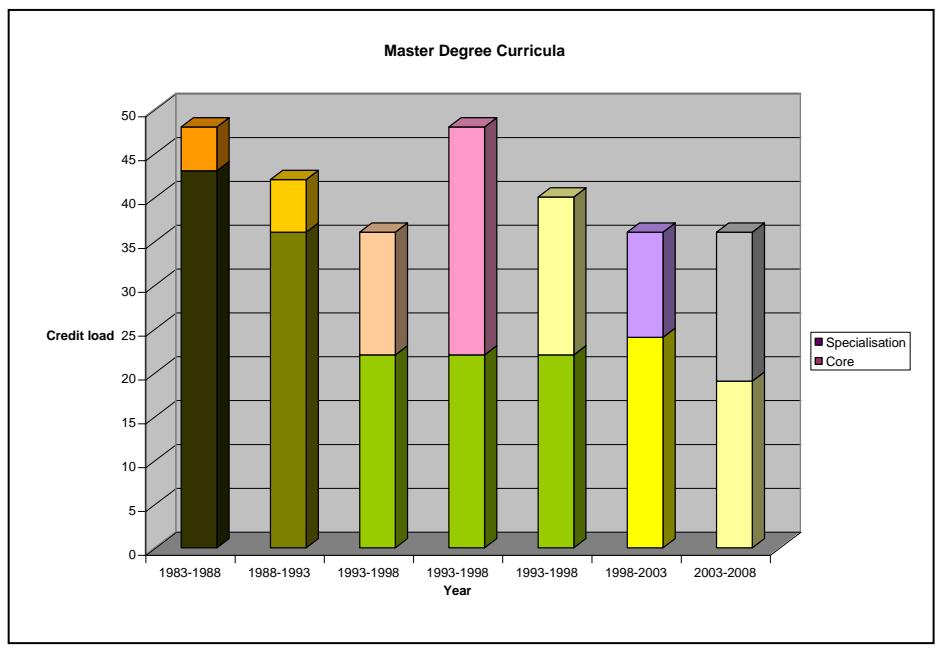
Figure 2. The Development of Master Degree Curricula 1983 - 2005
IV. THE DOUBLE MASTER DEGREE PROGRAMME ITB AND RUG
The reasons
In 2003, Department of Regional and City Planning of ITB collaborating with The Faculty of Spatial Sciences of RUG developing a double Master Degree Programme. This programme is designed so that student will take part of the course in Indonesia and part of the course in the Netherlands and finalising with one thesis supervises by professors from both RUG and ITB. Students will be awarded MSC Degree from RUG and MT Degree from ITB.
Although practically this programme was developed with the help of the National Planning Board (Bappenas) who provide scholarship for the students in the programme while in Indonesia, conceptually, this programme was developed base on two reasons:
The global context
Although the boundary between the south and north, or between the first and third, or between the developed and developing countries has almost been broken down, especially by the global agreement on trade and economic, however development inequality, poor and rich country, injustice and unfair development are still there. The global development process which could
drive to the more imbalance and injustice development in the global context and will have implication in the local development has to be kept afar. Thus, academically, "a critical understanding of global development processes, and their implication for urbanisation, urban development and the lives of women and men in all their diversity in cities and urban areas" as Levy (2006) puts is important, and this has to be seen in the wider context of socio-political and culture.
Development process in developed countries where the culture and the level of economic are different with that in developing countries and visa versa are one that to be understood to enrich the understanding of the global process, knowledge on the global development especially in the planning related problems of developed and developing world is important, exposure to both worlds therefore will enhance the capacity to deal with planning related problems. In the era of free market and free trade, one who has this knowledge will broaden their perspectives and in turn will broaden his/her personal marketability.
The local context
The promulgation of the Act no. 22 of 1999 regarding the Decentralisation / Local Autonomy and the Act no. 25 Central-Local Fiscal Relation marks the beginning of the new era in the administration of the Republic of Indonesia. These two acts give more power to local government to administer their own region. Within three years after the promulgation, the number of local government"s tasks and responsibilities increases, new districts and municipalities have been established; consequently, the need for skilled local government officers is eminent.
Furthermore, having experienced of more than 30 years under centralised government, most of the local government"s executives as well as legislatives member iare not equipped with good administration and implementation skills. The knowledge of what planning is, why it is important, and how it operates is limited. Most of them are still questioning the "who" should do the plan and "when" a plan is needed. In relation to this is the lack of capability of local officials in managing existing and planning for new infrastructure. Therefore abilities, not only to make a plan, but also to control the implementation and managing existing infrastructure are needed in the era of decentralisation.
Knowledge of how planning and infrastructure has been implemented in developed countries is important, not only for government officials, but a lso individuals who will provide their expertise in Indonesian context. It is therefore collaboration with developed countries education institution which enables the set up of curricula which adopted both developed and developing countries experiences, is crucial.
Based on the above reasons, although for the first second an third batch the education the participants are Indonesians, it is planned that the education will be offered to international students, particularly because it is believed that in the global era one who mastered developed as well as developing countries planning perspectives will have bigger opportunity to contribute positively in the global development process.
In addition to these, a very practical, yet an important consideration is the marketability of the programme. Double master degree which can be completed within less then two years is competitive compare to two year master degree programme in North America. Moreover because of the cheaper living cost in Indonesia, this programme cost 40% less to the students then two years programme offered in developed countries.
The curricula
In the framework of global and local context as above mentioned, ITB and RUG shared same practical questions for the development of the curricula:
What specialisation that ITB and RUG will offer? How, in term of technicality, courses will be offered? What kind of degree the student will receive?
After some deliberation it was agreed that ITB and RUG will offer specialisation on Development Planning and Infrastructure Management, the practical reasons behind this agreement is that ITB have been experienced and involved in research and practice of development planning subjects for more than 30 years while RUG has been involve and has the experience in delivering infrastructure planning course.
The courses are offered by both ITB and RUG and designed so that student are able to take part of the course in Indonesia and part of the course in RUG, and for the sake of practicality the degrees are awarded by each university separately, so there is no need to go for accreditation anymore.
In general the curriculum is developed based on the competencies required by planners. There are slightly different opinions among the planning educators on what actually the competencies needed. Friedmann (1996) maintains that there is substantive domain of planning which interwoven six sociospatial processes i.e.: Urbanisation processes, regional and interregional economic growth and change, cultural differentiation, transformation of natural ad
physical environments and urban and rural politics and empowerment. Others (e.g.: Faludi 2002; Sandercock 1988; Ozawa and Seltzer 1999; Kunzman 1997) discussed the key competencies that planners has to have and proposes some of the competencies needed for planner which can be summarised as the following:
- Technical knowledge
- Methodological
- Analytical
- Communicative
- Visionary
- Creative
- Intercultural/multicultural
These general requirements were served for the basis of the 2003 curricula development in ITB, and this was translated into courses that are offered in the core curriculum which are required for all specialisations including for the new specialisation developed together with RUG.
The curriculum for specialisation in Development Planning and Infrastructure Management is divided into two parts, one part delivered in ITB and the other part is in RUG. The curriculum is structured so that 40 % of the courses offered in both ITB and RUG are devoted to improve the ability to manage the development planning and infrastructure planning processes. This includes taught courses and a fieldwork component in which the ability to use tools and techniques is practised.; 30% to the ability to use comprehensive analytical tools and technique for planning; 20 % to the comprehensions of planning theory in relation to wider scope of development planning in developed as well as developing countries; and 10 % to the ability for synthesising models, tools and techniques into a communicative report in a form of individual master thesis based on a topic selected by students.
Here the local contents, from developing and developed country, are the important part of the curriculum, and it serves as strong point of the programme which basically offering two different knowledge and at the end students has to be able to bring them together in a comparative study in their thesis. The challenge is on the cultural differences, particularly when putting together the cultural context into the practice of development and infrastructure planning.
V. SUMMARY AND CONCLUSION
This paper has been discusses the development of curriculum at the Department of Regional and City Planning, describing the planning tradition in Indonesia context and tracing the influence and the response to the changing planning context in national as well as international level. Emphasis has been given to the changing contexts in planning education particularly to the development of Double Master Degree programme.
The shift of the focus from merely physical aspect to wider perspective of planning which include perspective of economy, social-politics and environment is not unpredictable given the development of the theory and the context of planning in Indonesia in the recent year. However, for undergraduate programme this shift is now questioned, one will say that for undergraduate programme the focus has to be in the physical aspect planning while master programme can have broader focus.
If in the beginning assistance from western university was emphasised on the development of curriculum, now collaboration with western university is to develop curriculum that fit with the recent need of planner who could mastering the global development processes. Local content from two different worlds has to be seen as strong point and that the curriculum has to be build base on the consciousness of the differences between the two, as this will broadening the understanding of the global development process.
Note
1 Planning traditions in this sense are derived from what Safier said as traditions in urban planning which can be distinguished from the combination of the constituent elements, or "component" such as :" ... a philosophical base, a set of explicit objectives, a form of operation, a methodology, organisational form - and system of technical, professional, educational, research and operational institutions and forum for its further development and consolidation...". Safier (1983) distinguished planning traditions as: Urban Design, Town Planning, Regional Planning, Transport Planning, Economic Planning, Process Planning, Project Planning, Corporate Planning, Social Planning, Development Planning, Gender Planning, Cultural Planning, Environmental Planning. See also Hall, (1988), Levy (1992), Moser (1993). The involvement of international aids and technical assistance in shaping the planning tradition in developing countries has been in the articles of many scholars, see for example King in Cherry (1980), Safier (1992), Rodwin (1981) and Hall (1988).
3 Kampung is indigenous settlements in which usually in bad physical condition; dense and in bad sanitation condition.
- 4 Nas (1982) in his book "The Indonesian Cities" discussed the development of town and town planning in Indonesia and showed the different patterns of Indonesian towns.
- 5 See for instance, King in his "Exporting Planning: The colonial and neo -colonial experience", and in Cherry (1980). See also Hall (1988).
- 6 Higgins (1968: 678), as quoted by Hill (1996), characterised Indonesia as the "chronic dropout". Higgins concluded that "Indonesia must surely be accounted the number one failure among the major underdeveloped countries". See also Glassburner ed. (1971).
- 7 Koenigsberger (1964) discussed the action planning approach which he and his team suggested for the development of Singapore. See also Winarso (1990).
- 8 Mattingly (1988) described development planning as a continuing Government planning activity in cities, towns and villages aiming to achieve economic growth and social progress. See also Safier (1983).
- 9 Winters (1991) dissertation provides a good account of this series of deregulations. He put it under "Jaman Deregulasi" in which he analysed the dynamics power involved in the deregulation. More detailed analysis of the reform can be seen in Hill (1996) and Booth (1992).
- 10 The package was aimed at increasing economic growth, non-oil export and to expanding job opportunities. This deregulation was also aimed at encouraging mobilisation of funds, efficiency of banks and non-banks institutions, and to developing capital markets (Winters, 1991).
- 11 During 1976 and 1997, Indonesia experienced a decreased level of poverty. In 1976, the number of poor people was 54.2 million (or 40.08 % of total population). The number decreased drastically to about 22.5 million (11.34 %) in 1996, and was estimated to be only 21.5 million in 1997. This was reflected by the improvement in social indicators such as health and education. The relatively stable economic growth during the last two decades was believed had given a positive impact on the improvement of social and economic welfare.
- 12 This increasing number of people living in poverty was due to the increasing level of poverty line from Rp. 42.220 (US$ 4.2) in 1996 to about Rp. 96.959 (US$ 9.6) in 1998 in urban area and from Rp. 31.141 (US$ 3.15) to Rp. 72,780 (US$ 7.2) in rural area. The shift in the poverty line is a result of substantial change in relative prices.
- 13 In particular, the government launching a social safety net program with the assistance of World Bank and the International Monetary Fund. (Firman, 2002)
- 14 credit for undergraduate is equal to 3 hours work in a week
- 15 Unlike credit for undergraduate, for master degree 1 credit is equal to 4 hours work in a week.
VI. REFERENCES
DPU Website 2006 at http://www.ucl.ac.uk/dpu/publications/dpu_news_49.htm USC Web site 2006 http://www.usc.edu/schools/sppd/about/
Firman, T., (2002), "Urban Development in Indonesia, 1990-2001: from the boom to early reform era through the crisis", in Habitat International, Vol. 26, pp 229- 249
- ----------------------- 2005, the Brain Business, The Economist, September 10th 2005
- Booth, P. (2005) The Nature of Difference: Traditions of Law and Government and Their Effects on Planning in Britain and France. In: Sanyal, B. (ed.) (2005) Comparative Planning Cultures. London, Routledge, pp. 259-84.
- Friedmann, J. (2005) Planning Culture in Transition. In: Sanyal, B. (ed.) (2005) Comparative Planning Cultures. London, Routledge, pp. 29-44, Routledge, London.
- Winarso, H. & T. Firman (2002) Residential land development in Jabotabek, Indonesia: triggering economic crisis?. Habitat International, No. 26, pp. 487- 506.
- Winarso, H., Pradono., Zulkaidi, D., Miharja, M., (2002), Pemikiran dan Praktek Perencanaan dalam Era Tranformasi di Indonesia, Bandung: Departemen Teknik Planologi ITB.
- Winarso, H, (1999), "Private Residential Developers and Spatial Structure of Jabotabek" in Chapman, P., Dutt, AK. Bradnock, RW., Urban Growth and Development in Asia, Ashgate, Aldershot.
- Healey, P., (1997), Collaborative Planning: Shaping Places in Fragmented Societies, Macmillan Press Ltd., Hong Kong.
- Booth, A., (1992), "Implementing Monetary Policy", in Booth, A., Ed., The Oil Boom and After: Indonesian Economic Policy and Performance in The Soeharto Era. Oxford University Press, Singapore.
- Levy, C. (1992), " Gender and the Environment: the Challenge of Cross Cutting Issues in Development Policy and Planning" in Environment and Urbanisation, Vol.4, No.1, pp. 134-149.
- Safier, M., (1992), "Urban Development: Policy Planning and Management", in Habitat International, Vol. 2, pp. 5-12
- Winters, JA. (1991), Structural Power and Investor Mobility: Capital Control and State Policy In Indonesia, 1965 - 1990, Unpublished Ph.D. Dissertation, Yale University.
- Moser, C, (1989), "Community Participation in Urban projects in the Third World" in Progress in Planning, Vol.32, pp. 71 – 133
- Hall, P,.(1988) Cities of Tomorrow : An Intellectual History of Urban Planning And Design in the Twentieth Century, Basil Blackwell, Oxford.
- Mattingly, M., (1988), "From Town Planning to Development Planning: A Transition Trough Training" in Habitat International, Vol. 12.
- Bogaers, E., de Ruijter, E., (1986), "Ir. Karsten and Indonesian Town Planning 1915 1940", in Nas, PJ., Ed., The Indonesian City, Foris Publication, Dordrecht.
- Nas, PJM., (1986),Ed., The Indonesian Cities, Foris Publication, Dordrecht.
- Safier, M., (1983), "Passage to Positive Planning", in Habitat International, Vol.. 7, No. 5/6. pp. 105–116.
- Rodwind, L., (1981), Cities and City Planning, Plennum Press, New York.
- King, AD., (1980), "Exporting Planning: the Colonial and Neo-Colonial Experience", in Cherry, Planning and the Environment in the Modern World. Vol.2: Shaping An Urban World., Mansell Information Publishing, London.
- Glassburner, B., Ed., (1971), The economy of Indonesia: Selected Readings, Cornell University Press, Ithaca.
- Koenigsberger, O., (1964), "Action Planning", in Architectural Association Journal, May.
- Hill, H., (1996), The Indonesian Economy Since 1966, Cambridge University Press, Hong Kong.
- Perloff, H.S. 1957 Education for Planning: City, State and Regional, Baltimore, Maryland: The John Hopkins University Press.
- Doebele , W.A., 1962, "Education for Planning in Developing Countries: The Bandung School of Regional and City Planning". Town Planning review XXXIII (2)
- Keeble, L., 1969: Principle and Practice of Town and Country Planning, London: Estate Gazette
- Faludi, A., 1973, Planning Theory, Oxford: Pergamon
- Cherry, 1980, Planning and the Environment in the Modern World. Vol.2: Shaping An Urban World., Mansell Information Publishing, London.
- Nienbanck, P L. 1988, Planning Education: Unleashing the Future, Journal of the American Planning Association, 54 no 4: 432-441.
- Amirahmadi, H 1993. Globalisation and Planning Education, Environment and Planning B. 20: 537-55
- Rydin, Y., 1993, The British Planning System; An Introduction, London: McMillan Press Ltd
- Friedman J., Kuester, 1994, Planning Education for the late twentieth century: An initial inquiry., Journal of Planning Education and Research 14 (1) 55-56
- Friedman, J., 1996, The Core Curriculum in Planning Revisited, Journal of Planning Education and Research 15: 89-104
- Alexander, ER, 1998, Approaches to Planning: Introducing Current Planning Theories, Concept, and Issues, New York: Gordon Breach Science Publisher.
- Ozawa, CP and EP, Seltzer, 1999, Taking our bearing: mapping a realationship between planning practice, theory and education. Journal of Planning Education and Research 18: 257. 66.
- Alexander. ER. 2001. What do planners need to know? Journal of Planning Education and Research 20: 376-80
- Almendinger 2001, Planning in the post modern time, London, Routledge
- Sofhany, TFS, 2002, Isue-isue Strategis Partisipasi Publik dalam Proses Perencanaan, in Winarso, H., Pradono., Zulkaidi, D., Miharja, M., (2002), Pemikiran dan Praktek Perencanaan dalam Era Tranformasi di Indonesia. Bandung: Departemen Teknik Planologi ITB
- Zulkaidi, D., 2002, "Kepentingan Nasional dan dan Kepentingan Propinsi dalam Pennataan Ruang" in Winarso, H., Pradono., Zulkaidi, D., Miharja, M., (2002), Pemikiran dan Praktek Perencanaan dalam Era Tranformasi di Indonesia, Bandung: Departemen Teknik Planologi ITB.
- Friedman, J., 2003; Why do Planning Theory? In Planning Theory, Vol 2 (1): 1 -10
- Oetomo, A., 2003: "Lintasan Sejarah Departemen Teknik Planologi ITB" in Departemen Pekerjaan Umum, Beberapa Ungkapan Sejarah Penataan Ruang Indonesia 1948-2000
- Van Horen, B., Leaf, M., Pinnawala, 2004, "localizing a Global Discipline: Designing New Plannig Programs in Sri Lanka" Journal of Planning Education and Research 23: 255-268
- Sanyal, B., 2005, Comparative Planning Culture, London: Routledge.
- Levy, C., 2006, "Dilemma on Urban Development Planning Education: Positioning the DPU" in DPU News, issues 48.
Wooldridge 2005, The brain Business, the Economist Septembers 10 Vilorioa 1974, , L.A., 1970, "Education for Planning: The Special Circumstances in Low Income Countries" in Phillipine Planning Journal, Vol. 1, No 2.