

1. Introduction
1.1.Background
Among 130 active volcanoes in Indonesia, Merapi volcano (2968 m) is the most active one. It is also one of the most active and hazardous volcanoes in the world (Lavigne, F.
et al., 2000; Thouret et al., 2000). Two recent major eruptions that caused fatalities occurred in 1994 and 2006. Merapi volcano lies between Yogyakarta Province and Central Java Province. This study covers only the part of Yogyakarta Province, which includes the area from the southwest flank to the southeast flank of Merapi volcano.
Thouret et al (2000) stated that the repose periods of Merapi volcano have not exceeded 3.5 years on average since 1822, where thirteen events were large enough to cause at least 7000 deaths. There are several typical hazards in Merapi which have been identified by experts according to the history of Merapi eruptions. The major ones are pyroclastic flows, lava flows, and lahars (Kurniawan, 2008; Newhall et al, 2000). In the hazard zone 2 and 3 (with the highest volcanic risk) delineated by Volcanological Survey of Indonesia, there are more than 200,000 people live in the area where pyroclastic flows and ash fall are possible to strike to, and along 13 rivers that flow from the peak of Merapi to downstream, where lava is possible to flow through, live approximately 120,000 people (Lavigne et al, 2000; Kurniawan, 2008).
This study addresses the question why despite the frequent eruption and hazardous Merapi volcano, many people are living in the area and insist to stay there. According to a study by Dove (2008) and Lavigne et al (2008), it is not about the low awareness of Merapi hazard that makes them insisted to stay in that area, but the existence of natural resources on Merapi that attracts them to return to their villages, since many of them work as farmers, stock breeders, and sand miners who mine the remnants of Merapi eruptions. Therefore, some people consider Merapi eruption as a blessing. It is also thought that the communities are returning to their villages during the volcanic crisis due to the unrealized risk among communities.
Those findings of studies in Merapi explaining about communities were represented only by adults. This study concerns whether children, who live in Merapi actually have special or different views from the adults. As a highly vulnerable group of people, a special study needs to be conducted with children. If Merapi
erupts, children might be one of the victims with the most disadvantages, such as emotional distress, injury, illness, death, and failure to complete education. Children are unique also because they are in the stage of growing up and engaged in different activities from that of adult. Therefore it is important to understand how they view their "world" or life around the study area. First is to know whether the existence of Merapi volcano influences their perception of their quality of life and how Merapi is valued as part of their environment. Second is to know whether there are factors other than Merapi which actually influences children's perception of having bad quality perception of having bad quality of life in the area which have been overlooked.
1.2.Objectives
The objective of this study is to identify factors affecting children's perception about the quality of life in their area, which in fact is a highly prone for volcanic eruptions. The following research questions will lead the study to reach the objectives:
- How do children live their daily lives around Merapi volcano.
- What are the factors which influence children's perception of the quality of life around Merapi.
- Whether Merapi influence children's perception on their quality of life around the area and how children consider about the role of Merapi in their villages.
1.2.3. Methods
This study was part of a bigger study through which a field survey was conducted. A purposive sampling was employed to decide the location of study. Since this study targeted children who have volcanic crisis experience and who might have been affected the most by volcanic activities, the authors decided to choose children who live in the closest area to the peak of Merapi Volcano. The field survey was carried out in three closest schools to Merapi in Sleman District, Yogyakarta Province, based on information from the Yogyakarta Province Education Department. The schools are located in the southwest, south, and southeastern flank of Merapi, i.e. Tarakanita Tritis, Pangukrejo, and Srunen Elementary School, respectively.
As for choosing the children as respondents, a cluster sampling was used. Not all children from all groups of ages were chosen. Dashiff (2000) stated that in doing studies about children, it is critical to distinguish the groups of age considering their biological, cognitive and emotional development differences. The group age that matches this study's target and methods was 10 – 14 years old. In this study, children from the 5th and 6th grades were chosen since their ages are normally within that group.
The field survey was carried out in August 2008, mainly in a form of workshop, where participants were divided into small groups (4- 7 children in one group) to enable a more intense communication between facilitators and participants. Each facilitator was responsible to one group from the beginning of the workshop until the end.
The workshop includes multi-methods approach as the main strategy to collect the primary data with children. The multi-method approach allows findings to be corroborated or questioned by comparing the data produced by different methods (Denscombe, 1998). The multi-methods in the workshop with children
include the following activities according to the order:
(1) Thematic Drawing
Thematic drawing was set to be the first activity to start the data collection to trigger children to engage in the whole workshop. The objective of this activity is to investigate issues among children about the problems in the village and about what children enjoy from living in the village. The tasks given for this session were to draw things that make them happy and unhappy living in their villages. Intentionally the instructions were kept in broad meaning, and the word related to volcanic hazard, a key-word of this study, was not mentioned before this session ended.
(2) Questionnaires
Questionnaire sheets were distributed after the thematic drawing session finished. In each group, the facilitator guided them to fill in the questionnaire. This activity aims to investigate several variables related to risk perception, disaster experience and other basic information of participants, by using quantitative measurements. In this paper, only the questions about basic characteristics and their view about Merapi volcano will be discussed.
(3) Mapping
This activity aims to investigate the participant's daily activities spatially and their perception of volcanic risks within the area. The facilitators gave children the task to draw a map of area where they spend their daily activities, including home, school, and other places where they go often. The data derived from this activity may also explain their social and cultural background.
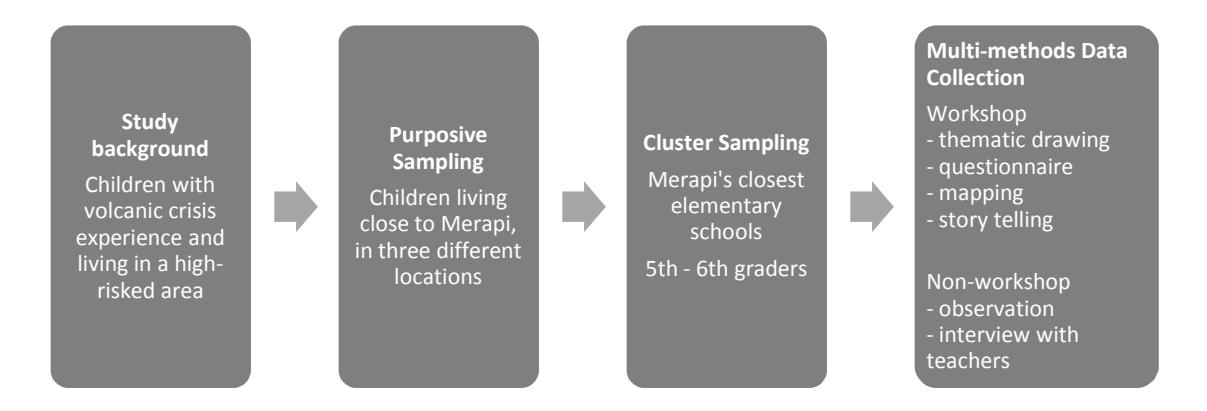
Figure 1. Approach and methods used for data collection of this study
(4) Story telling
The objective of this activity is to investigate children's experience of 2006 volcanic crisis. The result from this activity will not be discussed further in this paper.
After the workshop in each school, observation to each child's house was carried out to identify the locations of all houses of participants and observe the surrounding environments. The Global Positioning System (GPS) co-ordinate of each house was recorded. During the workshop, communication with children was established well. Therefore, they were willing to show around and take the research team to their houses. Almost every child knows people who live in their neighborhood, especially those within the same hamlet. Other key informant interview with school teachers, local-environment observation, and secondary survey were conducted to support the analysis of this study.
Data from thematic drawing and mapping were the main source of this study, while the data from other methods were used to support the analysis. Drawing activities were always followed by an interview with children about the interpretation of their drawing or maps. This is the best way to do to reduce subjectivity in data processing. Drawing, as a means of gaining further insight into the ways
participants interpret and understand their world or environment, has been employed by few researchers from various fields, such as health studies (Darbyshire et al, 2005; Amsden & Van Wynsberghe, 2005), social studies (Young & Barret, 2000; Blanchet-Cohen et al., 2003; Herth, 1998), anthropology (Mitchell, 2006), geography (Hemming, 2008; Esley, 2004), and disaster studies (Babugura, 2008).
2. Description
2.1.Basic characteristics
The participants of this study were the 5th and 6 th grade students (n=94) from three elementary schools. Topographically, the schools are separated by three rivers. Around the southwestern school area was exposed by 1994 eruption with many casualties. The school in the southern flank was not exposed by 1994 eruption, but in 2006 the lava directed to the village, although there were no casualties from the villagers. While the other school, in the southeastern flank was considered of not having any volcanic eruption exposure experience yet because the location is in the eastern most in the district. Through the history of Merapi eruptions, the pyroclastic flow was more directed to the west than to the east.
The basic characteristics of the participants are summarized in Table 1. Their ages ranged from 9 to 15 years old (µ =10.5; σ = 1.2). Most children participated in this workshop have lived in their hamlets for more than 5 years, which means that they have experienced directly the 2006 volcanic crisis. More than 75% of the children's houses are located < 7 km from the peak of Merapi. In the 2006 eruption, the pyroclastic flow traveled along the river until about 7 km from the peak of Merapi. This close distance to Merapi indicates the high volcanic risk own by the villages where the participants of this study lived.
The factors which influence children's perception of their quality of life in their villages and their thoughts related to Merapi were analyzed mainly from thematic drawing about what makes them happy and unhappy living in their villages and triangulated with other data. It is found that their perceptions were formed by the experience they had in daily activities. From the mapping activity and interview, it is found that in general children travel daily at least between home and school. Participants of each school are distributed into several hamlets with various distances. Most of them go to school on foot (89.4%). The farthest distance to school from home is 4.8 km, while the closest is less than 100 meters. By traveling on foot, children can feel and experience closely with the surrounding along the way between home and school.
2.2.Children's daily activities
Based on mapping of daily activities and the follow-up interview, the general daily schedule of children in weekdays could be generated. This mapping session was actually aimed not only information gathering on children's daily activities, but also how children perceive dangerous and safe places in terms of Merapi
hazards around their activity area. However, in this study, children's perception about dangerous and safe places will not be discussed.
As shown in a sample of drawing in Figure 2, children could explain their daily activities and places by making maps and interpret the map to the facilitators. The components in the drawing which related to places and types of activities from all drawings were analyzed and further categorized based on the characteristics similarity. There were four categories formed based on the type of activities as shown in table 2.
Table 1. Characteristics of children who participated in this study
| Characteristics (N=94) | ||
|---|---|---|
| Gender | Male Female | 52.1 47.9 |
| Distribution of participants in each school | Tarakanita Tritis School Pangukrejo School Srunen School | 25.5 30.9 43.6 |
| Length of stay in the hamlet | Less than a year 1 – 5 years More than 5 years | 1.1 10.6 88.3 |
| House distance from the peak of Merapi | <5 km 5 – 7 km >7 km | 14.9 62.8 22.3 |
Table 2. Types of children's activities and places
| No | Type of activities | Place |
|---|---|---|
| 1 | Educational | School, home, friend's house |
| 2 | Religious – cultural | Mosque, school, church, community leader's house |
| 3 | Social – leisure | School, friend's house, neighbor's house, relatives' house, guarding post ground/ sport's field, forest, gorge/river, night patrol/ guarding post, plantation field, home |
| 4 | Livelihood support | Small store, gorge, forest, plantation field, home |
Daily activities by Avelinus
The drawer explained that he has to pass two gorges, which he considered dangerous, in order to go to school ("SD", left-down side) everyday. He also needs to go to the forest to find grass for the livestock (left-up side).
Figure 2. A sample of daily activities map made by a child
Children's main activities are done mostly between home, school and various places for activities after-school. They have similar schedule everyday, starting from the morning preparation at home before going to school, continued by school time from around 06:30 am – 01:00 pm. After school, some children stay at home or go to a friend's house to study and play together, while some others go out to play, to work, or to do community-based activities, such as practicing on the traditional musical instruments in the community leader's house or some other community gatherings as shown in Table 2 for religious-cultural and social-leisure type of activities. These various after-school activities directed them to experience different things in various places with various people. Children's perception could be formed through their day-to-day experiences. With various experiences, the factors which formed children's perception also vary. Those factors are the main focus of the present paper, as explained in the following sub-chapter.
3. Factors influencing children's perception about the quality of life around Merapi Volcano
In order to indicate the factors which influence children's perception about the quality of life around Merapi Volcano, the participants of this study expressed what make them happy and unhappy living in their villages through the thematic drawing and the follow-up interview. They reconfirmed afterwards to the facilitators the reason why they drew each component illustrated in their drawings. The components from all 'happy' and 'unhappy' drawing themes were collected and analyzed with the support of the facilitators. The components which reflected the factors influencing their perception of their quality of life were further categorized according to the similarity of characteristics. As shown in Figure 3, the categorization process was adopted from the beginning step of grounded theory. The early step of the categorization process was supported by the facilitators of the workshop in this study.
Finally there are four categories emerged from children's drawing as factors which affected children's feeling about living around Merapi volcano: (i) nature, (ii) children's activities, (iii) man-made objects, and (iv) human factors. Most of components in those factors were also found and mentioned in their map of daily activities and the follow-up interview. This shows that children's feeling is much related with what they experience in daily lives. The summary is presented in the Table 3. Each factor which affects children's feeling towards their living near Merapi area is explained as follows.
3.1. Nature factor
As shown on the map of daily activities made during the workshop, children around Merapi are living very close with nature. In weekdays, children to school mostly on foot and therefore they have the chance to spend some time to experience the nature closely. Many of them have to pass hilly terrains, to cross the river, gorge, and plantation fields, as shown in the mapping sample in Figure 2. Occasionally some children have to go to the forest after school to pick some woods and grass. Since nature is involved in a big part of children's daily activities, particularly in their social activities, leisure, and activities to support their livelihood, including things they find in between place of activities, this factor has impacted children's feeling significantly. Many households around Merapi volcano depends their livelihood on nature (i.e. farming and stockbreeding).
The nature factor gives impact both positively and negatively to children's feeling of living in these villages. According to the participants, the main reasons that the nature factors make them perceive that they have good quality of life in their village are due to the great
atmosphere (i.e. mountains, including Merapi and weather), the beauty of nature (i.e. flowers, birds, mountain/ hills, river, and fishing pond), environmental preservation (i.e. the existence of the forest), and economically valuable for their livelihood (various trees and plantation, fishes, cows, chicken, sand from the river, woods and grass from the forest). Availability of spaces to play (the field, forest, and village streets without cars) is also perceived as creating good quality of life in this area.
At the same time, children perceived the threats of nature exist in their village. In their daily travels, many children indicated that the river and gorges are spots where they have to be careful not to fall down. A few children mentioned that in the night time, the trees make the environment darker and scary for children, as there is no light on the street. The gorge and forest are among places with high risk identified by children through their mapping activity. Children usually go to the gorge to mine the sand and rocks to get extra money or to play. While going to the forest usually aims to find woods for fire or house furniture, or to find grass to feed the cows.
Not only volcanic risk, but also other risks such as landslide and wild animal attack exist in this area. Animal attacks such as those by bees, snake, mosquito, duck, goat and rat, were drawn as things which make them feel unhappy living in the area.

Figure 3. The categorization process of the drawing components
Children reported that they feel worry if in some occasion natural disasters can distract their daily activities and causes loss. According to their opinions, the existing natural threats in their area include Merapi volcanic activities, heavy rains which may lead to flooding and cold lava, and landslide. In one of the schools, drought has also been an issue (in Tarakanita Tritis school area), where based on our field observation there was water scarcity in the village. Children represented the drought by drawing a sun.
Two samples of drawing which represent the nature factors influencing the quality of life in the area, along with each child's comment, are shown in figure 4. The left figure represents the natural potential owned by the area, as the factor which makes children happy living there. The right figure shows threatening factors to children.
Merapi volcano has significantly influenced children's perception of the quality of life in their villages. There are 25.5% of them drew or mentioned about Merapi in the happy drawing, and 41.5% in the unhappy drawing. Children were further specifically asked about the positive and negative impact that Merapi gives to their villages with an open-ended
question in the questionnaire session. Different from the thematic drawing, which allowed children to express factors which influence their perception without giving any keywords related to Merapi volcano, this item directly asked on how children think about Merapi volcano. The participants responded with various answers, and similar answers were grouped into one category. For the positive impact of Merapi, there were six categories formed from the answers, as shown in figure 5.
Some children answered more than one opinion, and few children did not answer since some of them have no idea and some of them think that Merapi does not give any positive impacts. About 38% children stated that Merapi volcano has given good impacts to their community because it produces sand and rocks. Sand mining is one of dominant occupation around Merapi. Therefore those children also think that volcanic eruption supports their livelihood. Many children also stated that Merapi gives positive impact since it provides beautiful scenery to the surroundings. This may also related to what makes Merapi became a tourist destination. Some children, mostly those from Tarakanita Tritis elementary school, also believed that Merapi eruptions could "fertilize the soil".
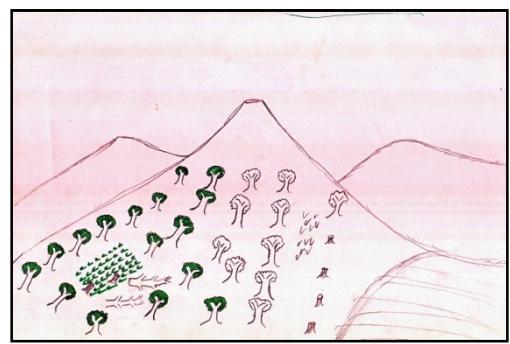
"We can sell the woods. We can take the grass for the cows. They have sand in the gorge, my father mines the sand."
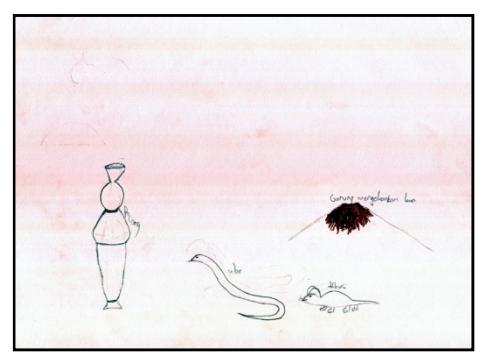
"Pocong (Indonesian ghost) is scary. Snake bites. The rats often run after me. I experienced eruption and it was hot"
Figure 4. Samples of thematic drawing representing the nature factors
They may either have seen the proof by themselves or from the explanation of older people in the village about the fact that they received this impact from the devastating eruption in 1994. Based on observation and interview with the teachers and local people, this school area and most of western part of Merapi volcano are in fact rich of Salak fruit plantation, which possibly was the indicator why children from this school think that Merapi eruptions could fertilize the soil. A study by Dove (2008) also stated that according to people in that area the periodic ash falls help to keep the grasslands unusually productive.
From the results above about positive role of Merapi in the villages of participants in this study, it could be derived that Merapi is indeed important and valuable in the eyes of most children with various reasons. The negative
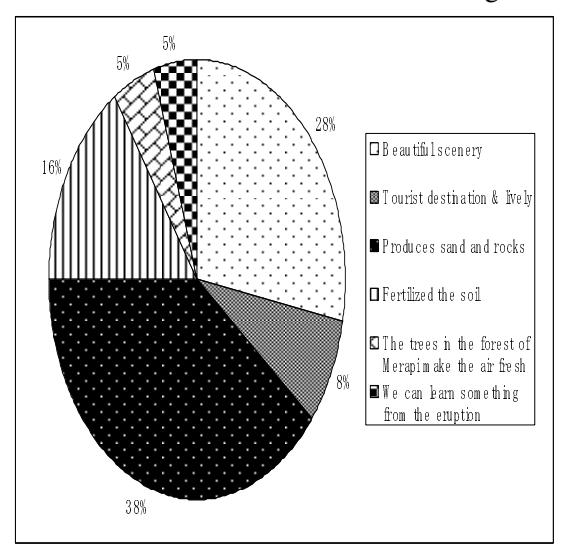
Figure 5. Children's opinions about the positive impacts of Merapi
impacts of Merapi to the villages around Merapi were also stated by children, including: (a) The hazards (earthquake, ash fall, lava, earthquake, and pyroclastic flow), (b) the impact to human (causes diseases, causes people to evacuate, make people scared and panicked, and distract people's activities, property loss), and (c) destroyed trees and environments.
The various answers about Merapi's negative impacts, and that they were all relevant with what can happen if Merapi erupts, showed children's great knowledge of volcanic hazards and risks in the area, which can be learned by other people who have less or no experience to volcanic disaster.
3.2. Children's activities
Children's activities have also become a factor which determines their happiness of living around Merapi. Enjoyable activities of children in the study area make them feel happy living there, which include fishing, playing kites, soccer, and bathing in the river. Those activities are related with the availability of open spaces as mentioned in the 'nature' factor. However, there are some other activities which make children feel unhappy. Children in this area should help their parents for their livelihood after school, by hoeing or digging the soil and going to a far field to find grass for the cattle. The grasslands are about 60 – 90 minute walk from a village around Tarakanita Tritis school area (Dove, 2008). Children found that those physical activities are tiring, more over when they have to do the activities after school. An example of children's activity as a factor which makes them feel unhappy is provided in figure 6.
Although working children as part of the family's effort for their livelihood might be assumed as normal among the communities, the fact that some children reported about their un-happiness due to those physical works should be further considered. The impact of children working in agriculture to health has been discussed in a study elsewhere (Gamlin and Hesketh, 2007), saying that as compared to quickly induce fatigue; there is a constant threat of animals; tools are basic; several acute
"Hoeing is tiring."
Figure 6. A sample of thematic drawing about an activity which makes the child unhappy and chronic exposures for child workers in agriculture, where some effects are not evident for months, years, or until adulthood. Several principal exposures to child workers are also happening in Merapi based on children's reports, including animal attacks/bites, excessive heat, repetitive tasks, long working hours, stress, and unsafe transportation. Those exposures can cause poisoning and hygienerelated illnesses, infection, thermal stress, musculoskeletal injury, fatigue, disability, mental health, and injury (Gamlin and Hesketh, 2007).
3.3. Man-made objects
Some children considered some man-made objects have influenced their quality of life in the area. The objects could be regarded as both useful and threatening. Objects which are regarded as useful include: truck, bulldozer, sabo dam, bridge, house, and school. While those which are considered as threats by children include: garbage, cigarette, vehicles, bulldozer, fast speeding truck, other vehicles, and roads.
There are some factors related to Merapi volcanic activities in this category. Sabo dam was mentioned as useful because it functions to retain lava from flooding, not only lava that flows during the eruptions, the previous
eruption's remnants could flow also as cold lava when heavy rain occurs. Other factors related to Merapi volcanic activities are bulldozer and trucks which are used for mining and transporting the sand in the gorge where pyroclastic flow or lahar traveled through. This is in contrast with the positive reason mentioned earlier, that apparently bulldozer and high speed trucks are parts of some other children's issues in a negative way, concerning pollution, safety and environment destruction. The sand mining trucks often pass the school even in school time. They pass also by some children's houses. Although the traffic in the study area is not as heavy as that in the cities, children found that the roads in their villages are not safe due to the high speed trucks and other vehicles.
Both of children's drawings shown on figures 7 and 8 are related to the objects or tools used for sand mining activities, i.e. a truck and a bulldozer. The first drawing expressed a positive thought of the truck, as a facility which could carry sand and rocks, and its impressive physical appearance to children. While through the second drawing children expressed a bulldozer as a threat to the child's area which destroys the forest and land.
3.4. Human factor
Children in this study area value the existence of their friends and relatives, as a good company to do activities and somebody to share with. In the drawings, they mentioned their friends' names and their relatives. Children in the study area know each other mostly. Almost in all daily activities they spend the time with friends: educational activities at school and friends' houses, religious and cultural activities at the mosque, school, church and community leader's house, and social & leisure activities where they play and get together.
"Because trucks are nice and big. They often pass by my house. They look nice and can carry sand and rocks."
"It destroys the forest and land"
Figure 7. Samples of thematic drawing about man-made objects
In opposed to that, some people's behavior and practices, mostly the outsiders, are part of children's concern. Children perceived that some human practices could lead to imbalanced nature, including animal shooting
"I don't like people who cut the trees illegally in the forest because it causes landslide"
Figure 8. A sample of thematic drawing about human's negative practices and illegal logging. Many children also have some concern in environmental disaster, such as landslide and floods, which may be caused by illegal logging. Other human-related factors are human behaviors which children found as disturbing. They include smoking, naughty friends, people dating in the forest, and an issue about who committed suicide in their area. The following figure shows an example of human's practice in the study area which perceived as negative factor to their quality of life.
Table 3. Factors which influence children's perception of their quality of life near Merapi area
| No | Factors | Objects/ Phenomenon | |
|---|---|---|---|
| Positive | Negative | ||
| (i) | Nature | Great atmosphere of the mountains and weather, the beauty of nature, environmental preservation, economically valuable things for their livelihood and availability of open spaces to play. | Threats of river, gorges, trees which make the streets darker, animal attacks, heavy rain, sun-heat and natural disasters. |
| No | Factors | Objects/ Phenomenon | |
|---|---|---|---|
| Positive | Negative | ||
| (ii) | Children's activities | Fishing, playing kites, soccer, and bathing in the river. | Physical activities to help the parents, including hoeing or digging, going to a far field to find grass for the cows. |
| (iii) | Man-made objects | Good and useful objects, including trucks, bulldozer, Sabo dam, bridge, school, and house. | Threatening objects, such as garbage, cigarette, vehicles, bulldozer, fast-speeding trucks, other vehicles, and roads. |
| (iv) | Human | Existence of friends and relatives. | People's behavior and practices, including illegal logging, smoking, naughty friends, people dating in the forest, a person who committed suicide. |
4. Conclusions
This study has shown an appreciation to children's voices which usually are underestimated in community planning and parents as their proxy are not at all times comprehend how children actually perceive things. With the methods used in this study, it is proven that children are able to give insight to community planners in identifying the real needs and potentials of their living area. Drawing, along with the follow-up interview to help with interpretation and combined with other methods, was able to explore children's daily lives and the quality of life in the vicinity of Merapi volcano. Children around Merapi spend their daily lives mainly by going to school and after school they spend various
activities, such as studying, playing, working to help the family's livelihood, and community activities. Overall, the types of activities include educational, religious-cultural, socialleisure, and livelihood-support activities. Children in this area are living very close with nature.
Children perceived that they have both negative and positive factors forming their quality of life in the vicinity of Merapi Volcano. There are four factors which influenced children's perception of the quality of life around Merapi area: (1) nature factor, (2) children's activities, (3) man-made objects, and (4) human factor. Due to the high volcanic risk in the study area, it might be thought as obvious that the volcanic activity is one of the factors that make those children perceived of having bad quality of life. It was proven correct through this study, that there were more than 40% of the children included Merapi volcano in their "unhappy" drawing. Most children experienced the 2006 volcanic crisis hence they could explain well that Merapi causes negative impacts to the village due to the hazard exposure, both to human and environments.
Despite all the perception of having bad quality of life due to the above factors, children stated that they were still willing to live there, with their own reasons. It could be because they are still dependents of their parents who live there, or because of the good side of their life around Merapi. Merapi volcano itself is included in the factors which make children perceived a positive quality of life around the area. For children, Merapi has given good impacts to their community because it helps the livelihood of the community, economical support and provide comfortable natural environment. Therefore, Merapi is still valued positively by children. These findings could support the reasons why the villagers kept returning to their villages as pointed out by Dove (2008) and Lavigne et al (2008). Although this study focused on different age group from the other studies, the findings could be linked since the adults now were once children before, the children now will be adults in the future, and both adults and children are interconnected in their lives. Therefore, if there is no change in the community, the current children may act similarly in the future with the current adult.
These Merapi communities are one of the examples of communities who live with high risks. Since children's current life determines the Merapi community's life in the future, their opinions and contribution should be taken into account. Particularly for the negative factors should be reduced for their better quality of life. For example, solution to the pollution and noise problems caused by the sand mining trucks that pass the school should be found to prevent children's health problem and lost concentration during their study. Safety education should be conducted for their safety on the street and on the way between home and school, how to deal with animal attacks and disasters. What needs to be further considered are how the positive factors as the community's potentials should be managed to cope the negative factors.
Both positive and negative factors could act as the entry points for policy maker in the effort to improve the quality of life of children and the community in general. To mention a few key ideas for future research, the four factors as the main finding of this study may be used to reflect or compare the cases of children's concerns in different areas. The result of studies on children and adults' points of view about their lives could also be integrated in future research, to find the significant differences if exist and innovate on how to utilize effectively the positive factors to countermeasure the negative factors.
Acknowledgments
The authors would like to thank teachers, children and parents from the three school area who have actively participated in this study. A great appreciation is also given to the facilitators of this study to support the authors in preparing the study, conducting the data collection and analyses.