

Introduction
Climate change is an inescapable challenge that people will have to address the issue of over coming years particularly in developing countries. Climate change is already affecting the region in Southeast Asia, including Indonesia, as it is evident by the increasing frequency and intensity of extreme weather events such as heat waves, droughts, floods and tropical cyclones in recent decades (ADB, 2009). Indonesia is one of the most vulnerable countries to climate change due to its coastlines, high concentration of population and economic activity in coastal areas as well as heavy reliance on agriculture, natural resources, and forestry. It is also predicted to give more pressure in urban areas that have already faced other challenges such as urbanization and economic development. Nowadays, ten percent of the world's population lives in close proximity to the coastal area. To minimize its impacts, it requires the process and additional interventions through adaptation measures and strategies. Although most communities have some abilities to respond to the changes and extreme climatic events, the expected impacts will go over this capacity almost in all cases. In the meantime, some local authorities also have tried to develop adaptation planning measures. It is found that the different type of adaptation measures has been established to prevent the impact of climate change and variability in urban areas of the coastal Indonesia.
However, the performance of local adaptation measures is rarely to investigate. Meanwhile, adaptation efforts in the country have so far been fragmented, lacking a strong link between national climate change strategies, plans, and existing disaster risk reduction, urban planning, and other relevant policies. This disconnection partly stems from a lack of conceptual understanding and partly due to the ongoing debate as to what constitutes the adaptation, and what represents a good and sustainable development. Thus, this study has the purpose to examine the performance of current measures of climate change adaptation at the local level in the coastal city of Semarang City in the context of urbanization and climate change. Semarang City is selected because it is a typical coastal city of Indonesia that is facing phenomena of urban development and climate change.
This paper begins with a literature review on the definition and characteristic of climate change adaptation. Methodology and performance criteria for analysis are mentioned. Then, climate change adaptation measures in the coastal cities of Indonesia are investigated, including national climate change adaptation policies and a case study of Semarang City. The results of analysis, such as the assessment of typology and performance of adaptation measures are exposed. The last part of the paper is the conclusion and recommendation.
Methodology
The methodological approach of this study is a desk study. The assignment begins with a review of existing literature to understand the differing contexts on the climate change adaptation. The investigation of measures and strategies for local climate change adaptation is based on the searching in the available published documents. To help assess the performance of adaptation measures, some criteria are applied. An outcome of the assessment is a lesson learned for implementation from some criteria in economic, environmental, social and institutional aspects. This study focuses on adaptation that several definitions have mentioned on it. The scope of the study area is a coastal city of Semarang City, Indonesia that has been experienced in climate change impacts and the urbanization process. Ultimately, the study seeks to reveal what lessons can be drawn from a case study of coastal city in Indonesia experiences in climate change
adaptation and how those lessons can be transferred to other local authorities to encourage them to engage in and advance on climate change adaptation.
Performance criteria
The criteria for assessing the performance of climate change adaptation measures are adopted following Dolan et al. (2001), Titus (1990), Smith and Lenhart (1996), Mizina, et al. (1999) and de Loe and Kreutzwiser (2000). Each adaptation strategy in the study area has different results depending on the context and circumstance of the aspects. Each particular case and every particular situation are different.
Indicator Description Environmental criteria Effectiveness To express whether or not the adaptation measures reduces the impact of, and/or enhances opportunities that may arise as a consequence of climate change Flexibility To express the ability of the adaptation to reduce risk or enhance opportunity under a range of climate conditions Economic criteria Economic efficiency To express whether the benefits of making the change exceed the costs of implementing the adaptation measure Feasibility To express whether an adaptation measure would be feasible given the personal economic circumstances of a stakeholder Social and institutional criteria Institutional compatibility To express whether an adaptation measure is consistent with the current management framework, laws, regulations and policy in which stakeholders operate
Table 1. The performance criteria for assessing adaptation measures
In this study, three performance criteria are applied to assess adaptation measures in the study area, including: 1) economic criteria; an economic criterion is used to define the effectiveness of strategies to maximize the benefit and minimize the costs generated by climate change impact. The main indicators of economic criteria are economic efficiency and feasibility; 2) environmental criteria; an environmental criterion is used to identify the quantity and quality conditions as well as the habitat condition of species in the ecosystem. The main indicators of environmental criteria are effectiveness and flexibility; 3) social and institutional criteria; the main indicators of social and institutional criteria are institutional compatibility and willingness to implement (see Table 1).
To express whether an adaptation measure is willing to adopt by stakeholders
Climate Change Adaptation
Willingness to implement
This section describes the definitions of climate change adaptation along with the characteristics and scopes of adaptation based on literature review.
Definitions of adaptation
Some definitions regarding adaptation have been noticed. Burton, et al. (2002) considered an adaptation to be the ability of social and environmental systems to adjust to change in order to cope with the consequences of change. Similarly, Smit, et al. (2000) suggested an adaptation to be adjustments made in ecological–social–economic systems in response to actual or expected climatic stimuli, their effects or impacts. In addition, the other descriptions of climate change adaptation have been identified as follows:
- a) Climate change adaptation refers to actions that reduce the negative impact of climate change and/or take advantage of new opportunities. It involves making adjustments in our decisions, activities and thinking because of observed or expected changes in climate.
- b) Adjustment in natural or human systems in response to actual or expected climatic stimuli or their effects. Adaptation can be carried out in response to (ex post) or in anticipation of (ex ante) changes in climatic conditions. It entails a process by which measures and behaviors to prevent, moderate, cope with and take advantage of the consequences of climate events are planned, enhanced, developed and implemented (adapted from UNDP, 2005; UKCIP, 2003; IPCC, 2001).
- c) According to the IPCC Third Assessment Report, adaptation "has the potential to reduce adverse impacts of climate change and to enhance beneficial impacts, but will incur costs and will not prevent all damages." Furthermore, it is argued that human and natural systems will, to some extent, adapt autonomously and that planned adaptation can supplement autonomous adaptation. However, "options and incentives are greater for adaptation of human systems than for adaptation to protect natural systems" (IPCC, 2001).
- d) The Intergovernmental Panel on Climate Change (IPCC) defines adaptation to climate change as the set of: "initiatives and measures to reduce the vulnerability of natural and human systems against actual or expected climate change effects" (IPCC, 2007).
Based on those definitions, climate change adaptation may be defined as the adjustment of a system to moderate the impacts of climate change, to take advantages of new opportunities or to cope with the consequences (Adger et al., 2003). This term refers to changes in processes, practices, or structures to moderate or offset potential damages or to take advantage of opportunities associated with changes in climate. It involves adjustments to reduce the vulnerability of communities, regions, or activities to climatic change and variability.
Adaptation characteristics and scopes
Smit, et al. (2000) mentioned a variety of typologies and distinctions related to the process of adaptation. According to several typologies considered, adaptation can be planned or spontaneous; passive, reactive or anticipatory, etc. It may be that planned, anticipatory adaptations that are carried out by governments or non-government organizations as a policy initiative (as opposed to those that are autonomous and/or mainly reactive) are those that require the most attention. Though, as argued by Fankhauser, et al. (1999), the distinction between autonomous and planned adaptation may be unclear in practice. Smit, et al. (2000) stated that the assessment of adaptations must address the following question: How good is the adaptation? Adaptations come in a huge variety of forms. Generally used distinctions are purposefulness and timing. Autonomous or spontaneous adaptations are considered to be those that take place invariably in reactive response (after the initial impacts are manifest) to climatic stimuli—as a matter of course, without directed intervention of a public agency. Estimates of these autonomous adaptations are now used in impact and vulnerability assessment. Planned adaptations can be either reactive or anticipatory (undertaken before the impacts are apparent). In addition, adaptations can be a short or long term, localized or widespread, and they can serve various functions and take several forms see Table 2.
Table 2. Bases for characterizing and differentiating to climate change adaptation (Adapted from Smit, et al., 1999)
| General differentiating concept or attribute | Example of terms used | |
|---|---|---|
| Purposefulness | Autonomous vs. Planned | |
| Spontaneous vs. Purposeful | ||
| Automatic vs. Intentional | ||
| Natural vs. Policy | ||
| Passive vs. Active | ||
| Timing | Anticipatory vs. Responsive | |
| Proactive vs. Reactive | ||
| Ex ante vs. Ex post | ||
| Temporal Scope | Short term vs. Long term | |
| Tactical vs. Strategic | ||
| Instantaneous vs. Cumulative | ||
| Contingency | ||
| Routine | ||
| Spatial Scope | Localized vs. Widespread | |
| Functions Effects | Retreat – Accommodate – Protect | |
| Prevent – Tolerate – Spread – Change – Restore | ||
| Form | Structural – Legal – Institutional- Regulatory – Financial – Technological | |
| Performance | Cost – Effectiveness – Efficiency – Implement ability – Equity | |
From a different perspective, at the local level or in particular sectors, development plans are being developed in which climate change could have an impact. Particularly sectors or regions which are already vulnerable to current climate variability do take climate change into account, sometimes well before specific adaptation plans were developed. The approaches of adaptation can be classified into bottom-up and top-down approach. Bottom-up approach departs from socio-economic developments; adding climate change concerns as one out of many possible pressure factors (assess risk-of-policy approach, approaching the problems through a development policy lens). In the area of climate change adaptation, the emphasis on developing and applying methods and tools has largely been emphasized in the top-down category (see Figure 1).
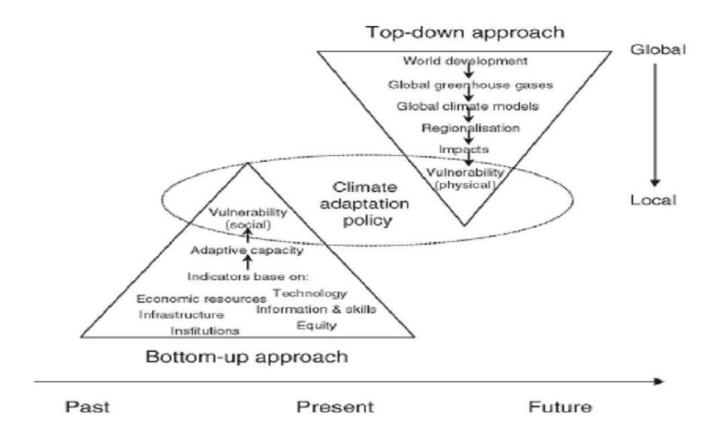
Figure 1. Bottom-up and top down approaches to climate change adaptation (Dessai and Hulme, 2003)
In the real situation, climate adaptation measures and strategies are not only limited to the relationship between the top-down and bottom up triangles, but also at all levels and stages. Climate adaptation can often be seen as an additional measures to the existing policy making process. In some regions and sectors, tipping points can exist above which impacts of climate change are so severe that such incremental changes are insufficient. Dessai and Hulme (2003) argued that both approaches should be used in a complementary fashion in support of climate change adaptation action and "climate proofing" of projects and plans. The classical top down approach is primarily based upon scientific information from the natural sciences (climate and impacts data, models and scenarios), sometimes complemented by socio-economic and governance information to assess vulnerability and sometimes adaptive capacity. The bottom up approach for developing adaptation options and making choices can be considered as a guided societal consultation process between stakeholders, in order to arrive at a preferred and socially accepted risk management policies, strategies and adaptation actions. The bottom up approach often assumes that limited to no information about the direction or magnitude of climate change is necessary for adaptation strategies.
Urbanization and Climate Change in Coastal Areas
Coastal areas become an attractive place for people to settle due to their economic advantages and aesthetic appeal. Unfortunately, this attraction has given a serious problem for future catastrophic loss caused by climate change and rapid urban growth, particularly in Asian coastal cities (Fuchs, et al., 2011). At present, some half of the world's population resides in close proximity to the coast line and it is predicted that in the future the coastal population will double and the growth is significant in the mega-coastal cities. While the growth of the cities brings the opportunities of many fold economic, social and cultural aspects, it can also bring the economic crisis and collapse in traditional social and cultural patterns of behavior in the past (Li, 2003). Furthermore, McGranahan, et al. (2007) stated that the concentration of populations and economic activities on and near the coast has had serious environmental consequences. Urban systems have completely altered the flows of water, energy and materials, transforming the preexisting ecosystems. Water drains more rapidly from built-over land, increasing peak flows and flood risks, particularly if the built drainage system is not adapted accordingly. Particularly in delta regions, land subsidence due to groundwater withdrawal and reductions in the rate of sediment deposition can lead, in effect, to sea-level rise, increasing flood risk as well as creating other problems. While economic activity and urban development often increase the environmental pressures that lead to flooding, low-income settlements, and poor groups within all settlements, tend to be the most vulnerable. It can be summarized that there is a correlation between urbanization and climate change in the coastal areas by considering the socio-economic and environmental aspects.
Climate Change and Adaptation in Indonesia
Indonesia is one of the countries that are most vulnerable to climate change impacts. Some evidences of the impacts are occurred. Climate change in Indonesia is characterized by the increase of surface air temperature, precipitation change, sea surface temperature rise, sea level rise, and extreme climatic events. According to ICCSR (2010), the surface air temperature data collected over a period of 100 years from a limited number of stations revealed that the temperature increased around 0.5 degree Celsius during the twentieth century. The projected average temperature increase in Indonesia is 0.8 to 1.0 degree Celsius for the period of 2020- 2050, relative to the baseline period of 1961-1990. Different from projected temperature increase, the projected precipitation pattern has more significant temporal and spatial variation.
The trend in rainfall pattern in Indonesia, in general, may be different not only seasonal but also monthly. The average sea surface temperature in Indonesian sea waters is projected to increase by as much as 0.65, 1.10, 1.70, and 2.15 degree Celsius in 2030, 2050, 2080, and 2100 sequentially. One of the immediate impacts of sea surface temperature increase is a depletion and migration of fishing stocks away from Indonesian waters. Sea level rise in Indonesia was projected using observed satellite altimeter and tidal data, as well as from global climate model (GCM) output. An average SLR of 0.6 to 0.8 centimeter/year has been estimated from the output of GCM models (ICCSR, 2010). The global climate change has both direct and indirect impacts on development sectors, such as agriculture, water resources, marine and fisheries, health, urban settlements, etc. Furthermore, climate change will affect the livelihood of people living together in rural and urban areas. The role of cities in dealing with climate change impacts is an important issue. Due to anthropogenic activities, cities are the main sources of greenhouse gas emissions, 70 percent of which come from the transportation sector and energy. At the same time, cities are also heavily affected by climate change risk and hazard since 60 percent of the country's population live in urban areas (ICCSR, 2010). Recognizing this challenge, cities should increase their capacities and resiliency to cope with climate change hazard and impacts.
National climate change adaptation policies and plans in Indonesia
Indonesia is already experiencing the effects of climate change. The direction of climate change varies among regions, since Indonesia is an archipelagic country which consists of about 17,000 islands according to National Institute of Aeronautics and Space (LAPAN) in 2002. With a vast coastline, high susceptibility to natural disaster, and high vulnerable agricultural production systems, Indonesia is one of the most vulnerable countries to climate change hazards in the world. The rising sea level, changes in precipitation and extreme climate events are a major issue. Adaptation to climate change is necessary in order to address climate change impacts. The Government of Indonesia (GOI) has made efforts related to adaptation to climate change impacts, including developing policy guidance to address climate change. Several national policy guidance documents addressing the impacts of climate change have been formulated by related institutions. The GOI has given special attention to environmental management since the early 1980s. Although Indonesia does not have any obligation to reduce greenhouse gas (GHG) emissions, it does have an interest in playing an active role in global efforts to tackle climate change.
In 2004, Indonesia ratified the Kyoto Protocol to Law No. 17 of 2004. Since the early 2000s, the GOI has already carried out several actions which cover mitigation and adaptation efforts, including the Establishment of National Commission on Clean Development Mechanism under the Ministry of Environment (MoE) in 2005, laws and regulations on energy, forest pollution control, and integrated coastal management. In 2007, Indonesia hosted the United Nations Framework Convention on Climate Change Conferences of the Parties-13 (UNFCCC COP-13) in Bali. The conference culminated in the adoption of the Bali Road Map and the Bali Action Plan, which consist of a number of forward-looking decisions that represent the various tracks that are essential to reaching a secure climate future. The GOI recognizes that tackling climate change mitigation and adaptation actions should be taken in a systematic and integrated manner. The Law No. 32 of 2009 on environmental protection and management also stipulated the need for strategic environmental assessment on the issue of climate change. Some policy initiatives on mitigation and adaptation were undertaken by related ministries, including:
- 1) National Action Plan on Climate Change (RAN-PI) was prepared by the MoE in November 2007, which contains the initial guidance and multi-sectoral coordination effort to address mitigation and adaptation to climate change.
- 2) National Development Plan: Indonesia Responses to Climate Change was prepared by the National Development Planning Board (BAPPENAS) in December 2007 and was revised in July 2008. The document is intended to strengthen and reinforce the RPJMN (National Medium-Term Development Plan) 2004-2009 as well as to include inputs for the preparation of RPJMN 2010-2014 in the context of integrating climate change.
- 3) Establishment of National Council on Climate Change (DNPI) was initiated through the Presidential Regulation No. 46 of 2008. The DNPI has the main responsibility to handle all matters in terms of external negotiation with international communities as well as government sectors and to implement programs at the community level.
- 4) Indonesia Climate Change Trust Fund (ICCTF) was launched in September 2009 as a follow up action after the Conference of the Parties (CoP) UNFCCC held in Bali in 2007. It was developed as a non-departmental government institution to deal with an innovative funding mechanism to address global climate change.
- 5) Indonesia Climate Change Sectoral Roadmap (ICCSR) was published by BAPPENAS in March 2010. It consists of nine sectoral strategies, namely forestry, energy, industry, transportation, waste, agriculture, marine and fisheries, water resources, and health, to deal with climate change challenge until 2030. The two major focuses of ICCSR are mitigation and adaptation (ICCSR, 2010).
- 6) National Action Plan on GHG Reduction, which was described in the Presidential Decree No. 61/2011, was approved in September 2011. This regulation serves as a guide for planning, implementation, monitoring, and evaluation of GHG emissions reduction to meet commitments to the GOI in reducing GHG emissions by 26% with own efforts or 41% with international aid in 2020.
- 7) National Action Plan for Climate Change Adaptation (RAN-API) in 2012. The RAN-API is a national action plan document on adaptation to the impacts of climate change, which involves integrating coordination among all the stakeholders, including the government, civil society organizations, international cooperation agencies and other stakeholders (RAN-API, 2012).
Beside the above plans and policies, the initiatives supported by international agencies give the influence to the local adaptation measures in Indonesia. Some on-going programs are currently conducted by international non-government organizations and donor agencies focusing on mitigation and adaptation efforts at the city level, such as: (i) the Asian Cities Climate Change Resilience Network (ACCCRN) funded by Rockefeller Foundation which has been implemented since 2009 in two cities: Semarang City and Bandar Lampung, (ii) the Stakeholder Coordination, Advocacy, Linkages, and Engagement for Resilience Program (the SCALE-Resilience) funded by United States Agency for International Development (USAID) and executed the activities in 4 (four) chosen areas in West Sumatra, Lampung, Maluku and West Jakarta, (iii) Japan International Cooperation Agency (JICA) - Climate Change Capacity Development, and (iv) the Deutsche Gessellschaft fur Internationale Zusammenarbeit (GIZ) - Policy Advice for Environment and Climate Change (PAKLIM) is an Indonesian - German Cooperation Program advising and supporting the national government, local governments and industries with climate change mitigation and adaptation initiatives. This indicates that adaptation and mitigation programs in Indonesia are still persuaded by international agencies. On the one hand, the local authority could get a benefit and a lesson learned from these programs; on the other hand, the sustainability of programs becomes a crucial problem. The
GOI should be more concerned, particularly in climate change adaptation at the local level in order to enhance the integration between a development plan and the adaptation measures.
Climate change adaptation in urban coastal area of Semarang City
The selected case study area of adaptation practices in the coastal city of Indonesia is Semarang City, located in Central Java Province. Semarang City is a medium sized city with a population of 1,559,198 people covering 373.70 square kilometers (Statistic Center Agency, 2013). It is characterized by coastal and hilly areas, making it vulnerable to disaster risks, including flood, storm surge and landslide as well as periodic drought. Limitations of climate data are still a major obstacle to obtain a comprehensive picture of climate variability and change conditions in Semarang City. However, based on the previous research, climate change has occurred in the city. It is characterized by a change in trend and nature of some climatic elements such as temperature and rainfall. The most tangible evidence of climate change can be seen especially from the trend of increasing surface temperature monthly average for over 100 years. Trend changes also occur in seasonal rainfall, which indicates a trend shift in the beginning and end of the season and the changing frequency of extreme climatic conditions. While there is an increase in the dry season, rainfall has an impact on the reduced likelihood of future drought.
Climate change is worsening the impact of these hazards and adds the further hazard of rising sea level in the long term. Some indications of the impacts of climate change in Semarang City are the incident of land subsidence, flood, seawater intrusion, and drought. A driving factor of land subsidence in the city is the high population growth. The growing population generates the increase of ground water consumption that results in the decrease of soil surface, especially in the residential and industrial area. Previous research indicates that the rate of land subsidence in the city is between 1-9 centimeters/year; mostly in the coastal area. Land subsidence leads to other disasters such as a tidal flood. Flood commonly occurs in low elevation in coastal areas. Mostly flood takes place in association with high tides. These impacts affect to urban infrastructure and socio-economic of the people. Due to land subsidence and sea level rise, the coastal area gets the impact of sea water intrusion into the groundwater aquifer. Meanwhile, the difficulty in obtaining drinking water increases during long dry seasons (drought) and during the rainy seasons (flood). The people in the city are depending on the water resources of groundwater (65 percent), piped water (33 percent) and the rest of surface water and rainwater. Semarang City has adopted climate change adaptation initiated by local government, which is an integrating climate resilient strategy into city planning; and the local community has adopted the physical adaptation.
Integrating climate resilience strategy into city planning
Local authority of Semarang City has established a program to minimize the impact of climate change impact. The program is the integration of climate resilience strategy into city planning, which is expected to help local municipal authorities and citizens take a longer term approach to planning, and consideration of the broader landscapes cities sits within, and interactions with upstream and downstream geographies. Measures are taken in order to adapt to climate change, develop a focus on long-term strategies to strengthen vulnerable groups. They also help avoid making decisions now that will create vulnerability in the future, such as developing infrastructure on the edge of floodplains or in coastal areas. The City Resilience Strategy (CRS) is a fundamental framework a city develops for anticipating and addressing potential climate change impacts (ACCCRN, 2010). Structural measure and non-structural measure to address the problem have been initiated by the government (see Table 3). The structural measure includes the improvement of the drainage system, pumping stations, the reshaping of land surface and land reclamation along the beach. The non-structural measure includes the improvement of the neighborhood by coastal planning and management (Marfai, et al., 2008).
Table 3. Structural and non-structural measures initiated by the government
| Subject | Plan and measure | Agency | ||
|---|---|---|---|---|
| Coastal land use | Detail coastal master plan | Regional development board | ||
| Monitoring land use change on the coastal | Public work department | |||
| area | ||||
| Law enforcement and implementation of the | ||||
| regulatory system | ||||
| Garbage disposal | Improvement garbage disposal system | Public work department | ||
| Involving local community on the public | Municipality health office | |||
| awareness system | Community | |||
| Tidal flood | Improving on the polder system | Regional development board | ||
| prevention | Improving the number of pump stations | Public work department | ||
| Land subsidence | Monitoring land subsidence | Public work department | ||
| Monitoring groundwater extraction | Mining and geology | |||
| department | ||||
| River and | Detail drainage master plan | Regional development board | ||
| drainage system | Improving drainage capacity and reduce | Public work department | ||
| sedimentation on the drainage system | Water resources department | |||
Source: Marfai, et al., 2008
Physical adaptation for the tidal flood hazard
Even though local government has initiated to develop programs to minimize the climate change impacts, the local community in a coastal city of Semarang has their plans to adapt the impacts. Based on the previous research (Marfai, et al., 2008), it can be found that the local communities are aware of the tidal flood hazard, but the understanding of a community does not manage to support their decision to leave the vulnerable area. The community has adapted the tidal flood hazard by a simple physical adaptation strategy, such as increasing the floor level following the water level and making small dams to block water enter the house. This response is not sufficient and aesthetically not proper from the environmental aspect. According to the community's perception attained, it can be said that instead of taking the tidal flood as the risk, the community intends to neglect the hazard and considered that the tidal flood is no longer as a threat towards their wellbeing. The physical adaptation may be very traditional, efficient and economically feasible for the community, however the adaptation technique may be classified to improper technique when it comes to aesthetic and health point of view. The unhealthy environment created by the tidal flood and the improper technique is sufficient only temporal condition, however for any longer circumstance it was not fit at all. It is important that the government should identify the existing institutional setting to provoke better condition.
Typology of Adaptation Measures in Semarang City
In Semarang City, two kinds of climate change adaptation strategies are identified, which are 1) an integrated climate resilient strategy in city planning in coastal areas, and 2) a physical adaptation for tidal flood hazard. Based on the description in the previous section, the typology of the measure of integration climate strategy into city planning can be classified to a planned adaptation. The strategy has been initiated by the local government to address the problem
through structural and non-structural measures. The structural measure includes the improvement of the drainage system and the pumping stations. The temporal scope of the strategy is on the long term strategy through strengthening vulnerable groups. The timing characteristic of adaptation is typically categorized to an anticipatory adaptation.
Table 4. The typology of adaptation measures in Semarang City
| Adaptation Typology | ||||
|---|---|---|---|---|
| Adaptation Measure | Purposefulness | Timing | ||
| Planned | Autonomous | Anticipatory | Responsive | |
| Integrating climate resilience strategy into city planning | | | ||
| Physical adaptation strategy for the tidal flood hazard | | | ||
Source: Analysis result, 2012
Another adaptation measure is a physical adaptation strategy introduced by the local community to protect their living place of the tidal flood hazard, such as increase the floor level following the water level and making small dams to block water enter the house. This strategy is appropriate for short term adaptation. This strategy can be classified in an autonomous adaptation because it has been initiated by the community in response to the hazard of tidal flood in their coastal area. The summary of the typology of adaptation measures in a coastal city of Semarang can be seen in Table 4.
Performance of Adaptation Measures in Semarang
Even though this study cannot provide an in-depth analysis of each of the adaptation measures and in fact, it is not easy to assess the performance of current adaptation measures through a desk study only, yet this study gives a basic indication of the state-of-the-art regarding on climate change adaptations in a coastal city of Semarang. Each adaptation measure has different scales of information and has their own characteristics. This study seeks to simplify the analysis based on the three main criteria in order to assess adaptation measures, which are economic, environmental, and social and institutional aspects. The analysis of selected urban coastal adaptation hints towards existing gaps and mismatches in adaptation endeavors by looking at some of the different ways in which adaptation strategies are being implemented in the coastal area of Indonesia in the context of climate change impact and urban development.
Economic criteria
The main indicators for economic criteria are efficiency and feasibility. Regarding those indicators, there is limited information that can be found among the cases of adaptation measures from the reports or document. It can be realized because it is a conditional matter. However, there are some adaptation measures stated it with indirect explanation. For instance, the case of adaptation strategy for integrated climate resilience strategy into city planning in Semarang City, the local government has structural and non-structural measures that will adopt to tackle the impact of climate change (Marfai, et al., 2008). In terms of economic efficiency and feasibility, the actual performance of adaptation practice results in a positive output because it is quite stable for a longer term. However, the feasibility of dependence on the financial resource for building structural measures should get attention, for example in improving the polder system and pump systems. Meanwhile, the local community has adapted the tidal flood hazard by simple physical adaptation strategy, such as increasing the floor level and making
small dams. The physical adaptation is very traditional, efficient and economically feasible only for the community. In terms of economic efficiency and feasibility criteria, the actual performance of adaptation practice is a moderate result because the strategy is quite stable for longer terms of involving the financial resource per household. Nevertheless, the measure is apparently neglected and lack of any update technology for improving the technique.
Environmental criteria
In terms of environmental criteria, there are evidences that can be found in the adoption of adaptation strategies. The criteria to assess the performance are effectiveness and flexibility. In the case of physical adaptation by the local community by a simple physical adaptation strategy, such as increasing the floor level following the water level and making small dams to block water enter the house (Marfai, et al., 2008). The strategy is very traditional and improper technique that is not sufficient for a long term condition and affects to their health and environmental aspects. Rather to have better improved environment, the community from time to time live in the deteriorating environment, which cannot support any better well-being. It means that the effectiveness and flexibility of this adaptation measures are low-managed. In the case of integrated climate resilience to city planning, it is not directly stated about the environmental performance of this strategy. However, structural measures such as improvement garbage disposal system and the polder system can give a positive impact on the environment.
Social and institutional criteria
Concerning the social and institutional criteria, the result can be seen from the institutional compatibility and willingness to implement. In the case of physical adaptation by the community, the adaptation strategies have given the results in increasing the awareness of people related to climate change and there are a clear consensus and common awareness amongst stakeholders. The local communities are aware of the tidal flood hazard as information given from the local authority. They also intend to adopt the adaptation measure to reduce the impact, for example by increasing the floor level and making small dams to block the water. However, it needs the improvement of knowledge and information to the local community regarding the implementation of the strategy. In the measure of integrated climate resilience in city planning, there is a result from adoption of adaptation measures with a clear consensus and common awareness amongst stakeholders. Although it is not obvious declared that the adaptation measure is reliable with the current planning, but this measure has been achieved the increasing capacity of local authority to mainstream the climate change into planning at the local level.
Although it is difficult to assess the performance of adaptation practices in the case of the coastal city of Semarang because of different typology as well as circumstance of geography, environment, social, economy and institutions, however the analysis can be done by looking indication results based on several criteria. The actual performance of adaptation measures in Semarang City can be seen in Table 5.
Table 5. The actual performance of adaptation measures in Semarang, Indonesia
| Adaptation Measure | ||||
|---|---|---|---|---|
| Criteria | Integration planning | Physical adaptation | ||
| Economic | ||||
| Feasibility | Moderate | Moderate | ||
| Efficiency | High | Moderate | ||
| Environmental | ||||
| Effectiveness | Moderate | Low | ||
| Flexibility | Moderate | Moderate | ||
| Social & Institutional | ||||
| Willingness to implement | Moderate | High | ||
| Institutional compatibility | Moderate | Moderate | ||
Source: Analysis result, 2012
Conclusion and Recommendation
Urbanization and climate change impacts are still challenges in the present that are facing coastal urban areas particularly in many developing countries. Coastal areas have attracted human settlement because of their economic advantages and aesthetic appeal. This process brings the areas to grow. On the other hand, the impacts of climate change and the concentration of populations and economic activities in these areas have had serious environmental as well as socio-economic consequences. Indonesia has adopted climate change adaptation measures and applied the adaptation practices to minimize the impacts. The investigation of current practices and performance of climate change adaptation measures in this study, which is based on desk study, is quite difficult to conduct because of scarce documentation. However, this study found the two adaptation cases in the selected coastal city of Semarang, which are 1) integrating climate resilience strategy into city planning; and 2) physical adaptation for the tidal flood hazard. Based on the result; it can be noted that the adoption of different typology of adaptation measures has varied characteristics and results depending on the context, resource and capacity of local institutions and communities. The performance of adaptation measures in Semarang City has been discussed according to economic, environmental, social and institutional aspects. It can be found that the different adaptation measures in the city have given different results and perspectives among the others.
According to the performance results of adaptation practices in the coastal city of Semarang, there is the gap in the implementation of adaptation measures. The lessons and possible actions to fill the gaps can be summarized as follows: firstly, according to the result of economic criteria, it is found that it is significant to consider the collaboration and cooperation as well as a strong commitment amongst stakeholders such as the government, the agencies, private company, research or academic institutes, and communities, in the context of climate change adaptation. Secondly, in terms of environmental criteria, strengthening the awareness and knowledge of the stakeholders and developing a reliable scientific basis in climate change research is important, particularly by involving research or academic institutions to deal with the scientific-based research of climate change analysis. Thirdly, in relation to social criteria, building adaptive capacity of stakeholders is essential. Building capacity is important in order to build up an understanding about climate change, its impacts, and possible adaptation strategies among a city's society. Only the knowledge about the potential effects will mobilize residents to mobilize residents to support governmental action for adapting. In addition, regarding to institutional performance, the integration of adaptation measures into development planning is strongly required to conduct. Semarang City has already given attention to integrating the adaptation measures into development planning in their cities/regions. These lessons will be useful for other coastal cities, particularly in developing countries to deal with the adjustment in responding to climate change impacts.
It is important to understand that through very unique geographical, cultural, political, institutional, economics, social, and environmental conditions, there is no one size fits all solutions to adapt. The lessons listed above are therefore not to understand as a key to adaptive planning, but factors that support a successful process. Moreover, as this study was written in a timely and financially restricted manner as well as no much available information obtained, thus there is a strong need for further study to incorporate more coastal cities and in-depth analysis and data/information regarding to the issue, including the methodology for analysis. It is equally important to find the drivers as well as the barrier and opportunity of the adoption of adaptation measures at the local level.
Acknowledgment
This article is a part of special study report titled 'Current Practice and Performance of Climate Change Adaptation Measures in Coastal Cities of Southeast Asia' with the financial support from AIT Fellowship.