

Introduction
Greater Jakarta is one of the urban areas in Indonesia that are having a rapid, dynamic growth (Firman, 2013). It consists of several territories, i.e. municipalities (kota) and districts (kabupaten), including Jakarta-Bogor-Depok-Tangerang-Bekasi (Jabodetabek). Like other dynamic urban areas in South East Asia, Greater Jakarta has evolved into an extended metropolitan area. This evolution process occurred as a consequence of challenges in the present era of globalization. Indirectly, these global challenges stimulate self-interventions that originate from civil society itself, via autonomous networks in society beyond government control. This process is called self-organization in urban development (Boonstra and Boelens, 2011). This self-organization process encourages social, behavioral, economic and political changes in Greater Jakarta through a gradual shifting process (Firman, 2013). This process is the result of the interrelationships between three fundamental phenomena, i.e. migration, local economic improvement, and urban development. Migration to the province of Jakarta and surrounding areas (i.e. Bogor, Depok, Tangerang, and Bekasi) is likely to have triggered self-organization in Greater Jakarta. The migration process stimulates population growth, which leads to an increase of economic needs. In order to comply with these needs, various economic activities emerge. These activities then initiate the generation of other activities, especially residential development. The combination of these activities stimulates the emergence of urban development in gradual processes through the creation of new city centers in rural areas, such as the regencies of Bekasi, Bogor, and Tangerang.
The emergence of urban development can be seen as a positive process of generating new economic activities, such as new small, medium and large enterprises that can reduce unemployment and contribute to local revenues. However, this urban development process also potentially creates a crucial challenge for urban planning strongly related to urban land-use change. McGee (2008) assumes that land uses, economic activities, and also flows of change are inherent parts of urban systems (Woltjer, 2014). In Greater Jakarta, urban land-use change can be seen as a representation of the urban development process that is stimulated by selforganization through a non-linear transition process. This means that there will be unpredictable changes in the structure and functions of the Greater Jakarta area during the transition process, because of the changeable context and causality (cf. De Roo, 2010). This land-use change may have negative impacts and go against current spatial plans when it grows out of control and results in urban morphological fragmentation (Barros and Sobreira, 2002). This negative impact could become a serious problem for Greater Jakarta, where planning institutions still tend to use a semi blueprint approach. Hence, their spatial plans for Greater Jakarta are positioned as the main guidline in managing urban land-use changes. However, these plans that are supposed to play a role as a 'tool' in guiding urban land-use change are not well implemented and enforced by the related local governments due to power dispersal at the decentral level, so that many problems occur. At the decentral level, the making and implementation of spatial plans for Greater Jakarta territories is limited by the hierarchical spatial planning system and its authority division. As a result, the increasing complexity in urban land-use change causes the spatial planning institutions to be inadequately equipped to deal with these developments, such that the implementation of spatial planning does not work well. This situation creates the emergence of other complex problems. One of the potential difficulties is the increase of built-up areas in protected zones (i.e. through new towns, industrial estates and slum areas), which stimulates environmental degradation. Therefore, it is very important to analyse and try to improve the spatial planning system in Greater Jakarta, in order to be able to guide the urban land-use changes that play an important role in the urban transformation process. This study is interested in the growing phenomena of 'planning that does not work' in developing countries, and particularly in Indonesia. Specifically, actor relationships can be elaborated to come up with an overview of how the current spatial planning system deals with complexity, especially selforganized urban development in an extended metropolitan area.
This study was aimed at identifying the urban transformation in Greater Jakarta that is triggered by a self-organizing process within its society and also the extent to which the spatial planning system can play a role in facing this development. In so doing, it is argued that the concept of non-linearity can add to the understanding of this phenomenon and provide a new perspective on the development of a spatial planning system that is able to deal with non-linear transition processes (viz. urban transformation). This objective resulted in several sub-research questions: (1) How is the urban transformation process (stimulated by self-organization) in Greater Jakarta positioned in the current spatial planning system. (2) To what extent does the current spatial planning system in Greater Jakarta deal with this urban transformation process. (3) How can the concept of non-linearity be used to improve the spatial planning system in responding to this urban transformation process.
The remainder of this paper is organized as follows. The next section presents the methodology of this research. An explanation about the implications of decentralization policies in Greater Jakarta, the emergence of self-organization and its role in stimulating urban transformation and its related government interventions can be found in the following section. This is followed by a discussion of the mismatch between the present spatial planning system and the urban system in Greater Jakarta and an alternative formulation of the spatial planning system in coping with urban transformation. In the last section, a summary is provided, along with some remarks on further studies.
Literature Review
Fundamentally, self-organization is the spontaneous emergence of global structure through local interactions, independent of external forces (Portugali, 2000; Heylighen, 2008). This means that under the dynamic relationship between elements and their environment and the dynamic interrelation among those elements, complex systems can manage themselves in a process of self-organization, creating the emergence of new structures. According to Prigogine (1977; 1984), Haken (1983; 1978; 1981), Maturana and Varela (1974), and De Roo (2014), selforganization relies on three processes: (1) dissipative, (2) synergetic, and (3) autopoietic processes. For the spatial planning context, these three processes can be translated into three stages, i.e.: triggering events, repetitive behavior, and collective results.
- Stage 1: Triggering events (dissipative processes) Self-organization is a specific process that can occur when there is a trigger from outside that stimulates a spontaneous action.
- Stage 2: Repetitive behavior by responding agents (synergetic processes) As an autonomous and spontaneous action that is triggered by an outside influence, selforganization then invites self-initiative from every individual or group of actors to conduct
interventions. These interventions then develop through an adaptive process in responding to conditional changes in the environment. Over a long time period, these interventions grow into unintentional repetitive behavior from the actors.
- Stage 3: Collective results (autopoietic processes) The repetitive behavior encourages a critical mass of people to execute similar interventions in response to something. The similar actions from a greater number of people then creates a collective result. The important feature of the collective result is the emergence of new patterns caused by the autonomous collective behavior of the actors.
These three stages of self-organization stimulate the emergence of self-management and selfregulation of the new system in an area and also encourages the appearance of self-governance in related governments. Self-management is an action which is operationalized through a partial intention that results from a self-organizing process, such that it creates a collective result. Similar to self-management, self-regulation occurs when there is a partial intention from agents that produces collective results, but now in a collective condition (i.e. an organized situation). Different from both former concepts, self-governance emerges through the collective arrangement of agents under a collective condition, such that it produces a collective result.
Table 1. Differentiation of Self-Organization, Self-Management, Self-Regulation, and Self-Governance
| Behaviour/actions | Conditions | Result | |
|---|---|---|---|
| Self-organization | no intent | no intent | collective |
| Self-management | partial intent | partial intent | collective |
| Self-regulation | partial intent | collective | collective |
| Self-governance | collective | collective | collective |
Source: De Roo, 2014 (forthcoming)
In a spatial planning system, the process of self-organization exerts its influence through the evolution of the urban system and planning oriented action. Theoretically, urban systems can be divided into four classes:
- A closed linear system (class I). In this system, the effect of interventions is easy to predict and the governing system is usually based on a technical, rational approach, and decisionmaking is generic and centralised (Rauws, 2009).
- A circular feedback system (class II). In this system, a number of stakeholders with various interests are involved. The outcome of the process within the realm of this system is less predictable than in closed systems (De Roo and Porter, 2007). Therefore, the governing system is usually based on a scenario approach.
- An open network system (class III). In this system, various stakeholders play a role and consensus building is essential. The governing process tends to be characterised by 'governance' trying to reach multiple goals. The governing system is usually based on a communicative approach (De Roo, 2003).
- A non-linear adaptive system (class IV). This system is characterised by co-evolution, pathdependency and new emergence (Rotmans et al., 2001; Rammel et al., 2007; Sydow et al., 2005; as cited in Rauws, 2009). Therefore, it is important for the planning system to anticipate the processes of co-evolution. Different from the other three classes with their stable
complexity, which leads to ignoring the aspect of time in the decision-making process (i.e. t = 0), a crucial factor in non-linear adaptive systems is time (i.e. t = n). Time is an important factor because the context changes continuously, so that planning should change as well.
According to De Roo (2003), planning-oriented action is a framework that is built by a relationship between goal-oriented, institution-oriented and decision-oriented action (see also De Roo, 1995; De Roo, 1996; De Roo and Miller, 1997). As part of the planning process, planning-oriented action is performed by individuals, groups or organizations. This action is designed to achieve goals in a systematic way by making and implementing choices and decisions, with the help of others if necessary, and by using the required resources. This means that there are various actors who participate by representing their own interests. There are three interrelated dimensions of spatial planning, which are strongly related to the effectiveness of governmental interventions that involve planning-oriented action (De Roo, 2003):
- 1) Functional Relates to the object or content of planning: physical or social reality.
- 2) Organisational Refers to the actors, stakeholders and shareholders, and the choices they make. Furthermore, it also refers to the rationalisation of these choices.
- 3) Institutional Refers to actors and institutions as well, but also to cultural values, scientific paradigms and tenets.
Methodology
To examine the role of the spatial planning system in facing urban transformation in Greater Jakarta, our methodology was derived from theoretical concepts, in particular self-organization, non-linearity in the transition process, and co-evolution of spatial planning. Data collection was conducted to elaborate the phenomenon of urban transformation in Greater Jakarta, which comprised observation of existing land use, participation in the 'Regulation and Management Review of Jabodetabekpunjur Area' workshop, and in-depth interviews with key actors in Greater Jakarta. Table 1 below summarizes the information collected during these interviews.
To identify the urban transformation of Greater Jakarta and build connectivity between the empirical phenomenon and its related theoretical concepts, a descriptive qualitative method was employed. This was implemented through two methods of analysis:
- Explanatory analysis
- In the explanatory analysis, qualitative relationships were identified through issues or case studies in the Greater Jakarta area. From this analysis it was derived how the process of urban transformation in Greater Jakarta, which is stimulated by self-organization, has impacted the implementation of spatial planning. In other words, it provides input for answering the first and second sub-research questions.
- Comprehensive analysis
- The comprehensive analysis tried to correlate the urban transformation phenomenon in Greater Jakarta with the spatial planning system. This correlation was based on the three main theoretical concepts (i.e. self-organization, non-linearity in urban transformation, and coevolution in spatial planning). This analysis provided input for answering the third and forth sub-research questions. In the end, the comprehensive analysis took the inputs from the four sub-research questions to give an answer to the main research question and also to provide a solution to deal with the occurring problems.
planning system?
transformation?
Jakarta?
To what extent does the current spatial planning system in Greater Jakarta deal with uncontrolled urban
How can the concept of non-linearity be used to improve the spatial planning system in responding to urban transformation in Greater
- Spatial planning experts
| Sub-Research Questions | Objectives | Related Stakeholders |
|---|---|---|
| How does the self-organizing process | Learning the kind of self | BKPRN1 - |
| trigger urban transformation in | organizing process that could | Directorate General of - |
| Greater Jakarta? | stimulate urban transformation in | Spatial Planning |
| Greater Jakarta | under Ministry of | |
| How is the urban transformation | Learning the government | Public Works2 |
| process (i.e. influenced by self | interventions & related | BKSP3 - |
| organization) in Greater Jakarta | instruments that are used in | - Local Governments |
| positioned in the current spatial | guiding urban transformation | (Bappeda)4 |
Table 1. Data Collection Process
responding to urban
Learning the effectiveness of the current spatial planning system in transformation in Greater Jakarta
Learning the kind of alternative spatial planning system based on the concept of non-linearity in order to respond urban
transformation in Greater Jakarta
- 1. Bappeda Provinsi DKI Jakarta (Jakarta Province)
- 2. Bappeda Kabupaten Bogor (Bogor Regency)
- 3. Bappeda Kota Bogor (Bogor Municipality)
- 4. Bappeda Kota Depok (Depok Municipality)
- 5. Bappeda Kabupaten Tangerang (Tangerang Regency)
- 6. Bappeda Kota Tangerang (Tangerang Municipality)
- 7. Bappeda Kota Tangerang Selatan (Tangerang Selatan Municipality)
- 8. Bappeda Kabupaten Bekasi (Bekasi Regency)
- 9. Bappeda Kota Bekasi (Bekasi Municipality)
- 10. Bappeda Provinsi Jawa Barat (West Java Province)
- 11. Bappeda Provinsi Banten (Banten Province)
Urban Transformation in Greater Jakarta
Urban transformation in Greater Jakarta can be indicated as a complex process that is influenced by internal and external aspects. The internal aspect refers to internal processes in the system that stimulate the emergence of the transformation process. In this context, Greater Jakarta acts as a system where self-organization is the main process and potentially encourages the emergence of urban transformation. Self-organization plays a role in stimulating urban transformation through several developments. In addition to the internal aspect, urban transformation in Greater Jakarta is strongly related to the implementation of decentralization policies. Decentralization affects the spatial planning system and governmental interventions in 1 National Spatial Planning Coordination Committee
2 National Ministry that has the responsibility of creating national spatial planning in Indonesia
3 Cooperating Agency for Development of the Greater Jakarta Area 4 Regional and Local Development Planning Agencies for each area in Greater Jakarta:
Greater Jakarta. The influence of decentralization is a crucial internal aspect of urban transformation in Greater Jakarta. Following this brief explanation, this section describes several fundamental elements associated with urban transformation (i.e. decentralization policies in Greater Jakarta), urban transformation in Greater Jakarta (i.e. stimulated by selforganization), related government interventions in Greater Jakarta, and also impacts of decentralization on urban transformation.
Decentralization Policies and their Implications for the Spatial Planning System in Greater Jakarta
Decentralization in Indonesia has been implemented since 1999, as regulated by Law 22/1999 on Local Governance. The concept of decentralization in Indonesia comprises three fundamental aspects: (1) the division of administrative boundaries, (2) the division of authority, and (3) the division of fiscal affairs (Miller, 2013). In 2004, this law was replaced by Law 32/2004 and the most recent regulation is Law 23/2014. Basically, this law explains that local affairs are devolved by the central government to local governments through two categories of division of authority, i.e. obligatory and non obligatory. In the present era of globalization, which is laden by competition processes, Indonesian decentralization policies potentially encourage local governments to exploit local resources more intensively (e.g. land, water, and other physical assets) in order to maximise their own income, without considering the political and socio-economic conditions of the region (Firman, 2008). Decentralization encourages local governments to develop their own region according to their own style and preferences.
In Greater Jakarta, the concept of decentralization challenges its governmental authority system. As a mega urban-region consisting of several local governments, Greater Jakarta tends to implement a 'fuzzy' system for its governmental authority. At the niche level, each local government has liberties to govern their own territories based on Law 23/2014. On the other hand, as a mega urban-region this area is urged to establish a complex coordination system of multilevel governance. Consequently, this coordination system creates a hierarchical spatial planning system. It stimulates fuzzy coordination among local governments in Greater Jakarta and is vulnerable to local egoism. Finally, this coordination system is unable to handle the next two spatial planning processes, i.e. spatial development promotion and spatial development control.
Development through Self-Organization in Greater Jakarta
Greater Jakarta is one of the extended metropolitan areas in Asia that have been transforming along with globalization. The total population of Jabodetabek in 2010 is about 22 million, spread over an area of 6.470,71 km2 (Ministry of Public Works, 2013). Over the last four decades, the development of economic activities in Greater Jakarta has triggered land conversion in both the core city of Jakarta and its peripheral areas. In the early 2000s, about 8.000 ha of primary forest and 4.000 ha of paddy fields were converted into residential and industrial areas in the southern part of Greater Jakarta (Firman, 2013). Within Jakarta City itself, many previously residential areas have become commercial areas, marked with high-rise apartments and condominiums. Over the past decade, the process of urban land-use conversion in Greater Jakarta has been faster in the periphery than in the city center (i.e. Jakarta City). The built-up areas in Jakarta have increased from 560 to 594 km2 between 2000 and 2010 (i.e. 0.6% increase per annum), while those in the periphery, including Bogor, Tangerang, Depok and Bekasi, expanded more significantly, from 544.2 to 849.7 km2 (i.e. 4.6% increase per annum) (Salim, 2013 as cited in Firman, 2013). This land-use change has been contributed by several
developments, most notably: (a) the development of shopping malls and apartment buildings in Jakarta City, (b) the development of large-scale residential areas, new towns, and industrial estates in fringe areas, (c) transportation development, and (d) the increase of slum areas along the river banks.
Basically, these urban land-use change phenomena begin with the emergence of selfinterventions that originate in civil society itself, via autonomous networks of society outside government control. These self-interventions result in repetitive collective behavior in an autonomous way and symmetry break in existing patterns because of the collective behavior, which encourages the emergence of new patterns. In other words, these phenomena lead to selforganized patterns at the higher level in Greater Jakarta. In the end, they encourage the emergence of new patterns of the system of social life, comparable to the new physical forms created through the urban land-use changes.
With regard to the synergetic concept of self-organization, the emergence of shopping malls and apartment buildings, large-scale residential areas, new towns and industrial estates in fringe areas, transportation development, and also the increase of slum areas are evidences that show the interrelationship between the elements of the system of social life. Globalization, as the triggering event, encourages a dynamic economic climate in Greater Jakarta. This climate encourages related actors to respond to changes by conducting self-interventions, which then result in an evolutionary process through interaction and interrelation between the elements of the system and create a collective repetitive behavior from the related stakeholders. In slum areas, the interrelation between the elements of the system of social life is shown through social interaction among lower-income residents who gradually migrate to Greater Jakarta and build their own dwellings. During the slum development process, there are interactions between the lower-income residents in deciding the appropriate place for their houses. They may reach a 'virtual' consensus in their internal societal system through voluntary action, which is then responded to by others through subsequent actions. Similar to the slum development phenomena, the development of shopping malls and apartment buildings is driven by the interrelationship between the private sector and urban economic life.
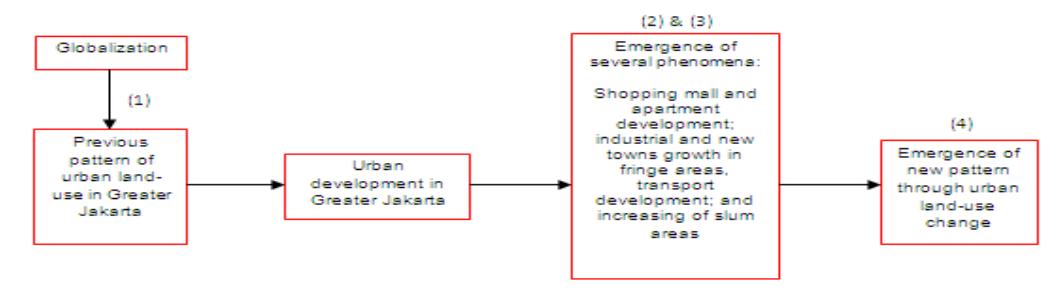
Detail explanation:
- (1) Triggering events from globalization (i.e. dissipative process)
- (2) Repetitive behavior of related stakeholders in the system (i.e. synergetic process), which then stimulates a collective result
- (3) Collective result, where there is a process of self-maintenance, identity forming and stabilization, and reproduction (i.e. autopoietic process)
- (4) The emergence of new patterns through a symmetry break from previous patterns
Figure 1. Visualization of Self-Organization in Greater Jakarta
The two previous processes (i.e. dissipative and synergetic) stimulate the final aspect of the whole process of self-organization, namely autopoiesis. Based on its definition for the social planning context, autopoiesis means that there is self-maintenance, identity-forming and stabilization, and also reproduction in the system. Through self-management, there is a creation process of new patterns which leads to a symmetry break. For Greater Jakarta, the autopoietic process is identified through the urban land-use conversion process, which is adjusted to the urban economic development, such as the adjustment of vacant land alongside the river banks in several cities to become new slum areas, etc. There are self-maintenance processes through collective repetitive behavior between lower-income residents in the form of creating new slum areas. The self-maintenance and identity-forming processes then ruin the previous pattern (i.e. the previous land use), creating a new form of land use in the area. Within a certain time period, the new slum area gradually develops and creates a new pattern of urban land use. In other words, this phenomenon indicates an urban transformation process in Greater Jakarta, which occurs through urban land-use changes. Specifically, the three processes and stages of selforganization, in the case of Greater Jakarta, can be described in Figure 1.
Through the explanation above, we realize that self-organization in Greater Jakarta can encourage urban development. Furthermore, the phenomena of urban development stimulate the emergence of an urban transformation in Greater Jakarta over a gradual time period. Crucially, the urban transformation in Greater Jakarta occurs as a non-linear process.
Spatial Planning Intervention by Related Governments in Greater Jakarta and Its Dilemmas
In the context of Greater Jakarta, the local authority, in formulating spatial planning documents, has been transforming in a complex way due to the pressures of globalization and the implementation of decentralization policies. On the one hand, the related local governments are required to fulfill their local development autonomously, but on the other hand their power is still limited by the partially centralized power from the central government (i.e. the ministry) in delegating development power and allocating financial sources for the development process. The implementation of decentralization in Greater Jakarta tends be a controlled decentralization process. This style of decentralization provides several pitfalls for the local governments, which have to face complex dynamic situations in executing their plans. As one of the local government officials in Greater Jakarta said:
"In implementing the concept of decentralization, the central government could be likened to a man who tries to release an animal but is still clutching its tail." (Head of Physical Environment, Facilities, and Infrastructure – Bappeda Tangerang Regency, 2014)
In accordance with this situation, most local governments in Greater Jakarta have tried to initiate autonomous interventions in implementing spatial development promotion to realize spatial structures and spatial development patterns based on their own priorities and abilities. In formulating these priorities, they tried to adapt to the rapid urban development. Specifically, the autonomous interventions can be identified as self-regulation from the local governments in Greater Jakarta through a self-initiation process that is stimulated by self-organization (De Roo, 2014).
Nevertheless, this self-regulation results in some constraints in synchronizing the spatial planning programs for several areas in the borderland between two or more cities or regencies.
For instance, Jakarta City has plans to build an industrial estate in areas that border on Tangerang Regency. In contrast, Tangerang Regency has planned a residential development in the same area. This complex situation has been growing for almost a decade without any intervention from the central government, which is supposed to act as a mediator.
Even though there is an institution in Greater Jakarta whose main task is to coordinate and monitor development in the region, namely the Jabodetabek Development Cooperation Agency (Badan Kerjasama Pembangunan – BKSP), coordination between local governments is not implemented well. There are various reasons for this; the delegation of power and political factors are probably the main reasons. As a representative of Bappeda DKI Jakarta and BKSP said:
"BKSP seems not to have the intention to live but also hesitates to die… Maybe because of a lack in its power to coordinate several provinces, municipalities, and regencies in Greater Jakarta." (Representative of Bappeda DKI Jakarta, 2014)
"BKSP has lost its power since the evolution from centralization to decentralization… Besides that, a lack of fiscal sources became one of the crucial aspects that influenced its downturn." (Representative of BKSP, 2014)
Because of this situation, the local governments intervene through implementation of spatial planning without coordination between the local governments and the central government, resulting in inconsistencies between existing land use and planned land use based on the strategic spatial planning documents for Greater Jakarta (RTR KSN Jabodetabekpunjur). The decentralization has encouraged a hierarchical spatial planning system, whereby the local governments in Greater Jakarta are obliged to attend the BKPRN forum. In this forum, organized by the central government, regional spatial planning documents are approved. On the other hand, the decentralization also gives opportunities to the local governments and society to improve social economic conditions independently from the central government, through selforganizion and self-regulation. The worst consequences occur when the local governments, who have a responsibility in managing urban and regional development, have to face their limited authority in managing urban land-use changes in their region due to the semi-centralized implementation of decentralization.
Indirectly, there is a lack of decentralization policies that have an impact on the spatial planning system in Greater Jakarta as a whole. The local governments are in an inadequate position, where they have to obey the central mandates while on the other hand they cannot ignore the reality that has been developing rapidly and needs a quick response. Hence, there is an emergence of autonomous interventions from each separate local government – evidencing selfregulation in Greater Jakarta – in managing their local spatial development through their own related local authority in the context of spatial planning.
The Role of Spatial Planning in Responding to Urban Transformation
The current extended urban development in Greater Jakarta, as explained in the previous section, clearly shows that a huge transformation is taking place, stimulated by self-organizing processes. Globalization and decentralization are the two main elements that influence the relationship between the spatial planning system and self-organization in Greater Jakarta. Based on the empirical evidence put forward in the previous section, the hierarchical spatial planning system in Greater Jakarta makes it rather impossible to influence current urban land-use
conversions or land-use change phenomena, such as the development of huge shopping malls and apartment buildings, the emergence of various large-scale residential areas, new towns, and industrial estates in fringe areas, transportation development, and the increase of slum areas along the river banks in several big cities in the Greater Jakarta Area. Ideally, the existing spatial planning system of Greater Jakarta is able to respond to these phenomena in a way that makes sense, i.e. identifying a balance between the urban development and the planning system to support society's desires. This means that the spatial planning system should first identify the base of the urban development process and how it can influence the urban transformation. Besides that, the spatial planning system should be able to predict the possible impacts of all processes on the spatial planning system itself, because planning is implemented in a dependent chain. Co-evolution in spatial planning is a related process that needs to further analyze the role of the spatial planning system in responding to urban transformation. There are two crucial points, which will be explained in the next section, namely a mismatch between the spatial planning system and the urban system in responding to the current urban transformation of Greater Jakarta, and positioning the concept of non-linearity towards an alternative spatial planning system in order to better cope with the urban transformation.
A Mismatch between the Spatial Planning System and the Urban System in Greater Jakarta
The urban transformation of Greater Jakarta is a mix of a closed linear system (class I), a circular feedback system (class II), an open network system (class III), and a non-linear adaptive system (class IV). The emergence of this mixed system has resulted in a shift away from a spatial-planning focus on reality; from 'object oriented' to 'intersubjective interaction'. This shift is strongly related to the decision-oriented action in planning-oriented action.
In the case of Greater Jakarta, various stakeholders have strong interests in interfering with urban development, while the local government's competence is still restrained by the 'semicontrolled' decentralization process. This situation causes policies not being flexible in responding to the reality out there, where the situation is getting complex, unclear, and rather fuzzy. Indirectly, this condition stimulates the related governments in Greater Jakarta to create self-regulating processes through self-intervention. According to the theoretical concepts, selfregulation begins with a shift in the spatial-planning focus through a change of the spatial planner's role. This means that the spatial planner tends to become an advisor as well as a participant in the planning arena (De Roo, 2003). Nevertheless, for the context of Greater Jakarta with its spatial planning authority relying on 'semi-controlled' decentralization, selfregulation does not encourage the spatial planner to shift his role to that of an advisor. The operationalization of the scenario and communicative approaches are clearly indicated through the following characteristics of planning-oriented action:
- For goal-oriented action, the related local governments use a linearly phased circular planning process (i.e. with feedback, correction, and self-regulation).
- For institution-oriented action, the related governments implement a decentralized shared governance and horizontal network under decentralization. Furthermore, there are various stakeholders (i.e. society, private sector, etc.) with highly variable and problem-based institutional links of which the responsibilities are difficult to identify.
- For decision-oriented action there is a strong emphasis on problem definition and selection in each related government, and coordination in terms of the whole through the BKPRN and BSKP forums.
These three characteristics imply a tendency of the spatial planning process in Greater Jakarta to employ a scenario approach in response to the growing complexity (i.e. urban transformation) there.
The above explanation of the spatial planning system and urban system in Greater Jakarta indirectly indicates a mismatch between both systems. This mismatch occurs when it is believed that the current urban system can be dealt with by a closed, linear and circular feedback system. However, we should recognize that the urban system is more diverse and that it is impossible for the existing spatial planning system to control everything. If we compare the existing spatial planning system and the empirical situation in Greater Jakarta, we find a condition where the spatial planning system seems to be left behind by the growing reality. This shows that the decision-oriented action in planning-oriented action in Greater Jakarta still lies in 'intersubjective interaction' in a stable complexity with a predictable uncertainty. However, reality has already changed rapidly through a non-linear transition process (i.e. under dynamic complexity) in which the uncertainty is hard to predict, because it is possible for the context to change in the future (i.e. it is necessary to consider time change, or: t ≠ 0 but t = n). In other words, it is impossible for the existing spatial planning system to control everything through the existing decision-oriented action. The result of this analysis implies that the decision-oriented action in planning-oriented action should be based on 'intersubjective interaction', taking into account time change (i.e. t ≠ 0 but t = n) in the decision-making process.
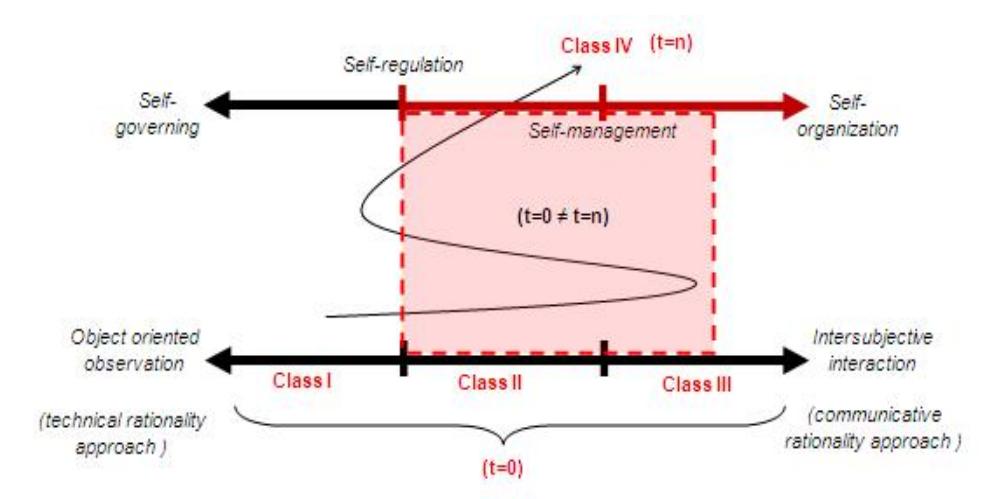
Figure 2. Position of the Existing Spatial Planning System in Greater Jakarta towards Growing Complexity Source: De Roo, 2010; De Roo, 2014 (forthcoming), modified
Figure 2 presents the position of the existing spatial planning system in relation to the phenomena of self-organization in Greater Jakarta. The red box indicates an inapproriate interpretation of time in planning-oriented action in the existing spatial planning system in response to the complex urban system that has already developed rapidly in non-linear fashion through self-organization. The inapproriateness of the interpretation of time in spatial planning was identified as one of the crucial problems in Greater Jakarta, apart from others (e.g. politics, etc.). The concept of time is important in the planning process, because the future must be discussed in this process. The future is a situation that has not yet occurred and that is filled with uncertainty. In planning, planners predict the future in line with their expectations. This leads them to implement the decision-making process under 'frozen' time, i.e. staying within the predicted uncertainty. Maybe this decision-making process (i.e. under 'frozen' time) can be implemented well, but only in those particular situations where a centralized political system is in effect. Meanwhile, Greater Jakarta has been implementing decentralization policies, even though it tends to rely on 'semi decentralization'. However, we cannot ignore the dimension of time in the planning process. The empirical situation shows that there is a lag between the existing spatial planning system in Greater Jakarta and the growing reality out there. This lag raises important questions about the efficiency and effectiveness of the existing spatial planning system in Greater Jakarta in responding to the growing complexity of the reality out there.
An Alternative for the Spatial Planning System in Greater Jakarta: An Actor-Consulting Model from the Perspective of the Non-Linearity Concept
The discrepancy between the empirical situation (i.e. the complex urban system) and the existing spatial planning system calls for an alternative spatial planning system, which could be implemented in Greater Jakarta effectively and efficiently. We realize that identification of an appropriate alternative spatial planning system in Greater Jakarta is not easy. There are many complex aspects that should be taken into account (i.e. various actors and their interests). Hence, we need to begin this identification process at the base of the spatial planning system, which is the decision-making process in planning-oriented action. Based on the empirical situation, planning-oriented action in Greater Jakarta still refers to the actor-related process that only considers the desired and potential contributions of the related stakeholders. This condition causes the spatial planning system to ignore the possibility of future uncertainty. In other words, the aspect of time change is not being considered. However, time is a crucial element in urban transformation in a non-linear transition.
Therefore, we need an innovative alternative for the current spatial planning system, which considers the possibility of future uncertainty. One of the solutions is to implement actor consulting. Basically, this model tries to facilitate the consultation process between the actors regarding their desired contributions and their present or actual contributions towards solving a particular planning issue. In other words, this model can be used to facilitate the identification and elaboration of three crucial elements, i.e. the desired, actual, and potential contributions of the related stakeholders. Consideration of these three kinds of contributions implies that the decision-making process in planning-oriented action already refers to the possibility of future uncertainty. By including these three elements, the spatial planning system already considers time change (i.e. t ≠ 0, t = n). For the context of Greater Jakarta, the implementation of this model should be coordinated by the cooperating agency for Greater Jakarta area development, BKSP.
Implementation of the current actor-related process in the spatial planning system in Greater Jakarta is done through several planning forums at BKSP and BKPRN. The central and local governments sit together with other related stakeholders (i.e. private sector or society) to discuss the forthcoming spatial plan. This process begins with the initiative of the governments who realize that there is an issue out there that needs to be addressed. This initiative then develops into a participation process among several related stakeholders who aim to reach a mutual covenant. Interestingly, this mutual covenant is managed by the government's interventions through several scenarios (e.g. S1, S2, etc.). This indicates that there still remains a semitechnical rationality in the spatial planning system in Greater Jakarta. In the end, this mutual covenant manifests itself in plans that are to be implemented. This whole process is visualized in Figure 3.
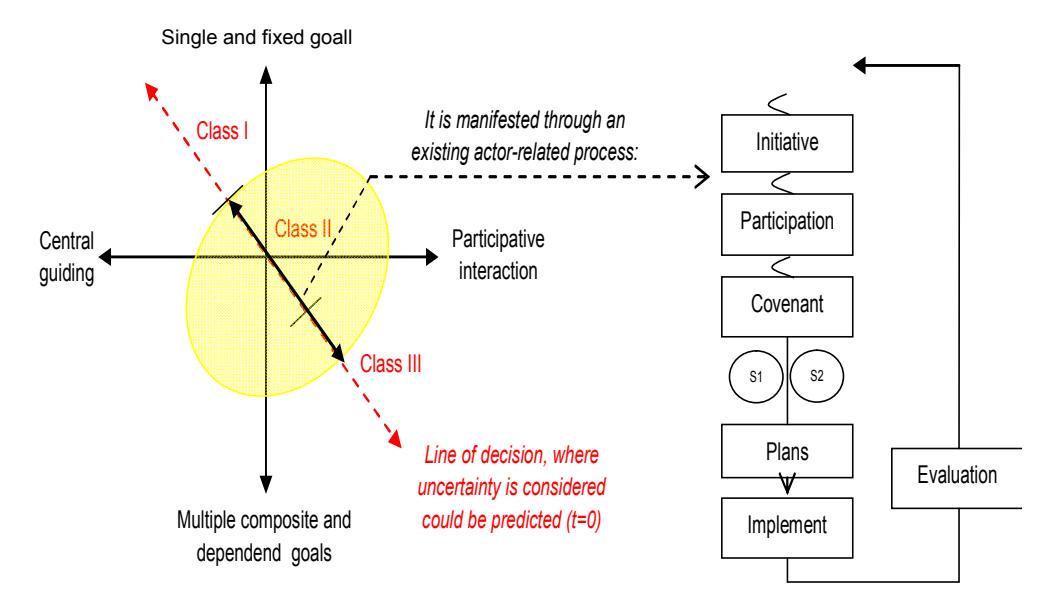
Figure 3. Actor-Related Process for the Existing Spatial Planning System in Greater Jakarta Source: De Roo, 2003 (modified)
Unfortunately, implementation of this actor-related process in the existing spatial planning system in Greater Jakarta has potential shortcomings. As can be seen in Figure 3, there is an assumption in the decision-making process that uncertainty in the future can be predicted. This is indicated by the formulation of scenarios. The formulation of scenarios implies a tendency to only consider desired and potential contributions out of the three crucial elements for planningoriented action. By only considering these two elements (i.e. desired and potential contributions), the aspect of time in the decision-making process is considered fixed (i.e. t = 0). This means that the planners tend to predict the future in line with their expectations. This situation leads the planners to implement the decision-making process under 'frozen' time, or within the predicted uncertainty (t = 0). However, the aspect of time cannot be considered fixed (t ≠ 0). It is an important aspect of how change should be considered (t = n) because of the uncertainty aspect of the future. Actual contributions, which are ignored, unconsciously influence the future. Therefore, we propose an alternative spatial planning system for Greater Jakarta through an evolution of the actor-related process. Evolution in this context means that we try to involve various possibilities in the future by identifying the desired, actual, and potential contributions of the related stakeholders in the spatial planning system.
Implementation of the actor-consulting model in the context of Greater Jakarta must be executed through several steps. The first step is the arrangement of a planning proposal, 2 which is coordinated by the related planners in the BKSP forum. The proposal must take the growing issues into consideration. This means that the proposal has to consider the phenomenon of selforganization in Greater Jakarta.
2 Planning proposal in this context includes the document of spatial planning (Rencana Tata Ruang/RTR) of each related municipality and also of RTR National Strategic Area (KSN) Jabodetabekpunjur
The other related stakeholders should then be consulted jointly about this proposal in discussion meetings (i.e. the related governments, representatives from the private sector, or even representatives from society in Greater Jakarta). During the discussion process, the desired, actual and potential contributions of the related stakeholders must be seriously discussed in order to consider the possibilities of future uncertainty. This discussion process will then result several objectives. Finally, through the consideration of future uncertainty, the objectives will be implemented jointly in various, more flexible ways (e.g. shared responsibilities between stakeholders, etc.).
According to the above explanation, we recognize that the role of BKSP is important and even crucial. Therefore, in order to implement this model, empowerment of BKSP's role is necessary. This empowerment could be accomplished through the return of the planner's professionalism in BKSP itself. This means that the planners no longer only see the future in line with predicted uncertainty (i.e. t = 0). All this time, the planners have been trapped in an ordinary planning cycle (i.e. issue-initiative-participation-covenant-predicted scenarios-plansimplement-evaluation) that tends to focus only on 'desired' and 'potential' aspects. They have ignored various possibilities in the future through disregarding the 'actual' aspect. Moreover, they should predict future uncertainty (i.e. t = n) through consideration of all three crucial elements (i.e. desired, actual, and potential contributions). Furthermore, BKSP should be run by professional planners who are neutral and not bound by political interests. In this new form, BKSP can become the appropriate mediator between the central and local governments in Greater Jakarta. In executing this task, the financial support and delegated power from the central government is also needed. Besides that, the support and active participation from the related local governments in Greater Jakarta are important to involve.
Conclusion
The discrepancy between the empirical situation and the existing spatial planning system in Greater Jakarta means that current government interventions through their spatial planning strategies are ineffective and inefficient. In other words, the growing complexity in Greater Jakarta necessitates its spatial planning system to be 'smarter' in responding to the urban transformation in that there is need of a spatial planning strategy, other than just the scenario and open network approaches, to better tackle non-linear development, since there are many related stakeholders in the urban transformation process who play a role in dealing with the selforganizing process (i.e. the level of complexity is already high).
Therefore, we need to identify an alternative spatial planning system that can be implemented in Greater Jakarta appropriately. We realize that to identify such a system is not easy. According to the above explanation, the emergence of various stakeholders results in multiple composite and dependent goals (i.e. for the functional-oriented action), so that the participative interaction (i.e. for the institutional-oriented action) cannot be avoided. Based on the concept of planningoriented action, these two dimensions (i.e. the functional- and institutional-oriented action) should be related to decision-oriented action (i.e. organizational-oriented action). Hence, we have to look for an alternative spatial planning system that stems from an identification process of the base of the spatial planning system, i.e. the decision-making process in planning-oriented action.
According to the empirical situation, the planning-oriented action in Greater Jakarta still refers to an actor-related process that only considers desired contributions and potential contributions of the related stakeholders. This causes the current spatial planning system in Greater Jakarta to ignore the possibility of future uncertainty. In other words, the aspect of time change is not considered (t = 0) in planning-oriented action through the decision-making process. However, the aspect of time is a crucial element for urban transformation in a non-linear transition (t ≠ 0 but t = n). The alternative spatial planning system should consider time change (t = n), because the possibilities of future uncertainty in a non-linear transition are hard to predict and cannot be ignored anymore. This means that the alternative system must pay more attention to the urban system evolving through self-organization, i.e. it should refer to the concept of non-linearity.
One of the options for the alternative planning system is to implement an actor-consulting model that not only considers the desired and potential contributions of the related stakeholders but also their actual contributions. The consideration of these three kinds of contributions (i.e. desired, actual and potential) means that the decision-making process in planning-oriented action already refers to the possibilities of future uncertainty. In other words, the spatial planning system will consider time change. In the context of Greater Jakarta, the implementation of this model should be coordinated by the cooperating agency for Greater Jakarta area development (BKSP). Empowerment of this agency in this role is necessary.
This empowerment could be accomplished through the return of the planner's professionalism in BKSP. This means that BKSP should be run by professional planners who are neutral and not bound by political interests. In its new form, BKSP can become the appropriate mediator between the central and local governments in Greater Jakarta. In executing this task, the financial support and delegated power from the central government are needed. Besides that, the support and active participation from the related local governments in Greater Jakarta should be involved. By adequately implementing this, we hope that present and future spatial planning problems in Greater Jakarta can be tackled efficiently and effectively.