

Introduction
Literature and references on social capital, which have grown enormously in recent years, disclose a disequilibrium between the relative lack of progressive development in measuring the concept and the volume of publications. Google Scholar gives more than 3,430,000 results for the search term "social capital". It is surprising that economists have not yet developed any profound and meaningful methodological approach to measure social capital, considering the quantitative traditions of economics (Jennings and Sanchez-Pages, 2017).
Social capital is a broad field of abstraction; therefore, it can be represented by an extensive variety of proxies (Jennings and Sanchez-Pages, 2017) or theoretical representations (Sequeira and Lopes, 2011). Thus, it can have different impacts on the economy. The concept of social capital has interdisciplinary leverage as both sociology and political science are engaged in economic studies (Perez et al., 2006). It can be stated as a characteristic embedded in a given society, as written by Putnam et al. (1993), "social capital . . . refers to features of social organization, such as trust, norms, and networks that can improve the efficiency of society by facilitating coordinated actions." Further studies on this variety of social capital are incorporated, for instance, in the abundance of literature on the effects of social networks, modeled as an asset in economics (Bofota, Boucekkine and Bala, 2012). On the opposite side of this definition, social capital, as a characteristic of the individual contributing to the evolution of the society, has been studied, for example, by Glaeser et al., (2002) and Fang and Loury (2004, 2005). On the individual level, social capital can be formulated as the individual social attributes, such as social network belonging and social skills (Agenor and Dinh, 2015). In our findings, social capital affects the decision of individuals whether to migrate or stay in rural areas (Prayitno et al, 2014).
Social capital, as a source of potential economic growth, is centered on the empirical level; its evidence is shown in the World Values Survey. This survey covers 29 market economies are encompassed in this study and are predicated on the constructed assessment of trust. Social capital has enabled developing villages into more productive and more financially beneficial villages, such as tourism villages, whilst also improving a threatened environment. It can be said that social capital is the driver of the carrying capacity of the region (Widhianthini 2017:2). The World Bank (2006), too, interpreted trust as one measurement of social capital, and the capability of a group of people to work collectively to reach mutual goals. Social capital is the stemming from trust in a society; a society that values trust will achieve more organizational innovations (Fukuyama, 1995; Sawitri and Soepriadi, 2014). The World Bank acknowledges social capital as one of the various kinds of capital, which it applies to quantify intangible capital. Research is undertaken as well on the connection between the diverse varieties of capital (social capital) and economic growth. One of these studies, published by Knack and Keefer (1997), explains a causal nexus between trust and growth. However, it did not find a very robust association. Temple and Johnson (1998), on the other hand, reveal that it is advantageous to utilize some measures of social capital and develop an index to forecast economic growth. Social capital and growth have been appraised in the majority of disciples in empirical studies (Beugelsdijk et al., 2004; Rupasinga 2000; and Whiteley 2000) along with a broad range of point estimates. Empirical studies have also focused on the interaction of social capital and income, such as Fukuyama (1995), Robison and Siles (1999), Narayan and Pritchett (1999), and Putnam et al., (1993), with the social capital definition at the aggregate level.
Some literature offers a scientific perspective of social capital in the theoretical construction of economic growth. Social capital is modeled on individual and aggregate levels, as Growiec and
Growiec (2012) show. They state that the comfort of establishing new interpersonal contacts (which is bridging social capital) is comparable to the existing group of contacts and the group of people with whom one is not yet introduced to but that might be taken into account. The cohort size, in turn, is defined by the total number of individuals in a society and, most significantly, determined by the degree of social trust. Bartolini and Bonatti (2008), applying an endogenous growth model, discovered a negative relationship between the extension of marketrelated activities and social capital. Their model also shows that economic growth and social capital have a negative correlation. More interestingly, given that this model explains the findings of Putnam (2000), on a decline of social capital in the US, even though the nation-state had grown. Nevertheless, most preceding studies formulated social capital as an accumulable asset, proven to be useful in production (Asian Productivity Organization, 2006; Bisin and Guaitoli 2006; Glaeser et al., 2002). Antoci et al. (2007, 2009) modeled a negative relation between the stock of social capital and economic growth. A negative connection is found between the stock of social capital and economic growth (D'Andrea and Hare, 2004), since time dedicated to market activities takes time away from related social events, i.e. decreasing the amount of time people devote to invest in social capital. The connection of human capital and social capital in economic growth is of great significance but is frequently left underdeveloped. (Baliamoune-Lutz and Lutz, 2004). The social capital dimension used in these studies usually relates to the individual level. Glaeser et al., (2002) published a robust empirical correlation between human capital and membership of existing social organizations (the proxy utilized to calculate social capital). Glaeser and Redlick 2009 presented a theoretical framework to analyze the factors that affect social capital. The first step is an analysis of how social capital is eventually molded by utilizing a prototype of optimal individual investment decision and the process of social accumulation (Hamzah et al., 2016).
Our research focuses on the relation of social and human capital in the migration decision model (Stutzer, 2010). The salient focus of our research is still rare in the theoretical discourse: the only literature we found so far on this matter is Bisin and Guaitoli's (2006) working paper, an Overlapping Generations (OLG) framework (Piazza-Georgi, 2002), a working paper of Gentili and Ferreti (2012) and a working paper of Agénor and Dinh (2013). Bisin and Guaitoli (2006) are interested in how the roles of human and social capital differ in rural and urban communities (The Economic and Labour Relations Review, n.d.) Agénor and Dinh (2013) investigate the connections between social capital, human capital, and product imitation (implementation or innovation), in an Overlapping Generations (OLG) framework (Sarracino, 2013). Gentili and Ferreti (2012) explain dynamic migration focused on the accumulation process causing a variation in the distribution of income in the OLG model.
To enrich the literature on this matter, we use empirical and theoretical frameworks on decision choices of social and human capital (migrate or stay) (Hofer and Aubert, 2013). Our analysis is different from Gentili and Ferreti (2012) because we did not use a dynamic migration model, we use overlapping generation (OLG) framework. The difference between Agénor and Dinh (2013) and our research is that we generate human capital by distributing it to the education sector and its social capital amount. We follow Bisin and Guaitoli (2006) that the growth of human capital can be proximate to a loss social capital or otherwise. Our approach emphasizes the economic dimension in two extents: first, by treating social capital as a product of an investment process or accumulation among individuals, which follows the logic of making people's prospective utility as great as possible; and second by taking into account that economic relationships are pivotal in producing social capital in economic theory of maximization—on which they will base their decision between migrating or staying.
This paper is constructed based on the following arguments. The second section explains the reason behind the utilization of the Overlapping Generation (OLG) model. The third section envisages the primary assumptions that the recommended measure of social capital is based on the economic theory overlapping generation model. The fourth part of this paper builds the theoretical model, which explains the accumulated social capital stock from investments. The relation between social capitals investments in individuals and decisions (migrate or stay) is explained in this section. The fifth and final section consists of a summary and conclusions.
Overlapping Generation Model
This paper uses the overlapping generation model because in the real-world individuals have different stages of life-cycle interaction. While young, they interact with adults and the old generation. This feature is captured in the overlapping generation model where the life of individuals is divided into three periods. Thus, at any point in time, the economy may be composed of three cohorts, or generations: the young, adult and the old.
The Model
Developing a theoretical model through prototyping social capital as a product of accumulation among individuals, or the investment process, follows the logic that maximizing individuals' prospect utility is the primary objective. To reach this aim, we developed an overlapping generations model that explains the interaction between agents and how it relates to the decision to migrate or stay.
Assumptions
Consider an economy where three agents live. Each agent lives for three periods where is the respective periods are defined as the young generation, adult generation, and old generation. With only one agent born each period, we consider and overlap the generations model with three agents and three periods.
Agents' Behavior
Every agent in the economy invests her time resource in either human capital formulation or social capital formation to maximize the (expected) utility. Her utility consists of sub-utility from social capital in the area she lives and goods consumption with wages from working. The assumption is that she can work only in the adult generation. Another assumption is that human capital investment positively influences her wage. Human capital accumulation is as follows:
\[h_{t+1} = \delta h_t + I_{t+1}^h \tag{1}\]
Where ht is human capital at period t (t =0,…, ∞), δ is the discount rate, and its human capital investment at period t. As all agents live for three generations, ht can be rewritten as ht (t = Y, A, O), where Y, A, O indicates each generation. She has a chance to work either in her home (H) or in a foreign (F) country, and she may get her salary either as ωH(hY) or ωF(hY). Wages in the adult generation are based upon the investment in her human capital in the young generation, and �ℎ�⁄ℎ > 0 (i = H, F) is assumed. Each agent is assumed to have an initial endowment for their human capital. The utility function is as follows.
\[U_t = u_1(c_t) + u_2(SC_t) (t = Y, A, 0)\] (2)
Her utility function \(U_t\) consists of \(SC_t = \{SC_Y * SC_A * SC_O\}^{\alpha}\) from the sub-utility from consumption \(u_1(c_t)\) and from social capital \(u_2(SC_t)\). \(c_t\) is the amount of consumption in the t generation, and \(SC_t\) is the extent of social capital in the region she lives in. Social capital in the region \(SC_t\) is given below.
\[SC_{t+1} = \delta SC_t + I_{t+1}^S \tag{3}\]
\(I_t^S\) is the social capital investment at period t. We also assume that each agent has social endowment \(SC_{YO}\). In each period, every agent decides to allocate her time resource either for human capital investment or social capital investment. Assuming that she has 1 endowment as time resource, and she decides to allocate time \(e_t\) for social capital investment, and \(1 - e_t\) for human capital investment, where \(0 \le e_t \le 1\), (t = Y, A, O). As a result, both human capital investment and social capital investment are a function of \(e_t\), \(I_t(e_t)\) and \(SC_t(e_t)\).
Concerning the definition of agents' behavior in the old generation, there is no chance for agents in the old generation to work, as shown in the formula below.
Country is defined as,
\[\max_{e_0} U_0 = u_1(c_0) + u_2(SC) \tag{4}\]
Subject to
\[Y_0 = p * c_0 \tag{5}\]
\(Y_0\) is her income in the old generation, and p is the price for a single good which is normalized as p=1. Her time allocation for capital investment is decided through budget constraint. Solving this optimization problem leads to indirect utility function \(V_0(e_0^*)\). As there is no transfer to other agents after she dies, there are no incentives to invest in human capital in the old generation, \(e_0=1\). Hereafter * indicates the optimized result.
In the adult generation, she has the chance to migrate and work in a foreign country. A higher wage is possible if she operates in a foreign country. Wage is defined as \(\omega^k (k = H, F)\), where H is the home country and F is the foreign country. Without loss of generality, \(\omega^H < \omega^F\). Upon migrating to a foreign country, her expected utility is expressed as follows.
\[EU_A^F = u_1(c_A) + u_2(SC^F) + \delta V_0 \tag{6}\]
She maximizes the utility above with the budget constraint \(Y_A = c_A + s_A\), where \(s_A\) shows saving for an adult generation. Obviously, there are no incentives to save her money for the next generation as consumption in earlier the generation brings about a higher utility if the amount of consumption is the same. Thus, \(s_A = 0\)
\[Y_A = \omega^F = c_A \tag{7}\]
By maximizing the expected utility function (7) with her budget constraint (8), the indirect utility \(EV_A^F\) can be calculated.
Likewise, the utility maximization problem of agents deciding not to move and stay in their home country is defined as
\[\max EU_A^H = u_1(c_A) + u_2(SC^H) + \delta V_0 \tag{8}\] with
\[Y_A = \omega^H = c_A \tag{9}\]
There is a possibility of a higher sub-utility from social capital in her home country than in the foreign country due to her investment in the social capital and social network of her country, which is greater than the social network in the foreign one. To create a more simple discussion, we assume that SCF = 0 and remove the superscription H from SCH. By solving the problem above, indirect utility \(EV_A^F\) is derived. Human capital investment in the adult generation does not have any effect on her age, \(e_A^* = 1\). As a result, her optimal decision is to migrate when \(EV_A^F \geq EV_A^H\), and to stay in her home country when \(EV_A^F > EV_A^H\).
In the young generation, she has no income yet as it is not allowed to work in the young generation, so \(c_Y = 0\). The investment in her human capital has a positive effect on her wage in the adult generation, while the investment in social capital has a positive effect on social capital in the region. She will decide her time allocation in the young generation by considering the balance. Her behavior in the adult generation is written as follows.
\[\max_{e_Y} EU_Y = u_2(SC) + \delta \max \left[ EU_A^F, EU_A^H \right]\] (10)
Equilibrium
Instantaneous utility in the young and old generations is common in both migrant workers moving to a foreign country in the adult generation and those who stay their home country. Thus, she decides her time allocation in the young generation \(e_Y\) and whether or not to migrate by comparing the following expected utility (Gunawan, 2015).
\[\hat{E}U_A^F = u_1(\omega^F(e_Y)) \tag{11a}\]
\[\widehat{E}U_A^H = u_1(\omega^H(e_Y)) + u_1(SC) \tag{11b}\]
In order simplify the discussion, following assumptions are made:
\[I_t(e_t) = 1 - e_t \tag{12a}\]
\[SC_t(e_t) = e_t \tag{12b}\]
\[u_1(c) = c \tag{12c}\]
\[u_2(SC) = SC \tag{12d}\]
Let us define the new functions as follows
\[q(e_{v}) = SC(e_{v}) \tag{13a}\]
\[f(e_Y) = \omega^F(e_Y) - \omega^H(e_Y) \tag{13b}\]
\(g(\cdot)\) is the monotonically increasing function from the definition of the social capital function (3). \(\omega^i(\cdot)\) (I = F, H) is the monotonically decreasing function from the definition of wages function. Also, we assume that \(f(e_Y)/\partial e_Y < 0\). This assumption shows that the marginal effect of human capital investment to the wage is higher for her wage in a foreign country than that inhome country. We can explain this relation more detail in Figure 1. The function of \(g(e_Y)\) is a monotonic increasing function, where \(\frac{\partial SC}{\partial e_Y}\Big|_{0-1}>0\), or \(\frac{\partial g(e_Y)}{\partial e_Y}>0\), \(\left(0\leq e_Y\leq 1\right)\) (Prayitno, 2015).
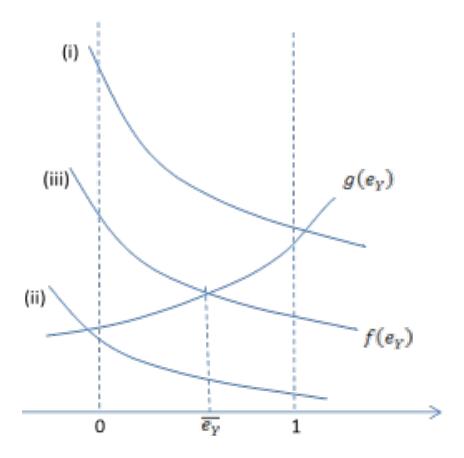
Figure 1. Correlation between \(f(e_V)\) and \(g(e_V)\).
Now we have a unique equilibrium for the following 3 cases.
[Case 1] \[f(0) < g(0)\]
In this case, \(g(\cdot)\) is always larger than \(f(\cdot)\). for f(0) < g(0) any \(0 \le e_Y \le 1\). All agents stay in their home country and \(e_Y^* = 1\).
[Case 2] \[f(1) > g(1)\]
\(f(\cdot)\) is always larger than \(g(\cdot)\) for any \(0 \le e_Y \le 1\). All agents migrate to the foreign country and \(e_Y^* = 0\).
[Case 3] \[f(0) \ge g(0)\] and \(f(1) \le g(1)\)
There is a threshold \(\overline{e_Y}(0 \le \overline{e_Y} \le 1)\) which satisfies \(\widehat{E}U_A^F = \widehat{E}U_A^H\) in this case. When \(f(0) \ge g(1)\), all agents migrate and \(e_Y^* = 0\). When \(f(0) \ge g(1)\) all agents stay in their home country and \(e_Y^* = 1\) (Gunawan, 2015).
Social Tie and Migration Decision
In the effect of social tie and migration decision, (3), (\(\alpha \ge 1\)) indicates the level of a social tie in the region. It is possible to have different equilibriums for different \(\alpha\). The threshold \(\bar{\alpha}\) where staying in the home country and migrating abroad is indifferent for agents. Firstly, it is easily shown that function (14a) is increasing function in \(\alpha\), and function (14b) is independent from \(\alpha\). In order to guarantee the existence of \(\bar{\alpha}\), the expected utility of migration \(\hat{E}U_A^F\) should be smaller than that of staying in the home country \(\hat{E}U_A^F\) when \(\alpha = 1\). This condition can be rewritten as
\(f(0) - g(0)|_{\alpha=1} \ge 0\). With the simple calculation of equations (3), (13a) and (13b), we can calculate \(g(e_Y)\) and \(f(e_Y)\).
\[\begin{split} g(e_{Y}) &= SC \; (e_{Y}) = \{SC_{Y} * SC_{A} * SC_{O}\}^{\alpha} \\ &= (SC_{Y0} + e_{Y})^{\alpha} * (SC_{A} + e_{A})^{\alpha} * (SC_{O} + e_{O})^{\alpha} \\ &= (SC_{Y0} + e_{Y})^{\alpha} * (\delta SC_{Y0} + 1 + \delta e_{Y})^{\alpha} * (\delta^{2}SC_{Y0} + \delta + 1 + \delta^{2}e_{Y})^{\alpha} \\ &= [\delta^{3}e_{Y}^{3} + (3\delta^{3}SC_{Y0} + \delta + 2\delta^{2})e_{Y}^{2} + \{(2\delta^{3} + 3\delta^{2} + 2\delta)SC_{Y0} + 1 + \delta\}e_{Y} + \delta^{2}SC_{Y0} + 1 + \delta]^{\alpha} \end{split}\]
When \(e_Y = 0\) and \(\alpha = 1\), \(g(e_Y) = \delta^2 SC_{Y0} + 1 + \delta\) and \(f(e_Y) = \omega^F(0) - \omega^H(0)\), and we have the following condition.
\[\omega^F(0) - \omega^H(0) \ge \delta^2 S C_{Y0} + 1 + \delta \tag{14}\]
This shows that when the wage difference is big enough, and the discount rate is small enough, a threshold of \(\bar{\alpha}\) exists. When the social tie is not strong in the region, all migrate to seek higher wage, and all agents stay in their home country when the social tie is strong.
The propositions are summarized below:
[Proposition 1]
A unique threshold \(\bar{\alpha}\) exists when conditions (refc) is satisfied.
[Proposition 2]
When the social tie in the region is strong enough \((\alpha \ge \bar{\alpha})\), all agents in the region stay in their home country. As a result, no migration equilibrium is observed. When the social tie in the region is weak \((\alpha \le \bar{\alpha})\), all agents in the region migrate to work in the foreign country.
From the propositions above, we can conclude that 'communities and households with higher social capital will not send their family members as migrant workers.'
Conclusion
In this paper, a methodological theory to measure social capital investment is developed. We showed the investment of social capital among interactions of three agents living in three periods in an overlapping generation. Social capital is molded by utilizing a model of optimal individual investment decision and the process of social accumulation. Social capital is the total stock of social capital from each agent in one period considering the discount rate. From this correlation, we could calculate the parameter to measure the social tie effect.
When social capital is a monotonically increasing function, wages is a monotonically decreasing function and \(\partial f(e_Y)/\partial e_Y < 0\); the assumption shows that the marginal effect of human capital investment on the wage is higher for her wage in a foreign country than that in the home country. We have a unique equilibrium for the following 3 cases: (i) case 1: f(0) < g(0). In this case, \(g(\cdot)\) is always larger than \(f(\cdot)\) for any \(0 \le e_Y \le 1\). All agents stay in their home country and \(e_Y^* = 1\). (ii) case 2: f(1) < g(1). In this case, \(f(\cdot)\) is always larger than \(g(\cdot)\) for any \(0 \le e_Y \le 1\). All agents migrate to the foreign country and \(e_Y^* = 0\). And (iii) Case 3:
\(f(0) \ge g(0)\) and \(f(1) \ge g(1)\). There exist a threshold \(\overline{e_Y}(0 \le \overline{e_Y} \le 1)\) which satisfies \(\widehat{E}U_A^F = \widehat{E}U_A^H\) in this case. When \(f(0) \ge g(0)\), all agents migrate and \(e_Y^* = 0\). When f(0) < g(1), all agents stay in their home country and \(e_Y^* = 1\) (Gunawan, 2015).
As a summary of this paper, the following propositions is presented. Proposition 1: A unique threshold \(\bar{\alpha}\) exists when conditions: (i) social capital function is increasing function in \(\alpha\); (ii) wage function is decreasing function and independent from \(\alpha\); and (iii) \(f(0) - g(0)|_{\alpha=1} \geq 0\), are satisfied; and Proposition 2: When social tie in the region is strong enough \(\alpha \geq \bar{\alpha}\)), all agents in the region stay in their home country. As a result, no migration equilibrium is observed. When the social tie in the region is weak \((\alpha < \bar{\alpha})\), all agents in the region migrate to work in the foreign country.
This paper has tried to illuminate the connection between social capital and migration decisions. We could prove the concept of social capital as social cohesion and represent as bonding social capital. Because there are two concepts of bridging and making ties of social capital, we should supplement the concept of bridging social capital in the model. This is the concern of our upcoming research.
Acknowledgement
An earlier draft of this article was presented at "The Third PlanoCosmo International Conference: Resilient City, Resilient Region", Bandung, 26 October 2015.